For Anyone Who Knows Life After Grief, Ed Sheeran’s Autumn Variation Shows Are A Joyful Celebration

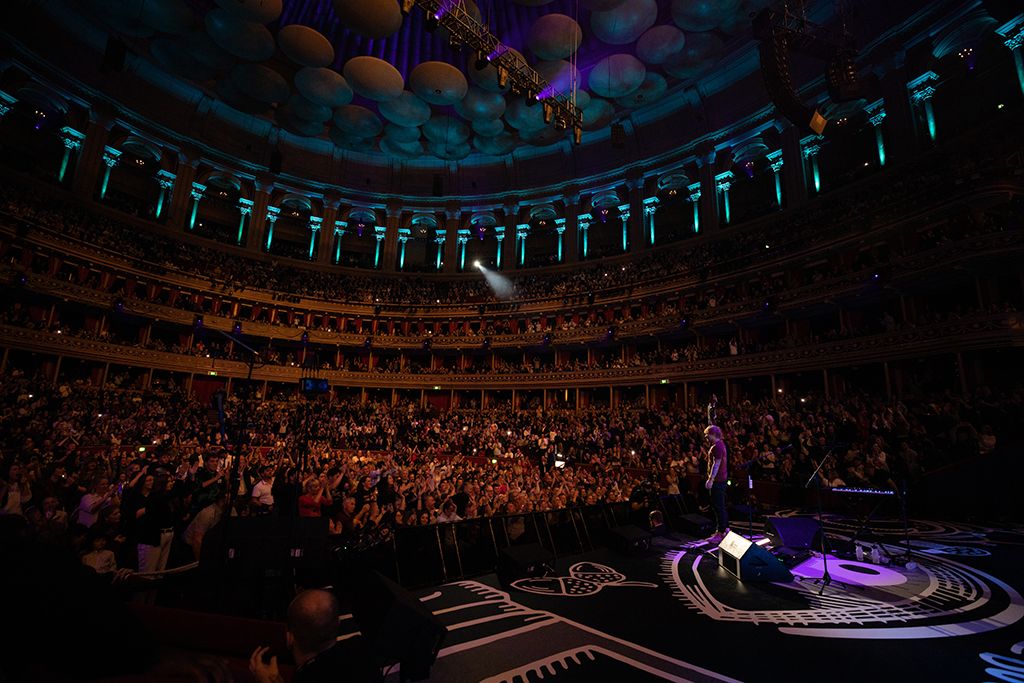
It was fitting there was a giant broken heart with a plaster hanging just behind Ed Sheeran as he played his Last Days of Autumn gigs at the Royal Albert Hall in London this weekend.

Sheeran performed just two evenings dedicated to playing his latest album – which was released on his own record label – from start to finish. These were the only two nights he’ll ever do this, he explained to the crowd. It was his way of keeping the album inspired by Elgar’s Enigma Variations and co-created with Aaron Dessner ‘special’.

And ‘special’ it was.

If you’ve been keeping up with Sheeran’s output this year – aside from hot sauces, guitars and serving up hot dogs – you’ll know he released two albums in four months, as well as a personal and revealing docuseries called The Sum Of It All.

During the promotion cycle for his album Subtract, Sheeran played several gigs where he performed the entire album in full – and in those shows, we see a grief and stress-ridden Sheeran break down in tears several times on stage, as he tries to explain the meaning of these intensely personal songs.

At one such moment captured in his docuseries, his wife Cherry Seaborn looks on worriedly, saying “I’ve never seen him cry on stage,” adding that he “hasn’t had the time to process and be at peace with his thoughts”.

It is rare to see such a real-time look at grief, and watching Sheeran try to hold back the tide while in public and on stage feels brutally familiar for anyone who has experienced the clusterfuck that is the grieving process. Fan or not, those moments are heartbreaking, and they’re as uncomfortable to watch as they are important.

So, for many of us huddled in the Royal Albert Hall this weekend, our most recent memories of seeing Sheeran standing in theatre and playing an entire album back-to-back are ones of sadness and vulnerability.

Which is why the giant broken heart with a plaster – illustrated by his friend Scarlett Curtis – felt like the perfect symbol for Sheeran’s weekend performances of Autumn Variations.
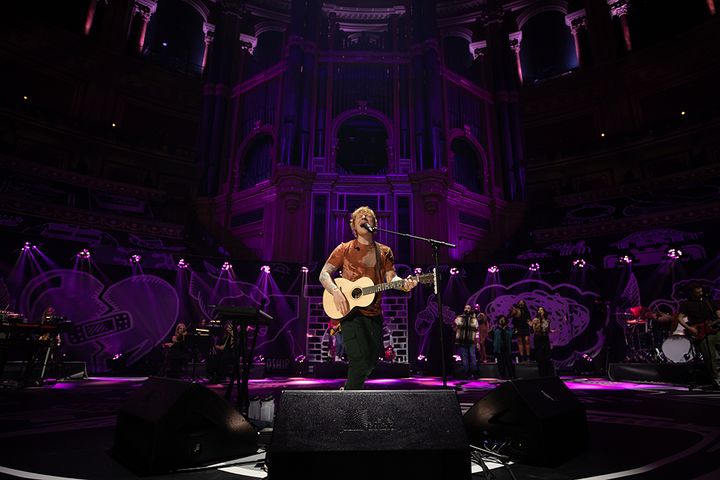
Ed Sheeran performs at the Royal Albert Hall, 19 November 2023

Warner Music

Instead of the grief-stricken image – Sheeran appeared joyful, processed. And – to roll with the autumnal theme here – he looked, literally, as if he had turned over a new leaf.

Bouncing on stage to open the show with the first track of Autumn Variations, Magical, Sheeran then stopped between each song to give a bit of backstory – including using the phrase ‘getting shit-canned’ to describe how Brits deal with both the dwindling light and warmth of late autumn.

It was interesting to note how, when speaking to the audience, he can now reference the period of his life that was met with grief and anxiety as just ‘Subtract’ or ‘what was going on when I wrote that album’ without having to spell it out.

Spelling it out, when somebody you love has just died or you’re going through a period of extreme stress, can be exhausting. Like having a wound reopened without warning – an unexpected retraumatisation.

There are plenty of times it can feel as though it would feel infinitely easier if everyone just knew – and Subtract is now that reference for Sheeran. You can still feel the weight of it – it’s part of Autumn Variations’ story – but it no longer feels like he is literally the vessel referenced in Boat, no longer is he being battered by unrelenting waves of grief and uncertainty.

Both musically and in his performances, Sheeran seems freed by the creative outlet that working with Aaron Dessner and having his own record label having afforded him. Subtract and Autumn Variations feel like Sheeran’s equivalent to Folklore and Evermore, with Dessner’s evocative use of strings and ‘soundscapes’ being the common thread between them.

A little bit country at moments, and a bit 90s at others, Sheeran and Autumn Variations felt truly at home in the iconic Royal Albert Hall.

Sheeran threw the crowd a little treat at the end of his Variations set, giving us a ‘million miles an hour’ whistle-stop tour of his big hits for being good girls and boys and sitting through this new album of his that he knows we’re ‘not as familiar with’.

Were we thrilled to stretch our legs and have a bit of a wiggle to Shape Of You after an hour of sitting? Of course. And I will never say no to watching Sheeran set up a song on his loop pedal or skip around stage belting out Shivers.

But this second act of the night seemed to reveal that he was perhaps a bit self-conscious about having us all in a room and not giving us what is essentially The Mathematical Eras Tour (Ed’s Version) – as if we were all locked in this hall against our will and force-fed a bizarre concept album. Far from a Ken staring uncomfortably into our eyes and singing at us for three hours – we were given a wholesome delivery of a wholesome album.
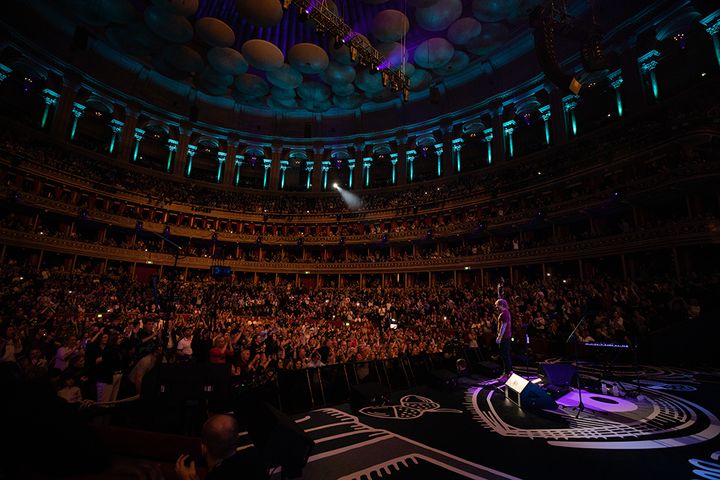
Ed Sheeran performs at the Royal Albert Hall, 19 November 2023

Warner Music

To me, seeing Sheeran live is a privilege – although I realise the many boyfriends who were no doubt dragged along may feel differently. To go from blasting out stadium shows ‘in the round’ with pyrotechnics, a rotating stage and a mega setlist – to then meaningfully fill and captivate an audience at the Royal Albert Hall with an album like Autumn Variations, and then end the night singing acapella, without any amplification – is skilful and impressive. To do it all with a mending heart makes it even more special.

That’s the thing the cool kids still don’t seem to want want to admit – Ed Sheeran is a special artist. And The Last Days of Autumn performances felt like a true celebration of a new era of Sheeran’s career and artistry, where he can create music, for both job and hobby, and have if feel lighter and freer – and perhaps even a little bit magical.

Share Button

Rishi Sunak Accused Of Saying ‘Just Let People Die’ During Covid

Rishi Sunak has been accused at the Covid inquiry of saying the government should “just let people die” during the pandemic.

The allegation against the prime minister is made in the diary of ex-chief scientific adviser Patrick Vallance.

Vallance made private notes every evening during the pandemic and these have been handed to the official inquiry.

In one entry dated October 25, 2020, Vallance recalls a meeting as arguments raged inside government over whether to impose second lockdown in England.

According to Vallance, Dominic Cummings told Boris Johnson in the meeting: “Rishi says just let people die and that’s okay.”

Vallance does not claim to have himself heard Sunak – who was then chancellor – make that comment.

Downing Street said it would not comment on the accusation. “The prime minister is due to give evidence before the inquiry at the time of their choosing. That’s when he’ll set out his position,” No. 10 said.

In his evidence on Monday, Vallance also said Sunak’s Eat Out To Help Out scheme “obviously” increased transmission of the virus.

The programme, which began in August 2020, cut the cost of food in order to encourage people to visit restaurants and other hospitality venues.

Asked if it had increased the number of deaths from Covid, Vallance said: “It is highly likely to have done so.”

He said: “I think it would have been very obvious to anyone that this inevitably would cause an increase in transmission risk, and I think that would have been known by ministers.”

Vallance said he had not been informed about the scheme before it was announced to the public.

The inquiry was shown a section of Sunak’s written evidence to the inquiry in which he denied government scientists warned against the programme.

“I do not. recall any concerns about the scheme being expressed during ministerial discussions, including those attended bye the CMO [chief medical officer Chris Whitty] and the CSA [chief scientific adviser Vallance]

Vallance also told the inquiry that Johnson was often “bamboozled” by Covid science and that Matt Hancock often said things that were not true.

Share Button

Blink And You’ll Miss It: The Surprising Everyday Object Set To Fly Over The UK On Tuesday

A toolkit will fly above the UK on Tuesday night, after it was drifted into the ether during a mission last week.

Nasa astronauts Jasmin Moghbeli and Loral O’Harra were fixing a solar panel on the International Space Station (ISS) when their tool bag just… slipped into space.

And because it was seen as low risk, the astronauts just left it behind.

Now, the bright, white bag is travelling 250 miles above Earth, around five minutes ahead of the ISS.

It’s surprisingly visible to people on the ground too, meaning you don’t have to be a NASA astronaut to see it – you just need binoculars or a telescope, and a spot of good weather.

Anyone in the south of the UK should be able to spot it between 6.24pm and 6.34pm on Tuesday evening, and it’s expected to return on November 24 between 5.30pm and 5.41pm.

It was first spotted by the Virtual Telescope Project last week, and it’s now being tracked by the US Space Force to make sure it doesn’t threaten the ISS or satellites.

Some estimates reported last week in the Smithsonian Magazine suspect it will re-enter the atmosphere between March and July 2024.

This is not the first time astronauts have lost something into space, though.

Nasa astronaut Ed White lost a spare glove in 1965 during a spacewalk, and in 2006, fellow Nasa astronaut Piers Seller lost a spatula as he repaired a heat shield.

And Nasa’s Heidemarie Stefanyshyn-Piper also lost her toolbag when attempting to repair parts of the ISS back in November 2008, as she became the first woman to lead a space walk, ever, at the time.

Worries about space debris are growing.

More than 170 million pieces have been dropped into the universe since that first glove was dropped back by White almost 60 years ago.

Share Button

Jeremy Hunt Challenged To Justify Any Inheritance Tax Cut

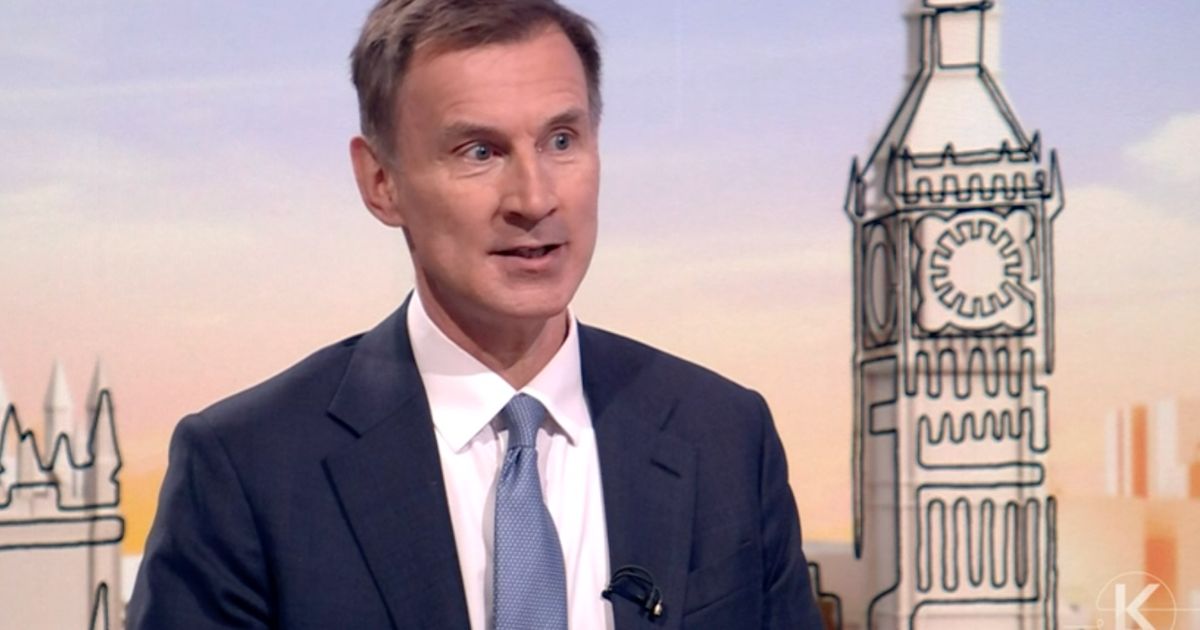
Jeremy Hunt was asked on Sunday to justify cutting inheritance tax for the rich at the same time as many people are struggling to pay bills.

On Wednesday the chancellor will unveil his Autumn Statement, setting out his tax and spending plans ahead of next year’s general election.

It has been reported he could cut the headline rate of inheritance tax – the tax on the estate (property, money and possessions) of someone who’s died – from 40% to 20%.

According to the Institute for Fiscal Studies (IFS), less than 4% of estates paid inheritance tax in 2020–21 as it only applies to wealth over a certain amount.

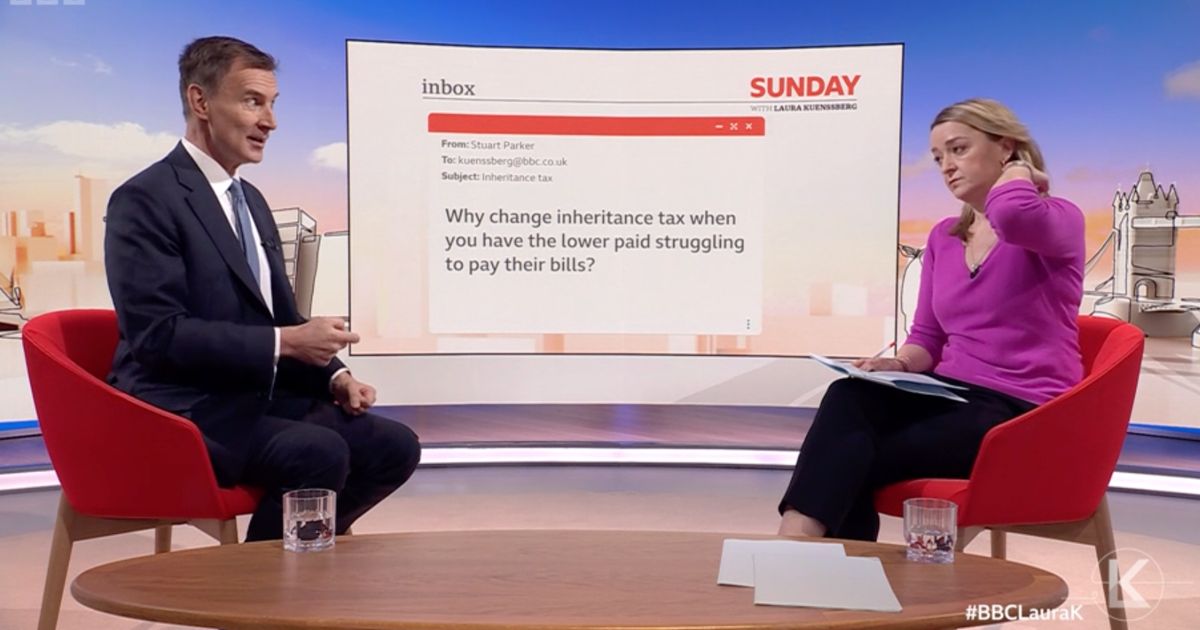
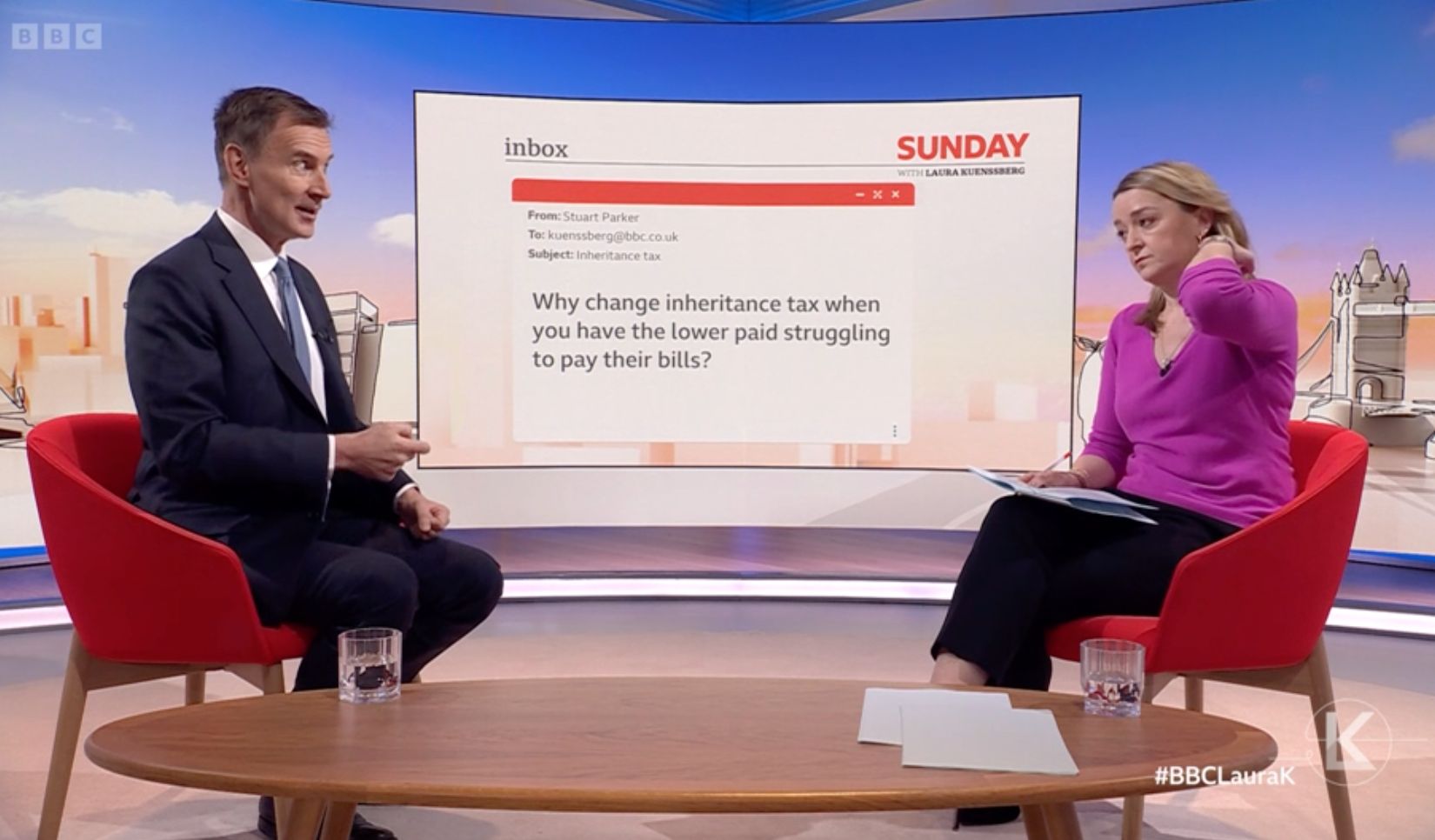
In an interview with the BBC’s Sunday with Laura Kuenssberg programme, Hunt was shown a question from a viewer who asked: “Why change inheritance tax when you have the lower paid struggling to pay their bills?”

Kuenssberg asked the chancellor: “What would it say about modern Conservative Party if you cut inheritance tax, at the same time as so many people are struggling?

“Why would you do that when people are having such a hard time?”

Hunt refused to rule in or rule out the cut, saying he was “not going to be drawn on any individual taxes”.

“I think you can read the papers this morning and you can see that I am going to abolish every single tax, there is – in fact, if you read the papers, there wouldn’t be any taxes left after Wednesday,” he said.

“I’m very sorry to say, I can confirm that won’t be the case. I would dearly love to bring down all different types of taxes.”

Rachel Reeves, the shadow chancellor, told the same programme cutting inheritance tax “in the middle of a massive cost of living crisis, and when public services are on their knees” was “not the right priority”.

“I understand people’s desire to pass on to their children what they’ve worked hard for but right now that is not the right thing to do and we would not support it,” she said.

However Reeves did not commit to reversing any inheritance tax cut implemented by the current government should Labour win the next election.

If inheritance tax was abolished completely, the IFS calculated it would cost the government £7 billion.

Around half of the benefit would go to those with estates of £2.1 million or more at death, who make up the top 1% of estates and would benefit from an average tax cut of around £1.1 million.

The IFS said the 90% or so of estates not paying inheritance tax would not be directly affected.

Share Button

Jeremy Hunt Refuses To Rule Out Cutting Benefits In Autumn Statement

Jeremy Hunt has refused to rule out increasing benefits by a smaller amount than usual by changing how the figure is calculated.

Benefits are usually “uprated” each April in line with the inflation rate of the previous September.

But according to Bloomberg News, the chancellor is considering pegging the increase to October’s inflation rate instead, and increase of 4.6% rather than 6.7%.

Speaking to the BBC’s Sunday with Laura Kuenssberg, Hunt did not commit to increasing benefits using the traditional method.

“I am not going to say this morning what I going to announce to parliament on Wednesday,” he said.

The interview came ahead next week’s Autumn Statement, which will see him set out his tax and spending plans ahead of next year’s general election.

As well as potentially squeezing benefits, it has also been reported Hunt could cut inheritance tax as well as some income taxes or national insurance.

Rachel Reeves, the shadow chancellor, told the same programme Labour would increase benefits by the standard amount.

“In government I will use the inflation rate that is traditional, the September inflation,” she said.

“If you pick and choose from year to year which inflation number is the cheapest thing to do then what you see is the gradual erosion of people’s incomes.”

According to the Institute for Fiscal Studies (IFS) picking the October rate rather than September would cut working-age benefits spending by about £3 billion.

It would reduce the money given to for the 8 million working-age households receiving means-tested or disability benefits.

The respected economics think-tank said real benefit levels would not just take several years to regain their pre-pandemic level but “would never get back to where they were without subsequent changes in policy”.

The Resolution Foundation also said the effect of benefit cuts under the Conservatives since 2010 was “already staggering”.

Torsten Bell, the think-tank’s director, said: “The poorest fifth are around £2,700 a year worse off as a result. And that’s just the average. When people wonder why so many families are struggling today, this is a key part of the answer,”

Share Button

Muslim And Arab Congressional Staffers Say They Feel ‘Betrayed’ By Democratic Bosses

As the death toll climbs from Israel’s attacks on Gaza and the U.S. makes few moves to rein in its closest military ally, one group is saying that it has never felt so invisible.

Muslim and Arab staffers and those whose family come from the region say they are struggling with a gnawing belief that their lives don’t matter to their colleagues. They describe the agony of watching the institution to which they’ve dedicated their career sending military aid amid the killing of thousands of civilians who look like them.

“They have the same faith as us, have the same names as us, a lot of our families live in the region,” one staffer said. “So when we hear that dehumanizing language, it’s dehumanizing us.”

Every day brings some new confirmation that “my life would not matter to this place if I had been born somewhere else,” said another.

Staffers who spoke for this story all requested anonymity because of a pervasive fear of retaliation. They ranged from junior staff to veterans in moderate and progressive offices in the Senate and the House.

A number said they have contemplated quitting. But they questioned who else would speak up for Palestinians as forcefully if they were to leave.

One aide, who broke down in front of their boss, said the congressperson resolved that night to call for a cease-fire. Another described to their boss how frightening it was for their family to visit relatives in the Palestinian territories because of the arbitrariness of the violence there.

“I did it in the hopes it would humanize the issue for him. And I know it reinforced what he was feeling,” the staffer said. Their boss also called for a cease-fire.

“They have the same faith as us, have the same names as us … . So when we hear that dehumanizing language, it’s dehumanizing us.”

But those members are firmly in the minority. Since the Oct. 7 attack in which Hamas killed an estimated 1,200 in Israel and took nearly 240 hostages, Israel has besieged the Gaza Strip with airstrikes, killing an estimated 11,000 people in Gaza — 4,200 of them children. The magnitude of the retaliatory strikes has caused a surge of outrage in the U.S., and polls have found rising support for an end to the bombing. Still, only two dozen members of Congress have called for a cease-fire.

The Biden administration and most of Congress have rejected cease-fire calls and are instead negotiating to send Israel billions of dollars’ worth of additional military aid.

Staffers say the disregard for Palestinian lives goes deeper.

Some offices have shown little urgency to help U.S. citizens and legal residents trapped in Gaza.

“Not only did those calls come in, we had absolutely zero guidance” to offer them, one aide said. “I read mail from folks who had relatives who were still trapped, and that, as far as I know, was lost in the pipeline, or they received the same generic responses that any constituent got.”

In the days after Hamas’ massacre, as Israel was announcing preparations for an all-out siege, the State Department’s crisis intake form, which is key to keeping track of which U.S. citizens and residents need evacuation or are unaccounted for, lacked the option to request assistance in the Palestinian enclaves of Gaza or the West Bank. A group of congressional staffers raised an alarm, and the State Department eventually updated the form. The department did not respond to a request for comment.

‘Wow, A Lot Is Going On’

In many corners of Capitol Hill, support for Israel is manifesting as a refusal to acknowledge the bloodshed of civilians in the Gaza Strip.

The office of Rep. Virginia Foxx (R-N.C.) responded to an earnest email calling for an end to the siege on Gaza and the resumption of electricity to its hospitals by equating the writer’s concern for Palestinian deaths with support for Hamas.

“This is in response to your form letter where you take a stance against Israel,” Foxx’s office replied, in a letter shared with HuffPost. “You need the facts because your position is alarming.” Saying her heart aches at the news coming out of Israel (and notably making no mention of Gaza), she continued, “it is unwise to support a regime which destroys its own hospitals during a humanitarian crisis.”

Reached for comment, Foxx’s office asked for the identity of the staffer who shared Foxx’s letter and likened this article to “ghostwriting for Hamas.”

The office of Hakeem Jeffries, the House minority leader, helped organize special transportation for members of Congress to attend Tuesday’s March for Israel on the National Mall. A spokesperson for Jeffries’ office said the Sergeant at Arms’ office suggested group transportation for security reasons because so many members planned to attend — but to many staffers, the unusual arrangements gave the event the imprimatur of a high-level function, like a state funeral.

At the rally, Senate Majority Leader Chuck Schumer (D-N.Y.) pledged “all the assistance you need” while House Speaker Mike Johnson (R-La.) set off a chant of “no cease-fire” among the crowd.

Meanwhile, discussions of the human toll in Gaza are taking place in hushed voices or not at all. One staffer said her office ignored the siege until calls began pouring in from angry constituents. “Now they’ll say, ‘Wow, a lot is going on’ — but no one wants to say what is going on.”

Several offices have been warned not to contradict their boss’s position in any public forum. Even the more supportive offices, others said, are fearful of the backlash if a staffer were identified at a pro-Palestinian rally. Some senior aides discouraged staff from joining a recent walkout on the House steps and warned that they should wear a mask if they feel they have to protest.

“We just want to be included in the empathy.…Even if you just add ‘and Palestinian lives’ and you don’t mean it. This is a place of performances. We do that all the time.”

But tiptoeing around the subject of mass death is becoming unbearable.

Last week, congressional leadership held a bipartisan candlelight vigil on the House steps to honor the victims of Hamas’ attack one month earlier. A Muslim aide recalled her disbelief when she realized the invitation made no mention of the lives lost among Palestinians. A day before the vigil, the estimated death toll in Gaza exceeded 10,000, and the United Nations secretary general warned that Gaza was becoming a “graveyard for children.”

The staffer said she left her desk and sobbed in the stairwell of the Rayburn House Office Building. She said she had never felt so invisible.

“Mourn Israeli lives, release the hostages ― I agree with all of that. We just want to be included in the empathy,” she said. “Even if you truly don’t care. Even if you just add ‘and Palestinian lives’ and you don’t mean it. This is a place of performances. We do that all the time.”

Others have similarly said that the lack of even empty gestures is crushing.

After Rep. Brian Mast (R-Fla.) compared “the idea of innocent Palestinian civilians” to “throw[ing] around the term ‘innocent Nazi civilians’ during World War II,” all but a handful of House members were silent. Democrats later abandoned an attempt to censure him.

“You would at least expect statements, which are empty and don’t have any action behind them, that recognize the value of human life, but we don’t even have that,” an aide said. “And that’s devastating.”

‘I Feel Betrayed By This Country’

The feeling of walking the hallways and seeing no recognition for the lives being lost is alien, one congressional staffer said. Her colleagues are planning their office holiday party while her social media feeds are flooded with photos of suffering and destruction, and her group chats are vibrating with grief.

“Several of the children who have died have not only looked like me or my siblings but bore my name,” said a staffer whose boss is avoiding any discussion of civilian deaths in Gaza. “When you are a Hill staffer working with the folks who have the power and the authority to change these outcomes and they choose not to, and choose not to even have the conversation, it frankly doesn’t get more scary than that.”

Lately, he said, he’s found it difficult to look his lawmaker in the eye.

“Literally you have people working in this building who know people who have died because of the policies this institution is supporting,” another staffer added. Last month, an Israeli bombardment destroyed the home of their mutual friend. She survived but lay trapped beneath her mother’s body for hours.

“As soon as I go in, I plaster a smile onto my face, and I’m nice and really friendly all day,” the staffer said. “But inside I feel like I’m being torn apart. I cannot wait to leave every day.”

Plenty are contemplating whether to leave Capitol Hill for good.

Those who work for the Democratic caucus have grown rapidly disillusioned with its claims to be the party of inclusion.

Unlike in the aftermath of the Sept. 11, 2001, terrorist attacks, one noted, there are a significant number of Muslim and Arab staffers on the Hill with foreign policy expertise and lived experience with the “war on terror.” They have strategic advice and warnings to offer. But any debate is so stifled that they have few opportunities.

“We can’t even start a conversation about whether what’s going on in Palestine is in our national interest,” this staffer said. “We’re finding that you can come to the table with every possible qualification, but just by coming to the table as a Muslim American, your opinion will be cast aside as ‘biased.’”

Another questioned “why we’re even here.”

“What’s the point of having Muslims on the Hill if we’re not even being asked our opinions or being given a little bit of space to share without doxxing, without being labeled pro-terrorist?” she asked. “All we’re expected to do is come in and blend in.”

For many, their colleagues’ apathy evokes a bitter question.

“At the end of the day, do they really think my life matters?” one staffer asked.

Recently, one staffer realized they’re not sure if they can bring themselves to volunteer for Joe Biden’s reelection campaign — or even, despite building a whole career in Democratic politics, continue to call themselves a Democrat.

But after Biden cast doubt on the number of Palestinians who had died so far in the siege, the staffer realized they couldn’t vote for him.

“I feel disgusted, abandoned, and, more than anything, I feel betrayed by this country,” the staffer said. They plan to write in the name of someone who was killed instead. “My vote has already been cast.”

Share Button

The 1 Key Upgrade To My Ice Cream Was Hiding In My Kitchen Cupboard

Winter schminter – ice cream is completely acceptable to scoff 365 days of the year in our opinion.

But before you tuck into that scoop of ice cream fresh outta the freezer, you’ve got one more thing to drizzle on it.

Strawberry sauce? Melted chocolate? No, what we’ve been recommended isn’t anything sweet.

Instead, it’s time to dive into that kitchen cupboard and reach for the… olive oil.

Yup, the very same olive oil you’ve been pouring on salads and using to fry stuff in – according to fans of the pairing, the richness of olive oil is a perfect pairing for the texture of ice cream.

Savoury and sweet are best friends, and olive oil complements the ice cream’s richness, resulting in a decadent dessert.

Don’t believe us? Well, First for Women writes that “A drizzle of olive oil over your scoop of ice cream may sound strange, but it adds a surprisingly rich, buttery note that perfectly complements the sweetness.”

Meanwhile, Serious Eats boasts that the flavour can also be fruity and peppery, depending on what type of olive oil you choose.

Then there’s the fact that it’s rich in antioxidants and anti-inflammatory properties, meaning that extra virgin olive oil is one helluva healthier topping for your ice cream than chocolate or sweets.

Olive oil is in fact a very common topping for ice cream in Italian restaurants and olive oil ice cream (as in ice cream made with olive oil), is a popular dessert in Italy itself. Apparently making ice cream with olive oil makes it a lot smoother – which when you really think about it does make sense.

Want to take things even further? A good pinch of sea salt on your olive oil covered ice cream is the next step to a savoury/sweet dessert of dreams.

Move over hundreds and thousands.

Share Button

It Was Thrilling Being Mistaken For A Straight Guy. Here’s What Changed My Mind.

It started innocently enough at an Olive Garden in Ohio.

“Would you and your wife like to start with something to drink?” the waitress asked casually.

“I’ll have a club soda and she’ll have a diet coke,” I found myself replying.

I was sitting across the table from my good friend Megan. Of course the server thought we were married. We’re roughly the same age, and we were both wearing wedding bands. Megan is like a beautiful, funny, younger Jessica Lange. Anyone would be thrilled to be married to her. But then again, my husband, Saul, is pretty awesome, too.

Saul and I had recently decided to relocate from New Jersey to Palm Springs. After traveling to California in February for what was supposed to be a two-month visit, we quickly fell for the community of gay men we discovered there after living in a wonderful but mostly straight small town in Jersey.

It took coordinated effort to move two cats, a dog and the two of us 2,600 miles to a new home. After Saul packed up the house and flew the animals west, I volunteered to drive a van with our most cherished possessions across the country with one of my best friends.

My sibling-like bond with Megan was formed through many years of long, gruelling days in television production before both of us got married and changed jobs. We’ve seen much less of each other in the last decade, but we knew we would easily fall back into our familiar friendship groove once we hit the road. But now, our relationship was taking a turn I didn’t expect.

When the waitress returned and placed our unlimited breadsticks on the table, I refrained from complimenting her fabulous multicoloured fake nails.

“I didn’t want her to think I’m some creepy husband flirting in front of his wife,” I explained to Megan a moment later.

“It’s more likely she would have wondered why I was married to a gay man,” she replied dryly.

Our ruse continued through Indiana, Illinois and Missouri. I started calling Megan “honey” in front of others and quickly grabbed the check at the end of each meal. I was determined to be the breadwinner in this fantasy hetero marriage.

I almost blew our cover at a gas station outside of Tulsa, Oklahoma, when a ruggedly handsome cowboy sauntered up to me at the pump.

“Are you looking for diesel?” he asked in a sexy, whiskey-rasped voice.

“It depends. Is your name Diesel?” I almost replied.

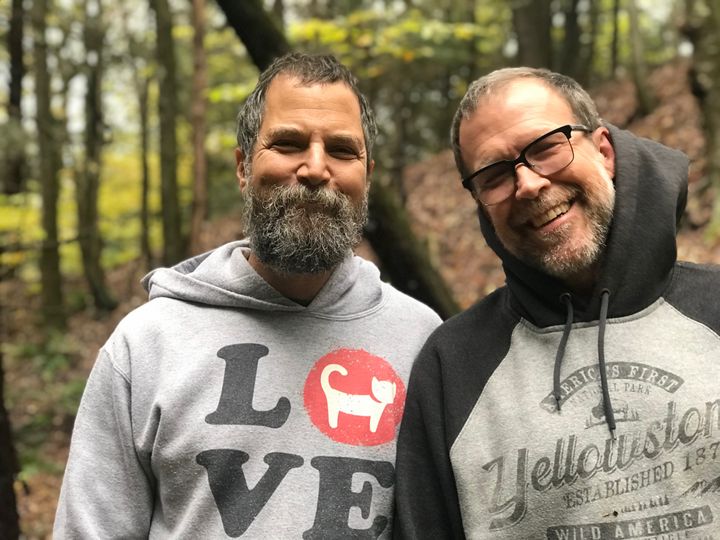
The author (right) in the Catskills with his spouse, Saul.

Courtesy of Keith Hoffman

The author (right) in the Catskills with his spouse, Saul.

But it wasn’t all fun. At a Taco Bell in Texas, we stood in line behind two rough-looking, solidly built women who looked like they didn’t bother to get out of their pyjamas anymore. They had wild bedhead and wore dark makeup over their angry eyes.

“I can’t understand a word anybody says in them damn masks!” one of them complained loudly, glaring at Megan and me. We were the only ones wearing the offending objects.

I had gotten used to the threats that come with being different, but I was definitely out of my comfort zone. I shifted a little closer to my faux wife.

When Megan stepped up to the counter and asked about Taco Bell’s gluten-free options, I went into high alert. I was convinced the women would start taunting us, but to my surprise, they left us alone. I’m not sure that would have been the case if Saul were at my side wearing one of his “I Love My Cats” T-shirts. Avoiding wheat was obviously less offensive than being in love with someone of the same gender.

By the time we got to New Mexico and sat in a tiny diner, happily making small talk with other male-female couples, my transformation was complete. I felt like Eddie Murphy in that classic “Saturday Night Live” skit in which he goes undercover to find out how white people really act when no Black people are around.

Was it wrong that I was getting a thrill out of being thought of as “normal” after a lifetime of internalising messages that gay wasn’t as good as straight and being made to feel like my queerness was, at best, a little weird, and often something much, much more terrible?

I still look for a slight reaction from a cashier when I tell them my grocery discount card is under my husband’s name. And I often think back to the day after my sister died, when an old friend called to tell me she was sorry for my heartbreaking loss before cheerfully adding, “Oh, and I want you to know I’m OK with you being gay!”

I’ve celebrated decades of Pride Months being “here and queer,” and I’ve participated in countless marches. I’ve stood up to homophobia at work, with my family, and in constant daily interactions ever since I came out at the age of 18.

Sometimes being proud is exhausting.

But now I realise it’s actually a luxury that I can “pass” as straight. That isn’t the case for everyone, and those people are often in danger everywhere they go. Being at risk starts early. LBGTQ youth are often targeted and bullied in grade and high school when they are at their most vulnerable. In fact, lesbian, gay and bisexual youth are almost five times more likely to have attempted suicide than heterosexual youth. A survey of trans and nonbinary youth conducted by the Trevor Project found that 60% had considered suicide in 2021.

“I realize it’s actually a luxury that I can ‘pass’ as straight. That isn’t the case for everyone, and those people are often in danger everywhere they go.”

What’s more, there are still so many forces at work trying to limit or roll back the rights of queer people ― especially those who identify as trans. State legislatures are continuing to advance bills targeting transgender and nonbinary people, including criminalising health care for transgender youth, barring access to the use of appropriate restrooms, restricting their ability to fully participate in school sports, allowing religiously motivated discrimination and making it more difficult to get ID documents with their correct name and gender.

These sobering facts make me realise how important it is that we don’t stop fighting. Sometimes that fight involves protesting, voting and speaking up and out about our identities. Sometimes fighting means coming out ― to the grocery cashier, the macho mechanic or the stranger sitting next to us on the plane ― because refusing to “pass” as straight and telling people who we are can be a radical act. It can change someone’s mind about who is queer and what it means to be queer, and that can have incredibly profound consequences. And because not everyone lives in a place or has a life where they’ll be safe if they do come out, it feels that much more important for people like me to do it if and when and as often as we can.

Many people have fought for generations for my right to say the words, “This is my husband, Saul,” and the fight continues. As Megan and I settle back into our own married lives with our respective spouses, one of the most powerful things I can still do is stay visible. So as much as I enjoyed my time in hetero land, it’s time to get back to work.

Keith Hoffman is finishing his memoir, “The Summer My Sister Grew Sideburns.” He has written for television shows such as “The Secret World of Alex Mack,” “Sister Sister” and the popular Nickelodeon cartoon “Doug.” He was a producer for the GLAAD Award winning series “30 Days,” and currently serves as executive producer for Animal Planet/Discovery, where he produced 10 seasons of “Finding Bigfoot.” His essays have appeared in HuffPost, New York Daily News and Grub Street Literary Journal. You can read his blog at TheRavenLunatic.com and find him on Instagram at @Keefhoffman and on Twitter at @khravenlunatic.

Share Button

Wondering Why Everyone’s Buying Skin Care With Niacinamide? Here’s Your Answer

If niacinamide were a person, it would already have earned a Nobel Peace Prize. As a skin care ingredient, it can go pretty much everywhere, calm things down right away and get everything working well together. But until they start awarding global honours for skin creams (and really, why not?), mighty niacinamide continues to prove there’s little it can’t do for beleaguered, stressed and irritated skin.

What It Is And How It Helps Skin

Niacinamide is a form of vitamin B3, a water-soluble vitamin that’s a powerful antioxidant everyone needs to support a number of cellular processes. “It’s not produced naturally by the body, so you must use skin care products specifically formulated with niacinamide to experience the ingredient’s benefits,” Tom Allison, senior vice president and global head of professional marketing at CeraVe, told HuffPost.

It appears in products intended to alleviate fine lines and wrinkles, acne, eczema, discolouration, rosacea, large pores, oily skin and sun damage, among other things. If that seems like a tall order for one ingredient to address all those issues, niacinamide is up to the job, experts say.

Erin Greer, executive director of education and training at Alastin Skincare, explained that one of the ingredient’s superpowers is restoring the moisture barrier function of the skin. “As we get older, we can lose the lipid barrier that makes skin radiant and luminous. Niacinamide produces ceramides that help to restore that barrier, reduce dehydration and help skin look better.”

In a sign of our overstressed times, dermatologist Dhaval Bhanusali said, “In general, there’s a trend toward ‘calming’ ingredients. Niacinamide is a popular option since it’s so well-tolerated. It’s truly a star ingredient and one I recommend often.”

Good For Dry Skin, Oily Skin — Pretty Much Good For Skin In General

You knew we couldn’t get this far into a skin care article without talking about free radicals, those pesky molecules with unpaired electrons that can build up and cause oxidative stress, which harms other cells and speeds up aging symptoms like wrinkles. “As a true multitasker, niacinamide neutralizes free radicals and helps to address the slowing of skin aging through repair and rejuvenation,” dermatologist Melissa Kanchanapoomi Levin said. But wait, she said, there’s more: “Because it’s also been shown to regulate oil secretion and cell skin turnover, it’s recommended for both dry, sensitive skin and oily, acne-prone skin types, too.”

It might be hard to find a skin care ingredient that plays so well with others. “Niacinamide tends to complement and work well when layered with several other active ingredients that compose a typical skin care regimen,” said dermatologist Janiene Luke, co-chair of the Skin of Color Society technology and media committee and associate professor and director of the dermatology residency program at Loma Linda University. “It typically can be used in people who also use retinoids, salicylic acid and other chemical exfoliants, as well as hydrating ingredients such as hyaluronic acid.”

How To Get Started And When You’ll See Results

“Most people can tolerate niacinamide, but I’d suggest looking for concentrations that range from 2% to 10%, since higher concentrations sometimes can cause irritation,” Luke said.

“With my patients, I’ve seen them do well with up to 6% niacinamide,” Bhanusali said. “If it’s higher than that, you should spot treat first and make sure you tolerate well before applying all over.”

If you like the results you’re seeing on your face, try using it all over your body, Deanne Mraz Robinson, dermatologist and assistant clinical professor of dermatology at Yale New Haven Hospital, told HuffPost. “Look for it as an ingredient in body lotion, as well. It’s a helpful ingredient for dry, itchy skin.” She did note some caveats: “It shouldn’t be used simultaneously with skin care products that contain vitamin C. When combined with vitamin C, it turns into niacin, which can cause redness and irritation in sensitive skin.”

Once you begin regular applications, you’ll need to be patient. “Niacinamide typically takes eight to 12 weeks to work if you’re using it regularly,” dermatologist Ellen Marmur said. “But in some cases, you will see almost immediate improvement.”

And, as always, use common sense: avoid it if you’re allergic to it, of course. And go slowly. “Some people do get irritated by higher concentrations of niacinamide, so you can get too much of a good thing,” said Michelle Wong, the chemistry Ph.D. behind the Lab Muffin Beauty Science blog.

Share Button

8 Very Controversial Esther McVey ‘Common Sense’ Moments

Esther McVey returned to the cabinet this week, in what was seen as an attempt by Rishi Sunak to reach out to the right-wing of the Tory party.

The MP for Tatton – known for her socially conservative views – has been given the job of ensuring “common sense” prevails across government, according to The Sun.

Richard Holden, the Conservative Party chairman, has praised his “plain-speaking” colleague.

But the new Cabinet Office minister has a long history of controversial statements.

She branded chancellor Jeremy Hunt “socialist” shortly after he had promised to make her deputy prime minister, questioning how “safe” the Covid vaccine was and spent thousands of pounds on a personal photographer.

Ellie Reeves, Labour’s deputy national campaign coordinator, said “common sense is a flower that does not grow in every garden.

“This string of evidence suggests Rishi Sunak might have again appointed someone wildly under-qualified for this job,” she said.

Here are eight eyebrow raising comments from McVey’s time in parliament.

1. Criticised describing the Covid vaccine as ‘safe’

Just last month, McVey attacked the government for having described the Covid vaccine as “safe”.

Speaking in the Commons, the then backbencher railed against “safe and effective” having become the vaccine “catchphrase”.

“It was repeated so many times over that couple of years. It cropped up everywhere: in government communications, in interviews with experts and across a media that was only too happy run with that covid slogan—safe and effective,” she told MPs.

“So ingrained did it become in the national psyche that to ever ask questions about the Covid vaccine became very difficult to do indeed.”

2. Spent £8,000 on a personal photographer

When serving as housing minister, McVey billed the taxpayer at least £8,000 in expenses for a professional photographer.

The spending was revealed as she mounted her campaign for the Tory leadership in 2019, a race ultimately won by Boris Johnson. She finished in last place.

3. Blasted ‘communist’ and ‘idiotic’ lockdowns

McVey also took aim at the government’s decision to impose lockdowns in an effort to fight the pandemic, damning Boris Johnson as “weak”.

Writing in the Daily Express earlier this month, she attacked “panicky civil servants and doomster scientists”.

“They should hang their heads in shame that they didn’t bother with any modelling on the downsides of lockdown on the nation’s children, their health and wellbeing, on mental health and on the economy,” she said.

’Instead, their collective panic, resulted in a communist style control over the public.

’Boris, whose instincts not to lockdown was right, was browbeaten and caved in to the elite establishment mob. Boris was weak and isn’t it ironic that Cummings – who prides himself on being anti-establishment – was the establishment enforcer for these idiotic lockdowns.”

4. Told Tory mayors they were a waste of time

On the eve of the last Tory conference, McVey dismissed regional mayors as “a waste of time and money”.

In her article she targeted Labour mayors Sadiq Khan and Andy Burnham. But there are also Tory mayors. Andy Street, the Conservative mayor of the West Midlands, was unimpressed.

5. Claimed benefit cuts were ‘fake news’

Back in 2018, McVey was work and pensions secretary. In a speech to party conference she said it was “fake news” to claim she was cutting benefits.

“If you were to believe everything you heard from Labour or read on social media you’d think we were somehow letting down the most vulnerable in society – especially disabled people,” she said.

“However, those who say we are cutting budgets are peddling fake news.”

At the time, most working age benefits had been frozen, a real terms cut in what people received.

6. Had to say sorry to MPs

The same year, McVey was forced to apologise in the Commons after claiming the National Audit Office (NAO) had asked for an accelerated rollout of Universal Credit. It had not.

“In fact, the NAO did not say that and I want to apologise,” she confessed to MPs.

7. Took a second job at GB News

In her 2019 Tory leadership campaign launch video, McVey said she wanted to be a public servant and represent the public’s views.

But having come last in the contest, she took on a second job as a presenter at GB News where she earned £58,650 in 2022, at an average of just under £900 per episode.

8. Called the Tory Budget ‘socialist’

In the 2022 Tory leadership campaign, Jeremy Hunt announced McVey would be his deputy prime minister should he win the contest. He lost but ended up as Rishi Sunak’s chancellor.

McVey then slammed his Budget as “Gordon Brown-esque in its devotion to a socialist paradise of tax and spend” and “a bad day for the Conservative Party”.

Share Button