Will Boris Johnson Come To Regret Making July 19 The Terminus Of His Roadmap?

You’re reading The Waugh Zone, our daily politics briefing. Sign up now to get it by email in the evening.

Just when you think you’ve got it beat, Covid-19 somehow comes back stronger. Like Arnold Schwarzenegger but without the charm, this Terminator of a virus has an “I’ll be back” menace that risks undoing all the hard work of the UK’s stunning vaccine rollout.

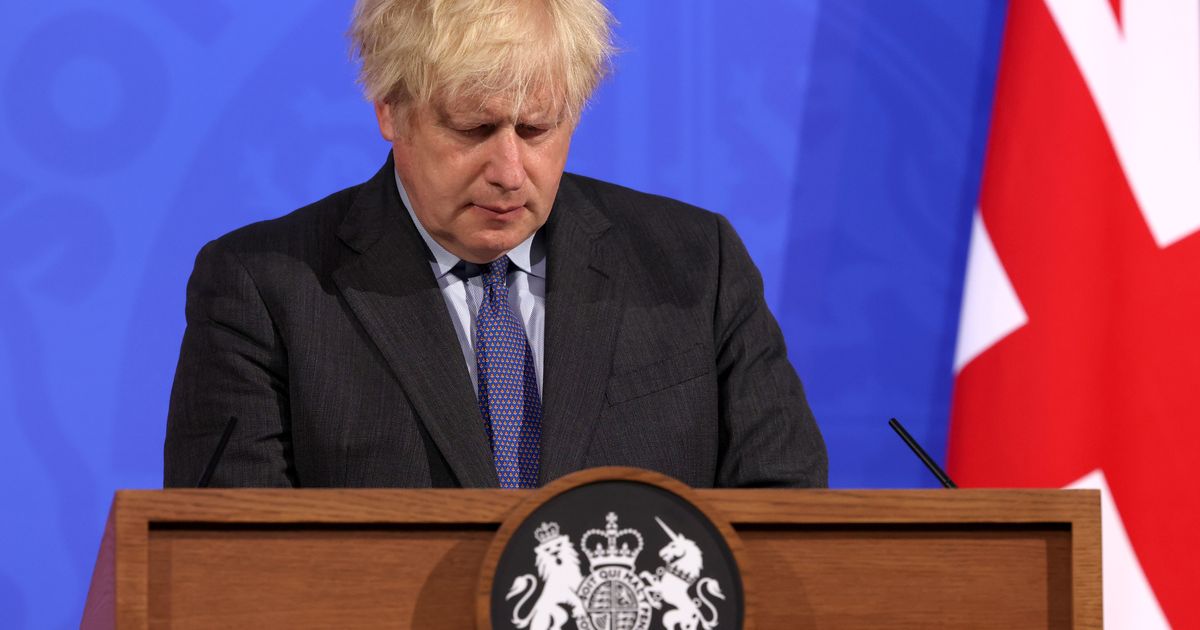
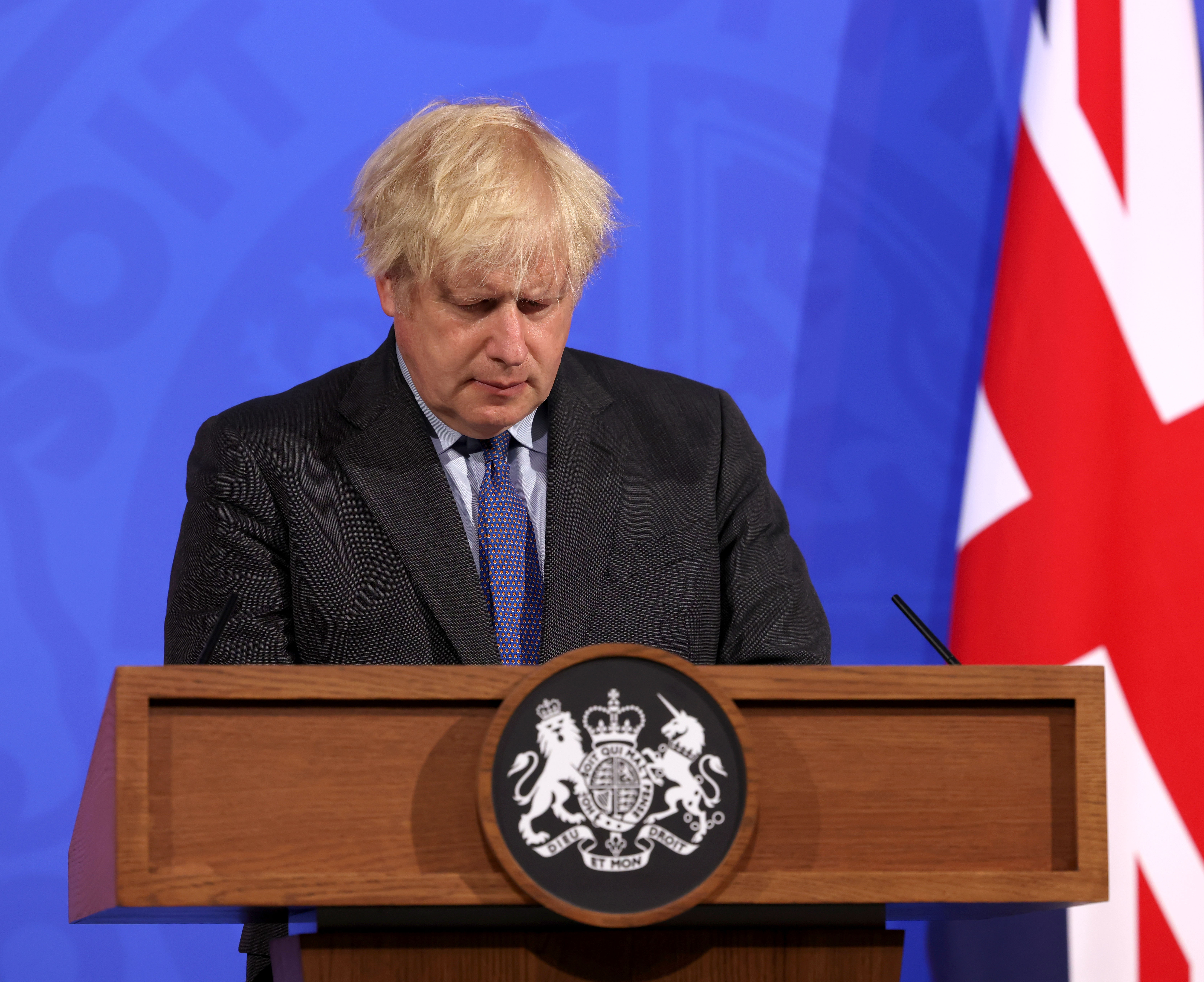
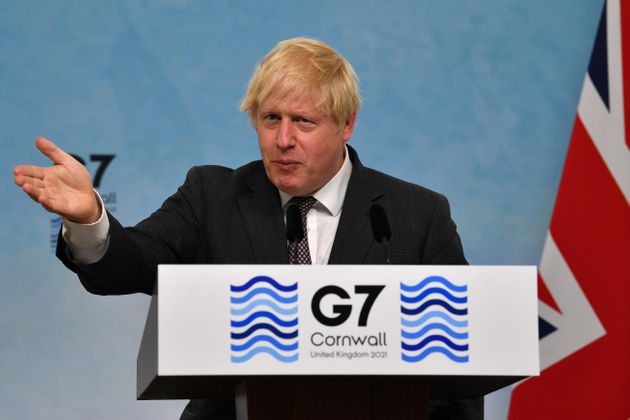
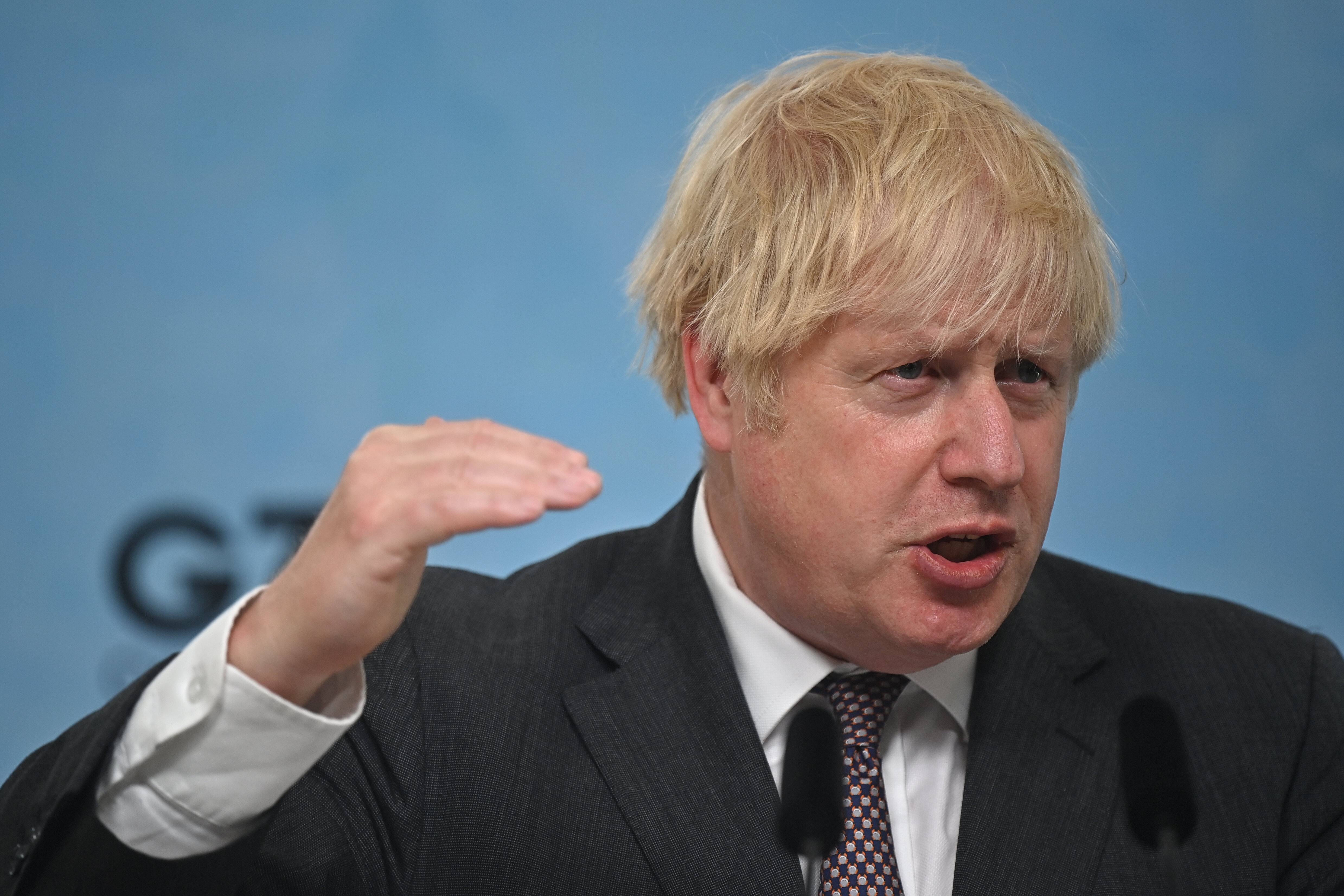
The epic battle between the vaccines and the virus certainly has high stakes. Perhaps that’s why Boris Johnson sounded unusually nervous as he announced he would indeed be postponing ‘Freedom Day’ by another four weeks. Instead of the sunshine of Midsummer Merrie England, there was a blizzard of scary charts of projected hospitalisations.

Fluffing his lines, the PM referred to “the adults of this company” (he meant “country”) and then wrongly declared the new unlocking date was July 29th (correcting it later to July 19th). Polling shows most of the public are relaxed about a delay, but Johnson is acutely aware that the 24% who are unhappy include several of his own backbenchers, and it showed.

Nowhere was this more telling than in his repeated reassurance that the Freedom Day Mk II was the real deal. He was “pretty confident” that July 19 will be “the terminus date” (he said “terminal date” too). June 21 was always a “‘not before’ date”, whereas this was much firmer, he suggested. This was not a defeat for lockdown sceptics, it was a victory, he seemed to imply.

That spin may or may not work on Tory MPs, but it could paint the PM into a corner for the first time in months. Ever since he bowed to Chris Whitty and Patrick Vallance’s plan for a cautious roadmap, he has been able to fall back on their insistence that all four tests have to be met (the new variant test was particularly shrewd) and that “data not dates” will drive his decisions.

But now with talk of “terminal” and fixed timelines, it feels like dates not data is the new approach. Steve Baker, Mark Harper and Sir Charles Walker, who will probably vote against the delay, have much more concrete evidence of a breach of faith should that July 19 date somehow slip again.

Whitty and Vallance gave the PM invaluable backing at the press conference. The chief medical officer in particular pointed out that even without the Indian variant, the very restoration of unrestricted indoor mixing of “households that are unrelated” was always going to lead to an uptick in cases. He added there had to come a point where fatalities switched from “deaths averted” to deaths delayed”, as with flu.

Patrick Vallance even suggested that locking down beyond July 19 would be counter-productive. And he made the case for that date containing the Goldilocks calculation of just how hot or cold to make the roadmap porridge. Giving over-18s their first jab and pushing unlockdown closer to the school holidays certainly added some sugar, as did a lifting of the cap on wedding numbers.

Still, for Keir Starmer, the talk of 19 July as a “terminal” date is an opportunity for a Judgement Day on Johnson’s competence. If the vaccination programme can’t sufficiently flatten the Delta variant spike, he is sure to step up his own attack line that Johnson’s failure to stop flights from India is the real culprit. Already today, the Labour leader hardened his rhetoric to say it was a “pathetic” border policy that had postponed freedoms.

Starmer’s clear aim is to drive a big wedge between the excellence of the NHS vaccine rollout and the government’s wider failures. It’s unclear whether it was the PM’s desire to keep alive post-Brexit trade talks with Narendra Modi that prompted his inaction, but the suggestion that he recklessly undermined both the NHS’s programme and public sacrifices is a toxic one.

Today’s failure to offer extra financial support to businesses added extra political risk too. Those firms which were hanging on by their fingertips will now face having to pay their share of furlough bills, with no extra income to fund them. Add in the self-employed already upset and an Opposition that was pro-enterprise could make inroads.

To oversee one Covid wave is a misfortune, to allow two begins to look like carelessness. But to trigger a third wave, squandering all the good work of your own vaccine success story, could be seen as unforgivable by a public which has to date been incredibly forgiving of its prime minister.

Share Button

Wedding Restrictions After June 21: What You Need To Know

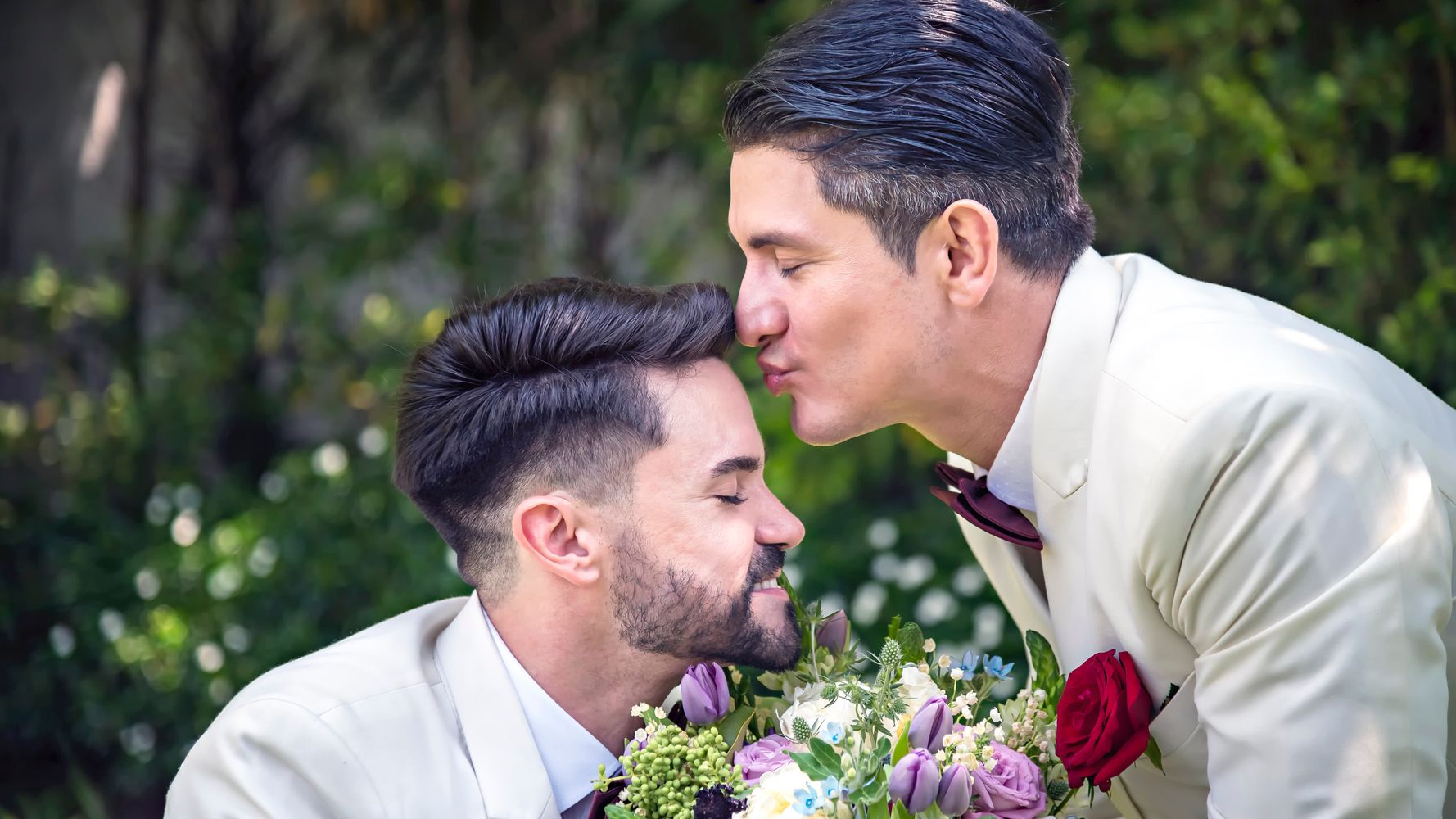
The 30-guest limit at weddings in England has been lifted, despite a four-week delay to the ending of lockdown.

From June 21, people can have more than 30 guests at a wedding, “provided social distancing remains in place”, Boris Johnson announced at a Downing Street press conference on Monday – welcome news to the many couples who have postponed their celebrations time and time again.

He told the Downing Street press conference that the spread of the Delta variant meant the government and public “faced a very difficult choice” between continuing with Step 4 of the roadmap on June 21 or giving the NHS “a few more crucial weeks” to get all remaining vaccinations administered.

“And since today I cannot say that that we have met all our four tests for proceeding with Step 4 on June 21, I think it is sensible to wait just a little longer,” he said.

It is not yet confirmed if there will be an upper limit on guest numbers, but the Mirror has reported that capacity limits may be the highest number of people wedding venues can accommodate while still being Covid-secure.

“I am sorry for all the disappointment that’s going to be caused by going a bit slower as we are today,” the prime minster told a journalist and bride-to-be who said she had already twice postponed her wedding.

The reporter had questioned why testing and vaccination status could not be used to open up weddings in the same way as football matches, and said weddings felt “bottom of the priority list despite being significant life events without which some people cannot progress with their lives.”

Boris Johnson, who married his wife Carrie in a secret ceremony in Westminster Cathedral on May 29 attended by 30 people, said he was sorry for the “many, many businesses” affected by delays – adding “it’s a few weeks that I think is worth it to get those jabs in”.

Share Button

Will Lockdown Be Extended? What We Know About Covid Rules On June 21

After weeks of ‘will they won’t they’ debate about whether Boris Johnson will delay the June 21 final lifting of Covid restrictions, we are finally about to find out what happens next.

The prime minister will deliver a press conference on Monday evening at which he will set out his plan for step four of the road map out of lockdown.

A delay is widely expected, amid a spike in Covid cases driven by the Delta variant first detected in India.

But there remain questions over how long it will be, whether rules for weddings or other activities could be relaxed, and what a delay means for the government’s pandemic strategy.

Here’s what we know so far:

What is happening with England’s lockdown?

The prime minister will meet senior ministers and officials on Sunday evening to make a final decision about whether to proceed with the June 21 unlocking.

He is then expected to deliver his verdict to the nation during a Monday evening press conference from Downing Street, after racing back from the Nato summit in Brussels.

Will lockdown easing be delayed?

Johnson looks almost certain to delay the widespread easing of restrictions, admitting over the weekend there are “grounds for caution”.

Reports suggest that he is mulling over a two or four-week delay.

But the smart money looks on the latter with England’s chief medical officer Chris Whitty reportedly favouring a longer delay.

Scientists advising the government have also now predicted that the PM will announce a delay on Monday.

Why will the June 21 unlocking be delayed?

The latest figures from Public Health England (PHE) on Friday showed there have been 42,323 cases of the Delta variant confirmed in the UK, up by 29,892 from the previous week.

It estimates the strain is 60% more transmissible compared with the previously dominant Alpha, or Kent, variant, and that cases are doubling every four-and-a-half days in some parts of England.

The Delta variant also now accounts for 96% of new infections.

Johnson said on Saturday that cases and hospitalisations are now going up and that he has “serious concern” about this potentially feeding through to more deaths.

Foreign secretary Dominic Raab said on Sunday that ministers would be looking at whether vaccinations have “broken the link” between rising cases and rising hospitalisations, “not just severed or weakened it”.

Professor Andrew Hayward, a member of the Nervtag group which advises ministers on new respiratory diseases, said it was clear the country was facing a “substantial” third wave of the disease.

He said the key issue was the extent to which that led to more people becoming seriously ill and requiring hospital treatment.

“We still don’t know how bad it could be,” he told BBC’s The Andrew Marr Show.

But what about Covid vaccines?

More than three quarters (78.9%) of adults have now had their first dose of the vaccine.

But the latest PHE estimates suggest that one dose of Pfizer or AstraZeneca is only around 33% effective against the Delta variant, compared with around 50% against the previously dominant Alpha variant.

Encouragingly though, once people have two jabs the vaccines’ effectiveness is only slightly reduced – from around 88% to 80%.

The problem is only 56% of adults have had both jabs, so a delay would give the NHS more time to give more people their second dose, and so reduce the risk of rising hospitalisations that could put the NHS under pressure.

Johnson said on Saturday that “we need to make sure we give the vaccines extra legs.”

On the plus side, deaths are still very low, although there is always a lag between rising cases feeding through to more deaths.

Could a lockdown delay last longer than four weeks?

WPA Pool via Getty Images

Boris Johnson has refused to say whether the June 21 schedule could be pushed back. 

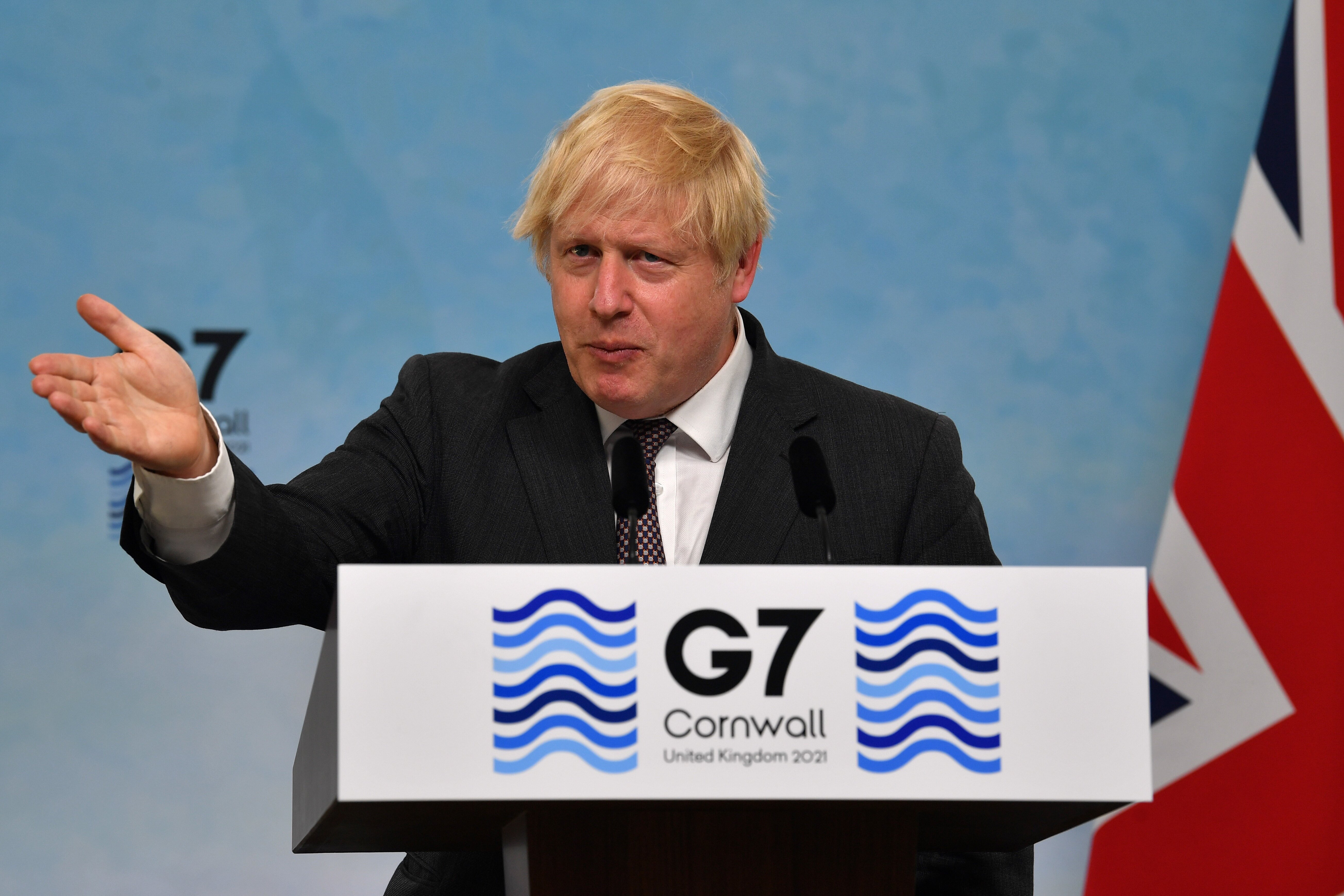
At a Sunday press conference to close the G7 summit in Cornwall, Johnson refused to say whether the June 21 schedule could be pushed back longer than four weeks.

Foreign secretary Dominic Raab meanwhile said that unlocking needed to be “irreversible” and so the government needed to proceed “carefully and cautiously”.

“We don’t want to yo-yo back in and out of measures,” he said.

He also refused to rule out the possibility that restrictions could stay in place beyond the end of July.

“We want to be irreversible so we have just got to be careful that we are there in terms of data,” he said.

Professor Stephen Reicher, a member of the Scientific Pandemic Insights Group on Behaviours (Spi-B), has meanwhile warned that there is a risk the Covid situation could go “backwards”.

He called on the government to provide more financial support to help people self isolate to stop the spread of the virus.

Could there still be some relaxation of Covid rules?

HuffPost UK last week revealed that Michael Gove said he would “bet” on some kind of “relaxation” of restrictions.

Reports suggest that Johnson may delay most of the roadmap, but lift the cap on the number of people who can attend weddings, which is currently at 30.

The PM may also choose to relax rules around attendance of large events to enable at least half-full stadiums at Euro 2020 games hosted at Wembley, including the final.

Will there be a backlash?

Polling by Opinium suggested broad public support for the government’s approach, with 54% in favour of a delay and 37% against.

But there is frustration among some Conservative MPs – already unhappy over the impact on the economy and on civil liberties – at the prospect of further delay.

Writing in the Mail on Sunday, Sir Graham Brady, the influential chairman of the backbench Tory 1922 Committee, said that it must be the final time.

“On any reasonable assessment we should be still on target for lifting restrictions on June 21,” he wrote.

“There is no excuse for this further catastrophic delay. It is unacceptable to restrict people’s most fundamental rights. And it must never ever happen again.”

Share Button

G7 Leaders Fall Short Of Directly Sharing 1bn Vaccine Doses Around The World

Leaders of the G7 group of wealthy nations have fallen short of directly providing one billion Covid vaccine doses to poorer countries over the next year.

The final communique of the Boris Johnson-hosted summit in Cornwall revealed that the leaders only managed to commit to sharing 870m spare doses over the next year, despite a high profile commitment to a billion.

The document insists that taken together with separate financial commitments it would mean the G7 has shared more than two billion doses since the start of the pandemic, and has met the 1bn target for the next year.

But the leaders are facing criticism from the likes of Oxfam, which accused leaders of “cooking the books” with its vaccine figures.

“A billion vaccine doses would have been a drop in the bucket, but they didn’t even manage that,” the charity said.

Earlier, former UK prime minister Gordon Brown said the summit will go down as “unforgivable moral failure” as the World Health Organisation (WHO) estimates that 11bn doses – more than ten times the number pledged – are needed to stamp out the pandemic.

At his closing summit press conference, Johnson rejected Brown’s criticism, highlighting US president Joe Biden’s commitment to providing 500m Pfizer vaccines for 92 low and lower-middle income countries and the African Union.

 “This is another billion made up of a massive contribution by the United States and other friends,” the UK prime minister said.

He said the UK’s contribution is another 100m from now to next June of the vaccines.

He said: “Already of the 1.5bn vaccines that have been distributed around the world, I think that people in this country should be very proud that half a billion of them are as a result of the actions taken by the UK government in doing that deal with the Oxford scientists and AstraZeneca to distribute it at cost.”

He added: “We are going flat out and we are producing vaccines as fast as we can, and distributing them as fast as we can”. 

The target to vaccinate the world by the end of next year will be done “very largely thanks to the efforts of the countries who have come here today”, according to Johnson.

But Oxfam’s head of inequality policy Max Lawson said leaders had “cooked the books” on vaccines and “completely failed” to meet the challenge of the biggest health emergency in a century.

“This G7 summit will live on infamy,” he concluded.

Edwin Ikhuoria, of the anti-poverty campaign One, said: “Throughout the summit we have heard strong words from the leaders but without the new investment to make their ambitions a reality.

“Crucially, the failure to get life-saving vaccines to the whole planet as fast as possible, means this was not the historic moment that people around the world were hoping for and leaves us little closer to ending the pandemic.”

What else was agreed at the G7 summit? 

Covid

G7 leaders renewed calls for a further investigation into the origin of Covid-19, following Biden’s surprise decision to order US intelligence agencies to continue probing the Wuhan “lab leak” theory.

The final summit communique called for a “timely, transparent, expert-led, and science-based WHO [World Health Organisation]-convened phase 2 Covid-19 origins study” including in China.

Johnson said that the best advice available to him remained that the virus jumped species from an animal.

However he said that it was important to keep an open mind as to what exactly happened.

“At the moment, the advice that we have had is that it doesn’t look as though this particular disease of zoonotic origin came from a lab,” he said.

“Clearly anybody sensible would want to keep an open mind about that.”

China

America’s wariness of China is continuing despite Biden replacing Donald Trump in the White House.

The president managed to convince leaders to sign up to a rival to Beijing’s influential Belt and Road investment programme in an effort to counter growing Chinese influence.

The Build Back Better World (B3W) programme will fund infrastructure, including green technology, and support growth in developing countries.

Leaders meanwhile pledged to call on China to “respect human rights and fundamental freedoms”, including in Xinjiang where Uighurs are believed to be suffering brutal human rights abuses that some say amount to genocide.

It also raised the situation in Hong Kong, calling on Beijing to respect its “rights, freedoms and high degree of autonomy”.

But reports suggest that there were some disagreements over how strong the language on China should be.

Environment

The G7 is committed to supporting a green revolution that creates jobs, cuts emissions and seeks to limit the rise in global temperatures to 1.5 degrees

Leaders set out the action they will take to slash carbon emissions, including measures like ending the use of unabated coal power – although they were unable to set a deadline for this.

The leaders did commit to ending funding for carbon-emitting overseas projects by the end of the year but the failure to agree a timeline may worry Johnson in the run-up to the Cp26 climate summit in Glasgow at which he is hoping to strike a much bigger global deal.

The G7 also set a goal of conserving or protecting at least 30% of their land and marine areas by 2030 as part of a push to reach that level of protection globally.

But Oxfam criticised the failure to make new pledges of climate finance, arguing that developing nations were looking for progress ahead of Cop26.

“Vague promises of new financing for green development projects should not distract from this goal,” the charity said.

Share Button

Boris Johnson Threatens To Suspend Key Brexit Deal Over Sausage War

Boris Johnson has threatened to suspend a key Brexit deal on Northern Ireland in an increasingly bitter row with the EU.

The prime minister spoke after meeting key EU players in the margins of the G7 summit in Cornwall, as wrangling over the Northern Ireland protocol threatened to overshadow the gathering.

French president Emmanuel Macron on Saturday morning urged Johnson to “keep his word” and apply the protocol in full, while European Commission president Ursula von der Leyen and European Council leader Charles Michel told him to “implement what we agreed on”.

German chancellor Angela Merkel also discussed the issue in talks with Johnson, who has now hit back with a complaint that the EU was being “theologically draconian” about the deal.

EXPLAINED Why A Brexit Sausage War Risks Overshadowing The Entire G7 Summit

Downing Street has indicated the UK would be prepared to unilaterally delay the full implementation of the protocol to prevent a ban on chilled meats crossing the Irish Sea from Great Britain.

Restrictions on British-produced chilled meats entering Northern Ireland are due to come into force at the end of the month, triggering talk of a so-called “sausage war”.

Johnson has now warned that unless there was a solution he would invoke Article 16 of the protocol which allows either side to take unilateral action to suspend the deal if its implementation were to lead to “serious economic, societal or environmental difficulties”.

Explaining his position, the PM told Channel 4 News: “It’s stated abundantly in the text that the protocol should be implemented in such a way as to ensure free trade, free movement of goods between Great Britain and Northern Ireland and all parts of the UK.

“It’s not working like that at the moment. We need to make sure it’s applied in a sensible way.

“There’s no reason at all to have prohibitions or barriers to the movement of potted plants, tractor parts, guide dogs for the blind, chilled meats – you name it – from Great Britain to Northern Ireland.”

On Sky News, he added: “I think we can sort it out but… it is up to our EU friends and partners to understand that we will do whatever it takes.

“I think if the protocol continues to be applied in this way, then we will obviously not hesitate to invoke Article 16, as I have said before.

“Don’t forget, the EU themselves invoked Article 16 in January, to disapply the protocol, so they can stop removal of vaccines from the EU to the UK.

“I’ve talked to some of our friends here today, who do seem to misunderstand that the UK is a single country, a single territory. I just need to get that into their heads.”

Johnson used the meetings with EU leaders to call for “pragmatism and compromise on all sides”, repeating his call to “minimise the impact [of the protocol] on the day-to-day lives of people in Northern Ireland”.

“I certainly think that the protocol is capable of being used and interpreted – by the way, up to the EU – in a pragmatic way or a theologically draconian way,” he told Channel 5.

“At the moment we are seeing… a lot of unnecessary difficulties. I think we can sort it out, with goodwill.

“What we don’t want to see is any more unnecessary barriers to trade and we want to sort it out as fast as we can, I’m sure with goodwill we can.”

Asked if there would be a trade war if agreement could not be reached, Johnson said: “The UK will do whatever we need to do to protect the UK internal market.”

“I don’t happen to think that a trade war is a very sensible or likely way forward. 

“I just think that we need some pragmatic solutions.”

Share Button

Emmanuel Macron Wants His Own ‘Special Relationship’ With Joe Biden

Boris Johnson this week confirmed that he doesn’t like to call the UK and United States’ close ties the “special relationship”, believing it makes Britain look “needy”.

But it appears Emmanuel Macron has no such concerns.

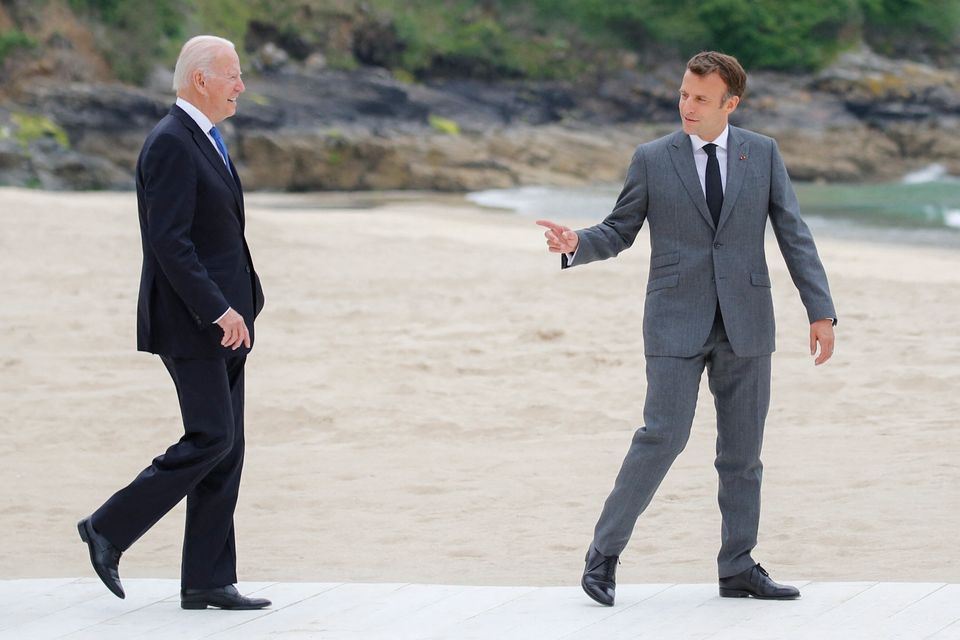
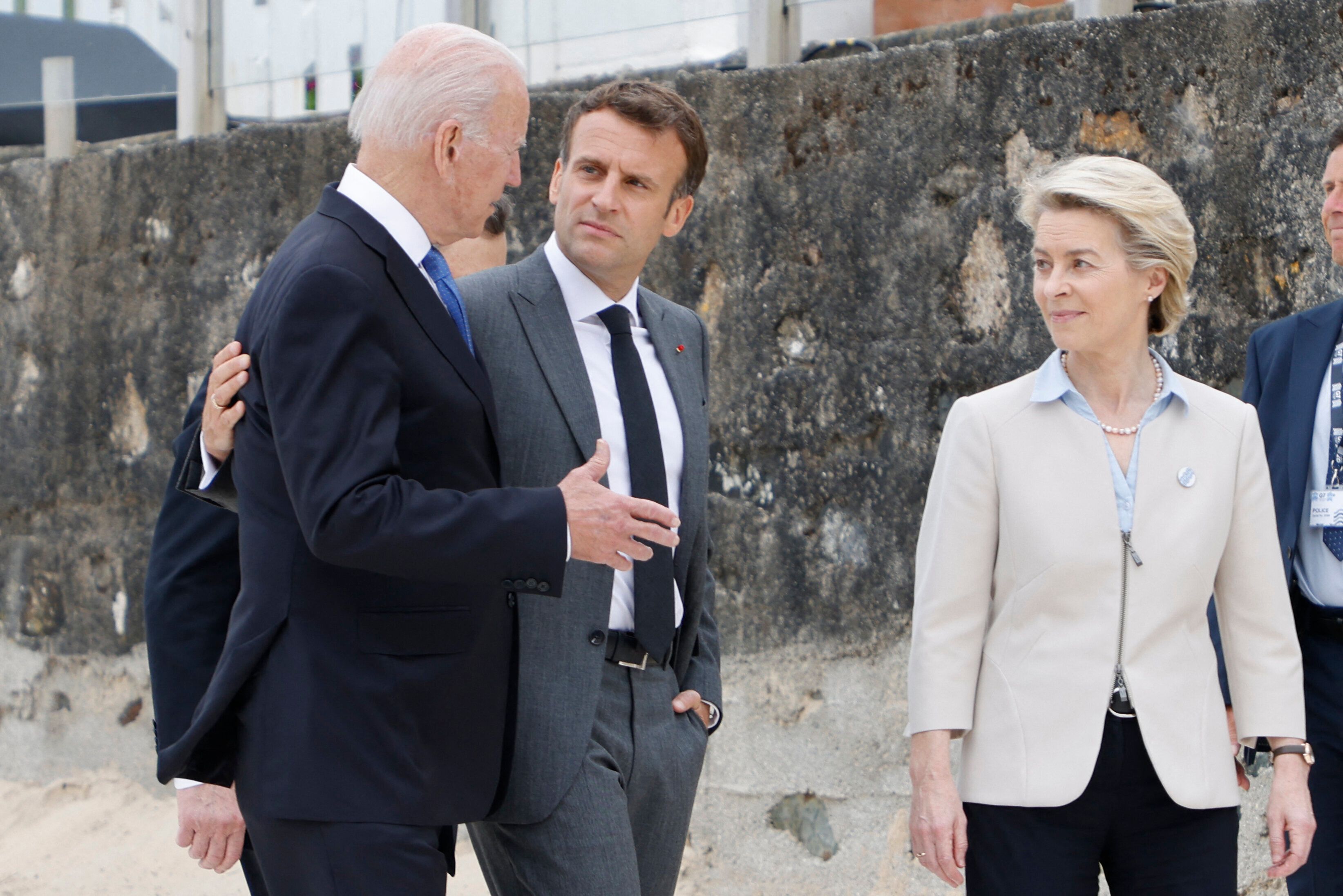
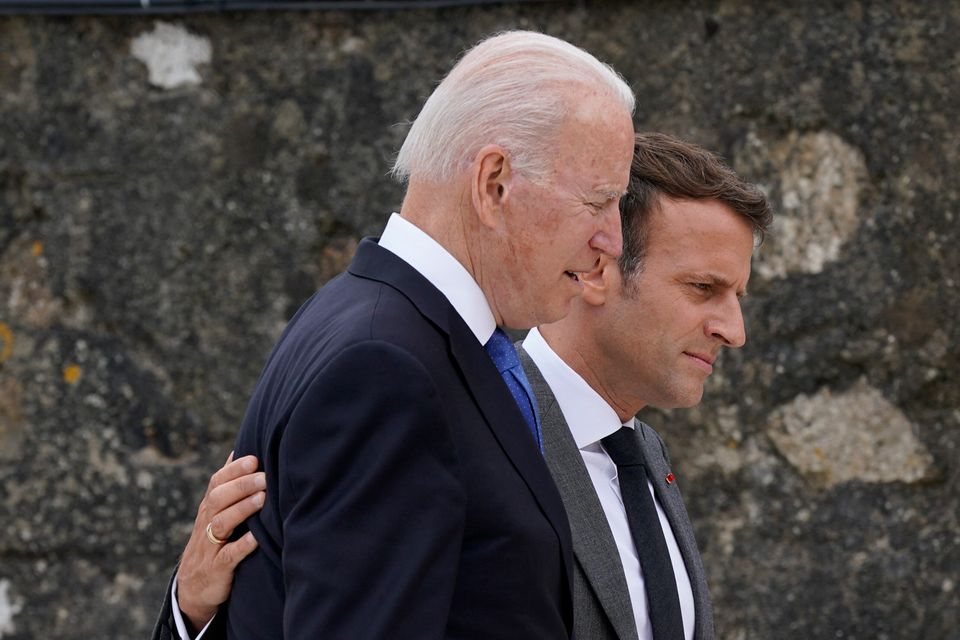
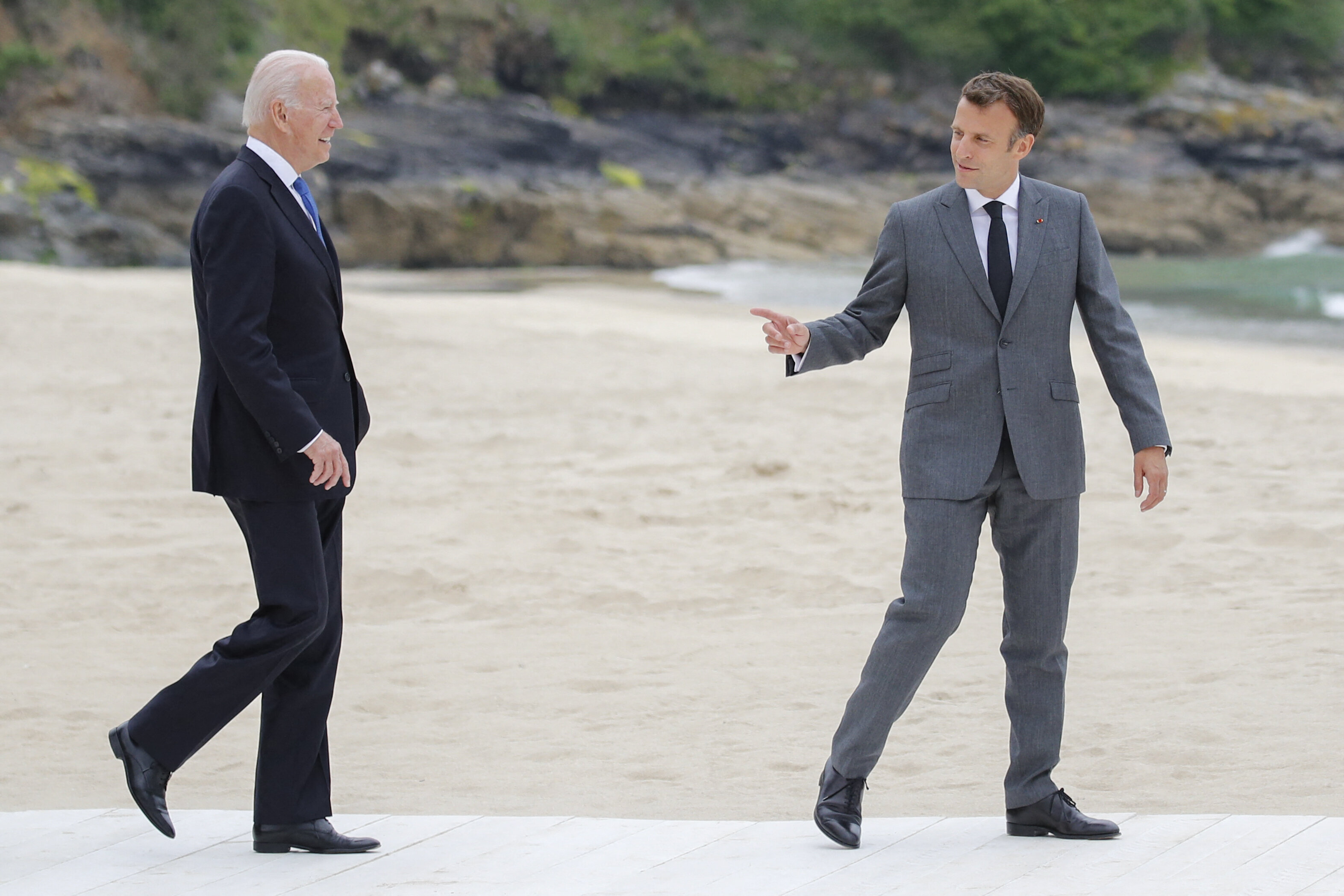
After the G7 summit got underway with an awkward “family photo” on the beach, the French president made a beeline for Joe Biden, throwing his arm around the American’s shoulders and beginning an animated discussion

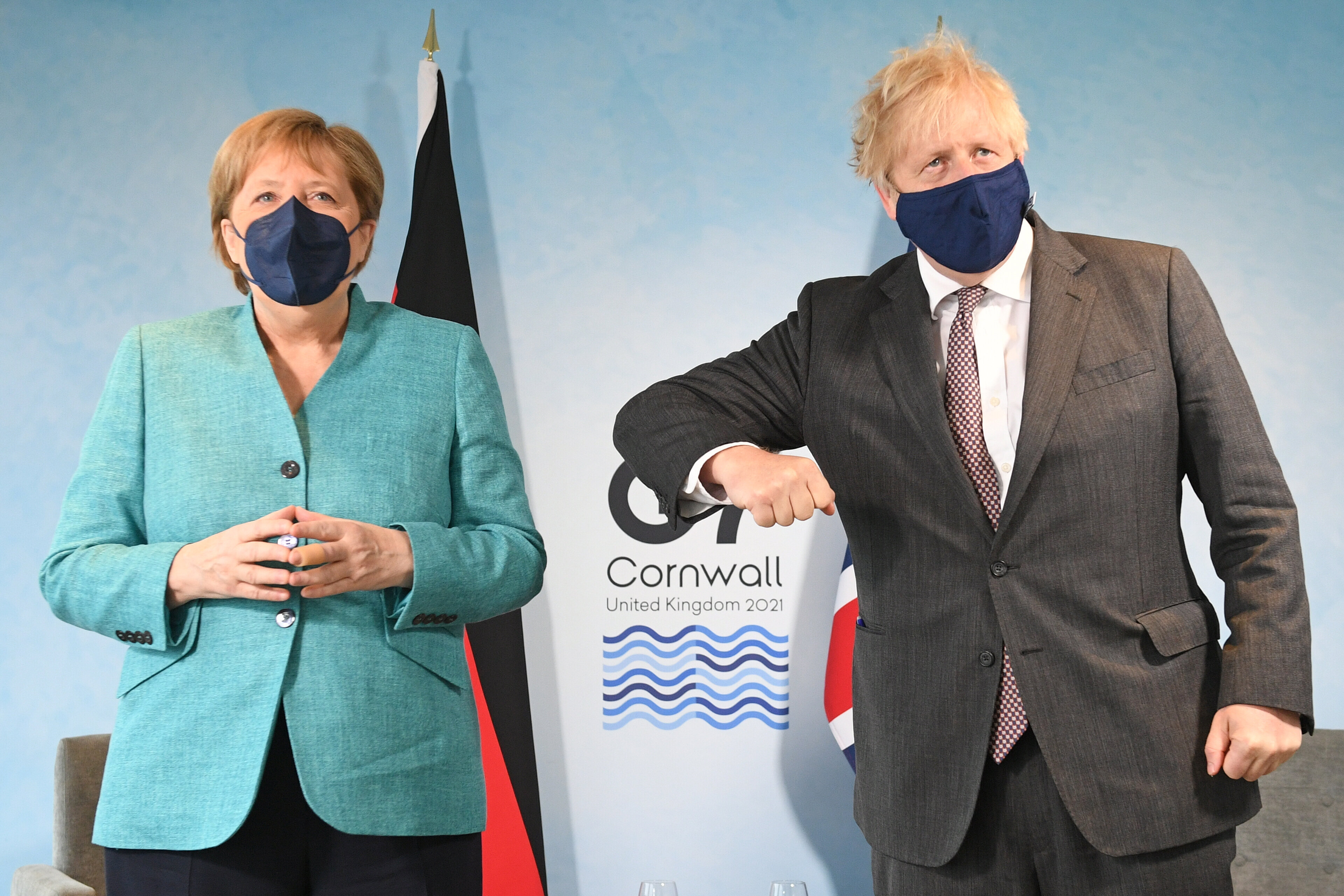
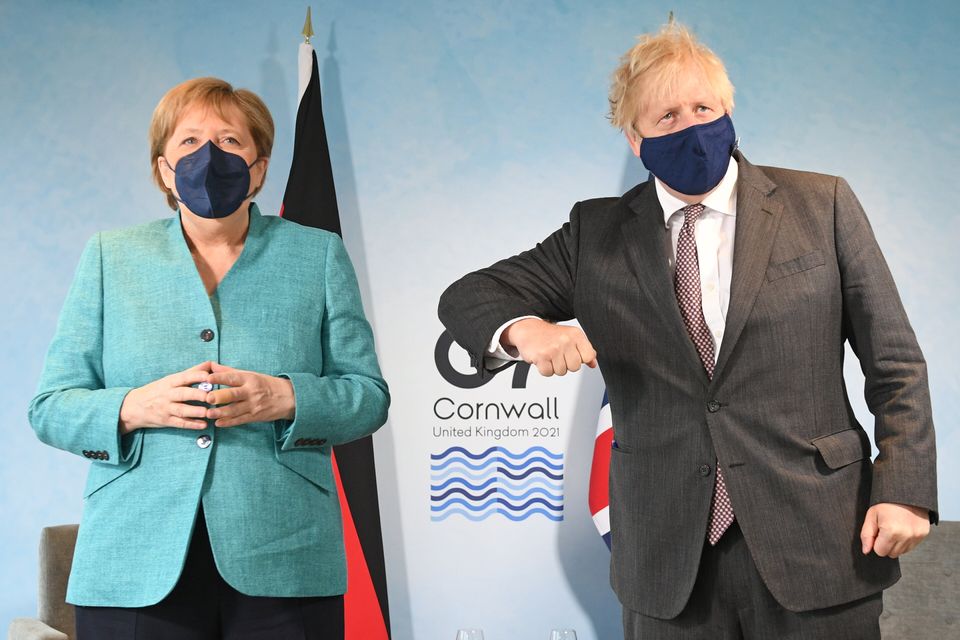
The Frenchman’s remarks were inaudible, but Johnson – who was out ahead of the pair after Angela Merkel told him “you are the leader” – will be hoping Macron was not trying to lobby Biden on the Brexit sausage war that is threatening to overshadow the G7 meeting.

PHIL NOBLE via Getty Images

French president Emmanuel Macron (right) greets US president Joe Biden at the G7 summit

LUDOVIC MARIN via Getty Images

Macron was flanked by European Commission president Ursula von der Leyen

PATRICK SEMANSKY via Getty Images

The vignette was one of several moments in which G7 leaders appeared uneasy at their first face-to-face meeting since the start of the Covid pandemic.

Biden at one point tried to break the tension, joking “everybody in the water” after leaders and their spouses were greeted with elbow bumps from Boris and Carrie Johnson on the beach at Carbis Bay in Cornwall.

After strolling down a lengthy walkway to the seafront, Jill Biden meanwhile joked that “I feel like we are at a wedding” while Johnson later agreed that it was like “walking down the aisle”.

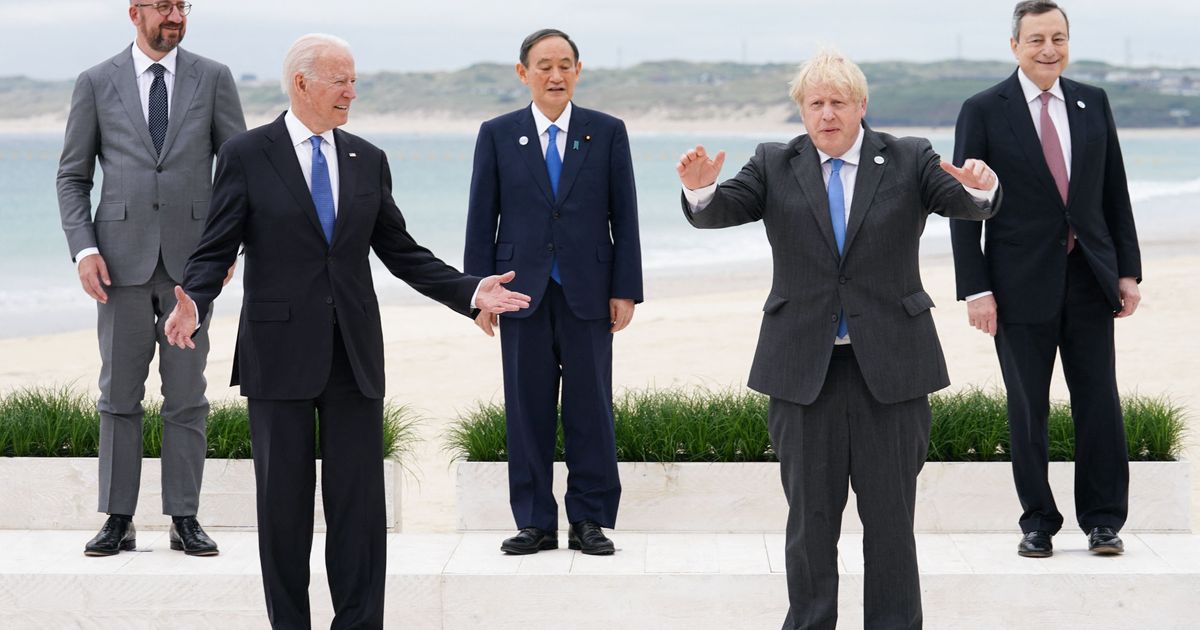
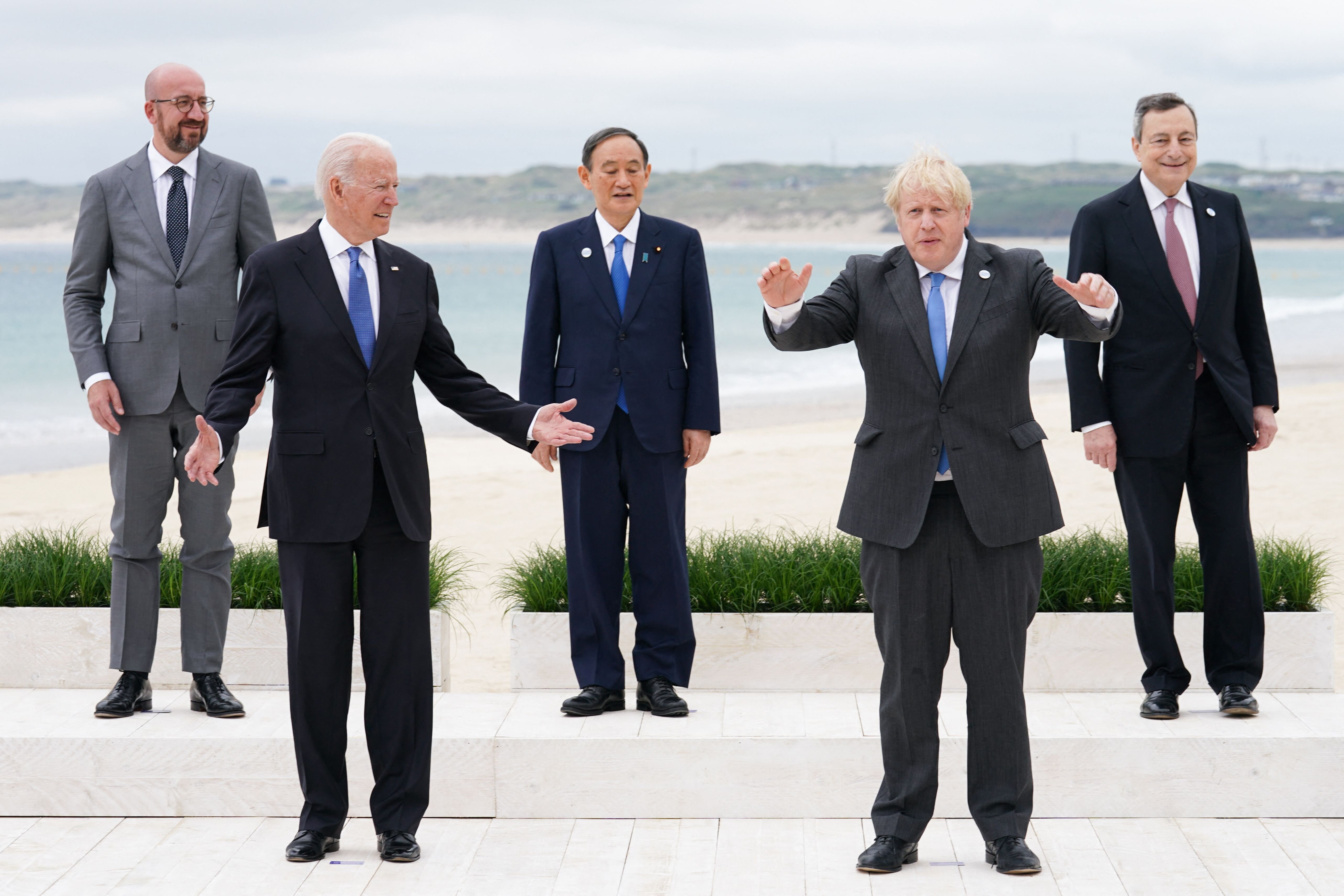
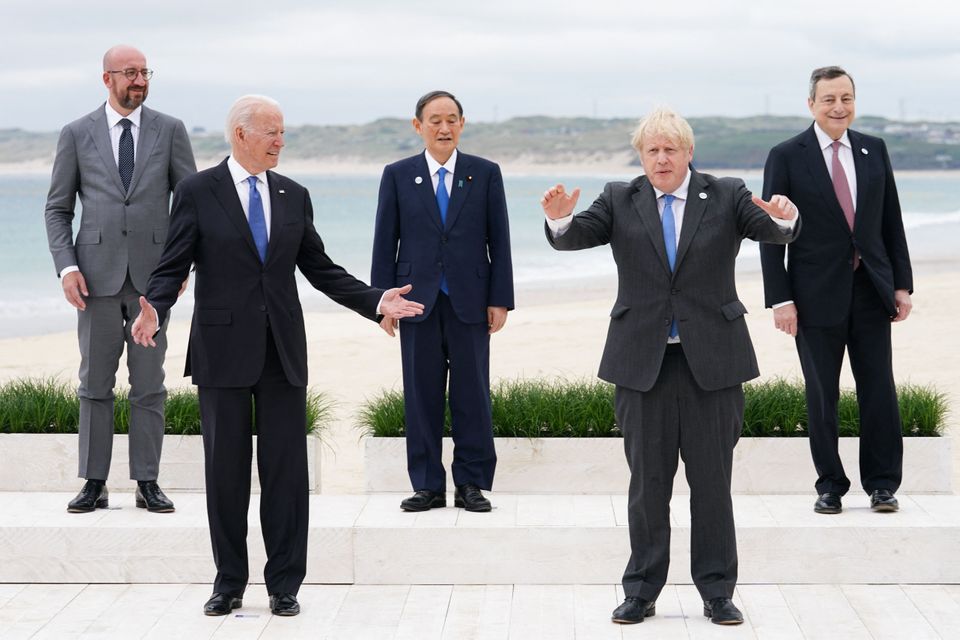
Leaders then struggled to create any kind of bonhomie as they stood two metres apart for a family photo.

As the talks finally got underway inside around a familiar circular table, Johnson bemoaned the carefully choreographed photo op as a “media circus”.

“This is meant to be a fireside chat between the great democracies of the world,” the PM complained.

In an unusual move for Johnson, he also suggested the G7 should support a more “feminine” economic recovery.

The PM said the citizens of G7 nations “want us to be sure that we are beating the pandemic together and discussing how we will never have a repeat of what we have seen”.

“But also that we are building back better together and building back greener and building back fairer and building back more equal and… in a more gender neutral and perhaps a more feminine way.”

Johnson also appeared to criticise his own Conservative Party for the way it handled the recovery from the 2008 financial crash by taking power in 2010 and embarking on a programme of austerity.

He said the G7 economies had the potential to “bounce back very strongly” from Covid.

“But it is vital that we don’t repeat the mistake of the last great crisis, the last great economic recession of 2008 when the recovery was not uniform across all parts of society,” the PM said.

There was a risk the pandemic could leave a “lasting scar” as “inequalities may be entrenched”, Johnson said.

“We need to make sure that as we recover, we level up across our societies and we build back better,” he added.

Share Button

Sea Shanties, Hot Rum And The Queen: How Boris Johnson Will Woo G7 Leaders

TOBY MELVILLE via Getty Images

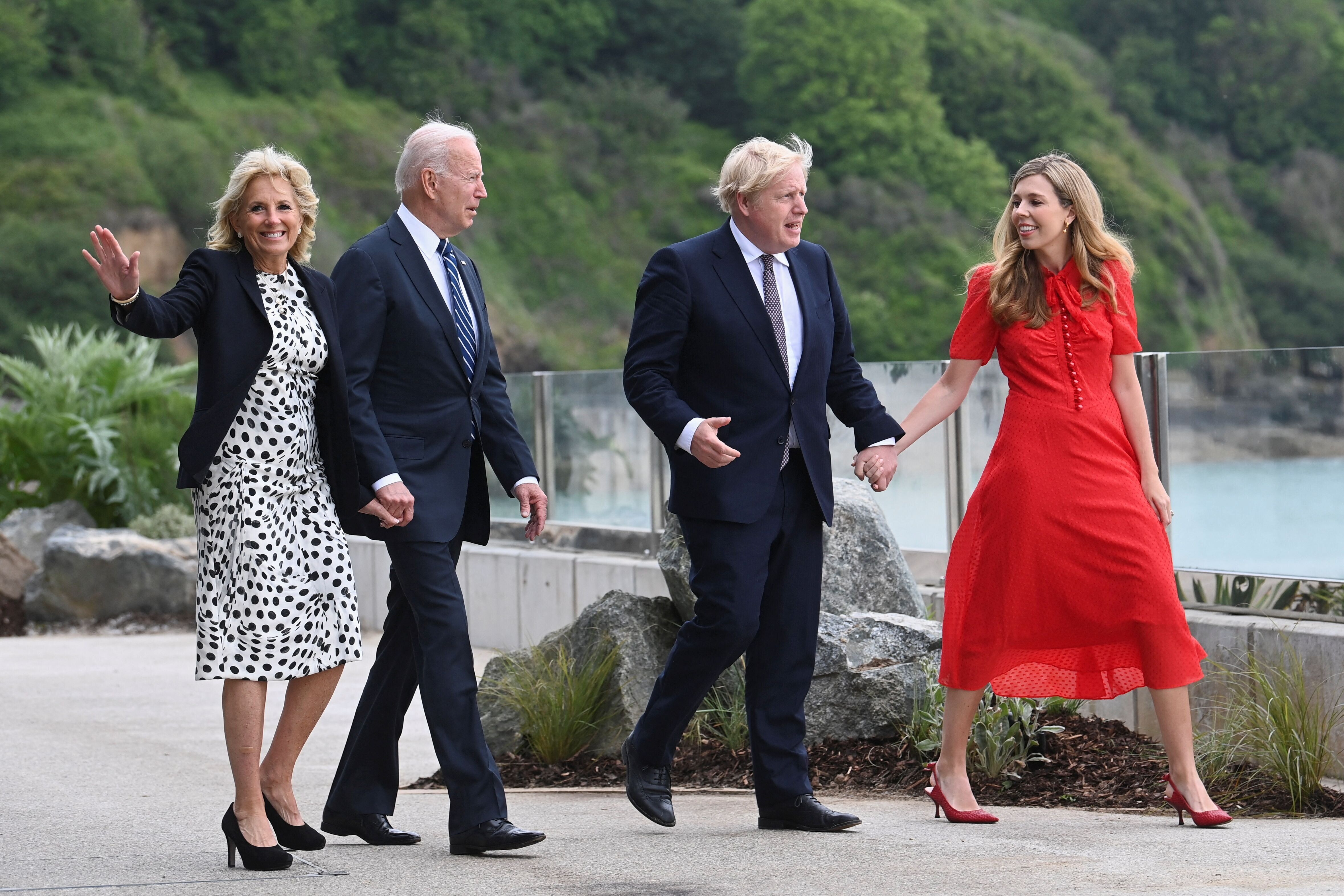
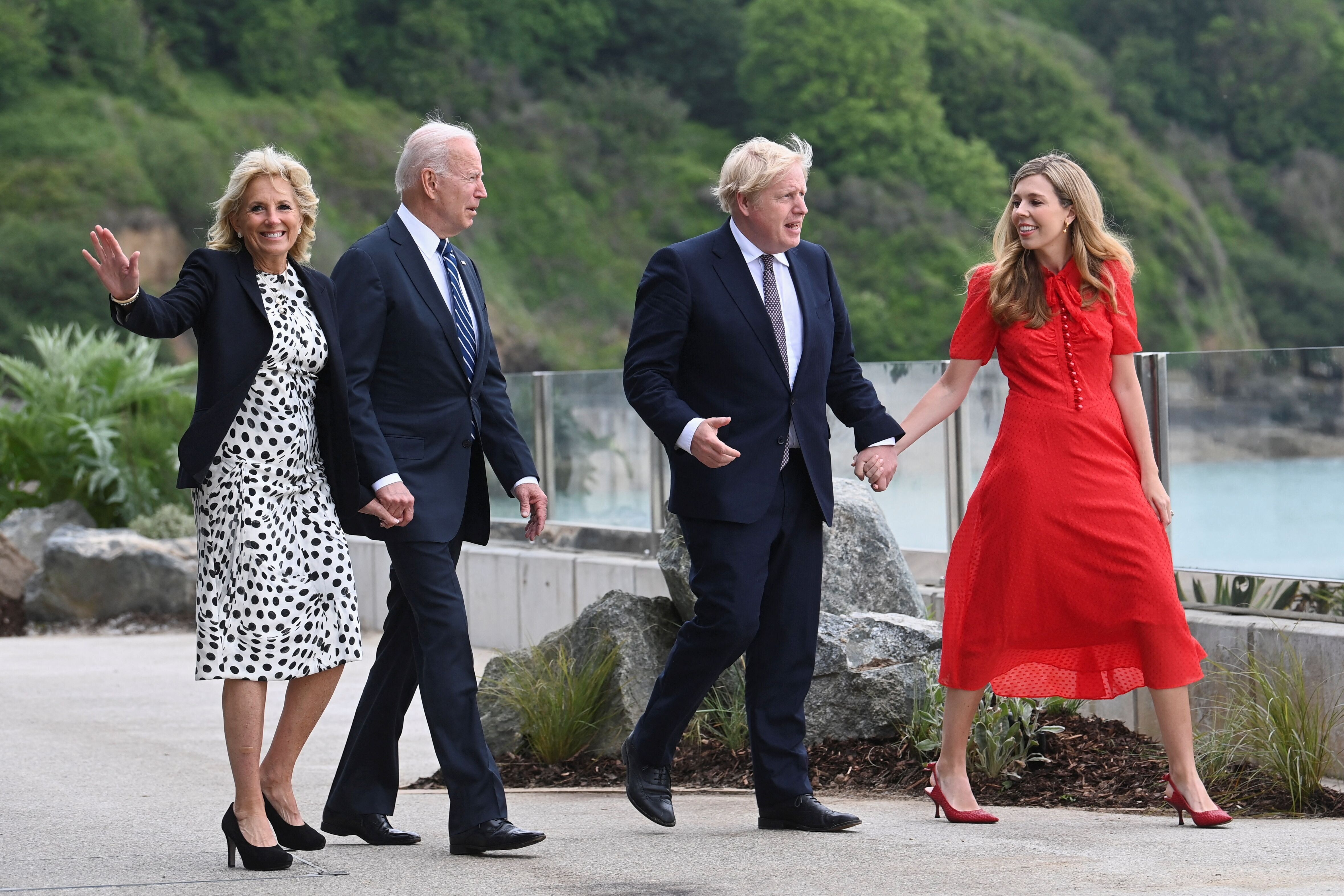
Boris Johnson and his wife Carrie Johnson  walk with US president Joe Biden and US first lady Jill Biden in Carbis Bay, Cornwall 

Imagine the nerves of hosting the first party for your group of friends after a year and a half in Covid lockdown.

Now imagine that your 12 guests are the leaders of some of the world’s richest countries and their spouses.

This is the challenge facing Boris Johnson at this weekend’s G7 summit in Cornwall.

And true to form, the prime minister has taken a massive risk by choosing to invite the likes of Joe Biden and Angela Merkel to a barbecue on the beach… in Britain.

The danger of relying on the UK’s changeable summer weather has already been highlighted after Johnson and Biden were forced to move their first ever face-to-face meeting indoors at the last minute on Thursday, as Cornish “mizzle” (mist/drizzle) shrouded the beautiful island of St Michael’s mount.

The PM will be hoping it clears in time for the Saturday night barbecue so leaders get a clear sight of the Red Arrows flypast as they dine on barbecued sirloin steaks and local lobster on the Carbis Bay sand.

And if a beach barbecue in 15C potentially cloudy weather wasn’t risky enough, leaders will be asked to stay outside after dinner to listen to sea shanty group Du Hag Owr while enjoying baked brie, hot buttered rum and toasted marshmallows around fire pits on the beach.

Despite the boho stylings sparking fresh speculation about Carrie Johnson’s influence over her husband, the PM’s official spokesperson told HuffPost UK she did not play a role in the decision to hold a beach barbecue, although she was closely involved in the partners’ programme for the weekend.

If Saturday night’s event is a risk, Johnson should have some credit in the bank from the Friday when he will host a reception with senior royals including the Queen, Prince Charles, Prince William and Kate, followed by a lavish dinner among the biomes of the Eden Project.

The menu for Friday night, cooked by Emily Scott, chef at the Watergate Bay hotel near Newquay: 

  • Starter: spiced melon, gazpacho, coconut, high note herbs.

  • Main: Turbot roasted on the bone with Cornish new potatoes and wild garlic pesto with greens from the local Padstow kitchen gardens.

  • Cornish cheese course: Gouda, Cornish yarg, helford blue.

  • Dessert: English strawberry pavlova.

  • Petit fours: clotted cream fudge, mini clotted cream ice cream cone with chocolate earl grey truffles.

The menu for Saturday night, cooked by Simon Stallard, from the Hidden Hut in Portscatho:

  • Canapes including: sparkling scallops, Curgurrell crab claws and Portscatho mackerel.

  • Main: Seared and smokey Moorland sirloin, Newlyn lobster and scorched leeks served with sides of layered Cornish potato chips, St Just purple sprouting broccoli and salt-baked beetroot.

  • Dessert: Beach Hut Sundae.

  • Afterwards the leaders will also be able to have baked brie, hot buttered rum and toasted marshmallows around fire pits on the beach.

Share Button

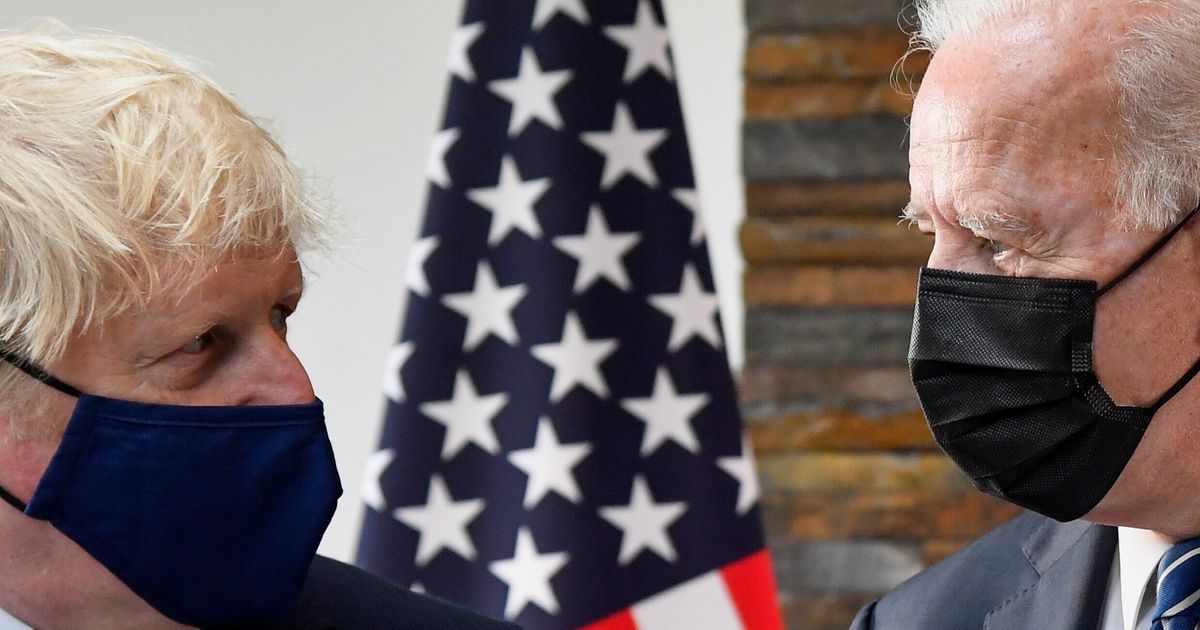
PM Downplays Brexit Tensions With ‘Breath Of Fresh Air’ Joe Biden

Boris Johnson has attempted to downplay tensions with US president Joe Biden over Brexit following the pair’s first ever face-to-face meeting as leaders.

The prime minister praised Biden as a “breath of fresh air” after the Donald Trump years and an ally who wants to work with the UK on issues from security to climate change.

Johnson meanwhile insisted that there is “absolutely common ground” as No.10 spoke of “complete harmony” between the pair on the need to protect peace in Northern Ireland amid a simmering row between the UK and EU over how post-Brexit arrangements are being implemented in the region.

Biden – who is proud of his Irish ancestry – is thought to be concerned about Johnson potentially refusing to implement parts of the Northern Ireland protocol and earlier this month ordered officials to deliver a formal diplomatic rebuke to the UK for imperilling the peace process over Brexit.

Johnson and his Brexit minister Lord Frost want the EU to be less “purist” about applying checks on goods entering Northern Ireland from Great Britain, but Brussels is threatening a trade war with the UK unless it properly implements the deal it signed up to.

The president was expected to use Thursday’s meeting to urge Johnson to “stand behind” the protocol.

But asked if Biden urged him to “crack on” and implement the deal, Johnson told reporters: “No he didn’t.

“But what I can say is that America, the United States, Washington, the UK plus the European Union, have one thing we absolutely all want to do, and that is to uphold the Belfast Good Friday Agreement and make sure we keep the balance of the peace process going.

“That’s absolutely common ground and I’m optimistic that we can do that.”

The PM added: “The talks were great, they went on for a long time, we covered a huge range of subjects and it’s wonderful to listen to the Biden administration and to Joe Biden because there’s so much that they want to do together with us, from security, Nato to climate change.

“It’s fantastic, it’s a breath of fresh air.”

WPA Pool via Getty Images

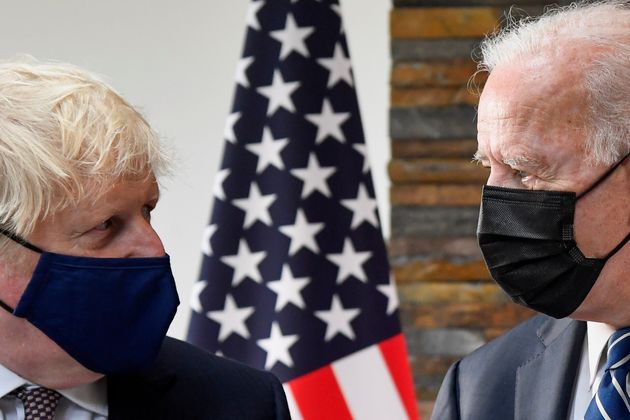
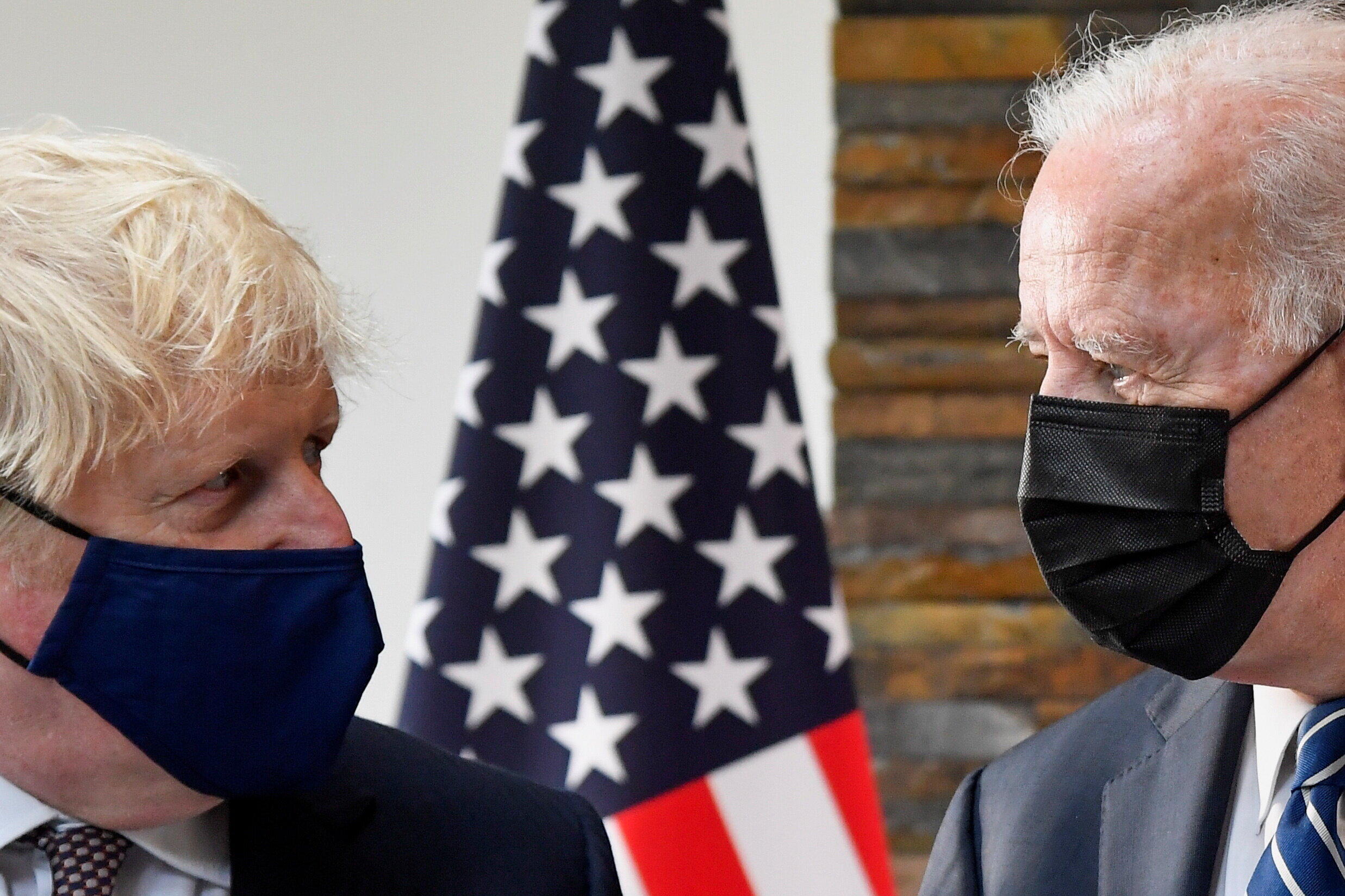
Boris Johnson speaks with US President Joe Biden at the Carbis Bay Hotel, Cornwall

It came after 80 minutes of talks between Johnson and Biden on the eve of the G7 summit in Carbis Bay, Cornwall, at which they signed a new Atlantic charter, paving the way for co-operation on challenges including climate change and security.

Also attending the meeting were UK foreign secretary Dominic Raab and US secretary of state Anthony Blinken.

Yael Lempert, America’s most senior diplomat in the UK, was also present hours after the Times revealed that she was ordered by Biden to deliver a demarche – a formal protest – in a meeting with Brexit minister Lord Frost on June 3.

In a joint statement following the meeting, Johnson and Biden reaffirmed their commitment to the Good Friday Agreement for peace in Northern Ireland. 

But Johnson had earlier tried to gloss over any tensions with Biden by suggesting the pair would not disagree on “anything”.

Ahead of the high level talks, the two leaders admired the view over Carbis Bay with their wives – Carrie Johnson and Jill Biden.

TOBY MELVILLE via Getty Images

Boris Johnson and his wife Carrie Johnson  walk with US president Joe Biden and US first lady Jill Biden in Carbis Bay, Cornwall 

As the politicians sat down to talk, Biden said: “I told the prime minister we have something in common. We both married way above our stations.”

Johnson responded: “I’m not going to dissent on that one. I’m not going to disagree with you there or indeed on anything else, I think highly likely.”

Art, clothes and a bike – leaders exchange gifts

As is customary, the leaders and their wives exchanged gifts.

Johnson gave Biden a framed photograph of a mural of Frederick Douglass, a former slave who became a leading figure in the 19th century abolitionist movement in the United States.

The image, painted by Ross Blair, is part of a mural trail around Edinburgh and the photograph was taken by Melissa Highton – a UK-US dual national.

First lady Jill Biden was given a first edition of Daphne du Maurier’s The Apple Tree. The author lived in Cornwall and drew inspiration for many of her works from the surroundings.

Meanwhile, the PM received from the Bidens a US-made bicycle and helmet, while Carrie Johnson was given a leather tote bag made by American military wives and a presidential silk scarf.

Talks between Frost and the European Commission’s Maros Sefcovic on Wednesday failed to make a breakthrough on the protocol.

The EU has threatened to launch a trade war against Britain if it fails to implement checks on goods entering Northern Ireland under the terms of the Brexit “divorce” settlement which Johnson signed.

But Frost has refused to rule out unilaterally delaying the imposition of checks on British-made sausages and other chilled meats due to come into force at the end of the month.

At a press conference in Brussels on Thursday ahead of the summit, European Commission president Ursula von der Leyen again insisted the protocol was the “only solution” to prevent a hard border between Northern Ireland and the Republic of Ireland and must be implemented in full.

In a joint statement following the meeting, Johnson and Biden reaffirmed their commitment to the Good Friday Agreement for peace in Northern Ireland. 

A Downing Street spokesperson added separately: “The prime minister and president both reaffirmed their commitment to the Belfast (Good Friday) Agreement and to protecting the gains of the peace process.

“The leaders agreed that both the EU and the UK had a responsibility to work together and to find pragmatic solutions to allow unencumbered trade between Northern Ireland, Great Britain and the Republic of Ireland.

“The prime minister outlined his ambitions to further expand opportunities for all the people in Northern Ireland and hoped that the US would continue to work with the UK to boost prosperity there.”

Share Button

Theresa May Attacks Boris Johnson’s £4bn Cut To Overseas Aid

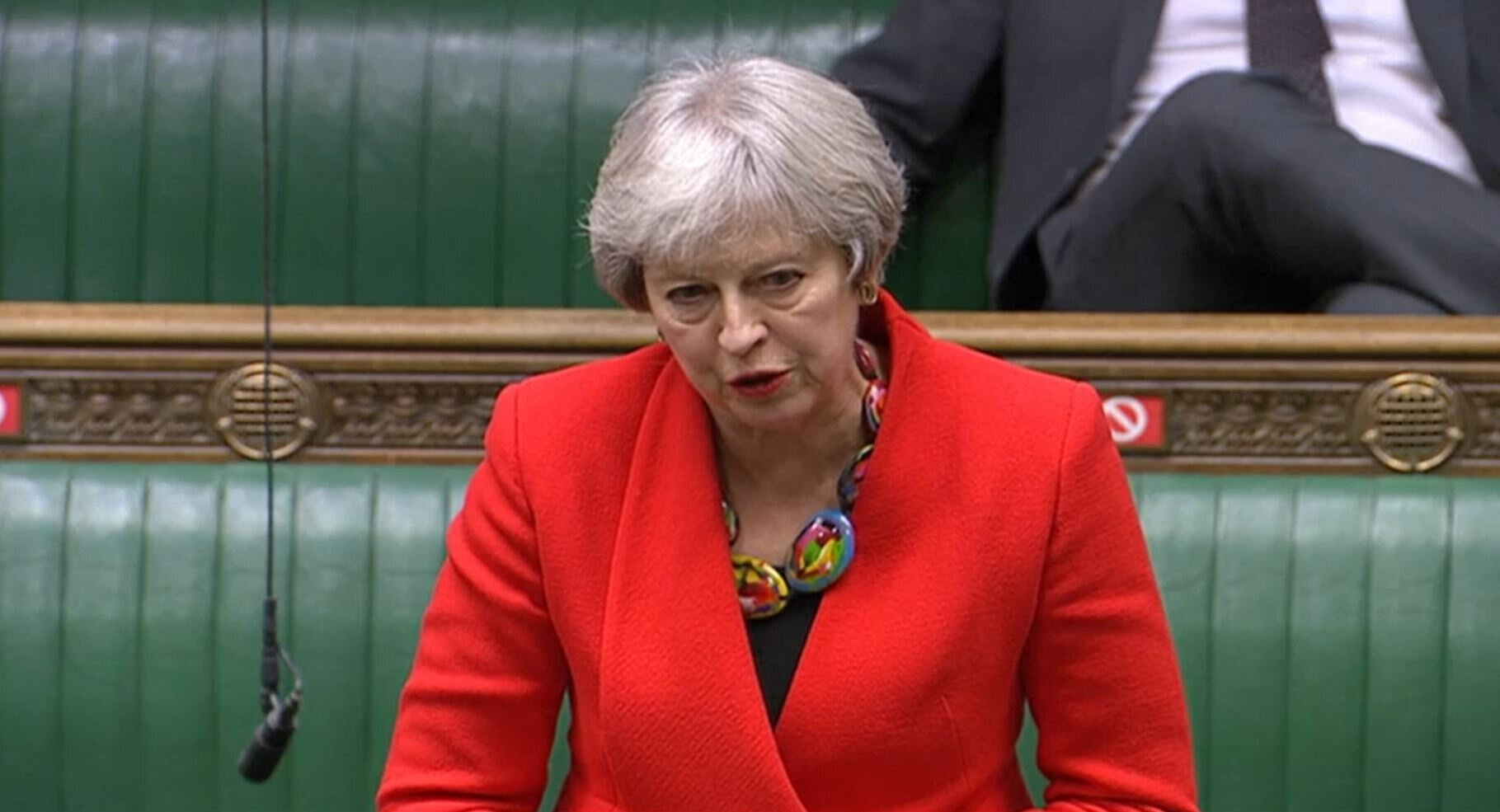
Theresa May has attacked Boris Johnson’s cut to overseas aid spending. 

The Tory former PM said the spending cut would damage the UK’s global reputation and make it more difficult to achieve a deal at the Cop26 climate summit in Glasgow this year.

Johnson is refusing to give MPs a vote on his decision to slash aid spending from the legally mandated 0.7% of national income to 0.5%, with Tory rebels believing they have a clear majority to reverse the cut.

The prime minister has also rejected pleas from Commons Speaker Lindsay Hoyle to allow MPs to vote on the decision.

In an emergency debate on Tuesday just two days before the G7 summit of world leaders, Tory rebels criticised the government over the cut and how it has handled the row.

May said the global fund to end modern slavery, an issue key to her prime ministerial legacy, was having its funding cut by 80% as a result of the government’s policy.

She also argued that slashing spending would run counter to Britain’s interests and “have a devastating impact on the poorest in the world and it will damage the UK”.

On the impact on the UK’s world standing, she said: “They (people) listen to us because of what we do, they listen to us because of how we put our values into practice.

“The damage it does to our reputation means that it will be far harder for us as a country to argue for change that we want internationally, that is across the board, including at Cop26 and also including setting out and putting into place the ambitions of the integrated review.

“I only hope that modern slavery is still there on the G7 agenda as it has been in the past.”

Former international development secretary Andrew Mitchell, who is leading the rebellion, told MPs the aid spending cut was an “unethical and unlawful betrayal”.

He said: “The way the government is behaving strikes at the heart of our parliament. 

“It is precisely because the government fears they would lose that they are not calling one (a vote). That is not democracy. 

“I want to argue to the House this afternoon that what the government is doing is unethical, possibly illegal, and certainly breaks our promise. 

“It’s not proper and it’s fundamentally un-British and we shouldn’t behave in this way.” 

Mitchell also repeated his insistence that trying to win favour in so-called “red wall” working class areas by cutting overseas aid spending was “very patronising” to those voters. 

The cut also breaks a pledge to keep the 0.7% target in the 2019 Tory general election manifesto, which helped propel Johnson to an 80-seat parliamentary majority.

“All 650 of us in this House elected at the last election promised to stand by the 0.7%,” Mitchell said.

Responding for the government, Treasury minister Steve Barclay said the cuts were needed given the huge scale of government borrowing to pay for Covid support measures such as the furlough scheme.

He questioned how the rebels proposed raising the £4.3bn required to reverse the cut.

“Leaving the next generation vulnerable to the degree of fiscal threat that would be entailed with a high debt level is not itself morally sound,” Barclay said.

“At the same time, loading ourselves with more debt now might well damage our ability to spend on aid later.”

Share Button

Boris Johnson Urged To Meet Covid Bereaved Families About Public Inquiry

Stefan Rousseau – PA Images via Getty Images

Jo Goodman, who lost her father Stuart, 72, to COVID 19 stands with other families bereaved by the virus outside Parliament. (Photo by Stefan Rousseau/PA Images via Getty Images)

Boris Johnson faces growing calls to meet the families of Covid victims before the public inquiry into how his government handled the pandemic. 

The prime minister has said an independent statutory inquiry that puts “state’s actions under the microscope” will begin in spring 2022.  

But Covid-19 Families For Justice, which represents some 4,000 grieving families, has made an urgent call for ministers to consult with them about the aims, remit and chair of the inquiry. 

The group’s key demand is the hearing allows for a rapid review phase. 

Families fear lives may be lost in future if ministers fail to address gaps in the UK’s preparedness, such as on PPE, and government does not quickly learn from disastrous mistakes on lockdowns and sending infected back people to care homes. 

However, ministers, including health secretary Matt Hancock, have refused to commit to meeting with families on the inquiry’s terms of reference. 

Jo Goodman, co-founder of the families group lost her father Stuart, 72, to the virus during the first wave. 

DANIEL LEAL-OLIVAS via Getty Images

Messages are pictured on hearts painted on the National Covid Memorial Wall, at the embankment on the south side of the River Thames in London

She told HuffPost UK Johnson delayed a meeting because families threatened legal action over the inquiry’s delay.

“We stand ready and willing to meet government ministers but they’ve yet to set a date,” she said. 

“Boris Johnson has previously promised to do so, but then went back on it because of the judicial review we had planned to seek.

“We have now dropped the judicial review, so there is no reason for the government not to meet with us. We are ready when you are prime minister.” 

MPs have also been pressuring the government,  confidence in the inquiry, which is likely to be traumatic for those hardest hit.  

Jack Dromey, MP for Birmingham Erdington and shadow Cabinet Office minister, has written to chancellor of the duchy of Lancaster, Michael Gove, after questions in the House of Commons were ignored. 

The letter, passed to HuffPost UK, underlines that “the country has experienced tragedy and human suffering on a scale not seen since the Second World War”.

Dromey stresses ministers were causing “deep hurt” to families who “simply want to know that the government is listening to them”. 

Leon Neal via Getty Images

Prime Minister, Boris Johnson and Secretary of State for Health and Social Care, Matt Hancock walk from Downing Street

The letter says that Johnson and Hancock have seven times refused to meet families and adds: “MPs across the House will have met with constituents who have suffered great loss due to coronavirus. Meetings with bereaved families and listening to their stories are some of the most difficult and emotional meetings I have been involved in since being elected a member of parliament.

“Such meetings cannot fail but to bring home the sincere desire by the bereaved families that there be a meaningful public inquiry into the government’s handling of the coronavirus pandemic with outcomes the bereaved families can trust to be fair and reasonable.” 

It adds: “That is why it is so important to the bereaved families that the government consults with them to ensure this is the case, by agreeing an appropriate chair and the right terms of reference.” 

The government has said the inquiry’s remit and chair will be chosen “in due course” and that spring 2022 was the appropriate time to begin the hearing. 

Asked about the inquiry in parliament, Gove has suggested families will have a role.

He told MPs: “A statutory inquiry is obviously the right way to ensure that all the right questions are asked and that full answers are arrived at.

“To ensure that the inquiry works, the experience, voices and views of those who have suffered so much must be a critical part in ensuring that it is set up appropriately.”

A government spokesperson, when asked if the PM would meet with the group, added: “Every death from this virus is a tragedy and our sympathies are with everyone who has lost loved ones.

“Throughout the pandemic senior ministers, including the prime minister, have met and will continue to meet with bereaved families.

“As the prime minister said, we have committed to holding a full public inquiry as soon as is reasonably possible.”

Share Button