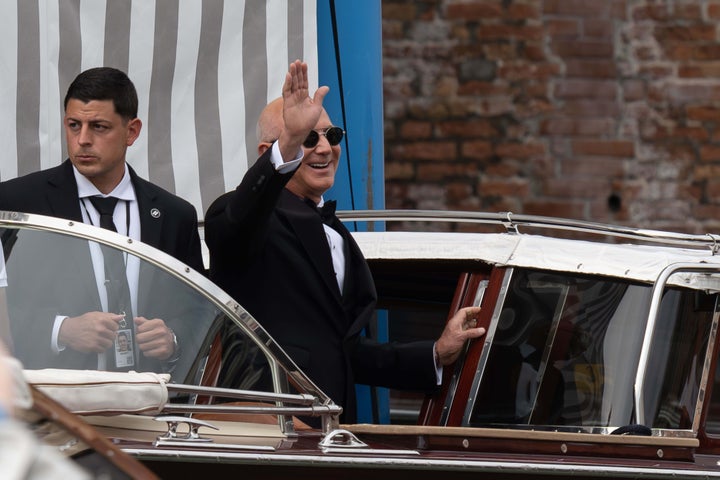
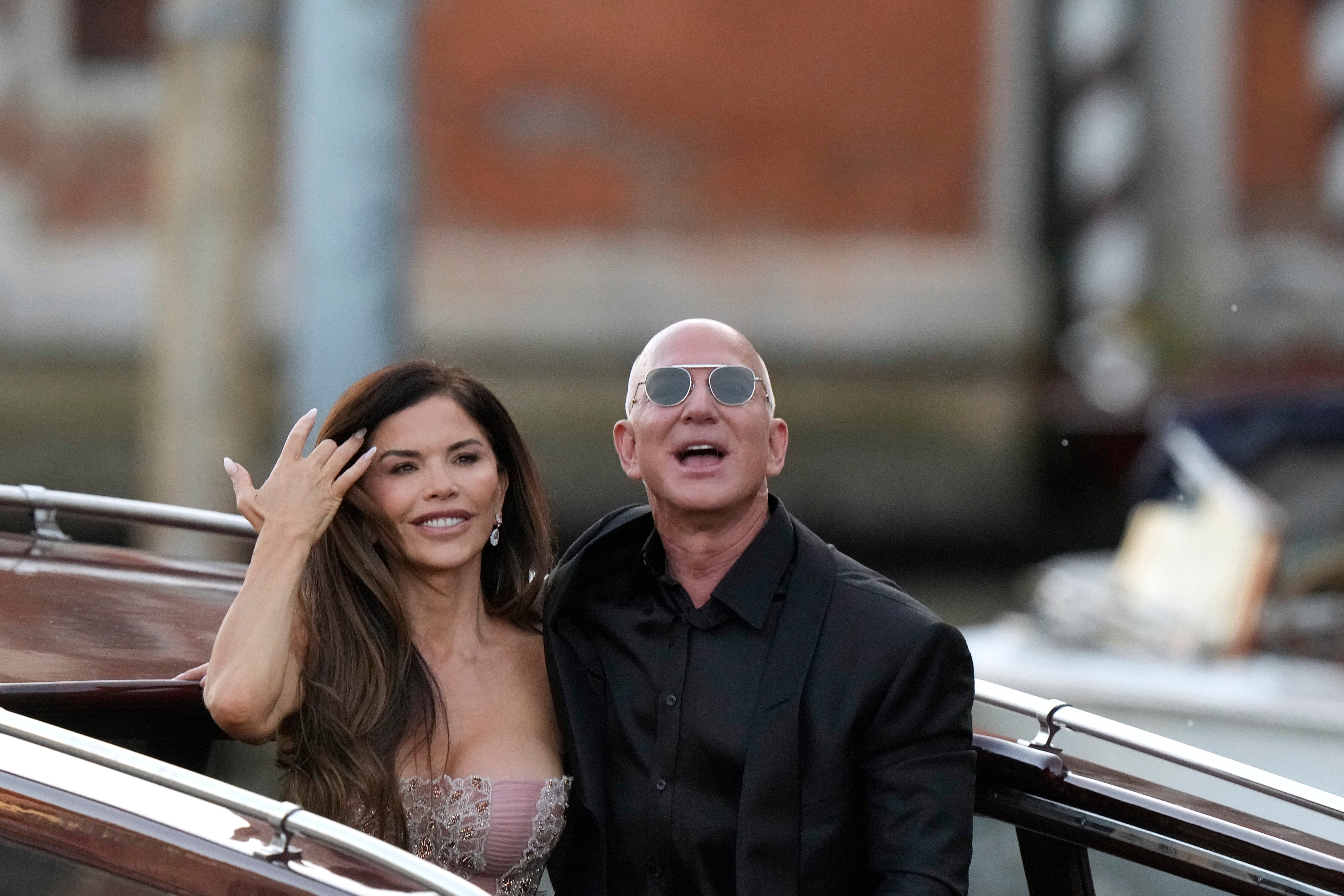
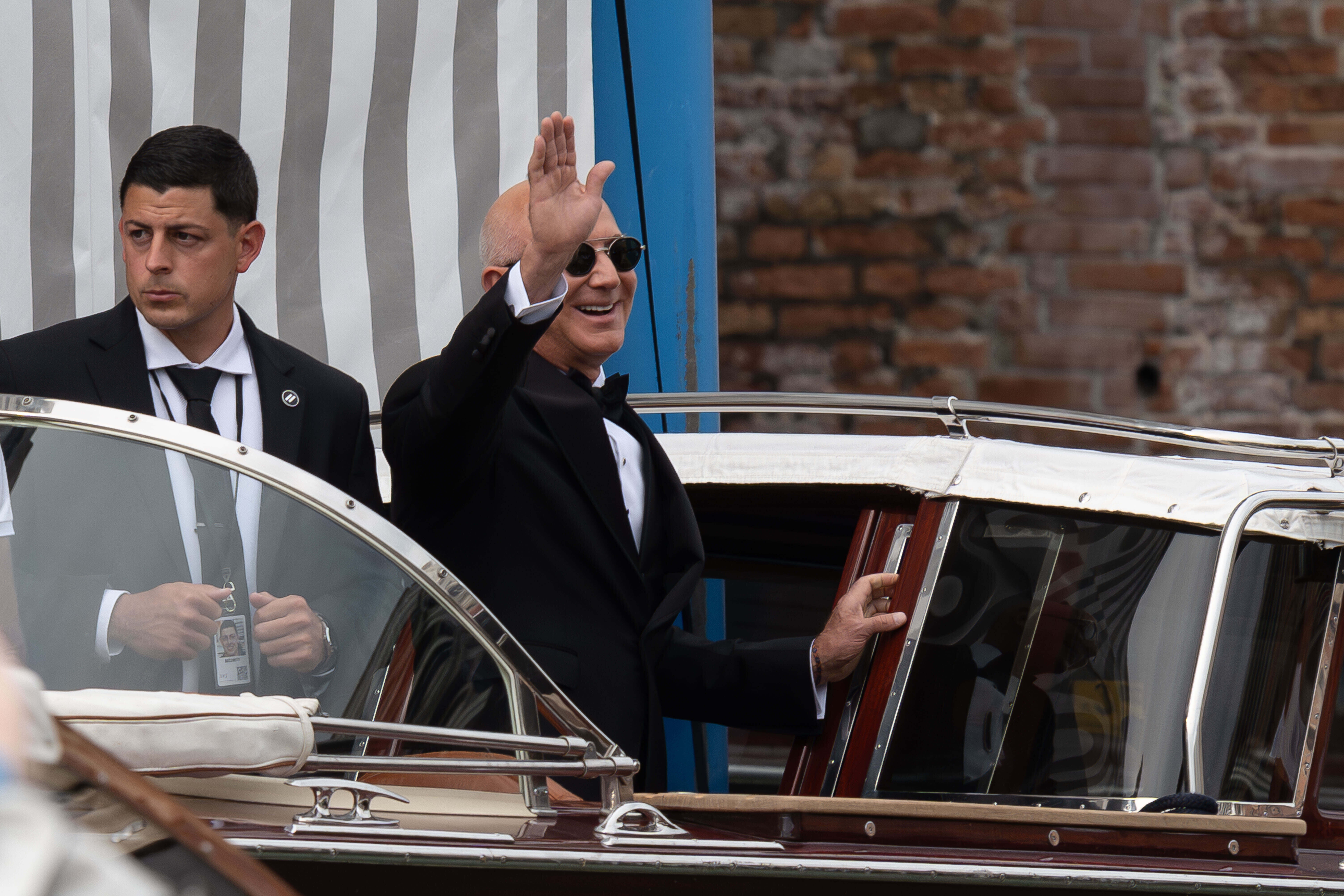
The many protestors who spoke out against Bezos’ Venice wedding took issue with the event for reasons far more significant than the couple’s taste level.
“Truly fascinating how money seems to destroy taste,” an X posted soon after ABC News shared the butterfly-adorned sheet.
Perhaps predictably, the rest of the event has received a similar response.
“Millennial grey Amazon warehouse carpet at your billionaire wedding is an insane, dead inside choice,” one X post ― which focused on the office-chic flooring choice the couple made ― reads.
“This is a dinner suit (aka tuxedo) and thus requires a formal waistcoat, which is cut lower on the body. He’s wearing a business vest, which is designed for business suits. Needs a waistcoat like the right,” the pro said.
″$50 million can’t buy class and taste: Things from the Bezos/Sanchez wedding that I have rated from 1 to 10 by how tacky/embarrassing they are,” their post title reads. To be fair, though, Forbes puts it at a still-unfathomable ”$20-plus million.”
Advertisement
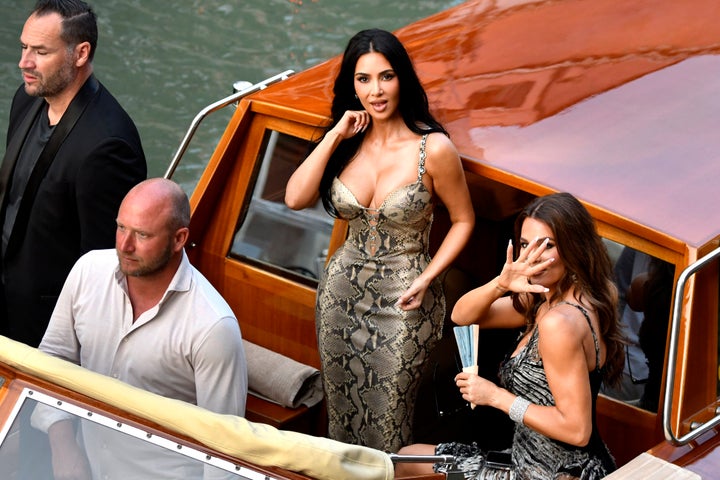
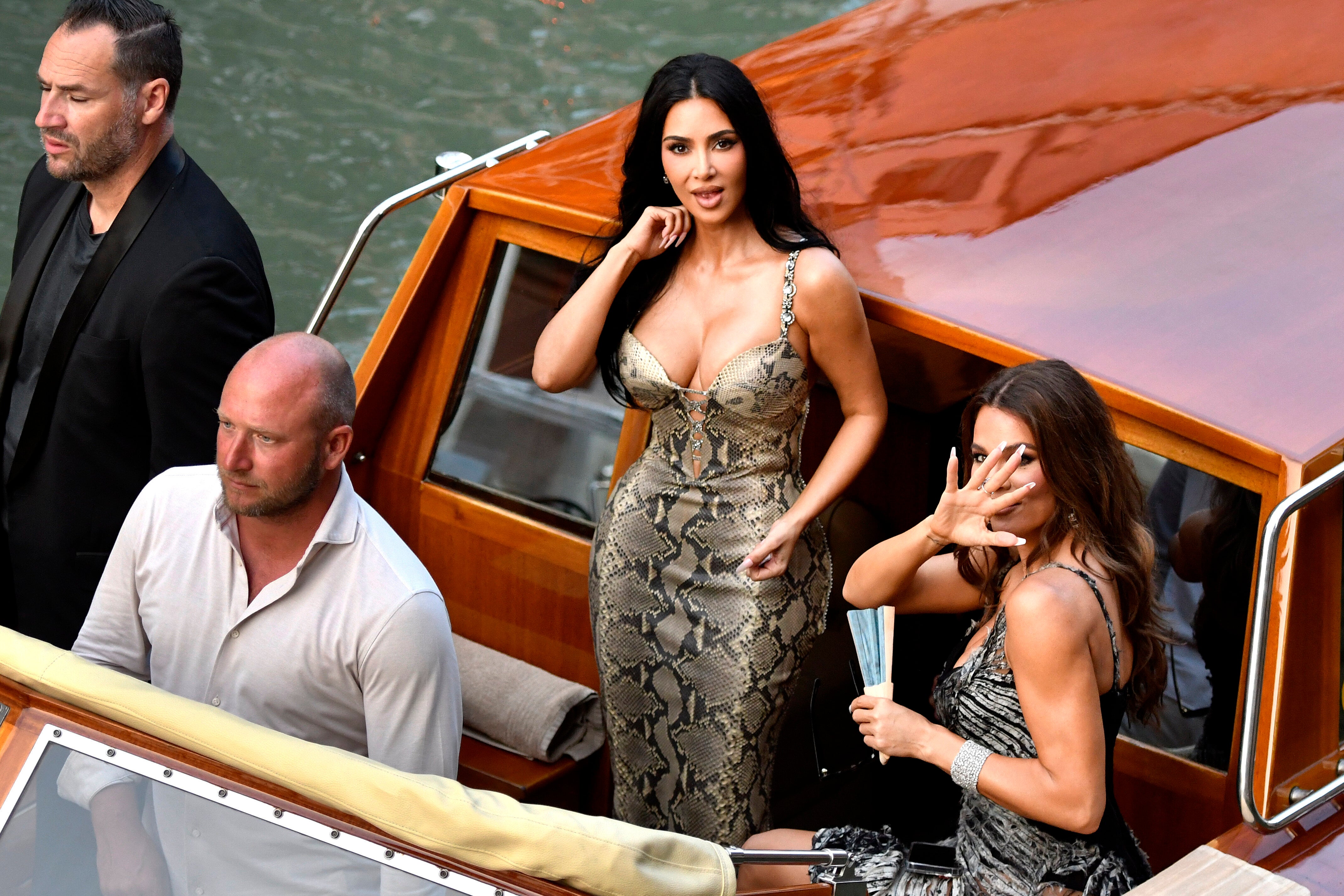
Top offenders included a “tacky” outfit donned by guest Kim Kardashian, along with the 90 private jets which appear to have arrived in Venice for the event (“Sad, unnecessary, maddening, but also embarrassing”).
via Associated Press
Kim Kardashian at the Bezos wedding
“Having a foam party on a $500 million yacht is still pretty tacky,” poster u/Potato3487 added (because yes, they really had one).
Advertisement
“I don’t think the selling point of my aisle should be ‘hides stains well’”, u/StasRutt chimed in.
In short, it seems most netizens have a uniform reaction to one of the richest men in the world’s nuptials: money, after all, can’t buy everything (including taste).
Wedding planning is incredibly stressful. There’s the expense, the (surprisingly political) guest list, the weather – to name just three stressors.
And that’s without the added complication of a difficult family dynamic.
Sometimes, as Redditor u/ThrowRAsisterswed shows, the tensions can build so high that the couple don’t even want to invite their own parents to the big day.
Advertisement
Writing to r/AITAH (Am I The Asshole Here), the site user asked: “AITAH for telling my parents they were deserve to be kicked out of my sisters wedding?”
So, we asked relationship therapist and author at Passionerad, Sofie Roos, about how to decide whether you should cut your relatives out of the celebration.
Advertisement
The bride-to-be’s brother is the “golden child”
The original poster (OP), who is the bride’s sister, says their parents have always given their son more leeway than the rest of their children.
“He has been babied to the point of uselessness by our mum and dad, and that’s made him an entitled slob,” she wrote, adding: “he could do wrong in my parents’ eyes.”
The brother has always performed “pranks” on his sister, “Kelly,” who is soon to be married. These included pulling her dress up at a family wedding.
Advertisement
As an adult, Kelly has distanced herself from her family. But at her recent engagement party, her sister said she brought the family back together again.
At this event, the brother tried to “prank” Kelly again by pouring water all over her. He was stopped by Kelly’s fiancé, who was so annoyed by the brother’s behaviour that he banned him from their wedding.
When their parents tried to justify their adult son’s actions, Kelly and her fiancé decided to ban them from the wedding, too.
Advertisement
Her sister told their parents she was right to do so, asking: “AITAH for telling my parents that they sucked a parents and deserved to be kicked out of my sisters wedding?”
Ask yourself 3 questions to see where your boundaries should lie
Roos tells us that though you might feel guilty about enforcing them, boundaries are “not a punishment towards others, but a protection for your own well-being.”
Those can sometimes include cutting your parents out of your wedding.
Still, she admits it’s a “loaded” topic, and has suggested some questions to ask yourself when considering which course of action to take.
Advertisement
Have your parents consistently ignored or diminished your boundaries, for instance?
If so, Roos says, “that’s a sign that setting a big boundary such as not inviting them to your wedding might be necessary to fully relax, be yourself and have a great time at your own wedding.”
Secondly, how do you feel when you spend time with your parents? Feeling tense or stressed about their presence is a red flag, she warns.
Lastly, “ask yourself what your wedding day would feel like without them – would it be easier to have a great day due to not needing to worry about criticism, drama, sneaky comments, or guilt?
Advertisement
If you are feeling relieved of the thought of them not coming… then that’s a strong indicator” you shouldn’t invite them, the therapist ends.
Sounds like in this case, the Redditor is in the right.
“She was engaged to a guy from a very well-off family. The wedding was in California, but they were living in Seattle. Very posh, very expensive.
“But the mother-in-law (MIL) was always horrible to her. Right at the beginning of the reception, the MIL came up and said some nasty things to her in a whisper, thinking she would just take it again.
Advertisement
“She lost it, families got involved, and she ended up on a plane back home that night. Her family had already started moving her things out of the apartment that evening.
3) “Six years ago in March, my fiancé and I decided to postpone our wedding.”
“The weekend the wedding would have been, he left me home alone to spend the weekend with his parents.
“His parents posted all over Facebook that they were celebrating him not getting married to me and were celebrating his ‘new girlfriend’, a friend of ours whom he constantly told me not to worry about.
Advertisement
“My mum screenshot all the posts, drove an hour out to where I was and said, ‘What are we going to do here?’
“I took a HOT shower and cried, then we packed all of my stuff up and left a letter to him on the dining room table with the ring.”
“It was a very small, backyard ’do. when we showed up, a relative of the groom ushered us out back and whispered that the wedding was off, but they had all this food and to help ourselves.
Advertisement
“Apparently, just that morning, the groom found out that the bride had cheated, but his family said they’d already spent all the money on the party, so they figured they’d just tell people when they arrived.
“It was one of the most awkward experiences of my life because the groom just sat dejectedly in a chair while people tried to cheer him up. We ate a little out of obligation and then got the hell out of there.”
Finally, it’s happening; the “wait until your late 20s, you’ll go to 15 weddings a year” people are being proven right.
Joy! I love love, and I consider myself privileged to be invited to anyone’s wedding (after all, they’re not cheap and are rarely easy). I adore all my friends’ partners, which is rare, and am thrilled they’re getting married.
Advertisement
Still, I keep noticing a trend, even among my most feminist, keenly socially active straight mates; the women are doing all the work, and the work never ends.
60% of respondents to a Wedshed poll said brides-to-be still do the lion’s share of the work. A site entry by Brides & Grooms Direct teaches a beleaguered fiancée “how to get a reluctant groom involved” in their big day.
A Redditor puts words to a sentiment I’ve heard too often from exasperated friends: “I’m probably lucky that he’s helping at all, but he truly thinks he’s putting in equal work by executing tasks that I assign.”
Advertisement
I knew gender roles would kick in – I just didn’t expect it to be so early
It’s no secret that self-proclaimed “liberal-minded” straight couples often fall into old-fashioned gender roles when it comes to childcare. Some of that is down to the unavoidable realities of pregnancy and birth, but a lot is thanks to chore inequality.
Though more and more of us say we think women and men should contribute equally to the household, 63% of women self-report doing most of the work at home compared to 22% of men.
I expected those bumps to show up over time. I was ready for my straight women friends to call me about unfair feeding schedules and frustrating double standards – years down the line.
Advertisement
But I’ve been shocked to see that all too often, the demands on women – all women, not just the bride – come as soon as the proposal is over.
A lot of the time, the bride-to-be kicks into event planning mode ASAP. The venue, the dress, the food, the guests, the music, the venue, the cake, the flowers, the clothes (both hers and his groomsmen’s) and the decor are too often seen as the “woman’s job”; fine if you like that, but beyond exhausting if you don’t.
Meanwhile, I have seen the girlfriends of groomsmen organise the boys’ stag planning sessions, the wives of best men flat-out write their speeches, and the mothers of family friends plan, dress, and organise their whole households’ timely arrival at the wedding.
Advertisement
I know not everyone has the same “ideal” wedding, and that some men really do go above and beyond. I’ve seen some truly delightful behaviour from my friends’ fiancés in the past.
But I’d be lying if I didn’t say I’ve been shocked by how unfair some pals, who also expected and explicitly mentioned wanting more help on the big day, have found the process.
I no longer believe in “bridezilla” tropes. I have seen too many exhausted, burnt-out friends simply snap under the sometimes huge burden of planning.
Advertisement
There are ways out
Wed Magazine writes that, “It’s fair to say that, traditionally, grooms have taken quite the back seat when it comes to wedding planning.”
One way out, they add, is for grooms to become proactively involved in the planning; “discuss what you both want from the day and how to utilise your respective strengths and weaknesses.”
The most equal wedding planning I’ve seen looked a lot like great household management; careful consideration of the tasks at hand, thorough respect for your partners’ time, and never slipping into “automatic gear” when it comes to assuming what your partner “should” want to do.
Advertisement
That can look different to everyone, and some of my friends genuinely prefer to take the helm – who am I to judge that?
But just as emotional and cognitive labour and housework still largely fall to women in straight couples, I have to admit, I’ve become pretty angry after realising how much it can affect their weddings too.
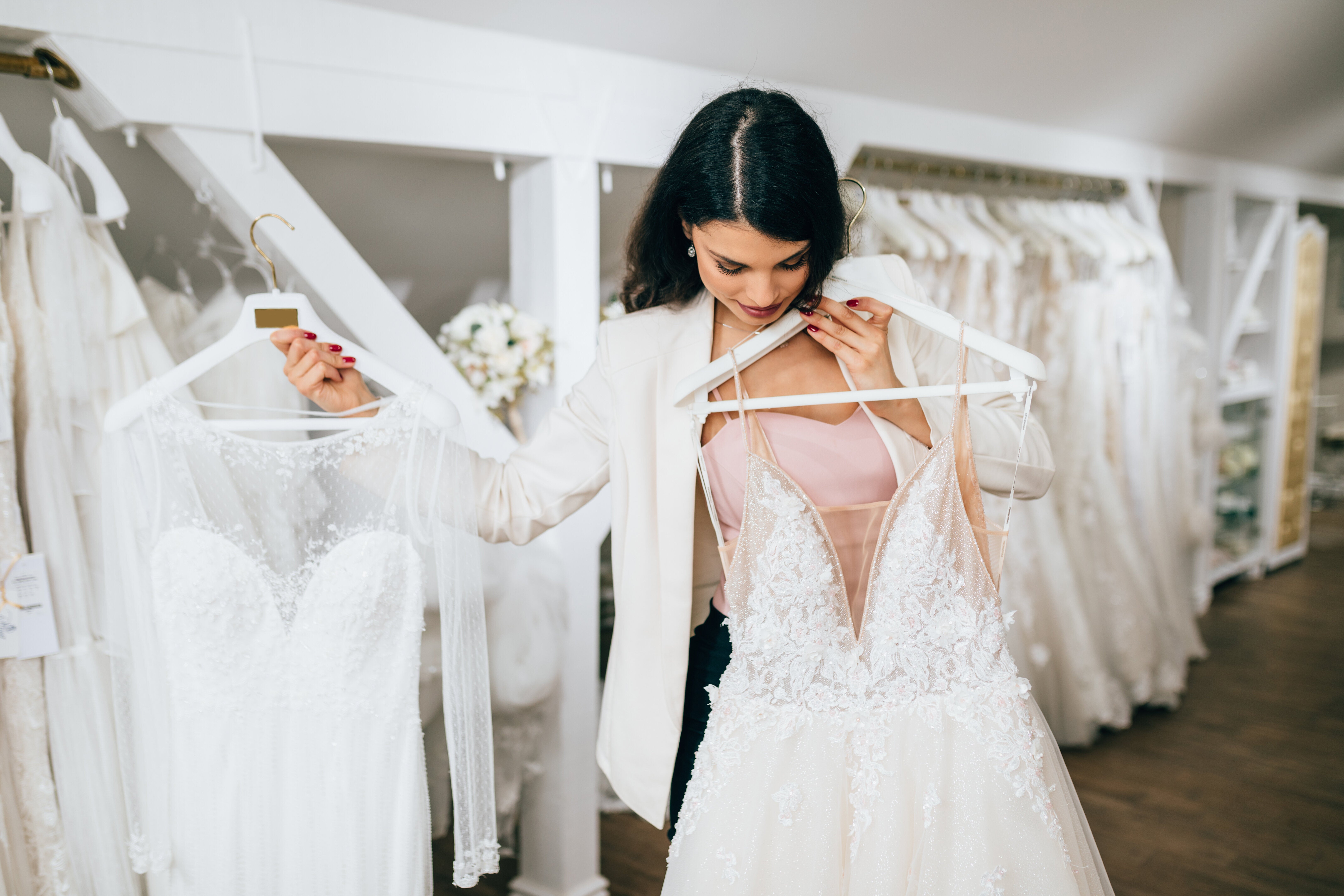

Shopping for that special dress is one of the most memorable experiences in the wedding planning process. It can also be incredibly overwhelming as you wade through endless styles, fabrics and opinions.
“Wedding dress shopping entails a deeply emotional journey, especially for those experiencing it for the first time,” Anna Ramirez, head of design at Pronovias, told HuffPost. “The process serves as a learning curve for many brides, as initial perceptions of gown styles often evolve during fittings, revealing what truly complements their body and boosts their confidence. It is common for brides to discover a style they hadn’t anticipated as their own.”
Advertisement
As the popularity of shows like “Say Yes to the Dress” have shown, there’s no shortage of opportunities for fun and drama in the world of bridal gowns.
To help keep any stress at bay, we asked wedding dress experts to share some common mistakes they see people making as they shop for their special day. Read on for the biggest missteps to avoid and some advice for making the wedding dress shopping process as enjoyable as possible:
Bringing Too Many People
“When you bring all of your friends and family to your appointment, you run the risk of being overwhelmed by too many opinions — even the well-intentioned ones,” said Nikki Deeds, global brand director at Allure Bridals. “Your mother-in-law may only like ballgowns, while your sister loves a vintage silhouette, and your mom insists on a traditional long sleeved lace gown like the one she wore in 1985. It’s hard enough to find the perfect dress, so why overcomplicate things with too many voices?”
She recommended bringing only a couple of people who make you feel your most relaxed and beautiful on the main shopping journey and then inviting the larger group to a final fitting or other appointment after you’ve said “yes” to your dream dress.
Advertisement
“Filter down your guest count to two people who are very close to you, that you have a very comfortable, loving relationship with,” echoed bridal designer Katherine Tash. “You need people cheering you on and wanting what’s best for you, not criticising or bringing down the energy.”
Wearing The Wrong Undergarments
“Don’t wear bright coloured underwear,” Tash advised. “It seems like it would be common sense to wear skin tone, but I consistently see brides forget and then become distracted by the colour showing through and asking if the gown is see-through.”
Wear a thong or seamless panty that blends in with your skin tone. Many brides opt for a well-fitting nude strapless bra or pasties, and some shop in shapewear as well.
“The right undergarments can significantly impact how a dress looks and feels,” said designer and Studio Levana founder Evgenia Shimanov. “Consider these elements when trying on dresses to get a complete picture. Nowadays, there are plenty of options for bras, spanks and other supportive undergarments.”
Shopping Without An Open Mind
“You may think you know exactly what you want in a wedding look, but I can’t tell you how many people change their mind after they try on ‘the one,’” Deeds said. “I’ve seen many a chic minimalist melt at the sight of themselves in a lacy ballgown, so never say never! Try on a bit of everything and see how you feel before narrowing your search on to one particular aesthetic.”
Advertisement
Look at your first appointment as an opportunity to experiment with different silhouettes, necklines, fabrics, embellishments, etc. Remember that clothes look very different on a hanger or even a mannequin than they do on your body.
“Keep an open mind to unexpected choices that may surprise you,” Shimanov said. “Try on a variety of styles, including those you may not have initially considered.”
Trying On Dresses Outside Your Budget
“My number one tip is simple: Start with the budget,” Deeds said. “Don’t fall prey to trying on the gorgeous but expensive gown featured in the shop window. There is absolutely always going to be something you’ll love in your price range, but if you fall head over heels for an out of budget gown from the start, it’s really hard to come back from that.”
Before you start putting on dresses, get real about your budget, taking into account the cost of accessories like the veil as well.
“I know learning something is out of budget can be annoying and sometimes triggering, but it’s best to do some research and learn what designers or bridal salons are in budget and which ones aren’t before your appointment,” said Leah Langley-McClean, founder and CEO of elleNelle Bridal. “This can help save time for all parties involved and eliminate some disappointment. Most stores and designers will publish a price range of their dresses or the typical spend of their clients, and a safe strategy is to shop where you fall in the middle of that range.”
Advertisement
Anchiy via Getty Images
It’s important to establish a budget before trying on dresses.
Waiting Too Long To Start
“With the popularity of fast fashion, some brides make the mistake of shopping too close to their wedding date which limits the selection of designer dresses they can purchase and have altered before the wedding,” said Marissa Rubinetti, executive vice president and chief operating officer at Kleinfeld Bridal. “Brides should shop for their wedding dress nine to 12 months prior.”
Shopping for a wedding dress too late in the process means limiting your options and also potentially having to pay big rush fees.
“Keep in mind that veils and accessories also require time, especially if you’re considering customisation options,” Shimanov said.
Forgetting About Alterations
Another reason it’s important to get an early start is to give yourself enough time for alterations. It usually takes a few fittings to ensure the dress fits perfectly to your body, and looks and feels the way you want.
Advertisement
“Allow eight to 10 weeks before the wedding for the first alteration appointment,” Rubinetti said.
Don’t forget about those all-important alterations as you calculate the timing and costs involved in your wedding dress shopping.
“Always account for the cost of alterations when determining your wedding dress budget,” Langley-McClean said. “It’s rare that your dress will fit perfectly, even with a made-to-measure dress. Our bodies are all different and alterations allow you to perfectly contour the dress to the unique shape of your body,” pointing out that alterations can add $300 to $1,000 to the cost of the dress.
She also advised getting in touch with an alterations specialist before shopping if you’re on a tight deadline and buying off the rack.
“They may even be able to jump on the phone with you during your appointment,” Langley-McClean added. “You want something that can be easily altered. The last thing you want to do is find yourself buying a dress 10 sizes too big and thinking the alterations process will be simple. I’m here to tell you, it won’t be.”
Not Doing Your Research
“I always think it helps to be prepared for any situation you’re entering into that can feel high pressure,” Tash said. “So do a little research on what your true style is, and research a store’s stock beforehand to understand which pieces from a designer the store carries.”
Advertisement
Before going to shops, you can gather style inspiration and get a preliminary sense of your vision from Pinterest, bridal blogs, influencers and more.
“Explore local flagship stores of preferred brands or nearby retailers listed on the brand’s website to try on specific gowns of interest,” Ramirez said. “Compile a list of preferred styles and brand names before your appointment. Sharing this information with the store in advance can help them better understand your preferences.”
Overshopping
“Do not overshop!” Rubinetti said. “Trying on wedding dresses can be exhausting. You should not plan more than two appointments in one day.”
She recommended shopping at a bridal salon with a range of styles you love to allow for some variety, at least at the beginning. Going from store to store and trying on gown after gown can get overwhelming and turn what should be a fun experience into a chore.
“Furthermore, it’s advisable to refrain from exploring other gown options after making a purchase,” Ramirez said. “Continuously browsing can sow doubt and undermine the confidence in your chosen gown. Once you have found the dress that resonates with you, trust that decision and avoid second-guessing. Fashion trends may evolve, but the key is to remember the joy and certainty you felt when you said ‘yes’ to your dress.”
Advertisement
Ultimately, you want to strike a balance and follow the process that feels right for you.
Julie Sabatino, a wedding stylist and author of “Dressed, Styled, and Down the Aisle: Becoming a Stylish Bride,” recommended figuring out what type of decision-maker you are. Do you need to feel as though you’ve explored every option before deciding, or do you only need to see a sample to make a decision and feel good about it?
“I’ve spoken with SO many brides that tell me they were pressured into purchasing a dress that they weren’t sure about and didn’t feel comfortable in on their wedding day, or worse, they bought another one right before the wedding,” Sabatino said.
Deferring Too Much To Others
“Prioritise your opinion when making decisions about your gown,” Ramirez said. “While input from your entourage can be valuable, remember that this day is about your preferences and feeling your best in your chosen dress.”
Listen to your gut when assessing whether or not you like a particular gown, not what other people say or what’s trendy at the moment.
“I always tell my brides to follow their instincts and follow their own vision and not someone else’s,” said fashion designer and creative director Monique Lhuillier. “A bride that stays true to her personal style and feels happy and confident on her special day will glow from within!”
Advertisement
Engaging In Negative Self-Talk
“Brides come to appointments and sometimes they are their own worst critic ― focusing on all their flaws and being hyper-critical of their body,” Langley-McClean said. “When those not-so-nice intrusive thoughts creep in and you’re about to go on a self-deprecating bender, I want to encourage brides to immediately stop and think about what it is that you do like about yourself, and say that instead. Yes, we all have our insecurities, but we don’t need to be mean to ourselves about it.”
The wedding dress experience understandably brings a lot of things people are self-conscious about to light, especially when it comes to the shape and size of their bodies. Ramirez emphasised keeping sizes and other numbers out of your mind as the consultant takes your measurements and places your order, especially because these gowns tend to run smaller than standard street size clothing.
“Size is merely a number, and the aim is to procure a gown that fits the bride at her largest measurement, with subsequent alterations tailoring the gown to her specific body shape,” she explained.
And don’t hesitate to talk to the consultant about any areas of sensitivity, whether it’s about physical insecurities or another issue that will affect the shopping experience.
“Be honest with your sales associate and let them know if you have any concerns that they should know about,” advised bridal stylist Jackie Avrumson.
Advertisement
Having Unrealistic Or Unclear Expectations
“While this is your time to live out your bridal fantasy, some real world considerations will help you pick the best dress for your wedding,” said Daniel Sanchez, creative director at Azazie.
He emphasised the importance of considering budget and season. These elements will also help you develop a clear wedding day vision.
“A lot of details will impact your wedding dress decision ― location, venue terrain, time of day and overall theme,” Sanchez explained. “Shop once you have selected your venue and theme. While shopping on the fly seems fun, many brides later find themselves last minute shopping for another option more in line with their wedding planning.”
The weather is particularly crucial, as choosing a dress without taking that into consideration can lead to physical discomfort.
“A heavy, ornate gown might not suit a beach wedding, and a lightweight dress might be inappropriate for a winter ceremony,” Shimanov said. “Select a dress that not only looks stunning but also feels comfortable to wear throughout your wedding day. Comfort is essential for enjoying every moment without distraction. Ensure the dress allows you to move freely and makes you feel completely at ease.”
Advertisement
Forgetting To Enjoy It
“So many brides feel disappointed if they don’t find THE dress at the first visit,” Deeds said. “Try to prioritise the journey, not the destination — enjoy the champagne, and time with family and friends, even if it takes two or three trips to your local bridal shops.”
Try to cherish the exciting moments throughout your wedding planning process. It’s meant to be happy, not stressful, so maintain some perspective.
“Remember that dress shopping is such a fun part of getting married,” Tash said. “And the best is yet to come after you walk down the aisle.”
Olivia Wilde has never been one to adhere to conventional fashion, and that includes her style choices for weddings.
The Booksmart and Don’t Worry Darling director was among the 200 guests who attended Colton Underwood and Jordan C. Brown’s nuptials in Napa Valley, California, over the weekend. True to form, she went against the grain, opting to wear what she described as a “wedding dress” for the occasion.
Advertisement
The dress in question was an ivory gown by designer Nili Lotan. While revealing her unconventional look on social media, Wilde made it clear that she was aware she was breaking a well-established wedding etiquette taboo ― but said she had a reason for doing so.
“Wore a wedding dress to a wedding so I could make a joke about it in my toast,” she quipped on her Instagram Story.
As many wedding experts will attest, it’s generally considered a major faux pas for a wedding guest to wear white, specifically as it can upstage the newlyweds. This rule is also assumed to include outfits in blush, cream and champagne fabrics, as these shades may appear white in photographs.
Advertisement
But Wilde said that neither Brown nor Underwood had an issue with her ensemble. “The grooms approved,” she wrote on Instagram.
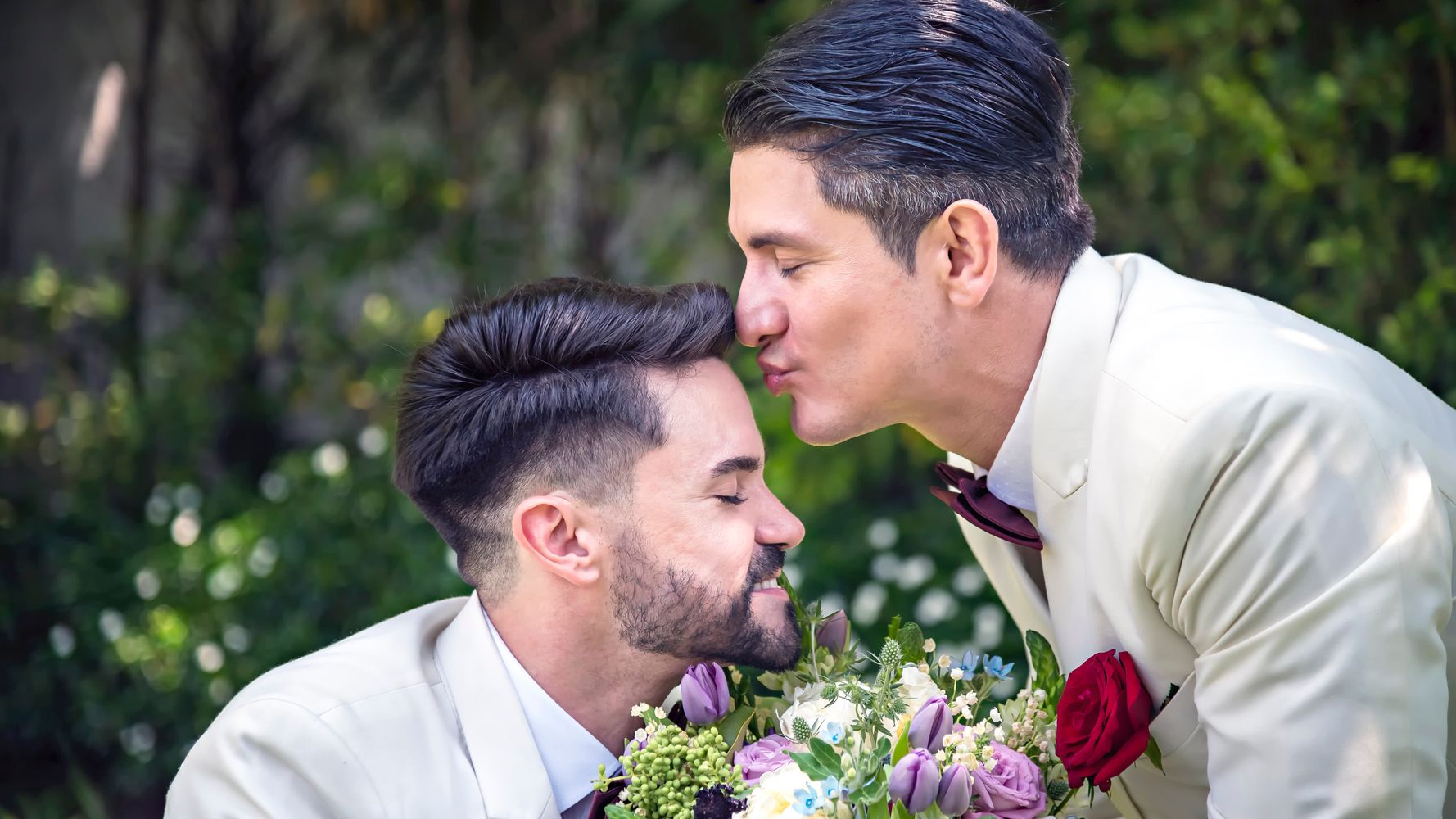
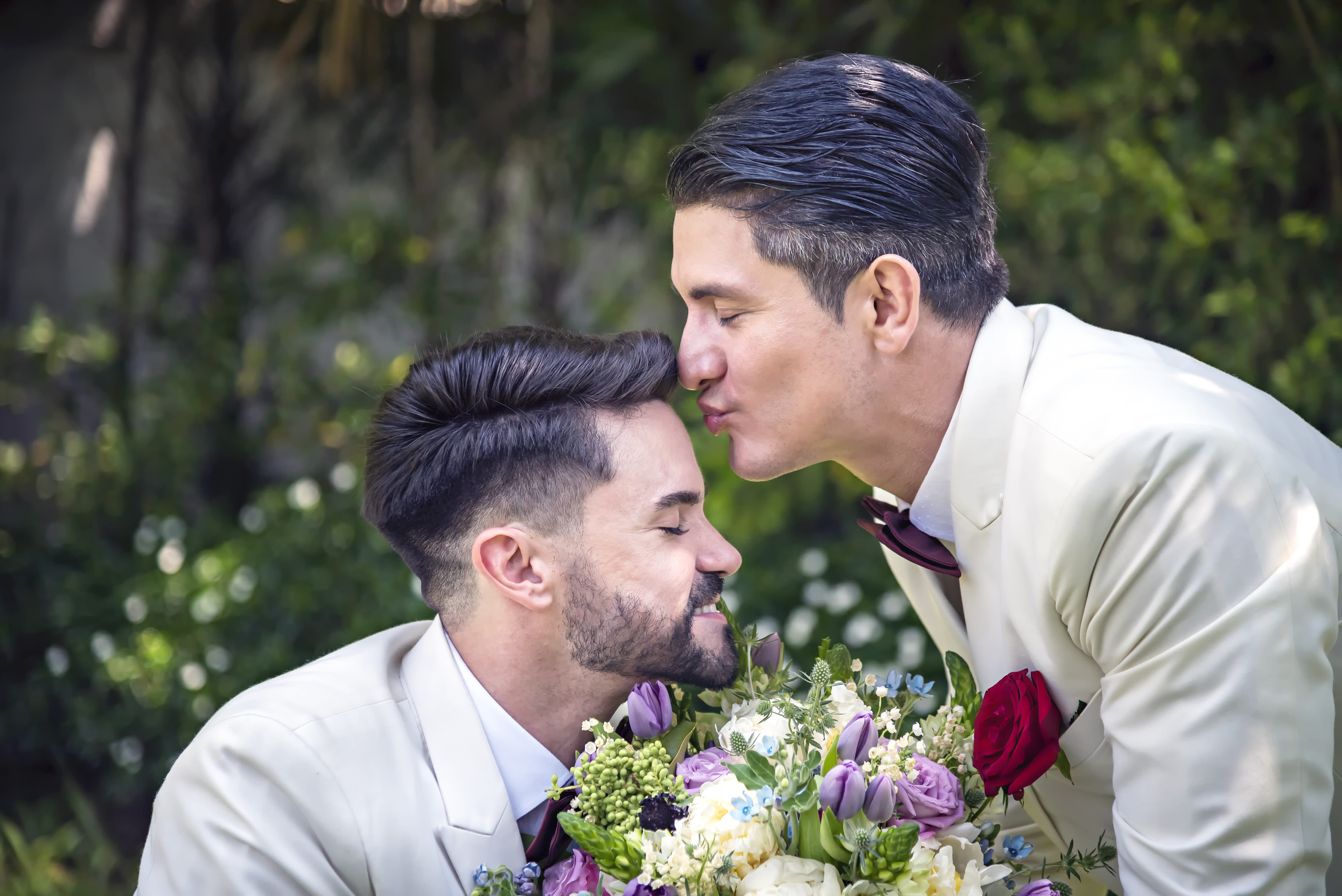
In an interview with People published on Sunday, Underwood said he and Brown aimed “to break some of the traditional norms of what a ceremony and a wedding look like,” especially since it would be the first same-sex union for many of their guests.
The former Bachelor began dating Brown, a Los Angeles-based political strategist, shortly after he came out publicly as gay in April 2021.
The two men got engaged sometime around Underwood’s 30th birthday on January 26, 2022.
“2021 was the most transformative year of my life,” Underwood told People in February of that year. “Starting 2022 off with my best friend, teammate and now fiancé is something I never thought was going to be possible.”
The 30-guest limit at weddings in England has been lifted, despite a four-week delay to the ending of lockdown.
From June 21, people can have more than 30 guests at a wedding, “provided social distancing remains in place”, Boris Johnson announced at a Downing Street press conference on Monday – welcome news to the many couples who have postponed their celebrations time and time again.
He told the Downing Street press conference that the spread of the Delta variant meant the government and public “faced a very difficult choice” between continuing with Step 4 of the roadmap on June 21 or giving the NHS “a few more crucial weeks” to get all remaining vaccinations administered.
“And since today I cannot say that that we have met all our four tests for proceeding with Step 4 on June 21, I think it is sensible to wait just a little longer,” he said.
It is not yet confirmed if there will be an upper limit on guest numbers, but the Mirror has reported that capacity limits may be the highest number of people wedding venues can accommodate while still being Covid-secure.
“I am sorry for all the disappointment that’s going to be caused by going a bit slower as we are today,” the prime minster told a journalist and bride-to-be who said she had already twice postponed her wedding.
The reporter had questioned why testing and vaccination status could not be used to open up weddings in the same way as football matches, and said weddings felt “bottom of the priority list despite being significant life events without which some people cannot progress with their lives.”
Boris Johnson, who married his wife Carrie in a secret ceremony in Westminster Cathedral on May 29 attended by 30 people, said he was sorry for the “many, many businesses” affected by delays – adding “it’s a few weeks that I think is worth it to get those jabs in”.
HuffPost is part of Verizon Media. We and our partners will store and/or access information on your device through the use of cookies and similar technologies, to display personalised ads and content, for ad and content measurement, audience insights and product development.
Your personal data that may be used
Information about your device and internet connection, including your IP address
Browsing and search activity while using Verizon Media websites and apps
To enable Verizon Media and our partners to process your personal data select ‘I agree‘, or select ‘Manage settings‘ for more information and to manage your choices. You can change your choices at any time by visiting Your Privacy Controls.