Pause in recent coral recovery on much of Great Barrier Reef

In-water monitoring by the Australian Institute of Marine Science (AIMS) shows hard coral cover across the Great Barrier Reef remains at similar levels to that recorded in 2022, with small decreases in the Northern, Central and Southern regions.

Published today (Wednesday 9 August), AIMS’ Annual Summary Report on Coral Reef Condition for 2022/23 found that while some reefs continued to recover, their increased hard coral cover was offset by coral loss on other reefs. Most reefs underwent little change in coral cover.

This follows last year’s report, which saw the Northern and Central regions recording their highest amount of coral cover since AIMS began monitoring 37 years ago.

The pauses in recovery in the Northern and Central regions were due in part to the 2022 mass coral bleaching event. Low numbers of coral-eating crown-of-thorns starfish and a cyclone in January 2022 also contributed to coral loss in the Northern region. Continued crown-of-thorns starfish outbreaks and coral disease kept coral cover similar to last year’s levels in the Southern region, with bleaching playing less of a role.

AIMS Research Program Director Dr David Wachenfeld said that while continued recovery on some reefs was good news, the pause in recovery showed that even relatively milder mass bleaching events had consequences for the Reef.

“The 2022 coral bleaching event was not as severe as the 2016 or 2017 events but caused enough mortality to pause recent regional gains in hard coral cover. The heat stress during the bleaching event also likely had sub-lethal effects, including reductions in coral growth and reproduction,” Dr Wachenfeld said.

“Conditions were relatively mild over the 2023 summer with low levels of coral bleaching and no cyclones crossing the Reef. However, we are only one large scale disturbance away from a rapid reversal of recent recovery.

advertisement


“The Reef remains a wonderful, complex and beautiful system, but it is at increased risk with climate change driving more frequent and severe bleaching events, putting increasing pressure on the ecosystem’s resilience.”

The Report found the following in average hard coral coverage for 2022/23:

  • Northern region (north of Cooktown) — 35.7%, down from 36.5% last year;
  • Central region (Cooktown to Proserpine) — 30.8%, down from 32.6%;
  • Southern region (south of Proserpine) — 33.8%, down from 33.9%.

Reef slopes on the perimeters of 111 reefs were surveyed between August 2022 and May 2023 for the report under the AIMS Long Term Monitoring Program (LTMP) — a 37-year-long dataset which is the largest, longest and most comprehensive information source on the status of the Great Barrier Reef.

AIMS Long-Term Monitoring Program leader Dr Mike Emslie said recovery over the last few years has been driven primarily, but not exclusively, by fast-growing branching and plate corals, or Acropora. These important habitat builders are also vulnerable to disturbances such as cyclones, crown-of-thorns starfish and coral bleaching.

“Acropora are highly abundant, responsible for most of the ups and downs in hard coral cover, and have been going through a rapid growth phase in recent years. But other corals on the Reef have also contributed to this recovery,” he said.

Dr Emslie noted the increased frequency of mass coral bleaching events on the Great Barrier Reef with four occurring since 2016.

advertisement


“The 2022 bleaching event was the first ever recorded during a La Niña year, which are usually characterised by cooler temperatures,” he said.

“If there were no disturbances, we would expect the recent increases in coral cover to continue this year. However, this pause indicates that a mass bleaching event, even if less severe, with low mortality, is still enough to put the brakes on this coral recovery.

“This means the Reef is still at risk of decline from more frequent disturbances. AIMS is working to understand the effect of this climatic instability through monitoring and research.”

Dr Wachenfeld added: “The best hope for the future of the Great Barrier Reef and all coral reefs globally requires reduction in greenhouse gas emissions to stabilise temperatures, best practice management of local pressures, and the development of interventions to help boost climate tolerance and resilience for coral reefs.”

BACKGROUND

The LTMP quantifies long term trends in the status of coral communities across the Great Barrier Reef.

Researchers use hard coral cover as one indicator of the condition of each reef, although there are many others. Percentage hard coral cover is estimated by trained scientists during manta tow surveys and is a metric which allows AIMS scientists to provide an overview of the Great Barrier Reef’s status and keep policy makers, managers and other scientists informed in a timely manner.

Manta tow surveys are an efficient way to survey large areas of reef. It is a standard method to assess percent hard coral cover, estimates of crown-of-thorns starfish, levels of coral bleaching, and fish and shark populations.

The LTMP also does detailed surveys on fixed sites on 73 reefs across the Great Barrier Reef. These data provide deeper insights into the corals, fishes and crown of thorns starfish at these sites, their abundance, their age and more detailed information about coral disease and bleaching. 3D images are taken of these reefs to assess reef complexity and their changing structures.

The AIMS monitoring team spent 120 days at sea during this survey period. They travelled 1016km around the perimeter of the 111 reefs they surveyed.

The AIMS LTMP team begin their new survey season in late August. Surveys will continue through the summer and conclude around May 2024.

The LTMP contributes to the Reef 2050 Integrated Monitoring and Reporting Program.

Share Button

People’s everyday pleasures may improve cognitive arousal and performance

Listening to music and drinking coffee are the sorts of everyday pleasures that can impact a person’s brain activity in ways that improve cognitive performance, including in tasks requiring concentration and memory.

That’s a finding of a new NYU Tandon School of Engineering study involving MINDWATCH, a groundbreaking brain-monitoring technology.

Developed over the past six years by NYU Tandon’s Biomedical Engineering Associate Professor Rose Faghih, MINDWATCH is an algorithm that analyzes a person’s brain activity from data collected via any wearable device that can monitor electrodermal activity (EDA). This activity reflects changes in electrical conductance triggered by emotional stress, linked to sweat responses.

In this recent MINDWATCH study, published in Nature Scientific Reports, subjects wearing skin-monitoring wristbands and brain monitoring headbands completed cognitive tests while listening to music, drinking coffee and sniffing perfumes reflecting their individual preferences. They also completed those tests without any of those stimulants.

The MINDWATCH algorithm revealed that music and coffee measurably altered subjects’ brain arousal, essentially putting them in a physiological “state of mind” that could modulate their performance in the working memory tasks they were performing.

Specifically, MINDWATCH determined the stimulants triggered increased “beta band” brain wave activity, a state associated with peak cognitive performance. Perfume had a modest positive effect as well, suggesting the need for further study.

“The pandemic has impacted the mental well-being of many people across the globe and now more than ever, there is a need to seamlessly monitor the negative impact of everyday stressors on one’s cognitive function,” said Faghih. “Right now MINDWATCH is still under development, but our eventual goal is that it will contribute to technology that could allow any person to monitor his or her own brain cognitive arousal in real time, detecting moments of acute stress or cognitive disengagement, for example. At those times, MINDWATCH could ‘nudge’ a person towards simple and safe interventions — perhaps listening to music — so they could get themselves into a brain state in which they feel better and perform job or school tasks more successfully.”

The specific cognitive test used in this study — a working memory task, called the n-back test — involves presenting a sequence of stimuli (in this case, images or sounds) one by one and asking the subject to indicate whether the current stimulus matches the one presented “n” items back in the sequence. This study employed a 1-back test — the participant responded “yes” when the current stimulus is the same as the one presented one item back — and a more challenging 3-back test, asking the same for three items back.

advertisement


Researchers tested three types of music — energetic and relaxing music familiar to the subject, as well as novel AI-generated music that reflected the subject’s tastes. Consistent with prior MINDWATCH research, familiar energetic music delivered bigger performance gains — as measured by reaction times and correct answers — than relaxing music. While AI-generated music produced the biggest gains among all three, further research is needed to confirm those results.

Drinking coffee led to notable but less-pronounced performance gains than music, and perfume had the most modest gains.

Performance gains under all stimulations tended to be higher on the 3-back tests, suggesting interventions may have the most profound effect when “cognitive load” is higher.

Ongoing experimentation by the MINDWATCH team will confirm the efficacy of the technology’s ability to monitor brain activity consistently, and the general success of various interventions in modulating that brain activity. Determining a category of generally successful interventions does not mean that any individual person will find it works for them.

The research was performed as a part of Faghih’s National Science Foundation CAREER award on the Multimodal Intelligent Noninvasive brain state Decoder for Wearable AdapTive Closed-loop arcHitectures (MINDWATCH) project. The study’s diverse dataset is available to researchers, allowing additional research on the use of the safe interventions in this study to modulate brain cognitive states.

Faghih served as the senior author for this paper. Its first author is Hamid Fekri Azgomi, who earned his Ph.D. under Faghih and is now a postdoctoral scholar of neurological surgery at the University of California San Francisco School of Medicine.

Share Button

Poor time management causes poor sleep for college students

A lack of time management skills, particularly in organization, can lead to poor sleep quality for college students according to research conducted at The University of Alabama.

Dr. Adam Knowlden, associate professor of health science with the UA College of Human Environmental Sciences, investigated time management and how it influences sleep health in full-time college students in the areas of setting goals and priorities, mechanics of time management, and preference for organization.

“College students tend to deal with lifestyle-related sleep problems,” said Knowlden. “For example, balancing academic and social obligations can be challenging for college students. Stress and anxiety also impact college students and we know that stress can impact the sleep quality college students receive by causing insomnia.”

According to Knowlden, more than 65% of college students describe their sleep quality as poor.

The study, which was recently published in the American Journal of Health Education, found the three factors associated with time management significantly influenced the overall sleep quality of college students. Knowlden reported that time management explained around 20% of the sleep quality outcomes measured.

“Among the three factors, having a preference for organization was the most crucial factor influencing sleep quality,” said Knowlden. “This suggests that individuals who prioritize and maintain an organized environment tend to experience better sleep quality.”

Knowlden, who has also conducted sleep health studies related to body composition and stress, says time management strategies should be learned and implemented prior to the start of the school year.

advertisement


“We know that there is a tradition of college students staying up late, sometimes an entire 24 hours, to study or cram for exams,” said Knowlden. “This is a tell-tale sign of the need for more focus on time management.

“However, until now, no study has looked specifically at time management to determine how much influence it has on the sleep of college students. We felt this was important to investigate because time management is something college students can work on improving.”

Knowlden recommends blocking out eight to nine hours of sleep and making it the most important appointment of the day.

“We know that during sleep is when learning takes place,” said Knowlden. “You can think of your mind like a computer. When we sleep, our brain is getting rid of information it doesn’t need, and keeping information it does need. This is why students that prioritize sleep do better academically.”

Share Button

Weight-loss drug heart benefit ‘significant’

Trial suggests Wegovy cuts risk of cardiovascular event in overweight people with heart disease by a fifth.

Share Button

Winter Covid vaccines axed for under-65s

Only those aged 65 and over or in at-risk groups should be invited for jab, say UK experts.

Share Button

Beyoncé Pays $100,000 To Keep D.C. Metro Open Late After Concert Weather Delay

After a severe storm thwarted her Renaissance World Tour stop on Sunday night, Beyoncé and her team shelled out $100,000 (around £78,344) to make sure the Beyhive made it home safely.

The singer’s tour paid to keep all 98 Metro stations in the Washington, D.C., area open for an extra hour after the show at the outdoor FedExField was delayed due to heavy rain and lightning, a news release from the Washington Metropolitan Area Transit Authority said.

“Due to inclement weather that may delay the start of tonight’s Renaissance World Tour at FedExField, Metro will extend the last train by an extra hour beyond the extended closing previously announced,” the transit authority said in a statement.

“The additional hour will be funded by the Tour to cover the $100,000 cost to run more trains, keep all 98 stations open for customers to exit, and other operational expenses,” it added.

The thoughtful gesture came hours after fans had to take cover as a precaution because of the storm.

“Due to lightning in the area, we are currently under a shelter in place order,” the stadium wrote in a statement on X, formerly known as Twitter.

“Fans outside of gates and in the parking lots are asked to return to their cars. All fans inside of the stadium are asked to shelter in place under covered concourse areas and ramps until further notice.”

FedExField issued the shelter-in-place warning on social media at 6:40 p.m. The 29-time Grammy winner usually hits the stage just before 9 p.m. local time for her headlining set.

After fans heard word of the Break My Soul singer’s generous efforts, they took to X to gush over her “power”:

While fans waited for the advisory to pass, several people were treated for heat exhaustion and one person was hospitalized, ABC affiliate WJLA reported.

CNN reporter Abby Phillip, who attended the crowded venue that night, said “no one seemed to really know what the plan should be”, which caused a “chaotic” scene inside the stadium.

“It was very uncomfortable…I mean it was pouring rain for a while and there was lightning in the air, so they didn’t want to let to let anyone in and obviously the concert wasn’t going to start, but it was really chaotic and I think that was kind of the experience that I and so many other people had…the chaos and the crowd and the rain and the heat,” Phillip said.

“It was one of those moments where it was a great concert, but that experience was a little bit scary,” Phillip added.

The shelter-in-place order was lifted after fans waited around for nearly two hours, and ticket holders were cleared to return to their seats around 8:25 p.m., according to another post from FedExField.

Bey eventually kicked things off around 10 p.m. as she performed amid the continued rain, according to Setlist.fm.

The star’s Renaissance World Tour is slated to wrap up in September.

Share Button

Florence Pugh Names Her Unlikely Celebrity Doppelgänger ― And Honestly, She’s Right

You’d never guess who Florence Pugh’s new celebrity doppelgänger is, thanks to her recent hair transformation.

The Oppenheimer actor let fans know via Instagram Stories last week that she now bears a distinct resemblance to a certain Food Network star.

“Sometimes when I get out of the shower I look like Guy Fieri and I love it,” she said, alongside a photo of her blond ’do styled in a fashion similar to the US restaurateur and media personality.

In a separate story, Florence told fans: “Just saying… could be the new mayor of flavour town. Or should I say… ’Flo’ver town.”

Florence debuted her shaved head at the Met Gala in May, accentuating her dramatic new look with a tall, feathered headpiece.

She later showed off a pink buzz cut while attending the Valentino Haute Couture show in Paris in early July. Shortly after, she tinted her hair orange for Oppenheimer’s UK premiere, before changing her hair colour once again, this time platinum blonde.

The 27-year-old told Radio Times last month that she “purposefully chose” her buzz cut, as she “wanted vanity out of the picture”.

“Hollywood is very glamorous ― especially for women ― and it’s hard for an audience to see past that,” she explained.

“Whenever I’ve not needed to be glam or have a full face of makeup, I fight to keep it that way. It helps the audience. Vanity is gone,” she said. “The only thing that people can look at then is your raw face.”

Florence Pugh attends the launch of Lotus London on July 27 in London.

David M. Benett via Getty Images

Guy, for his part, didn’t choose his hairstyle himself, at least the way he tells it. Rather, he put his fate in the hands of a friend.

“A friend of mine is a hairdresser, and I had long hair and she would give me a hard time forever about it,” the entertainer told The Wall Street Journal in March. “And one day I said, ‘Fine, do whatever you want.’ She goes, ‘Whatever I want?’”

And thus, his iconic ’do was born.

Share Button

My Daughter Wanted A Tattoo. It Didn’t Bother Me – Until I Saw What She Chose

Not long after her 18th birthday, my daughter appeared in the kitchen, pulled down the strap of her camisole and revealed a fresh tattoo on her right shoulder blade.

“Like it?” she asked.

“It’s puffy,” I said, “and red. Is that how it’s supposed to look?”

I’d turned away from the cutting board where my younger daughter and I were slicing peppers and bok choy for supper to examine my older daughter’s wounded skin. As I adjusted my glasses, I saw a woman’s body falling through space.

I hated it but kept my mouth shut. Grimacing hard, I returned to the vegetables. The chop-chop of stainless steel on wood became an audible stand-in for what I yearned to scream: How could you be so reckless? Why would you make such a damaging, irreversible choice?

My older daughter seemed oblivious to my distress as she torqued her body toward the mirror to admire herself. “It didn’t even hurt that much,” she said to my younger daughter, who’d abandoned meal prep to swoon enviously. I picked up two carrots and a bunch of scallions, waving them in the air. “Dinner anyone?” I’d lost my appetite, but we’d still have to eat.

The body branded on my daughter’s back should not have upset me — she’d been chattering about various tattoo options for months. And legally I was no longer obligated to worry. Now, along with voting, skydiving, operating the meat slicer at a deli, owning a pet, becoming a realtor and booking a hotel room, my “adult” child was authorised to enter the Mooncusser Tattoo and Piercing parlour in Provincetown, Massachusetts (motto: “Take it to the grave”) and pay a guy to drive a bunch of oscillating, ink-laden needles into her skin.

The mere fact of the tattoo was not the problem. Rather, it was the tattoo’s allusion to Seth, my husband, her father, that left me unsteady and clutching my knife fiercely.

Seth had jumped to his death off a bridge near our home in Cambridge when the girls were 11 and eight years old. He’d been a devoted father, a beloved robotics professor, and never diagnosed with a serious mental illness. Then, on a warm summer morning, Seth was gone.

That night, as our house filled with stunned family and friends, while a steady stream of chocolate babkas and pans of macaroni and cheese arrived at our doorstep, my daughter had asked, “Will we ever be happy again?” I’d said yes, but didn’t believe it.

I spent the following years trying to re-create the sense of safety and balance we’d lost. Over the course of that day-upon-day slog, my daughters and I became a single unit, attuned to each other’s moods and needs. When one of us required a break, we’d gather on the couch with sweet tea to watch Gilmore Girls, wallowing in its charmed landscape and mother-and-daughter high jinks. In summer, when we ached for the missing fourth towel on the beach alongside ours, I’d point toward the bay: “We’re diving in.” We all came to believe in the curative power of cold salt water.

Somehow, whether due to our tight-knit threesome or despite it, they grew up, from pixies scrambling to the top of the jungle gym to teenagers tucking deodorant in their backpacks and hiding texts from me.

I believed that my daughter must have known her falling-figure tattoo would unleash my old sadness and renew my fear that suicidal impulses can be passed through generations. But she looked surprised when I asked if she was considering a plunge from the sky herself anytime soon.

The author's daughters in 2023.

Courtesy of Rachel Zimmerman

The author’s daughters in 2023.

She shook her head at my apparent cluelessness. “It’s just a story,” she responded. “It’s Icarus, but a woman. Dad used to read it to me. I think it’s cool.”

Cool? Perhaps on someone else’s child. Not mine.

In my mind, Seth’s suicide had tainted all modes of falling: jumping, diving, flying, climbing, even landing. Since that time, I could not even bring myself to cross the Tobin Bridge. Nor could I understand why, with the newfound freedom of adulthood, my daughter chose to mark herself with an upside-down figure whose melting feather-wings failed to keep her aloft.

“There must be a reason you chose this tattoo,” I said, unable to let it go.

Her eyes, dark and sparkling like his, rolled. Then she shrugged and disappeared from the kitchen. “I’ll eat later,” she yelled. “I’m going out.” My younger daughter chimed in before exiting, too. “It’s her body,” she said. “Her choice.”

As dinner simmered, I stood alone at the stove, weary with the sense that our familiar unit was unravelling, like the band we’d formed was breaking up.

In a few weeks, our split would become official. The three of us drove to New York to drop my older daughter off at college with her tattoo and dyed eyebrows and piercings on anatomy unknown to me ― was it the rook or snug, tragus or antitragus, septum, rhino, nasallang or some other body part I’d need a piercing dictionary to figure out?

In her freshman dorm, she told me she was ready for me to leave. A moment later she changed her mind: “You can stay a few more minutes.” I tucked the baby blue sheets into her single bed, then unrolled the brand new mattress topper. “Comfy,” I said, with an upbeat lilt. There was so much more to say. But I knew better. Instead, I left a handful of protein bars on the battered desk. “I’ll walk you out,” my daughter said.

On a Manhattan street corner, the three of us sweating dirt, we pulled each other close. We are the same size, 5 feet tall, so when we huddle like this, we’re aligned, like classical architecture, face-next-to-face, hip-to-hip, like we belong to the same body. When we finally separate, the distance between us is that much more acute, like we’re falling, apart. “Love you,” we said in unison.

My younger daughter and I climbed back into the car to head home, singing show tunes the three of us used to sing together. I hear loss in the patchy harmonies.

A few days later, I phoned my daughter at college to check in. She didn’t answer my calls or texts. I was thrown back to the day Seth died. At first, I thought he’d been in an accident, and that’s what I think again. Something happened to her, I am certain, in the park, or at a party, on a fire escape, the drink was spiked, one misstep too many. Suddenly, I was sweating, breathing irregularly, trying to quiet the voice that said my child must be dead. The tattoo, I was certain, had prevailed.

A sleepless night. Then a text. “Alive,” she wrote. She’d been at an art opening downtown, eating 99-cent pizza at the place on Bleeker, perched on a stoop talking politics with a new friend until 3 am.

I wrote her a long email about my difficulty with our separation, why the falling-woman tattoo led me directly to her father’s jump from the bridge, and how I worried it might be a warning sign. She texted back while I was out walking the dog: “I didn’t think about the connection there but now I see how you did.”

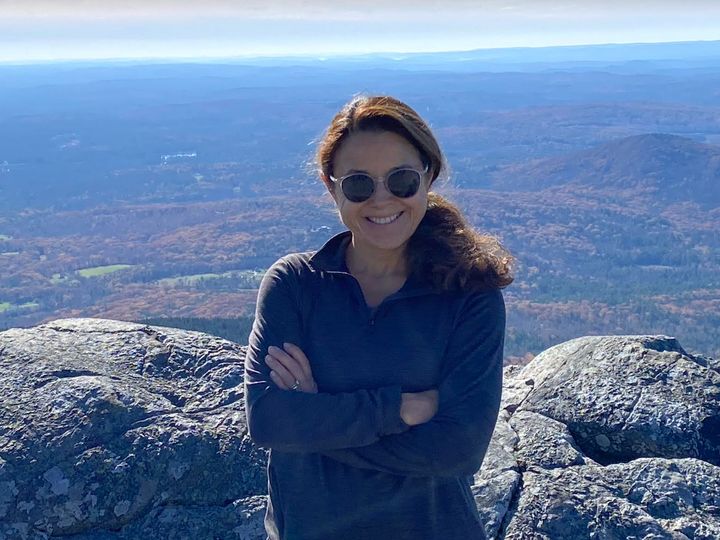
The author on a mountain in New Hampshire in 2022.

Courtesy of Rachel Zimmerman

The author on a mountain in New Hampshire in 2022.

She had never wanted to dwell on the details of her father’s death. Though my youngest had repeatedly asked, “How did Daddy die?” and dutifully attended her grief group for children, constructing art to honour the dead out of pipe cleaners and polished stones, my older daughter would have none of it.

She grieved for him in her own way, sideways: a passing lyric in a ukulele song; channeling him while playing the bullied, suicidal girl in the musical Heathers; lining her bedroom wall with “before” photos. She knew but also turned away from knowing ― the way we all know and don’t know so much: our partners, their secrets and our own.

As I pulled the dog along at a swift pace, I realised the meagre influence I’d had over my daughter was now gone. She’d figured out how to cope, to find good, on her own. She’d gained comfort from the tattoo, reliably covering her body like a favourite soft sweater.

This offered me some comfort, too. A tattoo of falling is not falling, I thought. It’s a recognition of falling. A testament to having not fallen. There is soap, my philosopher father used to tell us when we were children, and there’s the idea of soap. The tattoo helps keep him alive, a new facet of her story ― a story distinct from mine.

I tried to let go, the way mothers must. I read Kahlil Gibran, foolishly hoping that words on a page could ease this separation: “Your children are not your children… they are with you yet they belong not to you.”

As if to underscore the point, my daughter soon texted me a new picture ― a second tattoo, Ignatz, the mischievous mouse from the old Krazy Kat comic strip. Seth, a passionate comic collector, had the same tattoo, although he’d removed it years before we’d met.

“What do u think?” she texted.

“It’s cool, honey.” Now all I wanted was to remain in her 18-year-old orbit.

My new job as the mother of an adult child is to sort loss from loss, death from images of death, ideation from execution. The line is slim. When her number appears on my phone, there’s always a moment of trepidation, awaiting the sound of her voice. The words I hear could break either way. This is the cost of living. Never sure if she’ll fall hard and shatter or, miraculously, pull off a safe, auspicious landing.

Rachel Zimmerman, an award-winning journalist, has written about health and medicine for more than two decades. A contributor to The Washington Post, she previously worked as a staff writer for The Wall Street Journal and a health reporter for WBUR, Boston’s public radio station. She is the author of “Us, After: A Memoir of Love and Suicide,” to be published in 2024.

If you or someone you know needs help, call or text 988 or chat 988lifeline.org for mental health support. Additionally, you can find local mental health and crisis resources at dontcallthepolice.com. Outside of the U.S., please visit the International Association for Suicide Prevention.

Do you have a compelling personal story you’d like to see published on HuffPost? Find out what we’re looking for here and send us a pitch.

Share Button

‘Spider-like’ mitochondrial structure initiates cell-wide stress response

Often referred to as the “powerhouses of the cell,” mitochondria are well known for their role as energy suppliers, but these organelles are also critical for maintaining our overall health.Mitochondrial stress is associated with aging and age-related diseases, including neurodegeneration, but there has been a limited understanding of the molecular mechanisms behind this mitochondrial stress signaling. Now, a study by Scripps Research scientists has revealed an important step in this process.

The new study, published August 7, 2023, in the journal Nature Structural & Molecular Biology, shows how a mitochondrial protein structure is necessary to activate the cell’s integrated stress response (ISR) — a critical pathway that helps our cells maintain health. The researchers believe this mitochondrial structure, made up of a protein called DELE1, could serve as a target for future therapeutics for age-related diseases.

“Understanding the molecular details of this signaling pathway could help us potentially develop treatments for a range of diseases, such as neurodegenerative diseases, cancer and heart disease,” says first author Jie Yang, PhD, a postdoctoral fellow in the lab of Gabriel Lander at Scripps Research.

In order to maintain cellular function and health, mitochondria must continually sense and respond to stressors, such as viral infections and iron deficiency. However, their ability to do so decreases as people age.

“Just like every other part of our body, mitochondria age and become slightly less productive,” says co-author Kelsey Baron, a graduate student in the lab of Luke Wiseman at Scripps Research. “When you have this loss of mitochondrial productivity, your cells don’t have as much energy to fight different stressors, and many people believe that is a major trigger of neurodegeneration.”

One method by which mitochondria deal with stress is by activating the ISR. Prior studies have shown that the DELE1 protein is involved in activating this integrated stress response, but before now, little was known about the protein’s molecular structure. Characterizing DELE1’s structure is a key step towards understanding and treating diseases associated with mitochondrial stress.

The researchers focused on a fragment of DELE1 — the C terminus — that is known to be actively involved in initiating the ISR. When they isolated this fragment, they were surprised to find that it was much heavier than expected, which suggested that multiple copies of the protein fragment were binding together. Using electron microscopy, the team showed that this protein complex (or oligomer) was a highly symmetrical cylinder composed of eight identical fragments — in other words, an octamer.

advertisement


“It was completely unexpected that it was forming this much larger, oligomeric structure,” says study co-senior author Gabriel Lander, PhD, professor in the Department of Integrative Structural and Computational Biology at Scripps Research. “It’s kind of like two four-legged spiders whose legs are intertwined to form this flexible cylindrical structure.”

The researchers captured more than 12,000 electron microscope images of the octamer and then used algorithms to produce a three-dimensional structural model. Then, by looking at the positions of different amino acids (the building blocks of proteins) within the structure, they were able to identify which amino acids are involved in binding and assembling the octamer.

To test whether this oligomerization of DELE1 is required to activate the ISR, the researchers then introduced mutations into some of the key amino acids, which would disrupt the ability of DELE1 to bind together. When they cultured cells that contained this mutated, un-oligomerizable version of DELE1, the cells were unable to activate the ISR — suggesting that oligomerization is critical to activating this stress signaling pathway.

The next step is to find ways to use this structural information to manipulate these pathways — notably in different diseases and disorders, the researchers say.

“Knowing that this oligomerization step is a potential site of regulation gives us a platform for potential drug development,” says co-senior author Luke Wiseman, PhD, professor in the Department of Molecular medicine at Scripps Research. “We think that targeting this pathway has potential for improving outcomes in a variety of different disorders.”

As well as Jie Yang, Kelsey Baron, Luke Wiseman, and Gabriel Lander, authors of the study “DELE1 oligomerization promotes integrated stress response activation,” include Daniel E. Pride, Anette Schneemann, Wenqian Chen, and Albert S. Song of Scripps Research; and Xiaoyan Guo, Giovanni Aviles and Martin Kampmann of the University of California, San Francisco.

This study was funded by the National Institutes of Health (grants NS095892 and NS125674 and fellowship F31AG071162) and the Olson-King Endowed Skaggs Fellowship from Scripps Research.

Share Button

Mineralization of bone matrix regulates tumor cell growth

Tumor cells are known to be fickle sleeper agents, often lying dormant in distant tissues for years before reactivating and forming metastasis. Numerous factors have been studied to understand why the activation occurs, from cells and molecules to other components in the so-called tissue microenvironment.

Now, an interdisciplinary Cornell team has identified a new mechanism regulating tumor growth in the skeleton, the primary site of breast cancer metastasis: mineralization of the bone matrix, a fibrous mesh of organic and inorganic components that determines the unique biochemical and biomechanical properties of our skeleton.

The team’s paper, “Bone-Matrix Mineralization Dampens Integrin-Mediated Mechanosignalling and Metastatic Progression in Breast Cancer,” published Aug. 7 in Nature Biomedical Engineering. The co-lead authors are research associate Siyoung Choi and doctoral student Matthew Whitman.

The project is the latest collaboration between co-senior authors Claudia Fischbach, the Stanley Bryer 1946 Professor of Biomedical Engineering, and Lara Estroff, the Herbert Fisk Johnson Professor of Industrial Chemistry, both in Cornell Engineering, who together have been exploring the metastatic spread of breast cancer to bone for more than a decade.

Fischbach’s lab uses biomaterials in combination with cellular and tissue engineering approaches to understand how the tissue microenvironment regulates cancer in different contexts, while Estroff’s group specializes in biomineralization – the way biological organisms control the growth of crystals in their tissues.

“We know that cancer cells behave like seeds that need the right soil to grow, and we’re very interested in how the extracellular matrix, which is basically the material in between cells that holds everything together, affects tumor growth,” Fischbach said.

During physiological mineralization, bone mineral particles are deposited in and around collagen type I fibers. This process occurs naturally and is necessary for bone health but decreases with age – for example, due to hormonal changes as seen in women undergoing menopause. It can also result from dietary changes or chemotherapy.

advertisement


A connection between reduced bone health and the behavior of tumor cells is well-established. For example, decreased bone-mineral density has been correlated with increased risk for metastasis, and incomplete fracture healing has been shown to enhance bone metastasis. However, no one had been able to isolate which specific role bone-matrix mineralization plays in this process.

“You can’t study some these connections unless you have model systems in which you can control bone matrix properties in a defined way,” Fischbach said.

The researchers were able to create such systems by combining organic and inorganic matrix components, including collagen and the bone mineral hydroxyapatite, in a manner that mimicked physiological and pathologic mineralization. Estroff led the necessary materials synthesis and characterization techniques of the different bone matrix models, which the team then used to investigate tumor cell behavior, first in vitro and then in vivo through mouse models.

The presence of bone mineral reduced the growth of tumor cells in both settings. The presence of mineral also caused tumor cells to promote genes that were associated with better patient prognosis. These findings suggest that healthy bone matrix can reduce the risk for breast cancer skeletal metastasis.

Co-authors Matthew Paszek, associate professor in the Smith School of Chemical and Biomolecular Engineering, and Olivier Elemento, director of the Englander Institute for Precision Medicine and a professor of physiology and biophysics and of computational genomics in computational biomedicine at Weill Cornell Medicine, helped elucidate how bone matrix regulates cellular mechanosignaling, and connect the potential molecular mechanisms to patient data.

“This study basically shows for the first time that physiological interactions between mineral particles and collagen may be able to inhibit the activation of tumor cells that have spread to bone,” Fischbach said. “Now we’re broadly interested in how other cell types are influenced by varied bone-matrix mineralization. And how do mineral-dependent changes of their behavior regulate tumor cells?”

Co-authors include doctoral students Adrian Shimpi and Nicole Sempertegui; Aaron Chiou, Ph.D. ’20; Joseph Druso, Ph.D. ’16; Akanksha Verma, Ph.D. ’20; Stephanie Lux ’21; and Zhu Cheng, Ph.D. ’20.

The research was supported by the Human Frontier Science Program; the National Cancer Institute through the Center on the Physics of Cancer Metabolism; the National Institutes of Health; the Stem Cell Program of Cornell University; and the National Science Foundation.

The researchers made use of the Cornell Center for Materials Research, which is supported by the National Science Foundation’s MRSEC program; the Cornell NanoScale Facility, a member of the NSF-supported National Nanotechnology Coordinated Infrastructure; and the Cornell Biotechnology Resource Center.

Share Button