My Senior Dog Couldn’t Walk Anymore. Before She Died, She Led Me To My Husband.

“JUST BRING BACK MY MAYAAAAAAAA,” I sobbed into the phone to my then-boyfriend of two years, Tom.

He had just left our East London apartment for a two-hour journey to the specialty vet hospital, where our 13-year-old paralysed chiweenie waited to be picked up. Housebound with Covid, I waited impatiently for him to return with the love of my life.

Tom knew that Maya had always been my soulmate. She had been at my side since I was 19 and going to college in Greenwich Village. She gently snorted in my bag as I snuck past security into my film class, where a treat from my professor awaited her. Bouncy and bright, Maya romped through the city with me, often drawing adoration from passersby for her cuteness.

We were inseparable. I would wake to the surge of traffic or the rumble of street construction below, Maya nuzzled into my dark hair. Up we went to the coffee shop’s takeout window, where, surprise, surprise, more treats were ready for her taking. On the subway, to friends’ houses, on road trips across state lines, and on flights home to sunny, smoggy Los Angeles, Maya came along every step of the way.

During Hurricane Sandy, it was Maya and me against the world. No power, no running water. Maya and I traipsed along the Westside Highway at twilight, a Blessed Virgin Mary candle ablaze as a torch, walking past what felt like a post-apocalyptic downtown.

Maya even moved across the pond with me to London when I turned 30 – a reset after a five-year relationship abruptly ended.

She first moved in with my mum, who FaceTimed me at least four times a day while I spent the longest three months of my life waiting for her to arrive.

When she finally did, I felt whole, like I could exhale and lean into my new London chapter.

A few months later, Maya, almost 12, lost mobility in her back legs. I placed her in a leather duffel bag (unzipped, of course), threw in some blankets and rushed into the November night to the same specialty vet hospital, which would become our refuge for the next three years.

Still in my yoga pants and sweatshirt from that afternoon, the only thing I could think about was getting Maya better. I kept reassuring her, “It’s OK, it’s going to be OK,” even though I was ultimately reassuring myself. Stroking her soft face and trying to keep the tears back, I knew our lives would never be the same.

“Intervertebral disc disease,” the neurologist said. “She needs a spinal fusion immediately.” With only a 50% chance of regaining movement in her hind legs, I began to prepare for whatever came next.

Maya glowed in her new neon pink set of wheels. She zipped along the Hackney Canals with even more flair than before, drawing even more smiles in her new form than she had on four legs.

It was during this period that I met Tom. We both swiped right, and I planned for him to meet Maya on our third date. By then, I had accumulated a handful of dog sitters for her. While she could be home alone for up to four hours, for special nights out, I needed backup.

Maya was still figuring out her new self and was scooting all over the apartment in her white puffy diapers. As soon as I brought Tom up to meet her, Maya had an accident all over a floor pillow. Embarrassed, I began to apologise.

“It is not a bother,” he laughed as he picked her up. “Come on, you. Let’s get you cleaned up,” he cooed as he reached for the kitchen roll.

It was at that moment that I knew Tom was here to stay. During lockdown, he would drive from the other side of London and spend the entire weekend with us, giving Maya baths, making a duvet fort for her so we could watch The Twilight Zone, and going for long walks with Maya rolling beside us. He would even adorn her with origami crowns. My plus-one became a plus-two.

Tom and Maya in our yard in London, December 2020.

Photo Courtesy Of Jordan Ashley

Tom and Maya in our yard in London, December 2020.

On our first family holiday in summer 2020, we rented a cottage in the Cotswolds, where Maya rolled in green fields sprinkled with cows grazing. When she grew tired and needed a rest, Tom would scoop her up in his arms, like a bride being carried over the threshold, and blow on her face to cool her down.

When the three of us finally moved in together, our priority was securing a ground-floor apartment so Maya could come and go with ease. Our entire existence centered on Maya. It was never just Tom and me, but rather the three of us, moving as an imperfect unit into this new, cohesive life together.

As our love deepened, Maya’s age began to catch up with her. Despite being the ultimate roller girl, more health issues began to pile on: hyperparathyroidism, myoclonic seizures, pancreatitis and blindness. During this time, she would be up all night, distressed, howling and crying.

We took turns, surviving on three hours of sleep, our collective mental health wearing down, yet we persevered. On these late nights, I would turn on sound bath playlists, sing to her and do everything in my power to keep her settled on the futon we had set up in the living room. We would not give up on our Maya.

In January 2024, we celebrated her 16th birthday together. Our only measure of time was her comfort. As long as she was still eating, still bright-eyed and not in pain, we kept going. She had traded in her wheels for a stroller, and we pushed her everywhere, her head poking out to take in the breeze.

Maya was on a cocktail of medication, and our lives revolved around the rituals of caring for her – giving her syringes of medicine, hiding pills in peanut butter, cooking for her. She was a metronome, and our lives played to her rhythm.

Maya flew home with me that spring. By now, she could not be left alone, so it was easier to travel with her to ensure round-the-clock care. During this time, I felt Maya’s clock was running out.

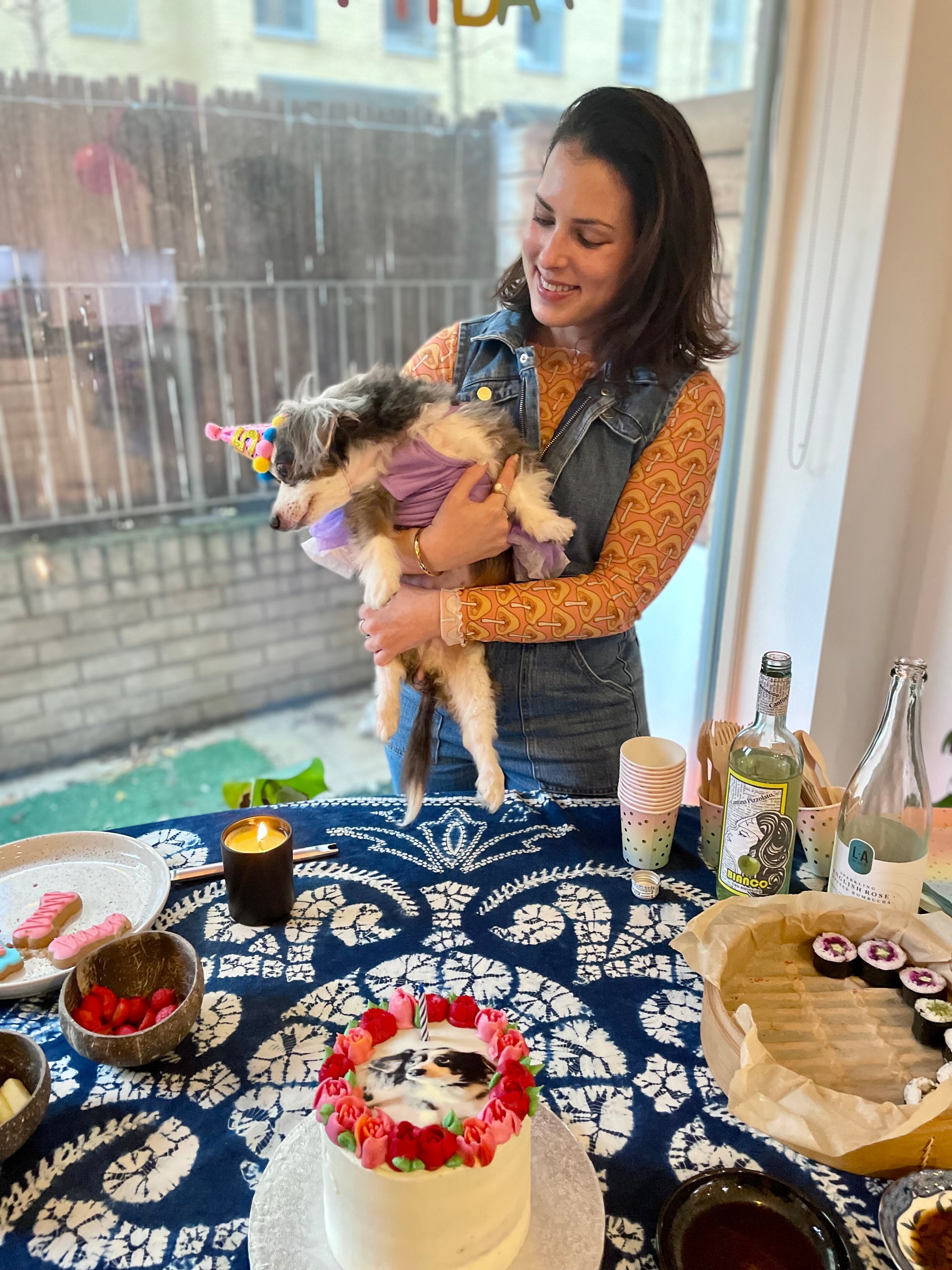
Maya's 15th birthday party in London, February 2024.

Photo Courtesy Of Jordan Ashley

Maya’s 15th birthday party in London, February 2024.

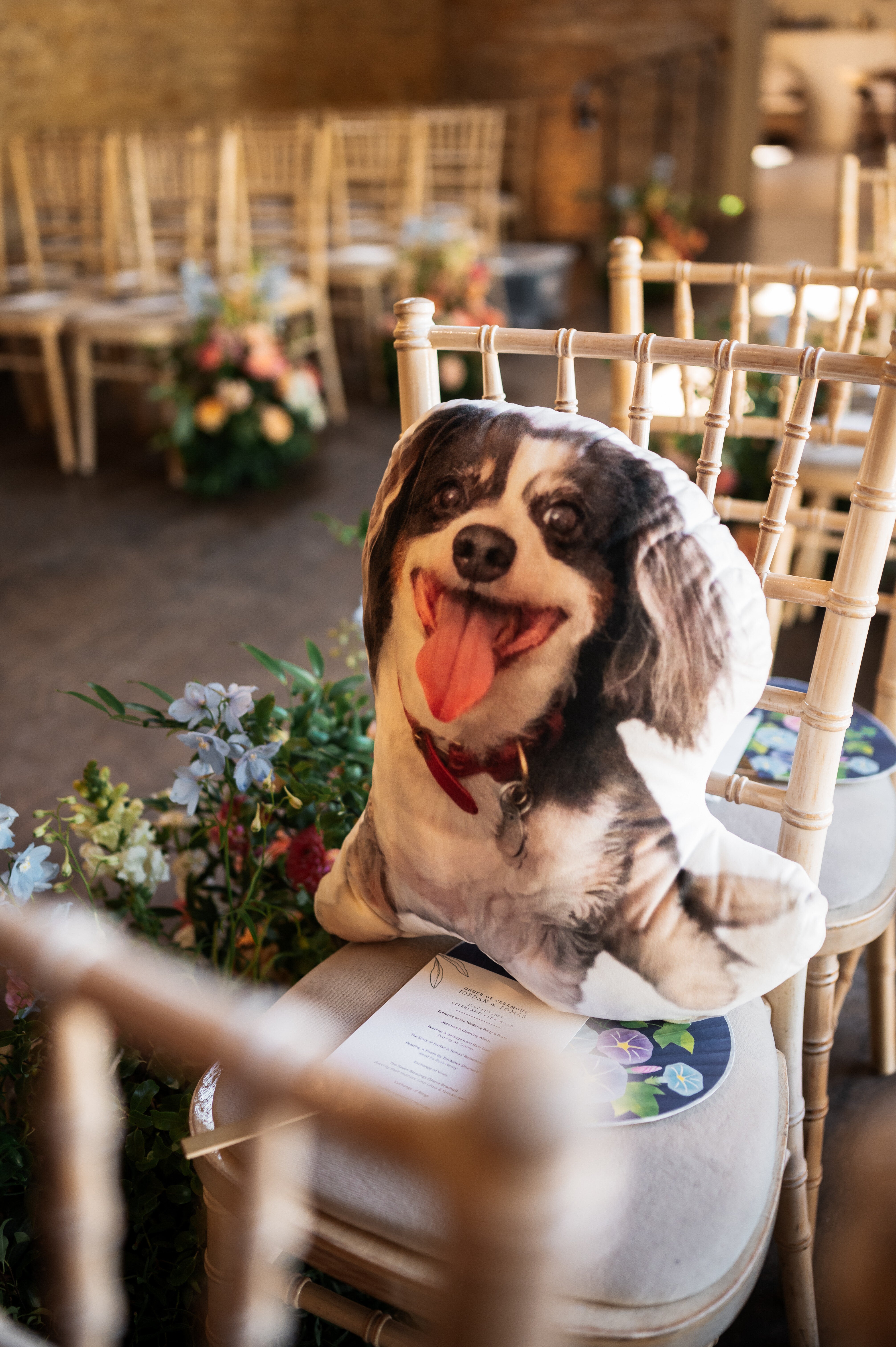
I knew an engagement was just around the corner. I had found the ring in his sock drawer, and I kept saying how important it was to me to have Maya at our wedding. She would be the bouquet, as I dreamed of carrying her down the aisle.

Tom would not be marrying just me; he would also be making a vow to her.

Within 48 hours of returning to the UK, Maya was rushed to the emergency vet because she could no longer breathe on her own. We began Googling videos on how to build an oxygen chamber at home from a plastic storage container. Tom found all the parts we would need and was ready to pick up the oxygen tank when the call came. It was time.

We sat with her on our laps for five hours, crying as we looked through all the photos of our many adventures over the years: Maya gliding in Williamsburg, a soggy Tom holding an even soggier Maya after a lake dip, Maya in her skulls and crossbones sweater, us singing happy birthday to her. And then my worst fear finally happened. Her spirit had grown too big for her now very tired body.

I was devastated. I don’t remember getting into the car or Tom driving us home. He held my hand and, through his own tears, led me into our now very empty apartment. Even though he was tucking me into bed and telling me to try to rest, I felt truly alone for the first time in 16-and-a-half years.

The engagement came six weeks later, while I was waiting for a taxi to Heathrow to fly back to New York. It would be the first time I would be in the city without her. Maya’s vet gave me an envelope of bluebells to plant in her honour. On that solo trip back to NYC, I walked down Sixth Avenue, turned left onto 13th Street, and stood in front of the apartment where Maya and I first became inseparable.

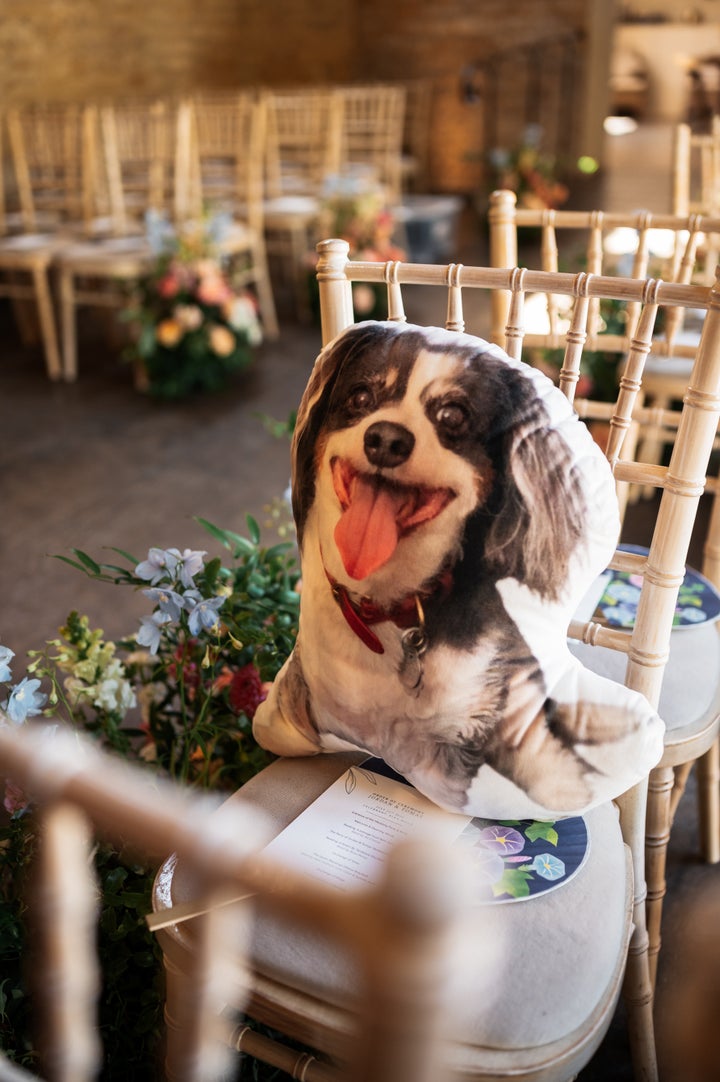
Maya's representation at the author's wedding in the Cotswolds, July 2025.

Photo Courtesy Of Jordan Ashley

Maya’s representation at the author’s wedding in the Cotswolds, July 2025.

Maya had always been my constant, my heartbeat outside my body. Losing her was like losing a piece of myself, the glue that held my world together. Kneeling, I spread some dirt beneath a tree and scattered the seeds.

Across the ocean, I knew my person was waiting for me. His love for Maya over those four years was one of the greatest acts of devotion I had ever witnessed. Our love for her and the shared grief of her absence would now be a journey Tom and I would navigate – together.

Jordan Ashley, Ph.D., is a writer and the founder and executive director of Souljourn Yoga Foundation, a nonprofit creating transformational yoga retreats that support girls’ education worldwide. Learn more at souljournyoga.com.

Do you have a compelling personal story you’d like to see published on HuffPost? Find out what we’re looking for here and send us a pitch at pitch@huffpost.com.
Share Button

When My Husband Died Suddenly, One Of His Family Members Said 5 Words That Taunted Me For Years

Not long after my husband, Keith, died suddenly in April 2000, I overheard one of his family members tell someone that she didn’t feel sorry for me and my young children. “This will make them stronger,” she asserted.

Seventeen years later, her words taunted me as I shuffled across the sizzling parking lot of a suburban shopping center on my way to a therapist’s office. Stronger. What a joke; I could barely walk.

Once inside, I slumped into an oversized chair and wearily told my new therapist, Elizabeth, my problem was that I sucked at life and the visit would be a waste of time for both of us.

The only reason I was there was because one of my adult daughters had threatened to call 911 if I didn’t get help for myself. She’d become alarmed after she couldn’t reach me and had stopped by my house, where she discovered me flat on my back on my sofa. I hadn’t bathed or changed my clothes in weeks.

Assuming Elizabeth would show me the door so she could move on to a more worthwhile patient, I was surprised when she instead asked me to elaborate. After listening for nearly an hour, she said, “What you’re suffering from has nothing to do with being bad at life. It’s called resilience fatigue.”

I’d never heard of it, but I knew all about resilience. Its necessity had been drummed into my head since I was a kid. “Pull yourself up by your bootstraps ….” “When the going gets tough ….” “If at first you don’t succeed ….” As I saw it, resilience was the crux of my problem. If I wasn’t so weak and lazy, I could allow adversity to transform me into a deeper, tougher individual.

“We have a lot of work to do,” Elizabeth told me.

The American Psychological Association defines resilience as “the process and outcome of successfully adapting to difficult or challenging life experiences.”

“Adapting” is the key word. If stressful events never let up, there’s no time to adapt. Resilience fatigue or toxic stress is about prolonged, excessive and unmanaged intense stress that leads to a sense of being constantly overwhelmed. Without sufficient coping mechanisms, the body’s stress response becomes overworked. This, in turn, can lead to an imbalance in our physiological systems and affect everything from mood to the immune system.

That sounded like me.

I’d been living in a near-constant state of anxiety mixed with dread since April 2000. I’d grown so accustomed to the feeling of impending doom — the racing heart, the perpetual tightness across my shoulders — that I thought it was normal.

Apparently it’s not.

Keith’s death would have been challenging enough on its own, but overnight I also became a single mother of three. Worse still, I was pregnant with our fourth child.

And that was just the beginning.

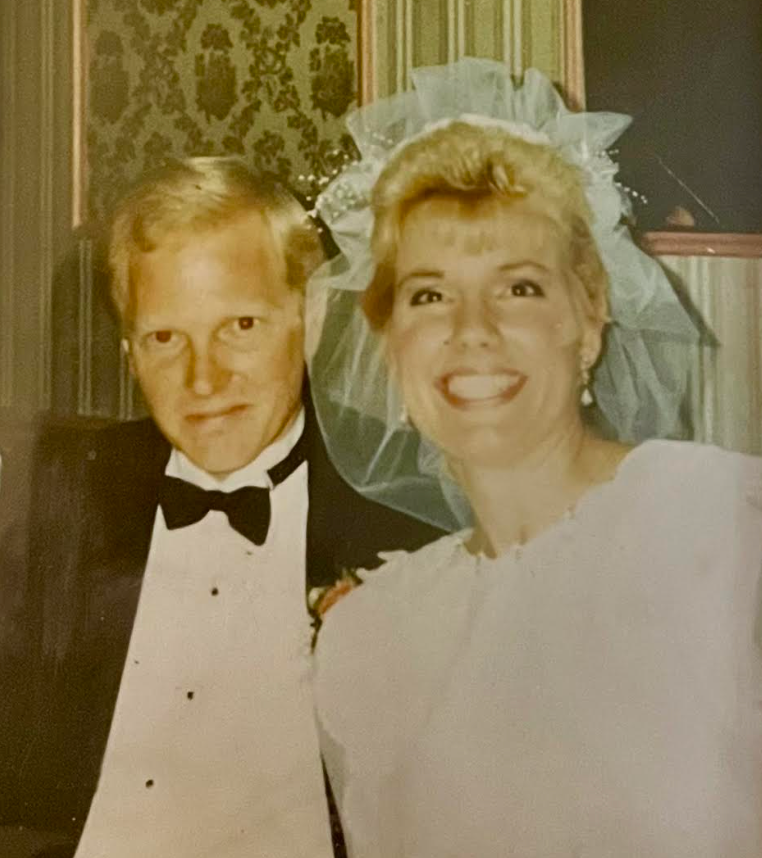
The author and Keith on their wedding day, March 4, 1989.

Courtesy Margaret Feike

The author and Keith on their wedding day, March 4, 1989.

Keith had minimal life insurance. I’d been a stay-at-home mother for almost a decade while we continually moved for his job as he climbed the corporate ladder. Even before I buried him, the realisation that I’d have to find both work and child care ASAP filled me with terror. A family of five had to have health insurance. We’d been insured through Keith’s employer, and I couldn’t afford to pay for it outright.

Finding work took precedence over everything, including grieving my husband and bonding with the baby born three weeks after he died.

I’d always assumed the capacity for resilience was limitless and also hardwired into human beings like the fight-or-flight response, but during my counselling sessions, I learned otherwise. It’s not innate; rather, it’s learned and comes not just from individual effort but also from available support and resources.

The times I attempted to discuss my fears or concerns with others, they dismissed them: “You’re young, you’ll bounce back ….” “God never gives you more than you can handle ….” “In a few years you’ll remarry and hopefully the next guy will be rich ….” This was what passed for support in my world.

Still, I believed grit and determination would not only save me but someday I’d look back on those terrible days and be thankful for what I’d gone through while reflecting on how far I’d come.

For a hot minute, that seemed to be the case. After an obsessive job search, I found a position in an auto insurance call center with top-notch benefits. My parents, who’d recently retired and had moved nearby, agreed to watch my kids and not charge me. I began humming the song “I Will Survive.”

Unfortunately, the job turned into a trap. Callers were frequently angry; they swore and shouted at me all day. There was little room for advancement unless I could put in overtime or travel, which was impossible given my situation. I’d leave work depressed and drained and come home to a messy house full of bickering kids and memories of the life I used to love.

I also began flashing back to the morning I found Keith dead in our bed. As time passed, I thought about him more instead of less, and I couldn’t understand why the last day of his life played on a constant loop in my head, as if I could change the outcome if I relived it enough times.

When I mentioned this to a relative, she chastised me. “You need to focus on all the good things you still have, not on the bad.”

Of course I was grateful for what I had, despite the fact that my finances were eroding at a frighteningly rapid pace. Despite the fact that I’d gone from enjoying a vibrant, hope-filled life with a man I loved to living like a cloistered nun. Despite the fact that one day my future had beckoned like the yellow brick road and the next there was a ROAD PERMANENTLY CLOSED sign blocking the entrance.

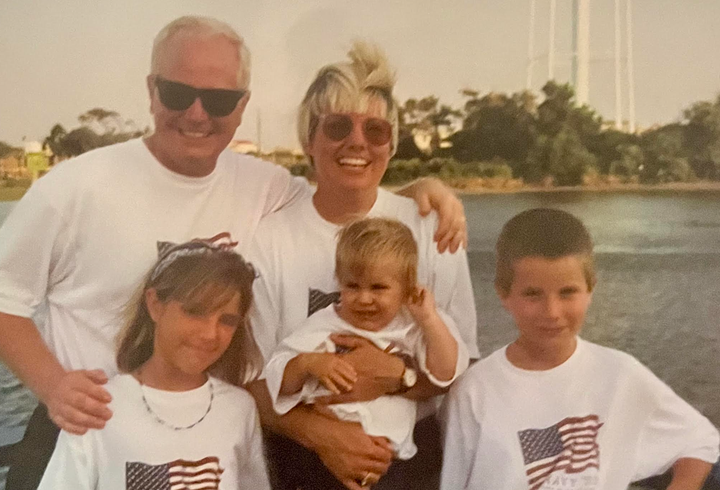
The author's family on their last family vacation in 1999. "Keith had less than a year to live," the author writes.

Courtesy Margaret Feike

The author’s family on their last family vacation in 1999. “Keith had less than a year to live,” the author writes.

Most of all I was grateful for my parents.

In their mid-60s, they were now practically raising a toddler and an infant. I was tired all the time and so were they. Our relationship deteriorated even as I suffered crushing guilt over what they were doing for me.

Yet I was certain I could turn everything around. So I prayed daily for acceptance of my situation. The Secret became my Bible, and I spewed positive affirmations morning, noon and night. I tried to banish negative thoughts from my head and focus on future abundance, not what I’d lost.

Nothing changed. Eventually I went through bankruptcy followed by foreclosure. I was fired from my job for not being able to keep up with the ever-changing metrics. When I discovered my oldest daughter was using heroin, I thought life could not get any worse.

I was wrong.

My father developed Alzheimer’s disease, and I moved in with my parents to help care for him. Two years after he died, my mother was diagnosed with terminal cancer, and I took care of her until the end.

By then my daughter was no longer using heroin, which was an unexpected miracle.

But at that point my younger daughter was in trouble for school truancy and drug use. Eventually she was removed from my home by Franklin County Children Services after her high school filed a criminal complaint with the local juvenile court and a judge ruled that she be placed in foster care at a local psychiatric residential treatment facility. It was a good thing I was unemployed, as my days became a merry-go-round of mandatory meetings with social workers, psychiatrists, counsellours and a court-appointed guardian. They picked apart my life and told me everything I was doing wrong as a parent but offered nothing in terms of concrete solutions or support.

My daughter was gone for over two years. Upon her return, she told me she’d been sexually assaulted while she was at the treatment facility. Guilt for what she’d been through vied with an impotent sense of rage deep inside me. The feelings were so inflammatory that sometimes I was sure I’d self-combust.

In the midst of my ongoing crises, I met a man in a writers’ group I’d joined in an attempt to get away from my life. Jim became a bright beacon in my otherwise dreary existence, so much so that I dared to envision a future with him. But three months after my mother passed, he died by suicide in my car. My younger son, who’d adored Jim, was so traumatised he had to be hospitalised after he became suicidal. My older son ghosted me for several years, deeming me a toxic mother.

I could no longer deny that my life had become a not-so-funny running joke, with me as the punchline. Sometimes I imagined my husband disgustedly shaking his head as he watched his family fall apart.

Just thinking about it exhausted me. One day I lay down on my living room sofa and couldn’t find the strength to rise again. I prayed for death as I thought about how I’d failed everyone, including myself.

Elizabeth helped me to reframe my viewpoint.

“Your husband died, then you had a baby. You had to hit the ground running with no time to grieve him or help your children. Your life became a runaway train that took 17 years to crash,” she said.

She put me in touch with a psychiatric nurse who prescribed a combination of antidepressants and anti-anxiety medications. She also utilised cognitive therapy, including EMDR (eye movement desensitisation and reprocessing). Slowly I began to feel better.

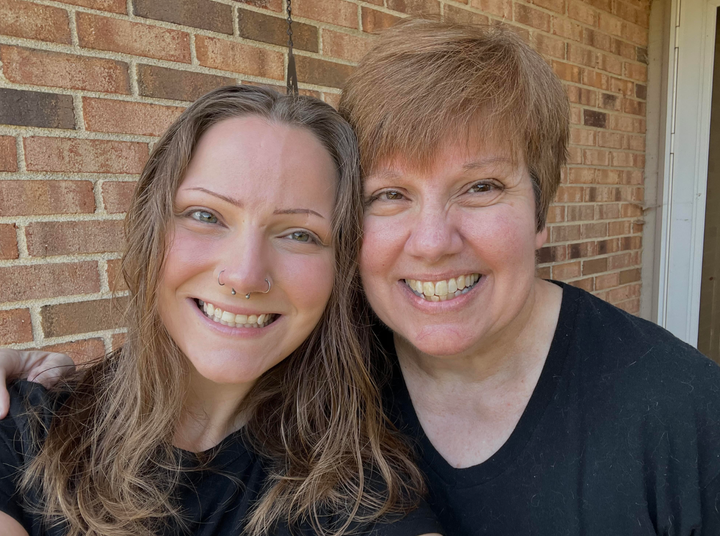
The author and her youngest daughter, Dianna. "She was born three weeks after her father died," the author writes.

Courtesy Margaret Feike

The author and her youngest daughter, Dianna. “She was born three weeks after her father died,” the author writes.

Of course you can’t always control what life throws at you, but Elizabeth pointed out that my path might have taken a different turn if I hadn’t been forced into a race against time to secure health insurance and child care, those fickle twins that dictate life for so many Americans.

Still, I had trouble letting go of the conviction that I’d traded in resilience for lethargy. All my life I’d heard that adversity builds character and that what doesn’t kill us makes us stronger. Elizabeth shook her head. “Those are dangerous generalisations and they’re mostly false. Beliefs like that allow us to minimise other peoples’ suffering without feeling guilt.”

A growing body of research shows that despite the widespread belief that negative life events result in “post-traumatic growth” or positive personality change, “the only type of growth that seems to arise consistently is deepened relationships,” according to the Society for Personality and Social Psychology. Our relationships with loved ones often become more meaningful during times of struggle.

“But that requires having supportive relationships in the first place,” Elizabeth said. “Other than your parents, who were tossed out of the frying pan into the fire with you, you’ve been going it alone all this time. What would you say to that relative who told you Keith’s death would make you stronger if you saw her today?”

I didn’t hesitate. “I’d say, ‘You have no idea how badly I wish you’d been right.’”

Seven years on, my own mental health is in a much better place, and my children are thriving. We’re closer than we’ve ever been, and all four are involved in healthy relationships and working at jobs they enjoy. My older daughter became a psychiatric nurse and the younger one is pursuing a nursing degree in the same field.

After my oldest child went through a divorce a few years ago, I began watching my two young grandchildren while she worked, paying it forward the way my parents did for me.

I understand the urge to offer platitudes to someone who’s experienced a loss or tragedy. The right words can be difficult to find. But it’s better to say nothing than to imply they’ll somehow benefit or be improved as a result of their misfortune.

Suffering hasn’t made me stronger, but it certainly has taught me about the kind of person I want to be. Now I’m able to offer more than platitudes to others going through difficult times because I can share my experience along with empathy. Pain does not build resilience; lending support does, even if it’s only a sympathetic ear.

I’m grateful that today I can be that support for my family.

This piece was originally published in December 2024 and we are sharing it again now as part of HuffPost Personal’s “Best Of” series.

Margaret Jan Feike’s personal essays concerning subjects such as addiction, mental health, and grief have been published by Salon, McSweeney’s, Modern Loss, and other venues. She resides in central Ohio with her younger two children and a herd of cats and recently completed her first novel.

Do you have a compelling personal story you’d like to see published on HuffPost? Find out what we’re looking for here and send us a pitch at pitch@huffpost.com.

Share Button

When My Daughter Received A Life-Altering Diagnosis, I Heard The Same Phrase Over And Over. I’ll Never Repeat It To Anyone Else.

I had just stepped out of the shower when my husband, Scott, called from the hospital, where our 9-year-old daughter had been a patient in the paediatric ICU for four weeks. He had relieved me that morning so I could go home, shower and return for a meeting with the doctors about our daughter’s condition.

When he told me our daughter’s diagnosis was “neuromyelitis optica,” a rare autoimmune disease that attacks the central nervous system, my heart didn’t just sink. It stopped. A silent, internal arrest. In a single moment, my physician’s mind ran through the prognosis. Rare, incurable, potentially fatal. My heart broke under the weight of my devastation.

Steam still hung in the air, my wet hair dripped as I clutched the towel around me, my skin still damp. When the words came through the phone, my legs gave way. I slid down the wall until I was sitting on the cold bathroom tile, the phone pressed to my ear, my breath caught in my chest.

Scott asked if I was still on the phone. “It’s good we finally have a diagnosis,” he said, searching for a foothold of hope.

After a long silence, I whispered: “That’s not a good diagnosis.”

As a physician, I knew exactly what this diagnosis meant: Not only was it incurable; it often led to blindness, paralysis and ongoing hospitalisations.

About a month ago, our daughter Nell had woken up one morning with nausea, dizziness and overwhelming fatigue. When I took her to the emergency room, her symptoms escalated rapidly. She became unresponsive, and a brain MRI revealed multiple large areas of inflammation.

As her neurological status declined, her tongue and the other muscles involved in swallowing became paralysed. Because she couldn’t clear her oral secretions, she developed aspiration pneumonia and was admitted to the ICU, where she developed right upper extremity paralysis and lower extremity weakness.

She remained in the ICU for five weeks, hooked up to beeping monitors and struggling to recover from what appeared to be a paediatric stroke. The diagnosis was made a few weeks later.

The contrast between the recent memories of my daughter powering down the lacrosse field, her face lit up with joy after scoring a goal, and now seeing her lying in the ICU was stark. She was unresponsive, her face pale, her little body wired with tubes and monitors. The sound of machines beeping echoed where there once had been giggles.

The author's daughter in the hospital.

Photo Courtesy Of Maggie Kang

The author’s daughter in the hospital.

I had clung to the hope that we would find a cause, treat it and somehow reclaim the life we once had. I am a fixer. It’s in my DNA, both as a doctor and a mom. But this? This wasn’t a problem to solve. It was a reality to endure. In an instant, the future I had imagined for her vanished.

I was left without a script, utterly lost.

And what made it harder were the unspoken and sometimes spoken expectation that we would “bounce back,” pick up the pieces and return to life as it was before.

Friends meant well when they told me, “You’re strong, you’ll bounce back,” or “She’s young, she’ll bounce back.” They thought they were encouraging me. But to me, it was a dismissal. This wasn’t a sprained ankle. This wasn’t a rough semester. This wasn’t a setback. It was annihilation.

The question wasn’t “How do we bounce back?” and return to some previous version of our lives. That was impossible. The real question was: How do we grow through devastation?

I had to learn to sit in the terrifying, liminal space between “what was” and “what is,” without knowing “what will be.” I had to let go of the fixer and become the witness.

It was agonising. The grief, the pain, the fear. I wanted to escape all of it. But once I stopped pressuring myself to bounce back and allowed myself to sit in the rubble of my old life, something shifted. I stopped denying the destruction. I started to feel loss, anger, vulnerability. And in that heaviness, I discovered the first step toward healing.

Only then could the real work begin. Not rebuilding the same house, but examining the pieces that remained. I asked myself: What is worth keeping? What needs to be left behind?

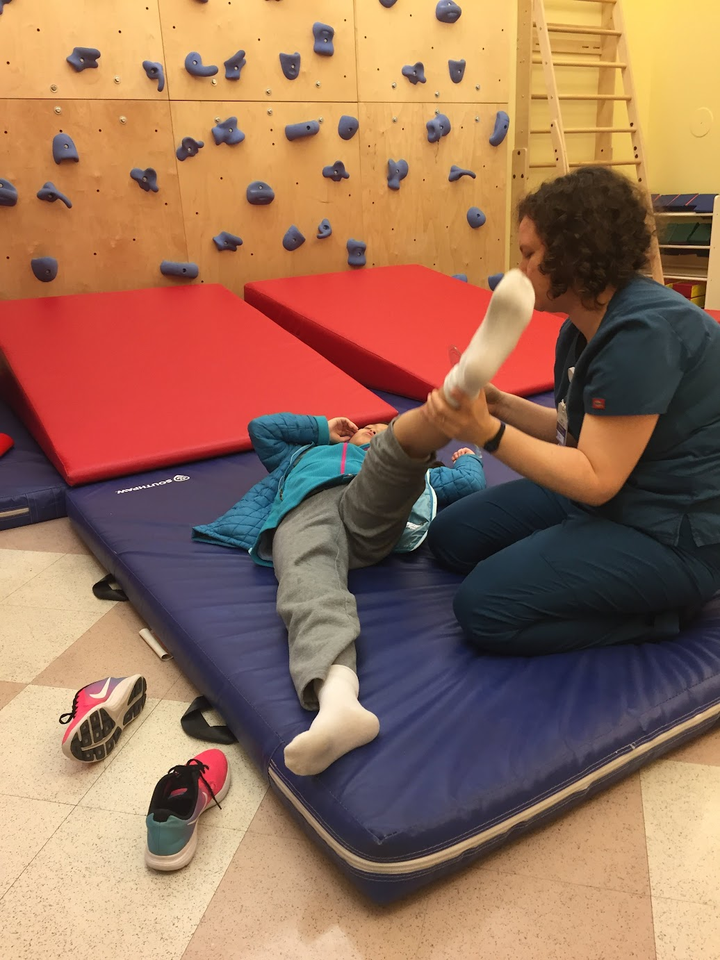
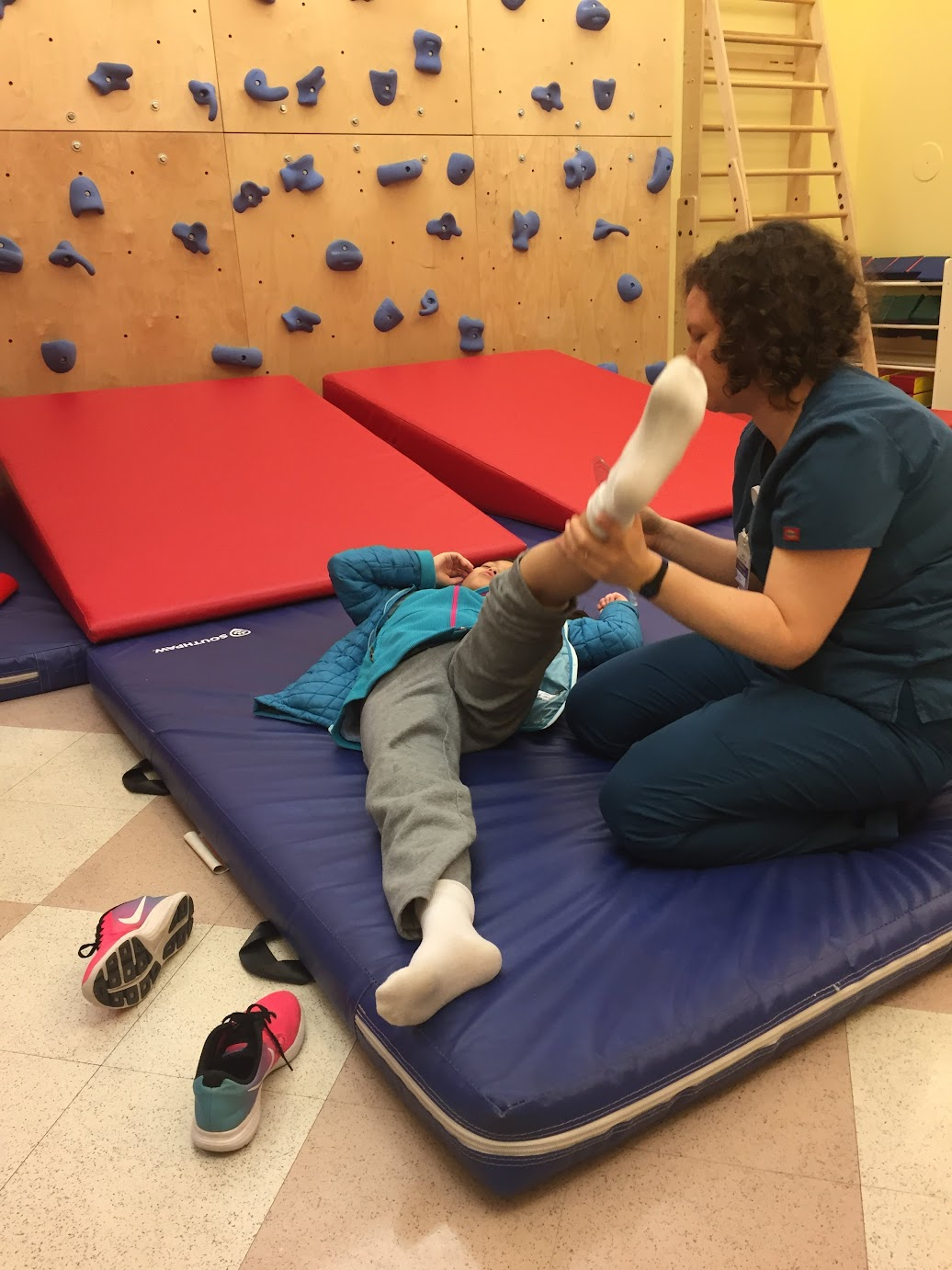
My daughter’s rehab journey was gruelling. I watched her take her first wobbly steps with a physical therapist by her side, her legs shaking but her face set with determination. I watched her clutch a pencil with weak fingers, her letters uneven and jagged like a toddler’s. I sat in waiting rooms as she cried in frustration, knowing her friends were back at school, sprinting down fields and hallways while she struggled just to walk across a room.

The ache of what was lost was overwhelming.

The author's daughter in rehab working with her PT on strengthening and stretching her lower extremities.

Photo Courtesy Of Maggie Kang

The author’s daughter in rehab working with her PT on strengthening and stretching her lower extremities.

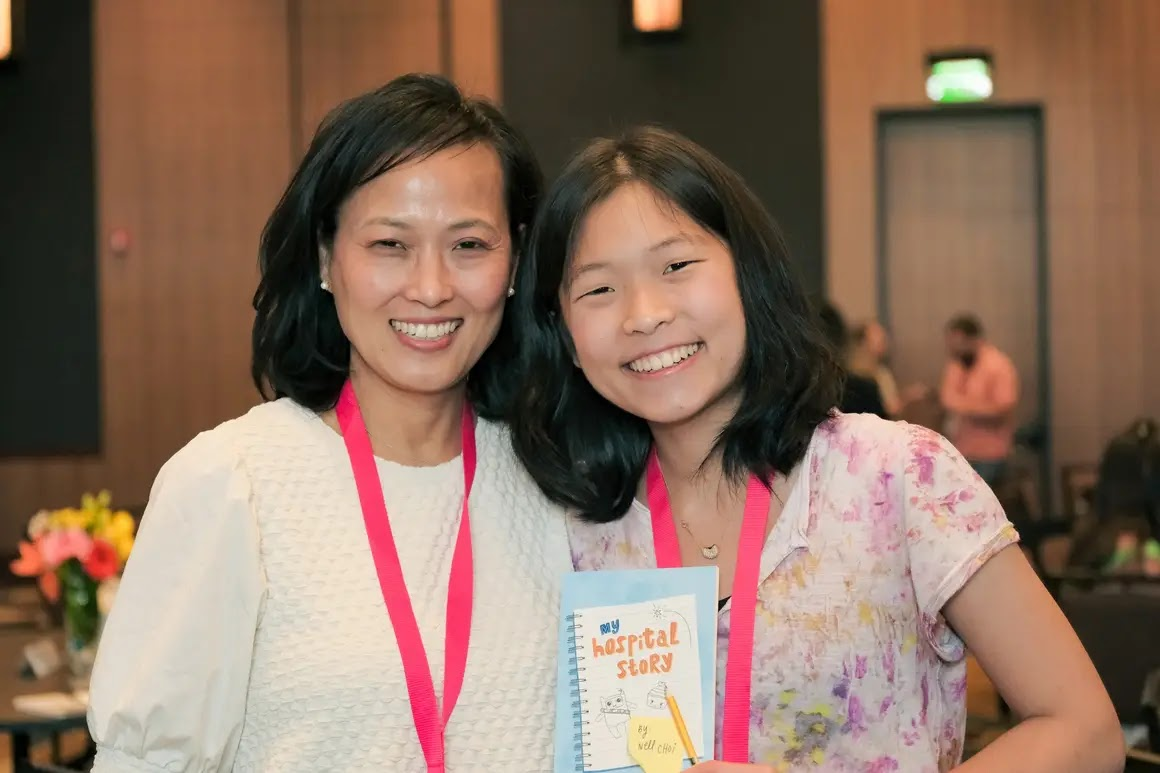
But slowly, something new began to take shape. My daughter didn’t return to lacrosse. Instead, she discovered art and writing. She found a way to transform her pain into creativity and purpose, eventually writing a book to help other kids and teens navigate hospitalisation and chronic illness.

We didn’t return to our old normal. We built a new one, grounded in acceptance, resilience and hope. We set aside dreams of athletic glory and the illusion of control, but we kept our core: love of family, strength and the belief that even pain can forge meaning.

That terrible experience, the one I desperately wanted to forget, has become part of who we are, woven into the fabric of our lives. It fuels our rare disease advocacy, shapes our shared mission and deepens our gratitude for each new day.

Now, when I face challenges, big or small, I don’t tell myself to bounce back. I sit in the rubble and really feel what has been lost. Because it’s only from that stillness that true growth begins. Not by rushing to return to what was, but by moving forward into who we are meant to become.

If you’re in your own rubble, whether it’s a diagnosis, a broken relationship, a lost job, or a quiet despair you can’t name, I want to offer you a different approach. Replace “When will I get over this?” with: “How is this experience changing me?” or “What is this pain teaching me?” This shift invites curiosity rather than judgment and opens the door to possibility and transformation.

Today, Nell is walking on her own and back in school full-time, although competitive sports are no longer part of her life.

Though Nell’s disease is incurable, and we live with the ongoing possibility of relapse, we are grateful for the few FDA-approved drugs that help keep the inflammation at bay. That reality, knowing the ground could shift at any moment, makes us cherish each day she can attend school, pursue her passions, cook meals with us and create new memories.

Having lived through this trauma has also connected us to the rare disease community, where we witness the extraordinary love parents pour into children who are dying or living with profound disabilities. This experience serves as a portal into a world that stands in stark contrast to the mainstream, where humanity can sometimes seem absent. But here, in the community of parents of children living with the uncertainty of rare, chronic conditions, humanity feels alive and fierce. Witnessing and being part of this has filled me with a humility and gratitude deeper than I could have imagined before.

The author with her daughter Nell on the beach 2.5 years after her diagnosis.

Photo Courtesy Of Maggie Kang

The author with her daughter Nell on the beach 2.5 years after her diagnosis.

I’m still a fixer at heart, but I’ve learned not to lament the things beyond my control. I’ve come to trust that my envisioned life may not, in fact, be the best way. And I’ve realised that trying to “bounce back” to my old life would negate the growth, the perspective, the resilience and the connections I’ve gained.

By sitting in this space and allowing it to reshape me, I have discovered more hope and connectedness than I ever thought possible.

Maggie Kang, M.D., is a physician, TEDx speaker, resilience and healthcare coach, and rare disease advocate. After her daughter’s rare disease diagnosis, she writes and speaks about grief, growth and finding meaning in the face of life’s disruptions. Learn more at maggiekangmd.com.

Do you have a compelling personal story you’d like to see published on HuffPost? Find out what we’re looking for here and send us a pitch at pitch@huffpost.com.

Share Button

‘I Was Made to Feel Like a Nuisance’: How Death Admin Becomes A Second Trauma For Grieving Families

Losing a loved one is something we all will experience at some point – and unfortunately, no prior loss can prepare us for the ones that lie ahead and the world-shattering emotions that come with them.

For those of us who have to face the financial admin that’s left behind when somebody dies, there is a compounded grief as we try to navigate the institutions and paperwork that are an essential part of death admin.

In fact, in Octopus Legacy’s Human Cost of Dying report, families rank financial institutions among the least helpful when dealing with a loved one’s death.

These findings reflect the stories of people like Rosie and Lucy, who have faced overwhelming hurdles in the wake of their loved ones’ passing.

HuffPost UK spoke with Rosie and Lucie about the traumatic obstacles they faced following their losses – and what needs to change.

Rosie’s mother dying left her with an unmanageable amount of admin

Rosie lives in Edinburgh with her husband and three children.

Back in 2003, Rosie’s mother came to live with the family. But sadly in 2009 she suffered from a ruptured aortic aneurysm, was rushed to hospital and placed in the high-dependency unit.

Speaking with HuffPost UK, Rosie explains how her mother’s health deteriorated over time: “She was non-responsive for a couple of weeks – and as she woke up, it became evident that something wasn’t right.

“She had suffered a stroke during the operation and was eventually transferred to a hospital which supported stroke rehabilitation. From there, she was eventually well enough to come home.”

Unfortunately, their family’s peace didn’t last long.

“A few months later, as I was coming home from a run, I saw my mum waving at me from a bedroom window. I then watched her fall,” says Rosie.

“I ran home and found that she had suffered another stroke – we returned her to the local stroke unit, and then back to the rehabilitation hospital. This time, she wasn’t in for stroke rehabilitation but in a geriatric ward. She never left.”

The family experienced a prolonged period of grief prior to her passing

Rosie admits: “For me the grieving process was initiated in 2009 when she first went into emergency surgery. This was a long, tortured process of gradually watching my mother losing herself.

“My mother had been a force of nature, immensely practical and sensible. If there was a problem, my mother would find a way to resolve it.

There were moments, during her rehabilitation when her very strong sense of humour would peep through. She would have a twinkle in her eyes watching the banter between staff on the ward. She would beam at me or my children when we came to visit – and pat our hands.”

But mostly, as she watched her mum deteriorate, she grieved.

“When my mum died it was a release. For her – and for all of us. We could actually say goodbye,” says Rosie.

Thankfully, the funeral went smoothly. Rosie and her family shared stories of her mother and bonded with others over their stories.

But the financial admin following the funeral was when the problems started

Rosie is self-employed and offered to work on the financial side of her mother’s estate on behalf of her siblings for an agreed fee. However, it wasn’t as simple as she had expected it to be.

“My mother had 13 ISAs with different institutions,” Rosie says.

“When my father died, my mother had become really interested in money management. She had invested in the stock market and had also taken advantage of great rates each year for her TESSA (tax exempt special savings scheme) and ISA allowance.

“I discovered that each bank had different requirements in order to close the accounts. Some required a death certificate certified in a branch. Some required a death certificate certified by a lawyer. Some required correspondence just from me. Some required correspondence from all three siblings. No two of the financial institutions I approached required the same process.

“The details are woolly now – but I remember sending endless letters / forms to my siblings for them to sign and return.”

The admin put a strain on Rosie’s relationship with her siblings

For Rosie, it seemed bizarre that there wasn’t a standard process that institutions used.

“Had I known at the outset, I would not have proposed to complete this work, particularly given the fact that my mother had died in Scotland, but her will was drawn up in England,” she says.

The siblings ended up needing to engage a legal firm to complete the work anyway.

“The whole process was time consuming, resulting in me spending far longer on the process than I had anticipated. Rather than supporting each other in a period of loss, we were really discussing who wanted a footstool, a salad bowl – or who had signed what form,” she says.

“The length of the process created friction between me and my siblings to the point that we had periods of not speaking following this time.”

One silver lining during this dark time was that Rosie’s mother had already been through the process of settling an estate when her husband died in 1993.

“As a very practical person, she had written a list every year, of all her assets and where they were. That was invaluable,” says Rosie.

“My mother had also taken the precaution to open joint accounts with each of us, so that we would be able to access funds in the event of her death.”

The admin following the loss of her husband put Lucie’s life on hold for years

After losing her husband during the pandemic, Lucie encountered administrative hurdles that sent her back to when she lost her husband.

Between receiving questions from pension providers like “could you have saved your husband?” and having bailiffs sent to her property, Lucie spent the next two years battling against a range of institutions.

Her life was on pause, and she was forced to relive the trauma of finding her husband dead every single time.

Speaking with HuffPost UK, Lucie says that young widowers face a wealth of obstacles that leave them unable to process their grief: “There are very few widows, particularly young widows, who can leave the financials to sort themselves out.

“Mostly, we really need that cash to keep going and enable at least a sense of stability at a time which is so destabilising. Having to relive your trauma, deal with what seems so trivial (yet unfortunately vital) takes strength and clarity which is so challenging to achieve at this time.

“Instead of focusing on self or family, one has to really focus on getting through a challenging process which means setting aside the grieving process – which, in my view, prolongs the process.”

Financial institutions left Lucie feeling overwhelmed and frustrated

If Lucie could suggest anything to organisations that frequently speak with grieving families, it’s better training. She urges: “Have specifically trained teams with appropriate scripts and understanding of the challenges.

“Additionally, ensure that customers are regularly reminded to provide statements of wishes, emergency contacts, nominated representatives who can deal with financials in the event of death or critical illness.”

She also believes that empathy can go a long way

Following a loss, particularly the loss of somebody very close to you, the world can feel like such a strange place – like you are the walking wounded and nobody quite understands the particular pain that you are feeling.

This is compounded by a lack of empathy in institutions that aren’t suitably prepared to work with people going through something so life-altering.

Lucie admits: “I was made to feel like a nuisance. So many inappropriate questions about the nature and circumstances of my husband’s death, none of which were relevant.

“Because I was pushing hard for resolution, I was made to feel like I was in the wrong and almost not grieving enough. It was a genuinely awful process.”

Lucie shares a warning to couples and families

Some of this is still unavoidable for families in the wake of a death, but Lucie believes preparation is essential.

She advises: “Agree on where you will store passwords. Communicate well about what financial products you have and where the information is.

“Draft a will. Complete your expression of wishes and update them regularly. Get comfortable talking about money and death.

“My biggest reflection is that these were not conversations we had; I had no idea where my husband’s paperwork was and most of it was on his laptop, the password of which I did not know… Share this stuff!”

Share Button

An 88-Year-Old Woman Was Brought To My A&E. When Her Family Told Me Why, I Was Stunned.

The computer said she was an 88-year-old female with a chief complaint of fatigue. From experience, I knew fatigue in an older person could be caused by almost anything. So … was it a heart attack? Depression? Cancer? An infection somewhere? Or was she just … fatigued?

The real reason she was there never crossed my mind.

The tiny woman had positioned herself precisely in the centre of the gurney. Her white tennis shoes sat under the chair with a thick, flesh-coloured knee-high stocking tucked inside each one. On the seat of the chair was a neatly folded yellow cardigan atop an equally neatly folded brown dress.

She wore her hospital gown like a jacket, open to the front, and her knobby hand clutched it closed over her cross-your-heart bra and waist-high white cotton panties. A Catholic cloth scapular with an image of the Virgin Mary hung on a string around her neck, and a tiny gold cross on a fine gold chain nestled in the hollow at the base of her neck.

“Hola. Mi nombre es Doctora Birnbaumer. Como se llama?” I said to her.

“Hola, Doctora. Mi nombre es Maria,” she replied.

Her eyes sparkled, and she sat up straighter, her posture that of someone who found life interesting. I checked her armband and offered to cover her with the sheet folded at her feet. She nodded.

I asked her how she was feeling. Fine, she told me. Was anything bothering her? No, she said. Any pain? No. Any shortness of breath, chest pain, headache? No, no and no. I went through my list and she denied anything being amiss.

Maria’s only encounters with the medical system had been for the births of her many children, several of whom she had outlived. She had been widowed over two decades before. She lived alone, with family nearby. She wasn’t working but had spent most of her life as a housekeeper. No meds, no allergies, no surgeries.

I asked if I could examine her, and she nodded. From head to toe, she was remarkably fit. Her bright, curious eyes nestled in a sea of soft skin and were bracketed by deep crow’s feet sculpted by years of smiling. The rest of her head and neck exam were normal. A tiny bit of curvature of the spine. Clear lungs, a strong, steady heartbeat with no abnormal sounds. Abdomen, extremities, neuro exam… all normal.

I was flummoxed. She watched me expectantly.

“So, are you sure nothing is bothering you today?” I asked.

She shrugged and raised her hands in a “what can you do?” gesture.

I was getting nowhere. Time for a different tactic.

I asked her why she was in the emergency room. She said she didn’t know.

New angle: “How did you get here today?”

Her face blossomed into a smile. Her daughter, granddaughter and great-grandson had come by her home, picked her up and brought her to the emergency department.

Finally. Maybe an answer.

With Maria’s permission, I sought out her family members in the waiting room. They were easy to find, all three resembling the petite woman on that gurney. The same dark eyes stared at me as I approached them, but while hers were bright and inquisitive, theirs were red-rimmed, and their eyelids were swollen.

As we entered the “family room” to talk, the two women deferred to the teenage boy, who acted as spokesman. He remained standing as the women and I sat.

They all turned to me, waiting. I cleared my throat.

“So, I was wondering, why did you bring Maria to the hospital today?”

Instantly all three sets of eyes filled with tears. The oldest woman nodded to the boy, and he spoke, dropping his gaze to the floor.

“My cousin. He died. The police came to my aunt’s house and told her he got shot.”

“Oh! I’m so sorry.” Now I understood the tears.

We sat for a few more moments in silence. No one moved. And I still didn’t know why Maria was there. I ventured, “So, is there something wrong with your great-grandmother?”

The boy answered. “My cousin. He is… was… Abuelita’s favorite. Everyone in the family knows it.” The boy’s voice was pleading, but I still didn’t understand. “We want you to tell her he’s dead,” he blurted.

And there it was.

The author at work in the emergency room.

Courtesy Diane Birnbaumer

The author at work in the emergency room.

I wish I could deny it, but my first reaction was irritation. Really? There was nothing medically wrong with her? The emergency room was packed with people, some were really sick, and I just spent 15 precious minutes on this? Did people really think the emergency room fixed everything?

Then the three of them started talking at once. They feared she’d have a heart attack or a stroke when she found out. They were terrified the news might kill her. They didn’t want to tell her. They wanted someone else to do it, and she needed to be somewhere that, if something terrible happened, she’d be taken care of.

I sat with what they told me for a moment. I recalled how I felt when my dad called me with the news that his thigh pain was from a tumour that had spread from a mass in his lung. I remembered how much I wanted someone to tell me it would be OK, that we would all survive this, that the world, now horrifyingly askew, would somehow right itself.

The healing that eventually happened didn’t result from any discussions with a doctor but grew from the love and support we gave each other as a family, from the times we would lean together, our hands and heads touching, creating an edifice, a steeple from which we could all draw strength.

Through these memories, my path forward became clear.

I took a breath and leaned forward to look each of them in the eyes. I made sure they heard me when I told them I was there for them, all of them… including Maria. I said I would be there with them, in the room, and around for hours to watch Maria if she needed anything and to make sure she was safe and taken care of. I told them I had their backs, but that the news needed to come from them.

They searched each other’s faces, and then they all nodded.

As we all walked into Maria’s room, her bright smile faded when she saw our faces. They moved to her bedside. I slid a box of tissues onto the table near Maria and stepped away.

Maria was now surrounded by the three generations of her progeny. They spoke to her in Spanish in hushed tones, and I watched as four lives — four generations — confronted the dreadful news.

Maria listened quietly. Her straight posture sagged the tiniest bit, her smile disappeared, and her face aged decades in moments. She reached one hand, spotted with age and deformed by years of labor, out to her family, and they all joined hands. With her other hand, she clutched her scapular, pulling gently on the string that attached it around her neck.

I eased out of the room, leaned against the wall in the hallway and remembered.

I remembered being a young woman deeply invested in caring for others and deciding my future was in medicine. I happily took on the years of schooling and training and debt required to become a doctor. I recalled the thrill of learning about the human body, how it works and what to do when it doesn’t.

I remembered cringing when I learned to start an IV and the patient gasped in pain. My heart broke the first time I told a patient they had a terminal disease. I cried myself to sleep the night when, as a third-year medical student, the man I assured would do fine during his coronary bypass surgery died on the operating table.

But I couldn’t remember exactly when my empathy started to slip away.

I knew that when I started my shifts, I walked through an ambulance bay packed with paramedics, gurneys and patients. I knew that no matter how hard or how fast I worked, the waiting room would never be empty. Patients came to the emergency department when they were injured and ill, but also when they could not get in to see their own physicians or when they lost their insurance or because after-hours was the only time they had off between jobs. Police brought in patients who had nowhere to go or had behavioural problems or whose addictions had consumed their lives.

There were never enough beds, patients waited for hours, and everyone — patients and staff alike — was understandably tired and angry. There was no way to do a good job — at least not as good a job as I had been trained to do. Despite that, administrative bean counters reduced my performance to counting how many patients I saw per hour and how many tests I ordered.

When I became an emergency physician, I had been all in on taking on the hard work and the erratic schedule, the difficult decisions and the busy shifts that went with the job. Over time, though, I had let the demands of a changing, overstressed and broken system knock me off course.

Standing in that hallway, listening to the soft murmurs of Maria and her family, I remembered why I was there — why I chose this profession, why I worked these crazy hours, why I did this job.

I pulled away from the wall and headed off to care for the next patient waiting to be seen.

Maria didn’t have a heart attack or a stroke. An hour later, she sent her great-grandson to find me to tell me she wanted to leave. Her family helped her into her clothing and gathered her things as I prepared what was needed to send her home. At the door to her room, I hugged each of them in turn, Maria last, knowing her visit to the emergency room was exactly what she and her family needed.

Apparently, it was exactly what I needed, too.

Note: Some names and identifying details have been changed to protect the privacy of individuals mentioned in this essay.

Diane Birnbaumer is an emergency physician and writer living in Los Angeles. Her poems and essays have appeared in Intima: A Journal of Narrative Medicine and the medical journals Annals of Emergency Medicine and Annals of Internal Medicine, as well as the anthology “The Things They Wrote: A Writing/Healing Project,” published by Room: A Sketchbook for Analytic Action. She is an ambassador for The OpEd Project and attends The Writers’ Program at UCLA Extension.

Share Button

How To Cope At Christmas When You’re Consumed By Grief

As the office radio blared the Christmas classic “I Wish It Could Be Christmas Everyday” by Wizzard, I was racing outside to take a call from my mum telling me that my nan had been taken to hospital and it wasn’t looking good.

My nan, who had played a huge part in raising me, had called me her ‘one true friend’ and who shamelessly loved Christmas more than anybody I knew, died four days later. She didn’t make it to Christmas but the celebrations went on, even as I felt my world had stopped.

Seven years later, I sat in a taxi as the driver blared ‘Stay Another Day’ in what was a cruel twist of fate as I’d just learned that my uncle was going to die within days from an aggressive form of cancer.

The song that was once a tacky festive favourite of mine was almost mocking my unthinkable situation.

Thankfully, my uncle did see Christmas that year but had spent it knowing he was about to die and he left us on December 29th.

Now, Christmas feels like a very different beast than it used to. Instead of wandering mindlessly around festive markets, I instead feel suffocated by the ‘joy’ that this season supposedly brings. I feel sick to my stomach with grief and nostalgia for a time when my family was bigger, happier and not in an apparently endless state of mourning.

A time when December didn’t fill me with dread.

According to Bianca Neumann, Assistant Director of Bereavement at Sue Ryder, my experience is common. She said: “The anticipation of Christmas can often be worse than the actual day itself. But unfortunately, for many, it is very common that grief is more intense and harder to deal with throughout the holiday season.”

It’s a complex mix for me, at least. Not only do I not feel like celebrating but even when I try to, all I can think about is how they should be here with us, celebrating too.

Neumann urges that this grief can come in many forms, saying: “Maybe you’re bursting into tears when you least expect it, perhaps you feel angry at the people around you, or maybe you’re feeling anxious, worrying about how you’ll feel or how you’ll get through it.

“Know that these feelings are all normal, and that you’re not on your own this Christmas.”

How to cope with Christmas when you’re grieving

Bianca Neumann shared her tips for getting through this not-so-festive season if you’re missing somebody:

Think about what you want to do

Neumman says: “You shouldn’t feel pressured to have Christmas as usual if it doesn’t feel right, although celebrating as you normally would, might be a comfort to you.

“This will be different for each person after a bereavement, so plan for a Christmas you feel comfortable with and give yourself permission to do what you want to do.”

Of course, no plan has to stay firm, either. Neumann urges that if you’re finding things difficult, you have the right to step away from the usual traditions and rituals until you feel that you’re ready to pick them up again.

She added: “Remember that all emotions, whether they are ones of sadness, joy or any other, take up energy. You might not know how you’ll be feeling from one day to the next, so be kind to yourself and try not to ‘over-do’ things.

“Take a break and, if you’ve got a hectic couple of days ahead of you, schedule in some quiet time – whether that’s going for a walk if you need to, setting aside a few minutes to yourself with a cup of tea, or spending some time writing in a journal.”

Forget the ‘should’

While it’s easy to get caught up in the expectations of Christmas, Neumann says: “Don’t feel guilty about the things you think you ‘should’ be doing and know that it’s okay to not be okay.

“Christmas can be a difficult time for anyone grieving and it can be tricky to escape with festive songs playing in every shop, cards coming in the post and re-runs of old favourites on TV.”

Let the tears flow if you need to

Neumann says letting yourself feel your feelings is essential: “As much as you may fear that you won’t stop crying once you start – you will, and you may even feel a little better for doing so. Tears can make us feel relaxed and less anxious, that’s why we often feel relief after a good cry.

“They are also a visible sign to others, signalling the need for support.”

Be open about your decisions

Once you’ve had a think about how you want to approach the holiday season, you may find it helpful to be open with those close to you.

Having conversations with friends and family about how you feel and what your plans are can help everyone support you in ways which are sensitive to your grief.

Consider old and new traditions

Neumann advises: “For many people, Christmas comes hand in hand with a number of traditions that can be linked to memories of the person you are grieving. This can leave you feeling upset, especially when you aren’t able to do these traditions in the same way.

“To help you get through this difficult time, consider the traditions and what they mean for you and those around you.”

She suggests that changing old or creating new traditions may help the children in your family, particularly if they’re struggling, too.

Some ideas include:

  • Buying or making your own Christmas ornament or bauble to remember those who have died. If a photograph feels too much, then perhaps use a ribbon of their favourite colour or a sentimental object.
  • Bringing out the person’s stocking, or make one for them, so that you, your friends and family can fill it with cards, messages or letters. You can decide as a family whether you then would like to share these out-loud or keep them private.
  • Having a small Christmas tree or memory wreath set up somewhere within your home in honour of the person who has died. You could decorate this tree or wreath with their favourite colours, photographs or any meaningful objects or messages.
  • Making a paper chain with a message or memory of the person written on to each ‘link’.
  • Buying a big candle in honour of them and lighting it for periods of reflection and remembrance.
  • Making an object or cash donation to a charity you know the person you are mourning would have supported in their honour.
  • Setting a place at the dinner table for the person who is not there or making a toast to them at the Christmas meal.
  • Decorating their headstone or plaque on Christmas Day.
  • Representing the person who has died through an object or symbol in your annual family Christmas photograph, if that’s something you do.
  • Do something from your own bucket list or something the person who has died has missed out on. For example, join an annual Christmas/Boxing Day swim, volunteer on Christmas Day or spend it in nature and go for a hike. Whatever you choose, it is OK to do something that makes that time meaningful to you.

Sue Ryder offers a range of online bereavement support.

Help and support:

  • Mind, open Monday to Friday, 9am-6pm on 0300 123 3393.
  • Samaritans offers a listening service which is open 24 hours a day, on 116 123 (UK and ROI – this number is FREE to call and will not appear on your phone bill).
  • CALM (the Campaign Against Living Miserably) offer a helpline open 5pm-midnight, 365 days a year, on 0800 58 58 58, and a webchat service.
  • The Mix is a free support service for people under 25. Call 0808 808 4994 or email help@themix.org.uk
  • Rethink Mental Illness offers practical help through its advice line which can be reached on 0808 801 0525 (Monday to Friday 10am-4pm). More info can be found on rethink.org.
Share Button

Dan Levy’s Good Grief Is The Movie I Wish I’d Had After My Mum Died

The elevator doors opened to reveal a woman who also appeared to be in her mid-20s. Pausing for her to step out, I noticed that she was wearing a button pinned on her shirt. It read, “Be kind to me. I’m grieving.”

As she moved past me, I wanted to stop her. I wanted to reach out with a gesture or words that would capture her attention. I wanted to let her know that I understood, to explain that my mom had died earlier that year, to tell her that I knew what it was to grieve. But before I had the chance, she was walking across the lobby and through the building’s automatic doors, so I stepped into the elevator, thinking about the loss I always carried with me and wondering what it felt like for her to carry a loss too.

At that time, my grief was still so fresh and so heavy. It was still hard to put it into words, to make others understand, and, as the elevator rose, I remember envying that stranger’s button, the way she so easily communicated to the rest of the world that her world had been forever changed. I needed to be able to do that, to help others to see my grief. I didn’t know if it would lessen the weight of it, but I thought that it might make it feel less consuming. Maybe it would help me process what the rest of my life would look like without my mom in it. Maybe doing so would be able to make me feel less alone.

Dan Levy’s new Netflix film, Good Grief, which he wrote, produced, directed and stars in, does all of the things that I wished I could have done for myself back then; it makes grief tangible.

The movie opens as if it’s a holiday film instead of a drama. Ella Fitzgerald’s Sleigh Ride plays as the first shot, a beautiful London townhouse decorated for Christmas and filled with people, appears on the screen. Inside, Marc (Dan Levy) is talking to his friend Thomas (Himesh Patel). It quickly becomes evident through Thomas’ simultaneously entertaining and self-deprecating story that he is dating someone awful, and he asks Marc, “Are there any decent men in this city?” Before Marc can respond, Thomas tells him that he can’t have an opinion because Marc’s “hot, wealthy husband is about to lead a singalong by a roaring fire.”

Himesh Patel as Thomas and Daniel Levy as Marc in "Good Grief."
Himesh Patel as Thomas and Daniel Levy as Marc in “Good Grief.”

What follows is The Before, a glimpse of the joyful and colourful life Marc shares with his hot, wealthy husband, Oliver (Luke Evans). There’s laughing and friendship and very nice clothes and a beautiful home and the freedom that exists when you’re married and childless and have exorbitant wealth. But as the singalong begins, as everyone sings “Every day will be like a holiday / When my baby, when my baby comes home,” it foreshadows what the rest of the movie will explore, what happens to Marc and his two closest friends when his baby can’t come home.

Without knowing the fate of Oliver, this seemingly perfect scene could function as the beginning of a cozy Christmas movie, but there are clues that this life, this party, is not only a “shimmering success,” as Oliver calls it, but also a flickering façade. Without giving away the plot, it’s enough to say that the dialogue and actions of the characters are brilliantly written to reveal the discord underlying the charmed life they appear to lead. Dan Levy’s writing and directing set the stage for a complicated grief.

In a movie with grief in the title, it spoils nothing to reveal that The Before becomes The After when Oliver leaves the party in a cab to go to Paris for work. The cab makes it only a block before he’s killed in a car crash. All of this takes place in the first nine minutes of the film in a scene that ends with Marc running toward the sirens he heard from inside his apartment and the flashing blue lights he saw out the window. As he runs down the street toward the accident, the viewer is left looking out the window. The music stops, the image fades and the title “Good Grief” appears on the screen.

This is when The After begins. The next scene opens without music as Marc lies in bed with his eyes closed. His world is deprived of colour. His face is in shadow. As the somber score slowly begins to play, he opens his eyes. What follows in the next 80 minutes is a realistic and intimate portrayal of the messiness of grief that takes place in a highly stylised world (the cinematography, sets, and costumes are beautiful).

From attending the funeral to dealing with the legal and financial logistics of someone being gone to entering a new season (in this case spring) that the person you love will never see and bemoaning the exhaustion and physical toll of grieving while questioning when it’s necessary to stop mourning and start living (in this case dating again), Good Grief portrays absence and the void it creates. This part of the movie, while short, feels weighty and reminds me of Joan Didion’s The Year of Magical Thinking, which chronicles the year after the sudden death of her husband, writer John Gregory Dunne. In the final pages of the memoir, at the end of that first year, she writes, “I also know that if we are to live ourselves there comes a point at which we must relinquish the dead, let them go, keep them dead.”

“What follows in the next 80 minutes is a realistic and intimate portrayal of the messiness of grief that takes place in a highly stylized world (the cinematography, sets, and costumes are beautiful).”

For many, that anniversary is that point. Marc’s friend Sophie (Ruth Negga) says as much at the end of the 14-minute sequence. It’s December again, and she encourages Marc to go out to a party instead of staying at home with a bag of takeout.

We have been here for you whenever you’ve needed us for almost a year now. We built you the nest, and we sat on you for a year. It’s time to hatch.”

The bulk of the movie takes place after this scene. Marc invites his two best friends, Thomas and Sophie, to Paris, and the pace of the movie slows down to capture the days immediately surrounding the anniversary of Oliver’s death.

This is where the movie gets messy. This is where the complications foreshadowed in the opening scene come to light and where Marc’s grief transforms from a private experience imbued with Didion-like magical thinking to a lived experience with long-term ramifications.

After my mom died, I learned that the transformative power of grief is not only personal but also relational. My mom’s death changed me as much as it did my relationships with the people around me. The closer I was to those people, like my husband, brother and best friends, the more those relationships shifted. This often-unexplored aspect of grief is what I found to be the most cathartic feature of Levy’s movie, and it was especially realistic because it highlighted the characters’ flaws, their imperfections becoming even more noticeable and relatable as they struggled through their grief.

While the film is about Marc’s individual grief, the section of the movie in Paris shows the way that loss ripples outward, complicating his relationship with his best friends, who are facing their own “messy secrets and hard truths.”

I don’t want to spoil what those complications are or where it leads them, but, as someone who also lost a loved one at Christmastime (my mom died 10 days before Christmas), I was grateful for the experience of bearing witness to Marc’s and his friends’ journey out of magical thinking and into the world, especially at a time of year when the rest of the world is bright and festive and joyful.

In a recent interview with NPR, Levy said the movie ”came from my own confusion around feelings of grief and what it all meant and whether I was honouring the people that I was mourning appropriately. In my case, it was my grandmother. And then five days before I wrote the screenplay, my dog of 10 years passed away, and so it was a very raw and confusing time. I couldn’t speak the feelings. I could only write them, and the feelings in it were the only way I could kind of make sense of my own.”

In the immediate aftermath of my mom’s death, I don’t think I would have been ready to watch a movie like Good Grief, but now, five years later, I’m thankful for the honest, raw messiness of it. The film captures both the confusion and isolation of what it feels like to grieve and how that grief can become hope, how there can be a goodness that occurs when we let the dead be dead, even when the relief of doing so becomes its own type of pain and loss.

In the movie, Levy compares that loss to an ulcer in one’s heart that never goes away, and it doesn’t. We always carry our grief with us, but, as his movie shows, it can be transformed into something better, something good.

If you’re expecting a funny, Schitt’s Creek-esque take on grief, this is not the movie for you. But if you are grieving and want to feel like someone out there understands what you’re going through, you can stream Good Grief now on Netflix.

Share Button

My Wife Of 45 Years Died. I Thought I Truly Knew Her — Until I Discovered Her Journals

“Feel her toes and feet. When they turn cold, you’ll know. You’ll know she’s ready to go,” the hospice nurse told me. “Human bodies are predictable.” She had witnessed life’s final act hundreds of times.

This was my Sue’s 13th day in hospice. I held her hand, still warm.

My wife of almost 45 years, my Sue, lay motionless, life draining from her body.

Her thin, grey hair fell in tufts around her head. Her eyes were closed. Her body was a wisp under the blankets. Her breathing was shallow. Her cold toes pointed toward the ceiling, and I wrapped my fingers around her heels. They felt hard, as if they were only bones, and the coldness was like a wetness that I couldn’t get off my hands, even though I kept wiping them on my pants, a towel and the bedspread.

Sue arched her back as if she were trying to touch her shoulders together and then her body fell back, relaxed, and was still.

She died at 10:22am, April 18, 2018.

No pulse, no heartbeat, no finger squeeze like the day before.

Sue was 73, killed by breast cancer that had gone undiagnosed for years despite regular checkups. The radiologist had missed the malignancy hiding behind scar tissue, and it spread without mercy.

Sue gave me instructions when she knew she was dying: “Think about one thing you’ll do right after I die. Just do the one thing, and then do another and then another.”

Sue is pictured meeting her sixth grandchild, just six weeks before she died.

Courtesy of Dan Fogel

Sue is pictured meeting her sixth grandchild, just six weeks before she died.

She understood me. If I thought about the enormity of losing her, I might go nuts, or do impulsive and stupid things. I had done many impulsive and stupid things in my life, which is why my father called me Schmendrick (a Yiddish term for a stupid person or fool).

Wasn’t the fact that Sue and I were together proof of my ability to jump headfirst into situations that many people would consider foolish?

I knew Sue was smarter than me, and she was right: The first moment without her was paralysing, so I did nothing.

I just stood there holding her hand. If I let go, the hospice staff would take her body away. She would no longer exist. She would be erased, other than in our memories. I couldn’t bear that, and I was not ready. Sue had known I wouldn’t be.

I couldn’t cry. I was silent. I looked at my daughters, my two-month-old grandson, and then back at Sue.

I waited for her to tell me what to do, how to react, how to feel and when to leave, as she had always done. I needed her to tell the family when to gather again. I needed her to explain this death.

“Just do the one thing,” I heard her say again in my head.

People thought Sue was shy. Pleasant. Practical. She kept her emotions tight inside her. I reasoned that Sue was stoic — a person who could endure pain without complaining, and handle life’s inevitable deep hurts and disappointments without sharing the load. And I never asked her directly about her emotions.

After 45 years, I thought I knew her. But I didn’t.

Days after she died, I pulled out a wedding-day photograph from June 26, 1973. Sue, 29, looks like a delicate hippie goddess with her long brown hair and peasant dress. I am 26. Skinny, redheaded, bearded, an eager Schmendrick ready to smash the glass under my foot at our wedding ceremony, under the chuppah, and in one firm stomp.

We broke with Jewish tradition and decided that both of us would smash a glass. This was all new to Sue, who grew up on a farm in Union City, Pennsylvania, as a Presbyterian.

“Whatever you do,” I said, “Don’t miss the glass. That’s lifelong bad luck.”

Sue’s stomp was tentative, and the glass rolled out from under her foot. Perhaps, at that moment, she realised how hard it would be to put her foot down when it came to me.

The author and Sue's wedding day, June 26, 1973.

Courtesy of Dan Fogel

The author and Sue’s wedding day, June 26, 1973.

No wonder she was nervous. We had met 10 months before that photo was taken. We worked together at Penn State. She was married, in the process of divorcing her husband of seven years, with a four-year-old daughter, Cathy, and another daughter who wasn’t mine on the way.

During our first lunch date, Sue said she knew early on that she never should have married her first husband. I didn’t ask why. I was distracted by the sexy dip in her upper lip, her tender smile, her soft voice, and how her body fit with mine.

I had proved myself a screw-up in ways that mattered to most people. I got kicked out of Penn State’s undergraduate school, and had to claw my way back to get my bachelor’s degree in international economics and then my master’s in psycholinguistics. Sue got a master’s scholarship from Penn State in horticulture. I was going to get a Ph.D. scholarship from the University of Wisconsin and Sue told me that she would go with me, but only if we got married.

Yep, Sue wanted to marry Schmendrick. She had two little girls who depended on her, yet somehow this smart woman decided she would depend on me. Trust me. That she needed me.

Sue was the most mature woman I had ever dated. Did I marry her to show the world I wasn’t a screw-up? I realised that I needed to be mothered by a person who was more centred than me. And being a father gave me a serious job. I adopted Cathy and Cristene, who was just seven months old when Sue and I got married. Our daughter Jessica came along in 1980.

I did many things to show the world, like getting my Ph.D., becoming a university dean, and attaining wide recognition for my international work. I started the first private business school in Central and Eastern Europe, in Budapest, Hungary.

Our lives seemed to roll along like a Lexus that was comfortable and dependable, until Sue got terminal cancer. I became numb and couldn’t cry following her death. Still, I somehow managed to “just do the one thing,” like keeping appointments and arranging her memorial … until I couldn’t.

The author and Sue's daughters (from left): Cristene, Jessica and Cathy.

Courtesy of Dan Fogel

The author and Sue’s daughters (from left): Cristene, Jessica and Cathy.

Two months after Sue’s death, I walked into an optometrist’s office. The receptionist had a frowning face and a bored smirk, which I suspected was from asking the same questions every 15 minutes: “Name? Insurance? Address?” I answered each one rapidly.

“Marital status?” she asked.

Marital status? I panicked. I am married. Wait, no, I’m not. I’m single — well, sort of. Am I a widower who is single? A single person who had a wife, and therefore a widower? Am I still married without a spouse?

The receptionist asked again, “Sir, marital status?”

“Widower,” I said out loud for the first time. When I left the appointment, I sobbed in the parking lot the way that most people cry the day of a person’s death. I felt a gut-twisting feeling: I may not stop crying.

That’s the day I understood how little I knew about what was happening to me. I felt as if a part of me had been amputated, and I had no idea what was left.

That’s the day my grieving started for real and became a constant companion.

Then I did what I’d always done when confronted with a challenge: read others’ experiences in research, memoirs and fiction, watched films, and talked to people.

I watched Ricky Gervais’ fictional TV series After Life and saw how his character struggled with losing his wife. I could relate to everything he felt. His anger was mine. My anger came out at family gatherings, when I insisted that my daughters tell me how they felt, and at work, where I found myself defying authority.

Grieving became a chisel. It broke away the shell of what I had believed about Sue, myself and our relationship, and forced me to see that I didn’t know Sue deeply.

We had used unspoken rules of conduct, dimmed our intimacy and foiled self-inspection. I learned that despite our years together, Sue had locked away secrets. We used loving gestures and words to avoid authentic and painful truths — what Buddhists call “near enemies.” We never asked each other the important question: “Who are you in the deepest part of your heart and soul?”

My Sue left a few handwritten notes in books and files around the house, as well as several journals. When I began to read them, I found that she was not stoic. She had plenty of painful thoughts that she’d never said out loud.

“I think I hate him,” she once wrote, referring to me.

Shayna Punim (Yiddish for "beautiful face"), the author's chow chow/shepherd mix.

Courtesy of Dan Fogel

Shayna Punim (Yiddish for “beautiful face”), the author’s chow chow/shepherd mix.

I was successful but chronically bored, so I hopped around impulsively, securing jobs in various cities and dragging Sue and the kids with me. I was blind to her desires, and she was reluctant to rip me a new one.

I never knew that she hated our move to Pittsburgh in 1990, our seventh relocation since 1973, including one to Budapest. I learned from her journals that Sue had been tired of the changes, but she never said so to me. She picked out two Pittsburgh houses she liked. We had to buy one quickly, and I chose the wrong one. Sue asked me to walk away from the deal the day of signing. Why didn’t I?

Was that why she hated me? Or was it because she wanted to get her Ph.D. in horticulture, a desire I discovered in her journals, yet my demands took precedent over hers? Or was it that I did not see her for who she was? And if she had something to say, why didn’t she say it out loud?

I went to therapy after her death and kept reading. I was forced to unravel the assumptions that we had based our lives upon. I felt lost about who she was at the core. My feelings were like that glass I had shattered under my foot all those years ago — broken and unfixable.

My therapist diagnosed me with attention-deficit/hyperactivity disorder, a neurodifference that makes me impulsive, lose focus, and have trouble using my brain’s executive functioning. My mind wanders like a pinball machine, a series of hyperlinks, tying together thoughts that have minimal connections. My teachers and parents, unaware of my ADHD, had told me, “You need to focus and try harder.” I was focusing and trying hard by attending to multiple things at once and moving fast.

I spent most of my time with Shayna Punim, the dog Sue got one year before she died so that I’d have a companion.

I began dating six months after Sue died — another example of my impulsive behaviour. I swiped left and right on eHarmony. As Mary-Frances O’Connor said in the book The Grieving Brain, my brain was searching for what it lost, and I thought finding another woman would resolve that search. It didn’t. I felt more lost, less in touch with myself, and more confused about Sue and what we had together.

It took Sue’s words — “just do the one thing” — to keep me from doing too many impulsive and stupid things, like marrying the first woman who bought me a scotch at a bar.

My therapy, dating, research and discussions have helped me realise grief can be a stern, persistent teacher.

Sue Fogel: June 15, 1944, to April 18, 2018.

Courtesy of Dan Fogel

Sue Fogel: June 15, 1944, to April 18, 2018.

I see how much pain I caused by not recognising Sue’s needs, and not asking what she wanted and why.

I see Sue when I look at the garden she planted, the place where we spread her ashes. The flowers bloom anew, year after year … and so does my hope that I’ll discover more about her and myself.

I want another chance to ask my Sue all my questions, but I am not going to get it.

Still, despite what I learned about Sue after she died, I know that journals and diaries tell only part of the story. I don’t doubt that Sue loved me ― and I know that I loved and still love her ― but I now realise that her life might not have been exactly the life I thought it was. But isn’t that the way for all of us? How much do we share ― even with our closest loved ones ― and how much do we keep hidden? How much is left unsaid across almost half a century?

Why do we do this? And at what cost to us, and to the ones we love? What’s most important for me now is to understand more about Sue, who she was, and to reconsider my own life ― then and now. How can I honour my Sue as I knew her and as I didn’t? How can I take responsibility for the mistakes I made? Maybe it begins with this essay. Maybe my true grieving starts with processing who I was with Sue, who I am now — without her — and who I want to be going forward. As Sue said, just do the one thing.

Dan Fogel is a semiretired academic and entrepreneur living north of Charlotte, North Carolina, on Lake Norman. He spends most of his time writing and completing his memoir, visiting with family and friends, and walking with his dog, Shayna Punim. His academic career includes research, publications, teaching and consulting focused on environmental sustainability principles and practices in organizations. This work took him to various parts of the world, most notably Western, Central and Eastern Europe, and South America. You can find him at SP3 and dan@spthree.com.

Do you have a compelling personal story you’d like to see published on HuffPost? Find out what we’re looking for here and send us a pitch.

Share Button

My Daughter Wanted A Tattoo. It Didn’t Bother Me – Until I Saw What She Chose

Not long after her 18th birthday, my daughter appeared in the kitchen, pulled down the strap of her camisole and revealed a fresh tattoo on her right shoulder blade.

“Like it?” she asked.

“It’s puffy,” I said, “and red. Is that how it’s supposed to look?”

I’d turned away from the cutting board where my younger daughter and I were slicing peppers and bok choy for supper to examine my older daughter’s wounded skin. As I adjusted my glasses, I saw a woman’s body falling through space.

I hated it but kept my mouth shut. Grimacing hard, I returned to the vegetables. The chop-chop of stainless steel on wood became an audible stand-in for what I yearned to scream: How could you be so reckless? Why would you make such a damaging, irreversible choice?

My older daughter seemed oblivious to my distress as she torqued her body toward the mirror to admire herself. “It didn’t even hurt that much,” she said to my younger daughter, who’d abandoned meal prep to swoon enviously. I picked up two carrots and a bunch of scallions, waving them in the air. “Dinner anyone?” I’d lost my appetite, but we’d still have to eat.

The body branded on my daughter’s back should not have upset me — she’d been chattering about various tattoo options for months. And legally I was no longer obligated to worry. Now, along with voting, skydiving, operating the meat slicer at a deli, owning a pet, becoming a realtor and booking a hotel room, my “adult” child was authorised to enter the Mooncusser Tattoo and Piercing parlour in Provincetown, Massachusetts (motto: “Take it to the grave”) and pay a guy to drive a bunch of oscillating, ink-laden needles into her skin.

The mere fact of the tattoo was not the problem. Rather, it was the tattoo’s allusion to Seth, my husband, her father, that left me unsteady and clutching my knife fiercely.

Seth had jumped to his death off a bridge near our home in Cambridge when the girls were 11 and eight years old. He’d been a devoted father, a beloved robotics professor, and never diagnosed with a serious mental illness. Then, on a warm summer morning, Seth was gone.

That night, as our house filled with stunned family and friends, while a steady stream of chocolate babkas and pans of macaroni and cheese arrived at our doorstep, my daughter had asked, “Will we ever be happy again?” I’d said yes, but didn’t believe it.

I spent the following years trying to re-create the sense of safety and balance we’d lost. Over the course of that day-upon-day slog, my daughters and I became a single unit, attuned to each other’s moods and needs. When one of us required a break, we’d gather on the couch with sweet tea to watch Gilmore Girls, wallowing in its charmed landscape and mother-and-daughter high jinks. In summer, when we ached for the missing fourth towel on the beach alongside ours, I’d point toward the bay: “We’re diving in.” We all came to believe in the curative power of cold salt water.

Somehow, whether due to our tight-knit threesome or despite it, they grew up, from pixies scrambling to the top of the jungle gym to teenagers tucking deodorant in their backpacks and hiding texts from me.

I believed that my daughter must have known her falling-figure tattoo would unleash my old sadness and renew my fear that suicidal impulses can be passed through generations. But she looked surprised when I asked if she was considering a plunge from the sky herself anytime soon.

The author's daughters in 2023.

Courtesy of Rachel Zimmerman

The author’s daughters in 2023.

She shook her head at my apparent cluelessness. “It’s just a story,” she responded. “It’s Icarus, but a woman. Dad used to read it to me. I think it’s cool.”

Cool? Perhaps on someone else’s child. Not mine.

In my mind, Seth’s suicide had tainted all modes of falling: jumping, diving, flying, climbing, even landing. Since that time, I could not even bring myself to cross the Tobin Bridge. Nor could I understand why, with the newfound freedom of adulthood, my daughter chose to mark herself with an upside-down figure whose melting feather-wings failed to keep her aloft.

“There must be a reason you chose this tattoo,” I said, unable to let it go.

Her eyes, dark and sparkling like his, rolled. Then she shrugged and disappeared from the kitchen. “I’ll eat later,” she yelled. “I’m going out.” My younger daughter chimed in before exiting, too. “It’s her body,” she said. “Her choice.”

As dinner simmered, I stood alone at the stove, weary with the sense that our familiar unit was unravelling, like the band we’d formed was breaking up.

In a few weeks, our split would become official. The three of us drove to New York to drop my older daughter off at college with her tattoo and dyed eyebrows and piercings on anatomy unknown to me ― was it the rook or snug, tragus or antitragus, septum, rhino, nasallang or some other body part I’d need a piercing dictionary to figure out?

In her freshman dorm, she told me she was ready for me to leave. A moment later she changed her mind: “You can stay a few more minutes.” I tucked the baby blue sheets into her single bed, then unrolled the brand new mattress topper. “Comfy,” I said, with an upbeat lilt. There was so much more to say. But I knew better. Instead, I left a handful of protein bars on the battered desk. “I’ll walk you out,” my daughter said.

On a Manhattan street corner, the three of us sweating dirt, we pulled each other close. We are the same size, 5 feet tall, so when we huddle like this, we’re aligned, like classical architecture, face-next-to-face, hip-to-hip, like we belong to the same body. When we finally separate, the distance between us is that much more acute, like we’re falling, apart. “Love you,” we said in unison.

My younger daughter and I climbed back into the car to head home, singing show tunes the three of us used to sing together. I hear loss in the patchy harmonies.

A few days later, I phoned my daughter at college to check in. She didn’t answer my calls or texts. I was thrown back to the day Seth died. At first, I thought he’d been in an accident, and that’s what I think again. Something happened to her, I am certain, in the park, or at a party, on a fire escape, the drink was spiked, one misstep too many. Suddenly, I was sweating, breathing irregularly, trying to quiet the voice that said my child must be dead. The tattoo, I was certain, had prevailed.

A sleepless night. Then a text. “Alive,” she wrote. She’d been at an art opening downtown, eating 99-cent pizza at the place on Bleeker, perched on a stoop talking politics with a new friend until 3 am.

I wrote her a long email about my difficulty with our separation, why the falling-woman tattoo led me directly to her father’s jump from the bridge, and how I worried it might be a warning sign. She texted back while I was out walking the dog: “I didn’t think about the connection there but now I see how you did.”

The author on a mountain in New Hampshire in 2022.

Courtesy of Rachel Zimmerman

The author on a mountain in New Hampshire in 2022.

She had never wanted to dwell on the details of her father’s death. Though my youngest had repeatedly asked, “How did Daddy die?” and dutifully attended her grief group for children, constructing art to honour the dead out of pipe cleaners and polished stones, my older daughter would have none of it.

She grieved for him in her own way, sideways: a passing lyric in a ukulele song; channeling him while playing the bullied, suicidal girl in the musical Heathers; lining her bedroom wall with “before” photos. She knew but also turned away from knowing ― the way we all know and don’t know so much: our partners, their secrets and our own.

As I pulled the dog along at a swift pace, I realised the meagre influence I’d had over my daughter was now gone. She’d figured out how to cope, to find good, on her own. She’d gained comfort from the tattoo, reliably covering her body like a favourite soft sweater.

This offered me some comfort, too. A tattoo of falling is not falling, I thought. It’s a recognition of falling. A testament to having not fallen. There is soap, my philosopher father used to tell us when we were children, and there’s the idea of soap. The tattoo helps keep him alive, a new facet of her story ― a story distinct from mine.

I tried to let go, the way mothers must. I read Kahlil Gibran, foolishly hoping that words on a page could ease this separation: “Your children are not your children… they are with you yet they belong not to you.”

As if to underscore the point, my daughter soon texted me a new picture ― a second tattoo, Ignatz, the mischievous mouse from the old Krazy Kat comic strip. Seth, a passionate comic collector, had the same tattoo, although he’d removed it years before we’d met.

“What do u think?” she texted.

“It’s cool, honey.” Now all I wanted was to remain in her 18-year-old orbit.

My new job as the mother of an adult child is to sort loss from loss, death from images of death, ideation from execution. The line is slim. When her number appears on my phone, there’s always a moment of trepidation, awaiting the sound of her voice. The words I hear could break either way. This is the cost of living. Never sure if she’ll fall hard and shatter or, miraculously, pull off a safe, auspicious landing.

Rachel Zimmerman, an award-winning journalist, has written about health and medicine for more than two decades. A contributor to The Washington Post, she previously worked as a staff writer for The Wall Street Journal and a health reporter for WBUR, Boston’s public radio station. She is the author of “Us, After: A Memoir of Love and Suicide,” to be published in 2024.

If you or someone you know needs help, call or text 988 or chat 988lifeline.org for mental health support. Additionally, you can find local mental health and crisis resources at dontcallthepolice.com. Outside of the U.S., please visit the International Association for Suicide Prevention.
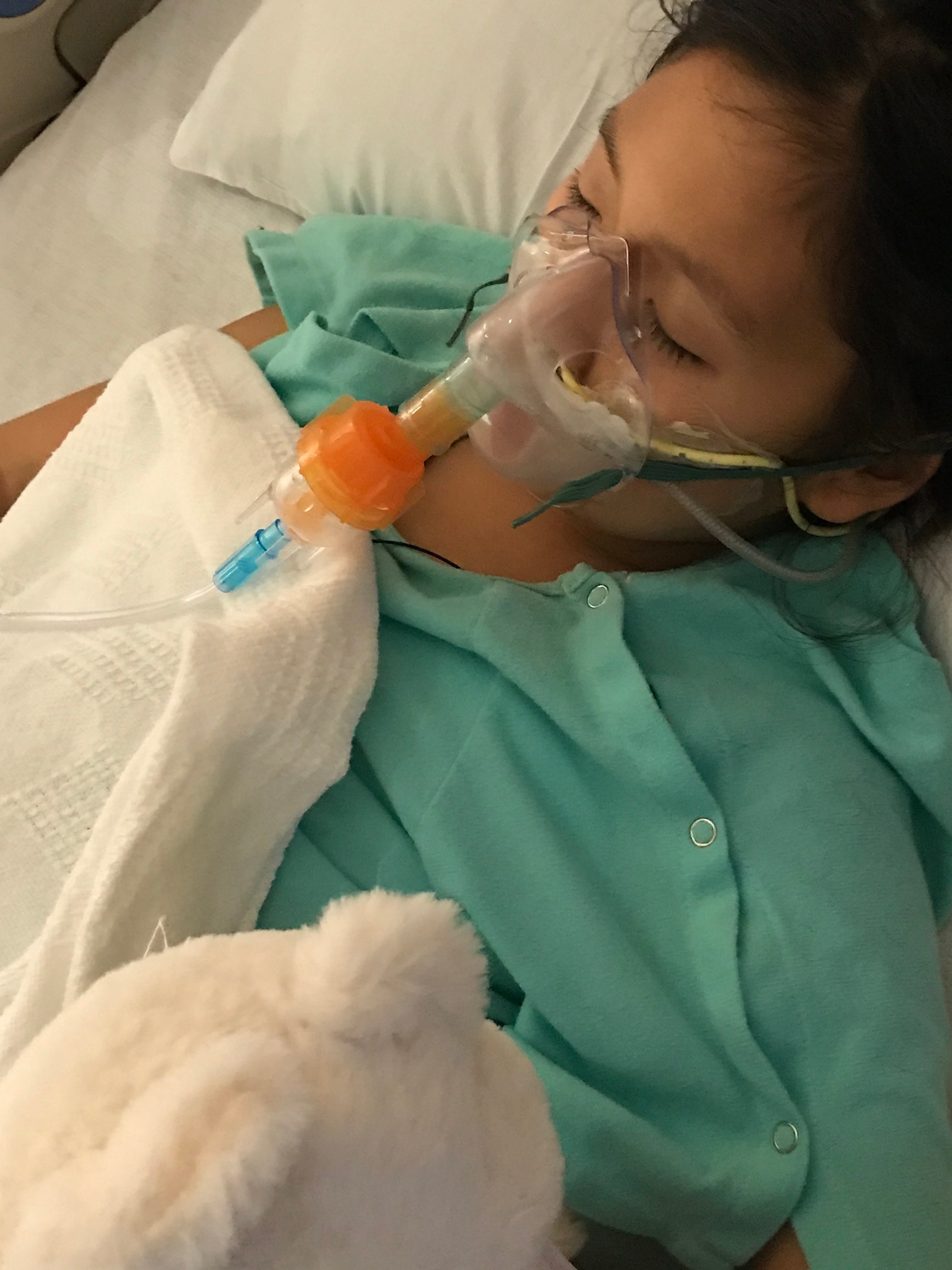
Do you have a compelling personal story you’d like to see published on HuffPost? Find out what we’re looking for here and send us a pitch.

Share Button

My Little Brother Died With An Unfinished Book And Adventure – Now I’m Completing Both

It was 5 days after my brother Toby’s death and, standing on a windswept Cornish headland in mid-January 2022, with some of his best friends, I decided to write the book “Moderate Becoming Good Later”.

It wasn’t my book to write but, as I reeled from the grief of losing my second brother and the last member of my close family, I realised that finishing it was the best thing I could still give him.
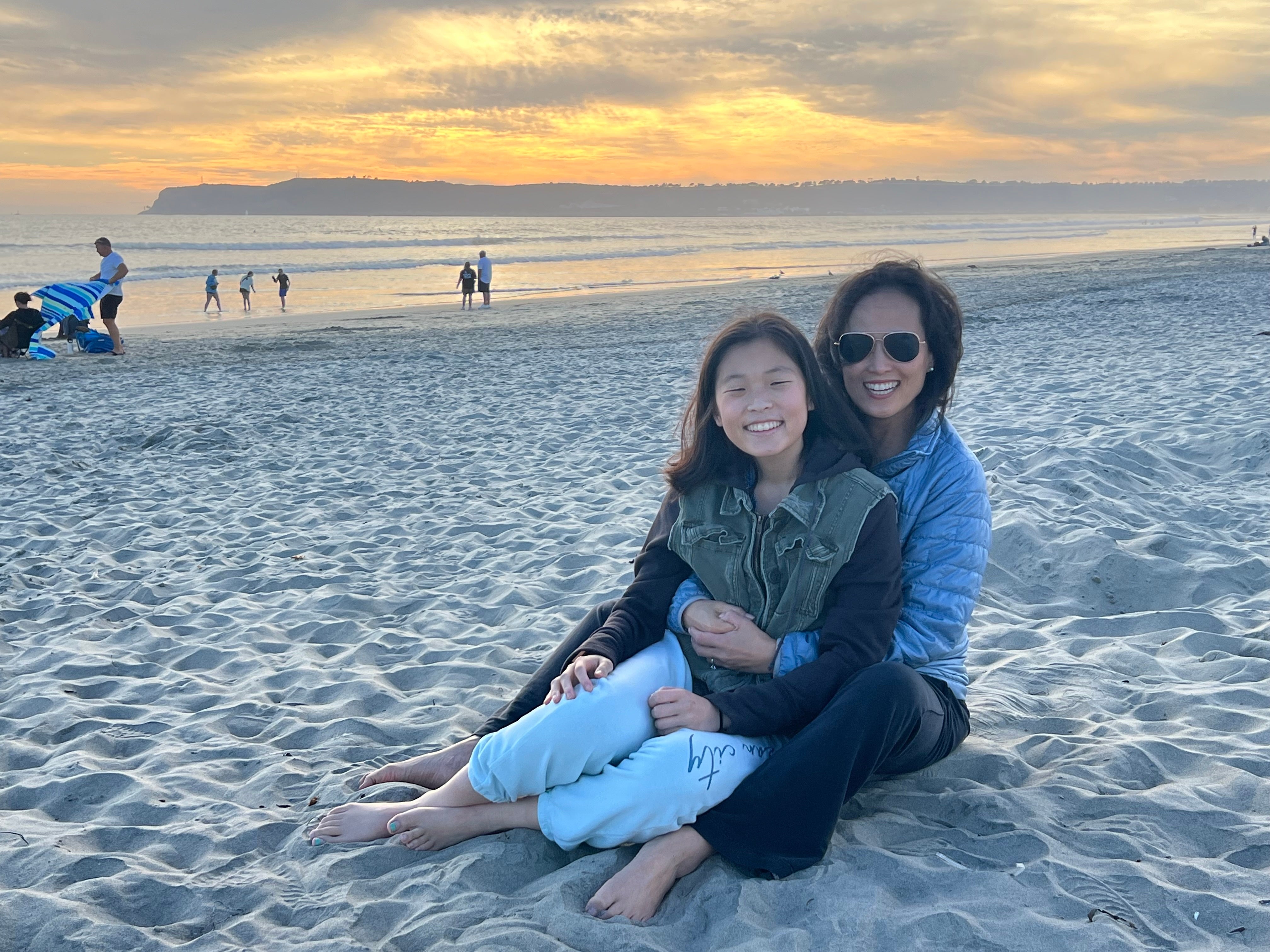
Like many of his friends and family, I knew all about the project. How he’d set off three and a half years earlier on a self-imposed challenge to sea kayak in all 31 sea areas of the Shipping Forecast (the marine weather forecast for the waters around the UK – reaching from Iceland in the north to Portugal in the south) and how in November 2021, he’d signed a publishing contact with Summersdale Publishers to tell his story.

I knew he hadn’t completed it (the agreement with the publishers was based on a proposal with 3 sample chapters). Before he died, he had taken to being somewhat elusive about how much he had drafted. Fair enough, I thought, because at this stage he was in the midst of terminal cancer. But admittedly, I was disappointed when I opened his external disk drive and clicked on the hopefully entitled “MBGL” folder, to find it empty.

A few days later, I came across the handwritten notebooks he had filled during his travels.

The detail in his observations lead me to one conclusion: he wanted his story to be told.

“Sitting in a chringhito beach bar overlooking the Ria Vigo,” he wrote in August 2019, “sailing boats low in water. Mist gradually lifting mountains re-emerging. Fading sunlight shining through the leaves of plants. A few people enjoying the loss of the sun on the beach. Low light picks up shadows on the bumpy sand making it look like waves.”

Now this I could work with.

For Toby, being in nature was one of the ways he dealt with Marcus’s death. It became a way for him to choose a full adventurous life, while no doubt, thinking in the back of his mind, “I’m next.”

So, I sat down for months with Toby’s notes, his blogs, his phone, his photos, his voice recordings and his videos and pieced together the book. When I look back, I feel like I was staring down a lion. Having lost my other brother Marcus in 2017, from cancer caused by Fanconi Anaemia (a rare illness they both shared), my dad from a heart attack in 2010, and my mum to mental illness in 1988, I knew that there is no running away from grief. Why not then turn to face it?

Cue a lot of crying at my desk and thinking to myself “who the hell does this?”. And yet, little by little, I got through it.

I spent an extra year with Toby at the best time in his life thanks to the book. On an adventure myself, I eventually turned something as ugly as cancer and death into something beautiful, despite acknowledging how hard they can be to deal with.

And something else happened, the more time I spent on the book, the more I wanted to get outside. For Toby, being in nature was one of the ways he dealt with Marcus’s death. It became a way for him to choose a full adventurous life, while no doubt, thinking in the back of his mind, “I’m next.”

On the 4 of January 2022, 6 days before he died, he wrote a note about the book and his journey on his laptop:

“It’s been a special experience that has shown me what can happen when you open the door to new adventures, perhaps asking what if? rather than why? …I hope that the journey can help others to find ways to connect with nature and imagine different realities.”

This comment stuck with me as I put the finishing touches to the manuscript in January this year. Who was I as the co-author to be encouraging others to get outside, when I struggle to get my kids dressed, fed and around the corner to the bus each school day?

Yes, I’d had some adventures, but since I became a mum they had been severely curtailed. Then I realised: Toby didn’t just leave me a book to write, he also left me an adventure to finish.

The adventure is on.

Katie Carr

The adventure is on.

Toby kayaked in 17 of the 31 sea areas of the Shipping Forecast, as part of the project. 4 of the ones left have no land, so are challenging to get to in a sea kayak, which leaves 10 areas for me. Rudimentary maths done; it was time to think feasibility.

When Toby started his journey, he’d been sea kayaking for over seven years, had the highest coaching and leading qualification that British Canoeing awards, was 10 years younger than me, had no kids and lived in the UK. I, on the other hand had never been in a sea kayak, was a mum of two and lived in Spain.

But this did not deter me. Toby’s challenge was to sea kayak in all areas of the Shipping Forecast. He was interested in the history of the places, the sense of connection across the seas and the solace you can find in the wild. I could see myself doing that bit.

I’d already made up my mind to finish Toby’s Shipping Forecast challenge when my aunt Nicky got me in a sea kayak for the first time in the clear turquoise waters of the Costa Brava (just up the coast from Barcelona). I was relieved to find out that kayaking is a rather lovely thing to do, just as well really! All I needed to do now was get better at it.

With Nicky’s help a plan came together: start in Bristol in early March, continue in May in Pembrokeshire and Anglesey, take the kayak to Ireland and tick of the Irish sea areas during a 3-week family holiday with my partner and 2 young boys in late June, then Hebrides in August – all of these with experienced sea kayakers. I’ll then complete the last 4 areas next year, ended up in the Shetland Islands.

So, the adventure is on. I know I wouldn’t have found the time to complete it if it was “just for me” but since it’s for Toby, I will.

And perhaps that’s the best thing that Toby could have given me.

Share Button