So, Should You Cancel Your New Year’s Eve Party?

Professor Lawrence Young, a virologist and professor of molecular oncology at Warwick Medical School, University of Warwick, says that having no restrictions for Christmas means we’ll be paying for it later.

“This is a very risky approach and is very likely to result in the need for more stringent restrictions in the near future,” he says.

“Given the extraordinarily and inexorable rapid spread of the omicron variant, it’s never been more important for people to take individual responsibility to protect themselves, their families and friends.”

He adds that it may take individual initiative to curb the spread of Covid (which, unfortunately might mean cancelling any New Year party you may have had planned).

Professor Young adds: “While we are hopeful that vaccines will do a lot of the heavy lifting when it comes to keeping omicron under control, other interventions are also required to prevent case numbers rising and the NHS becoming overwhelmed. Limiting the size of gatherings, avoiding crowded indoor spaces with poor ventilation, wearing a face covering and frequent use of lateral flow tests are all protective measures that we can take to limit the spread of this variant.”

If we aren’t being responsible with our Covid measures, and if the government aren’t more stern, then consequence will be severe, he adds.

“If the omicron variant continues to spread at the current rate, it is inevitable that more restrictions will be necessary in England. Waiting for case numbers and hospitalisations to increase is likely to be too late to suppress the spread of the omicron variant and will subject the NHS to unprecedented pressure.”

Prof. Young believes we need to “buy time” to ensure the booster jabs have taken effect and” not let Omicron continue to spread unfettered”.

“A short circuit break now would have prevented more people from getting infected and from having to isolate which is now impacting many essential services,” he says. “Have we learnt nothing from our previous experiences with coronavirus? Dither and delay will only mean more harsh measures later while we run the very real risk of many folk getting sick and massive disruption due to staff absences.”

So whatever your New Year plans, celebrate safely.

Share Button

Covid Latest: Why The Next Few Days Are Crucial

Downing Street has ruled out introducing any further restrictions this side of Christmas, but it remains unclear if this will change once the festive season is over.

As Omicron has swept through London at an alarming rate, making it the epicentre for the virus in the UK in just a few weeks.

So when it comes to weighing up the impact of Omicron and the potential damage from new Covid measures, the government and its scientific advisers are expected to look to the capital first to gage just what this new variant might do.

What’s going on in London?

Covid cases in London are increasing rapidly.

According to London.gov.uk, 20,491 people tested positive on Tuesday 21 December.

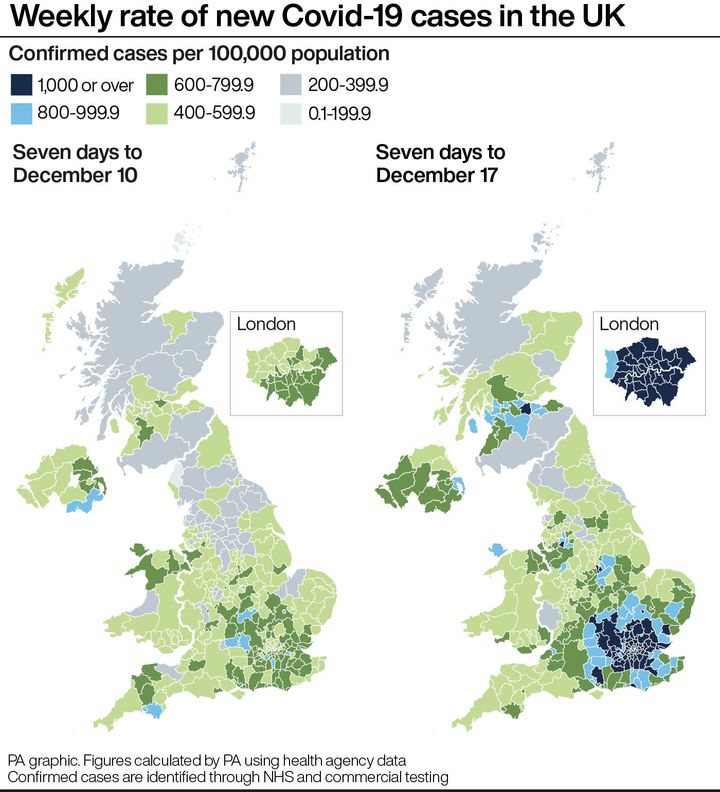
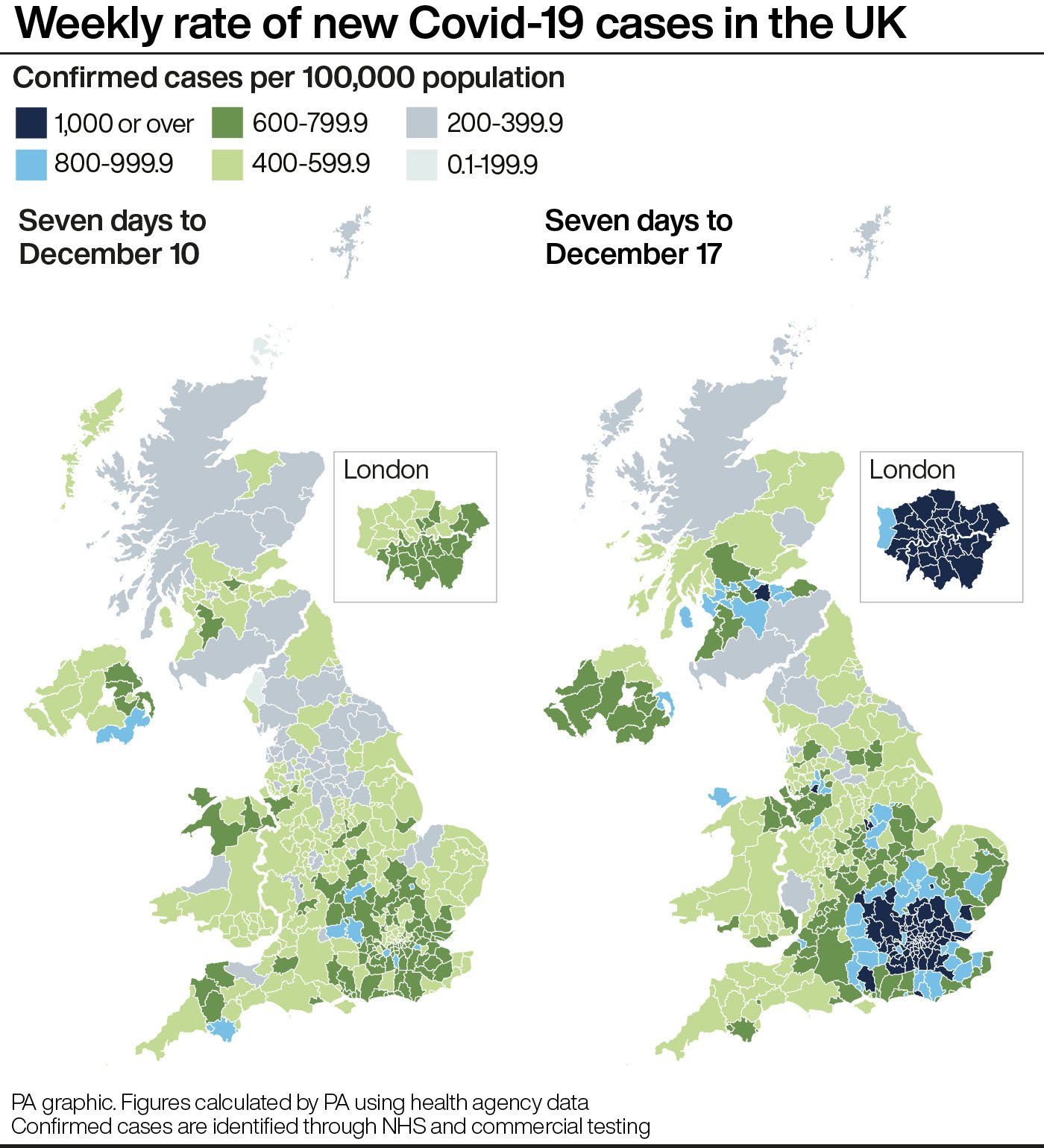
For the week ending 16 December, there were more than 800 positive cases per 100,000 population in every London borough.

Weekly rate of new Covid-19 cases in the UK show how London infections have shot up in recent weeks

PA Graphics/Press Association Images

Weekly rate of new Covid-19 cases in the UK show how London infections have shot up in recent weeks

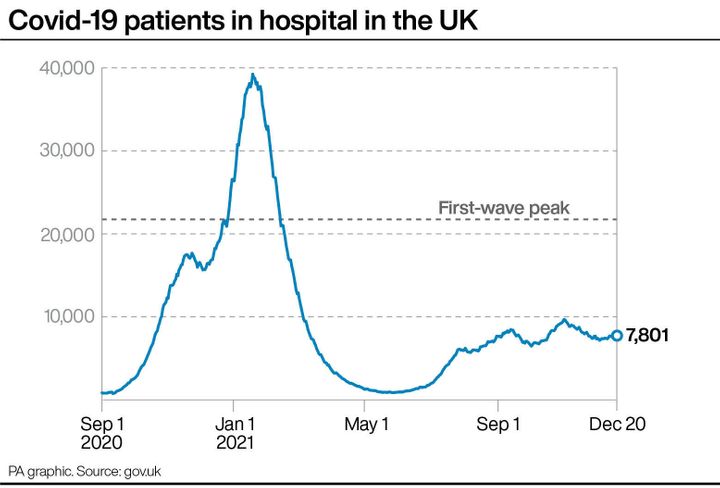
There were 1,904 total patients in London hospitals with Covid on Tuesday, up by approximately 600 compared to Tuesday 14 December.

On Sunday 19 December, 245 new patients were admitted to hospital in London with Covid.

There were 201 Covid patients in ventilation beds in London, an increase of seven since last week, and 19 people died in the city’s hospitals after testing positive for Covid.

According to Jane Merrick in the i, experts are most interested in the hospitalisation rate.

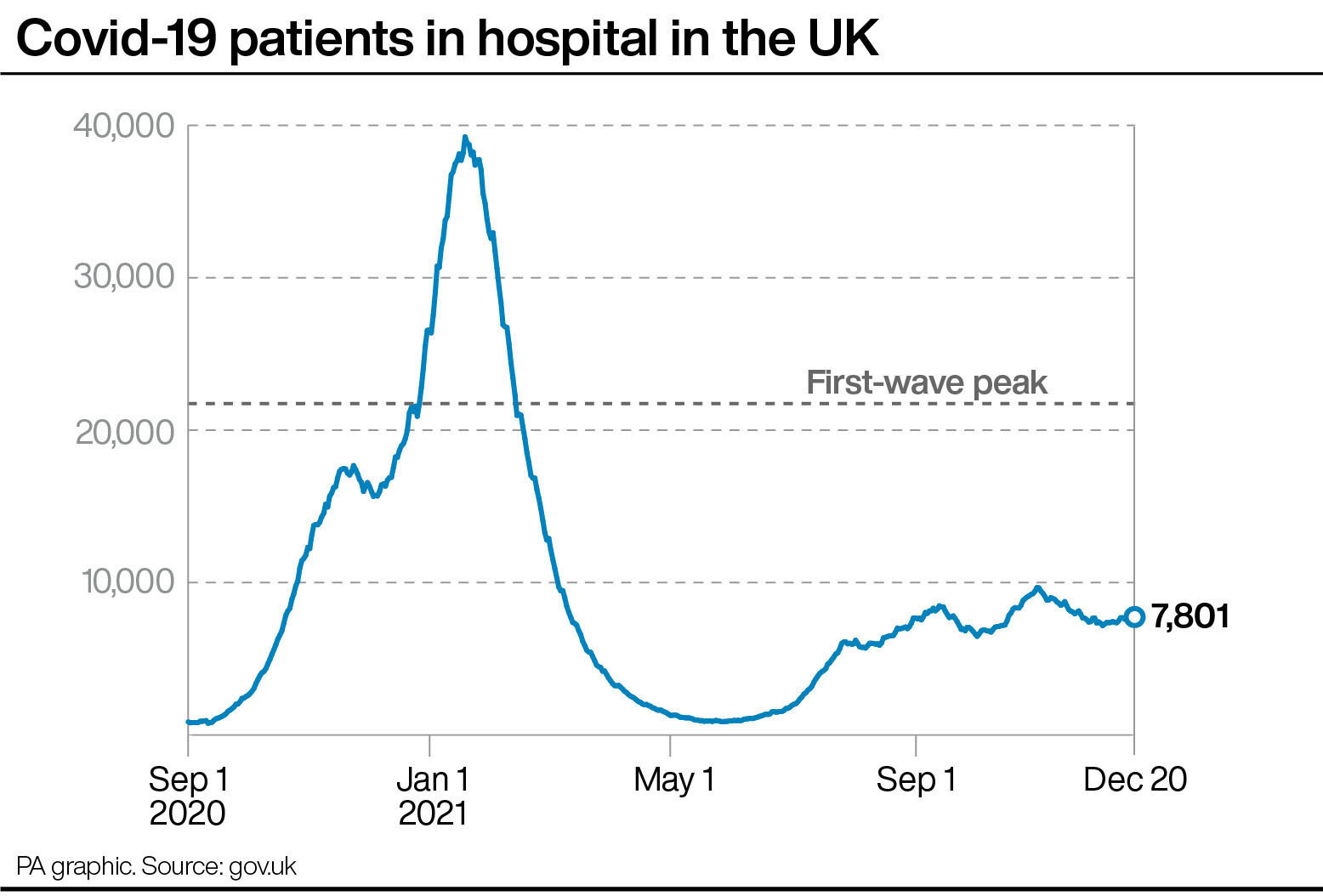
If the hospitalisations exceed around 400 Covid patients a day in London, that could put intense pressure on the NHS – meaning the virus was causing too much damage to the health service and more restrictions would be needed.

Covid-19 patients in hospital in the UK

PA GraphicsPress Association Images

Covid-19 patients in hospital in the UK

Why does this matter?

If hospitalisation numbers become too high in London, that suggests the rest of the country would soon follow suit.

As prime minister Boris Johnson has explained, scientists are still not clear how severe Omicron can be in some people who get infected.

Without this knowledge the government does not want to press on with introducing further restrictions.

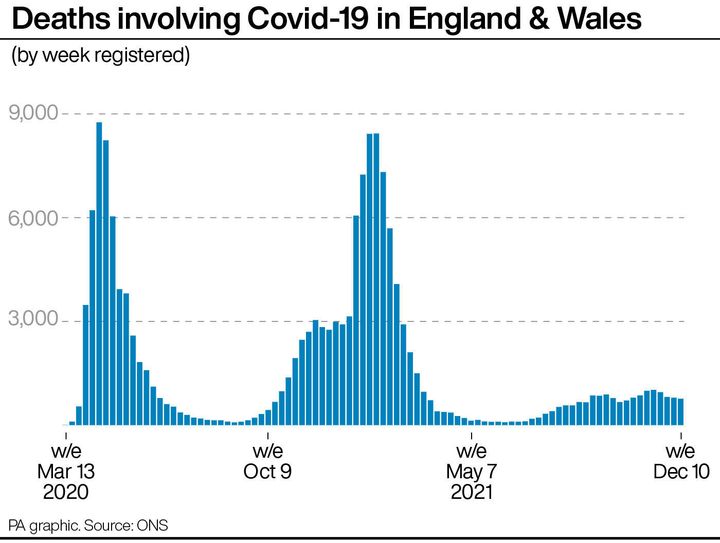
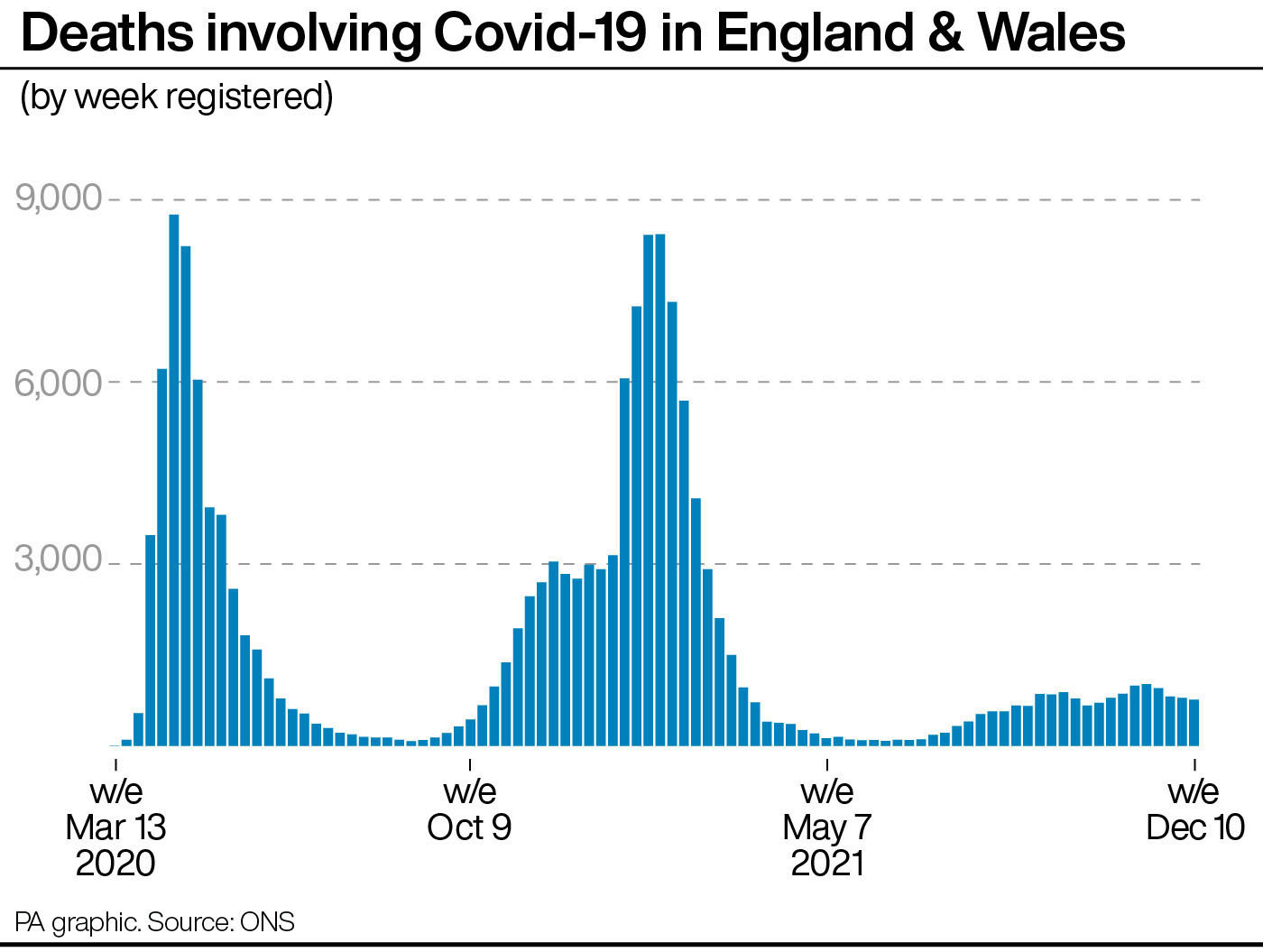
Deaths involving Covid-19 in England & Wales

PA GraphicsPress Association Images

Deaths involving Covid-19 in England & Wales

How hopeful should we be?

It’s important to note that hospitalisations lag behind infection rates by approximately two weeks.

But, as Omicron tightened its grip on London at the start of December, there is a chance that the low hospital admission rate may indicate the new variant truly isn’t as severe as the previous strains.

Covid rates in London hospitals are much lower than those at the end of 2020, when Johnson announced the UK’s third lockdown.

Approximately 1,904 people are in hospital now compared to 3,367 last year.

The World Health Organisation’s professor Paul Hunter told The Times that current Omicron infections were less than half of the original forecast – expected to be at 200,000 positive cases a day by 20 December.

He added: “It’s possible that something is changing with the epidemiology of Omicron – it’s possible that it’s not growing at the rate that it was.”

What else could impact the UK’s Omicron response?

London’s infection rate is not the only factor which will influence the government’s Covid response, especially as the variant spread rapidly through the UK.

The priority is still whether or not the NHS can cope if there’s a surge in cases, especially if some healthcare workers are off sick themselves with the virus.

Cases across the UK seems to have stabilised at approximately 90,000 for the sixth day in a row, too, despite the concerning situation in London.

Share Button

Covid: Self-isolation cut from 10 days to seven with negative test

Infected people in England can end quarantine early with negative test results on day six and seven.

Share Button

Covid: No new restrictions in England before Christmas – Boris Johnson

But Boris Johnson says “we can’t rule out any further measures after Christmas” as Omicron spreads fast.

Share Button

Covid-19: Israel could become the first country to give four vaccine doses

A fourth booster would be offered to over-60s and health workers as Israel prepares for Omicron wave.

Share Button

Birds’ dazzling iridescence tied to nanoscale tweak of feather structure

The iridescent shimmer that makes birds such as peacocks and hummingbirds so striking is rooted in a natural nanostructure so complex that people are only just beginning to replicate it technologically. The secret to how birds produce these brilliant colors lies in a key feature of the feather’s nanoscale design, according to a study led by Princeton University researchers and published in the journal eLife.

The researchers found an evolutionary tweak in feather nanostructure that has more than doubled the range of iridescent colors birds can display. This insight could help researchers understand how and when brilliant iridescence first evolved in birds, as well as inspire the engineering of new materials that can capture or manipulate light.

As iridescent birds move, nanoscale structures within their feathers’ tiny branch-like filaments — known as barbules — interact with light to amplify certain wavelengths depending on the viewing angle. This iridescence is known as structural coloration, wherein crystal-like nanostructures manipulate light.

“If you take a single barbule from an iridescent feather, cross-section it and put it under an electron microscope, you’ll see an ordered structure with black dots, or sometimes black rings or platelets, within a gray substrate,” said first author Klara Nordén, a Ph.D. student in the lab of senior author Mary Caswell Stoddard, associate professor of ecology and evolutionary biology at Princeton and associated faculty in Princeton’s High Meadows Environmental Institute (HMEI). “The black dots are pigment-filled sacs called melanosomes, and the gray surrounding them is feather keratin. I find these nanoscale structures just as beautiful as the colors they produce.”

Curiously, the melanosome structures come in variety of shapes. They can be rod-shaped or platelet-shaped, solid or hollow. Hummingbirds, for example, tend to have hollow, platelet-shaped melanosomes, while peacocks have rod-shaped melanosomes. But why birds evolved iridescent nanostructures with so many different types of melanosomes has been a mystery, with scientists unsure if some melanosome types are better than others at producing a broad range of vibrant colors.

To answer this question, the researchers combined evolutionary analysis, optical modeling and plumage measurements — all of which allowed them to uncover general design principles behind iridescent feather nanostructures.

Nordén and Stoddard worked with co-author Chad Eliason, a postdoctoral fellow at The Field Museum, to first survey the literature and compile a database of all described iridescent feather nanostructures in birds, which included more than 300 species. They then used a family tree of birds to illustrate which groups evolved the different melanosome types.

There are five primary types of melanosomes in iridescent feather nanostructures: thick rods, thin rods, hollow rods, platelets and hollow platelets. Except for thick rods, all of these melanosome types are found in brilliantly colored plumage. Because the ancestral melanosome type is rod-shaped, previous work focused on the two obvious features unique to iridescent structures: platelet shape and hollow interior.

However, when the researchers evaluated the results of their survey, they realized that there was a third melanosome feature that has been overlooked — thin melanin layers. All four melanosome types in iridescent feathers — thin rods, hollow rods, platelets and hollow platelets — create thin melanin layers, much thinner than a structure built with thick rods. This is important because the size of the layers in the structures is key to producing vibrant colors, Nordén said.

“Theory predicts that there is a kind of Goldilocks zone in which the melanin layers are just the right thickness to produce really intense colors in the bird-visible spectrum,” she said. “We suspected that thin rods, platelets or hollow forms may be alternative ways to reach that ideal thickness from the much larger ancestral melanosome size — the thick rods.”

The researchers tested their idea on bird specimens at the American Museum of Natural History in New York City by measuring the color of iridescent bird plumage that results from nanostructures with different melanosome types. They also used optical modeling to simulate the colors that would be possible to produce with different types of melanosomes. From these data, they determined which feature — thin melanin layers, platelet shape or hollowness — has the greatest influence on the range and intensity of color. Combining the results of the optical modeling and plumage analyses, the researchers determined that thin melanin layers — no matter the shape of the melanosomes — nearly doubled the range of colors an iridescent feather could produce.

“This key evolutionary breakthrough — that melanosomes could be arranged in thin melanin layers — unlocked new color-producing possibilities for birds,” Stoddard said. “The diverse melanosome types are like a flexible nanostructural toolkit, offering different routes to the same end: brilliant iridescent colors produced by thin melanin layers.”

This may explain why there exists such a great diversity of melanosome types in iridescent nanostructures. Iridescent nanostructures likely evolved many times in different groups of birds, but, by chance, thin melanin layers evolved from a thick rod in different ways. Some groups evolved thin melanin layers by flattening the melanosomes (producing platelets), others by hollowing out the interior of the melanosome (producing hollow forms), and yet others by shrinking the size of the rod (producing thin rods).

The findings of the study could be used to reconstruct brilliant iridescence in prehistoric animals, Nordén said. Melanosomes can be preserved in fossil feathers for millions of years, which means that paleontologists can infer original feather color — even iridescence — in birds and dinosaurs by measuring the size of fossilized melanosomes.

“Based on the thick solid rods that have been described in the plumage of Microraptor, for example, we can say that this feathered theropod likely had iridescent plumage much more like that of a starling than that of a peacock,” Nordén said.

The composition of melanosomes and keratin in bird feathers could hold clues for engineering advanced iridescent nanostructures that can efficiently capture or manipulate light, or be used to produce eco-friendly paints that do not require dyes or pigments. Super-black coatings such as Vantablack similarly use nanostructures that absorb and disperse rather than reflect light, similar to the black plumage of species in the birds-of-paradise (Paradisaeidae) family.

Iridescent feathers also could lead to a richer understanding of multifunctional materials, Nordén said. Unlike human-made materials, which are often developed for a single function, natural materials are inherently multipurpose. Melanin not only helps produce iridescence; it also protects birds from dangerous ultraviolet radiation, strengthens feathers and inhibits microbial growth.

“What if the different types of melanosomes initially evolved for some reason unrelated to the iridescent color — such as for making the feather mechanically stronger, or more resistant to microbial attack,” Nordén said. “These are some of the questions we are excited to tackle next.”

Share Button

Exquisitely preserved embryo found inside fossilized dinosaur egg

A 72 to 66-million-year-old embryo found inside a fossilised dinosaur egg sheds new light on the link between the behaviour of modern birds and dinosaurs, according to a new study.

The embryo, dubbed ‘Baby Yingliang’, was discovered in the Late Cretaceous rocks of Ganzhou, southern China and belongs to a toothless theropod dinosaur, or oviraptorosaur. Among the most complete dinosaur embryos ever found, the fossil suggests that these dinosaurs developed bird-like postures close to hatching.

Scientists found the posture of ‘Baby Yingliang’ unique among known dinosaur embryos — its head lies below the body, with the feet on either side and the back curled along the blunt end of the egg. Previously unrecognised in dinosaurs, this posture is similar to that of modern bird embryos.

In modern birds, such postures are related to ‘tucking’ — a behaviour controlled by the central nervous system and critical for hatching success. After studying egg and embryo, researchers believe that such pre-hatching behaviour, previously considered unique to birds, may have originated among non-avian theropods.

Led by scientists from the University of Birmingham and China University of Geosciences (Beijing), the research team from institutions in China, UK and Canada today published its findings in iScience.

The embryo is articulated in its life position without much disruption from fossilisation. Estimated to be 27 cm long from head to tail, the creature lies inside a 17-cm-long elongatoolithid egg. The specimen is housed in Yingliang Stone Nature History Museum.

Fion Waisum Ma, joint first author and PhD researcher at the University of Birmingham, said: “Dinosaur embryos are some of the rarest fossils and most of them are incomplete with the bones dislocated. We are very excited about the discovery of ‘Baby Yingliang’ — it is preserved in a great condition and helps us answer a lot of questions about dinosaur growth and reproduction with it.

“It is interesting to see this dinosaur embryo and a chicken embryo pose in a similar way inside the egg, which possibly indicates similar prehatching behaviours.”

‘Baby Yingliang’ was identified as an oviraptorosaur based on its deep, toothless skull. Oviraptorosaurs are a group of feathered theropod dinosaurs, closely related to modern-day birds, known from the Cretaceous of Asia and North America. Their variable beak shapes and body sizes are likely to have allowed them to adopt a wide range of diets, including herbivory, omnivory and carnivory.

Birds are known to develop a series of tucking postures, in which they bend their body and bring their head under their wing, soon before hatching. Embryos that fail to attain such postures have a higher chance of death due to unsuccessful hatching.

By comparing ‘Baby Yingliang’ with the embryos of other theropods, long-necked sauropod dinosaurs and birds, the team proposed that tucking behaviour, which was considered unique to birds, first evolved in theropod dinosaurs many tens or hundreds of millions of years ago. Additional discoveries of embryo fossils would be invaluable to further test this hypothesis.

Professor Lida Xing from China University of Geosciences (Beijing), joint first author of the study, said: “This dinosaur embryo was acquired by the director of Yingliang Group, Mr Liang Liu, as suspected egg fossils around the 2000. During the construction of Yingliang Stone Nature History Museum in 2010s, museum staff sorted through the storage and discovered the specimens.

“These specimens were identified as dinosaur egg fossils. Fossil preparation was conducted and eventually unveiled the embryo hidden inside the egg. This is how ‘Baby Yingliang’ was brought to light.”

Professor Steve Brusatte from the University of Edinburgh, part of the research team, said: “This dinosaur embryo inside its egg is one of the most beautiful fossils I have ever seen. This little prenatal dinosaur looks just like a baby bird curled in its egg, which is yet more evidence that many features characteristic of today’s birds first evolved in their dinosaur ancestors.”

Share Button

Rylan Reveals He Hasn’t Quite Parted With His Old Teeth As He Discusses His More ‘Natural’ Smile

Rylan Clark has revealed he isn’t quite ready to say goodbye to his old teeth just yet, despite having his famous veneers removed last month.

Now speaking to the MailOnline, Rylan said he’s still in possession of the veneers, and has some ideas about what to do with them next.

“I’ve still got them, they’re in a bag somewhere, I’m gonna get them framed,” he revealed.

“The new ones are a hell of a lot smaller, I couldn’t fit the last ones on a plane to the Pacific so I thought I’d make them a lot more natural.

“If I didn’t have the veneers, I would look like a gummy t**t so they’re staying.”

He added: “I do feel the older I get, the more comfortable I get with how I look and slow stuff down, hence the change of teeth and things like that.”

Rylan has previously stated that his veneers actually helped his career in the early days as they distracted viewers from his presenting ability.

He told Notebook in 2017: “I got my veneers finished the day before I started hosting Big Brother’s Bit On The Side, my first presenting job.

Share Button

Engineers test an idea for a new hovering rover

Aerospace engineers at MIT are testing a new concept for a hovering rover that levitates by harnessing the moon’s natural charge.

Because they lack an atmosphere, the moon and other airless bodies such as asteroids can build up an electric field through direct exposure to the sun and surrounding plasma. On the moon, this surface charge is strong enough to levitate dust more than 1 meter above the ground, much the way static electricity can cause a person’s hair to stand on end.

Engineers at NASA and elsewhere have recently proposed harnessing this natural surface charge to levitate a glider with wings made of Mylar, a material that naturally holds the same charge as surfaces on airless bodies. They reasoned that the similarly charged surfaces should repel each other, with a force that lofts the glider off the ground. But such a design would likely be limited to small asteroids, as larger planetary bodies would have a stronger, counteracting gravitational pull.

The MIT team’s levitating rover could potentially get around this size limitation. The concept, which resembles a retro-style, disc-shaped flying saucer, uses tiny ion beams to both charge up the vehicle and boost the surface’s natural charge. The overall effect is designed to generate a relatively large repulsive force between the vehicle and the ground, in a way that requires very little power. In an initial feasibility study, the researchers show that such an ion boost should be strong enough to levitate a small, 2-pound vehicle on the moon and large asteroids like Psyche.

“We think of using this like the Hayabusa missions that were launched by the Japanese space agency,” says lead author Oliver Jia-Richards, a graduate student in MIT’s Department of Aeronautics and Astronautics. “That spacecraft operated around a small asteroid and deployed small rovers to its surface. Similarly, we think a future mission could send out small hovering rovers to explore the surface of the moon and other asteroids.”

The team’s results appear in the current issue of the Journal of Spacecraft and Rockets. Jia-Richards’ co-authors are Paulo Lozano, the M. Alemán-Velasco Professor of Aeronautics and Astronautics and director of MIT’s Space Propulsion Lab; and former visiting student Sebastian Hampl, now at McGill University.

Ionic force

The team’s levitating design relies on the use of miniature ion thrusters, called ionic-liquid ion sources. These small, microfabricated nozzles are connected to a reservoir containing ionic liquid in the form of room-temperature molten salt. When a voltage is applied, the liquid’s ions are charged and emitted as a beam through the nozzles with a certain force.

Lozano’s team has pioneered the development of ionic thrusters and has used them mainly to propel and physically maneuver small satellites in space. Recently, Lozano had seen research showing the levitating effect of the moon’s charged surface on lunar dust. He also considered the electrostatic glider design by NASA and wondered: Could a rover fitted with ion thrusters produce enough repulsive, electrostatic force to hover on the moon and larger asteroids?

To test the idea, the team initially modeled a small, disk-shaped rover with ion thrusters that charged up the vehicle alone. They modeled the thrusters to beam negatively charged ions out from the vehicle, which effectively gave the vehicle a positive charge, similar to the moon’s positively charged surface. But they found this was not enough to get the vehicle off the ground.

“Then we thought, what if we transfer our own charge to the surface to supplement its natural charge?” Jia-Richards says.

By pointing additional thrusters at the ground and beaming out positive ions to amplify the surface’s charge, the team reasoned that the boost could produce a bigger force against the rover, enough to levitate it off the ground. They drew up a simple mathematical model for the scenario and found that, in principle, it could work.

Based on this simple model, the team predicted that a small rover, weighing about two pounds, could achieve levitation of about one centimeter off the ground, on a large asteroid such as Psyche, using a 10-kilovolt ion source. To get a similar liftoff on the moon, the same rover would need a 50-kilovolt source.

“This kind of ionic design uses very little power to generate a lot of voltage,” Lozano explains. “The power needed is so small, you could do this almost for free.”

In suspension

To be sure the model represented what could happen in a real environment in space, they ran a simple scenario in Lozano’s lab. The researchers manufactured a small hexagonal test vehicle weighing about 60 grams and measuring about the size of a person’s palm. They installed one ion thruster pointing up, and four pointing down, and then suspended the vehicle over an aluminum surface from two springs calibrated to counteract Earth’s gravitational force. The entire setup was placed within a vacuum chamber to simulate the airless environment of the moon and asteroids.

The researchers also suspended a tungsten rod from the experiment’s springs, and used its displacement to measure how much force the thrusters produced each time they were fired. They applied various voltages to the thrusters and measured the resulting forces, which they then used to calculate the height the vehicle alone could have levitated. They found these experimental results matched with predictions of the same scenario from their model, giving them confidence that its predictions for hovering a rover on Psyche and the moon were realistic.

The current model is designed to predict the conditions required to simply achieve levitation, which happened to be about 1 centimeter off the ground for a 2-pound vehicle. The ion thrusters could generate more force with larger voltage to lift a vehicle higher off the ground. But Jia-Richards says the model would need revising, as it doesn’t account for how the emitted ions would behave at higher altitudes.

“In principle, with better modeling, we could levitate to much higher heights,” he says.

In that case, Lozano says future missions to the moon and asteroids could deploy rovers that use ion thrusters to safely hover and maneuver over unknown, uneven terrain.

“With a levitating rover, you don’t have to worry about wheels or moving parts,” Lozano says. “An asteroid’s terrain could be totally uneven, and as long as you had a controlled mechanism to keep your rover floating, then you could go over very rough, unexplored terrain, without having to dodge the asteroid physically.”

This research was supported, in part, by NASA.

Share Button

Table Service-Only And Social Distancing Returns For Scottish Pubs

Pubs and restaurants in Scotland will have to become table service-only for three weeks from December 27, Nicola Sturgeon has announced.

Indoor hospitality and leisure venues will also have to ensure a one-metre distance between groups.

The first minister said the series of stricter Covid measures would need to be introduced to tackle to spread of the Omicron variant.

Large-scale Hogmanay celebrations will be cancelled and live sports will be “effectively spectator-free” for three weeks from Boxing Day.

Outdoor public events in will be capped at 500 people. Numbers at indoor public events are to be limited to 100 standing or 200 seated.

Sturgeon told the Scottish Parliament: “Difficult though it is, please follow this advice over New Year – minimise Hogmanay socialising as much as you can.

“If we all follow the advice to minimise the contact we have outside our own households, we will help limit the spread of infections. This is the bedrock of our plan for the immediate period ahead.”

In England, Boris Johnson yesterday stopped short of introducing immediate new restrictions.

But the prime minister has dropped heavy hints the tighter rules could be brought in after Christmas day.

Earlier, Cabinet Office minister Steve Barclay said the government would be looking “closely” at the data to see if a so-called circuit breaker lockdown was needed.

Transmission of Omicron has been described as “eye-wateringly high” by a leading expert.

Sir Jeremy Farrar, director of the global charitable foundation Wellcome, said “we’re in the most difficult, most uncertain time, perhaps of the whole pandemic, certainly since March of 2020.”

Share Button