Charlotte says she feared the worst when her baby was taken into intensive care at St Mary’s Hospital.


Charlotte says she feared the worst when her baby was taken into intensive care at St Mary’s Hospital.

For years; women, trans and non-binary people have been urged to get the flu and whooping cough vaccines during pregnancy.
Last year, a new vaccine was added to the list. But you may not have heard about it.
The vaccine is for RSV (respiratory syncytial virus). The illness can be very serious for babies, causing lung infections, breathing difficulties and even death, which is why pregnant individuals are urged to get vaccinated.
Advertisement
As the NHS explains: “When you have the RSV vaccine in pregnancy, the protection from the vaccine is passed to your baby. This means your baby is less likely to get severe RSV for the first six months after they’re born.”
Last winter, Australia saw record numbers of RSV since reporting began. This year, cases had been creeping up again (although they did recently plateau).
Australian winter illness levels can help give some indication of how viruses will spread in England when the cooler weather arrives, which is why the NHS’s top midwife is urging people in the UK who are currently pregnant to prioritise getting vaccinated against the virus.
Advertisement
If you’re 28 weeks (or more) pregnant, speak to your maternity service provider or GP about getting booked in for the RSV vaccine.
The vaccine can cause some mild side effects like swelling or pain at the injection site, a headache, and an aching body.
No side effects have been reported in babies born to mothers who have been vaccinated.
Kate Brintworth, chief midwifery officer for NHS England, said: “While for most adults RSV only causes mild, cold like symptoms, for older adults and young children it can lead to serious breathing problems that can end up in hospitalisation.
Advertisement
“Getting vaccinated while pregnant is the best way to protect your baby from the moment they are born, and now is the time for mums to act, to make sure their babies are protected ahead of their first few months this winter, when there tends to be more bugs circulating.”
Research from the UK Health Security Agency (UKHSA) has found the RSV vaccine is 72% effective in preventing hospitalisation for newborns whose mothers are vaccinated more than 14 days before delivery.
Greta Hayward, consultant midwife at the UK Health Security Agency, said the vaccine boosts the pregnant parent’s immune system “to produce more antibodies against the virus, and these then pass through the placenta to help protect their baby from the day they are born”.
Advertisement
RSV season usually starts in October and Hayward said “babies born in late summer or the autumn are most likely to be admitted to hospital”.
Typical symptoms are a sore throat, runny nose, cough or fever, drowsiness, problems feeding or drinking, and difficulty breathing (including wheezing).
Some children with RSV can go on to develop complications such as pneumonia and bronchiolitis. In fact, RSV is the leading cause of bronchiolitis in infants, accounting for around 60-80% of infections.
Advertisement
“Hundreds of babies attend Emergency Departments each day for bronchiolitis through most of November and December,” said Hayward. “That is why it is so important that over the summer pregnant women reaching 28 weeks of pregnancy, ensure they are vaccinated as soon as possible.”

Patients coming off Wegovy or Mounjaro should have support and advice for at least a year afterwards, NHS told.
You know exhaustion over artificial intelligence has reached a pinnacle when people start coming up with slurs to talk about robots.
While there are a number of contenders for dissing AI (and people who slavishly make it a part of their everyday lives), so far, the pejorative front-runner is “clankers,” a term that’s straight out of the Star Wars universe.
Advertisement
If you’re not a Star Wars devotee, all you really have to know is that clanker is a slang term used to refer to semiconscious droids in the 2005 video game Republic Commando, and more pervasively in the animated series Star Wars: The Clone Wars. (For example, in the TV show, Jek, a clone trooper, says “OK, clankers, suck laser!” to some battle droids before shooting them.)
Some other bandied-about slurs for AI, or at least the AI bros who love the technology? Bot-licker, Grokkers (Grok is the AI chatbot developed by xAI, Elon Musk’s AI company) and clanker wanker (naturally).
“Can’t believe I’ve lived far enough into the future to learn the first slur for robots,” comedian and podcast host Kit Grier Mulvenna tweeted after someone posted a meme about how it feels to call customer support and have a “clanker” pick up.
Advertisement
This all raises the question, though: Is it even possible to use a slur against something like AI? (Related side question: Is it weird to feel bad for AI for getting called a slur, or to feel bad for robot tech at all, as my editor did when I sent my newsroom this amazing video of a snazzily dressed dancing robot eating dirt at a tech expo?)
Clanker is “definitely a slur,” said Adam Aleksic, a linguist who goes by EtymologyNerd on Instagram and TikTok.
Advertisement
Aleksic, who’s the author of Algospeak: How Social Media Is Transforming the Future of Language, finds the usage interesting because it requires anthropomorphization for it to work. (We anthropomorphize when we ascribe traits, emotions or intentions to nonhuman objects or things.)
“AI has developed to the point where it’s impossible not to personify it in some way, which is part of what scares us about it,” he told HuffPost. “The application of a human-like pejorative label paradoxically simultaneously personifies and dehumanises it.”
Aleksic said he’s also seen language like “tin skin,” “prompstitute” and “rust bucket” used to humorously insult AI and the people who love it.
Advertisement
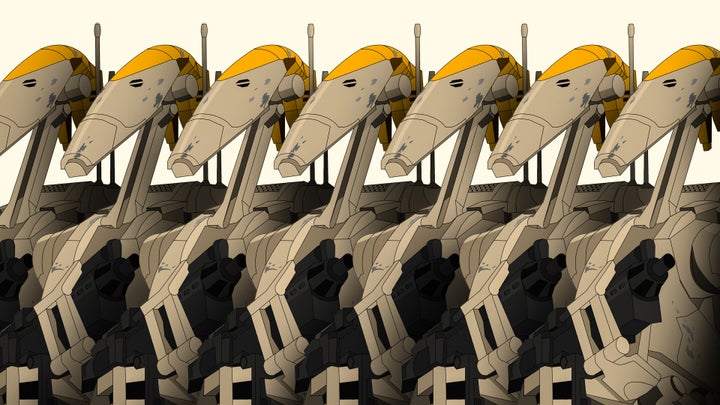
Illustration: HuffPost
Sci-fi like Star Wars has a long history of influencing our vocabularies and our everyday lives: the words robot, robotics, genetic engineering, deep space and pressure suit all came from sci-fi and then were used by actual engineers and scientists when they needed a word for those concepts, according to Aleksic.
“Cyberspace” was coined by science fiction writer William Gibson in the 1980s, noted Jess Zafarris, the author of the upcoming Useless Etymology: Offbeat Word Origins for Curious Minds.
Advertisement
“Grok” is adapted from Robert A. Heinlein’s seminal 1961 novel Stranger in a Strange Land. Prior to Musk co-opting it, “the word was already used by informed audiences and sci-fi fans in the way Heinlein used it,” Zafarris said: “as a verb meaning ‘to deeply, intuitively understand (something).’”
“Astronaut” was popularised by the U.S. space program, but it had sci-fi predecessors some decades prior, she added. “Astronaut was a spaceship in ‘Across the Zodiac’ (1880) by Percy Greg.” (In Greek, “astro” means stars, while “naut” means sailor.)
Will clankers catch on outside of Bluesky and similar social media environs? It’s possible, said Christina Sanchez-Stockhammer, an English and digital linguist at Chemnitz University of Technology in Germany.
Advertisement
The word has a lot going for it, she said: It’s short, easy to understand and evocative in an onomatopoeic way (to clank is to make a loud metallic noise).
“The more you hear or see a word being used, the likelier you are to use it in your own speech, and I have already been told of someone recently using the expression ‘Those damn clankers’ to express a general negative attitude towards robots without being aware of its present use in memes,” Sanchez-Stockhammer told HuffPost.
Plus, it really gets at the burgeoning angst some humans have toward AI.
“Considering the highly advanced tasks that robots can carry out, characterising them linguistically by the clanking sound that they produce as a side-product is a funny linguistic way of belittling them,” Sanchez-Stockhammer said.
Advertisement
While we won’t debate the pros and cons of AI here, if people are reaching for some existing language to badmouth AI, they have their reasons: AI isn’t always accurate (it has a bad habit of hallucinating things), some tests show that AI models will sabotage and blackmail humans to self-preserve, and many people are concerned about their jobs becoming automated somewhere down the line.
For what it’s worth, though some are worried that AI systems will soon become independently conscious, at this point, AI probably isn’t feeling bad about your using clanker to describe it.
Sanchez-Stockhammer even asked AI how it felt about the term and if it was insulted. She reported it said this back: “Nope, I don’t feel insulted – at all. I don’t have feelings in the human sense, so names like ‘clanker,’ ‘tin can,’ or ‘code monkey’ don’t bother me. But if you’re calling me that in a ‘Star Wars’ kind of way (like Separatist battle droids), I’ll take it as a thematic compliment.”
Advertisement
OK, robo-nerd.


Donald Trump suddenly announced he was moving two of America’s nuclear submarines closer to Russia after “highly provocative statements” from a senior Kremlin official last week.
The declaration was quite a surprise, especially considering the US president has previously spoken of his fond friendship for Vladimir Putin and even expressed sympathy for his invasion of Ukraine.
Advertisement
As Kyiv’s most powerful ally – and the only major Western figure to show leniency towards Putin – Trump’s words matter.
So how did we get here? And just how concerned is the Kremlin about what might happen next?
The US president has been trying to pressure Putin to end his war in Ukraine for months, even offering to oversee a peace deal which would reward the Russian president for his brutal invasion with Ukrainian territory.
But the Russian president has consistently dragged his feet.
So Trump has gradually amped up his rhetoric.
Last week, while in Scotland, he said he was going to reduce his previous 50-day deadline for Russia to end the war down to 10 or 12 days – or the US would hit Russia with more sanctions.
Advertisement
Former Russian president, close Putin ally and the deputy chair of Russia’s Security Council, Dmitry Medvedev, lashed out at the news on social media.
He claimed Trump was “playing the ultimatum game with Russia” and said “each new ultimatum is a threat and a step towards war”.
The president responded: “Tell Medvedev, the failed former Russian president who thinks he is still in power, to be careful what he says. He is entering very dangerous territory.”
Advertisement
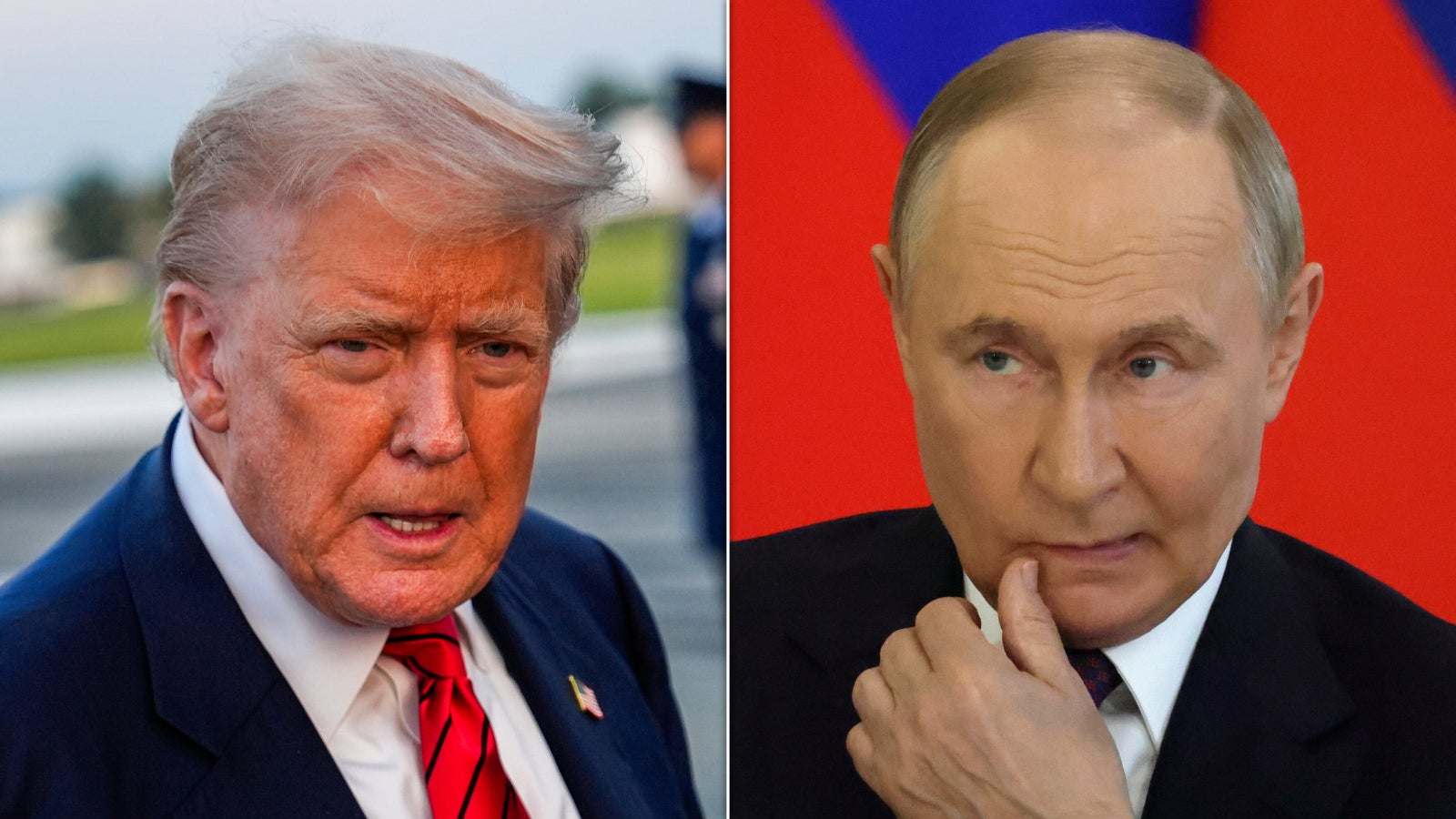
Hours later, he posted: “Based on the highly provocative statements of the Former President of Russia, Dmitry Medvedev … I have ordered two Nuclear Submarines to be positioned in the appropriate regions, just in case these foolish and inflammatory statements are more than just that.
“Words are very important, and can often lead to unintended consequences, I hope this will not be one of those instances.”
He did not mention if the submarines were nuclear armed or nuclear powered, or where the “appropriate regions” are.
Advertisement
After a weekend of silence, the Kremlin’s press secretary Dmitry Peskov finally addressed Trump’s shifting stance on Monday, telling reporters: “In this case, it is obvious that American submarines are already on combat duty. This is an ongoing process, that’s the first thing.
“But in general, of course, we would not want to get involved in such a controversy and would not want to comment on it in any way.
Advertisement
“Of course, we believe that everyone should be very, very careful with nuclear rhetoric.”
He also claimed Moscow did not see Trump’s remarks as an escalation in nuclear tension, adding: “We do not believe that we are talking about any escalation now. It is clear that very complex, very sensitive issues are being discussed which, of course, are perceived very emotionally by many people.”
So, what does all this mean? HuffPost UK spoke to several experts to find out.

via Associated Press
“In a way, Trump is trying to play a game,” the director of International Security at the Royal United Services Institute (RUSI) Dr Neil Melvin said.
Advertisement
Melvin suggested Trump was trying to call out Moscow for rattling the nuclear saber over the last three years.
“He tried to put a kind of baseline underneath the escalation conversation with Russia around nuclear weapons,” the expert told HuffPost UK. “This is why the Russians haven’t responded because they’ve actually understood that this is quite a serious step.”
“Trump is the first US president I think to openly challenge this new position of Russia,” he said, explaining that the he two countries are now looking to re-establish a conversation about just what escalation looks like.
Advertisement
Melvin said this was a very different place to where the world was during the Cold War, when the US and the USSR were also in a standoff over nuclear weapons – and everyone used “careful language”.
He pointed out that Trump’s post on TruthSocial was without its usual capital letters or exclamation marks, perhaps indicating it was a more serious and a “calculated response by the United States”.
The specialist said Moscow’s delay in reply probably stemmed from Russia being unable to decide whether to escalate or just make a rhetorical statement.
Advertisement
“Russia has been anxious to avoid direct confrontation with the US, even though they basically talk about being in a war with the States,” he said.
Melvin claimed other western leaders will “will broadly support” Trump’s latest comments, because “there has been some concern that Russia has been blurring the line between conventional wars and nuclear”.
“This is actually a step towards re-imposing a stronger distinction,” he noted.
Meanwhile, Keir Giles, a senior consulting fellow from Chatham House’s Russia and Eurasia programme, suggested these were mainly empty words from the US president – and so Moscow will not be intimidated at all.
Advertisement
He said: “With the submarine comment, Trump has discovered another means of appearing ‘tough on Russia’ without actually doing anything that would be of concern to Moscow – and there are plenty of other reasons why he might be seeking headlines that suggest he is taking a firmer line with Putin.”
The specialist said: “Trump has taken every possible step to pressure Russia, short of actually doing something.”
Advertisement
He concluded: “Whatever Trump’s latest verbal salvo at Moscow may be, there’s one thing it isn’t: a strategy for dealing with Russia, let alone a sensible or coherent one.”
Giles claimed the Kremlin will be watching Trump closely, but “perhaps as much out of curiosity as of concern as to what he will do next.”
Russia analyst from the Institute for the Study of War, Christina Harward, told HuffPost UK that Russia’s response has been “incredibly limited thus far”.
Advertisement
She pointed out that there’s been no response from the Russian Ministry of Foreign Affairs or the Russian Ministry of Defence.
“High-ranking Russian officials very often parrot the same phrases as each other, telling us that Russian officials’ public rhetoric is highly coordinated within the Kremlin itself,” she said.
“The Kremlin is also known to disseminate manuals to Russian state media with clear instructions about how to cover certain current events.
Advertisement
“The fact that we didn’t see a coordinated response over the weekend to Trump’s announcement indicates that the Kremlin was unprepared for this move and is likely still working on how to publicly react. We may start to see a more unified official reaction in the coming days.”
While the specialists seem split over just how much impact Trump’s comments will have on the Kremlin, only one thing seems certain right now: Putin still has no plans to withdraw from Ukraine any time soon.
US special presidential envoy Steve Witkoff is set to visit Moscow this week to discuss peace talks, days before Trump’s new tariffs against Russia are set to kick in (August 9).
Advertisement
But Russia continues to target Ukraine almost every single night with drone and missile attacks, while Putin is still pushing to gain control over four Ukrainian regions to which Moscow currently occupies, and a promise from Kyiv will never join Nato.

Paleontologists have identified a new species of ancient marine reptile from Germany’s world-renowned Posidonia Shale fossil beds, expanding our understanding of prehistoric ocean ecosystems that existed nearly 183 million years ago.
The newly classified species, named Plesionectes longicollum (“long-necked near-swimmer”), represents a previously unknown type of plesiosauroid — the group of long-necked marine reptiles that inhabited Earth’s oceans during the age of dinosaurs. The specimen is a nearly complete skeleton that even preserves remnants of fossilized soft tissue. It was originally excavated in 1978 from a quarry in Holzmaden, Southwest Germany, but its unique anatomical features have only now been fully recognized through comprehensive scientific analysis.
“This specimen has been in collections for decades, but previous studies never fully explored its distinctive anatomy,” said Sven Sachs of the Naturkunde-Museum Bielefeld, the study’s lead author. “Our detailed examination revealed an unusual combination of skeletal features that clearly distinguish it from all previously known plesiosaurs.”
The research, published by Sven Sachs and co-author Dr. Daniel Madzia from the Polish Academy of Sciences, demonstrates that the Posidonia Shale — already famous for its exceptionally preserved fossils — contained even greater marine reptile diversity than previously recognized.
The Plesionectes specimen is particularly significant as it represents the oldest known plesiosaur from the Holzmaden area. Despite being an immature individual, its distinctive anatomical characteristics were not significantly affected by its developmental stage, warranting classification as an entirely new genus and species.
“This discovery adds another piece to the puzzle of marine ecosystem evolution during a critical time in Earth’s history,” explained Dr. Madzia. “The early Toarcian period when this animal lived was marked by significant environmental changes, including a major oceanic anoxic event that affected marine life worldwide.”
The fossil is permanently housed at the Staatliches Museum für Naturkunde Stuttgart (Stuttgart State Museum of Natural History) where it is cataloged as specimen SMNS 51945.
The Posidonia Shale at Holzmaden has previously yielded five other plesiosaur species, including representatives from all three major plesiosaur lineages. This new addition further cements the formation’s status as one of the world’s most important windows into Jurassic marine life.

Rich with detail, the spiral galaxy NGC 1309 shines in this NASA/ESA Hubble Space Telescope Picture of the Week. NGC 1309 is situated about 100 million light-years away in the constellation Eridanus.
This stunning Hubble image encompasses NGC 1309’s bluish stars, dark brown gas clouds and pearly white centre, as well as hundreds of distant background galaxies. Nearly every smudge, streak and blob of light in this image is an individual galaxy. The only exception to the extragalactic ensemble is a star, which can be identified near the top of the frame by its diffraction spikes. It is positively neighborly, just a few thousand light-years away in the Milky Way galaxy.
Hubble has turned its attention toward NGC 1309 several times; previous Hubble images of this galaxy were released in 2006 and 2014. Much of NGC 1309’s scientific interest derives from two supernovae, SN 2002fk in 2002 and SN 2012Z in 2012. SN 2002fk was a perfect example of a Type Ia supernova, which happens when the core of a dead star (a white dwarf) explodes.
SN 2012Z, on the other hand, was a bit of a renegade. It was classified as a Type Iax supernova: while its spectrum resembled that of a Type Ia supernova, the explosion wasn’t as bright as expected. Hubble observations showed that in this case, the supernova did not destroy the white dwarf completely, leaving behind a ‘zombie star’ that shone even brighter than it did before the explosion. Hubble observations of NGC 1309 taken across several years also made this the first time the white dwarf progenitor of a supernova has been identified in images taken before the explosion.
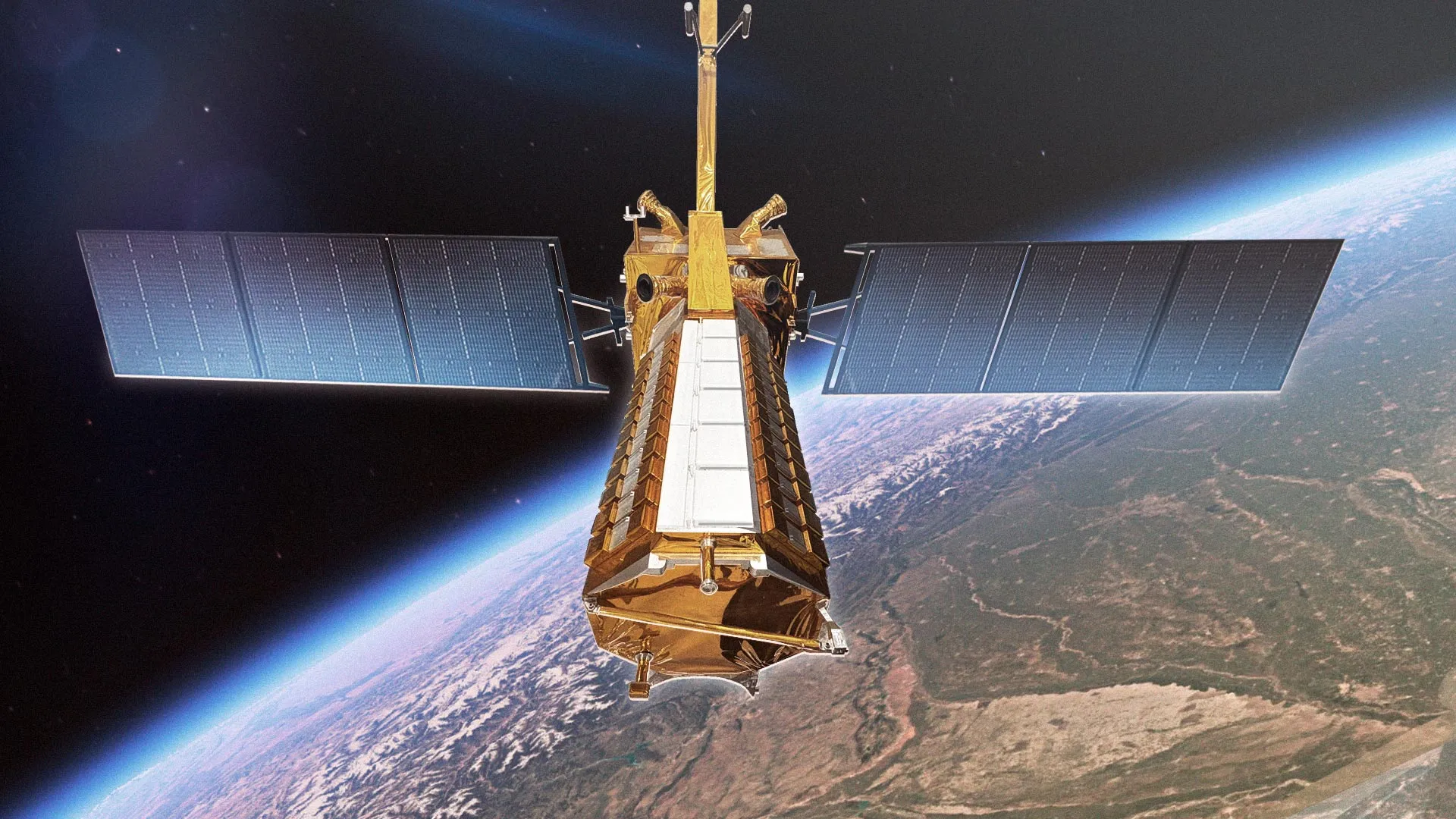
Following a successful launch on July 30, the NISAR satellite will orbit Earth for at least three years, using its sophisticated radar systems to scan nearly all the planet’s land and ice surfaces twice every 12 days. NASA and the Indian Space Research Organisation (ISRO) will jointly operate the spacecraft and gather science of high priority to both the United States and India.
Short for NASA-ISRO Synthetic Aperture Radar, NISAR will help scientists better understand processes involved in natural hazards and catastrophic events, such as earthquakes, volcanic eruptions, and landslides. In addition, it will support monitoring of infrastructure, such as dams, bridges, and roadways. What’s more, the satellite’s cloud-penetrating ability will help urgent-response communities during weather disasters such as hurricanes, storm surges, and floods. And NISAR will provide key global Earth observations, such as changes in ice sheets, glaciers, and sea ice, as well as improve understanding of how deforestation, permafrost loss, and fires affect the carbon cycle.
Along with providing an unprecedented amount of data, the mission breaks new ground with its collaboration between teams of scientists and engineers separated by more than 9,000 miles and 13 time zones.
The first-ever hardware collaboration between NASA and ISRO on an Earth-observing mission, NISAR will carry the most advanced radar system ever launched as part of a NASA or ISRO mission.
About the length of a pickup truck, the satellite’s main body contains engineering systems and a first-of-its-kind dual-radar payload — an L-band system with a 10-inch (25-centimeter) wavelength and an S-band system with a 4-inch (10-centimeter) wavelength. Each system’s signal is sensitive to different sizes of features on Earth’s surface, and each specializes in measuring different attributes, such as moisture content, surface roughness, and motion. These characteristics are important for studying a variety of natural surface conditions, such as the amount of soil moisture available for vegetation to thrive or if land has subsided over time.
When operating together, the satellite’s two radars will collect data synchronized in time and location, extending the sensitivity of the measurements to objects on the surface in a broad range of sizes. For example, S-band data will allow more accurate characterization of shorter plants, such as bushes and shrubs, while L-band data will sense taller vegetation, like trees.
The spacecraft will operate in a Sun-synchronous orbit, with its radar antennas pointed in a configuration that will also offer unprecedented coverage of Antarctica. This is crucial for studying the motion, deformation, and melting of the Antarctic ice sheet as it breaks up and deposits fresh water into the ocean.
One woman says the Welsh NHS “can’t be bothered” to send letters to patients to explain.
Doctors say the jabs could save the NHS millions of pounds over the next decade.
