This Mum Is Going Viral For Teaching Her Sons Life Skills Sans Gender Roles

Payal Desai is on a mission to make sure she’s raising boys who can take care of themselves and their emotions.

The teacher and mom from New Jersey is going viral on TikTok for sharing a series of life lessons that she’s giving her sons Carter, 7, and Dev, 3.

The videos ― which are soundtracked to Luniz’s 1995 hit “I Got 5 On It” and conclude with Desai deadpanning to the camera ― show the mom of two teaching the boys how to be non-dusty husbands to their future partners. (For the unfamiliar, “your dusty son” has become something of a meme lately; to be dusty is to exhibit an undesirable mix of laziness and general scrub-like behaviour.)

In one viral clip, she encourages Carter to make space for his feelings so he’ll know it’s normal to express what’s going on inside when he’s in a relationship. “Teaching my son to write down his feelings when he’s upset so your daughter won’t have to deal with his impulsive outbursts,” her caption reads.

<img class="img-sized__img portrait" loading="lazy" alt=""I want to equip my sons with tools in dealing with their emotions, but also let them know that there is always space for them, too," Desai said. ” width=”720″ height=”1092″ src=”https://www.wellnessmaster.com/wp-content/uploads/2023/09/this-mum-is-going-viral-for-teaching-her-sons-life-skills-sans-gender-roles-6.jpg”>

Payal Desai/TikTok

“I want to equip my sons with tools in dealing with their emotions, but also let them know that there is always space for them, too,” Desai said.

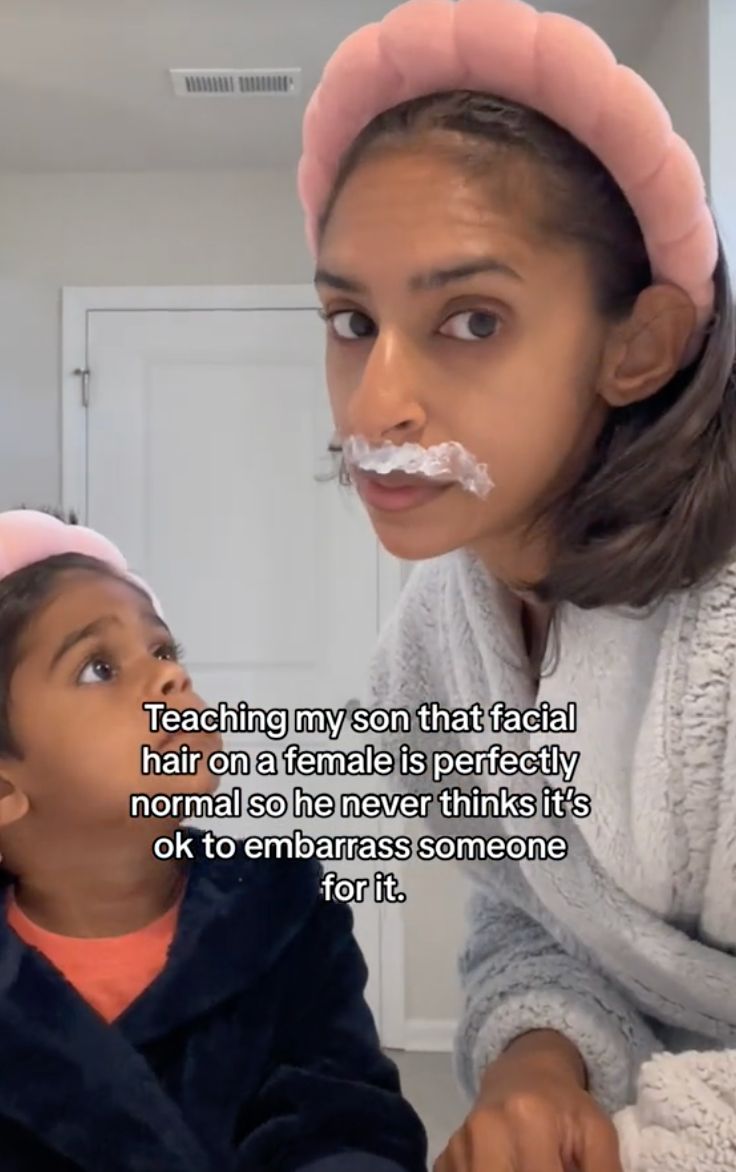
In another clip, Dev watches as his mom gets rid of peach fuzz above her lip so he’s not weird about women having body hair. “Teaching my son that facial hair on a female is perfectly normal so he never thinks it’s ok to embarrass someone for it,” it reads.

<img class="img-sized__img portrait" loading="lazy" alt="Desai's video about normalizing female facial hair is particularly popular. "I thank you for this from the bottom of my heart, from someone who was constantly bullied for her peach fuzz and hairy arms/legs," one woman wrote in the comments.” width=”720″ height=”1146″ src=”https://www.wellnessmaster.com/wp-content/uploads/2023/09/this-mum-is-going-viral-for-teaching-her-sons-life-skills-sans-gender-roles-7.jpg”>

Payal Desai/TikTok

Desai’s video about normalizing female facial hair is particularly popular. “I thank you for this from the bottom of my heart, from someone who was constantly bullied for her peach fuzz and hairy arms/legs,” one woman wrote in the comments.

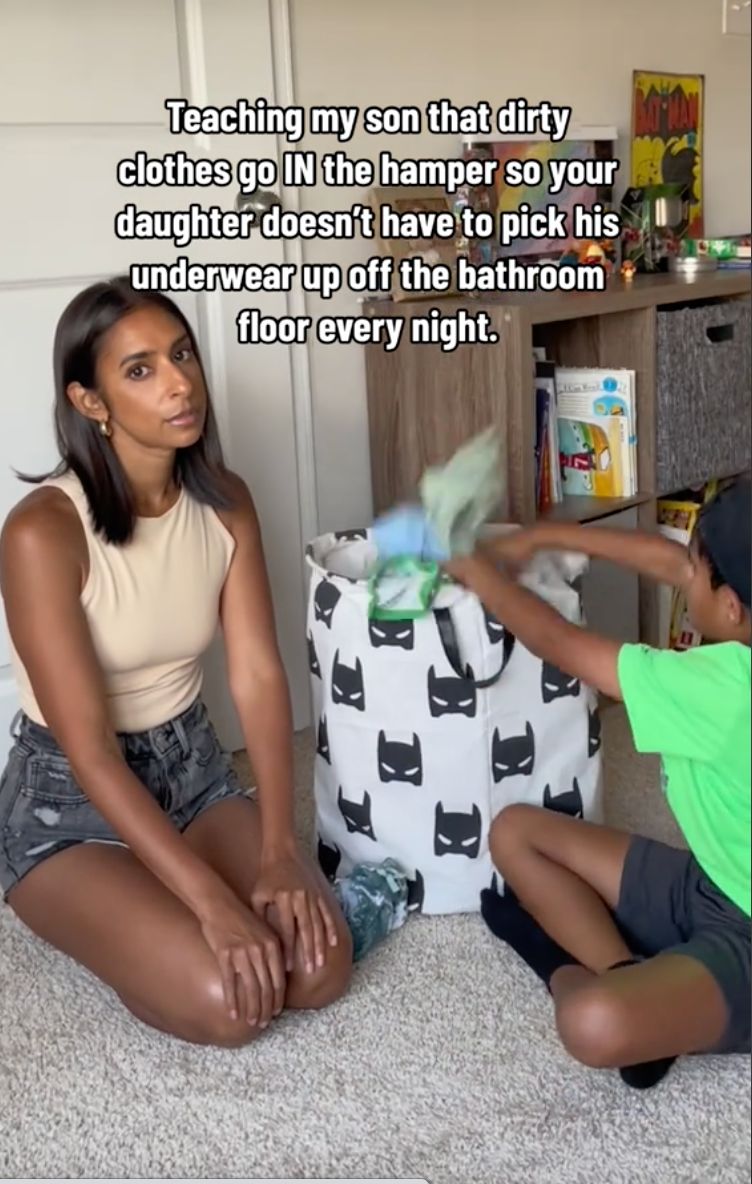
In another, she reminds Carter it’s important to do an equal share of chores around the house. (You might think younger couples would be more egalitarian in their approach to household chores, but according to studies, you’d be wrong.)

“Teaching my son that dirty clothes go IN the hamper so your daughter doesn’t have to pick his underwear up off the bathroom floor every night,” she typed.

<img class="img-sized__img portrait" loading="lazy" alt="Many of Desai's videos focus on the importance of splitting household chores. ” width=”720″ height=”1133″ src=”https://www.wellnessmaster.com/wp-content/uploads/2023/09/this-mum-is-going-viral-for-teaching-her-sons-life-skills-sans-gender-roles-8.jpg”>

In an interview with HuffPost, Desai said that she and her husband are trying to raise boys who can take care of themselves and not bottle up their emotions.

“Too often boys are told to ‘suck it up’ and hide their true feelings, and eventually, to ‘man up,’” she said. “I want to equip my sons with tools in dealing with their emotions but also let them know that there is always space for them, too.”

Desai was inspired to create the series after watching a comedic TikTok series from Eric Taylor — @girldad_e, as he’s known online — about raising daughters who know their worth and can recognise and steer clear of people’s “dusty sons.”

“I told my sister I wanted to do this trend but from the perspective of a mom of boys, and the first video really took off,” Desai said. “I then realised there was so much ground to cover.”

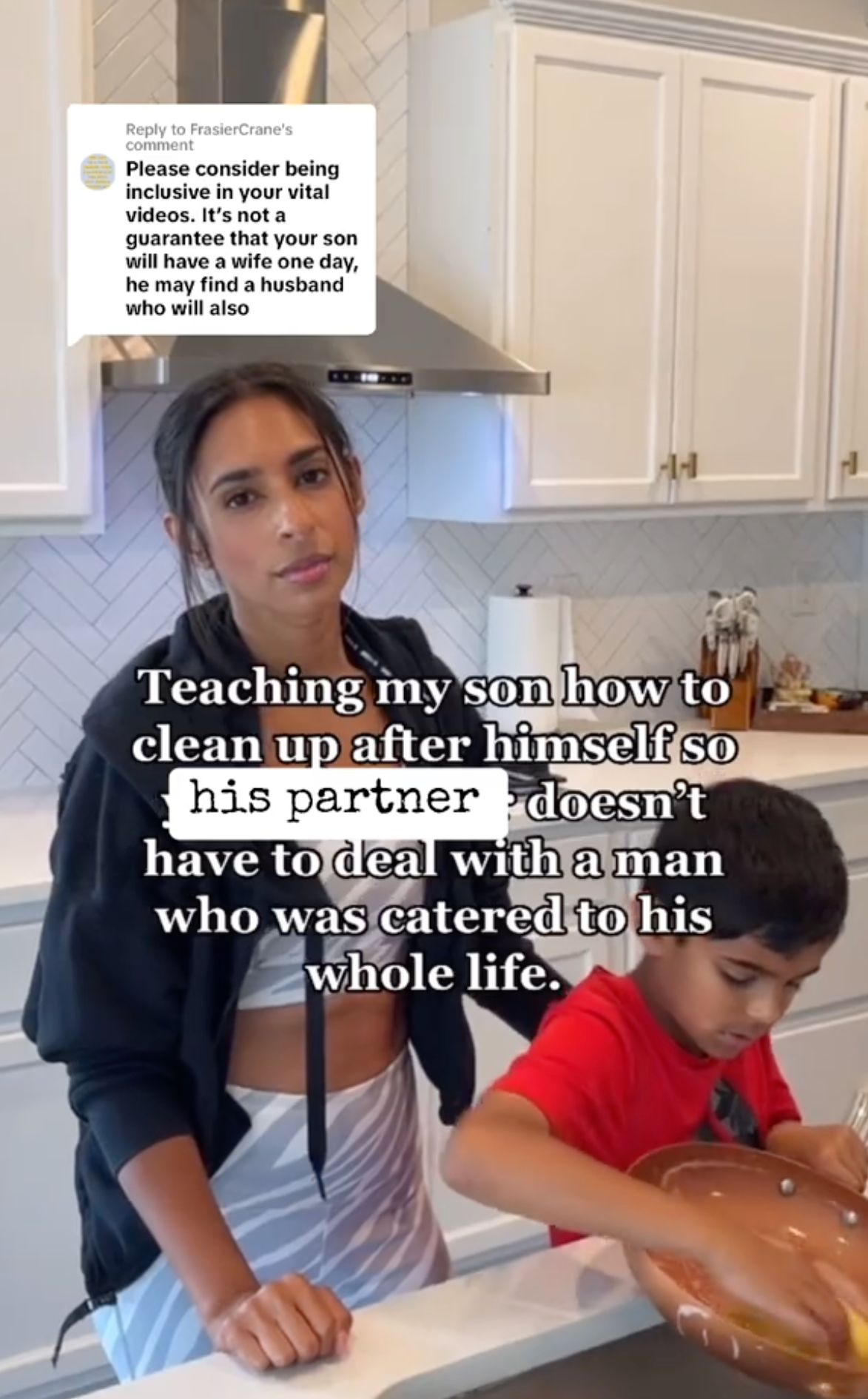
<img class="img-sized__img portrait" loading="lazy" alt="In another clip, Desai washes dishes with her son so his future partner doesn’t have to "deal with a man who was catered to his whole life."” width=”720″ height=”1160″ src=”https://www.wellnessmaster.com/wp-content/uploads/2023/09/this-mum-is-going-viral-for-teaching-her-sons-life-skills-sans-gender-roles-9.jpg”>

Payal Desai/TikTok

In another clip, Desai washes dishes with her son so his future partner doesn’t have to “deal with a man who was catered to his whole life.”

Though most of the comments on the videos are supportive (“First boy mom on TikTok that’s not toxic, love to see it,” “Is it too late to send this to my mother in law?”), some have remarked that they found the videos problematic.

“Picking up your underwear, being able to make something to eat for yourself and self regulation are not a favour or a gift to other women or people for that matter,” one woman wrote in an Instagram repost of the videos. “It is the literal bare minimum parents should teach their kids irrespective of gender.”

Desai disagrees with that line of criticism.

“If it were ‘standard,’ then many more people would live their lives according to these lessons,” she said. “The problem is it is not standard, and these are issues of equity we have to start talking about. I know it makes some people feel uncomfortable, but change only happens in discomfort.”

<img class="img-sized__img portrait" loading="lazy" alt="In one video, Desai and her sons Carter, 7, and Dev, 3, watch women’s soccer so "they understand what it means to be an ally to women."” width=”720″ height=”1045″ src=”https://www.wellnessmaster.com/wp-content/uploads/2023/09/this-mum-is-going-viral-for-teaching-her-sons-life-skills-sans-gender-roles-10.jpg”>

Payal Desai/TikTok

In one video, Desai and her sons Carter, 7, and Dev, 3, watch women’s soccer so “they understand what it means to be an ally to women.”

She has acknowledged feedback about referring to her sons’ future partners, promising to use more inclusive language. By and large, though, the response to the videos has been positive.

“Over the course of a month, my following on the platforms have skyrocketed, and I am so thankful it’s sending this positive message to dispel traditional gender roles and norms,” she said.

Dev and Carter, meanwhile, got a kick out of appearing on “Good Morning Philadelphia” TV show last week while his parents discussed the viral clips.

“Carter especially really got it more after the morning show!” Desai said. “He has enjoyed the recognition and understands the weight it holds.”

To see all of her videos, head to Desai’s TikTok or Instagram page.

Share Button

Cruz Beckham’s New Tattoo Is A Fitting Tribute To Mum Victoria’s Spice Girls Days

With David and Victoria Beckham’s eldest sons Brooklyn and Romeo already boasting their own elaborate collection of body art, it’s been revealed that Cruz is the latest member of the family to get inked.

The 18-year-old has already got a small number of tattoos, including a robot design and a record player, having started going under the needle on his 16th birthday.

He’s now unveiled his latest addition – and it’s a tribute to his mum’s days as part of the most iconic girl groups in history.

London-based tattoo artist Certified Letter Boy unveiled the results of Cruz’s latest tat earlier this week, with his new tattoo serving as a nod to Victoria’s time in the Spice Girls.

“I think we all get the vibe here don’t we?” the artist joked of the “Posh” design, adding: “Thank you for the trust my G.”

However, Cruz isn’t the only Beckham boy to keep it in the family when it comes to his tattoos.

David and Victoria are parents to four children; 24-year-old Brooklyn, 21-year-old Romeo, 18-year-old Cruz and 12-year-old Harper.

Last year, the family got even bigger when Brooklyn tied the knot with his wife, Nicola Peltz Beckham.

The group previously toured stadiums around the UK in 2019 as a four-piece, without Victoria’s involvement.

Share Button

Ryan Gosling Totally Made Ncuti Gatwa Melt While Making Barbie

It looks like even other Kens aren’t immune to Ryan Gosling’s charm.

Actor Ncuti Gatwa talked about his swoon-worthy Barbie co-star while praising his on-set experience in an interview with Elle magazine out last week.

Gatwa, who played one of the many Kens in Barbie, said when he first arrived to shoot the future blockbuster, he “was so nervous I hardly spoke for the first month.”

His nerves certainly didn’t die down after he exchanged looks with Gosling, who played the movie’s main Ken opposite leading Barbie, Margot Robbie.

“There was a time when I was talking to [director Greta Gerwig], and I turned around and Ryan Gosling was looking at me, and his eyes were so blue that I just… fell over,” the Sex Education star told Elle. “I just drowned in his eyes.”

Hey, Ken. Ryan Gosling attends the London premiere of Barbie on July 12, 2023.

Anadolu Agency via Getty Images

Gatwa said gazing into Gosling’s baby blues was just one of many special moments while making “Barbie,” which he said had “the most kind, empathetic set I’ve ever been on.”

He also did some serious bonding with star Barbie Robbie, who got the cast to attend a Magic Mike show together.

“We played So Solid Crew and all these old-school garage tunes, then we got to Magic Mike and all screamed our faces off at the incredible dancers,” said Gatwa. “Then we all went to [London nightclub] The Box… The group chat the next day was lit.”

Ncuti Gatwa attends the London premiere of Barbie on July 12, 2023.

Neil Mockford via Getty Images

In his interview, the new face of Doctor Who also talked about refusing to accept any labels, whether it comes to his sexuality or his fashion choices.

“There doesn’t need to be a label,” Gatwa said. “I believe that fully: that’s why I don’t like to label myself – and I don’t owe it to anyone.”

Gatwa, born in Rwanda and immigrated to Scotland as a child, told Elle about a pivotal moment in his journey, remembering a chance encounter with a Rwandan woman at Manchester Pride several years ago.

“I had never met another queer Rwandan person before,” he said. “I thought I was the only one in the world.”

Share Button

Caution over study suggesting under-50 cancer surge

Cases in under-50s jump 79% since 1990 but population rise and better reporting are likely factors.

Share Button

Atomic-scale spin-optical laser: New horizon of optoelectronic devices

Researchers at the Technion — Israel Institute of Technology have developed a coherent and controllable spin-optical laser based on a single atomic layer. This discovery is enabled by coherent spin-dependent interactions between a single atomic layer and a laterally confined photonic spin lattice, the latter of which supports high-Q spin-valley states through the photonic Rashba-type spin splitting of a bound state in the continuum. Published in the journal Nature Materials and featured in the journal’s Research Briefing, the achievement paves the way to study coherent spin-dependent phenomena in both classical and quantum regimes, opening new horizons in fundamental research and optoelectronic devices exploiting both electron and photon spins.

The study was conducted in the research group of Professor Erez Hasman, head of the Atomic-Scale Photonics Laboratory, in collaboration with Professor Elad Koren, head of the Laboratory for Nanoscale Electronic Materials and Devices in the Department of Materials Science and Engineering, and Professor Ariel Ismach at Tel Aviv University. The two groups at the Technion are in association with the Helen Diller Quantum Center and Russell Berrie Nanotechnology Institute (RBNI). Dr. Kexiu Rong conducted and led the research, and collaborated with Dr. Xiaoyang Duan, Dr. Bo Wang, Dr. Vladimir Kleiner, Dr. Assael Cohen, Dr. Pranab K. Mohapatra, Dr. Avinash Patsha, Dr. Subhrajit Mukherjee, Dror Reichenberg, Chieh-li Liu, and Vladi Gorovoy.

Can we lift the spin degeneracy of light sources in the absence of magnetic fields at room temperature? According to Dr. Rong, “Spin-optical light sources combine photonic modes and electronic transitions and therefore provide a way to study the exchange of spin information between electrons and photons and to develop advanced optoelectronic devices. To construct these sources, a prerequisite is to lift the spin degeneracy between the two opposite spin states either in their photonic or electronic parts. This is usually accomplished by applying magnetic fields under a Faraday or Zeeman effect, although these approaches generally require strong magnetic fields and cannot produce miniaturized sources. Another promising way takes advantage of artificial magnetic fields for photonic spin-split states in momentum space, underpinned by a geometric phase mechanism.

Unfortunately, previous observations of spin-split states have relied heavily on propagation modes with low quality factors, which impose undesired limitations on spatial and temporal coherence of the sources. This approach is also hindered by the spin-controllable properties of a bulk laser gain material being unavailable or nontrivial to access for active control of the sources, especially in the absence of magnetic fields at room temperature.”

To achieve high-Q spin-split states, the researchers constructed photonic spin lattices with different symmetry properties, which comprise an inversion-asymmetry core and inversion-symmetry cladding integrated with a WS2 monolayer to create laterally confined spin-valley states. The essential inversion-asymmetry lattice the researchers use has two important properties. (1) A controllable spin-dependent reciprocal lattice vector due to space-variant geometric phases from its constituting inhomogeneous-anisotropic nanoholes. This vector splits a spin-degenerate band into two spin-polarized branches in momentum space, being referred to as the photonic Rashba effect. (2) A pair of high-Q symmetry-enabled (quasi-) bound states in the continuum, that is, ±K (corners of the Brillouin zone) photonic spin-valley states, at the band edges of the spin-split branches. Moreover, the two states form a coherent superposition state with equal amplitudes.

Professor Koren noted that, “We used a WS2 monolayer as the gain material because this direct-bandgap transition metal dichalcogenide possesses unique valley pseudospins, which have been widely investigated as an alternative information carrier in valleytronics. Specifically, their ±K’ valley excitons (radiated as in-plane spin-polarized dipole emitters) can be selectively excited by spin-polarized light according to a valley-contrasted selection rule, thus enabling active control of spin-optical light sources without magnetic fields.”

In the monolayer-integrated spin-valley microcavities, ±K’ valley excitons couple to ±K spin-valley states owing to polarization matching, and spin-optical excitonic lasing is achieved at room temperatures through strong optical feedback. Meanwhile, ±K’ valley excitons (initially without a phase correlation) are driven by the lasing mechanism to find the minimum-loss state of the system, which leads them to re-establish a phase-locked correlation according to the opposite geometric phases of ±K spin-valley states. This lasing-mechanism-driven valley coherence removes the need for cryogenic temperatures to suppress the intervalley scattering. Moreover, the minimum-loss state of the Rashba monolayer laser can be regulated to be satisfied (broken) via a linear (circular) pump polarization, which provides a way to control the lasing intensity and spatial coherence.

“The unveiled photonic spin valley Rashba effect provides a general mechanism to construct surface-emitting spin-optical light sources. The demonstrated valley coherence in the monolayer-integrated spin-valley microcavity makes a step towards achieving entanglement between ±K’ valley excitons for quantum information by means of qubits,” explains Professor Hasman. “For a long time, our group has been working on developing spin optics to harness photonic spin as an effective tool to control the behavior of electromagnetic waves. In 2018, we were attracted by valley pseudospins in two-dimensional materials, and therefore began a long-term project to study the active control of atomic-scale spin-optical light sources in the absence of magnetic fields. We initially tackled the challenge of coherent geometric phase pickup from individual valley excitons by using a non-local Berry-phase defect mode.

However, the underlying coherent addition of multiple valley excitons of the realized Rashba monolayer light sources remained unsolved, owing to the lack of a strong synchronizing mechanism between the excitons. This issue inspired us to think about high-Q photonic Rashba modes. Following innovations in new physical approaches, we achieved the Rashba monolayer laser described here.”

The research was supported by the Israel Science Foundation (ISF), the Helen Diller Foundation and the joint Technion NEVET grant by RBNI. The fabrication was performed at the Micro-Nano Fabrication & Printing Unit (MNF&PU) of the Technion.

Share Button

Toddlers learn to reason logically before they learn to speak, study finds

How do we learn to speak during childhood or how do we acquire knowledge about the world around us? Toddlers’ social interactions in their social and family environment and in schools help to explain this, but they are not the only factors involved. Natural logical thinking, which manifests itself from a very early age and does not depend on knowledge of language, also facilitates the learning process, according to a study led by UPF’s Center for Brain and Cognition, the results of which have been published this Friday, 1 September, in the journal Current Biology.

The study focuses on a question that still generates debate among neuroscientists: whether infants who have not yet learned to speak (or are developing speech) are capable of logical reasoning. This pioneering research shows that this natural logical reasoning exists from at least 19 months of age, does not depend on knowledge of language and is developed mainly through the strategy of exclusion by elimination. In other words, if toddlers are faced with an unknown reality, they would try to analyse it and reach some conclusion about it by ruling out the options that are not possible, according to their level of knowledge at the time.

The results of the paper are presented in the article entitled The scope and role of deduction in infant cognition, written by Kinga Anna Bohus, Nicolo Cesana-Arlotti, Ana Martín-Salguero and Luca Lorenzo Bonatti. The principal researcher, L. Bonatti (ICREA), is the director of the Reasoning and Infant Cognition (RICO) research group at the Center for Brain and Cognition (CBC) at UPF. Kinga Anna Bohus (main author) also belongs to the group. N. Cesana-Arlotti and Ana Martín-Salguero, previously linked to the CBC at UPF, are currently researchers at Yale University (USA) and at the École Normale Supérieure in Paris.

Toddlers tend to solve uncertainties by ruling out impossible options according to the level of knowledge they have at any given moment

The study analyses the importance of two strategies for infants to deal with uncertainties: association and exclusion (or disjunction elimination). The first strategy would mean that toddlers hearing a new word that may refer to two unfamiliar objects that they can see, mentally associate the term with each of them. Subsequently, they would associate the term with the object with which this name fits better.

The second strategy (exclusion) explains how a toddler can learn a new word through logical reasoning by eliminating alternatives. For example, if they see two objects (A and B) and hear an unknown term that they know is not A (because they know the name of A), they will determine that it is the name of B. This is the predominant strategy, according to the results of the study.

Two experiments to analyse toddlers’ natural logic posed with known and unknown objects and terms

The research team conducted two different experiments, the first with 61 monolingual (26) and bilingual (35) 19-month-old toddlers and the second with 33 (19 mono and 14 bilingual). The analysis of each group was crucial to determine whether deductive processes depend on linguistic experience.

advertisement


In the first experiment, the participants were shown two objects, which they had to associate with one of the words they heard, through different tests. In the first test, they had to look at two objects they knew (e.g., a spoon and a biscuit) and, upon hearing a term (e.g., spoon), associate it with one of the two. In the second test, the infants were shown an object they knew (e.g., an apple) and an object they did not know (e.g., a carburettor), and they heard the word corresponding to the known object (apple), which they had to identify. The third test was the same as the second, except that the word heard corresponded to the unknown word (e.g., carburettor).

In the second experiment, two objects or animate beings were used (for example, an umbrella and a figure of a boy), each associated with a sound. Subsequently, the two objects were covered so that the infant could not see them and one of them was placed in a glass. When they were uncovered, the toddler could only see one of the two objects and had to guess, by elimination, which one was inside the glass. In a subsequent test (with the two objects covered and without changing their position), the infant listened to the sound associated with one of them and it was analysed whether he/she looked in the direction of the correct object.

In all these tests, their gaze movement patterns were assessed. For example, when reasoning by exclusion, toddlers look at object A and, if they rule out that the term they have heard refers to it, then they turn their gaze towards B. This is known as the double check strategy.

There are no relevant differences in the logic of monolingual and bilingual toddlers

The main author of the research, Kinga Anna Bohus, summarizes the main findings of the study as follows: “We studied the presence of the concept of logical disjunction in 19-month-old infants. In a word-referent mapping task, both bilingual and monolingual infants display a pattern of oculomotor inspection previously found to be a hallmark of disjunctive reasoning in adults and children.”

In short, the results of the study show no relevant differences between the logical reasoning of monolingual and bilingual toddlers, which confirms that it does not depend on linguistic knowledge. This natural logical thinking could be present before the age of 19 months, although there is still not enough scientific evidence to demonstrate its presence at earlier ages.

Share Button

New ribozyme can make RNA molecules accessible for click chemistry in living cells

RNA molecules are real all-rounders. They transfer the genetic information from the DNA in the cell. They regulate the activity of genes. And some of them have a catalytic effect: just like enzymes, they enable biochemical reactions that would be difficult or impossible to occur on their own. These special RNA molecules that accelerate such reactions are called ribozymes.

The team of chemistry professor Claudia Höbartner from Julius-Maximilians-Universität (JMU) Würzburg now presents a newly discovered ribozyme called SAMURI in the journal Nature Chemistry.

SAMURI can precisely modify other RNA molecules. This ability is very helpful for RNA research: “We can use such ribozymes as tools to label RNA with dyes and make it visible,” says JMU researcher Dr. Takumi Okuda. “In this way, the pathways of RNA in the cell and its interactions with other molecules can be studied even better.”

Ribozymes may also be considered for therapeutic use in the future. “We see new possible applications for ribozymes when the enzymes responsible for a specific task are missing or are no longer functional due to mutations,” says Claudia Höbartner.

Details about the new ribozyme

What distinguishes the new ribozyme SAMURI? It modifies other RNA molecules at a precisely defined site of a specific adenine. There it attaches molecules to which, in turn, dyes or other molecules can easily be clicked in — like buckling up a seat belt. Such reactions are known as click chemistry.

SAMURI also has the advantage that it is active under the same physiological conditions that prevail in living cells. This is not the case with other synthetic ribozymes.

Another special feature: SAMURI uses a new synthetic cofactor to make RNA molecules accessible for click chemistry. This cofactor was developed by Dr. Takumi Okuda; it was inspired by the ubiquitous natural cofactor SAM (S-adenosylmethionine). This is also where the name of the new ribozyme comes from: SAMURI stands for “SAM-analogue utilising ribozyme.”

The following steps in research

Claudia Höbartner’s group next wants to elucidate the structure and mechanism of action of SAMURI. She also wants to develop further ribozymes that can modify RNA building blocks other than adenine.

Share Button

Rise in young women vaping daily in the UK

Figures from the Office of National Statistics suggest more women aged 16-24 are vaping every day.

Share Button

NHS ombudsman calls for Martha’s rule to give power to patients

Rob Behrens says he was moved by the plea of Merope Mills, who shared the story of her daughter’s death.

Share Button

Miley Cyrus Reflects On Falling In Love With Ex-Husband Liam Hemsworth On Set

Miley Cyrus has reflected on the early days of her relationship with ex-husband Liam Hemsworth.

To promote her new single Used To Be Young, Miley has taken part in a series of TikTok videos looking back at key moments in her life and career, and sharing her memories from that time.

In one clip, the chart-topping singer reflects on appearing in the film The Last Song, which is where she and her future husband met.

“In 2008 I needed to do another feature film for Disney and I didn’t want it to be a part of Hannah Montana,” she recalled.

“Once we had written the screenplay, it was time to audition all the guys who [wanted to] play Will, my boyfriend in the movie. We had gotten it down from thousands to the final three, and Liam was a part of that final three.”

The Flowers singer continued: “I think one of the elements that made that movie feel so special was that it was watching two very young people fall in love with each other, which was happening in real-time, and in real life.

“So, the chemistry was undeniable. And that was the beginning of a long 10-year relationship.”

Holding up a photo of herself on set, she then joked: “I’m just your average teen with 250 individual hair extensions.”

Liam Hemsworth and Miley Cyrus in their film The Last Song

Touchstone/Kobal/Shutterstock

Miley and Liam began their relationship in 2009, eventually getting engaged before going their separate ways in September 2013.

The former couple then reunited in 2016, announcing their second engagement a few months later before tying the knot in December 2018.

Just under a year later, they announced their plans to divorce, with Miley subsequently being linked to Australian singer Cody Simpson, media personality Kaitlynn Carter and musician Maxx Morando.

As part of her Used To Be Young video series, Miley has spoken about other big moments in her past, including her past dispute with Sinéad O’Connor, the fall-out from her Vanity Fair photo-shoot when she was a teenager and how she and her father Billy Ray Cyrus have markedly different attitudes to fame.

Share Button