The ban comes after a vote in the French capital – but is it democracy in action?


The ban comes after a vote in the French capital – but is it democracy in action?
If you’re over 50 years old, you’ve probably noticed that food affects you a little bit differently than it did when you were younger. While a nightly bowl of ice cream used to be a delicious, harmless nightly staple, you might find that this habit now has a bigger impact on your health or makes you feel a certain way.
It’s possible that your doctor has talked to you about eating in a way that promotes bone strength or keeps your blood sugar in check, and there’s good reason for that. As we age, our nutritional needs change, and the phrase “you are what you eat” becomes more relevant than ever before.
Advertisement
Women see estrogen levels drop with menopause, which leads to a decrease in bone mass and an increased need for calcium-rich foods that can help stave off osteoporosis. And for both women and men, bodies lose the ability to produce insulin as easily over time, leading to blood sugar imbalances and the potential development of Type 2 diabetes. The metabolism slows down, too, particularly after age 60 — which means calorie-heavy foods are more likely to cause weight gain. And considering that heart disease is the No. 1 killer in the United States, eating a heart-healthy diet is key.
We know, we know. We’re delivering a lot of depressing news here. With that in mind, certain foods can be beneficial when it comes to keeping age-related health issues at bay. Here, a geriatrician and registered dietitians share the top foods people over 50 should pick up at the grocery store.
Because salt can contribute to high blood pressure, Dr. Nina L. Blachman, a geriatrician at NYU Langone Health, suggests limiting salt as much as possible. “Instead of salt, I recommend seasoning foods with herbs,” she said. Flavorful herbs like parsley, saffron or rosemary can go a long way when it comes to adding flavor to your food with little or even no salt.
According to nutritionist Tara Tomaino, a registered dietitian, beans (think chickpeas, black beans, etc.) are a great option for people over 50.
Advertisement
“Whether canned or dried, beans are a great food to incorporate in the diet for people 50 and over,” she said. “Beans are a great source of fiber as well as plant-based protein. Fiber is a key nutrient for heart health, blood-sugar management and weight control. If purchasing canned beans, be sure to rinse and drain them to get rid of the packing liquid and excess sodium. Aim to eat half a cup of beans per day by adding them to salads or soups.”
In case you haven’t heard, cottage cheese is making a major comeback — and luckily, Tomaino said, it’s a great option for people over 50.
“This high-protein food is a great choice for any meal of the day or even snacks,” she said. “Pair cottage cheese with fruit for a sweet and salty combo or blend into a dip to enjoy with fresh vegetables. Choose low-sodium or no-salt-added cottage cheese if high blood pressure is a concern.”
Choose from your favorite leafy greens, Tomaino suggests: spinach, kale, chard, collard greens and even broccoli.
“These vegetables are high in fiber, iron, magnesium, potassium and calcium, which are all crucial to heart health. Leafy greens are also low in carbohydrates and calories, making them an excellent addition to the diet if you are trying to manage weight and blood sugar.”
Advertisement
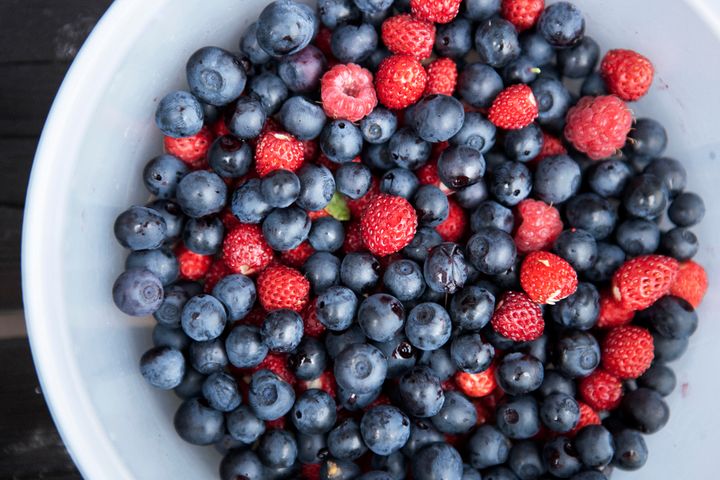
Glasshouse Images via Getty Images
All kinds of berries, including strawberries, blueberries and blackberries, are packed with health benefits for people over 50.
“Berries are high in antioxidants, which help mitigate inflammation and provide the body with anti-cancer properties,” Tomaino said. “Berries are also high in fiber, making them an excellent fruit choice for those managing blood sugar. Choose organic berries (fresh or frozen) when possible. Eat them on their own or add to oatmeal, yogurt, salads or smoothies.”
Salmon, ideally wild-caught, is a top food for people over 50 due to it’s omega-3 content, Tomaino said.
“Omega-3 fatty acids are beneficial to heart health and have also been linked to brain health,” she said. “Lower in saturated fat than red meat, salmon is a great protein choice to include in the diet at least once a week. Broiled salmon with veggies makes an easy weeknight sheet pan meal.”
Advertisement
Almonds, walnuts, flaxseeds and chia seeds are rich in heart-healthy fats, fiber and essential nutrients, explained nutritionist Marine Melamed. “They can help maintain healthy cholesterol levels, support digestive health, and provide a source of plant-based protein,” she said.
Skip the fatty cuts of meat and opt for lean cuts of chicken and turkey, or even eggs. “Lean sources of protein like poultry, lean cuts of meat, eggs and plant-based proteins (tofu, legumes, lentils) are essential for muscle maintenance, immune function and wound healing,” Melamed said.
Whole grains are another great option for the 50-plus crowd. “Quinoa, brown rice, whole wheat and oats are high in fiber and complex carbohydrates,” Melamed said. “They provide sustained energy, aid in digestion, and help regulate blood-sugar levels, reducing the risk of developing metabolic diseases.”
While nutritional needs and limitations do become more complex as we get older, with a few simple diet tweaks you can come up with simple, delicious ways to modify your diet. So get that grocery list started!

With the summer nearly over (although if we’re being honest, did it ever actually ever start?), we’re now fully open to embracing whatever autumn has to throw at us.
And by that, we mostly mean pumpkin spice lattes and the return of Strictly Come Dancing.
The countdown to the new series is now officially on, and to mark the occasion, the BBC has shared a first-look video at this year’s cast in action.
Advertisement
In a social media post, the stars of Strictly 2023 were all invited to show off their signature dance moves, with Krishnan Guru-Murthy offering up a rather subdued shuffle and Zara McDermott showing off her best “inflatable mascot outside a car dealership” moves.
And while others tried out flossing, twerking and the caterpillar, we have to hand it to Angela Rippon, whose moves were probably the closest thing to what the Strictly judges are looking for.
“To go with my age, the Charleston!” the former Come Dancing host announced, before demonstrating a rather impressive swivel.
Advertisement

While the BBC has yet to confirm when Strictly will be back on our screens, fans reckon they’ve worked out that the pre-recorded launch will air on Saturday 16 September, followed by the first live show on Saturday 23 September.
The 15 stars taking part have now been confirmed, with the judging and presenting line-up remaining the same.
Almost all of last year’s Strictly professionals will also be returning to the show, with two notable exceptions.
Cameron Lombard revealed earlier this year that he was stepping down from Strictly, while Amy Dowden is unable to compete as she is currently undergoing treatment for cancer.
Advertisement
However, Amy has insisted she will still be part of Strictly “in some way”, previously telling The Mirror: “Whether it’s on It Takes Two, or being up in Claudia’s area waiting for the scores, I’ll be there.”


The 19-year-old wants to seek an experimental treatment abroad, but doctors say she needs end-of-life care.

A Tory minister was skewered by Naga Munchetty as he struggled to defend the government over the closure of unsafe schools just days before the end of the summer holidays.
More than 100 will have either partially or completely shut their doors to pupils because the concrete used to build them – known as RAAC – is at risk of collapse.
Advertisement
Schools minister Nick Gibb this morning admitted that some of the affected schools have yet to be contacted by the government, and that it is still not known how many will have to close completely.
Appearing on BBC Breakfast, Gibb was grilled on the government’s response to the crisis, which will see thousands of pupils forced to learn from home when the new term starts next week.
The minister insisted the government had been “very proactive in assessing the school estate” and had taken action as soon as the extent of the problem became apparent.
He said RACC was used between the 1950s and 1990s, and that surveys were sent to every school in England in 2022 asking whether it was present in their buildings.
Advertisement
But Munchetty told him: “I’m sorry, please let me interrupt. You’ve given me the history of RACC and the dangers known.
“In 2018 when there was a national audit report saying that it was in 572 schools, why did it take until 2022 until surveys were sent to schools?”
Gibb said “warning notices” had been sent to all schools after that report, but that further evidence had emerged since then about the dangers posed by the crumbling concrete.
He added: “You seem to be criticising us for being more proactive than other governments around the world.”
Advertisement
The minister said that prior to yesterday, the government had already taken action in 52 schools where RACC was identified.
Munchetty said: “Is it fair to say that they were unsafe up until that point – that children were attending schools with buildings unsafe?”
Gibb replied: “This evidence was emerging over time …”
The presenter then interrupted to say: “It’s a simple yes or no, isn’t it? They were either safe or unsafe.”
The minister said: “Well we felt, having had that evidence, that parts of the school that had RACC that was in a criticial condition were not safe.”
“So they could have potentially collapsed?” Munchetty replied.
Gibb said: “Yes and that’s why we took action.”
Labour has accused the government of “staggering incompetence” in not taking action until just before schools return from the summer break.
Advertisement
Shadow education secretary Bridget Phillipson said: “Ministers have been content to let this chaos continue for far too long.”
Mike Short, head of education at the UNISON union, said the situation was “nothing short of a scandal”.


Former Strictly Come Dancing professional Oti Mabuse has shared a candid Instagram post about the “huge adjustments” she’s made due to her pregnancy.
Over the weekend, Oti announced that she and her husband, fellow dancer Marius Lepure, are expecting their first child, and in a follow-up Instagram post, revealed she had to take an extended break from dancing early on in her pregnancy due to the nausea it triggered.
Advertisement
“I actually do enjoy working out lately again,” she explained. “In the beginning it was the one thing along with dancing that would cause my nausea so I stayed away for the longest of time.
“This obviously was a huge adjustment for my body, mental health and stamina and came with another huge but beautiful life lesson. I am creating a human being and whatever my body needs I should listen to it.
“But now that I can walk, run [and] lift weights again… I’m excited to get active again.”
Oti joked: “And this new ass… OH MY DAYS. I love it.”
In her original post announcing her pregnancy news, Oti wrote: “This is new for us, scarier than swimming with sharks, jumping off cliffs or even swinging from bridges, but the best news we could have ever asked for.
Advertisement
“We love our little bundle of joy so much already… and can’t wait to see what our future will now look like as family of three plus Leo [the couple’s dog].
“It’s been a beautiful journey so far with close friends and family and nearly over but we have learnt a lot a long the way…. Christmas is about to get even louder.”
The South African performer followed this with a beautiful video in which she was seen sharing her happy news with her husband, Marius, as well as different family members and friends.
Oti is most well-known for her seven-year stint as a professional on Strictly, during which she made TV history as the only dancer to have won the show in two consecutive series.
Advertisement
More recently, she joined the panel of ITV’s Dancing On Ice and served as a judge on The Masked Dancer.

Wendy Clarke is encouraging women to get tested after being diagnosed with terminal cervical cancer.

An international team of marine scientists, led by the University of Groningen in the Netherlands and the Center for Coastal Studies in the USA, has studied the DNA of family groups from four different whale species to estimate their mutation rates. The results revealed much higher mutation rates than previously thought, and which are similar to those of smaller mammals such as humans, apes, and dolphins. Using the newly determined rates, the group found that the number of humpback whales in the North Atlantic before whaling was 86 percent lower than earlier studies suggested. The study is the first proof that this method can be used to estimate mutation rates in wild populations and was published in the journal Science on 1 September.
Mutation rate is a key parameter in genetics and genomics, where it is used to determine rates of evolution and adaptation. It is also used to derive the number of whales in the oceans before they were decimated by large-scale commercial whaling. However, estimating the rate at which new mutations appear in whales, or in any wild species, is difficult.
Pedigree method
For a long time, the phylogenetic method was used to measure mutation rates. This method uses fossil data from different species to estimate when they diverged. Subsequently, DNA from those species is compared to infer how many mutations must have occurred since the divergence. ‘However, the fossil record is not that exact. And some mutations may have disappeared over time,’ says Per Palsbøll, Professor of Marine Evolution and Conservation at the University of Groningen. He has studied whales since the late 1980s and is a corresponding author of the Science paper.
A more recent approach is the pedigree method, which uses the genomes of a pair of parents and their offspring to identify new mutations in the offspring. This more direct method relies on very few assumptions and is ideal for comparing mutation rates among different species, such as whales and humans.
Especially in wild species, the challenge is to obtain tissue samples from both parents and their offspring. First author Marcos Suárez-Menéndez: ‘The method has only been used on a handful of animals that are living in the wild, such as a single wolf pair and their cubs. It has also been used to estimate mutation rates in zoo animals, although it is uncertain if this reflects the mutation rates in the wild where the conditions are very different.’ However, the team, comprising scientists from the Netherlands, USA, Greenland, Denmark, Canada, and the UK, were able to use skin biopsy samples collected from whales during a collaboration that has been ongoing for more than thirty years.
Crossbow
Palsbøll collected his first whale biopsy samples amongst icebergs in the waters off West Greenland in 1988. ‘To do this, we had to sail very close to a whale and then fire a dart with a hollow point using a crossbow.’ The dart punches out a sample and bounces back into the water from where it is collected.
advertisement
Finding both parents of a whale calf is the first step in measuring the mutation rate using the pedigree method. This is where large-scale DNA analyses come in. Suárez-Menéndez analyzed data that were generated by the other first author, Martine Bérubé, from microsatellite markers in DNA. This DNA was extracted from a large archive of whale biopsy samples and used to create a genetic fingerprint of individuals. ‘I sifted through the microsatellite data to find individuals that were related as mother and calf. Next, I looked for possible fathers in the database.’
In this way, he managed to identify 212 putative parent and offspring trios in four different whale species. The DNA of eight trios was then sent off for genome sequencing. After a final paternity check, Suárez-Menéndez and his colleagues estimated the number of new mutations in the calf and the average mutation rate in whales.
Industrial whaling
The results showed that the mutation rates in whales are similar to the rates seen in pedigrees in smaller mammals such as humans, apes, and dolphins. In contrast, earlier estimates in whales using the phylogenetic method were much lower compared to these smaller mammals. Suárez-Menéndez: ‘And just like in humans, most new mutations originate from the father. So, whales are very similar to us in this respect.’
The team also used a slightly different maternal pedigree method to estimate the mutation rates in DNA from mitochondria, the cell’s power plants. This method has so far only been used in penguins. Mitochondria and their DNA are passed on through the maternal line and Suárez-Menéndez took advantage of four decades of sighting data of humpback cow and calf pairs in the Gulf of Maine, directed by senior author Jooke Robbins at the Center for Coastal Studies. ‘Our study revealed that the mutation rate in whale mitochondrial DNA is also much higher than earlier estimates based on the phylogenetic method,’ explains Suárez-Menéndez.
The newly determined, higher mutation rates were used to infer that the number of whales in the North Atlantic before industrial whaling. The result was 86 percent lower than earlier reported estimates based on phylogenetic mutation rates. ‘Our new mutation rates suggested that some 20,000 humpback whales lived in the North Atlantic before commercial whaling, in contrast to the previous estimate of 150,000,’ says Palsbøll. This is important information, not only for the conservation of whales but also for our understanding of the state of the oceans before whaling. Palsbøll: ‘Another conclusion of wide-ranging consequences is that our study shows that it is entirely feasible to estimate the mutation rate in wild animals.’
advertisement
Cancer
The human-like mutation rates in whales also led the authors to reject one possible cause of Peto’s paradox. This is the observation that, at the species level, the incidence of cancer does not appear to correlate with the number of cells in an organism. Whales have a hundred to a thousand times more cells than, for example, humans, so if they have the same cancer rate as humans, they should get cancer very early in life. Several mechanisms have been proposed for protecting these large sea mammals against cancer. One of those is a slower mutation rate as a consequence of whales having much lower metabolic rates. The discovery that this is not the case, implies that other mechanisms are probably at play in whales, such as an increase in the number of copies of the p53 gene which protects against cancer.
Finally, as the study relied on a large number of tissue samples that have been collected over several decades, the Science paper highlights the importance of long-term ecological research projects. Palsbøll: ‘It is difficult to acquire sustained funding for these kinds of long-term ecological studies. However, we wouldn’t have been able to do this research without the sustained commitment and dedication of the many colleagues who recorded all the sightings and collected the samples that our study relied on.’

A broad new strategy could hold hope for treating virtually all blood cancers with CAR T cell therapy, which is currently approved for five subtypes of blood cancer. Scientists in the Perelman School of Medicine at the University of Pennsylvania have demonstrated the potential efficacy of this approach in preclinical tests.
In the study, published today in Science Translational Medicine, the researchers used engineered CAR T cells to target CD45 — a surface marker found on nearly all blood cells, including nearly all blood cancer cells. Because CD45 is found on healthy blood cells too, the research team used CRISPR base-editing to develop a method called “epitope editing” to overcome the challenges of an anti-CD45 strategy, which would otherwise result in low blood counts, with potentially life-threating side effects. The early results represent a proof-of-concept for epitope editing, which involves changing a small piece of the target CD45 molecule just enough so that the CAR T cells don’t recognize it, but it can still function normally within the blood immune system.
“Up to this point, we haven’t had the tools to create a targeted cell therapy approach that could work across all different forms of blood and bone marrow cancers,” said senior corresponding author Saar Gill, MD, PhD, an associate professor of Hematology-Oncology. “We’re excited to create a new solution that could solve a major issue in immunotherapy, which is the inability to target surface markers that are found on both cancer cells and healthy cells.”
Each of the currently available cell-based immunotherapies for blood cancer is designed to work against a narrow range of malignancies based on their target antigens. For example, the first CAR T cell therapy, developed at Penn by Carl June, MD, the Richard W. Vague Professor in Immunotherapy, targets the CD19 protein marker on B cells, to treat B-cell lymphomas and leukemias. Four of the six CAR T cell therapies currently approved to treat blood cancers target CD19. The other two target the BCMA protein marker to treat multiple myeloma. While CAR T cell therapy has been remarkably successful, researchers at Penn and across the world are working to make it even more effective for more patients.
“One drawback of the current approach to CAR T cell therapy is that each therapy must be developed individually based on the targets for that cancer type,” said June, co-senior author of the study, who also directs the Center for Cellular Immunotherapies at Penn. “This study lays the groundwork for a more universal approach that could potentially expand CAR T cell therapy to all blood cancers.”
Because CD45 is found on nearly all blood cells — and is usually highly expressed on blood cancer cells — a treatment that wipes out all CD45-bearing cells would leave patients without any blood cells, including red blood cells, platelets, plasma, and even the marrow-based stem cells that generate new blood cells. Furthermore, since T cells are blood cells and normally express CD45, CAR T cells targeting CD45 effectively would kill each other before they could be infused into patients.
The team built on previous work to overcome this challenge, using CRISPR base-editing to develop a new strategy called epitope editing. This involves the genetic modification of both the CAR T cells and blood stem cells to alter a small piece of the CD45 structure or “epitope” where the CAR T cells bind to the CD45 molecule. The altered version of CD45 still works but differs enough from normal CD45 that the anti-CD45 CAR T cells do not recognize and attack it.
advertisement
“It’s essentially a blood stem cell transplant paired with CAR T cell therapy,” said lead author Nils Wellhausen, a graduate student in Pharmacology and a member of Gill and June’s labs. “The idea is that when the engineered cells are infused, the CAR T cells kill the cancer cells that bear normal CD45, but don’t kill each other or the newly engineered blood stem cells. This allows the engineered blood stem cells to begin making new blood cells.”
Because the strategy results in replacing the stem cells that create new blood cells, it also has potential use as a milder form of chemotherapy conditioning, which is given to patients before a bone marrow transplant to suppress the immune system.
The researchers tested the strategy in an extensive set of experiments in cell culture and mice models. They showed that the new approach not only keeps anti-CD45 CAR T cells from attacking each other or stem cells, but also enables swift destruction of blood cell cancers. In one test, the anti-CD45 CAR T cells eliminated leukemia cells within three weeks of infusion and were still present and capable of killing leukemia cells more than two months later.
Further toxicology studies and additional modeling studies are currently underway in preparation for an investigational new drug application before it can move into Phase I clinical trials.
Funding for the study was provided by the National Institutes of Health (P01CA214278-05, U54-CA-244711 25, P01CA214278-05, R01 CA177684 06A1, U54 CA 244711) and the Parker Institute for Cancer Immunotherapy.

Cloud gaming, which involves playing a video game remotely from the cloud, witnessed unprecedented growth during the lockdowns and gaming hardware shortages that occurred during the heart of the Covid-19 pandemic. Today, the burgeoning industry encompasses a $6 billion global market and more than 23 million players worldwide.
However, interdevice synchronization remains a persistent problem in cloud gaming and the broader field of networking. In cloud gaming, video, audio, and haptic feedback are streamed from one central source to multiple devices, such as a player’s screen and controller, which typically operate on separate networks. These networks aren’t synchronized, leading to a lag between these two separate streams. A player might see something happen on the screen and then hear it on their controller a half second later.
Inspired by this problem, scientists from MIT and Microsoft Research took a unique approach to synchronizing streams transmitted to two devices. Their system, called Ekho, adds inaudible white noise sequences to the game audio streamed from the cloud server. Then it listens for those sequences in the audio recorded by the player’s controller.
Ekho uses the mismatch between these noise sequences to continuously measure and compensate for the interstream delay.
In real cloud gaming sessions, the researchers showed that Ekho is highly reliable. The system can keep streams synchronized to within less than 10 milliseconds of each other, most of the time. Other synchronization methods resulted in consistent delays of more than 50 milliseconds.
And while Ekho was designed for cloud gaming, this technique could be used more broadly to synchronize media streams traveling to different devices, such as in training situations that utilize multiple augmented or virtual reality headsets.
“Sometimes, all it takes for a good solution to come out is to think outside what has been defined for you. The entire community has been fixed on how to solve this problem by synchronizing through the network. Synchronizing two streams by listening to the audio in the room sounded crazy, but it turned out to be a very good solution,” says Pouya Hamadanian, an electrical engineering and computer science (EECS) graduate student and lead author of a paper describing Ekho.
advertisement
Hamadanian is joined on the paper by Doug Gallatin, a software developer at Microsoft; Mohammad Alizadeh, an associate professor of electrical engineering and computer science and a member of the Computer Science and Artificial Intelligence Laboratory (CSAIL); and senior author Krishna Chintalapudi, a principal researcher at Microsoft Research. The paper will be presented at the ACM SIGCOMM conference.
Off the clock
At the heart of interstream delay in cloud gaming is a fundamental problem in networking known as clock synchronization.
“If the controller and the screen could look at their watches and at the same time see the same thing, then we could synchronize everything to the clock. But a lot of theoretical work on clock synchronization shows that there are certain bounds you can never overcome,” Hamadanian says.
Many approaches attempt clock synchronization by ping-pong messaging, where a device sends a ping message to the server, which sends a pong message back. The device counts how long it takes the message to return, and cuts that value in half to calculate the network delay.
But the path over the network is likely asymmetric, so it may take more time for the message to reach the server than it does for the return message. Therefore, this method is unreliable and can introduce hundreds of milliseconds of error. Humans can typically perceive interstream delay once it reaches 10 milliseconds.
advertisement
“So if something happens on the screen, we want it to happen within 10 milliseconds on the controller, as well,” Hamadanian explains.
He and his collaborators decided to try listening to game audio to synchronize these separate streams.
In cloud gaming, the microphone on the player’s controller records audio in the room, including game audio played by the speakers on the screen, which it sends back to the server. But using this for synchronization is unreliable because the room audio contains background noise.
So they designed Ekho to add identical sequences of extremely low-volume white noise, known as pseudo noise, to the game audio before it is streamed to the player’s screen. It uses these pseudo-noise segments for synchronization.
Before building Ekho, the researchers conducted a user study to prove that players could not hear the pseudo noise in the game audio. These noise sequences are also resilient to compression, which is important because audio sent from the controller is highly compressed to speed the data transfer.
Pseudo noise, real success
The Ekho-Estimator module adds pseudo-noise sequences to the game audio. When it receives the recorded game audio from the controller, it listens for those markers and tries to line up the streams. This enables it to precisely calculate the inter-stream delay.
The Ekho-Estimator sends that information to the Ekho-Compensator module, which either skips a few milliseconds of sound or adds a few milliseconds of silence to the game audio being sent by the server, which synchronizes the streams.
They tested Ekho on real cloud streaming sessions and found that it was superior to other synchronization methods, even when the microphone quality was poor or background noise was picked up by the recording.
Ekho limited interstream delay to less than 10 milliseconds for nearly 87 percent of the time during streams. No other method the team tested was able to cut that delay to less than 50 milliseconds.
“The traditional way of doing this, which involves trying to measure the synchronization error using the underlying network, the errors are significantly larger. When we started this project, were weren’t sure whether this could even be done. But the accuracy we can get down to with Ekho, at sub-millisecond levels, it is unheard of,” says Chintalapudi.
Impressed by these results, the researchers want to see how well Ekho performs in more complex situations, such as synchronizing five controllers to the same screen device. Also, since Ekho was targeted for cloud gaming, it has range limitations. Future work could seek to enhance Ekho so it can synchronize devices at either end of a very large room, like a concert hall.
“Using inaudible white noise as a sort of ‘timekeeper’ is a great example of how out-of-the-box thinking can produce unexpected results,” says Alizadeh. “The technique could improve user experience, not just in cloud gaming but potentially in any multidevice streaming scenario.”
