Silver nanoparticles show promise in fighting antibiotic-resistant bacteria

In a new study, scientists with the University of Florida found that a combination of silver nanoparticles and antibiotics was effective against antibiotic-resistant bacteria.

The researchers hope to turn this discovery into viable treatment for some types of antibiotic-resistant infections. Antibiotic-resistant infections kill more than a million people globally each year.

For centuries, silver has been known to have antimicrobial properties. However, silver nanoparticles — microscopic spheres of silver small enough to operate at the cellular level — represent a new frontier in using the precious metal to fight bacteria.

In this study, the research team tested whether commercially available silver nanoparticles boost the power of antibiotics and enable these drugs to counter the very bacteria that have evolved to withstand them.

“We found that the silver nanoparticles and a common class of broad-spectrum antibiotics called aminoglycosides work together synergistically,” said Daniel Czyż, senior author of the study and an assistant professor in the UF/IFAS department of microbiology and cell science.

“When combined with a small amount of silver nanoparticles, the amount of antibiotic needed to inhibit the bacteria decreased 22-fold, which tells us that the nanoparticles make the drug much more potent,” Czyż explained. “In addition, aminoglycosides can have negative side effects, so using silver nanoparticles could allow for a lower dose of antibiotic, reducing those side effects.”

The findings were both surprising and exciting, said Autumn Dove, first author of the study and a doctoral candidate studying microbiology and cell science in the UF/IFAS College of Agricultural and Life Sciences.

“When I first saw the result, my first thoughts were, ‘Wow, this works!'” said Dove.

Over the last several decades, overuse of antibiotics had led to the emergence of antibiotic-resistant bacteria and a decline in the effectiveness of traditional antibiotic drugs, the researchers said. The study’s findings indicate that silver nanoparticles have the potential to renew the effectiveness of some of these drugs.

“Let’s say you get a bad burn on your hand, and it gets infected with one of these resistant strains of bacteria,” Dove said. “It’s possible that dressing that burn with a combination of silver nanoparticles and antibiotics could both clear that infection and prevent those resistant bacteria from spreading elsewhere.”

Though antibiotics mainly target bacteria, they can also damage human and animal cells. Using a microscopic worm called C. elegans, the researchers confirmed that the silver nanoparticles did not also make the antibiotic more toxic to non-bacterial cells.

Building off the study’s promising findings, the scientists next plan to seek FDA authorization for clinical trials and work with UF Innovate to patent an antimicrobial product that uses silver nanoparticles.

The silver nanoparticles used in the study were manufactured by the Natural Immunogenics Corporation, which helped fund the study through the UF Industry Partnerships Matching Grant Program. This program pairs UF researchers with Florida-based technology and energy companies to research and develop new products.

Share Button

Thin, lightweight layer provides radiation barrier for perovskites in space, protection from elements on Earth

An ultrathin protective coating proves sufficient to protect a perovskite solar cell from the harmful effects of space and harden it against environmental factors on Earth, according to newly published research from the U.S. Department of Energy’s National Renewable Energy Laboratory (NREL).

Funded by the U.S. Department of Defense’s Operational Energy Capability Improvement Fund (OECIF), the NREL research was done for the Air Force Research Laboratory (AFRL) to develop low-cost innovative energy sources for powering the armed forces worldwide.

The research is the latest effort to determine the effectiveness of perovskites for use in space applications, where it would be exposed to protons, alpha particles, atomic oxygen, and other stressors. The ability to use perovskites to generate power in space is enticing because they offer a lower-cost and lightweight option to other technologies with the potential for achieving efficiencies similar to those of current space PV technologies.

Just as on Earth, perovskite solar cells need to have suitable durability. However, the environment in space is significantly different. While the biggest challenges on Earth are related to weather, in space perovskites must address the problems that come from radiation bombardment and extreme temperature swings. Perovskites show signs of better tolerance to radiation than many other solar cells, but plenty of testing remains to be conducted.

Researchers last year ran simulations to demonstrate how exposure to radiation in space would affect perovskites. They determined the next-generation technology would work in space but pointed out the need to encapsulate the cell in some way to provide added protection.

In the follow-up research, Ahmad Kirmani, lead author of the latest Nature Energy paper, said simulations demonstrated a micron-thick layer of silicon oxide would preserve the efficiency and increase the lifetime of perovskite solar cells in space. As a comparison, the micron-thick layer is about 100 times thinner than a typical human hair.

Kirmani said the silicon oxide layer could reduce the weight of conventional radiation barriers used for other solar cells by more than 99% and serves as a first step toward designing lightweight and low-cost packaging for perovskites.

High-energy protons travel through perovskite solar cells without causing much harm. Low-energy protons, however, are more abundant in space and wreak more havoc on perovskite cells by knocking atoms out of place and causing efficiency levels to steadily decline. The lower energy protons interact with matter much more readily and the addition of the silicon oxide layer protected the perovskite from damage even from the low-energy protons.

“We thought it would be impossible for the silicon oxide to provide protection against fully penetrating long-range particles such as the high-energy protons and alpha particles,” Kirmani said. “However, the oxide layer turned out to be a surprisingly good barrier against those as well.”

The results are detailed in the paper “Metal oxide barrier layers for terrestrial and space perovskite photovoltaics.” The co-authors are David Ostrowski, Kaitlyn VanSant, Rosemary Bramante, Karen Heinselman, Jinhui Tong, Bart Stevens, William Nemeth, Kai Zhu, and Joseph Luther, from NREL; and several key collaborators who work with the team from the University of North Texas and the University of Oklahoma. VanSant holds the unique position of being a postdoctoral researcher at NASA who conducts research at NREL.

Exposure to a stream of low-energy protons caused unprotected perovskite solar cells to lose only about 15% of their initial efficiency, the researchers found. A larger concentration of particles destroyed the cells, while the protected perovskites demonstrated what the scientists described as “a remarkable resilience.” With the simple barrier, the cells showed no damage.

In addition to making the cells more resilient in space, the researchers also tested how the barrier could provide benefit in more conventional applications. They then exposed the perovskite solar cells to an uncontrolled moisture and temperature environment for several days to mimic storage conditions. The protected cells retained their initial 19% efficiency, while the unprotected cells showed significant degradation, from 19.4% to 10.8%. The oxide layer also provided protection when other perovskite compositions typically more sensitive to moisture were exposed to water.

Further, the perovskite solar cells were subjected to a test chamber where they were bombarded with ultraviolet photons similar to the environment at low-Earth orbit. The photons interacted with oxygen to create atomic oxygen. The unprotected cells were destroyed after eight minutes. The protected cells retained their initial efficiency after 20 minutes and only had a slight drop after 30 minutes.

The simulations and experiments revealed that by reducing the damage from radiation, the lifetime of the protected solar cells used in Earth’s orbits and deep space would be increased from months to years.

“Power conversion efficiency and operational stability of perovskite solar cells have been the two primary focus areas for the community so far,” he said. “We have made a lot of progress and I think we have come far to the point that we might be pretty close to hitting those targets needed for industrialization. However, to really enable this market entry, packaging is the next target.”

Because perovskite solar cells can be deposited onto a flexible substrate, the emerging technology, coupled with the protective layer of silicon oxide, allows its use for various terrestrial applications such as powering drones.

NREL is the U.S. Department of Energy’s primary national laboratory for renewable energy and energy efficiency research and development. NREL is operated for DOE by the Alliance for Sustainable Energy LLC.

Share Button

Study finds how our brains turn into smarter disease fighters

Combating Alzheimer’s and other neurodegenerative diseases by inserting healthy new immune cells into the brain has taken a leap toward reality. Neuroscientists at the University of California, Irvine and the University of Pennsylvania have found a way to safely thwart the brain’s resistance to them, vaulting a key hurdle in the quest.

Their discovery about brain cells called microglia heralds myriad possibilities for treating and even preventing neurodegenerative disorders. The team’s paper appears in the Journal of Experimental Medicine.

When microglia are healthy, they serve as the central nervous system’s resident front-line disease warriors. “However, there is overwhelming evidence that they can become dysfunctional in many neurological conditions,” said Mathew Blurton-Jones, UCI professor of neurobiology & behavior and study co-lead author. “Until recently, scientists have mainly been looking at the mechanisms that drive microglial dysfunction and trying to find drugs to change their activity. But with this study, we’ve found a way to potentially harness microglia themselves to treat those diseases.”

Frederick “Chris” Bennett, assistant professor of psychiatry at Penn and co-lead author, added: “There is an obstacle because once our own microglia develop in the location where they are supposed to be in our brains, they don’t give up that space. They block the ability to deliver new cells that would take their place. If you want to insert donor microglia, you have to deplete the host microglia to open up room.”

Bennett and his laboratory partnered with Blurton-Jones and his lab on the project.

Microglia depend on signaling by a protein on their surface called CSF1R for their survival. The FDA-approved cancer drug pexidartinib has been found to block that signaling, killing them. This process would seem to offer a way to clear space in the brain to insert healthy donor microglia. However, there is a dilemma — unless the pexidartinib is stopped before the donor microglia are added, it will eliminate them, too. But once the drug is terminated, the host microglia regenerate too fast to effectively put in the donor cells.

This quandary has challenged efforts to treat people with certain rare and severe neurologic conditions. One is Krabbe disease, in which the body’s cells can’t digest certain fats that are highly abundant in the brain. Currently, clinicians use bone marrow transplantation and chemotherapy to try to introduce new immune cells similar to microglia into the brain. But this approach can be toxic and must be carried out before Krabbe symptoms manifest.

“Our team believed that if we could overcome the brain’s resistance to accepting new microglia, we could successfully transplant them into patients using a safer, more effective process in order to target a great number of diseases,” said co-first author Sonia Lombroso, a Penn Ph.D. student and member of the Bennett Lab. “We decided to investigate whether we could make the donor microglia resistant to the drug that eliminates their host counterparts.”

The researchers used CRISPR gene-editing technology to create one amino acid mutation, known as G795A, which they introduced into donor microglia produced from human stem cells or a mouse microglial cell line. Then they injected the donor microglia into humanized rodent models while administering pexidartinib, with exciting results.

“We discovered that this one small mutation caused the donor microglia to resist the drug and thrive, while the host microglia continued to die off,” said co-first author Jean Paul Chadarevian, a UCI Ph.D. student who is a member of the Blurton-Jones Lab. “This finding could lead to many options for developing new microglial-based treatments. Pexidartinib is already approved for clinical use and appears to be relatively well tolerated by patients.”

Approaches could range from fighting disease by replacing dysfunctional microglia with healthy ones to designing microglia that can recognize imminent threats and strike against them with therapeutic proteins before they cause harm.

The UCI-Penn team believes treatments based on this kind of microglial method could be developed within a decade. Their next investigations include studying in rodent models how to use the approach to attack the brain plaques associated with Alzheimer’s and to counter Krabbe and other similar diseases.

Support for the project was provided by the National Institutes of Health, National Science Foundation, The Paul Allen Frontiers Group, Klingenstein-Simons Fellowship Award in Neuroscience and the Susan Scott Foundation.

Share Button

Ambulance workers to strike on 10 February

Thousands of staff across five services in England will walkout in protest over pay.

Share Button

This TikToker Wants To See More Child-Free Areas – As Parents, We Get It

An actor on Tiktok has called for the creation of child-free suburbs after a trip to her local swimming pool ended in chaos. Because, well, kids.

Kitch, who is known as Tiktok user @soybabie__ and based in Melbourne, said she’d visited her pool to do laps, but her peaceful swim in the lap lane was disrupted by screaming kids who kept jumping in.

“I would like to know when somebody is planning on opening an adults only suburb where everything in it is only for adults, because I’m so sick of going places and kids are just everywhere screaming and I just have to put up with it,” she said in a Tiktok video, which has had a quarter of a million views.

“I just went for a swim. They have their own pool and they’re in the lap lane pool, not swimming laps just jumping in and screaming – and that’s just allowed because they’re allowed everywhere.”

“I just feel like for people like me that are evil and hate kids, we should have our own suburb where we can just be quiet and undisturbed,” she joked.

Most parents will tell you they love their child more than life itself. I’m the same. But I have to tell you, when I saw this, I thought: “Fair.”

Adults only holidays exist, so it doesn’t seem unreasonable to have more areas where children don’t venture.

Of course, there are some who would strongly disagree. One user commented on the video: “You used to be a kid mate.. ya know. So get over getting older.” The comment had 215 likes at the time of writing.

Another added: “Go live in Antartica.” Eek.

But plenty of parents, like myself, agreed that child-free people should have their own spaces to exist. In fact, we’d probably go to them too if we had a rare day to ourselves.

That’s not to say I don’t love my child fiercely. I do. But sometimes it’s nice to have some alone time where you can just… adult. The feelings aren’t mutually exclusive.

“As a parent of two small children, I completely understand what you’re saying and respect that childfree people need space too,” said one mum.

Another added: “As a mum, I agree. I hate going to dinner without my kids to listen to other people’s kids carry on. There should be more adult only places.”

“I would totally support a place without kids. Maybe I could go there too without my kids,” said another parent.

Some pointed out that adult only places like this do exist: retirement villages. But the original poster suggested they shouldn’t just be for older adults.

The video also prompted an interesting point that most adult only places are centred around alcohol – ie. bars and nightclubs. People suggested child-free parks, restaurants and even supermarkets should be a thing.

After the video was picked up by the media, @soybabie__ shared another video acknowledging that people were “pressed” that other people don’t want to be around children 24/7.

“I’m not saying kids shouldn’t be allowed at the pool, it’d just be nice if there were more places that were JUST for adults to enjoy and that includes parents wanting a break from their kids too,” she said.

Where do we sign up?

Share Button

Jess Hodgkinson: Lack of medication contributed to mother’s death

Jess Hodgkinson died shortly after giving birth to her daughter at Chesterfield Royal Hospital in 2021.

Share Button

Pamela Anderson Pays Homage To Her Most Iconic Look At Premiere Of Her New Documentary

<div class="js-react-hydrator" data-component-name="YouTube" data-component-id="8543" data-component-props="{"itemType":"video","index":0,"contentListType":"embed","code":"

","type":"video","meta":{"author":"Netflix","author_url":"https://www.youtube.com/channel/UCWOA1ZGywLbqmigxE4Qlvuw","cache_age":86400,"description":"Pamela Anderson defined a decade. Now she will define herself.\r\n\r\nPamela, a love story is only on Netflix January 31.\r\n\r\nSUBSCRIBE: http://bit.ly/29qBUt7\r\n\r\nAbout Netflix:\r\nNetflix is the world’s leading streaming entertainment service with 223 million paid memberships in over 190 countries enjoying TV series, documentaries, feature films and mobile games across a wide variety of genres and languages. Members can play, pause and resume watching as much as they want, anytime, anywhere, and can change their plans at any time.\r\n\r\nPamela, a love story | Official Trailer | Netflix\r\nhttps://www.youtube.com/@Netflix\r\n\r\nIn her own words, through personal video and diaries, Pamela Anderson shares the story of her rise to fame, rocky romances and infamous sex tape scandal.","options":{"_cc_load_policy":{"label":"Closed captions","value":false},"_end":{"label":"End on","placeholder":"ex.: 11, 1m10s","value":""},"_start":{"label":"Start from","placeholder":"ex.: 11, 1m10s","value":""},"click_to_play":{"label":"Hold load & play until clicked","value":false}},"provider_name":"YouTube","thumbnail_height":720,"thumbnail_url":"https://i.ytimg.com/vi/3SBJB8r8fVQ/maxresdefault.jpg","thumbnail_width":1280,"title":"Pamela, a love story | Official Trailer | Netflix","type":"video","url":"https://www.youtube.com/watch?v=3SBJB8r8fVQ","version":"1.0"},"flags":[],"enhancements":{},"fullBleed":false,"options":{"theme":"news","device":"desktop","editionInfo":{"id":"uk","name":"U.K.","link":"https://www.huffingtonpost.co.uk","locale":"en_GB"},"slideshowAd":{"scriptTags":[],"otherHtml":""},"slideshowEndCard":{"scriptTags":[],"otherHtml":""},"isMapi":false,"isAmp":false,"isVideoEntry":false,"isMt":false,"entryId":"63d8e456e4b01a4363901871","entryTagsList":"we-love-tv,nostalgia,netflix,pamela-anderson,baywatch,pamela-a-love-story","sectionSlug":"entertainment","deptSlug":null,"sectionRedirectUrl":null,"subcategories":"","isWide":false,"headerOverride":null,"noVideoAds":false,"disableFloat":false,"isNative":false,"commercialVideo":{"provider":"custom","site_and_category":"uk.entertainment","package":null},"isHighline":false,"vidibleConfigValues":{"cid":"60afc140cf94592c45d7390c","disabledWithMapiEntries":false,"overrides":{"all":"60b8e525cdd90620331baaf4"},"whitelisted":["56c5f12ee4b03a39c93c9439","56c6056ee4b01f2b7e1b5f35","59bfee7f9e451049f87f550b","5acccbaac269d609ef44c529","570278d2e4b070ff77b98217","57027b4be4b070ff77b98d5c","56fe95c4e4b0041c4242016b","570279cfe4b06d08e3629954","5ba9e8821c2e65639162ccf1","5bcd9904821576674bc55ced","5d076ca127f25f504327c72e","5b35266b158f855373e28256","5ebac2e8abddfb04f877dff2","60b8e525cdd90620331baaf4","60b64354b171b7444beaff4d","60d0d8e09340d7032ad0fb1a","60d0d90f9340d7032ad0fbeb","60d0d9949340d7032ad0fed3","60d0d9f99340d7032ad10113","60d0daa69340d7032ad104cf","60d0de02b627221e9d819408"],"playlists":{"default":"57bc306888d2ff1a7f6b5579","news":"56c6dbcee4b04edee8beb49c","politics":"56c6dbcee4b04edee8beb49c","entertainment":"56c6e7f2e4b0983aa64c60fc","tech":"56c6f70ae4b043c5bdcaebf9","parents":"56cc65c2e4b0239099455b42","lifestyle":"56cc66a9e4b01f81ef94e98c"},"playerUpdates":{"56c6056ee4b01f2b7e1b5f35":"60b8e525cdd90620331baaf4","56c5f12ee4b03a39c93c9439":"60d0d8e09340d7032ad0fb1a","59bfee7f9e451049f87f550b":"60d0d90f9340d7032ad0fbeb","5acccbaac269d609ef44c529":"60d0d9949340d7032ad0fed3","5bcd9904821576674bc55ced":"60d0d9f99340d7032ad10113","5d076ca127f25f504327c72e":"60d0daa69340d7032ad104cf","5ebac2e8abddfb04f877dff2":"60d0de02b627221e9d819408"}},"connatixConfigValues":{"defaultPlayer":"8b034f64-513c-4987-b16f-42d6008f7feb","clickToPlayPlayer":"5a777b9b-81fe-41a6-8302-59e9953ee8a2","videoPagePlayer":"19654b65-409c-4b38-90db-80cbdea02cf4"},"customAmpComponents":[],"ampAssetsUrl":"https://amp.assets.huffpost.com","videoTraits":null,"positionInUnitCounts":{"buzz_head":{"count":0},"buzz_body":{"count":0},"buzz_bottom":{"count":0}},"positionInSubUnitCounts":{"article_body":{"count":9},"before_you_go_slideshow":{"count":0}},"connatixCountsHelper":{"count":0},"buzzfeedTracking":{"context_page_id":"63d8e456e4b01a4363901871","context_page_type":"buzz","destination":"huffpost","mode":"desktop","page_edition":"en-uk"},"tags":[{"name":"we love tv","slug":"we-love-tv","links":{"relativeLink":"news/we-love-tv","permalink":"https://www.huffingtonpost.co.uk/news/we-love-tv","mobileWebLink":"https://www.huffingtonpost.co.uk/news/we-love-tv"},"section":{"title":"Life","slug":"lifestyle"},"topic":{"title":"We Love TV","slug":"we-love-tv","overridesSectionLabel":false},"url":"https://www.huffingtonpost.co.uk/news/we-love-tv/"},{"name":"nostalgia","slug":"nostalgia","links":{"relativeLink":"news/nostalgia","permalink":"https://www.huffingtonpost.co.uk/news/nostalgia","mobileWebLink":"https://www.huffingtonpost.co.uk/news/nostalgia"},"section":{"title":"Entertainment","slug":"entertainment"},"topic":{"title":"Nostalgia","slug":"nostalgia","overridesSectionLabel":false},"url":"https://www.huffingtonpost.co.uk/news/nostalgia/"},{"name":"Netflix","slug":"netflix","links":{"relativeLink":"news/netflix","permalink":"https://www.huffingtonpost.co.uk/news/netflix","mobileWebLink":"https://www.huffingtonpost.co.uk/news/netflix"},"relegenceId":3173032,"url":"https://www.huffingtonpost.co.uk/news/netflix/"},{"name":"pamela anderson","slug":"pamela-anderson","links":{"relativeLink":"news/pamela-anderson","permalink":"https://www.huffingtonpost.co.uk/news/pamela-anderson","mobileWebLink":"https://www.huffingtonpost.co.uk/news/pamela-anderson"},"relegenceId":2829794,"url":"https://www.huffingtonpost.co.uk/news/pamela-anderson/"},{"name":"baywatch","slug":"baywatch","links":{"relativeLink":"news/baywatch","permalink":"https://www.huffingtonpost.co.uk/news/baywatch","mobileWebLink":"https://www.huffingtonpost.co.uk/news/baywatch"},"relegenceId":3073432,"url":"https://www.huffingtonpost.co.uk/news/baywatch/"},{"name":"pamela a love story","slug":"pamela-a-love-story","links":{"relativeLink":"news/pamela-a-love-story","permalink":"https://www.huffingtonpost.co.uk/news/pamela-a-love-story","mobileWebLink":"https://www.huffingtonpost.co.uk/news/pamela-a-love-story"},"url":"https://www.huffingtonpost.co.uk/news/pamela-a-love-story/"}],"cetUnit":"buzz_body","bodyAds":["

\r\n\r\n HPGam.cmd.push(function(){\r\n\t\treturn HPGam.render(\"inline-1\", \"entry_paragraph_1\", false);\r\n });\r\n\r\n","

\r\n\r\n HPGam.cmd.push(function(){\r\n\t\treturn HPGam.render(\"inline\", \"entry_paragraph_2\", false);\r\n });\r\n\r\n","

\r\n\r\n HPGam.cmd.push(function(){\r\n\t\treturn HPGam.render(\"inline-2\", \"entry_paragraph_3\", false);\r\n });\r\n\r\n","

\r\n\r\n HPGam.cmd.push(function(){\r\n\t\treturn HPGam.render(\"inline-infinite\", \"repeating_dynamic_display\", false);\r\n });\r\n\r\n"],"adCount":0}}”>


In her newly-released Netflix documentary, Pamela Anderson reflects on her life and career in what she’s said is her attempt to “set the record straight”.

And at the doc’s red carpet premiere on Monday night, she was obviously still feeling the nostalgia.

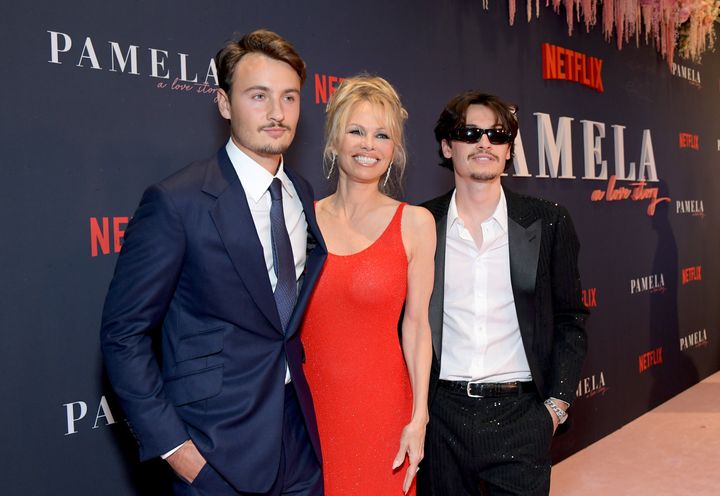
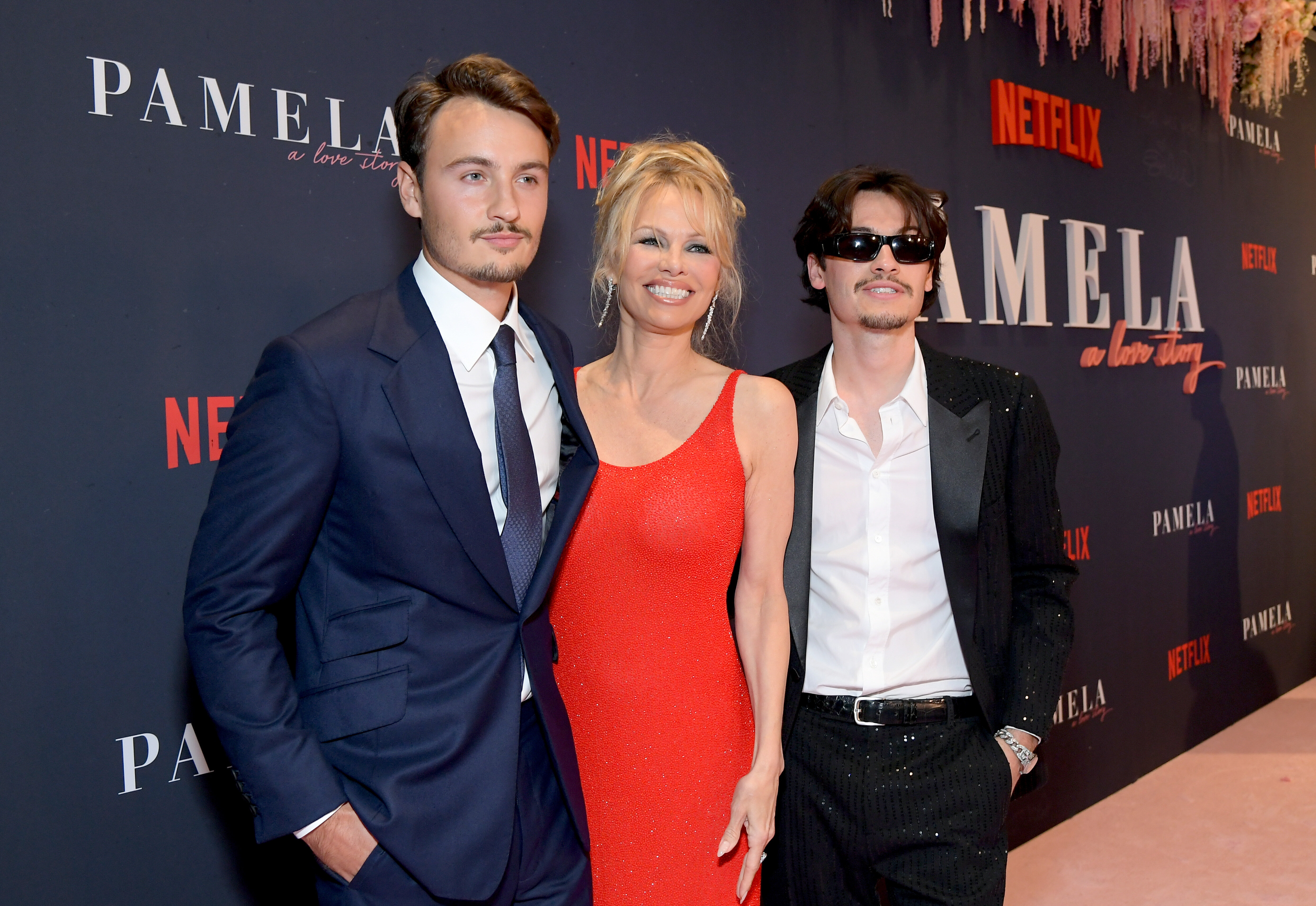
Pamela was seen attending the event in a bright red gown that appeared to pay tribute to her most iconic look.

Pamela Anderson at the launch of Pamela, A Love Story

Charley Gallay via Getty Images

The bright colour and round neck of Pammy’s outfit put many in mind of the swimsuit she wore in Baywatch, the TV series that shot her to fame in the 1990s.

Pamela Anderson on the set of Baywatch in the mid-90s

Fremantle Media/Shutterstock

Alongside her at the documentary’s premiere were her two sons Brandon Thomas and Dylan Jagger, whose father is Motley Crue musician, and Pamela’s ex-husband, Tommy Lee.

Pamela Anderson and her son Brandon Thomas Lee

Jon Kopaloff via Getty Images

Pamela with her sons Brandon and Dylan

Charley Gallay via Getty Images

Brandon and Dylan feature heavily in their mum’s new documentary, Pamela, A Love Story, with reports claiming it was their idea that she tell her own story in the film.

The doc is now streaming on Netflix, debuting almost a year to the day after Pam & Tommy – the miniseries in which Lily James portrayed the Baywatch icon – first aired.

Pamela is celebrating the debut of both her new documentary and memoir

Axelle/Bauer-Griffin via Getty Images

The show centred around Pamela’s marriage to Tommy Lee, and the theft of their private sex tape in the late 90s.

While Pam & Tommy received a largely positive reaction, including Emmy nominations for cast members Lily James, Sebastian Stan and Seth Rogen, it was made without the input or approval of the woman who inspired it.

Last week, Pamela branded the team behind Pam & Tommy “assholes” for going ahead without her consent, although she made it clear she had no beef with Lily James.

Share Button