Faster and more efficient computer chips thanks to germanium

Our current chip technology is largely based on silicon. Only in very special components a small amount of germanium is added. But there are good reasons to use higher germanium contents in the future: The compound semiconductor silicon-germanium has decisive advantages over today’s silicon technology in terms of energy efficiency and achievable clock frequencies.

The main problem here is to establish contacts between metal and semiconductor on a nanoscale in a reliable way. This is much more difficult with a high proportion of germanium than with silicon. The team at TU Wien, however, together with research teams from Linz and Thun (Switzerland), has now shown that this problem can be solved — with contacts made of crystalline aluminium of extremely high quality and a sophisticated silicon germanium layer system. This enables different interesting contact properties — especially for optoelectronic and quantum components.

The problem with oxygen

“Every semiconductor layer is automatically contaminated in conventional processes; this simply cannot be prevented at the atomic level,” says Masiar Sistani from the Institute for Solid State Electronics at TU Wien. First and foremost, it is oxygen atoms that accumulate very quickly on the surface of the materials — an oxide layer is formed.

With silicon, however, this is not a problem: silicon always forms exactly the same kind of oxide. “With germanium, however, things are much more complicated,” explains Masiar Sistani. “In this case, there is a whole range of different oxides that can form. But that means that different nanoelectronic devices can have very different surface compositions and therefore different electronic properties.”

If you now want to connect a metallic contact to these components, you have a problem: Even if you try very hard to produce all these components in exactly the same way, there are still inevitably massive differences — and that makes the material complex to handle for use in the semiconductor industry.

“Reproducibility is a big problem,” says Prof. Walter Weber, the head of the Institute for Solid State Electronics, TU Wien. “If you use germanium-rich silicon germanium, you can’t be sure that the electronic component, after you’ve put contacts on it, will really have the characteristics you need.” As a result, this material is only used to a limited extent in chip production.

That is a pity, because silicon germanium would have decisive advantages: “The charge carrier concentration is higher, especially positive charge carriers, the so-called “holes,” can move much more efficiently in this material than in silicon. The material would therefore allow much higher clock frequencies with increased energy efficiency than our current silicon chips,” says Lukas Wind, a doctoral student in Walter Weber’s research group.

The “perfect” interface

Now, however, the research team has been able to show how the problem can be solved: They found a method to create perfect interfaces between aluminium contacts and silicon germanium components on an atomic scale. In a first step, a layer system is produced with a thin silicon layer and the actual material from which the electronic components are to be made — the silicon-germanium.

By heating the structure in a controlled manner, a contact can now be created between the aluminium and the silicon: At around 500 degrees Celsius, distinctive diffusion occurs, the atoms can leave their place and start to migrate. Silicon and germanium atoms move into the aluminium contact relatively quickly, and aluminium fills the vacated space.

“The diffusion dynamics in the layer system used thus create an interface between aluminium and the silicon germanium with an extremely thin silicon layer in between,” explains Masiar Sistani. Through this manufacturing process, oxygen atoms never have the opportunity to get to this atomically sharp and highly pure interface.

“Our experiments show that these contact points can be produced in a reliable and easily reproducible way,” says Walter Weber. “The technological systems you need to do this are already being used in the chip industry today. So, this is not just a laboratory experiment, but a process that could be used relatively quickly in the chip industry.

The decisive advantage of the presented manufacturing process is that high-quality contacts can be produced regardless of the silicon-germanium composition. “We are convinced that the presented abrupt, robust and reliable metal-semiconductor contacts are highly interesting for a variety of new nanoelectronic, optoelectronic and quantum devices,” says Walter Weber.

Share Button

Tory MP Mark Francois Slammed For Using ‘Crass Racial Slur’ In The Commons

Tory MP Mark Francois has been strongly criticised for using a “crass racial slur” in the House of Commons.

Francois, a former minister and the MP for Rayleigh and Wickford, is under fire for his use of term “J***” in a defence debate on Monday.

Francois has subsequently said he meant “absolutely no disrespect or offence to anyone” by using the phrase.

Speaking in the Commons yesterday, Francois said: “Given the defence budget is likely to come under great pressure, why does it take BAE Systems 11 years to build a ship the J*** can build in four?”

Neither Commons Speaker Sir Lindsay Hoyle nor defence secretary Ben Wallace subsequently condemned the use of the term.

His remarks were strongly criticised by Labour MP Sarah Owen, the first MP of south-east Asian ancestry, who raised her objections in a point of order.

She accused Francois of using an “outdated and crass racial slur” and that his actions had fallen “well below the bar we should expect”.

Addressing Hoyle, Owen said: “Mr Speaker, you rightly and regularly remind us to use respectful language in this House, but unfortunately, this outdated and crass racial slur has fallen well below the bar we should expect.”

Following the criticism, Francois said in a statement: “I meant absolutely no disrespect or offence to anyone by using the phrase ‘Japs’, during defence questions in the House of Commons yesterday.

“I merely used it as an abbreviation for Japanese, as I had, by then, been asking an admittedly rather wordy question, about naval shipbuilding. Moreover, in the course of that same question, as the record clearly shows, I actually complimented the Japanese shipbuilding industry, for building warships much faster than here in Britain.”

In her point or order Owen also criticised environment minister and former chief whip Mark Spencer over his recent suggestion that “some little man in China” could be eavesdropping on his own private conversations in a debate about security.

She referred to a weekend article in the Times that asked why “there are only two MPs who identify as eastern south-east Asians in this place, despite making up 1.2 million of the country”.

“Perhaps it is comments like this by the member for Rayleigh and Wickford or ‘the little man in China’ trope trotted out by a government minister last week, or when the former leader of the House [Jacob Rees-Mogg] said the word ‘Yellow Peril’ from that despatch box,” Owen said.

Rees-Mogg subsequently apologised for his remarks, saying he did not know that what he had said was racist and that his use of the term was “out of ignorance”.

In response, Hoyle told Owen that “the casual use of racial terms causes upset and should not be used”.

“What I would say is Erskine May states that good temper and moderation are the characteristics of the parliamentary language and ask all members to remind themselves of that principle in choosing the words they use carefully.

“People reflect also the language that we use – if we set the best of language, therefore others might follow.”

A Labour source told HuffPost UK that Francois should apologise for his remarks.

“If there was ever any doubt, the nasty party is firmly back,” they said.

“While Rishi Sunak and the Conservative Party are distracted by scandal after scandal, their MPs are bringing our parliament into disrepute by using derogatory, racist language in the chamber.

“Mark Francois may need reminding that it is 2022, not 1940. He should apologise for this language.”

Share Button

NHS reaches deal for life-saving breast-cancer drug

Pembrolizumab will be offered to more women in England, to fight aggressive triple-negative tumours.

Share Button

Camilla’s Queen Consort Cypher Is Revealed (Here’s What That Means)

The Queen Consort’s new cypher has been revealed. And if you’re wondering what that means, it’s a monogram used to show Camilla’s official position.

The cypher will be used by the Queen Consort on personal letterheads, cards and gifts, as well as on the cross that she’ll lay at the Field of Remembrance on Thursday November 10.

The design incorporates the Queen Consort’s initial, ‘C’ for Camilla, and ‘R’ for Regina, – Latin for Queen. It sits alongside a representation of the Crown.

The cypher was selected personally by Camilla from a series of designs and will now become her personal property.

The Queen Consort’s official cypher.

Buckingham Palace

The Queen Consort’s official cypher.

The cypher was designed by Professor Ewan Clayton, a calligrapher on the Faculty and Academic Board of The Royal Drawing School, in collaboration with Timothy Noad, Herald Painter and Scrivener at The College of Arms.

Though you’ll catch the odd glimpse of the Queen Consort’s cypher, you’ll see the King’s official symbol far more frequently.

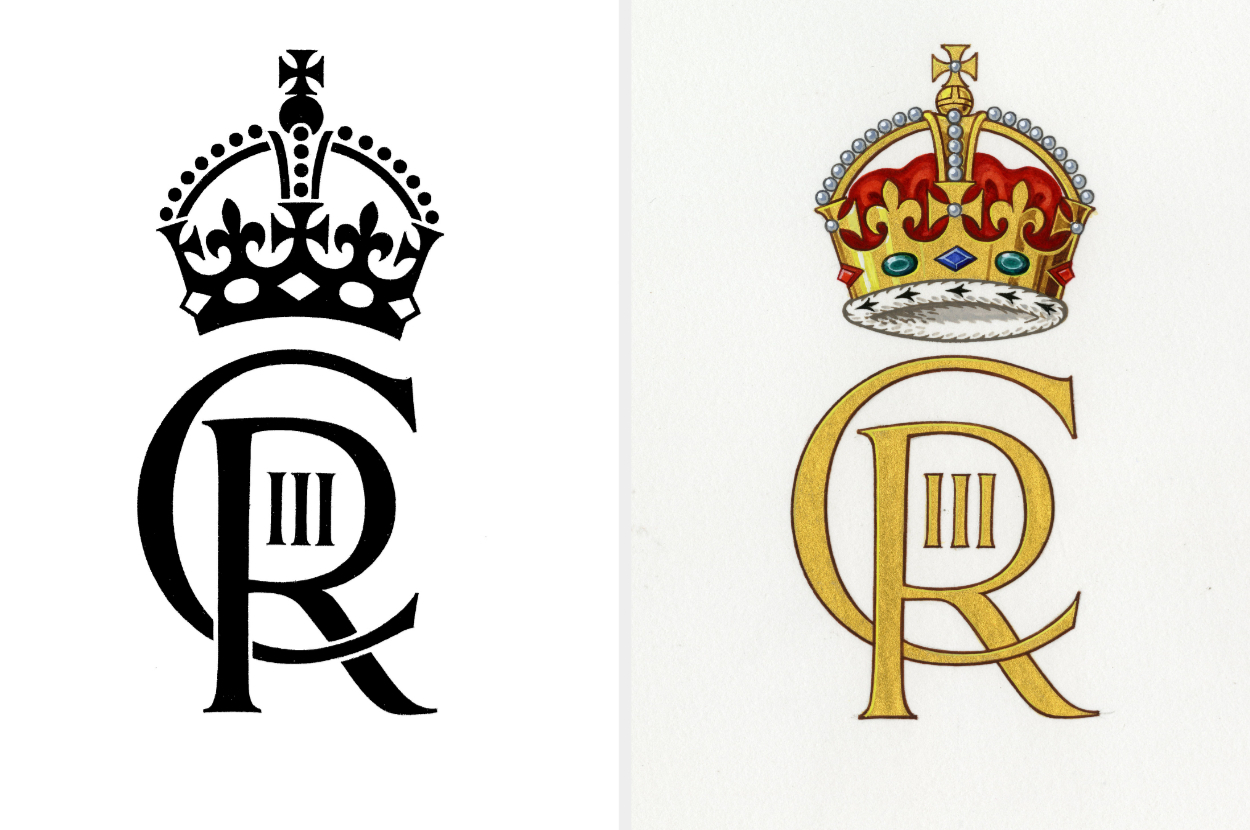
King Charles unveiled his chosen design in September and like Camilla’s, it includes the C for his first name and the letter R for Rex, the Latin name for King.

King Charles III's new cypher

Buckingham Palace via PA

King Charles III’s new cypher

In between these two letters is the Roman numeral for three (III) indicating that he is the third monarch in British history to be known as Charles, so it reads Charles Rex III.

Charles’ cypher will appear on government buildings, traditional police helmets, state documents and any post boxes built after his reign began.

It’s a slow process to make these changes, however, so you’re unlikely to see much of the two new cyphers ahead of Charles’ official coronation in May.

For now, you’ll continue to see the cypher of the late Queen Elizabeth II in many places across the country.

The official design, prepared at the College of Arms and approved by the Queen, for the Royal Cypher of Queen Elizabeth II.

PA Images via Getty Images

The official design, prepared at the College of Arms and approved by the Queen, for the Royal Cypher of Queen Elizabeth II.
Share Button

Early planetary migration can explain missing planets

A new model that accounts for the interplay of forces acting on newborn planets can explain two puzzling observations that have cropped up repeatedly among the more than 3,800 planetary systems cataloged to date.

One puzzle known as the “radius valley” refers to the rarity of exoplanets with a radius about 1.8 times that of Earth. NASA’s Kepler spacecraft observed planets of this size about 2-3 times less frequently than it observed super-Earths with radii about 1.4 times that of Earth and mini-Neptunes with radii about 2.5 times Earth’s. The second mystery, known as “peas in a pod,” refers to neighboring planets of similar size that have been found in hundreds of planetary systems. Those include TRAPPIST-1 and Kepler-223, which also feature planetary orbits of near-musical harmony.

“I believe we are the first to explain the radius valley using a model of planet formation and dynamical evolution that self-consistently accounts for multiple constraints of observations,” said Rice University’s André Izidoro, corresponding author of a study published this week in Astrophysical Journal Letters. “We’re also able to show that a planet-formation model incorporating giant impacts is consistent with the peas-in-a-pod feature of exoplanets.”

Izidoro, a Welch Postdoctoral Fellow at Rice’s NASA-fundedCLEVER Planets project, and co-authors used a supercomputer to simulate the first 50 million years of the development of planetary systems using a planetary migration model. In the model, protoplanetary disks of gas and dust that give rise to young planets also interact with them, pulling them closer to their parent stars and locking them in resonant orbital chains. The chains are broken within a few million years, when the disappearance of the protoplanetary disk causes orbital instabilities that lead two or more planets to slam into one another.

Planetary migration models have been used to study planetary systems that have retained their resonant orbital chains. For example, Izidoro and CLEVER Planets colleagues used a migration model in 2021 to calculate the maximum amount of disruption TRAPPIST-1’s seven-planet system could have withstood during bombardment and still retained its harmonious orbital structure.

In the new study, Izidoro partnered with CLEVER Planets’ investigators Rajdeep Dasgupta and Andrea Isella, both of Rice, Hilke Schlichting of the University of California, Los Angeles, and Christian Zimmermann and Bertram Bitsch of the Max Planck Institute for Astronomy in Heidelberg, Germany.

“The migration of young planets towards their host stars creates overcrowding and frequently results in cataclysmic collisions that strip planets of their hydrogen-rich atmospheres,” Izidoro said. “That means giant impacts, like the one that formed our moon, are probably a generic outcome of planet formation.”

The research suggests planets come in two “flavors,” super-Earths that are dry, rocky and 50% larger than Earth, and mini-Neptunes that are rich in water ice and about 2.5 times larger than Earth. Izidoro said new observations seem to support the results, which conflict with the traditional view that both super-Earths and mini-Neptunes are exclusively dry and rocky worlds.

Based on their findings, the researchers made predictions that can be tested by NASA’s James Webb Space Telescope. They suggest, for instance, that a fraction of planets about twice Earth’s size will both retain their primordial hydrogen-rich atmosphere and be rich in water.

The research was funded by NASA (80NSSC18K0828), the Welch Foundation (C-2035-20200401) and the European Research Council (757448-PAMDORA).

Story Source:

Materials provided by Rice University. Original written by Jade Boyd. Note: Content may be edited for style and length.

Share Button

New theory explains recovery delays in COVID-19 and cardiac patients

COVID-19 patients placed on ventilators can take a long time to regain consciousness. New research from Weill Cornell Medicine, NewYork-Presbyterian, MIT, and Massachusetts General Hospital is now illustrating that these delays may serve a purpose: protecting the brain from oxygen deprivation.

The existence of such a brain-preserving state could explain why some patients wake up days or even weeks after they stop receiving ventilation, and it suggests that physicians should take these lengthy recovery times into account when determining a patient’s prognosis.

In a study published Nov. 7 in the Proceedings of the National Academy of Sciences, the investigators connect the pattern seen among those who have survived severe COVID-19 with similar delays known to occur in a small fraction of cardiac arrest patients.

“The delayed recoveries in COVID-19 patients are very much like the rare cases we’ve documented in previous research. In this new paper, we describe a mechanism to explain what we’re seeing in both types of patients,” said study co-senior author Dr. Nicholas D. Schiff, the Jerold B. Katz Professor of Neurology and Neuroscience in the Feil Family Brain and Mind Research Institute and co-director of the Consortium for the Advanced Study of Brain Injury (CASBI) at Weill Cornell Medicine.

He found evidence for this explanation — that patients’ brains are protecting themselves — in animals, most notably painted turtles, that can tolerate extended periods without oxygen.

More than a decade ago, Dr. Schiff and his colleagues first observed these delays among comatose cardiac arrest patients who received cooling therapy to reduce brain damage caused by a loss of blood flow. In one such case, a 71-year-old patient took 37 days to awaken, before ultimately making a near-complete recovery.

During the pandemic, Dr. Schiff, who is also a neurologist at NewYork-Presbyterian/Weill Cornell Medical Center, performed neurology consultations for COVID-19 patients, and he soon began seeing similar, delayed awakenings occurring when patients were taken off ventilators and stopped receiving the sedatives given to them to reduce their movement.

In a separate analysis of a large cohort of Covid-19 patients from Weill Cornell Medicine and two other major U.S. medical centers, Dr. Schiff and his colleagues, including co-author of the current paper, Dr. Emery N. Brown, professor of anesthesia at Harvard Medical School, Edward Hood Taplin Professor of Medical Engineering and Computational Neuroscience in The Picower Institute for Learning and Memory at MIT and an anesthesiologist at Massachusetts General Hospital, found that a quarter of patients who survived ventilation took 10 days or longer to recover consciousness. The more oxygen deprivation they suffered while on the ventilator, the longer that delay.

In the prior study of cardiac patients, the researchers recorded a distinctive pattern in brain activity, one also seen in patients under deep anesthesia. (Recordings from COVID-19 patients are extremely limited.) Dr. Schiff read that a similar pattern had been seen in the brains of painted turtles, which can withstand up to five months without oxygen under ice in the winter. To do so, they activate the same inhibitory system within the brain targeted by anesthetics given to human cardiac and COVID-19 patients but in novel ways developed by evolutionary specializations.

Dr. Schiff and Dr. Brown propose that, by chance, the same protective response emerges in the patients.

“It is our theory that oxygen deprivation as well as practices in the ICU, including commonly used anesthetics, expose elements of strategies that animals use to survive in extreme conditions,” Dr. Schiff said.

“These observations may offer new insights into the mechanisms of how certain anesthetics produce unconsciousness and new approaches for ICU sedation and for fostering recovery from disorders of consciousness,” Dr. Brown added.

When patients fail to regain consciousness for an extended time, physicians may recommend withdrawing life-supporting care. This threshold is typically set at 14 days or less for cardiac patients, while no such guidelines exist for COVID-19.

In light of this new research, however, so long as they lack brain injuries, physicians should avoid making negative projections about these patients’ potential to recover, note the researchers.

Share Button

New quasiparticle discovered in moiré patterns

If you hold one wire mesh on top of another one and look through it, you’ll see a larger pattern called a moiré pattern formed by the overlapping grids of the two meshes, which depends on their relative twisted angle. Scientists developing new materials are actively studying moiré patterns in overlapping atomically thin materials — they produce intriguing electronic phenomena that includes unconventional superconductivity and ferromagnetism.

Supercomputer simulations have helped scientists reveal in a bilayer moiré system a new species of an electronic phenomenon called an exciton, which is an electrically neutral quasiparticle, yet one that can carry energy and consists of an electron and electron ‘hole’ that can be created for example by light impinging certain semiconductors and other materials.

The newly discovered excitons were produced by moiré patterns from two-dimensional sheets of exotic semiconductors called transition metal dichalcogenides, with the electron bound to the hole but separated from each other by a characteristic distance in the sheet. This was named an intralayer charge-transfer exciton and was a surprise to the scientists because such excitons do not exist in the individual sheets. The research can be used in the development of new optical sensors and communication technology such as optical fibers and lasers.

Novel Exciton Discovered

“In this work we discovered a novel exciton of unforeseen intralayer charge-transfer characteristics in a moiré superlattice formed by two atomically thin layers of transition metal dichalcogenide materials,” said Steven G. Louie, a distinguished professor of physics at the University of California, Berkeley (UC Berkeley), and a senior faculty scientist at the Lawrence Berkeley National Laboratory (LBNL).

Louie is the corresponding author of research published August 2022 in the journal Nature. In it, the scientists developed computer models that go beyond the conventional parameterized models that have been used to describe moiré systems and moiré excitons. Instead, they performed ab initio calculations that only start with the identity and initial position of the 3,903 atoms of the moiré superlattice unit cell.

First Principles

“It is a powerful method to accurately predict material properties,” Louie added, “because there’s no empirical fitting involved.”

In particular, to calculate the exciton states and the optical property of the moiré systems, they used the state-of-the-art GW plus Bethe-Salpeter equation (GW-BSE) approach, considered one of the most accurate approaches to predicting the optical properties of materials.

What’s more, Louie and colleagues used their calculations to predict the different electronic and optical responses of the excitons in the system. They worked with experimental colleagues Emma C. Regan, Zuocheng Zhang and Professor Feng Wang at UC Berkeley. In a nutshell, Wang and colleagues shone light on the material and then analyzed the reflected light to see how the system responded to the impinging photons under different conditions.

Sure enough, they verified the theoretical predictions by finding distinct signatures of the intralayer charge-transfer exciton in their measurements.

Computational Challenges Overcome With TACC Support

“The GW-BSE method is very accurate, but it is also very computationally challenging,” said study co-author Mit Naik, a postdoctoral researcher working with Professor Louie at UC Berkeley and LBNL.

The challenge in simulating an exciton is that it requires solving difficult six-dimensional integrals, numerous times, and the integrals are massive in the moiré superlattice because of the large size of the moiré unit cell — composed of many unit cells of the individual layers, 25×25 for one layer and 26×26 for the other.

Typical GW-BSE calculations are performed on systems of just up to a hundred atoms in the unit cell. Here, the authors needed calculations for a whooping 3,903 atoms. “Initially, it seemed almost impossible,” Naik said.

Undaunted, the scientists hit on a new method that reduced the computational cost by a million times without loss of accuracy.

“We found a way to approximate each layer’s two thousand atom integral as a sum over many three atom integrals, which were computationally much simpler to compute,” Naik said.

The theoretical technique they developed, called the pristine unit-cell matrix projection (PUMP) method, can be generalized to study other material systems such as interlayer or hybrid moiré excitons in multi-layer moiré superlattices, shallow defects in materials, and more.

The Texas Advanced Computing Center (TACC) supported Steven Louie’s first principles study of cutting-edge materials through a large resource allocation on TACC’s Frontera supercomputer, the most powerful academic system in the U.S and funded by the National Science Foundation.

He also was awarded allocations on TACC’s Stampede2 supercomputer made through the NSF-funded Advanced Cyberinfrastructure Coordination Ecosystem: Services & Support (ACCESS), formerly the Extreme Science and Engineering Discovery Environment (XSEDE).

In their bid to push the limit of the number of atoms in their calculations, the researchers initially faced some problems with running some of the large-scale moiré calculations on Frontera.

“We received support from the research associates at TACC, who helped us resolve these problems,” Naik recalled.

For instance, they were unable to run the large-scale simulations of ground-state properties on Frontera using a standard density functional theory (DFT) package called Quantum Espresso, because of the instability created by a new version of the Intel compiler used to for the DFT package.

The TACC consulting team found a way around the problem by installing an older, more stable version of the compiler. “This allowed us to compute the electronic structure of the WSe2 moiré superlattice that went into this work,” Naik said.

“Frontera and Stampede2 hardware efficiently catered to our requirements by providing state-of-the-art internode connectivity and sufficient memory on each node,” Naik added.

SCIENCE IMPACT

“The intralayer charge-transfer exciton we discovered through this artificial stacking of two monolayers has revealed an extraordinarily strong interplay of the atomic structure and the type of exciton possible in the moiré systems,” Louie said. “This is an important step in advancing the engineering of materials for desired properties.”

That’s because, once light creates charge-transfer excitons, they can be distorted or dissociated more easily with an external field or other perturbations than the standard Wannier-type excitons.

These considerations are important in many basic phenomena and potential applications, such as novel optical sensors and electro-optic modulation nanodevices. “That’s what we’re working on with our experimental colleagues right now,” Louie said.

“Excitonic properties of materials form the basic principles behind many of the optical and optoelectronic devices and sensors that we encounter in our daily lives,” said study co-author Felipe Jornada, an Assistant Professor in the Department of Materials Science and Engineering at Stanford University and a Principal Investigator at the SLAC National Accelerator Laboratory.

He gave the example of OLED TVs and displays, which use light emission from the recombination of excitons in organic semiconductors. Also, new smartwatches use advanced optical sensors to monitor the wearer’s blood oxygen levels.

“Beyond existing devices, the transition metal dichalcogenides and heterostructures of these materials that we’re working on are considered a promising material platform for post-silicon nanoscale optoelectronic devices. Moving forward, we believe that these are going to be a promising route towards novel sensors, displays, and technologies,” Jornada said.

The majority of the funding for the study was provided by the U.S. Department of Energy’s van der Waals heterostructure program (KCWF16). The theory and algorithm development for this work was carried out at the Center for Computational Study of Excited State Phenomena in Energy Materials (C2SEPEM) at the Lawrence Berkeley National Lab. They also used the National Energy Research Science Computing Center (NERSC) at the Lawrence Berkeley National Laboratory to perform part of the calculations.

Share Button

Rebel Wilson Reveals She’s Become A Mother As She Celebrates Birth Of Baby Girl

Rebel Wilson has announced that she has become a mother after welcoming a baby girl.

The Pitch Perfect star shared a photo of the newborn – who was born last week, via a surrogate – on her Instagram page on Monday afternoon.

“Beyond proud to announce the birth of my first child, Royce Lillian, born this past week via surrogate,” Rebel told her followers.

“I can’t even describe the love I have for her, she’s a beautiful miracle!”

She continued: “I am forever grateful to everyone who has been involved, (you know who you are), this has been years in the making… but particularly wanted to thank my gorgeous surrogate who carried her and birthed her with such grace and care.

“Thank you for helping me start my own family, it’s an amazing gift. The BEST gift!! I am ready to give little Roycie all the love imaginable.”

The Australian actor added: “I am learning quickly…much respect to all the Mums out there! Proud to be in your club.”

The Bridesmaids received a wave of support from her celebrity friends after the announcement, with Taika Waititi – who directed Rebel in Jojo Rabbit – commenting: “Yes Rebz, congrats.”

Rebel is best known for her performance in comedy films like Bridesmaids, Isn’t It Romantic and the Pitch Perfect series, as well as the musical Cats.

Share Button

Lee Anderson Has Said Putting Asylum Seekers In Hotels Leaves A Bitter Taste In His Throat

A Tory MP has said that placing migrants in temporary hotel accommodation “leaves a bitter taste in my throat” and called for them to be deported instead.

Lee Anderson also said asylum seekers arriving in the UK should be “sent back the same day”.

The Ashfield MP spoke out as the government continues to come under pressure over the situation at the Manston migrant processing centre in Kent.

At the peak of the crisis a week ago, around 4,000 people were held at the facility, which is designed to hold about 1,600.

Immigration minister Robert Jenrick told the Commons that the situation had since improved, with numbers “back below 1,600” after more than 2,000 people were placed in temporary accommodation.

But Anderson said: “When I hear words like sourcing housing and getting extra hotel spaces for illegal immigrants, it leaves a bitter taste in my throat.

“And I’ll tell you what, I’ve got 5,000 people in Ashfield who want to secure council housing and they cannot get one. Yet, we’re here debating this nonsense once again. When are we going to stop blaming the French, the ECHR, the lefty lawyers?

“The blame lies in this place right now — when are we going to go back and do the right thing and send them straight back the same day?”

Jenrick responded by telling Anderson that while the UK should be “guided by our common desire for decency” it was “not right that migrants are put up in three or four-star hotels at exorbitant cost to the United Kingdom taxpayer”.

He said Rishi Sunak would meet with the French president Emmanuel Macron to reach an agreement on how to stem the flow of small boat crossings in the Channel.

Alistair Carmichael, the Liberal Democrat home affairs spokesperson, criticised Anderson’s remarks.

“We all want to stop these dangerous Channel crossings and defeat the criminal gangs who profit from them, but the Conservatives’ approach isn’t working and they blame everyone but themselves,” Carmichael told HuffPost UK.

“For years, Conservative MPs from Lee Anderson to the home secretary – and even the prime minister – have contributed nothing but alienating rhetoric and simplistic proposals that do nothing to solve the problem. This sort of unhelpful, expensive and callous nonsense has only made the problem worse.

“If Conservative MPs really want to deal with the asylum backlog and save taxpayers’ money, the need to focus on fixing the asylum system they have broken and processing claims for asylum more quickly.”

Share Button

NHS Borders monitors high levels of scarlet fever

NHS Borders says the number of cases across the region is currently “unseasonably high”.

Share Button