Very high consumption over a long period of time can inhibit iron absorption, and women “of reproductive age” (so a lot of the trendy drink’s fans) might be at a higher risk, he added.
Here, we spoke to Dr Suzanne Wylie, GP and medical adviser for IQdoctor, about how much matcha is too much, and why it might affect your health.
Advertisement
Some matcha may be good for you
Speaking to HuffPost UK, Dr Wylie said that there really may be some health advantages to the popular green drink.
“Matcha, a finely ground powdered green tea, is celebrated for its high antioxidant content, notably epigallocatechin gallate (EGCG), which is linked to various health benefits, including improved focus and metabolism,” she explained.
“However, matcha also contains tannins and catechins, polyphenolic compounds that can bind to non-heme iron (the type found in plant-based foods) in the digestive tract, reducing its absorption.
Advertisement
“This effect is more pronounced in matcha due to its concentrated form, which retains the whole tea leaf, unlike traditional steeped teas.”
Therefore, she explained, it’s important to drink it in moderation.
Wondering how much is too much? “For most individuals, moderate matcha consumption, typically one cup per day, is considered safe and unlikely to cause significant health issues,” she said.
“However, excessive intake, especially when consumed with iron-rich meals or supplements, can lead to decreased iron absorption over time.”
Advertisement
How can I lower my risk of developing anaemia from matcha?
The first step is to drink less of it if you’re having loads, but Dr Wylie said those aren’t the only steps matcha lovers can take.
“It’s advisable to consume matcha between meals rather than with or immediately after meals rich in non-heme iron,” she said.
Advertisement
“Additionally, pairing iron-rich foods with vitamin C can enhance iron absorption. If iron supplementation is necessary, it’s best to take it at least one to two hours apart from matcha consumption.”
Those who should pay particular attention to their intake include vegetarians, vegans, menstruating individuals, and those with known iron deficiencies.
“Symptoms of iron deficiency may include fatigue, weakness, and pale skin,” the GP ended.
If you think you might have iron deficiency anaemia, the NHS says you should see your doctor.
And with the upcoming clock changes, some of us might feel even more tired than usual. Some research suggests that even though we technically “gain” an hour’s sleep, most of us don’t actually rest for an extra 60 minutes.
Instead, Harvard Health writes, we’re actually more likely to wake up in the middle of the night, get up earlier, and struggle to nod off in the first place.
Advertisement
This makes the advice from Dr Deborah Lee, a sleep expert from Doctor Fox, more welcome.
Working alongside Comfybedss, the doctor shared five tips for waking up more refreshed in this exhausting period.
1) Exercise in the morning if you can
OK, Dr Lee admits, most of us don’t exactly crave an early morning gym session – especially in cold, dark winter.
But “research has shown that doing a 30-minute workout with a medium effort will help you wake up a lot quicker than if you weren’t to reduce sleepiness,” she wrote.
Advertisement
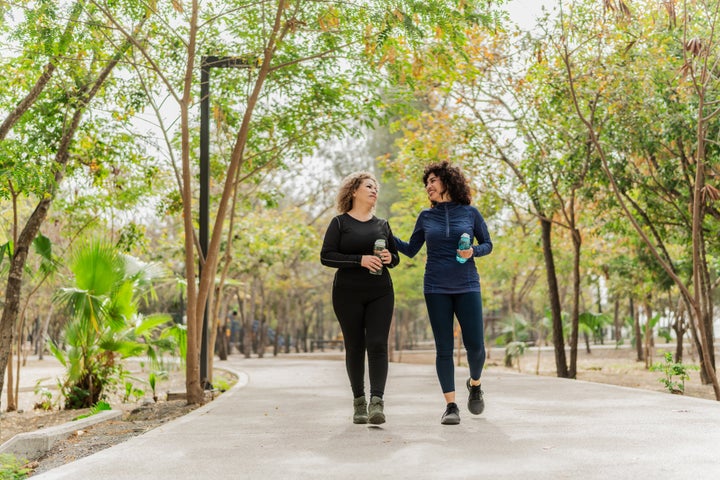
It doesn’t have to be a HIIT session or anything intense: a walk will suffice, she said (plus, morning light is uniquely good at regulating our body clocks).
2) Protect your Circadian rhythm
Speaking of which, the doctor said keeping your Circadian rhythm (or body clock) regular is important in the winter months.
“A huge factor in this is routine, and ensuring you’re going to sleep at the same time each night and waking up at the same time each morning,” Dr Lee said.
Advertisement
“It isn’t just your sleeping pattern that needs to be kept in routine, but your daily meals, your shower and bath routine and your technology ‘switch off’ time.”
Sadly, the sleep expert said, that includes weekends too – tough, “but if you push through, then it will make your Monday wake-up a lot easier!”
3) Use natural light or a SAD lamp to wake up in the morning
If waking up to an inky sky is getting you down, Dr Lee says you’re not alone.
“When your eyes see light in the morning, it gives signals to your brain that it’s time to wake up,” she wrote, which can be “really confusing for the mind”.
Advertisement
The best option, she advised, is to “utilise natural light by opening the curtains and getting outside as soon as possible”.
But if that’s not possible, “Invest in a night lamp so that you can put it on first thing in the morning. Or, a [SAD] lamp.
“These lamps will wake you, so it won’t be such a shock to the eyes when there’s a big, bright light next to you.”
Advertisement
4) Be picky about your breakfast
Though you might be tempted to grab some toast or a cereal bar in a rushed weekday morning, “but a breakfast that is rich in both carbohydrates and protein should make you feel more alert quickly,” the doctor said.
5) Wait before grabbing that cup of morning coffee
It’s natural to reach for caffeine on a groggy morning. But per the sleep expert, the best results actually happen when you wait.
“You shouldn’t be reaching for the caffeine until at least 45 minutes after you wake up, as this is when the caffeine will give you the biggest fix,” she stated.
“With [both flu and Covid circulating at higher rates, it’s important to know the difference between a cold and flu, or coronavirus and flu,” he said.
“Knowing which illness you might have means you can best treat yourself and protect others.”
Here are the different symptoms the doctor usually sees for both:
Symptom duration may tell them apart
Both flu and Covid share a lot of symptoms, including a fever, headache, chills, a runny nose, tiredness, aching muscles, and a dry cough.
Advertisement
“People with flu normally feel very unwell for two or three days and will continue to experience symptoms for around another five days. After that, you may feel tired and run down for a further two or three weeks,” the doctor said.
But “People with coronavirus usually begin to show symptoms five to six days after being exposed and symptoms commonly last up to two weeks,” he added.
Then, there’s the question of severity.
“It can be difficult to tell coronavirus apart from the flu as they share many of the same symptoms, however, they may feel more intense than having a flu,” Dr Patel said.
Advertisement
He added that you should seek immediate medical help if you notice:
Difficulty breathing at rest.
Confusion.
Loss of consciousness or drowsiness.
Constant pressure or pain in the chest.
Cold, clammy, blue, or pale skin.
Loss of speech or movement, regardless of whether it’s flu or Covid.
The only way to be sure is to take a Covid test
Though the flu and Covid can have different symptoms, Dr Patel said that “The only way to be certain whether you have the flu or coronavirus is to take a Covid test.
Advertisement
“While COVID-19 tests are no longer freely available on the NHS, you can still buy lateral flow, PCR and antibody tests online.”
Turns out that while some of us have different “chronotypes,” or natural predispositions towards being either night owls or early birds, some research suggests we should all try to nod off before a certain point anyway.
“To age healthily, individuals should start sleeping before 1am, despite chronobiological preferences,” the 2024 paper read.
The cohort study, which looked at 88,000 UK Biobank participants who were aged between 43 and 74, monitored participants’ sleep for a week before monitoring their heart health status over an average of 5.7 years.
They found that those who fell asleep between 10-11pm seemed the least likely to develop heart issues in that time.
Advertisement
What may be the best and worst sleep times for heart health?
Those who fell asleep between 11pm and midnight were 12% more likely to develop heart health and circulatory issues during the study.
For those who fell asleep after midnight, that rose to 25%. Those who kipped before 10pm had a 24% increased likelihood of developing heart health issues, too, though the number of people who had this earlier bedtime was small in the study.
And as we shared, 10-11pm seemed to be the bedtime linked to the lowest risk.
Women seemed to be more affected by the discrepancies than men, too.
This, however, was only an observational study. That means that the scientists couldn’t prove that differences in bedtime definitely caused the changes in heart health outcomes – it only showed an association, or link, between the two.
According to Harvard Health, “nontraditional sleep times may disrupt the body’s 24-hour internal clock, or circadian rhythm, which plays a key role in regulating physical functioning”.
Advertisement
And Regina Giblin, a senior cardiac nurse at the British Heart Foundation (BHF) said, “This large study suggests that going to sleep between 10 and 11pm could be the sweet spot for most people to keep their heart healthy long-term.
“Getting enough sleep is important for our general wellbeing as well as our heart and circulatory health, and most adults should aim for seven to nine hours of sleep per night.”
But, both warn, this study can’t prove that bedtime itself is definitely the cause of heart issues.
“More research is needed into sleep timing and duration as a risk factor for heart and circulatory diseases,” Giblin said.
Advertisement
Sleep is not the only factor that can impact heart health either, she added.
“It’s also important to look at your lifestyle… knowing your numbers such as blood pressure and cholesterol levels, maintaining a healthy weight and exercising regularly, cutting down on salt and alcohol intake, and eating a balanced diet can also help to keep your heart healthy.”
Though the NHS recommends most adults consider taking vitamin D until around March as daylight hours shrink, the service also noted: “There’s little evidence that supplements such as vitamin C, echinacea or garlic prevent colds or help you get better more quickly.”
And Dr Hussain Ahmad, a hospital doctor, said: “I don’t really like the word boost when we talk about the immune system. It gives the idea that you can switch it on or make it stronger with tablets or drinks, but that’s not how it works… taking lots of vitamin C or other supplements doesn’t make it work any better for most people.”
Instead, Dr Wyllie said: “The easiest way to help boost your immune system is to choose a healthy lifestyle. Maintaining a healthy weight, eating a balanced diet high in fruit and vegetables, and exercising regularly are all natural steps you can take to help your immune system function normally.”
However, though all doctors recommended doing what Dr Ahmad called “simple stuff” over a long period of time, Dr Wyllie said that some changes really can make a significant change.
Advertisement
“Quitting smoking is hugely beneficial for your overall health, but also helps the health of your immune system,” she revealed.
That’s partly because “your adaptive immune system, the part responsible for remembering and responding to threats, can be negatively impacted by smoking,” she said.
“It can take years for your immune system to recover after quitting smoking, so the sooner you decide to stop, the better.”
Advertisement
Additionally, you might be surprised by how much changing your pace of life helps. “Stress and tiredness can make you more likely to catch things, so slowing down when you can really helps,” Dr Ahmad advised.
Are there any genuine “immune boosts”?
Yes(ish). There is one exception to the “slow-burn, lifestyle change” rule: vaccines.
These “are the only proven ways to prepare your immune system for specific infections,” Dr Ahmad advised.
And Dr Wyllie shared “It is much safer and easier for your immune system to build its defences through vaccinations than by catching the disease”.
Advertisement
This is not to say that nobody should take supplements or that they’re useless – this is not the case, especially if you have nutrient deficiencies.
But, as Dr Ahmad put it, the best place for most of us to start is by trying our best to “eat proper meals with some fruit and veg in there, move your body every day, and make sure you’re getting enough rest”.
That, along with keeping up with any vaccines we’re eligible for, is as close to an “immune system boost” as we’re likely to get.
Though you might think extreme fatigue, regular headaches, and even unintentional weight loss are nothing out of the ordinary, both a GP and a cancer doctor have previously told HuffPost UK they could signal deeper health issues.
They can reveal everything from anaemia to more serious conditions. The key is to get them checked out to be on the safe side, the experts advised.
Advertisement
And now, cardiologist and scientist Dr Ernst von Schwarz has shared the four signs he’d always see a doctor about, no matter how innocuous you might believe them to be.
These are:
1) Pressure in your chest
“Chest pressure or pain is always suspicious of a lack of oxygen in the heart,” the doctor told us.
Per the NHS, sudden pressure, “squeezing”, or even burning sensations in your chest are worth calling 999 over as they could be a sign of a heart attack.
Even if the pressure or pain comes and goes rather than arriving suddenly, you should still speak to your GP.
Advertisement
2) Shortness of breath when you’re not being active
It’s normal for your breathing to get a little heavy after a jog or in your spin class. But if your breath is laboured when you’re sitting down or doing minimal movement, Dr von Schwartz said that could be a red flag.
“Shortness of breath can have a multitude of causes, from heart failure to ischemia to pulmonary issues such as asthma, COPD or pneumonia, vascular issues such as pulmonary emboli, [or] intoxication, anxiety, and panic attacks, among others,” he shared.
3) Fainting
This is always worth getting checked out, the cardiologist told us.
It can also be “a result of orthostatic dysregulation [low blood pressure after going from sitting or lying down to standing], as in POTS, or [a] lack of oxygen in the brain caused by very low or very high heart rates”.
The NHS said that though it’s likely not serious, you should always see a GP if you’ve fainted.
Per the NHS, these can last seconds or minutes. But Dr von Schwartz said he’d see a GP if they pass the five-second mark.
Advertisement
That’s because “palpitations can be caused by harmless extra beats or short atrial runs, but also by potential life-threatening ventricular tachycardia,” he said.
Definitely see your doctor if palpitations keep coming back, if they last longer than a few minutes, or if you have a heart condition or a family history of heart conditions.
Want to add some extra challenge to your walk? Or want to tone down your too-tough run? “Jeffing” may be your answer.
Jeffing is a training method that comprises both running and walking intervals during a workout. It was founded by Jeff Galloway, an Olympic runner, who came up with the run-walk concept to help folks of all levels run further, protect themselves from injuries and enjoy running more, according to Galloway’s website.
Advertisement
The method is known by a few different names, such as the Galloway run-walk program and the run-walk method, but they all have the same goal: to help people build endurance, run faster and move more by employing both running and walking intervals during a workout.
Here’s what jeffing might look like: Going for a two-minute run followed by a three-minute walk and repeating that a few times for a full workout.
Whether you’re a runner or not, jeffing is a way to make running more accessible and for your step count to skyrocket in the process. Here’s what to know:
Advertisement
‘Jeffing’ is useful for runners of all levels, but is especially valuable for beginners.
Jeffing is good for anyone to try, whether you’re running a marathon or lacing up your shoes for the first time ever.
“I’ve always thought of Galloway’s run-walk as taking what he did when he was an Olympic runner … and … [bringing it] to people like my mom who never thought that they could be a runner,” said Randy Accetta, the director of coaching education at the Road Runners Club of America and founder of Run Tucson.
Runners training for races are known to employ this run-walk (or run-jog) method in their training, Accetta added.
Advertisement
While jeffing can help someone running a high-stakes race cross the finish line, it can also be a particularly good strategy for new runners, said Jeff Dengate, the runner-in-chief for Runner’s World magazine.
“We’ve seen this time and time again where somebody [takes] up running, they head out their driveway, and they think, ‘I have to be a runner. I have to be fast,’ so they get down the road and they’re just cooked, they’re just exhausted,” Dengate said.
For new runners, having a run-walk strategy can keep that exhaustion from happening. “It’s a really good introduction to running,” said Riley Buchholz, the men’s and women’s cross country coach at Temple University in Philadelphia. And it can be protective.
Advertisement
“A lot of people don’t realize that whenever you’re running, you’re applying three to four times your body weight [on your joints] — so, it’s a lot on the body to handle, especially if you just start pumping out miles at a harder effort that you aren’t used to. It takes time to adapt to that,” Buchholz explained.
A mix of running and walking when you head out to the trail or track can help protect your body from that impact.
FG Trade Latin via Getty Images
Jeffing is a run-walk method that can help build up endurance and muscle strength.
Advertisement
It can help build up strength and endurance.
Don’t let the walking fool you. If your goal is to build up your running capability, this jeffing still has a place in your training.
Alternating between running and walking can help you build up your lung capacity, endurance, and muscles, noted Buchholz before adding, “Anytime you’re exercising, you’re getting better.”
“It helps a lot of people build, not only the stamina, the endurance, but also speed,” Dengate said. “Runners can get faster by using those little walk breaks as well.”
Advertisement
Jeffing is also a good way to learn your preferred pace and effort, Buchholz said.
It takes some of the pressure off running, too.
Anyone who has gone for a run knows the feeling of wanting to stop for a break but feeling guilty about the pause. While there is never a reason to feel guilty (movement is movement), jeffing helps take away those bad feelings during exercise.
“It gives us all the opportunity to exercise without having to feel bad about wanting to stop,” Accetta said. “In the Galloway run-walk, you [intentionally take] the walk breaks. So you know going in that you’re going to run for five minutes and walk for a minute.”
That way, when you’re done with your workout, you can proudly check it off your to-do list because you set out to run and walk from the beginning, Accetta added. “And that’s different than, ‘oh my god, I’m so tired, I need to take a nap. I need to stop walking’ and then stressing whether … you’re ‘quitting’ or not.”
Advertisement
Here’s how to try it:
While some people choose to follow a formula such as one-to-one efforts (meaning, for example, five minutes of running followed by five minutes of walking), there really isn’t a hard-and-fast rule, according to Accetta.
“I think the beauty of … jeffing, or run-walk, is that you can manipulate the effort and rest intervals to fit the physical and emotional needs of the athlete as well as the terrain,” Accetta explained. “For me, there is no perfect ratio.”
It’s all up to you how you start. New runners could try running for 30 seconds, followed by a three-minute walk, or even 15 seconds of running, followed by a three-minute walk. Experienced runners could run for 10 minutes and follow it up with a 30-second walk. There is no wrong formula.
Advertisement
Buchholz said he generally recommends a one-to-four ratio for beginner runners. “Normally, the running is the one and the four is your walking,” he said.
This means if you’re moving for 20 minutes, five minutes can be spent running and 15 can be spent walking, Buchholz said.
When it comes to pace, there are a few things to keep in mind. An everyday jog pace shouldn’t totally deplete you, according to Dengate. “We usually say to use the talk test. If you can’t carry a conversation with the person next to you, you’re probably running too fast on most days.”
“But then, how fast do we do those walk intervals? It’s not a full recovery — you want to walk with purpose … I like to tell people, move like you’re a New Yorker going down the sidewalk. You’re getting somewhere,” Dengate explained.
If you slow down too much during your walk interval, it’s hard to start running again, Dengate added.
Advertisement
Movement should feel good and rewarding, so take the pressure away and keep that in mind when you head outside for your weekly jeffing.
“Far too often we thought of running as punishment for other sports, or it’s something I have to do,” Dengate said. “I like to remind people, running is something we get to do. We’re fortunate enough to be able to have that opportunity to go out and spend that time doing it, so go have fun with it.”
October is Breast Cancer Awareness month. And on their page about the topic, the World Health Organisation (WHO) said the first pillar of the WHO’s Global Breast Cancer Initiative is to “empower individuals and communities to recognise symptoms and seek care early”.
Still, research has shown that women checking their breasts has dropped from 49% in 2022 to just 45% in 2024.
Advertisement
That’s a shame, breast cancer surgeon Dr Cihan Uras from Acıbadem Hospitals said, explaing that: “Breast cancer is the most common cancer among women worldwide… when it’s detected early, survival rates are very high.
“The best thing you can do for yourself is to be familiar with your own body and notice changes quickly. A self-check takes only three minutes,” the surgeon added.
How should I check my breasts at home?
Speaking to HuffPost UK, Dr Uras said the check, which should be done once a month, involves three steps.
Advertisement
These are:
1) Look in the mirror
To begin your test, the surgeon advised, stand topless in front of a mirror for one minute.
“Stand with your shoulders straight, with your hands on your hips, and look in the mirror for any noticeable differences. As you do this more often, these differences will be easier to spot,” he advised.
“Initial signs that you should be looking for include dimpling of the skin, any redness, rashes or changes to the nipple, particularly inversion or discharge.”
2) Raise your arms
This should take 30 seconds, Dr Uras told us.
“As you’re in the mirror, raise your arms above your head. Look for any changes in contour, any swelling that’s arisen, or any pulling of the skin,” the expert advised.
Advertisement
The move helps because it stretches the skin over your breasts.
“This makes subtle changes more visible, especially puckering or pulling of the skin that may not be very noticeable when your arms are by your side. It can also help reveal differences in movement between the two sides.”
3) Feel your breasts while standing and lying down
This should take about a minute and a half (90 seconds) all-in.
“While lying down, use the flat of your fingertips around your breasts to feel in circular motions,” the surgeon stated.
“Make sure that you cover the whole breast from the top to the bottom, as well as side to side. Don’t forget to go right up to your armpit area too. Apply different pressures; light, medium and firm, to ensure you’re feeling all layers of the breast tissue.
Advertisement
“You should be feeling around for any thickened areas, any tenderness that feels unusual to you, not to be confused with pushing down too hard, and of course any lumps.”
What should I do if I notice any changes?
If you do feel something a little different, don’t “panic straight away, as most are not cancer,” Dr Uras said.
But do get it checked as soon as possible, just in case.
“The chances are, you would’ve spotted it early, especially if you’re doing this every month, and your doctor can begin any treatment sooner rather than later,” the surgeon ended.
Advertisement
“The best time to do these checks is a few days after your period ends, when you’re less likely to experience tender breasts due to your cycle. For women who no longer get periods, picking the same time each month will just help you get into a better routine.”
You might have heard that some newer strains of Covid – namely, the Stratus and Nimbus variants – are on the rise in the UK.
Indeed, the UK Health and Security Agency (UKHSA) recently reported that XFG and NB.1.8.1 (Stratus and Nimbus) formed most of the Covid cases last month.
Advertisement
And because Covid cases are ramping up right now, especially among the very young and the elderly, that means more instances of both new strains.
So far as the UKHSA currently knows, these strains are not more dangerous or make you any sicker than “regular” Covid.
“The most important thing is for those eligible to get their vaccination when it is due,” they wrote, as this can help to prevent the most extreme versions of Covid taking hold.
Advertisement
But how can you tell Nimbus and Stratus variants from “normal” Covid, and what should you do if you spot it?
Nimbus and Stratus vs Covid-19 symptoms
Dr Zachary Hoy, an infectious disease specialist with Pediatrix Medical Group, previously told HuffPost that the Stratus variant “would have similar symptoms to other COVID variants that have recently been circulating.”
These include:
a high temperature or shivering
a new, continuous cough – coughing a lot for more than an hour, or three or more coughing episodes in 24 hours
But Dr Naveed Asif, GP at The London General Practice, also said that the Nimbus variant’s most unique feature is a sore throat – one that can create a “razor blade sensation” while swallowing.
And the Stratus variant may also be associated with a higher likelihood of developing a hoarse, raspy voice, a dry cough, exhaustion, and fever, though these can be a part of Covid-19 too.
Advertisement
What should I do if I have the Stratus or Nimbus variants?
As with any other strain of Covid and/or flu, you should try your hardest to avoid spreading the illness to others.
UKHSA says: “If you have symptoms of a respiratory infection, such as COVID-19, and you have a high temperature or do not feel well enough to go to work or carry out normal activities, you should avoid contact with vulnerable people and stay at home if possible”.
If you can’t do this, take precautions like wearing a well-fitting mask, avoiding crowded places, taking your exercise outdoors, away from others, covering your mouth or nose when you sneeze, washing your hands often with soap and water for at least 20 seconds, and avoid touching your face.
Advertisement
In terms of keeping yourself well while you have Covid, the NHS advises lots of rest, plenty of water, painkillers like paracetamol or ibuprofen if needed, sitting upright in a chair to help with breathlessness, and taking a spoonful of honey (don’t feed this to babies under a year old) to relieve sore throats and cough.
Call a doctor if your symptoms do not improve or get worse. Call 999 or go to the A&E if your breathlessness comes on suddenly or is so bad that you struggle to say short sentences when resting.
Darker streaks in your nails, horizontal ridges, and half-white, half-pink or brown nails with a clear line between the colours can all signify health issues.
So perhaps it shouldn’t be shocking that your nails can also show issues with your lungs and heart through another change to the area.
Advertisement
Cleveland Clinic writes that “nail clubbing” is most often linked to cardiovascular and pulmonary conditions, “like lung cancer, lung infections, interstitial lung disease, cystic fibrosis or cardiovascular disease”.
However, it can have other causes, like Crohn’s disease and liver conditions. It can sometimes simply be a genetic variant that isn’t anything to worry about.
What is “nail clubbing”?
Nail clubbing can start gradually, but it ends with your fingernails curving over rounded fingertips.
Advertisement
The nail looks wider and more bulging ― a bit like an inverted spoon ― and feels softer and “spongier”.
Your nails might feel warm and look red. Before the “clubbing” fully takes place, you might notice your nails widening at the top and beginning to wrap around your fingertips.
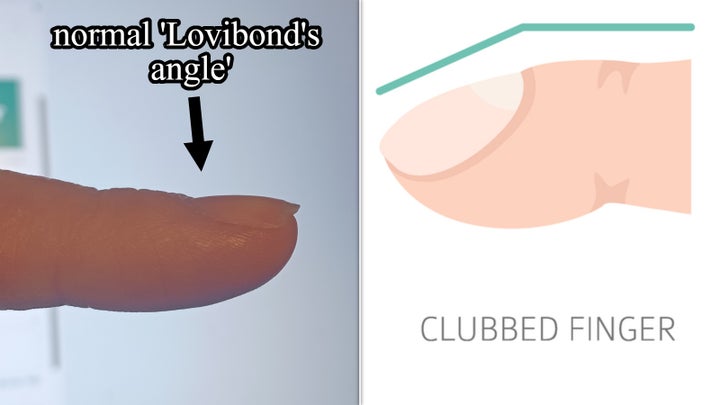
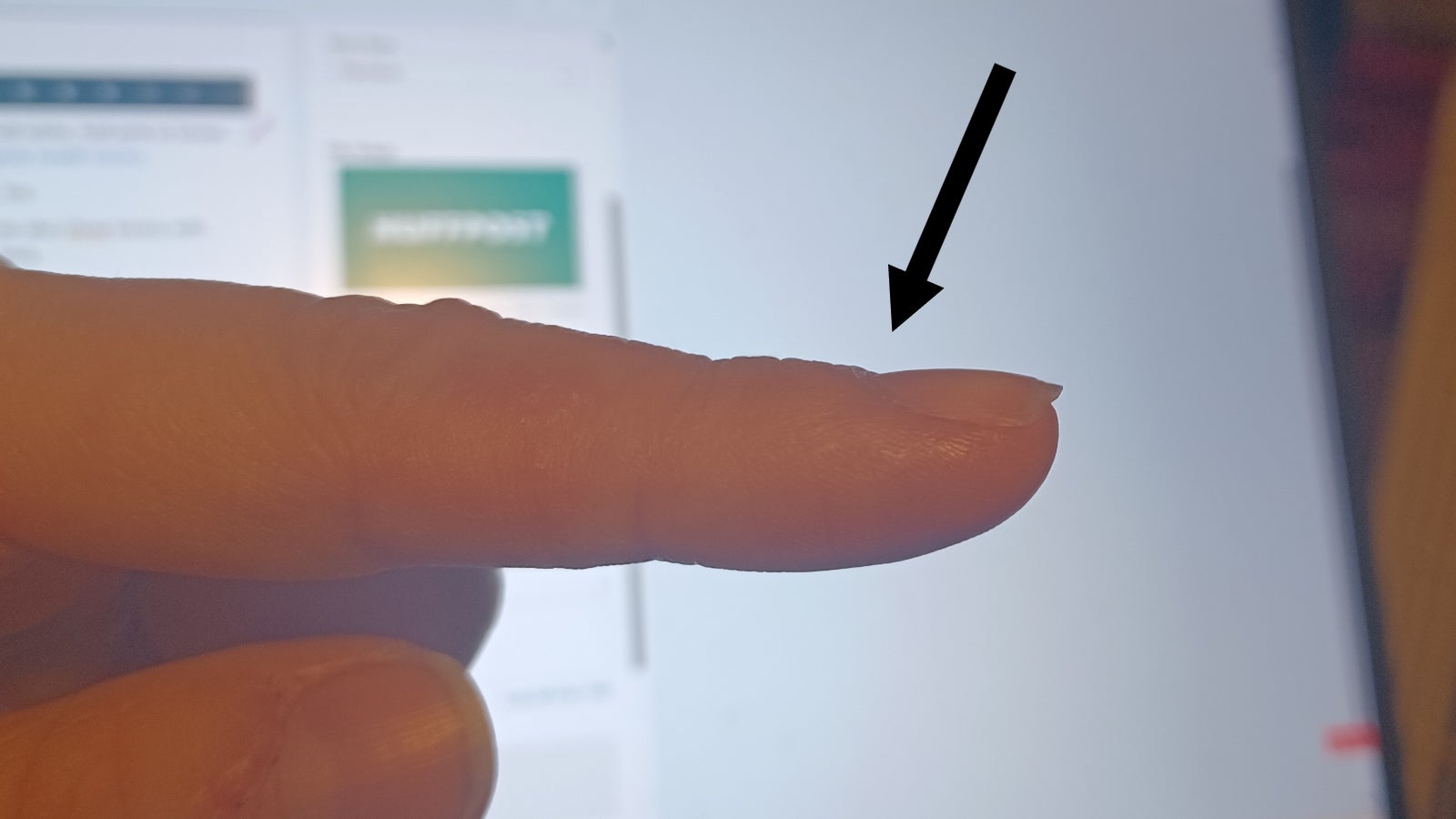
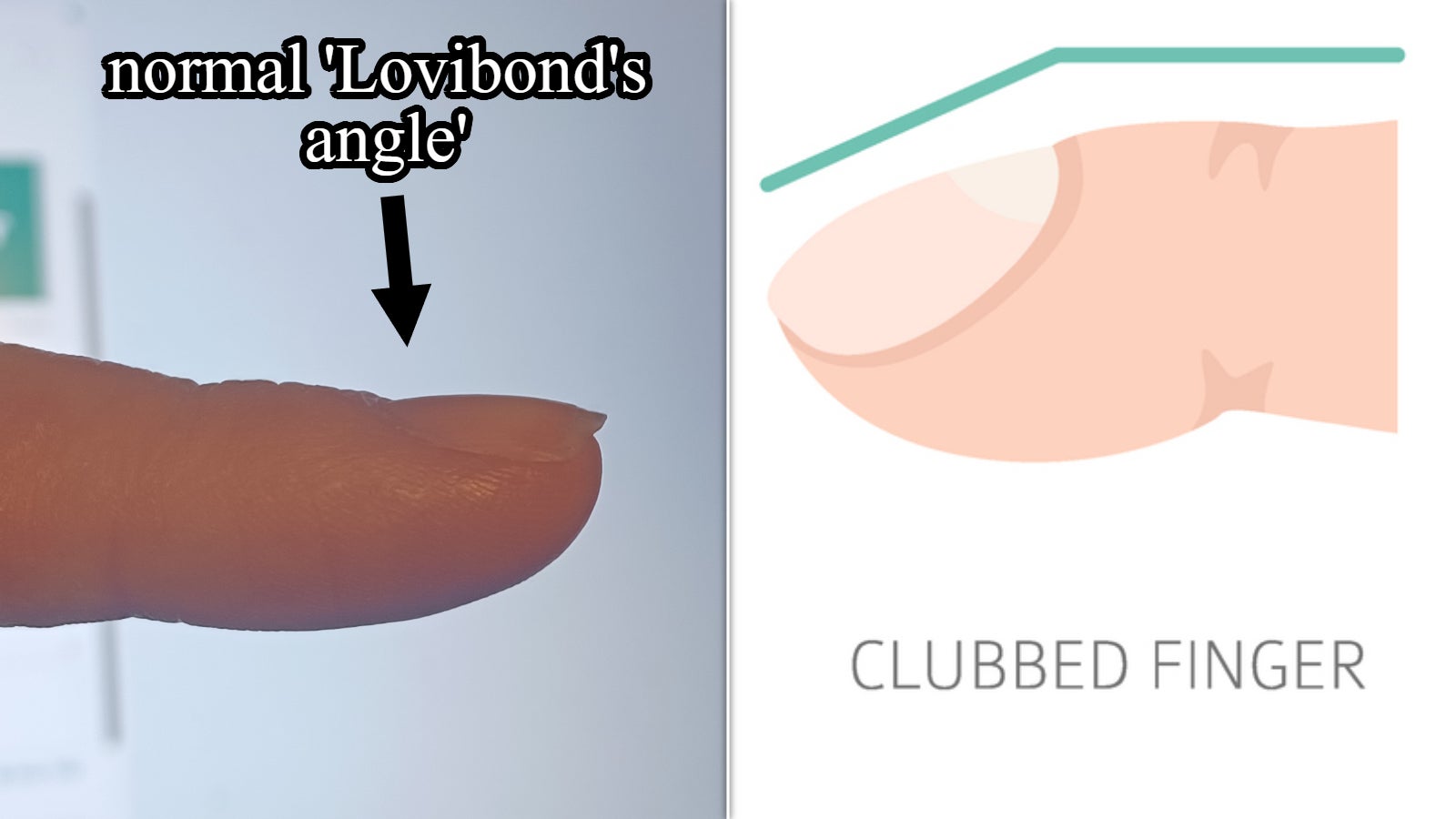
In the early stages, you might want to look out for the “Lovibond angle” sign.
The Lovibond angle is the small dent at the bottom of your nail that you can see from the side. But per the Cleveland Clinic, “In the early stages of nail clubbing, your nail and nail bed look flat from the side”.
And Mount Sinai adds that nails in the early stages of clubbing “may seem to ‘float’ instead of being firmly attached” to your nail bed.
Amy Glover / HuffPost UK / Getty images
Normal Lovibond’s angle vs clubbed fingernail
Advertisement
When should I see a doctor about suspected clubbed nails?
The change “can be a sign of many serious, long-term conditions,” the NHS says.
It is linked to “heart and lung diseases that reduce the amount of oxygen in the blood,” Mount Sinai added. Sometimes, this includes lung cancer.
So if you notice changes that suggest clubbing, speak to a doctor as soon as you can.
The condition may be harmless, but it’s improtant to get it checked out anyway.