Officials say women will only be be able to get three months’ worth of certain HRT products at a time.


Officials say women will only be be able to get three months’ worth of certain HRT products at a time.
UK scientists are continuing to investigate the cause of a surge in liver inflammation in children.
Numbers with the virus in the UK have decreased by a quarter, with one in 23 now testing positive.
Taking a plunge in cold water is increasingly popular, but what’s the safest way to enjoy it?
Nearly 3,000 packets of morning-after pills have been sent to the country as rape reports rise.

James Corden has promised to “go out with a bang” after announcing he will depart The Late Late Show next year.
The British star revealed he his quitting the US talk show during Thursday night’s episode, saying the programme had “changed my life” and promised there would be “lots of tears” when his tenure came to an end.
Advertisement
The presenter and actor has extended his contract with CBS to present the show for one more year before finishing in the summer of 2023.
“Seven and half years ago I started hosting this show and there’s no other way to put it, it has changed my life,” he said.
Advertisement
Advertisement
“I love it, I love all the people that work here, I am so proud of what we’ve achieved, it’s been beyond my wildest, wildest dreams.
“When I started this journey it was always going to be just that, a journey, an adventure.
“I never saw as it as my final destination, and I never want this show to overstay its welcome, I love making it and I really think in a year from now that will be a good time to move on and see what’s out there.”
Despite his status as a British host of a US late night show, James has enjoyed immense success with the programme which features scores of celebrity guests and special segments.
Advertisement
His popular Carpool Karaoke series, in which he drives to work with different musicians, singing their back catalogue over the radio and discussing their careers, has included Adele, Justin Bieber, Billie Eilish, Lady Gaga and Ariana Grande.
He promised viewers that his final 12 months would be full of fan favourites and “other surprises” which would be “a blast”.
“We are all determined to make this the best year we have ever had … we are going to go out with a bang,” he said.
“There’s going to be carpools and crosswalks and sketches and other surprises and there will be tears, there will be so many tears.”
He added: “This has been the hardest decision I’ve ever had to make. I’ve never taken this job for granted. Ever. Not once.
“The fact that you watch this … all over the world … is an absolute privilege for me and every single person who makes this show.
“Here’s to the next twelve months and it’s going to be a blast, I promise you that.”
James took over as presenter of The Late Late Show in 2015 from Scottish-born comedian Craig Ferguson, who spent 10 years as host.
Advertisement
His first episode, which aired in March of that year, featured Hollywood superstar Tom Hanks as a special guest.
George Cheeks, president and Chief Executive of CBS, told Variety: “In my two years at CBS, I’ve had the privilege to see James’ creative genius up close and experience his valuable partnership with CBS, both as a performer and a producer.
“We wish he could stay longer, but we are very proud he made CBS his American home and that this partnership will extend one more season on The Late Late Show.”



Making mistakes happens to all of us in our careers. But some of us hold on to these mistakes longer than others.
Maybe you lie awake at night still feeling queasy and anxious over the way you frustrated a client by accidentally giving them the wrong information. Maybe you are avoiding co-workers on your team because you feel like they are all judging you for that error, even though it happened last week. If either of these scenarios sounds familiar, you may be prone to obsessing over mistakes.
Advertisement
What fuels these constant worries is the shame of feeling completely inadequate and fear of others discovering your lack of capabilities, says Tanisha Ranger, a Nevada-based clinical psychologist. Once you start obsessing over mistakes because of your shame, it can steamroll into bigger problems like perfectionism.
“Shame often gives way to perfectionism, and perfectionism makes mistakes feel monumental. Essentially, ‘If I don’t do everything perfectly right then I am a failure and everyone will see my defectiveness,’” she says. “I’ve had many clients who struggled with obsessing over mistakes at work. [They lay] awake at night ruminating and beating themselves up over a mistake, not an intentional or careless mess-up, but a mistake.”
Advertisement
There’s a better way to acknowledge a mistake while still letting it go. Here’s how:
Advertisement
After you make an obvious mistake at work, you may want the ground to swallow you up to save you from the embarrassment, shame and anxiety of facing your co-workers again.
If these worries are keeping you up at night, challenge those thoughts by getting more realistic with your thinking, suggests Shannon Garcia, a psychotherapist at States of Wellness Counselling.
“Will the world end? Nope,” she says. “Will you get fired? Highly unlikely. Will you receive constructive feedback from your boss? Maybe. Will owning up to your mistake be uncomfortable? Probably. Have you survived past mistakes? Seems like it, if you’re reading this. Will you survive this one? Yes!”
Sometimes accidental oversights do hurt your job performance, but it’s important to not catastrophise what happened.
Advertisement
“Sure, it caused a delay. Yes, it may have cost the company some money. OK, it negatively impacted job performance. But is it actually the end of your career? Really? Likely not,” says Ranger. “Shrinking things down to their right size, not ignoring/suppressing and also not overblowing or exaggerating, is an important part of letting things go.”
If it helps, try putting yourself in the shoes of co-workers who have also made mistakes. Once you see the compassion and sympathy you hold for their slip-ups, you may be more inclined to be compassionate about your own.
“When a co-worker has made a mistake in the past, is it something you’ve judged them immensely for? Did you spend your day thinking endlessly about their mistake? No. People at work are likely reacting the same way,” Garcia says. “No one is thinking about this more than you are.”
To move past a mistake, you also need to rethink what it means to learn from a mistake. If you think turning over every angle of how an interaction with your boss could have gone better, for example, take a deep breath. Give yourself permission to release those thoughts, says organisational psychologist Laura Gallaher of the consulting firm Gallaher Edge.
People ruminate because they believe there are payoffs to worrying so much; they think “A conscientious person would worry about this,” Gallaher says.
“When you know that you can simultaneously be a conscientious person, and also forgive yourself to move forward, it will be easier to do so.”
What Garcia tells her clients the most is “be nice to yourself,” she says. Reframe your worries in a more positive light.
“The fact that you are anxious about it means you care. That’s what your boss, co-workers and customers care about the most,” Garcia says. “Try not to beat yourself up over it. Create an affirmation to repeat to yourself whenever those negative self-talk thoughts pop up: ‘I accept my mistake, I choose to learn from it, and I am moving forward.’”
If you are stuck in the world of “could’ve/should’ve” in regards to your error, be honest with yourself about what you did not know.
Advertisement
Ranger says she works with some clients by asking them to consider why they supposedly “should have known better.” “It’s always so enticing to impose our current knowledge and wisdom on a past version of ourselves that could not have known to make that decision with the information we had at that time,” she says.
When you make a big blunder at work, you may instinctually want to shut down, repress it, and forget it ever happened.
If you feel the urge to withdraw, challenge yourself to do the opposite. Be the one to bring it up in conversation with co-workers or your boss.
“If it was something that inconvenienced them, apologise for it,” Garcia says. “Then it’s a conversation happening where you are involved, people are likely to be gracious, and everyone can move on from there.”
It may sound counterintuitive, but being transparent about your mistake and its impact can be healing. “It can feel like a cold shower – before you do it, you fear it and feel uneasy or anxious,” Gallaher explains. “In the moment of being open, it can feel unpleasant at first, but once it’s over, you actually feel more refreshed 99% of the time. Taking accountability without blaming anybody is the most healing.“
Once you model being open and accountable, it may encourage others to do so as well. “Most of the time, when you lead with self-accountability, that vulnerability is courageous, and courage is contagious: People usually respond with their own self-accountability as well,” Gallaher says.
Of course, sometimes being honest about a mistake can also inspire eye-rolling judgement and harsh criticism from mean-spirited colleagues. You should hold yourself accountable for your mistake, but the judgement of your peers is not something you need to take on, too.
“Let them know what you intend to do differently to try to prevent something like this from happening in the future, and then accept that they may move on or they may not. It is outside of your control,” Ranger advises. “Taking on other people’s emotions is detrimental to yourself and makes it difficult for you to treat yourself with the kindness and compassion you deserve from you.”

If you’re watching EastEnders, you’ll see that Stuart Highway has been struggling with breast cancer.
Creators of the long-standing TV show wanted to shine a spotlight on male breast cancer and actor Ricky Champ, who plays Stuart, has been consulting with real-life victims to gain insight into the role.
Advertisement
Before the storyline kicked off, Champ met with Doug Harper, 61, from London, who was diagnosed with the condition in 2011.
Just before Christmas, Harper felt a lump on his left nipple which he presumed was a cyst and continued to ignore ‘as blokes do’, he says.
Advertisement
After showing the nipple to a GP, they sent him to hospital and ran tests on Harper, sadly confirming that it was cancer.
“As soon as I showed the nipple to the GP, their demeanour changed immediately and they booked an urgent appointment at the hospital for it to be checked out,” Harper tells HuffPost UK.
Advertisement
“Being told I had breast cancer was a scary and confusing time, not only for me, but also for my friends and family. But everyone was so supportive, some even made light hearted comments about the news to lift the gloom, something they knew I would appreciate.“
Just like Stuart on the soap, one of the reasons Harper felt confused was because he didn’t think it could be breast cancer as it’s not spoken about as much in men as women.
When the oncologist told him he had cancer he says he doesn’t remember anything else apart from asking if he was going to die – he was told hopefully that wouldn’t be the case.
Since having chemotherapy treatment, Harper has become passionate about raising awareness of the condition and informing people that it can happen to anyone, regardless of gender. He is also part of a male cancer support group that he attends monthly.
Advertisement
So when EastEnders came to him to ask about his experience, Harper was glad for the opportunity.
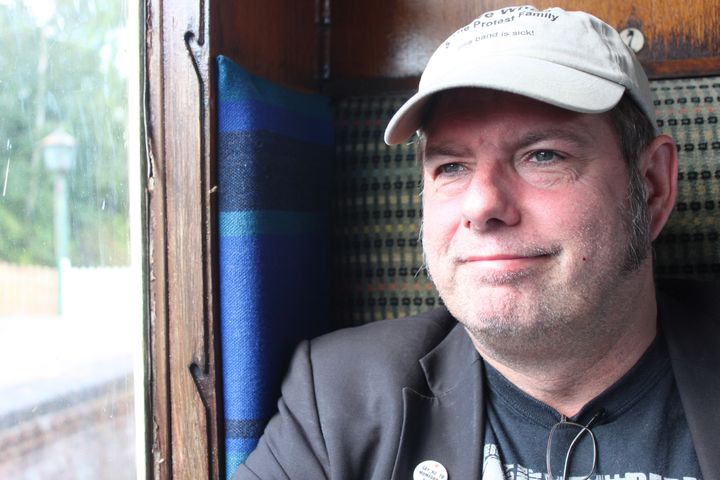
Doug Harper
He tells HuffPost: “Ricky was brilliant. While he’s been playing the part, he’s identified the problems that men with breast cancer can get, he just really embraced it. He came along to our group support meeting, and it was uplifting because we need more publicity for men with breast cancer.
“The storyline was really subtle, Stuart’s experience of first getting diagnosed was very similar to ours, being in denial, not thinking it was happening and the shock that comes with it.”
Harper mentions that the soap accurately showed how alienating the condition can be as Stuart is handed two leaflets of support for breast cancer patients – but in both, women are pictured.

Harper, who has since had chemotherapy, is in a band called Steve White & the Protest Family and has written a song about encouraging people to ‘check their moobs’.
He hopes more men will check themselves, saying: “Just know that men can get it. So, check your nipples, check under your arms. And if anything looks different, it could be a cyst or what looks like a cyst on your nipple, it could be a rash, an inverted nipple, or something else under your arms, if you see it, go straight to your doctor.”
He has also been working with Macmillan Cancer support. The charity’s strategic advisor for treatment, Dany Bell, who has more than 30 years’ experience working as a cancer nurse, added: “Nearly 400 men are diagnosed with breast cancer every year in the UK. But we know it’s still not something that is widely recognised or known by many people.
“Storylines like Stuart’s in TV shows like EastEnders play such a vital role in helping to raise awareness and to make more people aware of the signs of breast cancer in both men and women. Early diagnosis can improve – and even save lives – and we hope this important plot will get more men regularly check their own chests and reaching out for help, if needed.”
If you’re living with cancer and need to speak to people, about the big things and small things, you can contact Macmillan Cancer Support.



It may hurt, but exercise is beneficial for joints, experts say in guidance for doctors and patients.

In the quest to build smart skin that mimics the sensing capabilities of natural skin, ionic skins have shown significant advantages. They’re made of flexible, biocompatible hydrogels that use ions to carry an electrical charge. In contrast to smart skins made of plastics and metals, the hydrogels have the softness of natural skin. This offers a more natural feel to the prosthetic arm or robot hand they are mounted on, and makes them comfortable to wear.
These hydrogels can generate voltages when touched, but scientists did not clearly understand how — until a team of researchers at UBC devised a unique experiment, published today in Science.
“How hydrogel sensors work is they produce voltages and currents in reaction to stimuli, such as pressure or touch — what we are calling a piezoionic effect. But we didn’t know exactly how these voltages are produced,” said the study’s lead author Yuta Dobashi, who started the work as part of his master’s in biomedical engineering at UBC.
Working under the supervision of UBC researcher Dr. John Madden, Dobashi devised hydrogel sensors containing salts with positive and negative ions of different sizes. He and collaborators in UBC’s physics and chemistry departments applied magnetic fields to track precisely how the ions moved when pressure was applied to the sensor.
“When pressure is applied to the gel, that pressure spreads out the ions in the liquid at different speeds, creating an electrical signal. Positive ions, which tend to be smaller, move faster than larger, negative ions. This results in an uneven ion distribution which creates an electric field, which is what makes a piezoionic sensor work.”
The researchers say this new knowledge confirms that hydrogels work in a similar way to how humans detect pressure, which is also through moving ions in response to pressure, inspiring potential new applications for ionic skins.
“The obvious application is creating sensors that interact directly with cells and the nervous system, since the voltages, currents and response times are like those across cell membranes,” says Dr. Madden, an electrical and computer engineering professor in UBC’s faculty of applied science. “When we connect our sensor to a nerve, it produces a signal in the nerve. The nerve, in turn, activates muscle contraction.”
“You can imagine a prosthetic arm covered in an ionic skin. The skin senses an object through touch or pressure, conveys that information through the nerves to the brain, and the brain then activates the motors required to lift or hold the object. With further development of the sensor skin and interfaces with nerves, this bionic interface is conceivable.”
Another application is a soft hydrogel sensor worn on the skin that can monitor a patient’s vital signs while being totally unobtrusive and generating its own power.
Dobashi, who’s currently completing his PhD work at the University of Toronto, is keen to continue working on ionic technologies after he graduates.
“We can imagine a future where jelly-like ‘iontronics’ are used for body implants. Artificial joints can be implanted, without fear of rejection inside the human body. Ionic devices can be used as part of artificial knee cartilage, adding a smart sensing element. A piezoionic gel implant might release drugs based on how much pressure it senses, for example.”
Dr. Madden added that the market for smart skins is estimated at $4.5 billion in 2019 and it continues to grow. “Smart skins can be integrated into clothing or placed directly on the skin, and ionic skins are one of the technologies that can further that growth.”
The research includes contributions from UBC chemistry PhD graduate Yael Petel and Carl Michal, UBC professor of physics, who used the interaction between strong magnetic fields and the nuclear spins of ions to track ion movements within the hydrogels. Cédric Plesse, Giao Nguyen and Frédéric Vidal at CY Cergy Paris University in France helped develop a new theory on how the charge and voltage are generated in the hydrogels.
