The prize-winning discovery explains how the immune system attacks hostile infections, but not the body’s own cells.


The prize-winning discovery explains how the immune system attacks hostile infections, but not the body’s own cells.
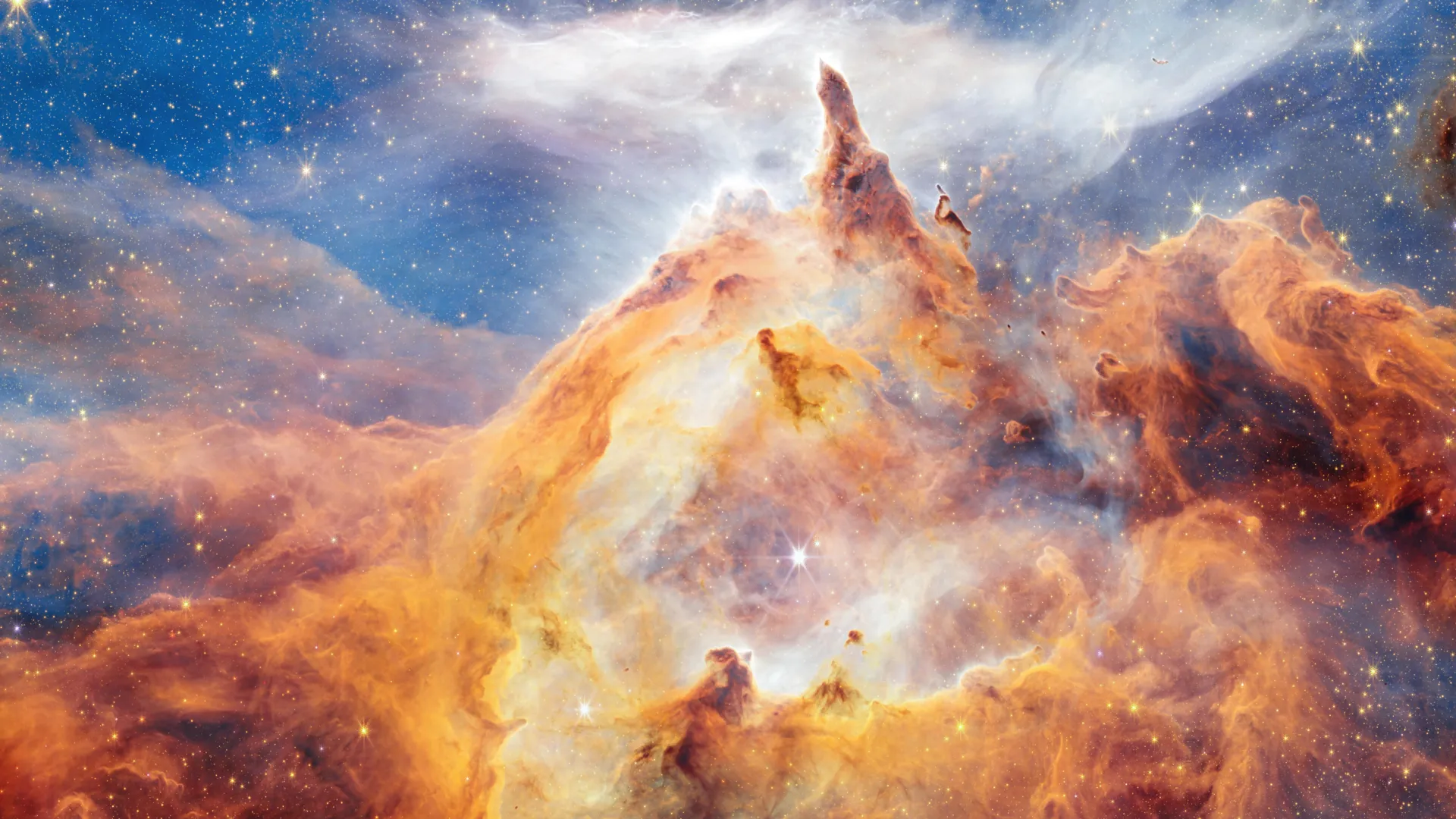
This is a sparkling scene of star birth captured by NASA’s James Webb Space Telescope. What appears to be a craggy, starlit mountaintop kissed by wispy clouds is actually a cosmic dust-scape being eaten away by the blistering winds and radiation of nearby, massive, infant stars.
Called Pismis 24, this young star cluster resides in the core of the nearby Lobster Nebula, approximately 5,500 light-years from Earth in the constellation Scorpius. Home to a vibrant stellar nursery and one of the closest sites of massive star birth, Pismis 24 provides rare insight into large and massive stars. Its proximity makes this region one of the best places to explore the properties of hot young stars and how they evolve.
At the heart of this glittering cluster is the brilliant Pismis 24-1. It is at the center of a clump of stars above the jagged orange peaks, and the tallest spire is pointing directly toward it. Pismis 24-1 appears as a gigantic single star, and it was once thought to be the most massive known star. Scientists have since learned that it is composed of at least two stars, though they cannot be resolved in this image. At 74 and 66 solar masses, respectively, the two known stars are still among the most massive and luminous stars ever seen.
Captured in infrared light by Webb’s NIRCam (Near-Infrared Camera), this image reveals thousands of jewel-like stars of varying sizes and colors. The largest and most brilliant ones with the six-point diffraction spikes are the most massive stars in the cluster. Hundreds to thousands of smaller members of the cluster appear as white, yellow, and red, depending on their stellar type and the amount of dust enshrouding them. Webb also shows us tens of thousands of stars behind the cluster that are part of the Milky Way galaxy.
Super-hot, infant stars -some almost 8 times the temperature of the Sun – blast out scorching radiation and punishing winds that are sculpting a cavity into the wall of the star-forming nebula. That nebula extends far beyond NIRCam’s field of view. Only small portions of it are visible at the bottom and top right of the image. Streamers of hot, ionized gas flow off the ridges of the nebula, and wispy veils of gas and dust, illuminated by starlight, float around its towering peaks.
Dramatic spires jut from the glowing wall of gas, resisting the relentless radiation and winds. They are like fingers pointing toward the hot, young stars that have sculpted them. The fierce forces shaping and compressing these spires cause new stars to form within them. The tallest spire spans about 5.4 light-years from its tip to the bottom of the image. More than 200 of our solar systems out to Neptune’s orbit could fit into the width its tip, which is 0.14 lightyears.
In this image, the color cyan indicates hot or ionized hydrogen gas being heated up by the massive young stars. Dust molecules similar to smoke here on Earth are represented in orange. Red signifies cooler, denser molecular hydrogen. The darker the red, the denser the gas. Black denotes the densest gas, which is not emitting light. The wispy white features are dust and gas that are scattering starlight.
The James Webb Space Telescope is the world’s premier space science observatory. Webb is solving mysteries in our solar system, looking beyond to distant worlds around other stars, and probing the mysterious structures and origins of our universe and our place in it. Webb is an international program led by NASA with its partners, ESA (European Space Agency) and CSA (Canadian Space Agency).
Former England captain Lewis Moody says in an exclusive BBC interview he has “a reluctance to look the future in the face”.
The universe is full of different types of radiation and particles that can be observed here on Earth. This includes photons across the entire range of the electromagnetic spectrum, from the lowest radio frequencies all the way to the highest-energy gamma rays. It also includes other particles such as neutrinos and cosmic rays, which race through the universe at close to the speed of light.
Curiously, “cosmic rays” are not actually rays – this name has historical reasons – but small particles, mostly atomic nuclei, which are accelerated to enormous energies somewhere in the universe. Although their sources are not yet fully understood, they are most likely associated with some of the most extreme environments in the universe, such as black holes, supernovae, or rotating neutron stars (a type of dead star).
But occasionally cosmic rays have much higher energy than usual. We’ve known about this since 1962, but we still have no idea why.
We also don’t know where this ultra-high-energy cosmic radiation comes from.
Now, research from the Norwegian University of Science and Technology (NTNU) may have found the answer to this big unanswered question in physics.
Supermassive black holes may be the cause
Foteini Oikonomou, an associate professor at NTNU’s Department of Physics, is working on the case. In a recent article, she and her colleagues present a completely new and plausible explanation for this ultra-high-energy radiation.
The lead author is PhD research fellow Domenik Ehlert from the same department. The team also includes postdoctoral fellow Enrico Peretti from the Université Paris Cité. Their work focuses on astroparticle physics, which studies the relationship between the smallest particles in the universe and the universe’s largest phenomena.
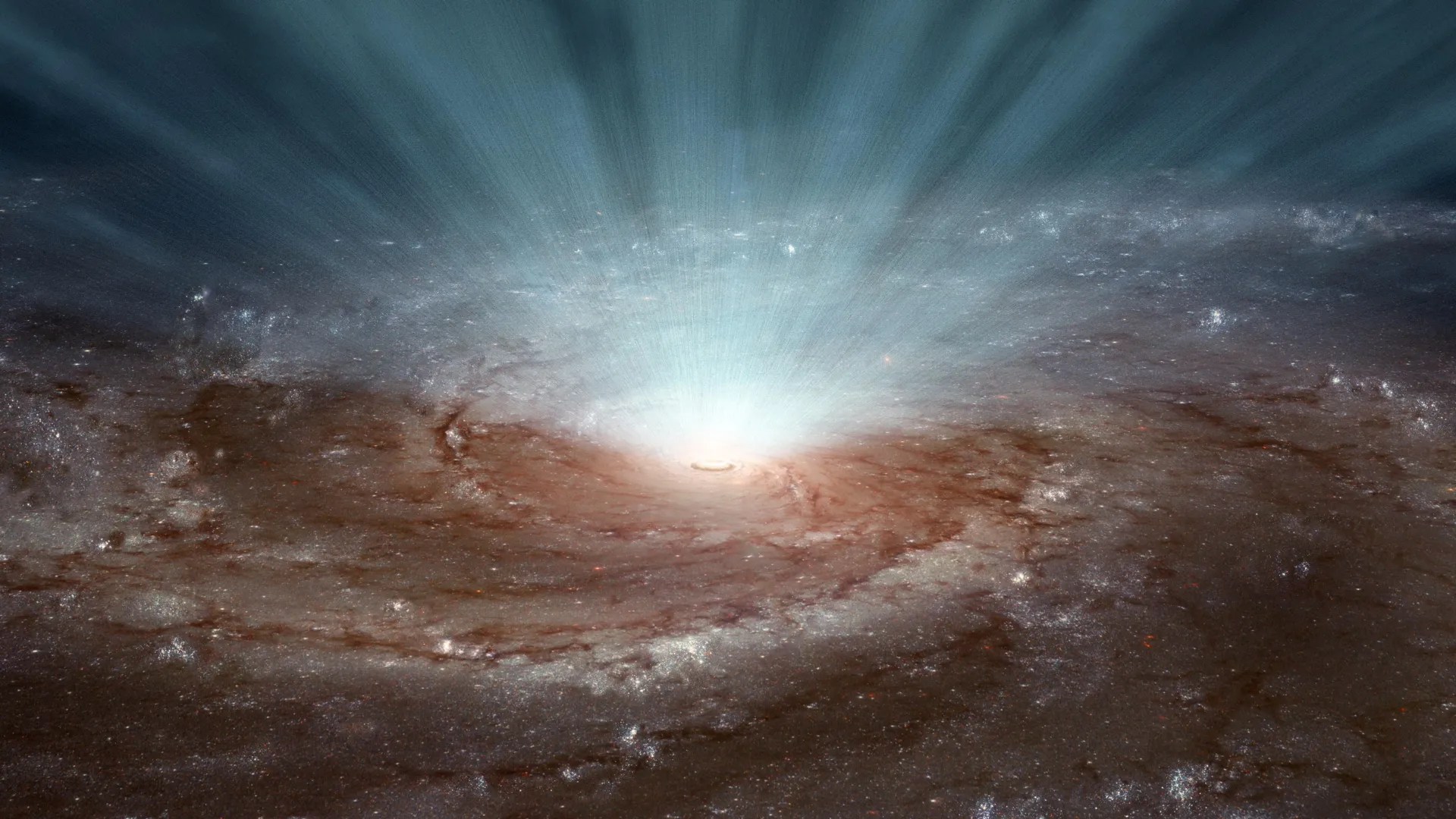
“We suspect that this high-energy radiation is created by winds from supermassive black holes,” said Oikonomou.
But what on earth does that mean?
Active black holes create winds
The Milky Way is the neighborhood in the universe where you and I live. Our Sun and solar system are part of this galaxy, along with at least 100 billion other stars.
“There is a black hole called Sagittarius-A* located right in the centre of the Milky Way. This black hole is currently in a quiet phase where it isn’t consuming any stars, as there is not enough matter in the vicinity,” Peretti said.
This contrasts with growing, supermassive, active black holes that consume up to several times the mass of our own Sun each year.
“A tiny portion of the material can be pushed away by the force of the black hole before it is pulled in. As a result, around half of these supermassive black holes create winds that move through the universe at up to half the speed of light,” Peretti said.
We have known about these gigantic winds for approximately ten years. The winds from these black holes can affect galaxies. By blowing away gases, they can prevent new stars from forming, for example. This is dramatic enough in itself, but Oikonomou and her colleagues looked at something else, much smaller, that these winds could be the cause of.”
It is possible that these powerful winds accelerate the particles that create the ultra-high-energy radiation,” said Ehlert.
To understand this, we also need to explain a little bit about atoms.
Atoms and enormous amounts of energy
Atoms consist of a nucleus, which is made up of protons and neutrons. These particles are made up of quarks, but we don’t need to go into that right now.
One or more electrons can be found around this nucleus in the so-called cloud.
“The ultra-high-energy radiation consists of protons or atomic nuclei with energy up to 1020 electron volts,” explained Oikonomou.
If that number doesn’t mean anything to you, you should know that in this context, it is an absolutely enormous amount of energy.
“A particle like this, which is smaller than an atom, contains about as much energy as a tennis ball when Serena Williams serves it at 200 kilometers per hour,” said Oikonomou.
It corresponds to approximately a billion times more energy than the particles created by researchers in the Large Hadron Collider in Switzerland and France.
Fortunately, these cosmic rays are destroyed by the Earth’s atmosphere. When they reach ground level, they are as harmless as all the other cosmic radiation that reaches us at the Earth’s surface.
“But for astronauts, cosmic radiation is a very serious problem,” Oikonomou said.
Airline crews don’t need to worry about this because they don’t fly high enough.
“The main concern for astronauts is cosmic low-energy radiation produced by our own Sun, because it is much more common. The rays we study are infrequent enough that it is extremely unlikely they would pass through an astronaut,” she said.
Other suspects
Previously, researchers have looked into whether these high-energy particles come from gamma-ray bursts, from galaxies that are creating new stars at an extremely high rate, or from plasma outflows from supermassive black holes.
However, Oikonomou and her colleagues have another hypothesis.
“All the other hypotheses are very good guesses – they are all sources that contain a lot of energy. But no one has provided evidence that any of them are the source. That is why we decided to investigate the winds from the supermassive black holes,” said Ehlert.
Guilty? Maybe
So what do we actually know? Is it the winds that create the high-energy particles in the cosmic radiation?
“Our answer is more of a cautious ‘maybe’,” said Oikonomou.
That doesn’t sound particularly dramatic. However, when researchers ask questions like this, they often feel a sense of excitement and think “YES, that might just be the case!,” but that doesn’t mean it is the case in this instance.
“We find that the conditions related to these winds align particularly well with particle acceleration. But we are still unable to prove that it is specifically these winds that accelerate the particles behind the high-energy cosmic radiation,” Oikonomou said.
However, the model the researchers are using can explain one specific aspect of these particles that we still don’t understand. Within a certain energy range, the particles have a chemical composition that other models cannot explain in any meaningful way.
“We can also test the model using neutrino experiments,” said Oikonomou.
That, however, is something for a completely different article.
“In the years to come, we hope to collaborate with neutrino astronomers to test our hypothesis,” Oikonomou said. Perhaps they will then find more evidence, one way or the other.
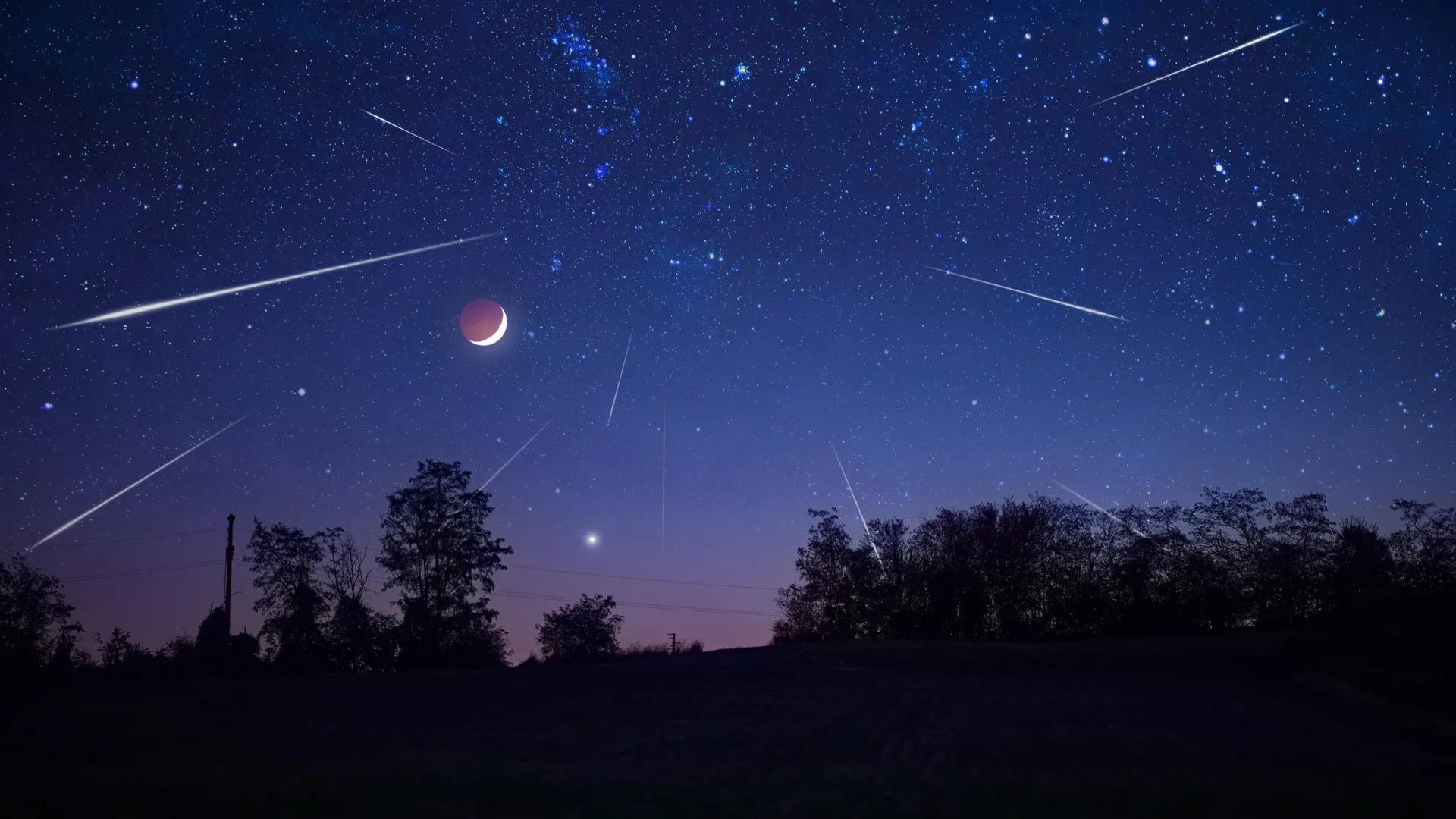
A supermoon takes over the sky, the Draconid meteor shower peeks through, and the Orionid meteor shower shines bright.
Skywatching Highlights
<See video link at the bottom.>
Transcript
What’s Up for October? A Supermoon takes over, the Draconid meteor shower peeks through, and the Orionid meteors sparkle across the night sky.
The evening of October 6, look up and be amazed as the full moon is bigger and brighter because — it’s a supermoon!
This evening, the moon could appear to be about 30% brighter and up to 14% larger than a typical full moon. But why?
Supermoons happen when a new moon or a full moon coincides with “perigee,” which is when the moon is at its closest to Earth all month.
So this is an exceptionally close full moon! Which explains its spectacular appearance.
And what timing — while the supermoon appears on October 6th, just a couple of days before on October 4th is “International Observe the Moon Night”!
It’s an annual, worldwide event when Moon enthusiasts come together to enjoy our natural satellite.You can attend or host a moon-viewing party, or simply observe the Moon from wherever you are.
So look up, and celebrate the moon along with people all around the world!
The supermoon will light up the sky on October 6th, but if you luck into some dark sky between October 6th and 10th, you might witness the first of two October meteor showers — the Draconids!
The Draconid meteor shower comes from debris trailing the comet 21P Giacobini-Zinner burning up in Earth’s atmosphere
These meteors originate from nearby the head of the constellation Draco the dragon in the northern sky and the shower can produce up to 10 meteors per hour!
The Draconids peak around October 8th, but if you don’t see any, you can always blame the bright supermoon and wait a few weeks until the next meteor shower — the Orionids!
The Orionid meteor shower, peaking October 21, is set to put on a spectacular show, shooting about 20 meteors per hour across the night sky.
This meteor shower happens when Earth travels through the debris trailing behind Halley’s Comet and it burns up in our atmosphere.
The full duration of the meteor shower stretches from September 26 to November 22, but your best bet to see meteors is on October 21 before midnight until around 2 am.
This is because, not only is this night the shower’s peak, it is also the October new moon, meaning the moon will be between the Earth and the Sun, making it dark and invisible to us.
With a moonless sky, you’re much more likely to catch a fireball careening through the night.
So find a dark location after the sun has set, look to the southeast sky (if you’re in the northern hemisphere) and the northeast (if you’re in the southern hemisphere) and enjoy!
Orionid meteors appear to come from the direction of the Orion constellation but you might catch them all across the sky.
Here are the phases of the Moon for October.
The soap actor meets families fighting for their children’s education for BBC Panorama.

Labour are being accused of being “worse than the Tories” with the new government crackdown on protests.
The Home Office announced on Sunday that it would be granting police forces new powers to put conditions on repeat demonstrations.
Advertisement
That means if a protest has taken place at the same site for weeks on end and caused “repeated disorder”, officers could force organisers to hold the event elsewhere.
The Home Office said anyone who breaches these conditions risk arrest and prosecution.
It comes after the Met Police arrested nearly 500 people at protest against the proscription of the Palestine Action group in London on Saturday.
The march went ahead despite calls from the government and the police for the protests to be postponed out of respect for Thursday’s deadly synagogue attack in Manchester where two people were killed.
Advertisement
Home secretary Shabana Mahmood said current legislation is also being reviewed to make sure it is being applied fully.
Mahmood said: “The right to protest is a fundamental freedom in our country. However, this freedom must be balanced with the freedom of their neighbours to live their lives without fear.”
She added: “Large, repeated protests can leave sections of our country, particularly religious communities, feeling unsafe, intimidated and scared to leave their homes.
Advertisement
“This has been particularly evident in relation to the considerable fear within the Jewish community, which has been expressed to me on many occasions in these recent difficult days.”
Speaking on LBC, the home secretary defended the new measures and insisted it was a good use of police time.
She said: “I have no truck with this argument that suggest that police resources are better deployed elsewhere, enabling mass criminality by people who have a political point to make.”
Advertisement
LBC presenter Lewis Goodall said that human rights organisations are starting to accuse Britain of “showing authoritarian tendency” by arresting people for doing nothing more than “holding up placard”.
She replied: “What Britain is doing is making sure the law of our land is maintained.
“It is not ‘holding up a placard’, and I really must pick you up on that, Lewis, in holding up a placard, you are breaking the law because you are supporting a proscribed organisation.”
Advertisement
Not many others felt the same way online though.
Independent MP Jeremy Corbyn, who used to be Labour leader, described the crackdown as a “disgraceful assault on the right to protest”.
Many other critics compared it to the Conservatives’ enhancement of police powers during their time in office, and claimed Labour were “giving the incoming Reform government everything they could wish for”.
Advertisement
Advertisement
Advertisement

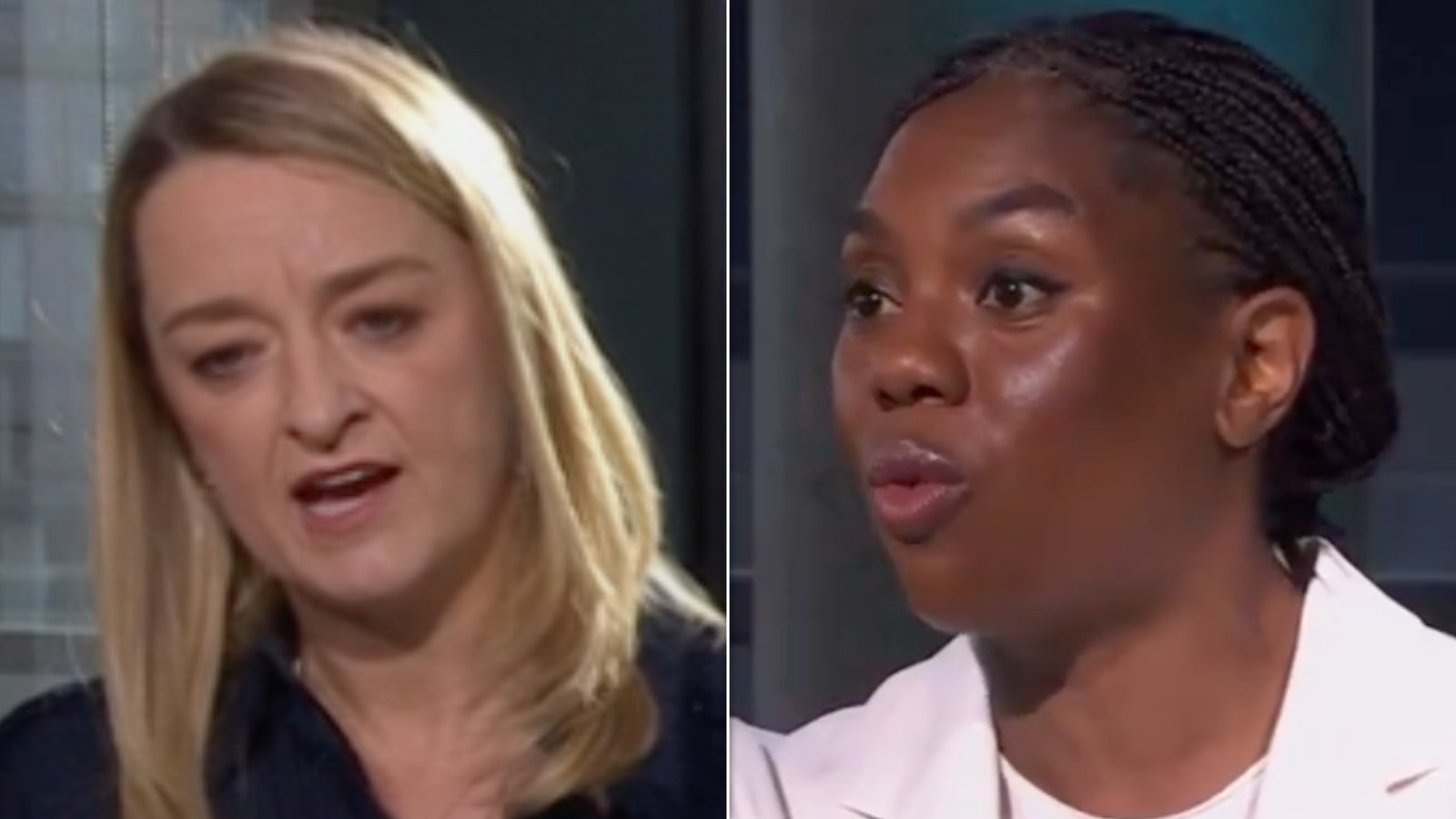
Kemi Badenoch angrily hit back at Laura Kuenssberg this morning over the Tories’ poor performance in the polls.
According to YouGov research from mid-September, just 16% of the public said they would be willing to vote Conservative – a shocking decline from a party that were in power 15 months ago.
Advertisement
There’s also been an exodus of former Tory ministers joining Reform, including one of Badenoch’s own frontbenchers in the shadow cabinet, Danny Kruger.
But, speaking on the first day of the Conservatives’ annual conference in Manchester, Badenoch tried to downplay criticism that she needed to do more to help her party.
The BBC’s Kuenssberg tried to bring up the topic by saying: “While you have been working out exactly what you wanted to do, the Conservative Party’s position – which was already dreadful – has got worse –”
Advertisement
But Badenoch cut in: “Laura. Polls are not elections.
“If I had rushed out and said all those things right at the beginning, people would have said, ‘Why should we believe you? Why have you suddenly changed?’
“Simply saying something doesn’t mean you’re going to be fine in the polls.
“What you’re saying is a counterfactual. You don’t know that if I had rushed out all of those things right at the beginning that we would be doing well. You have no idea.
“What I’m doing is being very consistent. I’m saying, vote for me, we will get through this, we’re going to have very clear credible plans, they’re not going to fall apart the minute someone asks a question like you get with Reform.”
Advertisement
During the same interview, Badenoch did actually refuse to many detailed questions about her new plan to control the country’s borders by removing 150,000 people with “no right” to be in the UK per year.
When Kuenssberg asked where these so-called illegal migrants would be deported, the Tory leader said: “I am tired of answering these irrelevant questions about where they should go. They will go back to where they should be or another country, but they should not be here!”
The MP for North West Essex also used her time on air to lay into Labour, claiming: “We’re not going to waste our time in opposition – like Labour did, they had 14 years in opposition, and they’ve got nothing.”
Advertisement
But the Tory leader has been heavily criticised herself for taking such a long time to come up with many firm policies, despite winning the leadership contest last November.
Kuenssberg concluded their interview by asking Badenoch: “What if the problem is you?”
She replied: “I was elected to do exactly what I am doing now. And I think Conservative Party members are going to keep their faith in me.”
She refused to say she would resign if the Tories performed poorly in the May local elections.
Advertisement


Family Beef is our family advice column at HuffPost Family. Have a beef you want us to weigh in on? Submit it here.
Dear Family Beef,
My Dad’s (58) new girlfriend (28) is only two years older than me (F26). I want him to be happy but I can’t get over how creepy it is that she was in elementary school the same time I was, that she was still in diapers when he was changing mine. It’s just weird. He has had other girlfriends since divorcing my mom, but they were all in their 40s and 50s and felt more age appropriate. So I’ve never had a bad reaction like this.
He keeps asking me and my boyfriend to go to dinner with them and making comments about how we’ll “get along so well” and I keep finding excuses to avoid it. I find the whole thing embarrassing and don’t want other people in my life to see and judge him as a creepy old cradle robber..
Is this something I should talk to him about or ignore until it hopefully goes away?
— I Don’t Want A Sister Step Mom
Dear Sister Step,
Oh, you’re absolutely allowed to be weirded out. Validating the weird-out here. That’s not to say that their relationship itself is weird, though.
This is one of those situations where what you feel matters, but not nearly as much as what the two adults in a relationship feel about each other. But your ambivalence isn’t uncommon or necessarily irrational either. Two things can be true!
Advertisement
These days, so-called “age-gap” relationships get a lot of flak because, as you allude to in your letter, there’s a lot of judgment floating around. There are situations where the older partner may have more obvious power or sway over the younger partner (emotionally, financially, etc.), and the cartoonish stereotypes of older individuals perpetually chasing youth or younger people looking for a “sugar parent” to spoil them. These dynamics can happen and can be frustrating to watch from the sidelines — but, ultimately, it’s up to those two adults to decide what kind of relationship they want to be in and how they are with one another.
“An adult child has come to understand power dynamics and is used to a level of separation with their parents’ generation,” sexologist and couples clinician Dr. Lexx Brown-James, told HuffPost. “So having a parent dating someone of similar age can feel discomforting because we make the connection that a parent could be dating one of our friends or someone that we could even date.”
To me, it’s not a bad idea to take a little space while you figure out why you feel the way you do. Talk with some trusted neutral parties (friends! your partner! a therapist!) before engaging with your dad and this partner. You might need to purge the “WTF” feelings in a safe, non-toxic way. And that gives you a better chance at responding to the situation you’re actually in rather than just reacting to the scariest stories you’ve been telling yourself about the situation.
Advertisement
“Not meeting a parent partner first off is absolutely a worthwhile strategy and there are a few considerations,” Brown-James notes. “In the ’Ber months of the year, is this person coming to family functions especially? Also, is your parent being safe? There can be questions around health, technology, and other factors that some times elder generations are less savvy with, how much do you as the child want to be involved? Also, know that choosing not to meet the partner, may create some resentment or hurt in your parental relationship. That can cause grief for both of you.”
Avoiding the conversation entirely, though? That won’t be beneficial to any of these relationships. Sure, you may “luck out” and this relationship could go just a few weeks or months before fizzling out – but the T. rex method of “stand still until the scary, uncomfortable or awkward thing is gone” really isn’t ever as effective as we’d want it to be.
But, Brown-James does note that you might want to consider a few things before you initiate a conversation.
Advertisement
“Consider what your parent is looking for in bringing this to you. Are they looking for permission, are they just sharing, are they wanting feedback, are they wanting you to participate in a family structure? Once intentions are set, you can decide your boundaries and share them,” Brown-James said. “In less safe relationships, where maybe there is more expectation on a child to confirm or agree, there might need to be a further distance.”
Elizabeth DeVaughn, a licensed psychotherapist and relationship specialist, also adds that playing through the pain of this discomfort and having the conversation can serve to deepen your parent-adult child relationship in the long run.
“The discomfort she’s feeling could be a beautiful opportunity to connect with her dad authentically. She can name the discomfort she’s feeling while also expressing that she’s working through the details of the discomfort with a therapist or with friends,” DeVaughn said. “This way, she gives herself space to process while staying open to the fact that her dad may be building a great relationship with this new woman.”
Advertisement
I know I would be so morbidly curious enough to want to witness the pair together myself, to really understand if they have something special or if the May-December situation is actually as cartoonish as my nightmares. Some of these dynamics are actually just normal couples who make each other happy. But you won’t know what their situation actually is if you keep them at arm’s length and, if it is as bad as you fear, you can be an informed observer.
Now, if you do decide to power through the discomfort and have dinner with them, here are a few other ways to make that process a little bit easier on you:
Ultimately, your dad is an autonomous person as is his 28-year-old GF. Whatever ride they are on together is theirs — and whether or not there’s a lasting love there (or if the age difference gets in the way) is something they need to find out for themselves.
Advertisement
So this is where you have to pull out the “radical acceptance” that therapists are always going on about: You’re not in their relationship, and you can’t make the call on what is “right” for them.
“Radical acceptance means acknowledging reality, rather than resisting the relationship,” Dr. Greg Gomez, Clinical Director at The Oasis Rehab in California “In this situation, it is recognising that the parent has chosen to remain in the relationship regardless of the age gap. This is beyond the child’s control.”
You can, however, have boundaries. You don’t need to want to hang out with him and his partner at this stage in their dating life. You can respectfully side-step the hangs for a bit longer until you get a sense of how lasting this relationship might be.
Advertisement
You can also use some of these tried-and-true strategies for first meetings to make this less of a “Four Seasons” eye-roll situation and more of a “short getting-to-know-you chat with a new person” situation:
A term that comes up a lot in non-monogamous and poly circles that might be helpful for you? Compersion. This means that you’re able to be happy for the happiness that you can feel over someone else’s happiness. (The Buddhist term “mudita,” or a sympathetic joy, is similar as well).
It’s a really lovely idea that can benefit all of your relationships when you put it into practice: You don’t need to love or cheer on every decision your loved one makes, but you can look to see if they are happy in this relationship — and try to access the part of you that is genuinely thrilled for that happiness.
“Radical acceptance can be hard,” Brown-James said. “Here is where compersion comes into play. Can you be happy for your parent’s happy? Isn’t that what really matters most?”
Advertisement
You said it yourself: You want your dad to be happy — and this relationship, even if you don’t understand it, might just be something that makes him feel that way.
Some of our Platinum HuffPosters offered up their own advice on this question. Here’s what they had to say:
“I would say let the Dad have his fling.The longer she ignores him the more attractive the younger woman will seem to him. Maybe she should meet her & try to see what it is that he sees in her. It can’t hurt to try [and] it would make her Dad happy. Life is too short for this kind of drama.”
—Sue McCarthy
“Did Dad ask for your opinion on his dating life? You want him to be happy, but you want him to make you happy, as well? Grow up. You’re not a child any longer and Dad’s a grown man. It’s not his job to make you happy, he doesn’t need to run his life according to your comfort level. Your entire complaint is about you, not Dad. You’re worried about being embarrassed for whom? Yourself? Dad doesn’t seem to be worried. Stop whining and judging and give Dad grace. If he’s happy, the problem is you, not him. Don’t run away and pout, have an honest conversation with Dad, share your feelings with love and compassion, keeping in mind that you do not have the right to define happiness for another person even if that person raised you and loves you. This lady may or may not be a temporary relationship for Dad, but the damage you’re doing to your own relationship with him may not be easily healed. The biggest question for you: is your selfishness really worth the price you might pay?
— Respectfully submitted for your consideration by Lynne M, a 74 year old woman with wisdom that’s come at a price.
“As long as your dad dates this person, the issue will not go away. You should definitely speak with him. Hearing from you on how uncomfortable dinner would make you is respectful and necessary.”
— MADDEN


Drinking any amount of alcohol likely increases the risk of dementia, suggests the largest combined observational and genetic study to date, published online in BMJ Evidence Based Medicine.
Even light drinking — generally thought to be protective, based on observational studies — is unlikely to lower the risk, which rises in tandem with the quantity of alcohol consumed, the research indicates.
Current thinking suggests that there might be an ‘optimal dose’ of alcohol for brain health, but most of these studies have focused on older people and/or didn’t differentiate between former and lifelong non-drinkers, complicating efforts to infer causality, note the researchers.
To try and circumnavigate these issues and strengthen the evidence base, the researchers drew on observational data and genetic methods (Mendelian randomization) from two large biological databanks for the entire ‘dose’ range of alcohol consumption.
These were the US Million Veteran Program (MVP), which includes people of European, African, and Latin American ancestry, and the UK Biobank (UKB), which includes people of predominantly European ancestry.
Participants who were aged 56-72 at baseline, were monitored from recruitment until their first dementia diagnosis, death, or the date of last follow-up (December 2019 for MVP and January 2022 for UKB), whichever came first. The average monitoring period was 4 years for the US group, and 12 for the UK group.
Alcohol consumption was derived from questionnaire responses — over 90% of participants said they drank alcohol — and the Alcohol Use Disorders Identification Test (AUDIT-C) clinical screening tool. This screens for hazardous drinking patterns, including the frequency of binge drinking (6 or more drinks at a time).
In all, 559,559 participants from both groups were included in observational analyses, 14,540 of whom developed dementia of any type during the monitoring period:10,564 in the US group; and 3976 in the UK group. And 48,034 died: 28,738 in the US group and 19,296 in the UK group.
Observational analyses revealed U-shaped associations between alcohol and dementia risk: compared with light drinkers (fewer than 7 drinks a week) a 41% higher risk was observed among non-drinkers and heavy drinkers consuming 40 or more drinks a week, rising to a 51% higher risk among those who were alcohol dependent.
Mendelian randomization genetic analyses drew on key data from multiple large individual genome-wide association studies (GWAS) of dementia, involving a total of 2.4 million participants to ascertain lifetime (rather than current) genetically predicted risks.
Mendelian randomization leverages genetic data, minimizing the impact of other potentially influential factors, to estimate causal effects: genomic risk for a trait (in this case, alcohol consumption) essentially stands in for the trait itself.
Three genetic measures related to alcohol use were used as different exposures, to study the impact on dementia risk of alcohol quantity, as well as problematic and dependent drinking.
These exposures were: self-reported weekly drinks (641 independent genetic variants); problematic ‘risky’ drinking (80 genetic variants); and alcohol dependency (66 genetic variants).
Higher genetic risk for all 3 exposure levels was associated with an increased risk of dementia, with a linear increase in dementia risk the higher the alcohol consumption.
For example, an extra 1-3 drinks a week was associated with a 15% higher risk. And a doubling in the genetic risk of alcohol dependency was associated with a 16% increase in dementia risk.
But no U-shaped association was found between alcohol intake and dementia, and no protective effects of low levels of alcohol intake were observed. Instead, dementia risk steadily increased with more genetically predicted drinking.
What’s more, those who went on to develop dementia typically drank less over time in the years preceding their diagnosis, suggesting that reverse causation — whereby early cognitive decline leads to reduced alcohol consumption — underlies the supposed protective effects of alcohol found in previous observational studies, say the researchers.
They acknowledge that a principal limitation of their findings is that the strongest statistical associations were found in people of European ancestry, because of the numbers of participants of this ethnic heritage studied. Mendelian randomisation also relies on assumptions that can’t be verified, they add.
Nevertheless, they suggest that their findings “challenge the notion that low levels of alcohol are neuroprotective.”
And they conclude: “Our study findings support a detrimental effect of all types of alcohol consumption on dementia risk, with no evidence supporting the previously suggested protective effect of moderate drinking.
“The pattern of reduced alcohol use before dementia diagnosis observed in our study underscores the complexity of inferring causality from observational data, especially in aging populations.
“Our findings highlight the importance of considering reverse causation and residual confounding in studies of alcohol and dementia, and they suggest that reducing alcohol consumption may be an important strategy for dementia prevention.”
