A cleaner future for tires: Scientists pioneer chemical process to repurpose rubber waste

Every year, millions of tires end up in landfills, creating an environmental crisis with far-reaching consequences. In the United States alone, over 274 million tires were scrapped in 2021, with nearly a fifth of them being discarded into landfills. The accumulation of these waste materials presents not only a space issue but also introduces environmental hazards, such as chemical leaching and spontaneous combustion. While pyrolysis — a process that chemically recycles rubber through high-temperature decomposition — is widely used, it generates harmful byproducts like benzene and dioxins, posing health and environmental risks.

A U.S. Department of Energy-funded study, “Deconstruction of Rubber via C-H Amination and Aza-Cope Rearrangement,” recently published in Nature and led by Dr. Aleksandr Zhukhovitskiy, William R. Kenan, Jr. Fellow and Assistant Professor in the Department of Chemistry at UNC-Chapel Hill, introduces a novel chemical method for breaking down rubber waste. This pioneering technique utilizes C-H amination and a polymer rearrangement strategy to transform discarded rubber into valuable precursors for epoxy resins, offering an innovative and sustainable alternative to traditional recycling methods.

Rubber, including the synthetic kind used in tires, is composed of polymers cross-linked together into a three-dimensional network that behaves as a tough, flexible material. Recycling these materials is difficult due to the extensive cross-linking within the polymer structure, which gives rubber its durability but also makes it resistant to degradation. Traditional methods for breaking down rubber focus on two main approaches: de-vulcanization, which breaks sulfur cross-links but weakens the polymer’s mechanical properties, and cleavage of the polymer backbones using oxidative or catalytic methods, which often result in complex, low-value byproducts. Neither approach provides an efficient, scalable solution for repurposing rubber waste.

“Our research seeks to overcome these challenges by developing a method that breaks down rubber into functional materials that possess value even as a mixture,” said Dr. Zhukhovitskiy, who is the corresponding author of the study.

The researchers introduce a sulfur diimide reagent that enables the installation of amine groups at specific locations in the polymer chains. This step is crucial because it sets the stage for the subsequent backbone rearrangement. This chemical reaction reorganizes the polymer backbone, breaking down the rubber into soluble amine-functionalized materials that can be used to produce epoxy resins.

The researchers showed that their two-step process works very well. In a test with a model polymer, they broke it down significantly, reducing its molecular weight from 58,100 g/mol to about 400 g/mol. When they applied the method to used rubber, it broke down completely in just six hours, turning it into a soluble material with amine groups that could be used to manufacture broadly useful materials like epoxy resins.

The efficiency of this method is particularly striking when compared to traditional recycling techniques, which often require extreme temperatures or expensive catalysts. The researchers achieved their results under mild conditions (35-50°C, or 95-122°F) in aqueous media, making the process more environmentally friendly and cost-effective.

Epoxy resins are widely used in industries for adhesives, coatings, and composites. They are usually made from petroleum-based chemicals like bisphenol A and curing agents. This research shows that amine-modified poly-dienes, produced using the researchers’ method, can create epoxy materials with strength similar to commercial resins.

“In moments like this I come to appreciate the power of organic synthesis,” said Maxim Ratushnyy, a co-author of the paper and former postdoctoral scholar at UNC-Chapel Hill. “It is fascinating to see the ease with which the developed sequence of simple, yet powerful, organic transformations can take on a stubborn C — C bond and convert polybutadiene and polyisoprene-based rubbers into potentially valuable epoxy resins.”

Beyond its practical applications, this study marks a significant step toward greener recycling technologies. The researchers evaluated the environmental impact of their process using the Environmental Impact Factor (E-factor), a measure of waste generated relative to the product yield.

“E-factor is a simple but powerful metric to compare the impact of a new process to incumbents, but also to highlight process steps that can be improved as we work to transition this process out of the lab and into practice,” said Dr. Geoff Lewis, a research specialist at the University of Michigan’s Center for Sustainable Systems.

While the complete E-factor, which includes solvent use, was high, the simple E-factor, excluding solvents, was much lower, highlighting areas where the process could be further optimized for sustainability. The team is already exploring greener solvent systems and alternative reaction conditions to reduce waste generation.

“Our research represents a paradigm shift in how we approach the problem of rubber waste,” said Sydney Towell, a co-author of the study and Ph.D. candidate at UNC-Chapel Hill. “By harnessing the power of C-H amination and backbone rearrangement, this method provides a new pathway to transforming post-consumer rubber into high-value materials, reducing reliance on landfills and minimizing environmental harm.”


Share Button

Children of moms who smoked or were obese are more likely to become obese adults

A study finds that factors beyond a person’s control, like socioeconomic status and whether their mom smoked or was obese, can influence whether they are overweight or obese as teenagers or adults. Glenna Nightingale of the University of Edinburgh, UK and colleagues report these findings on March 26, 2025 in the open-access journal PLOS One.

Obesity is considered to be a global public health concern, but experts still disagree about the precise origins and causes of rising obesity rates. One topic under debate is whether a person’s individual genetics and behaviors are more or less important than environmental factors, like socioeconomic status, in developing obesity.

In the new study, researchers estimated the impact of several factors on a person’s weight, including societal factors, like a person’s job type, as well as early life factors, like a person’s birth order, how they were delivered and whether their mother smoked or was obese. They looked specifically at whether a person was overweight, obese or severely obese at age 16 and age 42. They also looked at participants’ weight between ages 16 to 42, a range that spans the rise in obesity rates in the United Kingdom. The data came from the 1958 National Child Development Study, a long-term study that followed the lives of more than 17,000 people born in a single week in March 1958 across England, Scotland and Wales.

The analysis showed that if a mother was obese or if she smoked, her child was more likely to be obese or severely obese at each of the ages examined. The findings demonstrate that these early life factors can have a persistent effect on a person’s weight. Notably, these factors were just as powerful before and after the start of the rise in obesity rates in the UK, suggesting that the impact of individual factors, like behaviors, likely did not change during that time.

The results suggest that societal and early-life risk factors could be used to target obesity prevention programs for children and adults. The researchers also conclude that, since individual risk factors have not changed as obesity rates have risen, new studies are needed to identify societal factors that may have caused the current obesity pandemic.

The authors add: “Our research shows that the effect of maternal influences persists through to age 42 and that strikingly, those predictors were just as powerful (and prevalent) in the era before the current obesity pandemic began. This suggests that, as Geoffrey Rose pointed out, novel studies are needed of factors at the community/societal level that may have caused the current obesity pandemic, since individual-level risk factors appear not to have changed over the time period spanning the pandemic’s onset and growth.”

Share Button

Dubai Chocolate Keeps Going Viral. So Why Hasn’t Anyone I Know Eaten It?

Don’t get me wrong, I completely understand the appeal of the viral Dubai chocolate bar.

Stuffed with pistachio cream and crunchy knafeh (crispy shredded phyllo pastry), the gooey, nutty delight feels like it’s been a social media staple for years now.

It looks delicious, and it’s meant to be so unbelievably popular that retailers Waitrose and Lidl have imposed two-per-person limits on their versions of “Dubai-style” bars.

So why don’t I know anyone who’s eaten one? I live in pretty central London next to loads of trendy food spots; I’d try the bar if I saw it on any shelves near me, but I haven’t.

Am I just too far into my 20s to know anyone cool enough to try the trend? Is the price tag (Lindt’s version will run you a tenner for 145g in Waitrose) too high for my cohort? Or is the UK’s fascination with the sweet mostly confined to our screens?

I asked as many people as I could about their experience with it; here’s what I found.

I struggled to find many people who’d actually eaten the bar in the UK

Most of the people I spoke to said they’d seen the bar more often in Europe and (duh) Dubai than they have in the UK.

Jelena Skene from PressFlow says that while she’s eaten one of the bars, she’s the only one she knows who has.

“I actually got one from my mother-in-law who went to Dubai,” she told us.

“She got it as a present (I love chocolate in any form) – she said it was incredibly hard to get because there are always queues so she ended up ordering one on Deliveroo!”

Meanwhile, Kristin Herman, a food editor at Academized, said “I’ve only got one colleague here in the UK who actually buys and eats the viral Dubai chocolate.”

But, she added, “I’ve noticed it’s more popular among my colleagues in Europe. Particularly in Germany. Over there it seems to have gained more traction.”

She agrees that the high price might be why it’s not “as mainstream” in the UK yet, though as she points out, “I do think people are eating it. It’s just circulating in different circles.”

A friend of mine thought the viral chocolate was actually from France, because that’s the only place she’d seen it in the wild.

Maybe the Lindt bar, and brands like it, will buck the trend – but as of now, I found it hard to find many people who’d actually eaten the tasty-looking dessert in the UK.

So… why?

It could just be down to taste. “Perhaps it’s a case when trends catch on at different speeds depending on the market,” Herman said.

I reckon part of the problem could lie in how the bar is made, too.

Something like a Hobnob or a Twix is pretty manufacturing-friendly; their base is usually made from inexpensive ingredients (oats, wheat, syrup) and is sturdy enough to withstand chocolate, caramel, and more.

But pistachios, which can take decades to mature, are undeniably pricey and labour-intensive; knafeh is delicate; the chocolate, which is expensive right now, must be tempered for that signature snap (no wonder Lindt’s bar cost a tenner).

Then, there’s the fact that the trend was an online one first.

Perhaps, because TikTok allows us to see crazes from around the world, I, a regular scroller, have simply gotten it into my head that everyone knows about Dubai chocolate.

Not so! UK friends without the app had to search the name online to find out what it is.

Only time will tell if the (honestly, quite gourmet) snack becomes popular enough to finally, finally break into my friend group’s cupboards…

Share Button

I Have An Unusual Skin Condition. After 10 Years, I’m Done Hiding It.

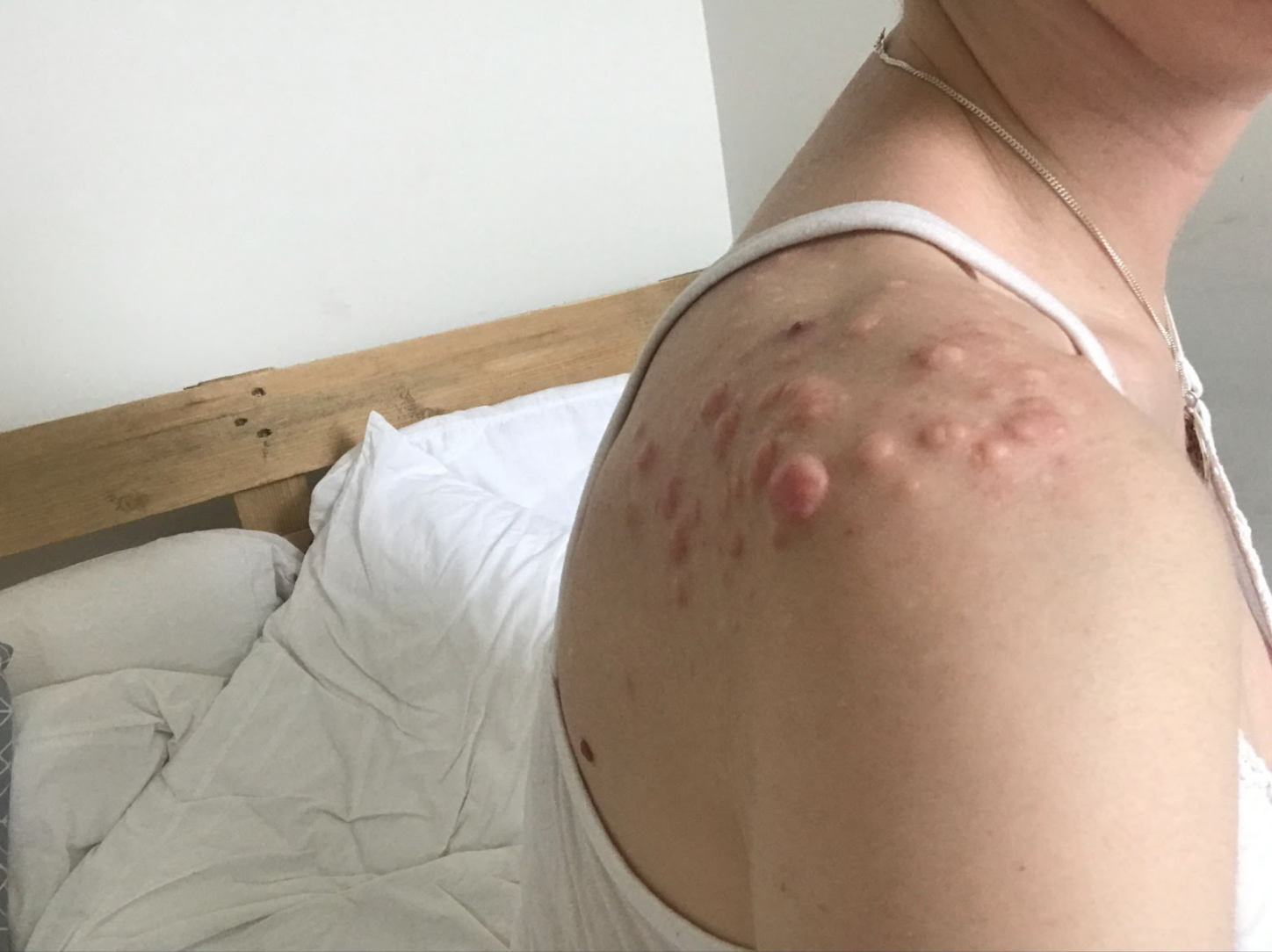
I was 19 years old when I noticed a large lump forming in the centre of my chest. My teenage face had always been scattered with pimples, and on my shoulders I had what was referred to at the time as “bacne.” But this felt ― and looked ― different.

At first I thought it was one of those under-the-skin pimples that had led to a diagnosis of cystic acne and prescription of Lymecycline when I was 15, but the red, raised lump on my chest was much firmer and didn’t have a “head.”

The lumps gradually spread across my shoulders and neck, hardening like small red stones on my body. It took me years to admit something was wrong. Instead, I avoided the mirror when I undressed so that I didn’t have to notice the growing number of large, protruding bumps. It wasn’t until they started to become irritated and itchy that I finally visited my doctor, who referred me to a dermatologist immediately.

At the dermatology clinic, the doctor examined me with the kind of squint that suggested my skin was a medical mystery she might enjoy unraveling. “You have a form of keloid scarring that develops from acne called keloid acne vulgaris,” she announced. It sounded to me like a rare disease that people in the 1600s would have been shunned for.

My mind was stuck on one thing: How do I get rid of them? Dr. Haddon explained there wasn’t a “cure,” but steroid injections could help shrink the scars. A few weeks later, however, I received a call from Dr Haddon: “We’re running a dermatology case study open day for unusual cases. It might be a good opportunity for you to get advice from multiple specialists. Would you be interested?”

That’s how I found myself standing in a hospital room, stripped down to a vest top, while a group of dermatologists — clipboards in hand — filed in. Instead of my name, there was a sheet of paper stuck to the outside of the door with “Case Study 6” on it.

One by one, the doctors walked up to peer at my scars and make notes. Occasionally, one would reach out and prod my shoulder like I was some kind of interactive display at a museum. My skin wasn’t just a problem, it was a spectacle. One doctor asked how long the bumps had been there, but for the most part the room was silent other than the sounds of note-taking and shuffling of shoes on the squeaky hospital floor. Nobody asked how I felt about any of this.

The dermatologists moved on to the next patient — No. 7, presumably ― and I walked out feeling more alien in my skin than ever.

Although I began the steroid injections, my scars didn’t seem to fade much. They were sore, and they itched a lot, especially at night. I would wake up to red scratches over my keloids, which made them look even more inflamed.

The author at 25 years old, months after her first full year of steroid injections.

Photo Courtesy Of Emily Tisshaw

The author at 25 years old, months after her first full year of steroid injections.

My keloid scars aren’t anything like the regular acne scars I have on my face. Those I can easily hide with a high-coverage foundation and a touch of concealer. These are large lumps that only sleeves and turtlenecks can cover. So that’s what I wore for the next 10 years.

In my 20s, I became an expert in covering up. Winters suited me. In summer, when everyone else was in backless tops, their shoulders golden and glowing, I layered T-shirts under my dresses. Everyone around would be in strappy tops and slip dresses while I was stuck sweating through the armpits of my T-shirts.

The worst thing was seeing friends casually throw their hair up into messy buns, their smooth backs catching the sunlight while I was feeling like an outcast in my layers. I told myself I was making a fashion choice, not deploying a shame-based survival tactic.

I would “warn” partners about my scars before undressing. No one ever outwardly expressed any discomfort with my skin ― I seemed to be alone in that feeling. I even once had a girlfriend who told me she thought my scars were “cool.”

The author in a rare crop top she found that covered her shoulders.

Photo Courtesy Of Emily Tisshaw

The author in a rare crop top she found that covered her shoulders.

Every six weeks, I went back to Dr. Haddon for my steroid injections. It was a routine I despised. The process was painful, the results were minimal, and every visit reminded me that I was permanently stuck in this cycle of trying to “fix” myself. At one appointment, I asked, “How long do I need to keep getting these?” She hesitated before saying, “As long as you feel you need them.” Something about that answer sat differently with me.

Years passed and I continued on in my normal routine of black turtleneck winters and shirt-under-dress summers, until I started sea swimming. I had worn a bathing suit occasionally over the past decade, on holidays abroad and family outings to indoor pools, but I always felt uncomfortable, and it was never something I would’ve chosen to do on my own. But now I was willingly getting into a bikini, because I had realised that I needed to get sober.

In recovery, the ice-cold British ocean became my replacement for the highs I once desperately chased. The shock of the water jolted me awake in a way nothing else could, numbing every thought except the one telling me to keep breathing.

For the first time in years, I stood on a beach, scars exposed, and walked into the sea without thinking about who might be looking. It was terrifying. And then, it wasn’t.

It felt like with every swim, I got more comfortable. The water didn’t care what I looked like. The sea wasn’t judging me.

I spent almost every morning for two years splashing in the cold ocean. I stayed away from drugs. I found a community of other women who liked to sea swim. They called themselves The Blue Tits. Their bodies were all different sizes, some had stretch marks and some were covered in beautiful coloured tattoos. I wasn’t judging their bodies like I judged my own. And after a decade of shame, I could feel something shifting. I was tired of hiding. I realised I didn’t owe anyone “perfect” skin. If I could stand on a beach as the rain fell, and the icy water pelted my skin, I knew I could wear a damn dress without the extra layer.

The truth was, I was exhausted. Exhausted from the constant anxiety over whether someone might notice my scars, or question why I always covered my shoulders. Exhausted from missing out on clothes I loved. Exhausted from feeling like my body was something to be hidden.

The author, always pairing her dresses with tees (age 28).

Photo Courtesy Of Emily Tisshaw

The author, always pairing her dresses with tees (age 28).

After years of sharp needles that burnt like a hot rod on my skin, Dr. Haddon agreed that further steroid injections weren’t necessary, and also that the skin could be tattooed on after a few months had passed — something I had wanted to do for a while. I visited an artist who had prior experience covering scars with tattoos. “I once tattooed a guy who was run over by a car!” he told me.

I asked him to do “something big,” and he covered my right shoulder with a large green snake that twisted down my arm intertwined with orange peonies. Snakes are supposed to symbolise new life: the shedding of skin, releasing the weight of the past. But I wasn’t letting go of my old self, I was embracing her for the first time. After years of running, it felt like I had finally come home.

At 30, the author is embracing her skin and showing off her tattoos.

Photo Courtesy Of Emily TIsshaw

At 30, the author is embracing her skin and showing off her tattoos.

I wish I could say that I am now cured of all insecurity, but the truth is, self-acceptance isn’t an overnight transformation. I still have days where I wish my skin told a different story. But I’ve learned to love who I am, scars and all. Today, I’ve swapped the turtlenecks for tank tops. I let the sun touch my shoulders. I let myself be seen.

Share Button

Who are the millions of Britons not working?

About a quarter of the working age population – those aged 16 to 64 – do not currently have a job.

Share Button

Baby slings unsafe for hands-free feeding, charities warn

Parenting charities, including the NCT, have updated their advice saying slings and carriers are unsafe for feeding.

Share Button

Zayn Malik Marked 10 Years Since He Left One Direction With This Surprise Cover

Zayn Malik surprised fans at his show on Tuesday night with an impromptu throwback to his One Direction days – on the anniversary of his exit from the band being announced.

The chart-topping singer is currently nearing the end of his first ever solo world tour, but kicked things off in a different way at his show in Mexico City.

Much to fans’ delight, Zayn opened the set with a live performance of Night Changes, which also happened to be the last single One Direction released with him still a part of the group.

Zayn with his One Direction bandmates Liam Payne, Louis Tomlinson, Niall Horan and Harry Styles in 2012

via Associated Press

Zayn had not performed the song – which he co-wrote alongside all four of his former bandmates – since parting ways with 1D in 2015.

Unlike the other four members of the group, One Direction songs have never formed part of his live setlists.

It has been an emotional few months for Directioners, following the shock death of Liam Payne in October 2024, at the age of 31.

Back in November, Zayn joined his bandmates Niall Horan, Harry Styles and Louis Tomlinson – with whom he’d not been seen in public since his departure from the group – at Liam’s funeral.

Prior to that, he paid an emotional tribute on Instagram, writing: “I lost a brother when you left us and can’t explain to you what l’d give to just give you a hug one last time and say goodbye to you properly and tell you that I loved and respected you dearly.

“I will cherish all the memories I have with you in my heart forever, [I have] no words that justify or explain how I feel right now other than beyond devastated. I hope that wherever you are right now you are good and are at peace A and you know how loved you are.”

He signed off the emotional message: “Love you, bro.”

Share Button

This Is Why Netflix’s The Residence Is Dedicated To Andre Braugher

Those who’ve already made it to the end of Netflix’s new murder mystery The Residence will have seen that the show is dedicated to the American actor Andre Braugher.

Andre – who died of lung cancer in December 2023, at the age of 61 – was a two-time Emmy winner known for his roles in shows like Thief, The Good Fight and Brooklyn Nine-Nine.

He also appeared in the films City Of Angels, Salt and She Said.

Andre Braugher pictured in 2018

via Associated Press

Naturally, some viewers might have been left pondering what his connection to Netflix’s latest hit show was, after seeing that The Residence was dedicated in his memory.

Why was The Residence dedicated to Andre Braugher?

Andre had actually been cast in the show prior to his death in 2023.

He was due to play White House Chief Usher A.B. Wynter, the staff member whose death sparks the murder mystery that forms the central plot.

In fact, production was halfway through when Andre died, with half of his scenes having been filmed.

After production was shut down, the decision was made to recast the role, with Giancarlo Esposito taking over.

Giancarlo Esposito in The Residence

Creator Paul William Davies told Deadline: “It was brutal and it was really hard for so many of us. We were lucky enough that Giancarlo, who also knew Andre, was close to him and had the deepest respect for him, was able to come in and do that role, and do it in his own way, but also honouring Andre.

“That’s a very difficult assignment, just on so many levels and he handled it with extraordinary grace and navigated that in a way that comforted us. It was hard.”

Of the decision to honour Andre after the whole series, rather than just one episode, Paul added: “There might have been a natural inclination to do that after the first episode, but for me, it was important to do that at the end of the whole series, to say, you were part of all this, and we have not forgotten you.”

The Residence is available to stream in full on Netflix.

Share Button

Fertility patients sold unproven add-ons, HFEA says

Despite little proof add-ons help, many IVF clinics offer them, the UK’s fertility regulator warns.

Share Button

GPs and sports centre join forces

A group of GP practices join up with a sports centre operator to open a new healthcare service.

Share Button