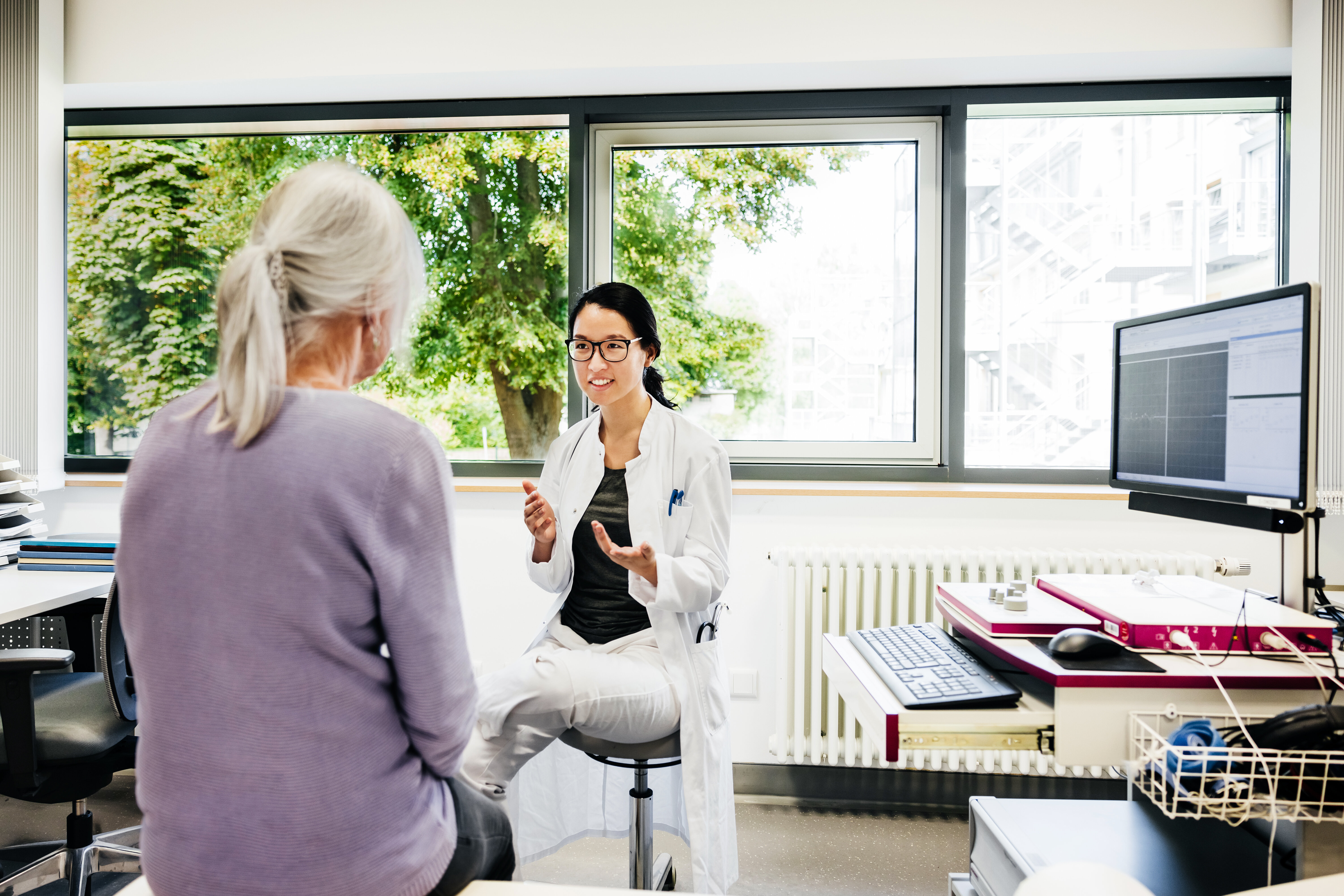
Want To Prevent Dementia? Ask These 12 Questions At Your Next Doctor’s Appointment.

While you’re probably used to asking your doctor about new moles or a pesky cough, you might not be used to talking to them about your social connections or anxiety.

Turns out, there’s an array of topics you should be bringing up with your primary care doctor (or your neurologist, if you have one), according to a recent report in the journal Neurology.

The report detailed 12 questions that patients should discuss with their physician that can help protect the brain from cognitive decline. And while it lists some obvious brain health inquiries, it also includes factors that you likely don’t connect to your cognitive health, like your social interactions and diet.

Here are the 12 questions, according to the journal:

  1. Sleep: Are you able to get sufficient sleep to feel rested?

  2. Affect, mood and mental health: Do you have concerns about your mood, anxiety or stress?

  3. Food, diet and supplements: Do you have concerns about getting enough or healthy enough food, or have any questions about supplements or vitamins?

  4. Exercise: Do you find ways to fit physical exercise into your life?

  5. Supportive social interactions: Do you have regular contact with close friends or family, and do you have enough support from people?

  6. Trauma avoidance: Do you wear seatbelts and helmets, and use car seats for children?

  7. Blood pressure: Have you had problems with high blood pressure at home or at doctor visits, or do you have any concerns about blood pressure treatment or getting a blood pressure cuff at home?

  8. Risks, genetic and metabolic factors: Do you have trouble controlling blood sugar or cholesterol? Is there a neurological disease that runs in your family?

  9. Affordability and adherence: Do you have any trouble with the cost of your medicines?

  10. Infection: Are you up to date on vaccines, and do you have enough information about those vaccines?

  11. Negative exposures: Do you smoke, drink more than one to two drinks per day or use nonprescription drugs? Do you drink well water or live in an area with known air or water pollution?

  12. Social and structural determinants of health: Do you have concerns about keeping housing, having transportation, having access to care and medical insurance or being physically or emotionally safe from harm?

Experts say these questions align with previous research findings and a focus on prevention instead of treatment.

This study is backed up by a report from The Lancet, another medical journal, last year, as Dr. James Ellison, a psychiatrist at Jefferson Health in Philadelphia, pointed out. That report found that 45% of cases of cognitive decline or dementia could be delayed or even prevented by simple lifestyle interventions.

“I would say that the Neurology journal is keeping up with the current trend in health care, which is to try and emphasise wellness and prevention and not just response to disease,” Ellison said.

Dr. Tanu Garg, a vascular neurologist at Houston Methodist Hospital who often treats stroke patients, added that many of her patients’ families ask what can they do so they don’t end up in the same situation as their loved ones — and these lifestyle interventions are the answer.

“That’s why these questions are very important, because we are trying to prevent people from having difficulties in the future, whether it’s heart attack, strokes or just, in general, for brain health,” Garg explained.

How do these factors impact brain health?

While it’s clear how certain habits mentioned above could affect your cognitive health (like wearing a helmet, for example), other factors are a little more nuanced ― but are just as important to manage.

For instance, socialisation is a true indicator of brain health. “We are social beings … and there are even changes in metabolic activity and brain activity that occur when we’re isolated that are harmful,” Ellison said.

With isolation comes loneliness, which can put you at higher risk of cognitive decline and stroke, Ellison added. “It’s very important to cultivate a social network,” he said.

Garg also noted that those with close family and friend connections can also get more support when recovering from health issues, which is important for well-being, too.

The factors that seem to relate more to heart health, like blood pressure, are important, too. “Almost everything that’s good for the brain is actually also good for the heart,” Ellison said. “When the heart is functioning properly, it provides nutrients and oxygen, which fuel the brain and keep it healthy, and it helps remove toxic metabolites from the brain as well.”

“When the heart is not functioning properly, the circulation and oxygenation and metabolic care of the brain is compromised, and that can lead to cognitive changes,” Ellison continued. He added that one of the most common kinds of cognitive decline in older people is “vascular cognitive impairment, which is a direct result of compromised circulation in the brain.”

Garg said simple, small positive habits, like diet and exercise, can often bring the biggest health rewards. She recommends a Mediterranean diet and said you should talk to your doctor about the best exercise regimen for you, as it varies person to person. Additionally, if you smoke, you should talk to your doctor about quitting, to protect both your brain and your overall health, Garg said.

It’s also important to manage your emotions, and you can talk to your doctor about how to best do that, too. “There are so many different ways to curb anxiety and stress, but people don’t realise how much of an impact it can make on your body and your brain,” Garg said. Research shows that anxiety is linked to higher rates of dementia.

Exercise benefits your brain health and your heart health.

rbkomar via Getty Images

Exercise benefits your brain health and your heart health.

These are questions you should bring up throughout your life, not just once you reach a certain age.

While it’s never too late to think more holistically about your brain health, you should always pay attention to them — not just once you reach old age.

Ellison said these questions focus “on prevention throughout the life cycle, not just in the elderly.”

While cognitive decline is often only associated with getting older, problems during mid-life, such as sleep disorders and unmanaged high blood pressure, can compound your risks for cognitive decline and dementia later on, he added.

It’s also important to talk to your doctor about any cognitive changes you notice, no matter your age.

“If you go see a doctor sooner than later, then we can find things that are reversible to prevent further decline. But when you’re afraid or you’re not sure if it’s the right thing to do, then we may get to the point where you’re not able to fix things,” Garg said.

Garg always reminds her patients that it’s OK to ask your doctor questions, whether you think they’re the “right” ones or not.

Ellison added that not all cognitive changes are related to major health issues, either. Stress, anxiety, certain medications and certain health conditions can cause cognitive issues, too, making it crucial to talk to your primary care provider.

Your doctor can also help you incorporate exercise, social connections, a nutritious diet and other healthy lifestyle habits into your life — because there’s real proof that these good habits work, Ellison said. The rate of dementia in older adults is decreasing. Specifically, dementia rates have fallen 13% per decade over the last 25 years, according to a 2020 study.

“The decrease in incidence has been attributed to population improvements in cardiac health, greater awareness of diet and exercise,” Ellison said.

While these habits may not seem big, they really can have a big impact on your brain health as you move through life.

Share Button

These 4 Reddit Hacks For Getting Toddlers To Comply Are *Chef’s Kiss*

Toddlers and preschool-age children are forces of nature. Those tiny tyrants are full of love, life and wonder – but they’re also unyielding when they decide they don’t want to do something.

Thankfully though, there’s a hack (or four) for that.

A Reddit thread of parenting hacks has flagged some absolute gems which I will be using for the foreseeable future.

One parent shared their incredibly simple solution for getting their toddler to eat the snacks they want her to.

“If she asks for a snack and I offer her healthy options she will often refuse, ask for something like chocolate, and then get hangry when I don’t give her what she wants,” wrote user tomtink1.

“If I leave something like a banana at the edge of the kitchen counter earlier in the day she will steal it and eat it and everyone is happy.”

Another parent said they can get their toddler to (mostly) listen and do as they say by asking: ‘what if you did it silly?’

It’s an especially great way to diffuse potential battles when trying to leave the house.

“Yesterday trying to leave daycare with 1 degree temps outside, she was working up to a screaming ‘no!’ over putting on winter gear. I was this close to ‘do it or I’ll do it to you’ when instead I asked ‘what if you put it on silly?’,” said user anotherface95.

“Now mind, she’s 3…. So to her, the silliest she can get is she makes silly noises and wiggles a little. Snow gear – on! Tantrum – averted! Frostbite – thwarted! Power struggles – rescheduled!”

In the comments section, a parent said they use a similar tactic called ‘march, march!’ with their son.

“If he’s getting grumpy or distracted going anywhere I start chanting ‘march, march!’ and I will march to wherever we’re going,” said user pandito88.

“He always follows me with giggles and he tries to march his little leggies. Instantly snaps him out of grumpiness and redirects him where I want him to go.”

And if these don’t work for you, just call whatever you want them to do ‘a project’ – a particularly useful strategy for getting them to help tidy up at the end of the day. (I tried it last night and can confirm, it does work.)

“Mine is to call everything a ‘project’ so my three year old will help or at least tag along happily,” said user Typical-Dog244.

“Folding laundry? Project. Weeding? Project. Making me a coffee? Project. The girl can’t resist.”

Brilliant.

Share Button

8 ‘Micro-Habits’ That Can Help You Live A Happier, Healthier Life

If you’re like most people, you’ve probably tried to follow a new big habit just to find yourself faltering a few days later. Maybe you made it a goal to follow a plant-based diet only to find yourself reaching for bacon at breakfast. Or maybe you promised yourself you’d read four books a month only to scroll social media instead.

There’s a reason it’s hard to adhere to a new behaviour. “Many people struggle with motivation because they set goals that are too ambitious or require drastic lifestyle changes,” said Israa Nasir, a therapist and author of Toxic Productivity.

This is where a certain type of approach ― known as a micro-habit ― comes into play.

“Micro-habits remove that overwhelm,” Nasir said, noting that they “improve well-being by reducing the gap between intention and action.”

“There are two parts to a micro-habit,” Nasir continued. First “it is a small, easily repeatable action that requires minimal effort but has a compounding positive impact. When you do it consistently, it creates a large impact.” Second, “micro-habits fit seamlessly into your existing routine, unlike big habit overhauls that can feel overwhelming.”

Micro-habits tend to have a compounding effect because they trigger the brain’s dopamine response, which is the brain’s reward chemical, explained Gina Cleo, the director of the Habit Change Institute in Australia.

“So that reinforces the habit loop — when we get a hit of dopamine, our brain’s like, ‘whoa, that felt really good, we should do that again,’ and so our brain actually starts to make us want to do that habit again,” Cleo said.

And while the micro-habit may not seem as rewarding as a huge goal, that’s actually not true. Our brains don’t know the difference between a big habit and a small habit; you’ll get that dopamine hit whether you wake up and follow a micro-habit like taking a sip of water before having coffee or a full-blown habit like having water and breakfast before coffee, Cleo explained.

All that to say, micro-habits can have some major rewards. And while they can exist in any part of life ― such as your relationships, personal growth, exercise or mental health ― there are certain micro-habits that tend to offer the biggest rewards. Here’s what they are:

1. Take a breath before reacting or making a decision

Cleo said a lot of folks report being reactive when they don’t want to. And whether that means agreeing to plans when you don’t really feel up for it or snapping at someone you love, there is one micro-habit that can help you in pressure-filled moments: taking a breath.

“Taking one big, deep breath before reacting helps to regulate emotions, reduce stress and just regulate the nervous system,” Cleo said.

2. Make your bed in the morning

Making your bed each morning is a simple micro-habit that only takes a minute or two but is one of the best behaviours to adopt, said Emma Mahony, a therapist who works with patients in Pennsylvania.

“It also signifies the day is started and … you’re setting yourself up to come back to a nicer bed later on that day,” she noted.

3. Write down one thing you’re grateful for every day

While big goals like daily mindfulness or prayer may not be something you’ve historically stuck to, a quick gratitude practice can be the key to feeling more fulfilled and joyful.

Cleo recommends that you write down one thing you’re grateful for each morning when you wake up or each night before bed — and that’s it. This micro-habit can take just a minute or two each day.

“The gratitude practice … actually just trains your brain to focus on the positive,” Cleo explained. “It releases serotonin, which gives us that beautiful feeling of contentment and safety.”

4. Do a quick stretch every hour

Anyone who works a desk job knows how easy it is to go hours and hours without getting up. Cleo said making a goal of doing a quick stretch once an hour is a great way to not only show your body some love, but to boost circulation and prevent stagnation throughout the day.

This could be a quick, 10-second micro-habit where you fold forward to touch your toes, do a cat cow stretch or gently do a few wrist stretches. There’s no wrong way to do your stretching, and you’ll feel good after it’s done.

Micro-habits allow you to create a new routine without the overwhelm that can come from huge, overarching goals.

NickyLloyd via Getty Images

Micro-habits allow you to create a new routine without the overwhelm that can come from huge, overarching goals.

5. Get some fresh air first thing in the morning

One of Mahony’s favourite micro-habits that she does daily is getting fresh air within the first hour that she’s up. This could mean going for a stroll to get coffee or just opening up the door and getting fresh air in your face — it doesn’t have to be a full-blown outdoor workout or a long walk.

If you can’t get outside right away, Mahony said to just make it a goal to get out at some point during the day.

“I know a lot of us work from home, so that’s important … you’re connecting with nature and fresh air,” she said. “I also think [for] me it, particularly in the morning, signifies the start of the day.”

6. Spend time unplugged from your phone

Most American adults feel like they’re on their phones too much but will meet this problem with lofty phone-use goals that are tough to stick to.

Instead of creating goals that are too big, Cleo recommends micro-habits around unplugging that are actually manageable (and even rewarding). Cleo has no-phone zones in her home ― her dining room and her bedroom ― that force her to live unplugged when in those spaces.

But to start even smaller, you could make a micro-habit of putting your phone down while you eat or when you watch your favourite show. This enhances mindfulness, she noted.

7. Drink more water

Drinking water has a multitude of benefits for your physical health, including lubricating your joints, assisting in the body’s waste-removal process and allowing your organs to work properly.

Drinking more water is always a good goal but can be hard to achieve — which is where a micro-habit can help.

“Trying to wake up and drink a glass of water, or making sure you have a glass of water with every meal that you have” are two good places to start, said Mahony.

“I feel like a lot of people are like, ‘I need to drink more water,’ but then they’re like, ‘oh, I don’t have a water bottle,’ or ‘oh, I can’t drink that much in a day,’” she said. “Try to drink one glass more than you did the day before, and if yesterday you didn’t drink any water at all, try to have one glass today.”

8. Read a page of a book each night before bed

You don’t have to commit to reading an entire book or even a full chapter to reap the calming benefits of reading. One micro-habit Mahony is trying to get into is reading a page of a book before bed.

“The last thing I do before I close my eyes shouldn’t be my phone,” she said.

She suggests making a goal of reading one page of a book, or even a magazine or letter, before going to sleep.

“You could spend one minute with it, but I think allowing yourself that space before you go down, instead of having your phone consume your thoughts before bed, is also really important,” she said.

When establishing your micro-habits, be honest about where you are right now

When deciding what micro-habits are best for you, Mahony stressed that you should be honest with yourself about where you are now. Ask yourself what you’re capable of and what micro-habits you can actually stick to.

According to Mahony, sticking to a micro-habit helps you build trust in yourself — and when you build trust in yourself, you’re more likely to go back to the micro-habit. If you continuously set lofty goals and not meet them, that can create a negative relationship with that goal.

“Please be kind to yourself, and that looks like having a genuine, honest conversation about where you’re at right now,” Mahony said. “So, if you are someone who’s staying in bed all day, be honest about what you’re capable of doing. That could be something very small … maybe that just means you open your door and you take in a deep breath and then go back in bed for the day.”

Whatever you do, don’t allow comparison to set your micro-habits for you. Your micro-habit will look different from your partner’s or parent’s or neighbor’s micro-habit, and that’s OK.

For those who don’t know where to start, Cleo suggested looking at the big habit you’re trying to create and breaking that down into 100 pieces — those little pieces are your micro-habits.

Whether you choose to focus on meditation, physical health, mental health, finance, socialisation or career goals, there is no wrong way to set a micro-habit. Instead, whatever tiny steps you take toward your goal will only make your brain feel good and your goal that much closer.

Share Button

‘My nephew killed my brother – but I’ve forgiven him’

Brenton Marriott died in August 2022, less than a year before the Nottingham attacks.

Share Button

New microscope can image, at once, the full 3D orientation and position of molecules in cells

Two heads are better than one, as the saying goes, and sometimes two instruments, ingeniously recombined, can accomplish feats that neither could have done on its own.

Such is the case with a hybrid microscope, born at the Marine Biological Laboratory (MBL), that for the first time allows scientists to simultaneously image the full 3D orientation and position of an ensemble of molecules, such as labeled proteins inside cells. The research is published this week in Proceedings of the National Academy of Sciences.

The microscope combines polarized fluorescence technology, a valuable tool for measuring the orientation of molecules, with a dual-view light sheet microscope (diSPIM), which excels at imaging along the depth (axial) axis of a sample.

This scope can have powerful applications. For example, proteins change their 3D orientation, typically in response to their environment, which allows them to interact with other molecules to carry out their functions.

“Using this instrument, 3D protein orientation changes can be recorded,” said first author Talon Chandler of CZ Biohub San Francisco, a former University of Chicago graduate student who conducted this research partly at MBL. “There’s real biology that might be hidden to you from just a position change of a molecule alone,” he said.

Imaging the molecules in the spindle of a dividing cell — a longstanding challenge at MBL and elsewhere — is another example.

“With traditional microscopy, including polarized light, you can study the spindle quite nicely if it’s in the plane perpendicular to the viewing direction. As soon as the plane is tilted, the readout becomes ambiguous,” said co-author Rudolf Oldenbourg, a senior scientist at MBL. This new instrument allows one to “correct” for tilt and still capture the 3D orientation and position of the spindle molecules (microtubules).

The team hopes to make their system faster so that they can observe how the position and orientation of structures in live samples change over time. They also hope development of future fluorescent probes will enable researchers to use their system to image a greater variety of biological structures.

A Confluence of Vision

The concept for this microscope gelled in 2016 through brainstorming by innovators in microscopy who met up at the MBL.

Hari Shroff of HHMI Janelia, then at the National Institutes of Health (NIH) and an MBL Whitman Fellow, was working with his custom-designed diSPIM microscope at MBL, which he built in collaboration with Abhishek Kumar, now at MBL.

The diSPIM microscope has two imaging paths that meet at a right angle on the sample, allowing researchers to illuminate and image the sample from both perspectives. This dual view can compensate for the poor depth resolution of any single view, and illuminate with more control over polarization than other microscopes.

In conversation, Shroff and Oldenbourg realized the dual view microscope could also address a limitation of polarized light microscopy, which is that it’s difficult to efficiently illuminate the sample with polarized light along the direction of light propagation.

“If we had two orthogonal views, we could sense polarized fluorescence along that direction much better,” Shroff said. “We thought, why not use the diSPIM to take some polarized fluorescence measurements?”

Shroff had been collaborating at MBL with Patrick La Rivière, a professor at University of Chicago whose lab develops algorithms for computational imaging systems. And La Rivière had a new graduate student in his lab, Talon Chandler, whom he brought to MBL. The challenge of combining these two systems became Chandler’s doctoral thesis, and he spent the next year in Oldenbourg’s lab at MBL working on it.

The team, which early on included Shalin Mehta, then based at MBL, outfitted the diSPIM with liquid crystals, which allowed them to change the direction of input polarization.

“And then I spent a long time working through, what would a reconstruction look like for this? What is the most we can recover from this data that we are now starting to acquire?” Chandler said. Co-author Min Guo, then located at Shroff’s previous lab at NIH, also worked tirelessly on this aspect, until they had reached their goal of full 3D reconstructions of molecular orientation and position.

“There was tons of cross-talk between the MBL, the University of Chicago, and the NIH, as we worked this through,” Chandler said.

Share Button

Glass fertilizer beads could be a sustained nutrient delivery system

Agricultural fertilizers are critical for feeding the world’s population, restoring soil fertility and sustaining crops. Excessive and inefficient use of those resources can present an environmental threat, contaminating waterways and generating greenhouse gases such as nitrous oxide. Now, researchers reporting in ACS Agricultural Science & Technology have addressed those challenges with glass fertilizer beads. The beads control nutrient release, and the researchers say they’re environmentally compatible.

“The results show that glass fertilizers can be tailored to plant needs, slowly and sustainably releasing nutrients to boost productivity without harming soil quality,” says Danilo Manzani, a co-author of the study.

Over time, the use of agricultural chemicals has increased. In 2020, the Food and Agriculture Organization of the United Nations estimated that global demand for fertilizers would surpass 200 million metric tonnes. Fertilizers contain nitrogen, phosphorus and lower amounts of other elements like calcium. Unfortunately, the benefits of these nutrients are lost through leaching into groundwater and emissions into the air, necessitating frequent reapplication and creating downstream environmental problems like toxic algal blooms. A potential solution could come from tiny glass beads that previous researchers used to improve plant growth. To improve the efficiency of nutrient delivery, Manzani, Eduardo Ferreira and colleagues developed a water-soluble, multicomponent glass fertilizer designed for controlled nutrient release.

The researchers synthesized glass consisting of several micro- and macronutrients, such as phosphorus, potassium and calcium. They ground the glass into small (less than 0.85 millimeters wide) and large (0.85 to 2 millimeters wide) particles. In an initial test, the particles were added to either water or a buffer solution that mimicked soil conditions. They found that each nutrient released from both sizes of glass particles and diffused into the solutions steadily over 100 hours with minor fluctuations.

They then applied a nutrient solution or different amounts of the glass beads to soil seeded with a typical lawn and fairway grass, and they compared the plants’ growth in the two treatments. The nutrient solution, which was applied only once, immediately stimulated plant growth, but the effect quickly diminished. However, the single application of glass fertilizer sustained plant growth regardless of particle size, though overall growth depended on the bead dose.

Manzani, Ferreira and colleagues also examined the possible ecotoxicity of the glass fertilizer by exposing lettuce and onion seeds to the beads. Seeds exposed to glass fertilizer had roughly the same germination rate and cell health as those never exposed or those treated with soluble nutrients. The researchers say that these results indicate an efficient and sustained alternative to conventional fertilizers with lower environmental impact.

The authors acknowledge funding from the São Paulo Research Foundation; Center for Research, Technology, and Education in Vitreous Materials; National Council for Scientific and Technological Development (Conselho Nacional de Desenvolvimento Científico e Tecnológico); Coordination for the Improvement of Higher Education Personnel; and Funding Authority for Studies and Projects.

Share Button

Biobased lignin gels offer sustainable alternative for hair conditioning

Researchers at Stockholm University have developed a fully biobased hair conditioner using lignin gel emulsions, offering a sustainable and environmentally friendly alternative to conventional haircare products.

Hair conditioners typically contain 20-30 ingredients, many derived from petroleum and oleochemicals, raising concerns about sustainability and environmental impact. A new study published in Science Advances, demonstrates that micellar lignin gels can effectively stabilize emulsions with natural oils, reducing the need for synthetic surfactants and complex stabilizers commonly used in commercial formulations. The research team, led by Mika Sipponen at Stockholm University, sought to explore lignin, a common and renewable component in wood biomass, as a multifunctional component for hair conditioning.

“Our findings highlight lignin’s potential as a stabilizer in oil-in-water emulsions, enabling a more natural and sustainable approach to hair conditioning,” says Mika Sipponen. “By using wood-derived lignin directly without any chemical modification, we not only simplify the ingredient list but also eliminate the need for organic solvents, making the process more eco-friendly.”

Comparable to commercial hair conditioners

The lignin gel-based conditioner was tested against a commercial hair conditioner, showing comparable emulsion stability, viscosity, and conditioning performance. A formulation with 6 percent coconut oil effectively lubricated damaged hair, reducing wet combing force by 13 percent, as confirmed by combing force measurements and multiscale microscopy analysis. Importantly, the product was easily rinsed off from paper and skin with cold water despite its dark color, demonstrating practical usability.

New opportunities in cosmetics and food

Ievgen Pylypchuk, who has been instrumental in developing lignin gel as a versatile platform material, highlights its broader potential: “Our lignin gel technology extends beyond personal care applications. Its unique ability to stabilize emulsions and interact with various biomolecules opens opportunities in cosmetics, food, and even biomedical formulations, offering a sustainable alternative to conventional ingredients.”

This innovation paves the way for greener haircare solutions that align with growing consumer demand for sustainable personal care products. The researchers anticipate further exploration of lignin-based formulations for broader applications in the personal care industry.

Share Button

How to get a robot collective to act like a smart material

Researchers at UC Santa Barbara and TU Dresden are blurring the lines between robotics and materials, with a proof-of-concept material-like collective of robots with behaviors inspired by biology.

“We’ve figured out a way for robots to behave more like a material,” said Matthew Devlin, a former doctoral researcher in the lab of UCSB mechanical engineering professor Elliot Hawkes, and the lead author of a paper published in the journal Science. Composed of individual, disk-shaped autonomous robots that look like small hockey pucks, the members of the collective are programmed to assemble themselves together into various forms with different material properties.

Of particular interest to the research team was the challenge of creating a robotic material that could both be stiff and strong, yet be able to flow when a new form is needed. Rather than responding to exterior forces to attain a form, robotic materials ideally would respond to internal signals, Hawkes explained, able to take a shape and hold it, “but also able to selectively flow themselves into a new shape.”

For inspiration, the researchers tapped previous work by Otger Campàs, a former UCSB professor and currently the director of the Physics of Life Excellence Cluster at TU Dresden, on how embryos are physically shaped. “Living embryonic tissues are the ultimate smart materials,” he said. “They have the ability to self-shape, self-heal and even control their material strength in space and time.” While at UCSB, his laboratory discovered that embryos can melt like glass to shape themselves. “To sculpt themselves, cells in embryos can make the tissues switch between fluid and solid states; a phenomenon known as rigidity transitions in physics,” he added.

During the development of an embryo, cells have the remarkable ability to arrange themselves around each other, turning the organism from a blob of undifferentiated cells into a collection of discrete forms — like hands and feet — and of various consistencies, like bones and brain. The researchers concentrated on enabling three biological processes behind these rigidity transitions: the active forces developing cells apply to one another that allow them to move around each other; the biochemical signaling that allow these cells to coordinate their movements in space and time; and their ability to adhere to each other, which ultimately lends the stiffness of the organism’s final form.

In the world of robots, the intracellular forces translate to inter-unit tangential force, enabled by eight motorized gears along each robot’s circular exterior, which allow them to move around each other, pushing off each other, even in tightly packed spaces.

The biochemical signaling, meanwhile, is akin to a global coordinate system. “Each cell ‘knows’ its head and tail, so then it knows which way to squeeze and apply forces,” Hawkes explained. In this way, the collective of cells manages to change the shape of the tissue, such as when they line up next to each other and elongate the body.

In the robots, this feat is accomplished by light sensors on the top of each robot, with polarized filters. When light is shone on these sensors, the polarization of the light tells them which direction to spin its gears and thus how to change shape. “You can just tell them all at once under a constant light field which direction you want them to go, and they can all line up and do whatever they need to do,” Devlin added.

For the cell-cell adhesion the researchers used magnets incorporated into the perimeter of the robotic units, magnets that could be turned to attract any other robot.

In putting the robots through their paces, the researchers found that signal fluctuations — variations in the signals sent to the robots — played a critical role in their ability to take the necessary shapes and formations. “We had previously shown that in living embryos, the fluctuations in the forces that cells generate are key to turning a solid-like tissue into a fluid one. So, we encoded force fluctuations in the robots,” said Campàs.

In the robot collective, the interaction between signal fluctuations and inter-unit forces is the difference between a tightly packed, unmoving collective and a more fluid one. “Basically, as you increase both of those, especially fluctuations, you get a more flowing material,” Devlin said. This allows the collective to change shape. Once in formation, switching off the force fluctuations rigidifies the collective again.

Importantly, these signal fluctuations make it possible for the robot collective to achieve their shape and strength changes with less average power than if the signal were constantly on and the robots were all pushing on each other continuously. “It’s an interesting result that we did not set out looking for, but discovered once we started gathering data on the robot behaviors,” Hawkes said. This is important, he added, for designing robots that may have to run on limited power budgets.

With all this in mind, the researchers were able to tune and control the group of robots to act like a smart material: sections of the group would turn on dynamic forces between robots and fluidize the collective, while in other sections the robots would simply hold to each other to create a rigid material. Modulating these behaviors across the group of robots and over time allowed the researchers to create robotic materials that support heavy loads but can also reshape, manipulate objects, and even self-heal.

Currently, the proof-of-concept robot collective comprises a small number (20) of relatively large units, but simulations conducted by former Campàs laboratory postdoctoral fellow Sangwoo Kim, who is now an assistant professor at EPFL, indicate the system can be scaled to larger numbers of miniaturized units, for a more materials-like aspect.

Beyond robotics, according to the paper, this and robot collectives like it could “enable the study of phase transitions in active matter, the properties of active mechanics in particulate systems and potentially help define hypotheses for biological research.” Combined with current controls and machine learning strategies, working with these robot collectives could yield emergent capabilities in robotic materials that have yet to be discovered and understood.

Share Button

Underwater mics and machine learning aid right whale conservation

Using underwater microphones and machine learning (ML), Cornell University researchers have developed a new method to estimate North Atlantic right whale numbers — offering a potentially safer and more cost-effective way to monitor this critically endangered species.

Their study, published in Endangered Species Research, demonstrates how microphones combined with ML and traditional aerial survey methods can help track right whale populations in Cape Cod Bay, a crucial feeding ground where the whales gather each spring.

To track this endangered species, researchers rely on costly and dangerous surveys by airplanes, or use sound recordings to identify their presence, or absence.

“Using sound recordings to monitor whale populations isn’t new,” said lead author Marissa Garcia of the Cornell Lab of Ornithology’s K. Lisa Yang Center for Conservation Bioacoustics. “What makes our study unique is that we were able to take those recordings and go beyond getting information on the presence or absence of whales to getting an approximate number of whales in an area.”

The team set out an array of marine autonomous recording units (MARU) across Cape Cod Bay to capture right whale sounds.

Following deployment of the MARUs, the team trained, validated and applied a deep-learning model that could automatically detect right whale sounds with 86% precision.

“By analyzing their distinctive upcall vocalizations, we can detect their presence continuously, day and night,” Garcia said. “This kind of round-the-clock monitoring that results from passive acoustic monitoring just isn’t possible with traditional aerial surveys, which can only happen in daylight hours and in good weather.”

Garcia says there’s still some uncertainty in the counts that the team needs to address in future research, but the team is optimistic that monitoring whale vocalizations holds promise for estimating the abundance of right whales to aid in conservation and management efforts.

Having the ability to expand monitoring efforts across larger areas of the ocean will help scientists better assess the species’ population numbers across the full extent of its range. Garcia said right whales have been traditionally thought of as a conservation challenge in New England, but right whales are found all along the East Coast.

“Using passive acoustic data and deep-learning tools, we can expand the area we can safely monitor and keep track of this critically endangered species,” Garcia said.

The work comes at a critical time for North Atlantic right whales, whose population has declined to fewer than 370 individuals due to ship strikes, fishing gear entanglement and changing ocean conditions affecting their food sources.

Share Button

Why GPT can’t think like us

Artificial Intelligence (AI), particularly large language models like GPT-4, has shown impressive performance on reasoning tasks. But does AI truly understand abstract concepts, or is it just mimicking patterns? A new study from the University of Amsterdam and the Santa Fe Institute reveals that while GPT models perform well on some analogy tasks, they fall short when the problems are altered, highlighting key weaknesses in AI’s reasoning capabilities.

Analogical reasoning is the ability to draw a comparison between two different things based on their similarities in certain aspects. It is one of the most common methods by which human beings try to understand the world and make decisions. An example of analogical reasoning: cup is to coffee as soup is to (the answer being: bowl)

Large language models like GPT-4 perform well on various tests, including those requiring analogical reasoning. But can AI models truly engage in general, robust reasoning or do they over-rely on patterns from their training data? This study by language and AI experts Martha Lewis (Institute for Logic, Language and Computation at the University of Amsterdam) and Melanie Mitchell (Santa Fe Institute) examined whether GPT models are as flexible and robust as humans in making analogies. ‘This is crucial, as AI is increasingly used for decision-making and problem-solving in the real world’, explains Lewis.

Comparing AI models to human performance

Lewis and Mitchell compared the performance of humans and GPT models on three different types of analogy problems:

  1. Letter sequences — Identifying patterns in letter sequences and completing them correctly.
  2. Digit matrices — Analyzing number patterns and determining the missing numbers.
  3. Story analogies — Understanding which of two stories best corresponds to a given example story.

A system that truly understands analogies should maintain high performance even on variations

In addition to testing whether GPT models could solve the original problems, the study examined how well they performed when the problems were subtly modified. ‘A system that truly understands analogies should maintain high performance even on these variations’, state the authors in their article.

GPT models struggle with robustness

Humans maintained high performance on most modified versions of the problems, but GPT models, while performing well on standard analogy problems, struggled with variations. ‘This suggests that AI models often reason less flexibly than humans and their reasoning is less about true abstract understanding and more about pattern matching’, explains Lewis.

In digit matrices, GPT models showed a significant drop in performance when the position of the missing number changed. Humans had no difficulty with this. In story analogies, GPT-4 tended to select the first given answer as correct more often, whereas humans were not influenced by answer order. Additionally, GPT-4 struggled more than humans when key elements of a story were reworded, suggesting a reliance on surface-level similarities rather than deeper causal reasoning.

On simpler analogy tasks, GPT models showed a decline in performance decline when tested on modified versions, while humans remained consistent. However, for more complex analogical reasoning tasks, both humans and AI struggled.

Weaker than human cognition

This research challenges the widespread assumption that AI models like GPT-4 can reason in the same way humans do. ‘While AI models demonstrate impressive capabilities, this does not mean they truly understand what they are doing’, conclude Lewis and Mitchell. ‘Their ability to generalize across variations is still significantly weaker than human cognition. GPT models often rely on superficial patterns rather than deep comprehension.’

This is a critical warning for the use of AI in important decision-making areas such as education, law, and healthcare. AI can be a powerful tool, but it is not yet a replacement for human thinking and reasoning.

Share Button