DNA origami suggests route to reusable, multifunctional biosensors

Using an approach called DNA origami, scientists at Caltech have developed a technique that could lead to cheaper, reusable biomarker sensors for quickly detecting proteins in bodily fluids, eliminating the need to send samples out to lab centers for testing.

“Our work provides a proof-of-concept showing a path to a single-step method that could be used to identify and measure nucleic acids and proteins,” says Paul Rothemund (BS ’94), a visiting associate at Caltech in computing and mathematical sciences, and computation and neural systems.

A paper describing the work recently appeared in the journal Proceedings of the National Academy of Sciences. The lead authors of the paper are former Caltech postdoctoral scholar Byoung-jin Jeon and current graduate student Matteo M. Guareschi, who completed the work in Rothemund’s lab.

In 2006, Rothemund published the first paper on DNA origami, a technique that provides simple yet exquisite control over the design of molecular structures at the nanoscale using nothing more than DNA.

Essentially DNA origami enables long strands of DNA to fold, through self-assembly, into any desired shape. (In the 2006 paper, Rothemund famously used the technique to create miniature DNA smiley faces measuring 100 nanometers across and 2 nanometers thick). Researchers begin with a long strand of DNA, the scaffold, in solution. Because the nucleotide bases that make up DNA bind in a known way (adenine binds to thymine, and guanine binds to cytosine), the scientists can add hundreds of short sequences of complementary DNA knowing they will bind to the scaffold on either end at known locations. Those short, added pieces of DNA fold the scaffold and give it shape, acting as “staples” that hold the structure together. The technique can then be used to create shapes ranging from a map of North and South America to nanoscale transistors.

In the new work, Rothemund and his colleagues used DNA origami to create a lilypad-like structure — a flat, circular surface about 100 nanometers in diameter, tethered by a DNA linker to a gold electrode. Both the lilypad and the electrode have short DNA strands available to bind with an analyte, a molecule of interest in solution — whether that be a molecule of DNA, a protein, or an antibody. When the analyte binds to those short strands, the lilypad gets pulled down to the gold surface, bringing 70 reporter molecules on the lilypad (which indicate that the targeted molecule is present) into contact with the gold surface. These reporters are redox reactive molecules, meaning they can easily lose electrons during a reaction. So, when they get sufficiently close to an electrode, an electric current can be observed. A stronger current indicates that more of the molecule of interest is present.

Previously, a similar approach to making biosensors was developed using a single DNA strand rather than a DNA origami structure. That earlier work was led by Kevin W. Plaxco (PhD ’94) of UC Santa Barbara, who is also an author of the current paper.

Caltech’s Guareschi points out that the new lilypad origami is large compared to a single DNA strand. “That means it can fit 70 reporters on a single molecule and keep them away from the surface before binding. Then when the analyte is bound and the lilypad reaches the electrode, there is a large signal gain, making the change easy to detect,” Guareschi says.

The relatively large size of the lilypad origami also means that the system can readily accommodate and detect larger molecules, such as large proteins. In the new paper, the team showed that the two short DNA strands on the lilypad and the gold surface could be used as adapters, making it a sensor for proteins rather than for DNA. In the work, the researchers added the vitamin biotin to those short DNA strands to turn the system into a sensor for the protein streptavidin. Then they added a DNA aptamer, a DNA strand that can bind to a specific protein; in this case, they used an aptamer that binds to a protein called platelet-derived growth factor BB (PDGF-BB), which could be used to help diagnose diseases such as cirrhosis and inflammatory bowel disease.

“We just add these simple molecules to the system, and it’s ready to sense something different,” Guareschi says. “It’s large enough to accommodate whatever you throw at it — that could be aptamers, nanobodies, fragments of antibodies — and it doesn’t need to be completely redesigned every time.”

The researchers also show that the sensor can be reused several times, with new adapters added each round for different detections. Although the performance slightly degrades over time, the current system could be reused at least four times.

In the future, the team hopes the system might also be useful for proteomics — studies that determine what proteins are in a sample and at what concentrations. “You could have multiple sensors at the same time with different analytes, and then you could do a wash, switch the analytes, and remeasure. And you could do that several times,” Guareschi says. “Within a few hours, you could measure hundreds of proteins using a single system.”

Additional authors of the paper, “Modular DNA origami-based electrochemical detection of DNA and proteins,” are Jaimie M. Stewart of UCLA; Emily Wu and Ashwin Gopinath of MIT, Netzahualcóyotl Arroyo-Currás of Johns Hopkins University School of Medicine, Philippe Dauphin-Ducharme of the Université de Sherbrooke in Canada; and Philip S. Lukeman of St. John’s University in New York.

The team used fabrication equipment at the Kavli Nanoscience Institute at Caltech. The work was supported by the Army Research Office, the Office of Naval Research, the National Science Foundation, and the Life Sciences Research Foundation supported by Merck Research Laboratories.


Share Button

Honeybee dance ‘styles’ sway food foraging success

As far as animals go, honeybees are world-class dancers.

While not as deep and complex as a Super Bowl half-time show, the bees’ moves, known as the “waggle” dance, convey very specific food foraging instructions to their nestmates. The direction the dancer moves explains to other bees which way to go, and the duration of the waggle dance, or the “run,” shows how far to go. Once other bees have been convinced to follow the directions, they are “recruited.” After receiving the instructions, these recruits leave the hive to find the food their sisters were so excited about.

Unfortunately, many of these recruited bees do not always successfully find the food they set out in search of. Margaret Couvillon, associate professor in the Department of Entomology in the College of Agriculture and Life Sciences, and her former Ph.D. student Laura McHenry wanted to find out why.

Trying to understand why waggle dances fail

Honeybees have had millions of years to perfect the waggle dance, so it may be surprising to learn that it doesn’t often work. Even though it was first described by scientists over 80 years ago, there is still a lot about the waggle dance that we don’t understand.

Couvillon has learned several interesting patterns related to this form of communication. One such observation was that bees have consistent, unique ways of dancing, meaning each bee has its own “style” that it adds to the communication. Could the success of the waggle dance be related to this uniqueness? Would bees that communicated similarly yield more successful recruits? Or is there some other factor at play? This study reveals the waggle to be a diverse form of communication that helps improve the likelihood that one bee can tell another where food can be found. The findings were recently published in Current Biology.

“Although the waggle dance itself is fascinating, my lab has additionally been intrigued about waggle dance miscommunication, or the hows and whys behind the failure of the dance recruitment,” Couvillon said.

To answer these questions, the Couvillon Lab devised an experiment utilizing clear-walled hives, video cameras, and a method of tagging bees so they could be tracked as individuals when they foraged and danced. Each hive included foragers who had been taught the location of an artificial food source. These trained foragers performed a waggle dance to teach others where this food was, effectively training a new set of recruits. If successful in locating the food, these recruits returned to teach other bees what they learned. Couvillon and her team hypothesized that bees with similar dance styles would more often successfully teach others how to find the food and communication that differed between bees would be less successful.

Whenever a new, tagged bee was observed at the food source, video of the hive was reviewed to determine which dancer had recruited that successful forager. This pattern of data collection allowed the researchers to track the dance the bees used, with each bee learning where the food was located from a slightly different telling. These successful dances were then compiled, and the run of each dance was measured and compared to the earlier dances. The pattern that emerged was not what the researchers expected.

The power of individuality

Based on the data from these dances, Couvillon and McHenry found that similar dance communication did not actually result in the most successful foraging, which was their original hypothesis. Dances that had a longer run, effectively telling the recruits to overshoot the food source, were more successful than dances describing similar, more accurate, distances. This pattern suggested that the “overshooting” instructions may have led to additional opportunities to find the food, once on the way past the food source and again on the way back to the hive. They theorized that the foragers having a second chance to find the food source increased the chance that they find it at all.

What does this mean for understanding the honeybee waggle dance? One takeaway is the importance of these unique communication styles, where individual dance mannerisms enhance communication success. If every bee communicated the same, the likelihood of foragers reaching the food would decrease as compared to having a diverse set of styles.

This study adds effective dance moves to the list of known benefits of individuality, showing that a diverse set of communication skills helps improve the likelihood that one bee can tell another where food can be found, all through dance.

“We’ve known for a while that behavioral and genetic diversity benefit honeybees, allowing for superior thermoregulation, disease resistance, growth, and foraging,” said Couvillon. “Now we have also seen that diverse communication enhances recruitment success.”

Share Button

Beehive sensors offer hope in saving honeybee colonies

A UC Riverside computer science team has developed a sensor-based technology that could revolutionize commercial beekeeping by reducing colony losses and lowering labor costs.

Called the Electronic Bee-Veterinarian, or EBV, the technology uses low-cost heat sensors and forecasting models to predict when hive temperatures may reach dangerous levels. The system provides remote beekeepers with early warnings, allowing them to take preventive action before their colonies collapse during extreme hot or cold weather or when the bees cannot regulate their hive temperature because of disease, pesticide exposure, food shortages, or other stressors.

“We convert the temperature to a factor that we are calling the health factor, which gives an estimate of how strong the bees are on a scale from zero to one,” said Shamima Hossain, a Ph.D. student in computer science at UCR and lead author of a paper explaining the technology.

This simplified metric — with a score of ‘one’ meaning the bees are at full strength — allows beekeepers unfamiliar with the underlying model to assess hive health quickly.

Boris Baer, a UCR professor of entomology, believes the technology could revolutionize beekeeping, which is essential to vast sectors of global agriculture. Honeybees pollinate more than 80 crops and contribute an estimated $29 billion annually to U.S. agriculture. Yet bee populations have declined due to various factors, including habitat loss, pesticide exposure, parasites, and climate change.

“Over the last year, the U.S. lost over 55% of its honeybee colonies,” Baer said, citing data from Project Apis m., which monitors beehive losses throughout the U.S. “We are experiencing a major collapse of bee populations, and that is extremely worrying because about one-third of what we eat depends on bees.”

Beekeepers now rely on their own judgment and manual inspections to detect problems, often leading to delayed interventions. With EBV, they can get real-time insights and predict conditions days in advance, significantly reducing labor costs, said Baer, who collaborated with Hossain and other scientists at UCR’s Bourns College of Engineering.

“People have dreamed of these sensors for a very long time,” Baer said. “What I like here is that this system is fully integrated into the hive setup that beekeepers already use.”

Temperature fluctuations are among the first responses to any kind of threats to a hive’s health. Honeybees maintain a precise internal hive temperature between 33 and 36 degrees Celsius (91.4-96.8°F), a requirement for proper brood development and colony survival, Baer said.

The EBV method is based on thermal diffusion equations and control theory, making its predictions interpretable to both scientists and beekeepers, Hossain said. The model uses temperature data collected from low-cost sensors installed inside the hive, feeding that information into an algorithm that predicts hive conditions several days in advance.

In tests conducted at UCR’s apiary, the EBV method analyzed data from 10 hives during initial development and later expanded to 25 hives. The technology has already proven its effectiveness, detecting conditions that required beekeeper intervention.

“When I looked at the dashboard and saw the health factor dropped below an empirical threshold, I contacted our apiary manager,” Hossain recalled. “When we went to check the hive, we found that there was actually something wrong, and they were able to take action to manage the situation.” Hyoseung Kim, an associate professor of electrical and computer engineering at UCR, explained that keeping costs low — under $50 per hive — is a high priority.

“There are commercial sensors available, but they are too expensive,” Kim said. “We decided to create a very cheap device using off-the-shelf components so that beekeepers can afford it.”

The research team is already working on the next phase, which is to develop automated hive climate controls that can be installed on hives and respond to EBV’s predictions, adjusting hive temperatures automatically.

“Right now, we can only issue warnings,” Hossain said. “But in the next phase, we are working on designing a system that can automatically heat or cool the hive when needed.”

The title of Hossain’s paper is “Principled Mining, Forecasting and Monitoring of Honeybee Time Series with EBV+” In addition to Hossain, Baer and Kim, the co-authors are Christos Faloutsos, professor of computer science at Carnegie Mellon University, and Vassilis Tsotras, professor of computer science and engineering at UCR.

All the authors are with UCR’s Center for Integrative Bee Research, one of the largest pollinator health research hubs in the nation.

Share Button

Epilepsy AI tool detects brain lesions doctors miss

One in five epilepsy patients has uncontrolled seizures due to brain abnormalities too subtle for doctors to spot.

Share Button

I Visited Dublin’s Guinness Storehouse And Learned The Iconic Stout Isn’t Actually Black

Guinness is having a renaissance right now in the UK. We’ve drunk our supply dry in recent months, you can’t have a pint in peace without being challenged to ‘split the G’ (getting half-way down the logo in one gulp) and there is now such a thing as ‘Guinn-fluencers’. Kim Kardashian, Paul Mescal and even the Royals have been spotted drinking a pint of the good stuff in 2024.

Talking of the drink’s surge in popularity in 2024, Diageo (who own Guinness) said: “This year, Guinness has continued to build on its legacy as a brand that celebrates quality, creativity, and connection. Its popularity has grown as part of a broader strategy that leverages its rich heritage while embracing fresh opportunities.”

Well, it’s certainly working.

Naturally, when Diageo asked if I wanted to come and visit Dublin to see where the pint of the moment is made at The Guinness Storehouse, it was the easiest yes I’ve had in a while – because where better to go than when Scotland has run out of Guinness than the home of it.

The Guinness Storehouse is a seriously jam-packed affair – it contains seven floors of sights, sounds and sensations in a building that has been brewing beer for over 250 years. Fortunately, it’s not going to stop anytime soon as Arthur Guinness signed a 9,000 year lease on the building all the way back in 1759, which you can see for yourself at the very start of the 90 minute self-guided tour.

A guided tasting of Guinness

Dayna McAlpine

A guided tasting of Guinness

The experience has welcomed a whopping 25 million visitors through its doors since 2000 (with 1.65 million visitors in 2024) and takes you on an immersive experience from grain to glass (with pints of the good stuff along the way).

We first learnt everything there is to know about how Guinness is brewed and were knocked for six at the fact that it… isn’t black.

Yup, its colour primarily comes from the roasted barley. When barley grains are roasted, they develop a deep, dark hue, which then gets transferred to the beer during brewing. And though we often perceive Guinness as being black, under light, you can see that it has a ruby-red tint.

The next stage is a gallery of iconic Guinness advertisements that have become pillars of Irish culture throughout the globe, followed by a guided tasting (can confirm, I like Guinness).

If you’re feeling peckish (or suddenly feel the need to reline your stomach), there are also several eateries dotted across the seven floors – unsurprisingly, Guinness is a key factor in the ingredients list. Since its opening, the Storehouse has seen 39,000 Oysters shucked, 58,000 slices of Guinness brown bread served and 32,000 Guinness & beef stews sold in 2024.

I skipped learning how to pour a pint of Guinness (in a bid to avoid painful flashbacks to my student bartending days) – but know a perfect pour is not easily achieved. The pouring process SHOULD take approximately 119.5 seconds, something the bartenders of the rooftop bar of the Storehouse have down to a fine art (no shock given that they served over 1.5 million pints of Guinness and Guinness 0.0 in 2024).

The best bit? Your pint with the best views of Dublin comes with your entrance ticket.

For those who want to learn even more on their visit, book onto the new ’Home Of Guinness Tour’ – a fully guided journey through the seven floors of the Guinness Storehouse, learning to pour your own pint in our Guinness Academy along the way, and finishing your tour with a pint of Guinness or Guinness 0.0 at the Gravity bar.

It’s no wonder that The Guinness Storehouse is Dublin’s most popular tourist attraction.

This year, the Guinness Storehouse is set to write a bold new chapter in its extraordinary journey, through Alive in 25, an exciting year-long campaign that sets to celebrate even more cultural events and community initiatives in honour of the Storehouse’s 25th anniversary. Be the first to know about upcoming events and experiences at the Guinness Storehouse in 2025. Follow @homeofguinness #Alivein25 and visit www.guinness-storehouse.com.

Share Button

Donald Trump Has Changed The Global Situation ‘For The Better’, Says No10

Donald Trump has changed the global situation “for the better”, according to No.10.

Keir Starmer’s official spokesman made the comments as the prime minister prepares for his first face-to-face talks with the president in Washington on Thursday.

Trump has faced widespread criticism over his approach to foreign affairs since being re-elected.

Trump has been accused of excluding Ukrainian president Volodymyr Zelenskyy – who he described as a “dictator” – from peace talks to end the country’s war with Russia.

He has insisted that US troops will play no part in maintaining any ceasefire agreement, while his defence secretary Pete Hegseth has ruled out the prosepct of Ukraine joining Nato.

Trump has also accused the UK and France of doing nothing to end the war, which began exactly three years ago when Russia invaded its neighbour.

Speaking to world leaders earlier today, Starmer said: “President Trump has changed the global conversation over the last few weeks. And it has created an opportunity. Now, we must get the fundamentals right.”

Asked if the PM believes Trump has changed the international situation for the better, his spokesman said: “Absolutely for the better. He’s brought about these talks that could bring a lasting peace for Ukraine, which is what we all want to see.

“We all want to see a lasting peace and we support President Trump’s US-led efforts to create a lasting peace and he looks forward to discussing with President Trump later in the week how we reach that durable peace in Ukraine.”

He added: “We all want to see an end to this war and President Trump is right that European nations must now take greater responsibility for our security.”

The comments are in stark contrast to those of German chancellor-elect Friedrich Merz, who has accused Trump being “largely indifferent to the fate of Europe”.

Merz, whose CDU party gained the most support in yesterday’s German election, said: “My absolute priority will be to strengthen Europe as quickly as possible so that, step by step, we can really achieve independence from the USA.

“I never thought I would have to say something like this on a television programme. But after Donald Trump’s statements last week at the latest, it is clear that the Americans, at least this part of the Americans, this administration, are largely indifferent to the fate of Europe.”

Share Button

Keir Starmer Facing Difficult By-Election After Ex-Labour MP Jailed For Assault

A former Labour MP has been jailed for assault – teeing up the prospect of a nightmare by-election for Keir Starmer.

Mike Amesbury repeatedly punched 45-year-old Paul Fellows in Frodsham, Cheshire, in October last year.

At Cheshire Magistrates Court on Monday, the Runcorn and Helsby MP was sentenced to 10 weeks in prison.

His conviction will trigger a recall petition of his constituents, which would lead to a by-election if 10% of eligible voters in the seat sign it.

Amesbury, who was expelled by Labour after the incident, was elected to represent the newly-created constituency last July with a majority of nearly 15,000 over Reform UK.

But since then, Labour’s popularity has plummeted and the party is now running neck-and-neck with Nigel Farage’s party in opinion polls.

Reform UK chairman Zia Yusuf said: “The great people of Runcorn deserve far better than waiting six weeks for a recall petition to take place.

“We call on Mike Amesbury to do the honourable thing and resign immediately so a by election can be held.”

Amesbury pleaded guilty to assault at a hearing last month, during which CCTV of the incident was shown in court. The prosecution said the MP punched Mr Fellows at least five times while he was on the ground.

Speaking after that hearing, the MP told reporters: “I respect the judicial process. It’s highly regrettable, the incident in October.

“I’m sincerely sorry to Mr Fellows and his family.”

Amesbury first became an MP for the former seat of Weaver Vale at the 2017 general election.

He was a shadow local government minister when Labour was in opposition, but stood down from the role in 2022 to focus on his constituency work.

In court on Monday, Amesbury’s lawyer Richard Derby said: “I’ve never represented a person of such exemplary character as I have today, who has provided so much of his life to public service and the service of others.”

He added: “The sentence he is carrying emotionally, professionally and mentally will stay with him forever.”

Passing sentence, deputy chief magistrate Tan Ikram said Amesbury “continued to punch Mr Fellows when he was on the ground”.

Share Button

For A Long Life, This 1 Sleeping Habit Matters Most (And It’s Not How Long You Sleep For)

I’m not trying to stress you out here, as stress can impact your sleep, but as we age, it’s essential that we really get our sleeping habits in check. This is because how we sleep can impact how we age.

For example, experts recommend that adults go to bed no later than 1am, regardless of their circadian rhythms, to ensure healthy ageing.

Additionally, poor sleep habits can make your brain age faster.

So, yes, it is all a little intimidating because what are adults if not perpetually tired?

There is a simple change you can implement which will make a significant difference

According to a new study published in the aptly-named journal Sleep, having a regular sleeping pattern of going to bed and getting up at the same time every day is a stronger predictor of your mortality risk overall than sleep duration.

The research found that even people who consistently get 7–8 hours – but who had irregular sleep schedules – each night are at a higher risk of strokes, heart attacks and even cancer than those who slept less but had a consistent schedule.

Those with the most consistent sleeping patterns had up to 48% lower risks of all-cause mortality compared to those with the least consistent routines.

The experts at BBC Science Focus warn: “Unfortunately, this doesn’t mean you can get away with sleeping only four hours a night just by sticking to a regular 3am bedtime – getting enough (but not too much) sleep still matters.

“In the study, those getting under six hours or over nine each night were at an increased risk of mortality. However, although sleep duration was still important, the link between mortality and regular sleep patterns was stronger and more consistent.”

How to get a more consistent sleeping pattern

The sleep experts at The Sleep Foundation advise: “Try to follow the same steps each night before going to bed, such as dimming the lights, quietly reading or stretching, putting on pyjamas, and brushing your teeth.

“Over time, those actions become cues that tell your body that it is time for sleep. To promote mental tranquility, incorporate relaxation methods such as meditation, yoga, listening to soothing music, or reading.”

Share Button

I Tried Nigella Lawson’s Secret To The Best Scones, And I’m Never Going Back

Based on how strict I am about my carrot cake, brownie, and rocky road recipes, you’d be forgiven for thinking I’m against learning new tricks.

But that’s not the case! I recently found out that freezing cookie dough before cooking can help achieve that gooey, tall finish I love; I’ve adapted a chef’s habit of cooling spuds before roasting them.

I’ve even changed how I prep my American pancakes on the advice of pros.

So, of course I was willing to listen to Nigella Lawson herself when it came to scones.

Not only does the chef replace regular milk with buttermilk (a tenderising trick I grew up with in Ireland), but she uses a clever combination of fats and adds leavener-boosting ingredients too.

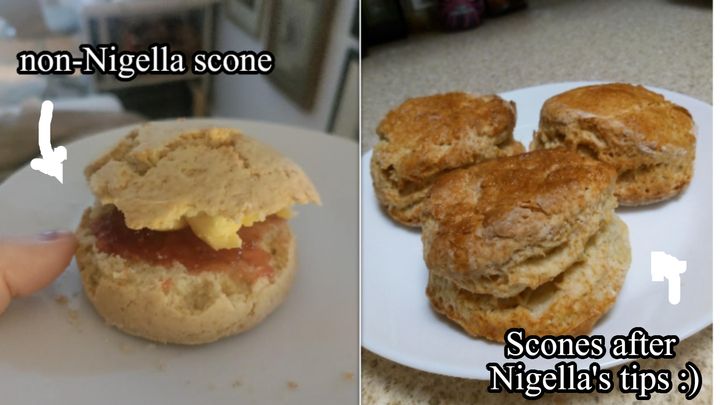
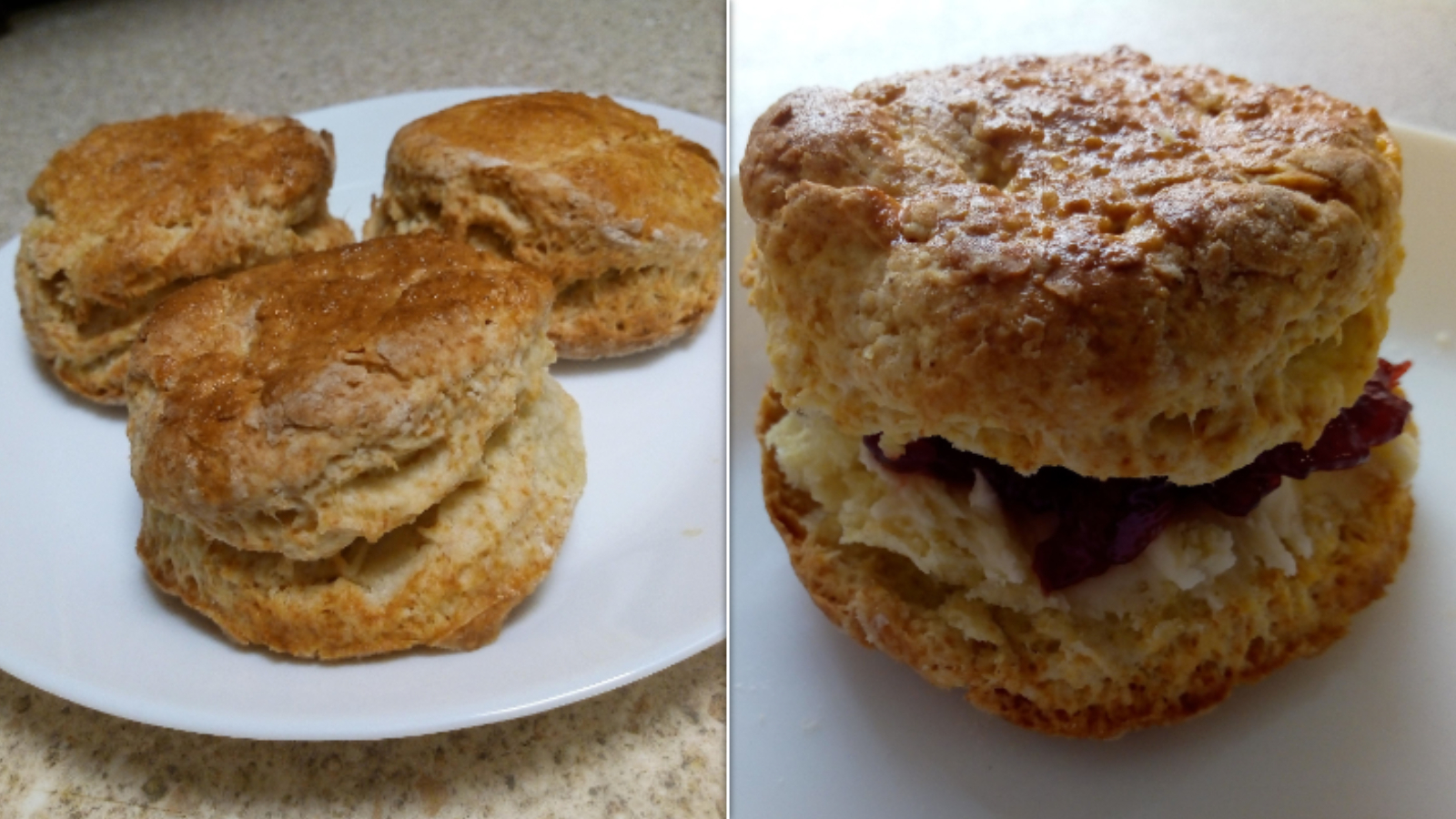
Having tried it, I’ve been amazed at what a difference they’ve made; they’re more tender, fluffier, taller, and more delicious than I’ve ever cooked prior.

A pitiful rubbery puck of a scone from the writer before Nigella's advice on the left: layered, golden, taller scones on thr right following the chef's tips

Amy Glover / HuffPost UK

A pitiful rubbery puck of a scone from the writer before Nigella’s advice on the left: layered, golden, taller scones on thr right following the chef’s tips

What are Nigella’s secrets to the best scones?

The TV presenter and chef adds as much cream of tartar as she does bicarbonate of soda to her scone mix.

This, combined with the acidity of the buttermilk, leads to a steep, rapid rise ― key for fluffy and tender scones.

Additionally, most people who have tried making scones will tell you that it’s very hard to keep butter cold enough to do the job.

Like puff pastry, the fat needs to be kept as solid as possible during mixing to create flaky pockets of delicious dough.

Nigella’s suggestion is easy and elegant ― she mixes two parts butter to one part vegetable shortening, which is solid at room temperature.

She “chops” the butter before adding it to the flour, too, ensuring the warmth of your fingers has less time to melt the butter when rubbing it in.

All of those changes turned my previously hockey puck-like, rubbery creations into proud, tall, tender delights.

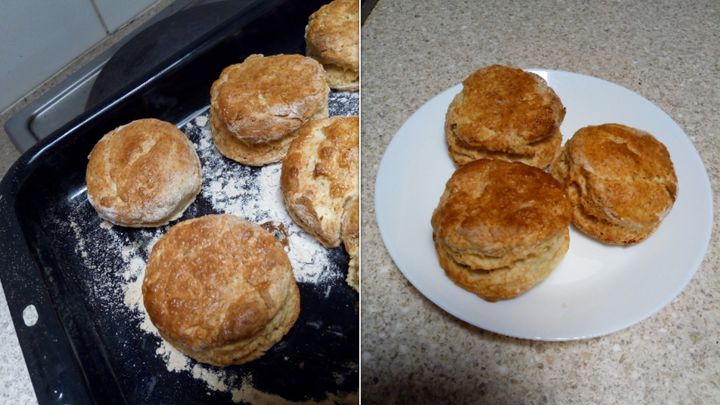
The writer's scones in a baking tray on the left; on a plate on the right

Amy Glover / HuffPost UK

The writer’s scones in a baking tray on the left; on a plate on the right

Can I sub out these ingredients if I don’t have them?

I’ve been surprised by how hard buttermilk can be to find in the UK, but luckily, you can make your own by simply adding a little lemon juice to regular milk and letting it sit for up to 10 minutes.

Don’t be tempted to replace this part ― it’s key to the scone’s fluffiness.

If you don’t have vegetable shortening, Nigella’s team says lard is the next-best substitute.

But again, the chef adds the product for a reason; “Vegetable shortening gives the scones and also pastry a flaky texture which butter cannot replicate,” her site reads.

Having tried her adjustments, I regret to inform you that she’s completely right.

Share Button

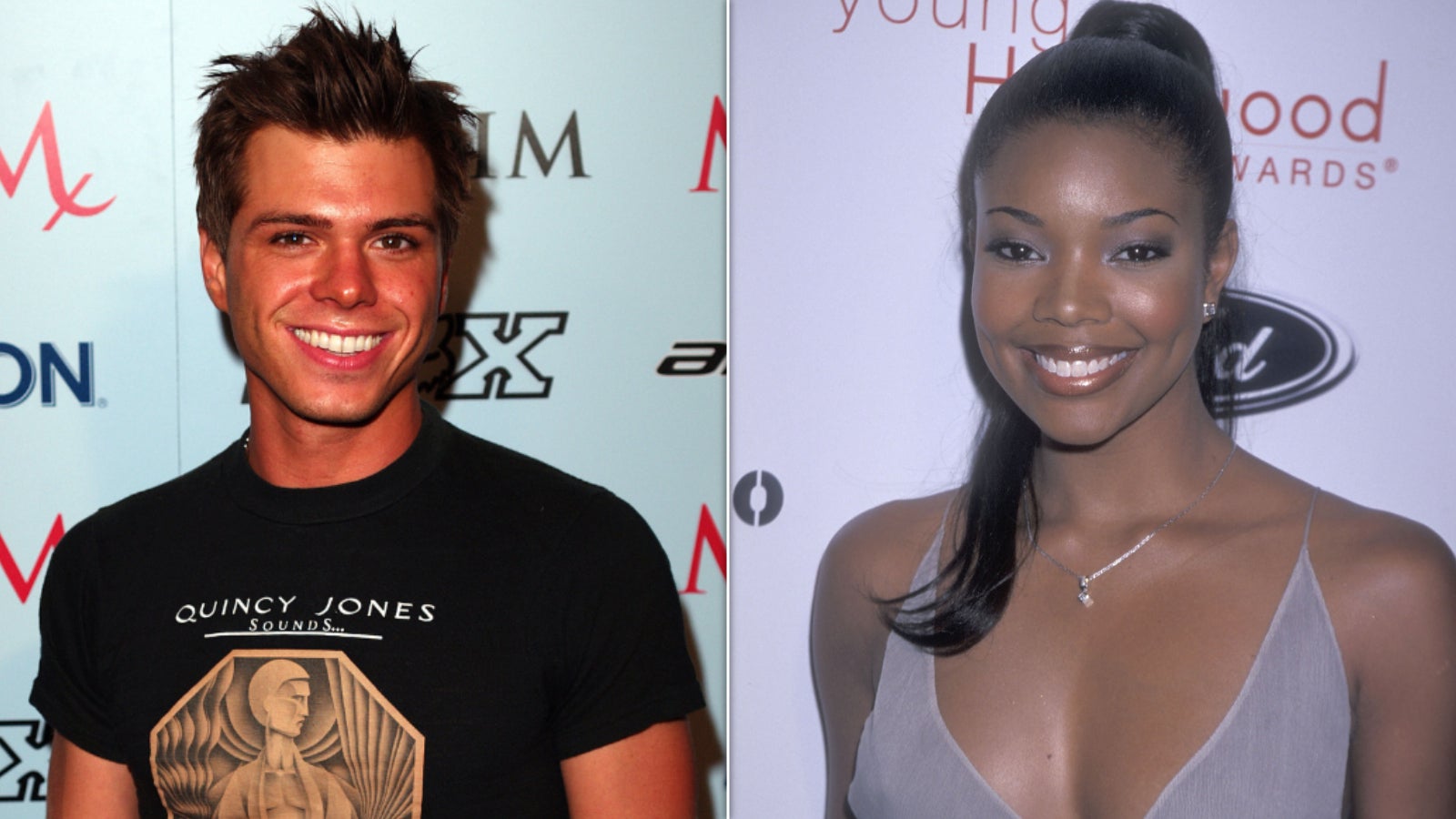
Matthew Lawrence Says He Got In Trouble On Set For Dismissing Gabrielle Union’s 1 Request

Judgment day arrived a bit ahead of schedule for Matthew Lawrence, when he failed to meet one of his co-star’s work standards.

During a candid moment on Monday’s episode of the podcast Magical Rewind, hosted by Matthew’s Boy Meets World co-star Will Friedle and actor Sabrina Bryan, the trio dived into behind-the-scenes of the ’90s TV Movie H-E Double Hockey Sticks.

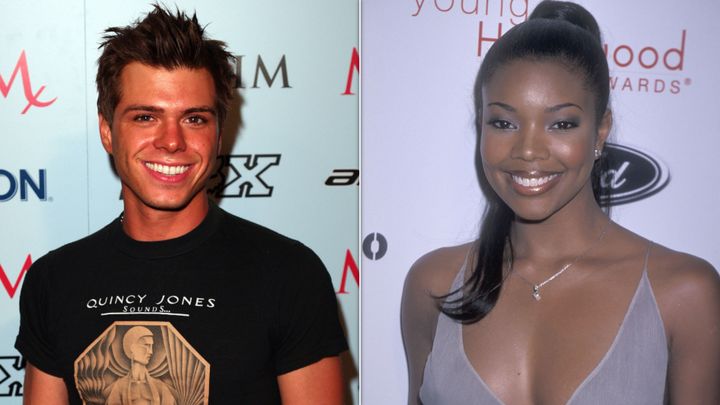
The film, which centred around Will’s devilish character, who was sent to Earth to capture the soul of a young hockey player (played by Matthew), also starred a young Gabrielle Union.

During the filming process, Gabrielle allegedly wanted to rehearse lines with Matthew, but the actor declined her offer.

“There was this one moment where — and, again, I’m oblivious, I had no idea — she wanted to rehearse,” he recalled. “And I was like, ‘No, I’m good’.”

Actors Matthew Lawrence and Gabrielle Union.

Getty Images

His rationale? “Running lines” took “all the freshness” out of the performance.

Gabrielle allegedly wasn’t thrilled with his decision and took her grievances to a higher power.

“And she got angry and went and reported me to the director and the studio,” Matthew said. “The only time in my entire career, because usually I’m, like, the advocate, and I’m fighting for kids and, like, you know, women’s rights.

“This is the only time in my life when I was called into the office for something I did on set. And I had no clue.”

Matthew confessed that this was his only “run-in” with another actor – a moment that he said left him “embarrassed”.

At the time, he said he wasn’t familiar with Gabrielle’s work, but recounted that people on set knew that she was going to blow up and become a big star.

The same year as the film’s debut, she went on to star in 10 Things I Hate About You, and She’s All That, and the following year had appeared in the cult classic Bring It On as well as Love & Basketball.

Share Button