Lily Allen Claims She’s ‘Not In A Great Place’ And ‘Not Eating’ In Frank Mental Health Discussion

Lily Allen has disclosed that she’s been “not really in a great place mentally” for around three years.

The chart-topping singer opened up about her mental health struggles during the latest edition of her BBC Sounds podcast Miss Me?, which she co-hosts with her friend Miquita Oliver.

“I’ve been going through a tough time over the last few months and my eating has become an issue,” she explained.

“My therapist and I talk about it and she says ‘How long has this been going on?’. And I said, ‘Well, about three years, really’. And she’s like, ‘OK, why haven’t you mentioned it before?’. And it’s not because I’m lying about it. It’s just because it doesn’t seem to be at the top of the list of important things that I need to talk about. But obviously it is.”

Lily said that her ADHD, with which she was diagnosed fairly recently, means she isn’t always good at “talking about the bigger picture” or “linking things”.

“My body and my brain are two very separate things to me. I know a lot of people feel those two things are very connected to each other, but for me it’s very different,” she said, as reported by the Daily Mail.

“I spend a lot of time in my head, and not a lot of time thinking about my body.”

She added: “I’m really not in a great place mentally at the moment, and I’m not eating. I’m not hungry. I obviously am hungry, but my body and brain are so disconnected from each other [that] the messages of hunger are not going through my body to my brain.

“I’m not avoiding food, I’m just not thinking about it because I’m so in my head. My body’s, like, a few steps behind me.”

Last year, the Brit Award winner admitted to the Off Menu podcast that she often “forgets” to eat.

“I love food. I love eating, but I’m just not very good at remembering to do things,” she claimed. “I get up in the morning and I’m looking after kids and I just forget.”

Throughout her time in the spotlight, Lily has spoken candidly her mental health and issues with her body image, claiming in 2010 that she had body dysmorphic disorder.

Listen to the latest episode of Lily Allen’s podcast Miss Me? here.

Help and support:

Share Button

‘A Reverse Robin Hood’: Kemi Badenoch Accused Of Supporting ‘Massive Tax Cuts For The Rich’

Kemi Badenoch has been criticised after saying a flat rate of income tax for everyone in the country is an “attractive idea”.

Labour accused the Tory leader of being “a reverse Robin Hood” because the policy would mean “massive” tax cuts for the rich.

They also compared her to former Tory prime minister Liz Truss, who was forced from office after her plans for huge unfunded tax cuts caused economic chaos.

Under the current tax system, workers pay higher rates of income tax as their salaries increase.

Appearing at an event on Monday, Badenoch was asked is she supported replacing that with a flat tax rate, with everyone paying the same regardless of their income.

She replied: “It’s very attractive but if we’re going to get to that sort of scenario there’s a lot of work we will need to do first.

“We cannot afford flat taxes where we are now. We need to make sure we rewire our economy so that we can lighten the burden of tax and of regulation on individuals, and on those businesses that are just starting out in particular.”

A Labour spokesperson said: “Kemi’s reverse Robin Hood would mean massive tax cuts for the rich, paid for by everyone else.

“While Labour protects working people with no tax rises on their payslips, the Tories are bringing out the ghost of Christmas past with these Truss-style tax cuts for millionaires.

“They haven’t listened and they haven’t learnt.”

At the same event on Monday, Badenoch also suggested that the UK’s regulatory standards were too high – but that she supported them.

She said: “Where we continue regulating ourselves at very high standards – which we should do – but in a way that other countries don’t follow, which puts us at a disadvantage, which means that there’s no level of playing field if you’re a farmer, for example, and many others. And we need to start thinking differently.”

A senior Labour source told HuffPost UK: “I don’t get how anyone could follow each clause of that sentence and have a clue what she is suggesting.”

Share Button

‘That’s A Sickness’: Donald Trump Criticizes Fans Of Shooting Suspect Luigi Mangione

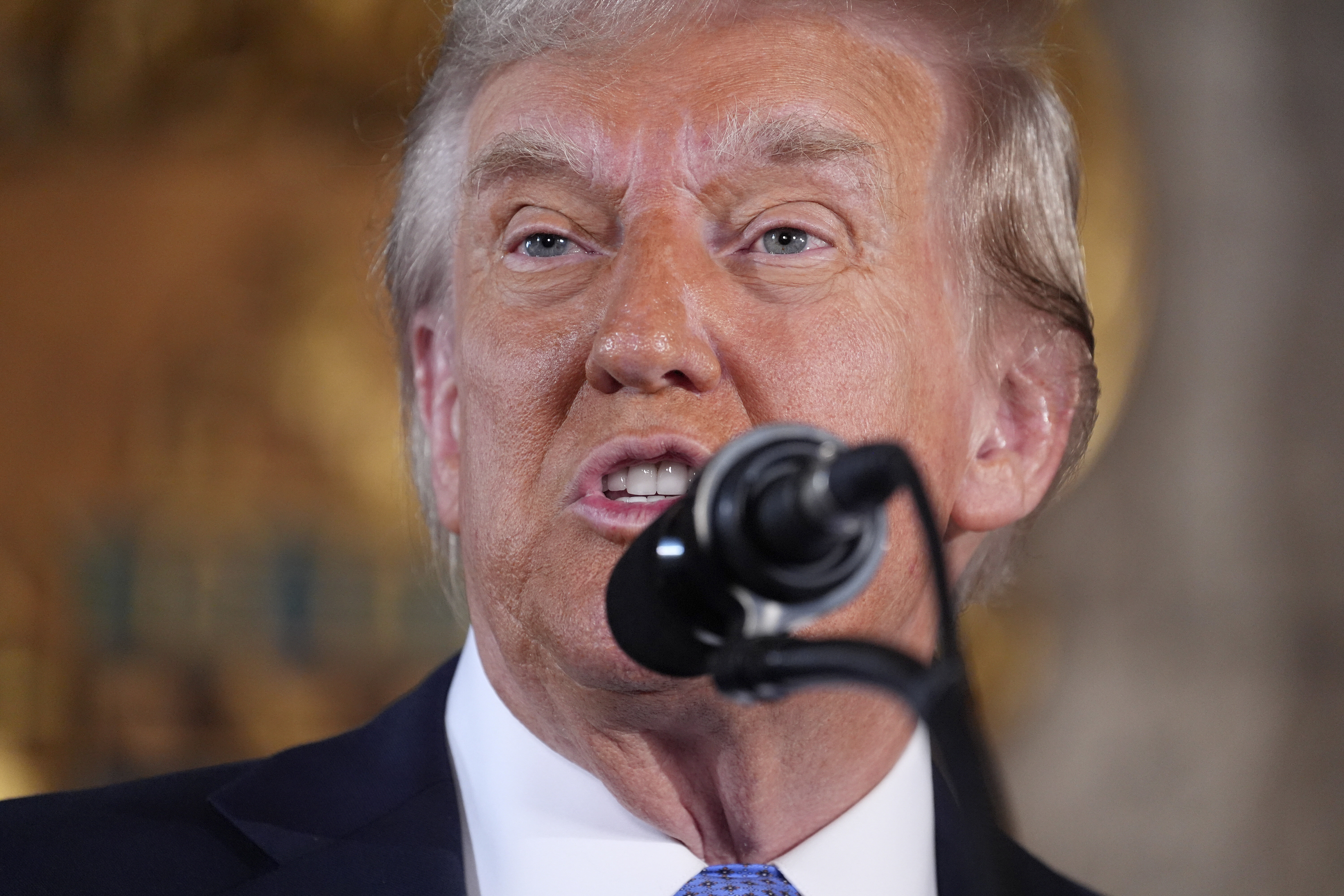
President-elect Donald Trump called the glorification of shooting suspect Luigi Mangione a “sickness,” criticising people who have celebrated the killing of UnitedHealthcare CEO Brian Thompson in New York earlier this month.

“I think it’s really terrible that some people seem to admire him, like him. And I was happy to see that it wasn’t specific to this gentleman that was killed. It’s just an overall sickness as opposed to a specific sickness,” Trump said on Monday during a wide-ranging press conference in Florida.

“It was cold-blooded, just a cold-blooded, horrible killing,” he went on. “And how people can like this guy is — that’s a sickness, actually. That’s really very bad. The way it was done. It was so bad. Right in the back. Very bad.”

Trump also suggested that some of the gleeful online posts about Thompson’s death could be fake, adding that “it’s hard to believe that that could even be thought of, but it seems there’s a certain appetite for him. I don’t get it.”

Mangione, 26, has been charged with murder in Thompson’s killing. He was arrested in Pennsylvania last week and remains in custody there. Police said his fingerprints match prints that investigators found on a water bottle and a granola bar wrapper near the scene of the shooting in Manhattan.

Mangione described his anger toward corporate America in a “manifesto” published last week. Words etched on shell casings at the scene ― “deny,” “defend,” “depose” ― also echoed a phrase commonly used to describe insurer tactics to avoid paying claims.

Some people online have expressed support for Mangione and glee over the death of a top health industry CEO. Others condemned the killing but said the industry deserves the scorn and criticism, due to insurance practices that prioritise profits over people’s lives and well-being.

“All of that pain that people have experienced is being concentrated on this event,” Representative Alexandria Ocasio-Cortez told reporters last week. “It’s really important that we take a step back, this is not to comment and this is not to say that an act of violence is justified, but I think for anyone who is confused or shocked or appalled, they need to understand that people interpret and feel and experience denied claims as an act of violence against them.”

Share Button

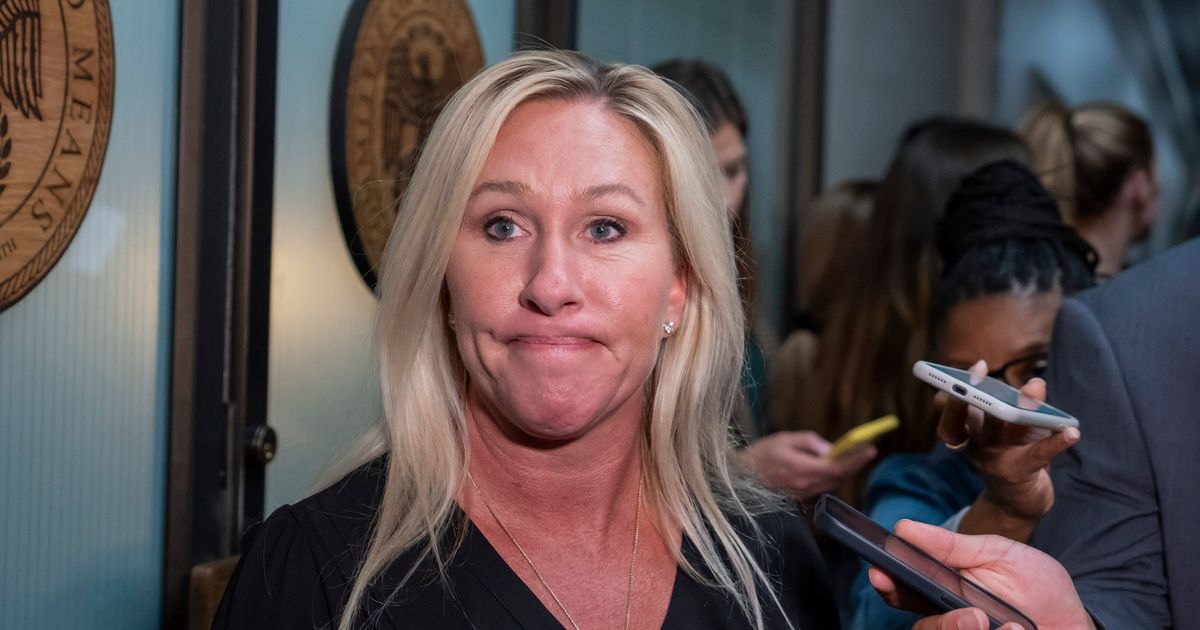
Marjorie Taylor Greene Slammed For Saying Vaccines Cause Autism

The congresswoman declared on social media that she believes in the debunked idea that vaccines cause autism, a claim that has been researched again and again and found to be baseless.

“I fully believe vaccines cause Autism,” Greene wrote on X, formerly Twitter. ”It’s another example of crimes against humanity. And innocent babies, children, and their families are the victims.”

Greene’s post quickly received a community note pointing out that “the scientific literature on this is so extensive, that claiming otherwise can only be explained through sheer ignorance, or some sort of nefarious political purpose.”

The note included links to many, many sources explaining the issue in more detail.

Greene’s post got quite a bit of attention, and a great deal of mockery.

Share Button

Mother behind Martha’s Rule shares scheme’s early success

Merope Mills began her campaign after an inquest found a change of hospital care plan could have saved her daughter’s life.

Share Button

The psychological implications of Big Brother’s gaze

A new psychological study has shown that when people know they are under surveillance it generates an automatic response of heightened awareness of being watched, with implications for public mental health.

In a paper published in the journal Neuroscience of Consciousness psychology researchers from the University of Technology Sydney (UTS) worked with 54 participants to examine the effects of surveillance on an essential function of human sensory perception — the ability to detect another person’s gaze.

Lead author, Associate Professor of neuroscience and behaviour Kiley Seymour, said previous research has established the effects on conscious behaviour when people know they are being watched, but the new study provided the first direct evidence that being watched also has an involuntary response.

“We know CCTV changes our behaviour, and that’s the main driver for retailers and others wanting to deploy such technology to prevent unwanted behaviour,” Associate Professor Seymour said.

“However, we show it’s not only overt behaviour that changes — our brain changes the way it processes information.

“We found direct evidence that being conspicuously monitored via CCTV markedly impacts a hardwired and involuntary function of human sensory perception — the ability to consciously detect a face.

“It’s a mechanism that evolved for us to detect other agents and potential threats in our environment, such as predators and other humans, and it seems to be enhanced when we’re being watched on CCTV.

“Our surveilled participants became hyper aware of face stimuli almost a second faster than the control group. This perceptual enhancement also occurred without participants realising it.”

Associate Professor Seymour said that given the increasing level of surveillance in society and the ongoing debates around privacy reform, the study’s findings suggested the need for closer examination of the effects of surveillance on mental processes and on public health more broadly.

“We had a surprising yet unsettling finding that despite participants reporting little concern or preoccupation with being monitored, its effects on basic social processing were marked, highly significant and imperceptible to the participants.

“The ability to rapidly detect faces is of critical importance to human social interactions. Information conveyed in faces, such as gaze direction, enables us to construct models of other people’s minds and to use this information to predict behaviour.

“We see hyper-sensitivity to eye gaze in mental health conditions like psychosis and social anxiety disorder where individuals hold irrational beliefs or preoccupations with the idea of being watched.

“Whilst this investigation was specifically focussed on unconscious social processes, future investigations should explore effects on the limbic system more broadly, which would have more general implications for public mental health and the importance of privacy.”

Share Button

Microchips capable of detecting and diagnosing diseases

In a world grappling with a multitude of health threats — ranging from fast-spreading viruses to chronic diseases and drug-resistant bacteria — the need for quick, reliable, and easy-to-use home diagnostic tests has never been greater. Imagine a future where these tests can be done anywhere, by anyone, using a device as small and portable as your smartwatch. To do that, you need microchips capable of detecting miniscule concentrations of viruses or bacteria in the air.

Now, new research from NYU Tandon faculty including Professor of Electrical and Computer Engineering Davood Shahrjerdi; Herman F. Mark Professor in Chemical and Biomolecular Engineering Elisa Riedo; and Giuseppe de Peppo, Industry Associate Professor in Chemical and Biomolecular Engineering and who was previously at Mirimus, shows it’s possible to develop and build microchips that can not only identify multiple diseases from a single cough or air sample, but can also be produced at scale.

“This study opens new horizons in the field of biosensing. Microchips, the backbone of smartphones, computers, and other smart devices, have transformed the way people communicate, entertain, and work. Similarly, today, our technology will allow microchips to revolutionize healthcare, from medical diagnostics, to environmental health” says Riedo,

“The innovative technology demonstrated in this article uses field-effect transistors (FETs) — miniature electronic sensors that directly detect biological markers and convert them into digital signals — offering an alternative to traditional color-based chemical diagnostic tests like home pregnancy tests,” said Shahrjerdi. “This advanced approach enables faster results, testing for multiple diseases simultaneously, and immediate data transmission to healthcare providers” says Sharjerdi, who is also the Director of the NYU Nanofabrication Cleanroom, a state-of-the-art facility where some of the chips used in this study were fabricated. Riedo and Shahrjerdi are also the co-directors of the NYU NanoBioX initiative.

Field-effect transistors, a staple of modern electronics, are emerging as powerful tools in this quest for diagnostic instruments. These tiny devices can be adapted to function as biosensors, detecting specific pathogens or biomarkers in real time, without the need for chemical labels or lengthy lab procedures. By converting biological interactions into measurable electrical signals, FET-based biosensors offer a rapid and versatile platform for diagnostics.

Recent advancements have pushed the detection capabilities of FET biosensors to incredibly small levels — down to femtomolar concentrations, or one quadrillionth of a mole — by incorporating nanoscale materials such as nanowires, indium oxide, and graphene. Yet, despite their potential, FET-based sensors still face a significant challenge: they struggle to detect multiple pathogens or biomarkers simultaneously on the same chip. Current methods for customizing these sensors, such as drop-casting bioreceptors like antibodies onto the FET’s surface, lack the precision and scalability required for more complex diagnostic tasks.

To address this, these researchers are exploring new ways to modify FET surfaces, allowing each transistor on a chip to be tailored to detect a different biomarker. This would enable parallel detection of multiple pathogens.

Enter thermal scanning probe lithography (tSPL), a breakthrough technology that may hold the key to overcoming these barriers. This technique allows for the precise chemical patterning of a polymer-coated chip, enabling the functionalization of individual FETs with different bioreceptors, such as antibodies or aptamers, at resolutions as fine as 20 nanometers. This is on par with the tiny size of transistors in today’s advanced semiconductor chips. By allowing for highly selective modification of each transistor, this method opens the door to the development of FET-based sensors that can detect a wide variety of pathogens on a single chip, with unparalleled sensitivity.

Riedo, who was instrumental in the development and proliferation of tSPL technology, sees its use here to be further evidence of the groundbreaking way this nanofabrication technique can be used in practical applications. “tSPL, now a commercially available lithographic technology, has been key to functionalize each FET with different bio-receptors in order to achieve multiplexing,” she says.

In tests, FET sensors functionalized using tSPL have shown remarkable performance, detecting as few as 3 attomolar (aM) concentrations of SARS-CoV-2 spike proteins and as little as 10 live virus particles per milliliter, while effectively distinguishing between different types of viruses, including influenza A. The ability to reliably detect such minute quantities of pathogens with high specificity is a critical step toward creating portable diagnostic devices that could one day be used in a variety of settings, from hospitals to homes.

The study, now published by the Royal Society of Chemistry in Nanoscale, was supported by Mirimus, a Brooklyn-based biotechnology company, and LendLease, a multinational construction and real estate company based in Australia. They are working with the NYU Tandon team to develop illness-detecting wearables and home devices, respectively.

“This research shows off the power of the collaboration between industry and academia, and how it can change the face of modern medicine,” says Prem Premsrirut, President and CEO of Mirimus. “NYU Tandon’s researchers are producing work that will play a large role in the future of disease detection.”

“Companies such as Lendlease and other developers involved in urban regeneration are searching for innovative solutions like this to sense biological threats in buildings.” says Alberto Sangiovanni Vincentelli of UC Berkeley, a collaborator on the Project. “Biodefense measures like this will be a new infrastructural layer for the buildings of the future”

As semiconductor manufacturing continues to advance, integrating billions of nanoscale FETs onto microchips, the potential for using these chips in biosensing applications is becoming increasingly feasible. A universal, scalable method for functionalizing FET surfaces at nanoscale precision would enable the creation of sophisticated diagnostic tools, capable of detecting multiple diseases in real time, with the kind of speed and accuracy that could transform modern medicine.


Share Button

Corals depend on near neighbors to reproduce

A new study reveals corals must be within only a few metres of each other to successfully reproduce, leaving them vulnerable in a warming world.

The international research, led by The University of Queensland’s Professor Peter Mumby, measured the success of a natural spawning event in March this year.

“In what came as a surprise, we saw that corals needed to be within 10 metres of one another, and preferably closer than that for fertilisation to take place,” Professor Mumby said.

“We knew corals couldn’t be too far apart, but we found they need to be closer than we’d expected.

“Climate change impacts like bleaching are killing and reducing the density of corals, so we’re concerned that individuals may end up too far apart to reproduce successfully.”

To quantify reproduction success, the team placed containers above 26 coral colonies on a reef in Palau, Micronesia during a time when the mostly hermaphroditic corals released eggs and sperm.

“The containers captured some of each corals’ eggs and drifted to the surface where they followed the tide,” Professor Mumby said.

“Although the eggs could not escape, sperm could enter the container and fertilise the eggs.

“After an hour of drifting, the proportion of fertilised eggs was noted for each type of coral along with the distance to similar established corals.”

Fertilisation averaged 30% when corals were very close, but it declined to less than 10% at a separation of 10 metres and was virtually zero by 20 metres.

Co-author Dr Christopher Doropoulos of the CSIRO, Australia’s national science agency, said coral reproduction was fundamental to population resilience and evolution.

“In the future we may need to help corals continue this key part of their lives,” Dr Doropoulos said.

“Understanding the importance of local neighbourhoods provides tangible targets for interventions like coral restoration.

“Ideally, the density of corals would be monitored at important locations and restoration carried out to return the density back to the levels required for successful reproduction.”

Professor Mumby has been working on efforts to repair damaged coral reefs.

“Our work over the past 5 years on the Great Barrier Reef through the Reef Restoration and Adaptation Program is also helping to define these critical thresholds to help restoration practitioners set targets for density to help maintain coral populations,” he said.

The study was funded by the McCusker Foundation and the Australian Government’s Reef Restoration & Adaptation Program.

The research is published in the Proceedings of the National Academy of Sciences USA (PNAS).

Share Button

One in four babies in England born by Caesarean

Experts link the rise to a growing number of complex pregnancies, where the mother is older or obese.

Share Button

Zelenskyy Calls On World To Be ‘United’ Against Putin As UK Says Russia Is Making ‘Further Gains’ In Ukraine

Volodymyr Zelenskyy has called on the world to be “united and stronger than ever” against Vladimir Putin as the UK said Russia is making “further gains” in Ukraine.

According to the latest intelligence update from the Ministry of Defence, Moscow’s troops are advancing on the “key logistical hub” of Pokrovsk in Donetsk after gaining control of the nearby village of Shevchenko.

In a post on X, the MoD said: “Russia will likely continue to make gains towards Pokrovsk whilst continuing to advance westwards to the south of the town.”

Zelenskyy, the Ukrainian president, revealed that in the last week alone, Russia has used nearly 630 guided aerial bombs, around 550 strike drones, and over 100 missiles against his country.

He said: “I am grateful to the warriors defending Ukraine and to our partners who understand our need to bolster Ukraine’s air defences to save the lives of our people.

“Now, the world must be united and stronger than ever. Only through strength can we together force Russia and its allies to give up terror and achieve a just peace.”

Meanwhile, Zelenskyy has also announced that Ukraine will support humanitarian efforts in Syria following the fall of its former president, Bashar al-Assad.

He said: “For Ukraine, this is important: the calmer the situation in such regions, the more actively the world can help us achieve peace.

“It is precisely for this reason that Moscow tries so hard to ignite more conflicts and wars in various parts of the world, fuelling instability and adding to global challenges.”

The president said a “grain from Ukraine” programme would allow his country to provide Syria with food.

“We call on everyone worldwide to join stabilisation efforts to ensure that the war—ignited over a decade ago in Syria with the involvement of Iran and Russia—can finally come to an end,” he said in a post on X.

Share Button