Much of modern life depends on the coding of information onto means of delivering it. A common method is to encode data in laser light and send it through optic cables. The increasing demand for more information capacity demands that we constantly find better ways of encoding it.
Researchers at Aalto University’s Department of Applied Physics found a new way to create tiny hurricanes of light — known to scientists as vortices — that can carry information. The method is based on manipulating metallic nanoparticles that interact with an electric field. The design method, belonging to a class of geometries known as quasicrystals, was thought up by Doctoral Researcher Kristian Arjas and experimentally realised by Doctoral Researcher Jani Taskinen, both from Professor Päivi Törmä’s Quantum Dynamics group. The discovery represents a fundamental step forward in physics and carries the potential for entirely new ways of transmitting information.
Half order and chaos
A vortex is in this case like a hurricane that occurs in a beam of light, where a calm and dark centre is surrounded by a ring of bright light. Just like the eye of a hurricane is calm due to the winds around it blowing in different directions, the eye of the vortex is dark due to the electric field of bright light pointing to different directions on different sides of the beam.
Previous physics research has connected what kind of vortices can appear with how much symmetry there is in the structure that produces them. For example, if particles in the nanoscale are arranged in squares the produced light has a single vortex; hexagons produce a double vortex and so on. More complex vortices require at least octagonal shapes.
Now Arjas, Taskinen and the team unlocked a method for creating geometric shapes that theoretically support any kind of vortex.
“This research is on the relationship between the symmetry and the rotationality of the vortex, i.e. what kinds of vortices can we generate with what kinds of symmetries. Our quasicrystal design is halfway between order and chaos,” Törmä says.
Good vibrations
In their study, the group manipulated 100,000 metallic nanoparticles, each roughly the size of a hundredth of a single strand of human hair, to create their unique design. The key lay in finding where the particles interacted with the desired electric field the least instead of the most.
‘An electrical field has hotspots of high vibration and spots where it is essentially dead. We introduced particles into the dead spots, which shut down everything else and allowed us to select the field with the most interesting properties for applications,’ Taskinen says.
The discovery opens a wealth of future research in the very active field of topological study of light. It also represents the early steps for a powerful way of transmitting information in domains where light is needed to send encoded information, including telecommunications.
‘We could, for example, send these vortices down optic fibre cables and unpack them at the destination. This would allow us to store our information into a much smaller space and transmit much more information at once. An optimistic guess for how much would be 8 to 16 times the information we can now deliver over optic fibre,’ Arjas says.
Practical applications and scalability of the team’s design are likely to take years of engineering. The Quantum Dynamics group at Aalto, however, have their hands full with research into superconductivity and improving organic LEDs.
The group used the OtaNano research infrastructure for nano-, micro- and quantum technologies in their pioneering study.
The research was published early November in Nature Communications.
Researchers have named two newly discovered freshwater snail species from Brazil after characters from The Lord of the Rings.
Described in the open-access journal Zoosystematics and Evolution, Idiopyrgus eowynae and Idiopyrgus meriadoci were named in honour of Éowyn and Meriadoc Brandybuck from J.R.R. Tolkien’s iconic series.
In their research paper, the authors explain the name Idiopyrgus eowynae, stating, “Éowyn exemplifies courage, resilience, and resistance against darkness, both internal and external, standing against Gríma Wormtongue and the Witch-king of Angmar.”
Regarding Idiopyrgus meriadoci, they write, “Besides standing with Éowyn against the Witch-king in the Battle of the Pelennor Fields, Merry is also an example of the fight for nature conservation in Middle-earth, pushing the Ents into action and ultimately ending Saruman’s threat to Fangorn Forest.”
The discovered species are troglobitic and were found in a single limestone cave in the Serra do Ramalho karst area of Bahia state, northeastern Brazil. The gastropods belong to the family Tomichiidae, a group previously known for inhabiting surface freshwater environments but now shown to have adapted to subterranean ecosystems.
Both snails have unique periostracal hairs — thorn-like structures — on their shells, a feature uncommon among Brazilian freshwater snails. Their cave-specific adaptations include reduced pigmentation, fragile shells, and small size.
The Gruna do Pedro Cassiano cave, where the snails were discovered, is a fragile ecosystem threatened by water extraction, deforestation, and climate change. Due to the species’ limited habitat and environmental threats to their subterranean ecosystem, the authors recommend their classification as vulnerable. The findings highlight the importance of protecting Brazil’s subterranean biodiversity and raise concerns about the impact of human activities on these delicate ecosystems.
On his choice of Tolkien-inspired names for the new species, lead author Dr Rodrigo B. Salvador of the Finnish Museum of Natural History said, “I tend to use lots of pop culture references in my species names — from books, comics, Dungeons & Dragons, and video games. If we think about it, there is a long-standing tradition in taxonomy of using names from mythology and literature to name species.
“Granted, in the old days, those names mostly came from Greek and Roman myths and Shakespeare. Today, we have newer mythologies and literature classics, so in a way, we’re just continuing that tradition.”
Currently, the world is suffering from environmental problems caused by plastic waste. The KAIST research team has succeeded in producing a microbial-based plastic that is biodegradable and can replace existing PET bottles, making it a hot topic.
The university announced on the 7th of November that the research team of Distinguished Professor Sang Yup Lee of the Department of Chemical and Biomolecular Engineering has succeeded in developing a microbial strain that efficiently produces pseudoaromatic polyester monomer to replace polyethylene terephthalate (PET) using systems metabolic engineering.
Pseudoaromatic dicarboxylic acids have better physical properties and higher biodegradability than aromatic polyester (PET) when synthesized as polymers, and are attracting attention as an eco-friendly monomer* that can be synthesized into polymers. The production of pseudoaromatic dicarboxylic acids through chemical methods has the problems of low yield and selectivity, complex reaction conditions, and the generation of hazardous waste.
To solve this problem, Professor Sang Yup Lee’s research team used metabolic engineering to develop a microbial strain that efficiently produces five types of pseudoaromatic dicarboxylic acids, including 2-pyrone-4,6-dicarboxylic acid and four types of pyridine dicarboxylic acids (2,3-, 2,4-, 2,5-, 2,6-pyridine dicarboxylic acids), in Corynebacterium, a bacterium mainly used for amino acid production.
The research team used metabolic engineering techniques to build a platform microbial strain that enhances the metabolic flow of protocatechuic acid, which is used as a precursor for several pseudoaromatic dicarboxylic acids, and prevents the loss of precursors.
Based on this, the genetic manipulation target was discovered through transcriptome analysis, producing 76.17 g/L of 2-pyrone-4,6-dicarboxylic acid, and by newly discovering and constructing three types of pyridine dicarboxylic acid production metabolic pathways, successfully producing 2.79 g/L of 2,3-pyridine dicarboxylic acid, 0.49 g/L of 2,4-pyridine dicarboxylic acid, and 1.42 g/L of 2,5-pyridine dicarboxylic acid.
In addition, the research team confirmed the production of 15.01 g/L through the construction and reinforcement of the 2,6-pyridine dicarboxylic acid biosynthesis pathway, successfully producing a total of five similar aromatic dicarboxylic acids with high efficiency.
In conclusion, the team succeeded in producing 2,4-, 2,5-, and 2,6-pyridine dicarboxylic acids at the world’s highest concentration. In particular, 2,4-, 2,5-pyridine dicarboxylic acid achieved production on the scale of g/L, which was previously produced in extremely small amounts (mg/L).
Based on this study, it is expected that it will be applied to various polyester production industrial processes, and it is also expected that it will be actively utilized in research on the production of similar aromatic polyesters.
Professor Sang Yup Lee, the corresponding author, said, “The significance lies in the fact that we have developed an eco-friendly technology that efficiently produces similar aromatic polyester monomers based on microorganisms,” and “This study will help the microorganism-based bio-monomer industry replace the petrochemical-based chemical industry in the future.”
The results of this study were published in the international academic journal, the Proceedings of the National Academy of Sciences of United States of America (PNAS) on October 30th.
This study was conducted with the support of the Development of Next-generation Biorefinery Platform Technologies for Leading Bio-based Chemicals Industry Project and the Development of Platform Technologies of Microbial Cell Factories for the Next-generation Biorefineries Project (Project leader: Professor Sang Yup Lee) from the National Research Foundation supported by the Ministry of Science and Technology and ICT of Korea.
This year, negotiators from nearly 200 countries are looking to hash out a climate finance deal in an effort to fund poorer countries who are still struggling to go green.
But, almost three decades since the climate summit began, scientists are still sounding alarm and pleading for more action from governments while previous agreements hang in the balance.
Brits do not have high expectations for COP29
According to the latest YouGov poll, just 9% of Brits are feeling optimistic, saying it’s either very likely (1%) or fairly likely (8%) that COP will result in significant action to tackle climate change.
A whopping 73% have a more pessimistic view, saying it’s either fairly (44%) or very unlikely (29%) to result in anything noteworthy.
Advertisement
While 53% of Brits think there’s a chance summits like COP could offer significant progress on tackling the threat to the environment, they also said there are plenty of other methods which might be more important.
For instance, 78% think the development of cleaner and more environmentally friendly technologies is one of the most important ways to tackle climate change, and 71% think encouraging companies and corporations to promote more environmentally friendly practices is key.
A further 68% believe trade deals which encourage countries to cut carbon emissions are essential, while 59% think more UN action of the environment would have a significant impact.
More than half (59%) also believe pressure from the public for governments to act is essential for the fight against climate change.
Advertisement
Temperatures continue to soar, despite years of warnings
There’s no doubt that some COP summits over the years have achieved significant deals between countries at their close.
The meetings have established an annual platform for climate change discussion, secured international promises to reduce greenhouse gas emissions, created the Paris agreement, pledged to move away from coal and vowed to help developing countries which are especially vulnerable to climate change.
But, as the specialists warns that 2024 is set to be the warmest year on record, it’s hard not to escape the sense of hopelessness that comes with the 29th COP talks.
That’s because the world has been too slow to reduce carbon emissions.
In fact, some scientists believe the path to limit global warming to 1.5C has already disappeared.
YouGov also found 17% of Brits think it is too late to avoid the worst effects of climate change – up six percentage points on 2019 – while 57% of those surveyed think the UK can still avoid the worst effects of climate change, but it would take drastic action.
Advertisement

Meanwhile, climate disasters continue to destroy communities around the world – just last month, Spain was hit with intense flooding leading to more than 200 deaths.
Emergency services remove cars in an area affected by floods in Catarroja, Spain, on Sunday, Nov. 3, 2024.
via Associated Press
Donald Trump’s impact this year
The 2015 Paris agreement was meant to a pivotal moment as almost 200 countries signed the deal to limit global warming to 1.5 degrees Celsius.
But Trump pulled the US out of the agreement when his term began in 2017, even though the country is the second largest emitter in the world.
Joe Biden signed the US back up in 2021, but, now Trump has been re-elected, he is expected to pull the country out once again when his second term starts.
Advertisement
The Republican president-elect has also promised to increase US oil and gas production, even though it is already the largest in the world.
China is currently the world’s largest greenhouse gas polluter, but even the country’s top climate envoy Liu Zhenmin told journalists on Monday that Beijing is “concerned about the United States after the election”.
Liu said: “Everyone’s concerned about he next steps, whether after the US election, US climate policy will or won’t change. But most [COP] colleagues still feel that regardless if a country’s climate policy changes or doesn’t change, international multilateral climate cooperation should continue.”
Keir Starmer’s spokesperson would not be drawn on whether the UK was concerned over Trump’s potential changes to US climate policy on Monday, only saying they were waiting for the new administration to get into power first.
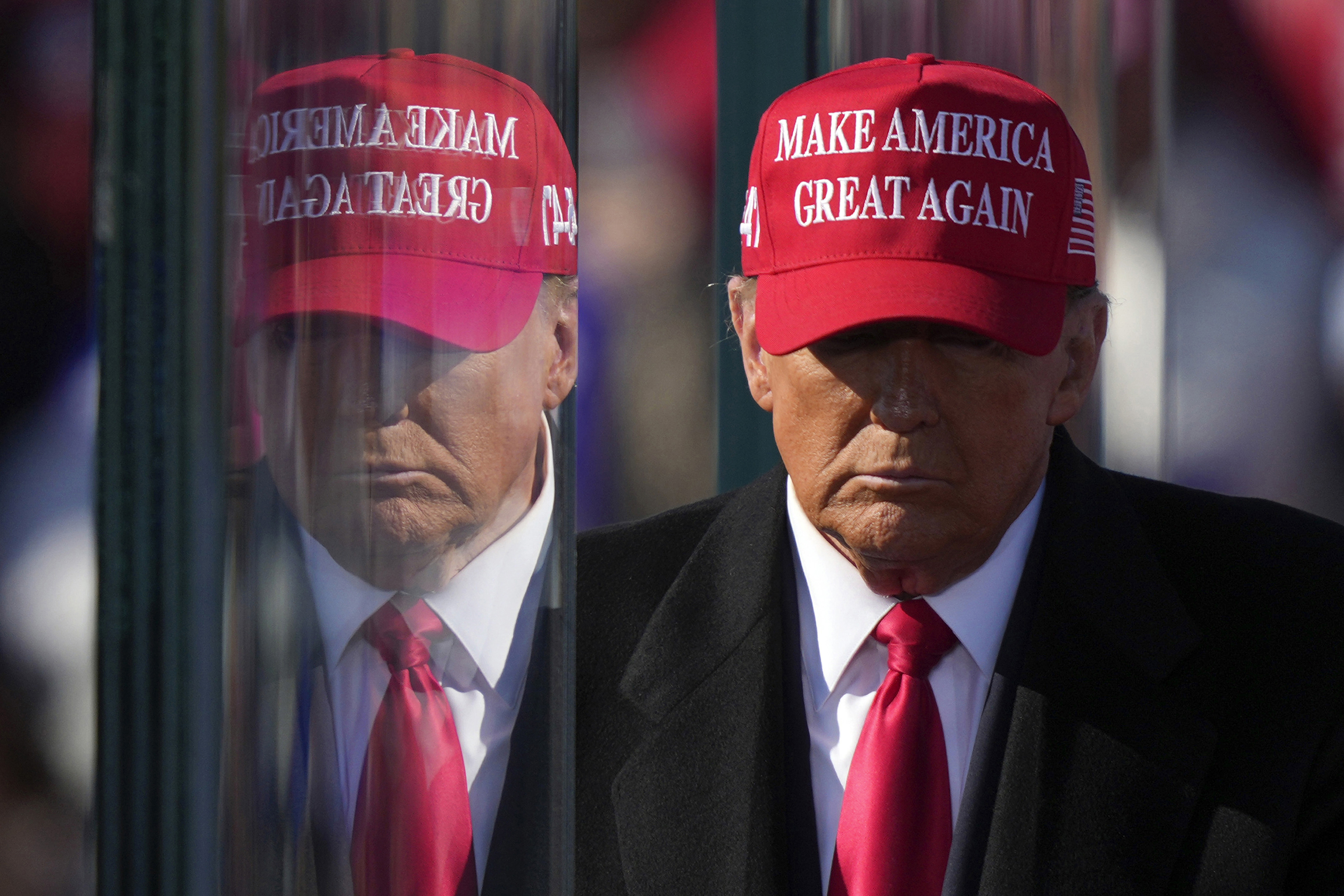
Republican presidential nominee former President Donald Trump is reflected in the bullet proof glass as he finishes speaking at a campaign rally in Lititz, Pa., Nov. 3, 2024.
via Associated Press
Advertisement
Other leaders’ absence
While around 100 world leaders have said they plan to visit COP29 within the first three days of the 11-day conference, there are concerns that too many heads of state might just skip it.
After all, Starmer is one of only two G7 leaders who will be speaking at the summit.
Outgoing US president Biden will not be present, nor will his successor Trump, although an American contingency will still attend the negotiations.
French president Emmanuel Macron will not be there due to tensions with Azerbaijan’s conflict with Armenia, while German chancellor Olaf Scholz will also miss the summit after his ruling coalition fell.
The EU delegation will be a bit thin too and European Commission president Ursula von der Leyen abstained as the EU parliament is in a state of transition.
Despite being very vulnerable to the effects of climate change, Papua New Guinea will not be attending either with the country’s prime minister James Marape saying it was a “total waste of time” with “empty promises and inaction”
Advertisement
Narendra Modi, India’s prime minister, is also unlikely to attend, as is China’s president Xi Jinping.
COP26 president, Sir Alok Sharma, told BBC Radio 4’s Today programme: “I think it is disappointing that we don’t have more world leaders coming to this Cop and, I mean, Keir Starmer is coming, and I think that’s great. It’s showing UK leadership.”
But, he continued: “What also matters is what all of these countries and the delegations actually announce in terms of the pledges, and also, really importantly, what progress has been made in implementing … existing climate commitments.
“Ultimately those detailed negotiations are led by ministers rather than heads of government, so those ministers are obviously coming. Some of them are already here, so we’ll have to see what progress they managed to make.”
Hugh Grant has revealed Quentin Tarantino surprised him when he revealed his favourite film from the British actor’s vast back catalogue.
In a new interview with Letterboxd, the Heretic star recalled a “weird experience” at an event in London, in which a “sweaty person pushed his way through the crowd to me”, only to reveal himself as the Pulp Fiction filmmaker.
“To my enormous surprise, he said, ‘Oh, man, I love Music And Lyrics’,” Hugh continued.
“He said he watched it on a plane, and was so disappointed that the plane landed before the film ended, that he had to quickly go and order it from Blockbuster or something. And I thought, ‘Surely not, not Quentin Tarantino’…?”
Music And Lyrics featured Hugh as a former 80s music icon, who leans on an unlikely source when he’s tasked with writing a new song for a modern-day pop star.
Elsewhere in his Letterboxd interview, Hugh opened up about shooting those musical scenes, admitting: “[The dancing in Music And Lyrics] was hell, because it was freeform, just kind of ‘express yourself’, ‘enjoy the music’, ‘feel it’ like a real rock star, and I’m so not that person, and I really struggled with that.
“I had to have my charming makeup lady in New York bring me little swigs of whisky in a 7Up bottle and a certain amount of lorazepam to really get in the mood for that one.”
In his September debate with Vice President Kamala Harris, Republican presidential nominee Donald Trump was asked if he wanted Ukraine to be victorious in its efforts to fight off Russia’s brutal invasion.
“I want the war to stop,” Trump, now president-elect, replied. “That is a war that is dying to be settled. I will get it settled before I even become president.”
Advertisement
Now, after Trump’s win Tuesday, Ukraine and its allies in the US are preparing for the worst — a complete end to US military aid, forcing the embattled European country to choose between capitulation and limping along — and hoping Trump’s affinity for Russian President Vladimir Putin won’t win out.
What hopes they have appear to rest on the idea that Trump considers himself the consummate dealmaker — and if he wants to have any leverage in trying to broker a peace, he needs to help Ukraine keep the pressure on Russia on the battlefield.
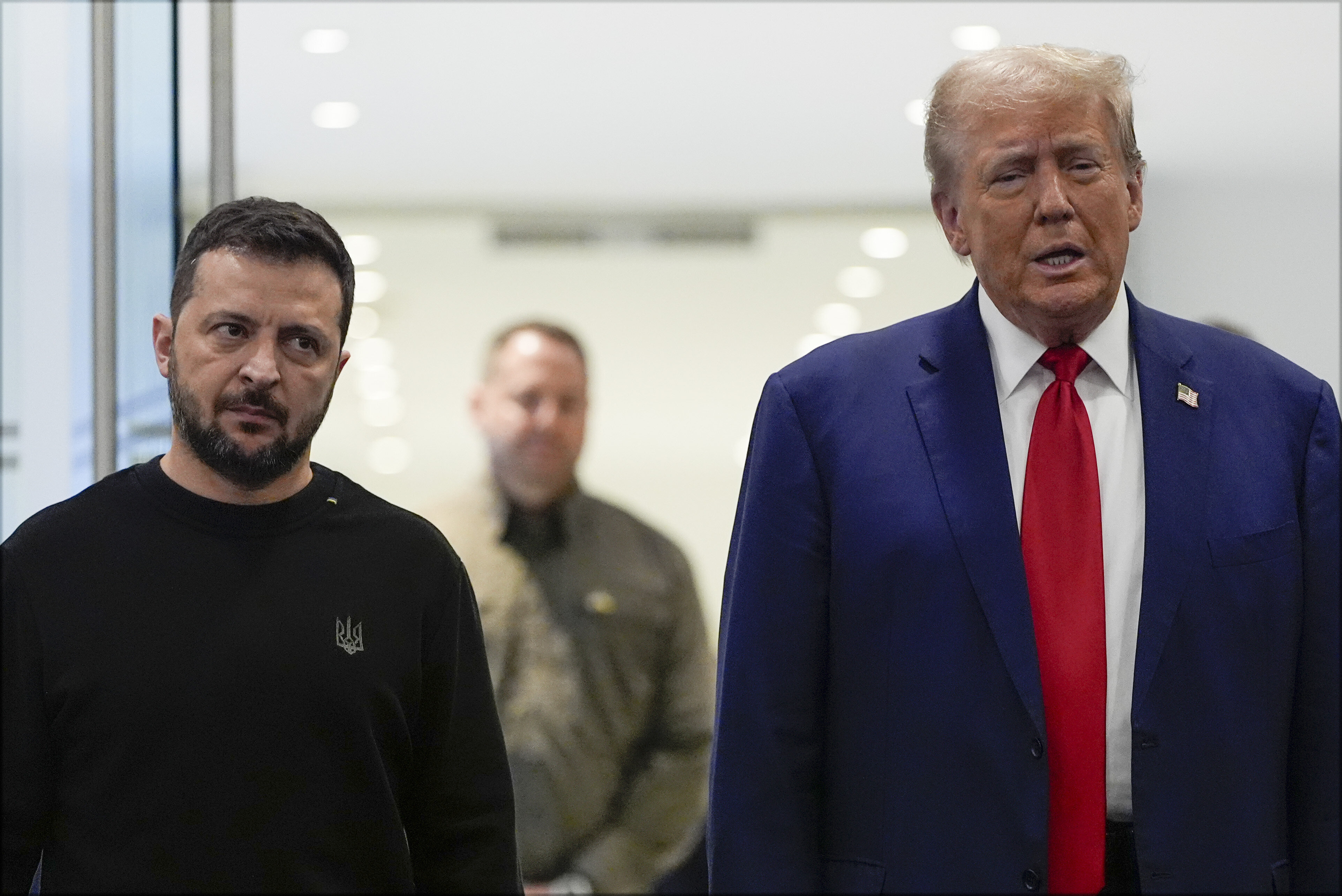
Donald Trump meets with Ukraine’s President Volodymyr Zelenskyy at Trump Tower on Sept. 27 in New York.
via Associated Press
Putin, through his military, has sought to show Ukrainians this week the cost of continuing to resist. On Thursday, waves of armed drones led to an eight hour air alert in in Kyiv, keeping many of its residents huddled in the subway for safety.
Advertisement
In the Black Sea port city of Odesa, Russian drones armed with thermobaric bombs hit residential areas Thursday, local media reported. These bombs contain two stages — an initial explosive that spreads a flammable accelerant, and a second stage that ignites that fuel, drawing the air out of the surrounding area to make a larger explosion. In addition to the blast, these “vacuum bombs” literally suck the air out of the lungs of those nearby.
Stopping these attacks will require more US military aid, on top of the $52.7 billion already committed to Ukraine since the invasion began in February 2022. The Biden administration has been criticised by Ukrainian officials and military experts for providing too little aid to Ukraine, and too slowly, even as Ukraine’s president, Volodymyr Zelenskyy, has asked for new weapons to strike into the interior of Russia.
After the election, the pro-Ukraine advocacy group Razom urged Congress to pass a new aid package in the post-election lame duck session before Trump takes office in January.
Children sit on a floor inside Arsenalna metro station during air alert in Kyiv, Ukraine on Wednesday.
via Associated Press
Advertisement
“The aid package must enable Ukrainians to survive the winter, push Putin’s forces back, and give President-elect Trump the flexibility he needs to act from a position of strength,” Razom said.
“Failure to urgently pass a supplemental package risks undermining President-elect Trump’s position before he assumes office.”
Why would Republicans in Congress agree to fund more weapons for a war Trump has said he would like to end, and has signalled he will end, by threatening to cut off weapons to Ukraine?
Leverage, according to Doug Klain, policy analyst for Razom.
Biden is planning to exhaust the current amount of so-called drawdown authority by the end of the year. Drawdown authority allows the president to declare some US weapons to be surplus, and thus available to be sent to allies abroad. It has been one of the main ways US weaponry has been donated to Ukraine.
Trump would need to go back to Congress to get similar authority if Biden follows through.
That would give Trump a way to show Russia he wasn’t going to just ”[let] Putin do what he wants,” Klain said.
Advertisement
Drawdown authority is discretionary — Trump alone could decide whether to use it or not. Being able to credibly threaten to send Ukraine more weapons without needing congressional approval would bring a recalcitrant Putin to the bargaining table, the argument goes.
A soldier of Ukraine’s National Guard 15th Brigade carries a reconnaissance drone Leleka on a wheat field near the front line in Zaporizhzhia region in Ukraine in July.
via Associated Press
“All that Republicans would be doing by passing a new supplemental during the lame duck session is giving Trump options,” Klain said.
A spokesperson for House Speaker Mike Johnson (Republican, Louisana) told HuffPost that the Republican majority had no interest in taking up a Ukraine supplemental soon. In April, Johnson put his political life on the line by bringing forward a Ukraine funding bill to the House floor, against the wishes of many in his party.
Oleksiy Goncharenko, a Ukrainian parliament member representing Odesa, also held onto the idea of Trump as a wild card.
Advertisement
“Yes, there are a lot of challenges, but also there are possibilities,” Goncharenko told HuffPost. “What’s good about Trump? Good is that he’s unpredictable, not only for us, but for Putin, too.”
Goncharenko said the world was devolving from a rules-based international order to “a deals-based international order.”
“I think that President Trump will try to make a deal with Putin. But the question is, will he succeed or not? And if he will not succeed, how will he react?”
The bedrock assumption underlying much of Trump’s thinking about Ukraine may be that Putin — after losing, by Kyiv’s count, 700,000 soldiers in just under 1,000 days — would be happy simply to consolidate his gains in eastern and southern Ukraine in return for a ceasefire.
Speaker of the House Mike Johnson (R-La.), right, meets with Ukrainian President Volodymyr Zelenskyy at the Capitol July 10 in Washington.
via Associated Press
Advertisement
But Ukrainians believe Putin would use a ceasefire to rearm for another war, and even Russian public officials hint that he would not have achieved his objective if the war were to end now.
“We control only what we do. We can’t control what the Russians do. And the Russians are very clear about what they’ll do,” Klain said.
Another assumption that may be behind Trump’s thinking — that Ukrainians would simply give up and accept Russian control over Ukraine’s territory — is also questionable.
Advertisement
“Ukraine will never, ever accept Ukrainian territories to be Russian. Not Donald Trump, nor anybody else, will make us accept this. But the question is how to reclaim them,” Goncharenko said.
Ukrainian military veterans with amputations rest on bench on Khreshchatyk street in August in Kyiv, Ukraine.
Global Images Ukraine via Getty Images
Goncharenko did say he thought Zelenskyy made “a big mistake” in visiting a Scranton, Pa., artillery factory in September to thank the workers there. Zelenskyy made the visit while in the US to speak to the United Nations and consult with Washington. But the visit included no Republican elected officials, leading top Republicans to slam it as partisan.
The Times did not report what the subject of the call was, but Musk is a key supplier to the Ukrainian military as the CEO of satellite Internet provider Starlink, which has become vital for Ukraine’s battlefield communications. Ukraine’s Donbas region, one of the key fronts in the war, is also rich in rare earth minerals, such as lithium, that are important in the production of electric cars — like those built by Tesla.
Advertisement
Ukrainians could take heart that Trump appears to be considering at least one well-known Ukraine hawk for a top job in his administration. House Armed Services Committee Chair Mike Rogers (Republican, Alaska) is reportedly under consideration to lead the Pentagon.
Children from Gymnasium No. 6 head to a basement set up with classrooms during an air alert in Zaporizhzhia, Ukraine, Sept. 3. The city is building a dozen subterranean schools designed to be radiation- and bomb-proof.
via Associated Press
Goncharenko was philosophical about what was next in the conflict. Given Trump’s stance and Harris’ stout defence of Ukraine aid, the choice of who Ukrainians should root for had been an easy one.
But Goncharenko said he personally was not despairing.
“We are where we are,” Goncharenko said. “We can’t change anything [in the U.S.]. We just can’t. So we just need to watch what will happen and we should do the best we can do.”
The shadow foreign secretary began her interview with the BBC presenter by slamming the Labour Party for previously insulting the president-elect on social media.
Advertisement
However, Kuenssberg quickly reminded Patel how, the day after the January 6 2021 riots on the US Capitol, the Conservative MP said the scenes were “horrendous” at the “heart of democracy”.
At the time, Patel said: ”[Trump’s] comments of being associated with that violence, and he has failed to condemn that violence, and I think that is completely wrong. People have died.”
“There is no justification for it,” the then-home secretary said, adding that there is “clearly more he could have done and should have done.”
So on Sunday, Kuenssberg said: “I just wonder, after the Capitol riots – back in January 6 [2021] those famous days – you yourself said that Donald Trump’s comments directly led to violence and he did very little to de-escalate the situation.
Advertisement
“Do you want to apologise to him for saying that, as you’re urging Labour politicians to do?”
Patel replied: “That was a major situation, I was home secretary at the time and I was obviously working with our US counterparts on security issues.
“No one wants to see violence after elections.”
Kuenssberg asked again if she stood by her comments, but Patel just repeated that it was a “serious situation” at the time.
“You clearly pointed the finger at Donald Trump for stoking that situation,” the presenter reminded her.
“Well, times have moved on,” Patel said, while saying that the riots “undermined democracy”.
“Do you stand by that? You were clearly very worried about democracy,” Kuenssberg pushed.
Patel replied: “We were absolutely worried at the time, I think those comments – in light of what happened – were absolutely right and fair and relevant.”
She then deflected back to Labour, saying: “The previous comments of our chief diplomat [David Lammy] were much more personal, much more personal and undiplomatic to the president-elect of the US.”
Advertisement
The current foreign secretary David Lammy called him “neo-Nazi-sympathising sociopath” during Trump’s first administration – although he has since dismissed those comments as “old news”.
Patel also told the BBC that that she had a “very strong working relationship” with the US in the past, and one that is built on “trust and respect” – and claimed this government will have to work “harder” to earn that.
“Any violence of that scale is unacceptable,” she said. “Within that context, those comments were absolutely right and appropriate.”
Fortune magazine claims that’s because youths aren’t up to the task; they don’t dress appropriately, set reasonable expectations, show up on time, show enough initiative, or kick off their careers with a can-do attitude, the publication reckons.
Advertisement
The message is repeated across multiple media outlets; young people can’t get, or keep, jobs, and they’re all to blame, we’re told.
So I’ll admit I was relieved to speak to the founder of the London Interdisciplinary School, Ed Fidoe, who said the generation’s workplace woes are “not remotely Gen Z’s fault.”
So what’s going on?
There are a “couple of forces” to consider, the founder told HuffPost UK.
Many organisations aren’t hiring right now, and those that are feel that they can “trim their graduate intake” ― even though they “regret it, sort of four years, five years later,” he said.
Then, there’s “a structural problem, a structural challenge, which is… Gen AI, and the impact it has on graduate jobs,” he added.
Advertisement
Ed shared that “something like 80% [of students] get a 2:1 or a first from Russell Group universities” (it was 87.7% in 2022), meaning internships are crucial if you want to stand out from the crowd.
But the sort of “low-level” research jobs typically given to some interns “could be done very, very easily by the technology that exists.”
“We help broker our students to get internships every year, and… each year, it’s become quite a lot harder to place them,” the founder revealed.
Even where Ed does see some cultural misalignments between young people and the workforce, he still doesn’t think it’s helpful to blame Gen Z.
Though the founder says more and more young people are not given enough “challenges” on things as basic as handing coursework in on time, he states that universities’ failure to prepare students for “the real world” is partly down to an increasingly customer-provider relationship increasingly dear uni fees may encourage.
Advertisement
University courses themselves are rigid too, he pointed out ― “it’s built in that there’s no change in the university sector. And then we send people out into the most volatile work market that we’ve seen in probably 50 years.”
Especially post-pandemic, Ed continued, “if we see lots of layoffs, it’s not actually because it’s Gen Z being lazy. It’s just… that’s just what happened.”
So what can Gen Z, unis, or employers do to make the situation better?
Though he doesn’t think Gen Z are entirely culpable for their lot, Ed does think that universities could do a better job of setting fair expectations for students.
He calls unis “a wonderful place to be able to provide lots of support, but [also] lots of challenges,” exposing young people to “new environments and new ideas and new thinking.
“And… if universities are backing away from that, then again, my generation is doing that generation a disservice, because what it means is they are optimising for their own ease… because people are worried about being sued. But as soon as those students leave, they’re going to enter a workplace, and the workplace is on the whole not going to be conforming to that,” Ed explained.
Advertisement
He adds that in the London Interdisciplinary School, “we want people to have difficult conversations. What we don’t want is people to avoid them.”
But Ed says employers themselves often have a skewed view of what their youngest workers can offer.
Far from being underqualified, he says, some Gen Z may find themselves bored by the realities of work ― a phenomenon that may be exacerbated by employer’s perceptions of young people.
“We hear lots about employers saying that graduates don’t have any of the skills they need for the workplace…pick a list; problem-solving, initiative, communication, teamwork, all the stuff, and they’re deeply ill-prepared,” he says.
He adds: “The thing that’s not talked about very much is that graduates, particularly from… often very intellectually challenging degrees, go into work and go, this is really boring.”
He advises employers to “think a bit harder… about what your students are actually capable of because they are highly capable.”
Advertisement
“Think a bit harder about what they could be really outstanding at,” Ed says.
“There will be some things they can be better at than you are currently, and not just technology, right? Which is the sort of lazy perspective.”