Ukraine’s Hopes Rest On Appealing To Trump’s Dealmaking Instincts

In his September debate with Vice President Kamala Harris, Republican presidential nominee Donald Trump was asked if he wanted Ukraine to be victorious in its efforts to fight off Russia’s brutal invasion.

“I want the war to stop,” Trump, now president-elect, replied. “That is a war that is dying to be settled. I will get it settled before I even become president.”

Now, after Trump’s win Tuesday, Ukraine and its allies in the US are preparing for the worst — a complete end to US military aid, forcing the embattled European country to choose between capitulation and limping along — and hoping Trump’s affinity for Russian President Vladimir Putin won’t win out.

What hopes they have appear to rest on the idea that Trump considers himself the consummate dealmaker — and if he wants to have any leverage in trying to broker a peace, he needs to help Ukraine keep the pressure on Russia on the battlefield.

Donald Trump meets with Ukraine's President Volodymyr Zelenskyy at Trump Tower on Sept. 27 in New York.
Donald Trump meets with Ukraine’s President Volodymyr Zelenskyy at Trump Tower on Sept. 27 in New York.

via Associated Press

Putin, through his military, has sought to show Ukrainians this week the cost of continuing to resist. On Thursday, waves of armed drones led to an eight hour air alert in in Kyiv, keeping many of its residents huddled in the subway for safety.

In the Black Sea port city of Odesa, Russian drones armed with thermobaric bombs hit residential areas Thursday, local media reported. These bombs contain two stages — an initial explosive that spreads a flammable accelerant, and a second stage that ignites that fuel, drawing the air out of the surrounding area to make a larger explosion. In addition to the blast, these “vacuum bombs” literally suck the air out of the lungs of those nearby.

In the southern city of Kherson, Russians have recently started using drones with first-person cameras to hunt unsuspecting civilians as they go about daily errands, dropping bombs on them from above. Locals have grimly started calling it the “human safari.”

Stopping these attacks will require more US military aid, on top of the $52.7 billion already committed to Ukraine since the invasion began in February 2022. The Biden administration has been criticised by Ukrainian officials and military experts for providing too little aid to Ukraine, and too slowly, even as Ukraine’s president, Volodymyr Zelenskyy, has asked for new weapons to strike into the interior of Russia.

After the election, the pro-Ukraine advocacy group Razom urged Congress to pass a new aid package in the post-election lame duck session before Trump takes office in January.

Children sit on a floor inside Arsenalna metro station during air alert in Kyiv, Ukraine on Wednesday.

via Associated Press

“The aid package must enable Ukrainians to survive the winter, push Putin’s forces back, and give President-elect Trump the flexibility he needs to act from a position of strength,” Razom said.

“Failure to urgently pass a supplemental package risks undermining President-elect Trump’s position before he assumes office.”

Why would Republicans in Congress agree to fund more weapons for a war Trump has said he would like to end, and has signalled he will end, by threatening to cut off weapons to Ukraine?

Leverage, according to Doug Klain, policy analyst for Razom.

Biden is planning to exhaust the current amount of so-called drawdown authority by the end of the year. Drawdown authority allows the president to declare some US weapons to be surplus, and thus available to be sent to allies abroad. It has been one of the main ways US weaponry has been donated to Ukraine.

Trump would need to go back to Congress to get similar authority if Biden follows through.

That would give Trump a way to show Russia he wasn’t going to just ”[let] Putin do what he wants,” Klain said.

Drawdown authority is discretionary — Trump alone could decide whether to use it or not. Being able to credibly threaten to send Ukraine more weapons without needing congressional approval would bring a recalcitrant Putin to the bargaining table, the argument goes.

A soldier of Ukraine's National Guard 15th Brigade carries a reconnaissance drone Leleka on a wheat field near the front line in Zaporizhzhia region in Ukraine in July.
A soldier of Ukraine’s National Guard 15th Brigade carries a reconnaissance drone Leleka on a wheat field near the front line in Zaporizhzhia region in Ukraine in July.

via Associated Press

“All that Republicans would be doing by passing a new supplemental during the lame duck session is giving Trump options,” Klain said.

A spokesperson for House Speaker Mike Johnson (Republican, Louisana) told HuffPost that the Republican majority had no interest in taking up a Ukraine supplemental soon. In April, Johnson put his political life on the line by bringing forward a Ukraine funding bill to the House floor, against the wishes of many in his party.

Oleksiy Goncharenko, a Ukrainian parliament member representing Odesa, also held onto the idea of Trump as a wild card.

“Yes, there are a lot of challenges, but also there are possibilities,” Goncharenko told HuffPost. “What’s good about Trump? Good is that he’s unpredictable, not only for us, but for Putin, too.”

Goncharenko said the world was devolving from a rules-based international order to “a deals-based international order.”

“I think that President Trump will try to make a deal with Putin. But the question is, will he succeed or not? And if he will not succeed, how will he react?”

The bedrock assumption underlying much of Trump’s thinking about Ukraine may be that Putin — after losing, by Kyiv’s count, 700,000 soldiers in just under 1,000 days — would be happy simply to consolidate his gains in eastern and southern Ukraine in return for a ceasefire.

Speaker of the House Mike Johnson (R-La.), right, meets with Ukrainian President Volodymyr Zelenskyy at the Capitol July 10 in Washington.

via Associated Press

But Ukrainians believe Putin would use a ceasefire to rearm for another war, and even Russian public officials hint that he would not have achieved his objective if the war were to end now.

Klain pointed to remarks by Sergei Karaganov, a prominent pro-war Putin ally, at a recent conference. Asked about Trump’s peace ideas, Karaganov said the important thing wasn’t what Trump wants but what Russia wants, adding Ukraine needs to be “shared” and demilitarised.

As if to emphasize the point, Putin did not call Trump to congratulate him and a prominent political pundit show on Russia 1, a state-sponsored TV channel, aired pictures from former First Lady Melania Trump’s nude modeling days soon after Tuesday’s election.

“We control only what we do. We can’t control what the Russians do. And the Russians are very clear about what they’ll do,” Klain said.

Another assumption that may be behind Trump’s thinking — that Ukrainians would simply give up and accept Russian control over Ukraine’s territory — is also questionable.

“Ukraine will never, ever accept Ukrainian territories to be Russian. Not Donald Trump, nor anybody else, will make us accept this. But the question is how to reclaim them,” Goncharenko said.

Ukrainian military veterans with amputations rest on bench on Khreshchatyk street in August in Kyiv, Ukraine.

Global Images Ukraine via Getty Images

Goncharenko did say he thought Zelenskyy made “a big mistake” in visiting a Scranton, Pa., artillery factory in September to thank the workers there. Zelenskyy made the visit while in the US to speak to the United Nations and consult with Washington. But the visit included no Republican elected officials, leading top Republicans to slam it as partisan.

On Friday, The New York Times reported Trump put Tesla CEO Elon Musk on the phone with Zelenskyy during a brief phone call.

The Times did not report what the subject of the call was, but Musk is a key supplier to the Ukrainian military as the CEO of satellite Internet provider Starlink, which has become vital for Ukraine’s battlefield communications. Ukraine’s Donbas region, one of the key fronts in the war, is also rich in rare earth minerals, such as lithium, that are important in the production of electric cars — like those built by Tesla.

Ukrainians could take heart that Trump appears to be considering at least one well-known Ukraine hawk for a top job in his administration. House Armed Services Committee Chair Mike Rogers (Republican, Alaska) is reportedly under consideration to lead the Pentagon.

Children from Gymnasium No. 6 head to a basement set up with classrooms during an air alert in Zaporizhzhia, Ukraine, Sept. 3. The city is building a dozen subterranean schools designed to be radiation- and bomb-proof.

via Associated Press

Goncharenko was philosophical about what was next in the conflict. Given Trump’s stance and Harris’ stout defence of Ukraine aid, the choice of who Ukrainians should root for had been an easy one.

But Goncharenko said he personally was not despairing.

“We are where we are,” Goncharenko said. “We can’t change anything [in the U.S.]. We just can’t. So we just need to watch what will happen and we should do the best we can do.”


Share Button

Priti Patel Ties Herself In Knots Defending Her Past Criticism Of Trump

Priti Patel defended her past criticisms of Donald Trump on Sunday, telling Laura Kuenssberg that “times have moved on”.

The shadow foreign secretary began her interview with the BBC presenter by slamming the Labour Party for previously insulting the president-elect on social media.

However, Kuenssberg quickly reminded Patel how, the day after the January 6 2021 riots on the US Capitol, the Conservative MP said the scenes were “horrendous” at the “heart of democracy”.

At the time, Patel said: ”[Trump’s] comments of being associated with that violence, and he has failed to condemn that violence, and I think that is completely wrong. People have died.”

“There is no justification for it,” the then-home secretary said, adding that there is “clearly more he could have done and should have done.”

So on Sunday, Kuenssberg said: “I just wonder, after the Capitol riots – back in January 6 [2021] those famous days – you yourself said that Donald Trump’s comments directly led to violence and he did very little to de-escalate the situation.

“Do you want to apologise to him for saying that, as you’re urging Labour politicians to do?”

Patel replied: “That was a major situation, I was home secretary at the time and I was obviously working with our US counterparts on security issues.

“No one wants to see violence after elections.”

Kuenssberg asked again if she stood by her comments, but Patel just repeated that it was a “serious situation” at the time.

“You clearly pointed the finger at Donald Trump for stoking that situation,” the presenter reminded her.

“Well, times have moved on,” Patel said, while saying that the riots “undermined democracy”.

“Do you stand by that? You were clearly very worried about democracy,” Kuenssberg pushed.

Patel replied: “We were absolutely worried at the time, I think those comments – in light of what happened – were absolutely right and fair and relevant.”

She then deflected back to Labour, saying: “The previous comments of our chief diplomat [David Lammy] were much more personal, much more personal and undiplomatic to the president-elect of the US.”

The current foreign secretary David Lammy called him “neo-Nazi-sympathising sociopath” during Trump’s first administration – although he has since dismissed those comments as “old news”.

Patel also told the BBC that that she had a “very strong working relationship” with the US in the past, and one that is built on “trust and respect” – and claimed this government will have to work “harder” to earn that.

“Any violence of that scale is unacceptable,” she said. “Within that context, those comments were absolutely right and appropriate.”

Share Button

Gen Z’s Job Struggles Are ‘Not Remotely Their Fault,’ Uni Founder Says

I have seen headline after headline screaming the bad news: Gen Z (roughly, those born between 1997-2012) are getting fired en masse.

Fortune magazine claims that’s because youths aren’t up to the task; they don’t dress appropriately, set reasonable expectations, show up on time, show enough initiative, or kick off their careers with a can-do attitude, the publication reckons.

The message is repeated across multiple media outlets; young people can’t get, or keep, jobs, and they’re all to blame, we’re told.

So I’ll admit I was relieved to speak to the founder of the London Interdisciplinary School, Ed Fidoe, who said the generation’s workplace woes are “not remotely Gen Z’s fault.”

So what’s going on?

There are a “couple of forces” to consider, the founder told HuffPost UK.

Many organisations aren’t hiring right now, and those that are feel that they can “trim their graduate intake” ― even though they “regret it, sort of four years, five years later,” he said.

Then, there’s “a structural problem, a structural challenge, which is… Gen AI, and the impact it has on graduate jobs,” he added.

Ed shared that “something like 80% [of students] get a 2:1 or a first from Russell Group universities” (it was 87.7% in 2022), meaning internships are crucial if you want to stand out from the crowd.

But the sort of “low-level” research jobs typically given to some interns “could be done very, very easily by the technology that exists.”

“We help broker our students to get internships every year, and… each year, it’s become quite a lot harder to place them,” the founder revealed.

Even where Ed does see some cultural misalignments between young people and the workforce, he still doesn’t think it’s helpful to blame Gen Z.

Though the founder says more and more young people are not given enough “challenges” on things as basic as handing coursework in on time, he states that universities’ failure to prepare students for “the real world” is partly down to an increasingly customer-provider relationship increasingly dear uni fees may encourage.

University courses themselves are rigid too, he pointed out ― “it’s built in that there’s no change in the university sector. And then we send people out into the most volatile work market that we’ve seen in probably 50 years.”

Especially post-pandemic, Ed continued, “if we see lots of layoffs, it’s not actually because it’s Gen Z being lazy. It’s just… that’s just what happened.”

So what can Gen Z, unis, or employers do to make the situation better?

Though he doesn’t think Gen Z are entirely culpable for their lot, Ed does think that universities could do a better job of setting fair expectations for students.

He calls unis “a wonderful place to be able to provide lots of support, but [also] lots of challenges,” exposing young people to “new environments and new ideas and new thinking.

“And… if universities are backing away from that, then again, my generation is doing that generation a disservice, because what it means is they are optimising for their own ease… because people are worried about being sued. But as soon as those students leave, they’re going to enter a workplace, and the workplace is on the whole not going to be conforming to that,” Ed explained.

He adds that in the London Interdisciplinary School, “we want people to have difficult conversations. What we don’t want is people to avoid them.”

But Ed says employers themselves often have a skewed view of what their youngest workers can offer.

Far from being underqualified, he says, some Gen Z may find themselves bored by the realities of work ― a phenomenon that may be exacerbated by employer’s perceptions of young people.

“We hear lots about employers saying that graduates don’t have any of the skills they need for the workplace…pick a list; problem-solving, initiative, communication, teamwork, all the stuff, and they’re deeply ill-prepared,” he says.

He adds: “The thing that’s not talked about very much is that graduates, particularly from… often very intellectually challenging degrees, go into work and go, this is really boring.”

He advises employers to “think a bit harder… about what your students are actually capable of because they are highly capable.”

“Think a bit harder about what they could be really outstanding at,” Ed says.

“There will be some things they can be better at than you are currently, and not just technology, right? Which is the sort of lazy perspective.”

Share Button

Can TikTok’s ‘Hair Theory’ Help You Look Decades Younger?

There really might be some truth to the expression “New hair, new you.” Search “hair theory” on TikTok, and you’ll find hundreds of videos of users transforming their whole vibe by simply changing how they style their hair:

One minute, they’re a business professional with a tightly pulled-back bun. The next, they’re an easygoing flower child with loose, bouncy curls, then a fun, edgy rocker chick with a flip of the hair. Even subtle changes like the positioning of someone’s part can completely transform how they are perceived.

But how you style your hair can also dramatically alter how people perceive another thing about you — your age.

A refreshed hairstyle instantly transforms the Golden Girls from America’s favorite retirees into contenders for a “Sex and the City” reboot. Likewise, short, stiff styles can make actors like Jennifer Aniston and Julia Roberts look like they’re ready to embark on their fifth Viking River Cruise.

Often, people trying to shave a few years off their appearance might focus on staying on top of the latest makeup and clothing trends. But changing your hairstyle could be the missing piece of the puzzle to look decades younger.

“It’s always the hair!” said Nicky Clarke, a hairstylist who was honored with the Officer of the Most Excellent Order of the British Empire in 2008 for his contributions to the British hairdressing industry.

“You can change your clothes, you change your makeup… but it’s always the hair. You can instantly make somebody look younger or older [with their hair],” said Clarke.

Jalia Pettis, a Phoenix-based hairstylist, has also seen the transformative nature of hairstyles firsthand.

“A hairstyle can change your whole vibe. I’ve seen it happen countless times as a session stylist who works on set,” Pettis said.

If you’re ready to undergo your hairstyle transformation (and maybe wind back the clock on your appearance a few years), these are the key areas our experts say to focus on.

Color

Unsurprisingly, gray hair is one of the most obvious hints of aging, and many women visit their local salon for regular color touch-ups.

However, our experts stress that the key to looking younger isn’t just about covering up the grays. It’s essential to pick the right color.

“When a hair color is too flat or doesn’t complement the skin tone, it can make fine lines or dullness more noticeable, which can unintentionally age you,” Pettis said.

Rather than a flat color, try adding highlights or lowlights to keep your style looking youthful and fresh, recommends Joseph Maine, celebrity hairstylist and co-founder of Trademark Beauty.

Mary Steenburgen at age 71 in March 2024.

Jordan Strauss via Associated Press

Mary Steenburgen at age 71 in March 2024.

“Adding warm tones to your hair can really brighten up your complexion and bring a more youthful glow to aging skin by giving it that extra bit of warmth and color,” Maine said.

According to Clarke, the key to appearing more youthful is creating softness. Clarke recommends a slightly softer color around the face to create a smoother, more youthful look.

“If you’re a blonde, having those slightly lighter pieces within your honey tones tends to make things pop. If you’re a brunette, you can have those slightly dark honey tones around the face,” Clarke said.

Halle Berry at age 58 on Sept. 16, 2024

Evan Agostini via Associated Press

Halle Berry at age 58 on Sept. 16, 2024

But if you’re done with the constant upkeep of maintaining colored hair, you can still rock your silver locks while keeping your look fresh. A salt-and-pepper mix tends to age people, according to Clarke, but pure colors tend to be more flattering.

“We can see women who have got that wonderful Silver Fox thing going on,” Clarke said. “And that works because it’s almost not gray; it’s a pure color, whether it be a silver gray or a white.”

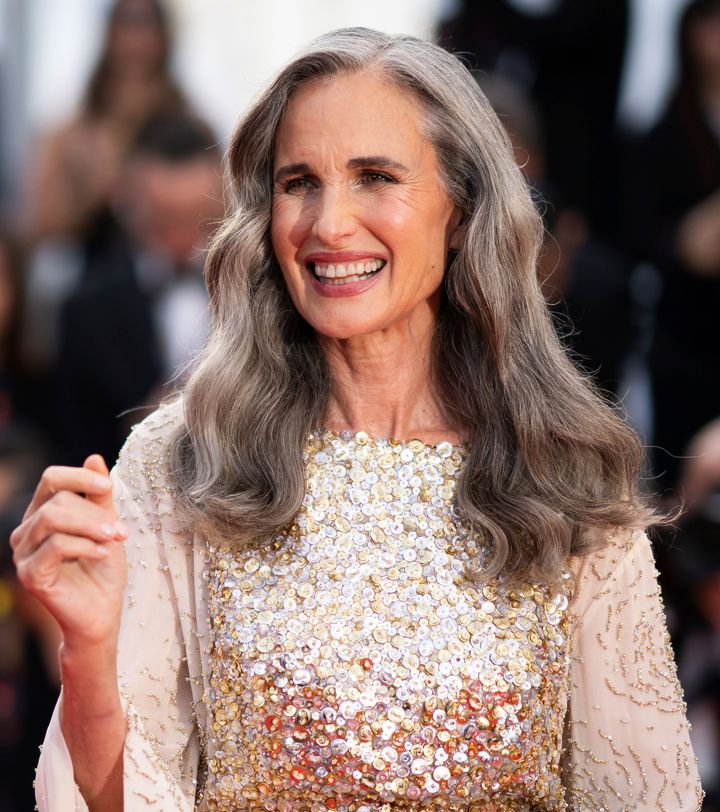
Andie MacDowell at age 66 on May 24, 2024.

Scott A Garfitt via Associated Press

Andie MacDowell at age 66 on May 24, 2024.

Texture

When you look at pictures of yourself in your 20s, you might notice something different about your hair that you can’t quite put your finger on. The cut and color are the same, so why does your hair look so different now?

“As we age, the texture and density of our hair changes,” Pettis said. “But there are things you can do to keep it healthy and looking youthful. It’s all about moisture, protection, and retention.”

Salma Hayek at age 58 on Oct. 29, 2024.

Evan Agostini via Associated Press

Salma Hayek at age 58 on Oct. 29, 2024.

To keep your hair in tip-top shape, Pettis recommends investing in deep conditioning products and products that strengthen your hair.

Ingredients like keratin, collagen and hydrating oils can also help maintain your hair’s youthful shine and elasticity, Maine said.

Our expert stylists also stress that as you age, protecting your delicate strands becomes even more important, particularly when styling your hair. Opt for low-heat styling options or use heat-protectant products to protect your locks and prevent breakage.

Cut and style

With trends constantly shifting and changing, the hottest hairstyles of the past can now instantly reveal your age. Even millennials have had to face the music as their beloved side parts were declared “old” by Gen Z.

If you can’t seem to embrace the Gen Z middle part, fret not. When choosing a new, fresh look, our stylists encourage picking styles that flatter your unique features, rather than pursuing whatever is currently trendy.

“It’s all about keeping things soft and touchable to avoid anything that feels too rigid or stuck in time,” Maine said. “Personally, I think it’s important to pay attention to your features, texture, and lifestyle when choosing an appropriate style more so than age.”

Short hair

Due to its easier upkeep, many older women tend to adopt shorter hair, causing some people to associate shorter locks with maturity. But according to our experts, that doesn’t mean a shorter style will necessarily age you.

“There are times when shorter hair works much better than longer hair because you can make short hair with a kind of a sporty feel to it,” Clarke said.

Jamie Lee Curtis at age 65 on Sept. 6, 2024.

Evan Agostini via Associated Press

Jamie Lee Curtis at age 65 on Sept. 6, 2024.

“A short pixie cut can lift the face and emphasize cheekbones,” Maine said. “Long hair can sometimes drag the face down.”

If you go for the big chop, our experts recommend that you avoid overly structured styles (like the infamous “Karen” haircut) and stick to softer, looser styles.

“I always say that to create a younger look, the objective is to try and get hair that has movement in it,” Clarke said.

Long hair

While longer hair tends to be associated with youth, Maine cautions that as your hair ages and its color and texture change, longer hair can potentially make you look older.

“Very often, long hair is dragging you down if it’s not cut and styled right,” Clarke said.

That said, it doesn’t mean long hair is completely out of the cards for you in your golden years.

“If someone has a silky hair texture or can rock a voluminous blowout to balance out their proportions, longer hair can absolutely work!” Maine said. “This is why it’s so important to consider all factors instead of just saying ‘older women should avoid short hair if they want to look youthful.’”

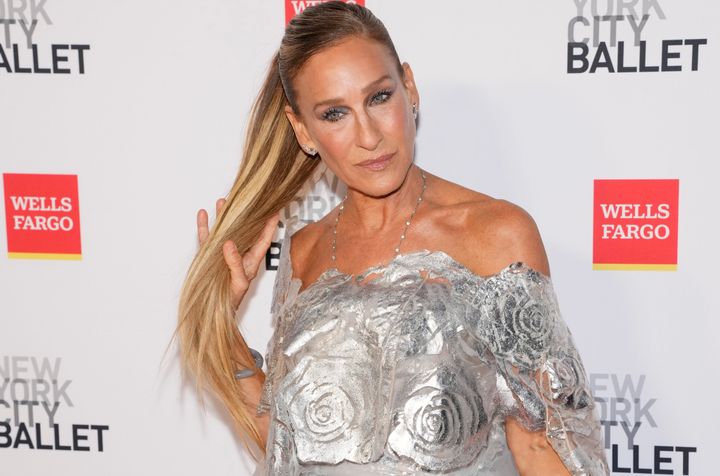
Sarah Jessica Parker at age 59 on Oct. 9, 2024.

Charles Sykes via Associated Press

Sarah Jessica Parker at age 59 on Oct. 9, 2024.

For longer hairstyles, Maine recommends soft layers around the face to create shape and make your hair look touchable.

Not ready to let go of the old ’do?

Even if you feel like it’s time for a change, struggling with letting go of your old hairstyle is not unusual. When changing your style, our experts recommend going at your own pace to find a look you absolutely love.

“My advice to anyone looking to step outside their comfort zone is to trust your gut,” Pettis said. “The moment you start second-guessing and letting other people’s opinions sway you, that’s when you step into dangerous territory.”

Fortunately, with a smartphone and a selfie, you see whether a new style works for you without ever setting foot in a salon.

“Using technology is a fantastic way to try out a new hairstyle before fully committing,” Maine said. “There are tons of apps that let you see different cuts and colors on your face, making it easy to quickly figure out if a style might suit you.”

And once you get your hair cut, bear in mind that it may take time to adjust to your new look — and that’s OK.

“No matter your age, it can be tough to see yourself differently, especially if you’ve had the same look for a while,” Maine said. “Hair frames your face and is closely tied to your identity, so it’s completely normal to need an adjustment period when making a big change.”

Share Button

Ex-Obama Adviser Snidely Boils Down Harris Defeat To 1 Faction Of Democratic Party

David Axelrod, a former senior adviser to Barack Obama during his presidency, on Thursday said Democrats have “become a smarty-pants, suburban, college-educated party” ― and that led to Kamala Harris’ defeat in the White House race.

Many pundits have been upping their blame game in the aftermath of the 2024 election. But analysis from Axelrod, a strategist who successfully helped engineer both of Obama’s national campaigns, merits attention.

“I do have concerns about the way the Democratic Party relates to working-class voters in this country,” Axelrod told broadcaster Anderson Cooper on CNN. “The only group that Democrats gained with in the election on Tuesday was white college graduates. And among working-class voters, there was a significant decline.”

He continued to hammer home a point about the more affluent income bracket that Harris appealed to.

“The only group … Democrats won among were people who make more than $100,000 a year,” Axelrod said. “You can’t win national elections that way, and it certainly shouldn’t be that way for a party that fashions itself as the party of working people.”

Axelrod suggested snobbery played a part in Democrats’ failed messaging after President Joe Biden had helped working people.

“You can’t approach working people like missionaries and say, ‘We’re here to help you become more like us.’ There’s a kind of unspoken disdain, unintended disdain in that,” he said.

“I think Biden has done programmatically some good things for working people. But the party itself has increasingly become a smarty-pants, suburban, college-educated party, and it lends itself to the kind of backlash that we’ve seen.”

Rep. Robert Garcia (D-Calif.), a Harris campaign co-chair, somewhat echoed Axelrod’s point in a separate conversation on CNN.

“There’s a lot of work to do to ensure that we communicate to folks that the Democratic Party is the party of working people, is the party that supports immigrants, is the party that supports the social safety net,” Garcia said.

H/T Mediaite

Share Button

Madonna Serves Up a ‘F**k Trump’ Cake With A Side Of Scathing Commentary

Madonna didn’t sugarcoat her feelings as she revealed her utter disgust at President-elect Donald Trump’s looming return to the White House in her Instagram stories.

The pop star on Thursday first shared the picture of a cake with “Fuck Trump” written on top.

Then, the singer shared a picture of herself and said: “Trying to get my head around why a convicted felon, rapist, Bigot was chosen to lead our country because he’s good for the economy.”

Madonna has criticised Trump for years.

During his 2016 campaign, she shared video online of a Trump piñata being battered and criticised his sons (Donald Trump Jr. and Eric Trump), asking “How Big of. Pussy Do you have to BE to kill this Noble Animal for sport” after images of them posing with a dead leopard resurfaced.

When Trump did win eight years ago, she said it felt “like women betrayed us” with their support for him, and the following year she likened the heartbreak she experienced following Hillary Clinton’s loss to Trump to a breakup.

Midway through Trump’s first term, Madonna revealed how Trump’s presidency (and her son’s fledgling soccer career) prompted her to move to Portugal. “I felt like we needed a change, and I wanted to get out of America for a minute ― as you know, this is not America’s finest hour,” she said.

Share Button

Study of mountaineering mice sheds light on evolutionary adaptation

Teams of mountaineering mice are helping advance understanding into how evolutionary adaptation to localized conditions can enable a single species to thrive across diverse environments.

In a study led by Naim Bautista, a postdoctoral researcher in Jay Storz’s lab at the University of Nebraska-Lincoln, the team took highland deer mice and their lowland cousins on a simulated ascent to 6,000 meters. The “climb” ventured from sea level and the mice reached the simulated summit seven weeks later. Along the way, Bautista tracked how the mice responded to cold stress at progressively lower oxygen levels.

“Deer mice have the broadest environmental range of any North American mammal, as they are distributed from the plains of Nebraska to the summits of the highest peaks in the Rocky Mountains and Sierra Nevada,” said Storz, Willa Cather Professor of biological sciences. “This study tested whether they are able to thrive across such a broad range of elevations by evolving adaptations to local conditions or by possessing a generalized ability to acclimatize.”

Conducted in a specialized lab at Canada’s McMaster University, the study divided each team of highland and lowland mice into two distinct groups — a control that remained at sea level throughout the study, and an acclimation group that embarked on the seven-week ascent.

After seven days at sea-level, conditions for the acclimated group advanced by 1,000 meters in elevation weekly, with oxygen levels reduced to reflect what climbers would experience. The research team monitored the ability of each mouse to cope with cold exposure by means of metabolic heat production.

Data showed that the highland and lowland deer mouse cousins do not share a general ability to acclimate to hypoxia (low oxygen conditions). As the simulated elevations rose above 4,000 meters, the homefield advantage of the highland mice quickly became apparent. As oxygen levels dropped, the highland mice were better able to regulate body temperature than their lowland counterparts owing to more efficient breathing and circulatory oxygen-transport.

“The results show us that the highlanders and lowlanders do not share a generalized ability to acclimatize to changing environmental conditions,” Bautista said. “Rather, the mice living at higher elevations share evolved ways to acclimatize to low oxygen conditions that are distinct from those of the lowland prairie mice.”

The study also showed that the highland mice have a genetic advantage that helps suppress thickening of the right ventricle of the heart, a symptom of pulmonary hypertension, which is a common malady among lowland mammals that are forced to acclimatize to low oxygen conditions.

Bautista said the findings show how adaptation to local conditions can allow a widely distributed species like the deer mouse to thrive in diverse environments.

“It highlights how evolved changes specific to populations help shape their flexibility,” Bautista said. “Ultimately, it is these changes that influence their ability to survive within different habitats.”

Bautista is finalizing plans to repeat the study, taking it to new heights by measuring the responses of the yellow-rumped leaf-eared mouse, the world’s highest-dwelling mammal. The species hails from the Andes mountains, living at elevations up to 22,110 feet, and was discovered by Storz.

The deer mice study was recently published in PNAS. Other members of the research team include Storz; Ellen Shadowitz and Graham Scott of McMaster University; Nathanael Herrera and Zachary Cheviron of the University of Montana; and Oliver Wearing of the University of British Columbia.

Share Button

Heartier Heinz? How scientists are learning to help tomatoes beat the heat

By studying tomato varieties that produce fruit in exceptionally hot growing seasons, biologists at Brown University identified the growth cycle phase when tomatoes are most vulnerable to extreme heat, as well as the molecular mechanisms that make the plants more heat tolerant.

The discovery, detailed in a study in Current Biology, could inform a key strategy to protect the food supply in the face of climate instability, the researchers said. Agricultural productivity is particularly vulnerable to climate change, the study noted, and rising temperatures are predicted to reduce crop yields by 2.5% to 16% for every additional 1 degree Celsius of seasonal warming.

The scientists took some lessons from evolution to experiment with how best to speed up the adaptation process for varieties of tomato plants, explained study author Sorel V. Yimga Ouonkap, a research associate in molecular biology, cell biology and biochemistry at Brown. It would take a long time to wait for evolution to weed out the vulnerable tomato varieties like Heinz in favor of those that can handle extreme heat, a process that might also jeopardize the qualities that make vulnerable crops commercially desirable.

“We’re trying to figure out thermoregulation at a molecular and cellular level, and identify what and where we need to improve so that we can target those in commercial plant cultivars and conserve everything about them except for this one aspect that makes them vulnerable to extreme heat,” Ouonkap said. “Over time, you can start accumulating different resistance mechanisms as the growing conditions continue to change.”

Understanding thermotolerance, or the ability of a plant to withstand extreme temperatures, is a promising strategy to address climate adaptation, said study author Mark Johnson, a professor of biology at Brown.

“Imagine if you could just make a Heinz tomato more resilient to temperature stress without affecting the flavor profile or the way people experience the tomato,” Johnson said. “That would be a great advantage.”

Plant reproduction: a ripe area for research

The plant reproduction phase has been the focus of research in Johnson’s lab for many years. While the scientific literature includes studies of how heat stress affects plant growth in general, or the development of key reproductive structures, there was an absence of work that specifically examined what happens after pollen lands on the stigma during plant reproduction, Johnson said.

For Ouonkap’s thesis project, he focused on the pollen tube growth phase of the plant reproductive cycle. He studied different cultivars of tomato plants known for their ability to produce fruit in exceptionally hot growing seasons. The tomato varieties in the study were native to the Philippines, Russia and Mexico and were all grown in the Plant Environment Center at Brown.

Collaborating with scientists at the University of Arizona, Ouonkap studied how heat stress affects the ability of the pollen to grow in the flower of the tomato plant. He focused on how gene expression changes when tomato pollen produced by plants growing in optimal greenhouse conditions were exposed to high temperatures when growing in a petri dish.

The team’s partners in Arizona found that exposure to high temperature solely during the pollen tube growth phase limits fruit and seed production more significantly in tomato cultivars that were heat sensitive than those that were heat tolerant. Importantly, Ouonkap found that pollen tubes from the Tamaulipas variety of tomato, known to be tolerant to heat, have enhanced growth under high temperature. His molecular analysis of the pollen tube in these tomatoes allowed the research team to pinpoint the mechanisms that were associated with thermotolerance.

Tomatoes are an ideal organism for this kind of research, the researchers said. The ability of different varieties to adapt to a variety of extreme climates offer scientists insights into how species vary in their responses to environmental conditions. Tomatoes are also an important commercial crop in countries all over the world, from the Mediterranean to Egypt to Turkey to California — some of which are among the most vulnerable to extreme heat conditions.

With the right molecular mechanisms now identified, a next step would be determining specific techniques for enabling tomato growth in different climates. In one hypothetical scenario, scientists might develop a small molecule that could prime the pollen in the plants to be able to withstand a heat wave, Johnson explained.

“When the weather forecast showed two weeks of high temperatures during the pollen tube growth phase, the farmer would apply a product to plants that would change the gene expression so that the pollen would be resilient to heat,” he said.

While that type of manipulation is still far off in the future, the researchers said this area of research is ripe for exploration.

This project was funded by the National Science Foundation (IOS-1939255) with additional support from the United States Department of Agriculture National Institute of Food and Agriculture (2020-67013-30907, 2024-67012-41882) and the National institutes of Health (5R35GM139609, PI AEL).

Share Button

Measurements from ‘lost’ Seaglider offer new insights into Antarctic ice melting

New research reveals for the first time how a major Antarctic ice shelf has been subjected to increased melting by warming ocean waters over the last four decades.

Scientists from the University of East Anglia (UEA) say the study — the result of their autonomous Seaglider getting accidentally stuck underneath the Ross Ice Shelf — suggests this will likely only increase further as climate change drives continued ocean warming.

The glider, named Marlin, was deployed in December 2022 into the Ross Sea from the edge of the sea ice. Carrying a range of sensors to collect data on ocean processes that are important for climate, it was programmed to travel northward into open water.

However, Marlin was caught in a southward-flowing current and pulled into the ice shelf cavity where it remained, with its sensors on, for four days before re-emerging. During this time the ‘lost’ glider completed 79 dives, taking measurements of the water within the cavity to a depth of 200 metres, right up to base of the overlying ice shelf.

Researchers from UEA’s School of Environmental Sciences recorded a 50 metre-thick ‘intrusion’ of — relatively — warm water that had entered the cavity from the nearby open water. Water temperatures ranged from -1.9°C to a warmer -1.7°C under the ice.

Subsequent re-analysis of all available measurements shows that heat transported into cavity has increased over the last 45 years, most likely due to warming of the Ross Sea because of climate change. The findings are published in the journal Science Advances.

“While the temperature increase — four thousandths of a degree a year — might not seem all that much, it could lead to around 20 to 80 cm of additional ice loss per year over the 45 years we look at,” explained lead author Dr Peter Sheehan.

“We found the waters of the intrusion were warm enough to melt the underside of the ice shelf, unlike the freezing-point waters they likely displaced. What’s new here is that we can track the warm water pretty much from the open water of the Ross Sea at the ice front, back into the cavity. We have not seen one of these intrusions happening directly before.”

Dr Sheehan added: “A trip into the cavity underneath the Ross Ice Shelf was not planned, and it’s not normally possible to measure this region of an ice shelf: you can’t send instruments this close to the underside of an ice shelf deliberately, it’s too risky.”

The ice shelves that surround Antarctica are exposed to the warmth of the ocean across the expanse of their undersides that float out over the continent’s shelf seas, and the ocean-driven melting that occurs at the ice base is the largest cause of Antarctic ice-mass loss.

While the melting of floating ice does not itself substantially raise sea level, ice shelves slow the seaward flow of land ice and so stabilize the Antarctic ice sheet; their thinning and disintegration would hasten the delivery of land ice to the ocean and accelerate global sea-level rise.

One of the processes that can drive warm surface water under the Ross Ice Shelf is wind. Certain wind patterns lead to southward flow in the surface ocean and into the ice shelf cavity.

These wind-driven ocean-surface flows are called Ekman currents, and as with any ocean current, these have an associated heat transport. Because this is an ocean-surface process, this heat is instantly available to melt the overlying ice: it doesn’t have to wait to be mixed upward to the ice base.

Ekman heat transport is particularly relevant for climate scientists because oceans absorb and redistribute much of the Earth’s heat. Changes in this system can have profound effects on weather, sea levels, and global temperature trends.

Dr Sheehan and co-author Prof Karen Heywood used long-term measurements of wind and ocean temperature — blended with a model to fill in spatial and temporal gaps in the record — to calculate the strength of southward Ekman heat transport over the last 45 years. They found that the heat transported into the cavity by Ekman currents has increased.

Year-to-year variability is driven by the wind. However, the trend towards greater heat transport into the cavity is likely linked to warming of the Ross Sea — because the water has warmed, winds today will transport more heat energy into the cavity than winds of comparable strength in the past.

Prof Heywood said: “It appears reasonable to expect that the magnitude of the Ekman heat flux, and of the melting that it drives, will increase yet further as climate change drives continued ocean warming. This trend is a concern in itself.

“The influence of surface-water intrusions, alongside the trends and variability in the Ekman dynamics that can drive these, must be incorporated into climate models, not least given continued uncertainty in the response of Antarctic land-based ice to climate change.”

This is the first time that this process has been looked at using a long-term, multi-decadal data set. Previous understanding of surface-water intrusions has come mainly from comparisons of hydrography in open water, for example from ships, observations from tagged seals, and ice moorings deployed within a cavity.

The study was funded by the UK Natural Environment Research Council, the US National Science Foundation and European Research Council Horizon 2020 programme.

Share Button

Geologists rewrite textbooks with new insights from the bottom of the Grand Canyon

Any boomer, gen xer, millennial, gen zer or alpha who’s studied geology has likely gained foundational knowledge from Edwin Dinwiddie McKee’s landmark studies of the Grand Canyon’s sedimentary record — even if they don’t readily recognize McKee’s name.

The legendary scientist, who lived from 1906-1984, studied and documented the stratigraphy and sedimentation of Colorado Plateau geology, especially the Grand Canyon’s Cambrian Tonto Group, for more than 50 years. His time-tested tenets have influenced generations of geoscientists.

“The Tonto Group holds a treasure trove of sedimentary layers and fossils chronicling the Cambrian Explosion some 540 million years ago, when the first vertebrates and animals with hard shells rapidly proliferated and sea levels rose to envelope continents with emerging marine life,” says Carol Dehler, professor at Utah State University. “McKee marveled at this pivotal geologic period, yet had no knowledge of plate tectonics or global sea level change, and his ideas were often shunned by the scientific community of the time.”

Yet, what if McKee could have fast-forwarded through time and availed himself of current-day stratigraphic, depositional and paleontological models, data and technological muscle?

Dehler, with colleagues James Hagadorn of the Denver Museum of Nature & Science, Frederick Sundberg, Karl Karlstrom and Laura Crossey of the University of New Mexico, Mark Schmitz of Boise State University and Stephen Rowland of the University of Nevada, Las Vegas, along with their students and interns, have employed these tools to construct an updated and insightful framework of McKee’s foundational ideas. They report their efforts in “The Cambrian of the Grand Canyon: Refinement of a Classic Stratigraphic Model,” the cover story of the November 2024 print issue of the Geological Society of America’s GSA Today journal, published online Oct. 23, 2024.

The team’s research was supported by a National Science Foundation Division of Earth Sciences grant.

“The Grand Canyon is an epic Rosetta Stone for geology,” says Hagadorn, Tim & Kathryn Ryan Curator of Geology at DMNS. “And we’re helping to further decode it. Because Grand Canyon rocks record global changes in climate and tectonics, our work help us understand strata that were deposited worldwide during the Cambrian period.”

Studying the Tonto Group, he says, is like being a detective at a crime scene.

“You can see clues and discern at least part of what happened,” Hagadorn says. “But determining how it happened and the sequence of events takes time and effort. Just like the scene of a crime, the rock record of the Grand Canyon is much more complicated than what we currently know and its story is still being written.”

Dehler says the team’s new model offers three key pathways for deeper understanding.

“From the Tonto Group’s 500-meter-thick strata, we’re learning about sea-level rise and the effects of catastrophic tropical storms — probably more powerful than today’s devastating hurricanes — during a period of very hot temperatures when the Earth was ice-free,” she says.

Sea levels were so high during this time period, Dehler says, that rocks like the Tonto Group were deposited atop every continent on Earth, as seas bathed the continents in a complex mosaic of shallow marine, coastal and terrestrial environments.

Further, she says, advanced chronological tools are revealing new information about the tempo of sedimentation, as well as how rapidly trilobites and other “disgusting, cockroach-looking creatures” diversified.

“Our findings are a reminder science is a process,” Hagadorn says. “Our work in the Grand Canyon, one of the world’s most well-known and beloved landscapes, connects people to this science in a very personal way.”

Share Button