Hurricane Helene’s gravity waves revealed by NASA’s AWE

On Sept. 26, 2024, Hurricane Helene slammed into the Gulf Coast of Florida, inducing storm surges and widespread impacts on communities in its path. At the same time, NASA’s Atmospheric Waves Experiment, or AWE, recorded enormous swells in the atmosphere that the hurricane produced roughly 55 miles above the ground. Such information helps us better understand how terrestrial weather can affect space weather, part of the research NASA does to understand how our space environment can disrupt satellites, communication signals, and other technology.

These massive ripples through the upper atmosphere, known as atmospheric gravity waves, appear in AWE’s images as concentric bands (artificially colored here in red, yellow, and blue) extending away from northern Florida.

“Like rings of water spreading from a drop in a pond, circular waves from Helene are seen billowing westward from Florida’s northwest coast,” said Ludger Scherliess, who is the AWE principal investigator at Utah State University in Logan.

Launched in November 2023 and mounted on the outside of the International Space Station, the AWE instrument looks down at Earth, scanning for atmospheric gravity waves, ripple-like patterns in the air generated by atmospheric disturbances such as violent thunderstorms, tornadoes, tsunamis, wind bursts over mountain ranges, and hurricanes. It does this by looking for brightness fluctuations in colorful bands of light called airglow in Earth’s mesosphere. AWE’s study of these gravity waves created by terrestrial weather helps NASA pinpoint how they affect space weather.

These views of gravity waves from Hurricane Helene are among the first publicly released images from AWE, confirming that the instrument has the sensitivity to reveal the impacts hurricanes have on Earth’s upper atmosphere.

Share Button

DNA evidence rewrites story of people buried in Pompeii eruption

Researchers from the University of Florence, Harvard University and the Max Planck Institute for Evolutionary Anthropology in Leipzig have used ancient DNA to challenge long-held interpretations of the people of Pompeii. Contrary to physical appearances, the DNA evidence revealed unexpected variations in gender and kinship, revising the story as written since 1748. The genetic data also underlined the cosmopolitan nature of the Roman Empire, showing that Pompeians were mainly descended from immigrants from the eastern Mediterranean.

In 79 AD, Mount Vesuvius experienced one of its most significant eruptions, burying the Roman city of Pompeii and its inhabitants under a thick layer of small stones and ash known as lapilli. Many of Pompeii’s inhabitants lost their lives as their homes collapsed under the weight of the lapilli raining down from many kilometres above. Those who survived the initial phase of the eruption eventually succumbed to the dangerous pyroclastic flows. This fast-moving stream of hot gas and volcanic matter instantly enveloped their bodies in a solid layer of ash, effectively preserving their bodies, including their features.

Since the 1800s, casts had been made by pouring plaster into the voids left by these bodies after their decay. The research team extracted DNA from the heavily fragmented skeletal remains embedded in 14 of the 86 famous casts undergoing restoration. This extraction process allowed them to accurately establish genetic relationships, determine sex and trace ancestry. Interestingly, their findings largely contradicted previous assumptions based solely on physical appearance and the positioning of the casts.

Genetic relationships of victims revisited

“This research shows how genetic analysis can significantly add to the stories constructed from archaeological data,” says Professor David Caramelli, from the Department of Anthropology at the University of Florence. “The findings challenge enduring notions such as the association of jewellery with femininity or the interpretation of physical proximity as evidence of familial relationships.” “Moreover,” Caramelli adds, “the genetic evidence adds a layer of complexity to simple kinship narratives. For example, in the House of the Golden Bracelet, the only site where we have genetic information from multiple individuals, the four people traditionally thought to be the two parents and their children actually have no genetic ties to each other.”

“The scientific data we provide do not always align with common assumptions,” says David Reich of Harvard University. “For instance, one notable example is the discovery that an adult wearing a golden bracelet and holding a child, traditionally interpreted as a mother and child, were an unrelated adult male and child. Similarly, a pair of individuals thought to be sisters, or mother and daughter, were found to include at least one genetic male. These findings challenge traditional gender and familial assumptions.”

Cosmopolitan nature of the Roman Empire

The genetic data also provided information about the ancestry of the Pompeians, who had different genomic backgrounds. The finding that they were mainly descended from recent immigrants from the eastern Mediterranean highlights the cosmopolitan nature of the Roman Empire.

“Our findings have significant implications for the interpretation of archaeological data and the understanding of ancient societies,” says Alissa Mittnik of the Max Planck Institute for Evolutionary Anthropology. “They highlight the importance of integrating genetic data with archaeological and historical information to avoid misinterpretations based on modern assumptions. This study also underscores the diverse and cosmopolitan nature of Pompeii’s population, reflecting broader patterns of mobility and cultural exchange in the Roman Empire.”

“It is also likely that the use of these casts for narration purposes could have led to past restorers modifying their postures and placements,” adds David Caramelli. “The combined use of genetic data and other bioarchaeological methods provides us with the chance to better comprehend the lives and habits of the victims of the Vesuvius eruption.”

Gabriel Zuchtriegel, Director of the Pompeii Park, says, “The Pompeii Park has been including ancient DNA analysis in its study protocols for years, not only for human victims, but also for animal victims.” He explains that the Park manages a variety of research projects through its own laboratory. These include isotopic analysis, diagnostics, geology, volcanology and, in particular, reverse engineering. He stresses that “all these elements together contribute to a comprehensive, updated interpretation of the archaeological findings. These efforts are turning Pompeii into a veritable incubator for the development of new methods, resources and scientific comparisons.” Zuchtriegel concludes: “From this point of view, this study marks a true change in perspective, in which the site itself plays a central role in advancing archaeology and research.”

Share Button

Astrophysicists use echoes of light to illuminate black holes

A team of astrophysicists, led by scholars from the Institute for Advanced Study, has developed an innovative technique to search for black hole light echoes. Their novel method, which will make it easier for the mass and the spin of black holes to be measured, represents a major step forward, since it operates independently of many of the other ways in which scientists have probed these parameters in the past.

The research, published today in The Astrophysical Journal Letters, introduces a method that could provide direct evidence of photons circling black holes due to an effect known as “gravitational lensing.”

Gravitational lensing occurs when light passes near a black hole and its path is bent by the black hole’s strong gravitational field. The effect allows the light to take multiple paths from a source to an observer on Earth: some light rays might follow a direct route while others could loop around the black hole once — or multiple times — before reaching us. This means that light from the same source can arrive at different times, resulting in an “echo.”

“That light circles around black holes, causing echoes, has been theorized for years, but such echoes have not yet been measured,” says the study’s lead author, George N. Wong, Frank and Peggy Taplin Member in the Institute’s School of Natural Sciences and Associate Research Scholar at the Princeton Gravity Initiative at Princeton University. “Our method offers a blueprint for making these measurements, which could potentially revolutionize our understanding of black hole physics.”

The technique allows the faint echo signatures to be isolated from the stronger direct light captured by well-known interferometric telescopes, such as the Event Horizon Telescope. Both Wong and one of his co-authors, Lia Medeiros, Visitor in the Institute’s School of Natural Sciences and NASA Einstein Fellow at Princeton University, have worked extensively as part of the Event Horizon Telescope Collaboration.

To test their technique, Wong and Medeiros, working alongside James Stone, Professor in the School of Natural Sciences, and Alejandro Cárdenas-Avendaño, Feynman Fellow at Los Alamos National Laboratory and former Associate Research Scholar at Princeton University, ran high-resolution simulations which took tens of thousands of “snapshots” of light traveling around a supermassive black hole akin to that at the center of the M87 galaxy (M87*), which is located around 55 million light-years away from Earth. Using these simulations, the team demonstrated that their method could directly infer the echo delay period in the simulated data. They believe that their technique will be applicable to other black holes, in addition to M87*.

“This method will not only be able to confirm when light orbiting a black hole has been measured, but will also provide a new tool for measuring the black hole’s fundamental properties,” explains Medeiros.

Understanding these properties is important. “Black holes play a significant role in shaping the evolution of the universe,” says Wong. “Even though we often focus on how black holes pull things in, they also eject large amounts of energy into their surroundings. They play a major role in the development of galaxies, affecting how, when, and where stars form, and helping to determine how the structure of the galaxy itself evolves. Knowing the distribution of black hole masses and spins, and how the distribution changes over time, greatly enhances our understanding of the universe.”

Measuring the mass or spin of a black hole is tricky. The nature of the accretion disk, namely the rotating structure of hot gas and other matter spiraling inward towards a black hole, can “confuse” the measurement, Wong notes. Light echoes provide an independent measurement of the mass and spin, however, and having multiple measurements allows us to produce an estimate for those parameters “that we can really believe in,” states Medeiros.

Detecting light echoes might also enable scientists to better test Albert Einstein’s theories of gravity. “Using this technique, we might find things that make us think ‘hey, this is weird!'” adds Medeiros. “The analysis of such data could help us to verify whether black holes are indeed consistent with general relativity.”

The team’s results suggest that it may be possible to detect echoes with a pair of telescopes — one on Earth and one in space — working together to perform what can be described as “very long baseline interferometry.” Such an interferometric mission need only be “modest,” states Wong. Their technique provides a tractable, practical method to gather important, reliable information about black holes.

Share Button

20 Years After ‘Mean Girls,’ Jonathan Bennett Is Finding New Ways To Make Fans Swoon

To a generation of viewers, Jonathan Bennett will forever be known as Aaron Samuels, the dreamy jock who won the heart of Lindsay Lohan’s character in the 2004 teen comedy classic “Mean Girls.”

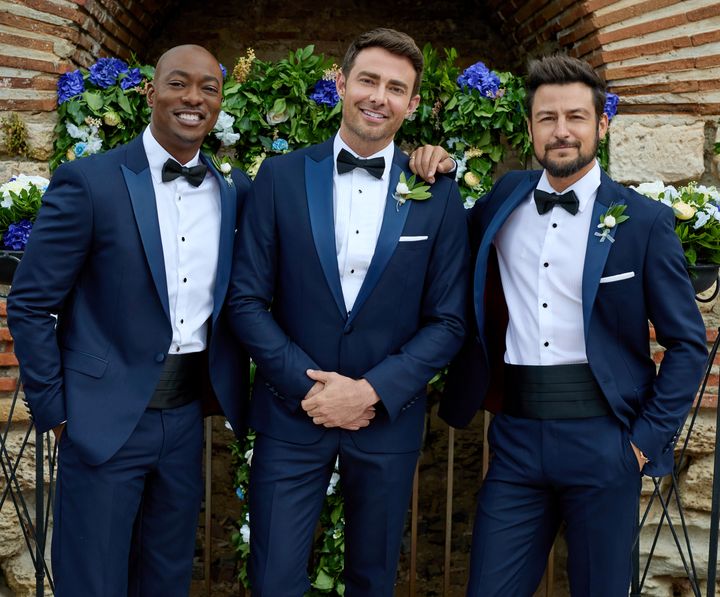
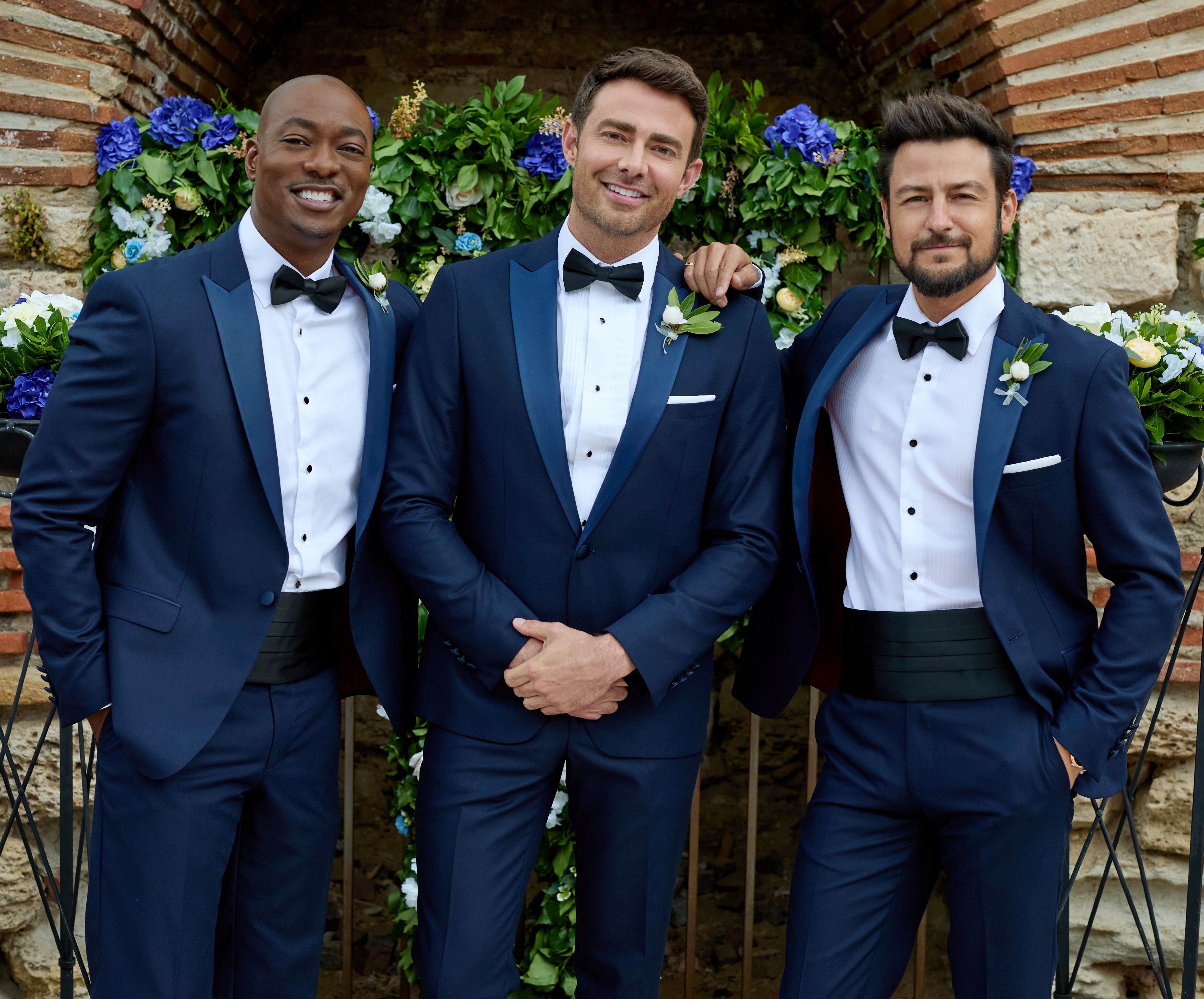
The actor, who is gay, has more recently been finding creative ways to reflect his lived experience through his work. This fall, he’s one of the principal stars of Hallmark’s “The Groomsmen” trilogy, in which he portrays Danny, a gay athlete who supports his two straight friends (Tyler Hynes and B.J. Britt) as they prepare for their respective weddings ― while holding out hope for a fairy-tale ending of his own.

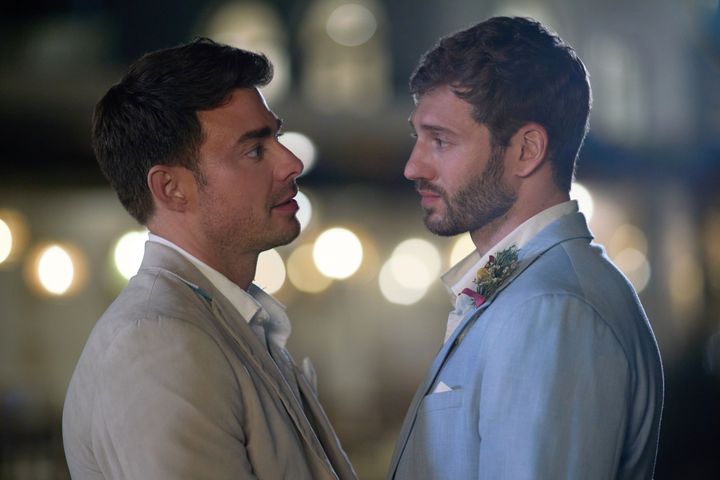
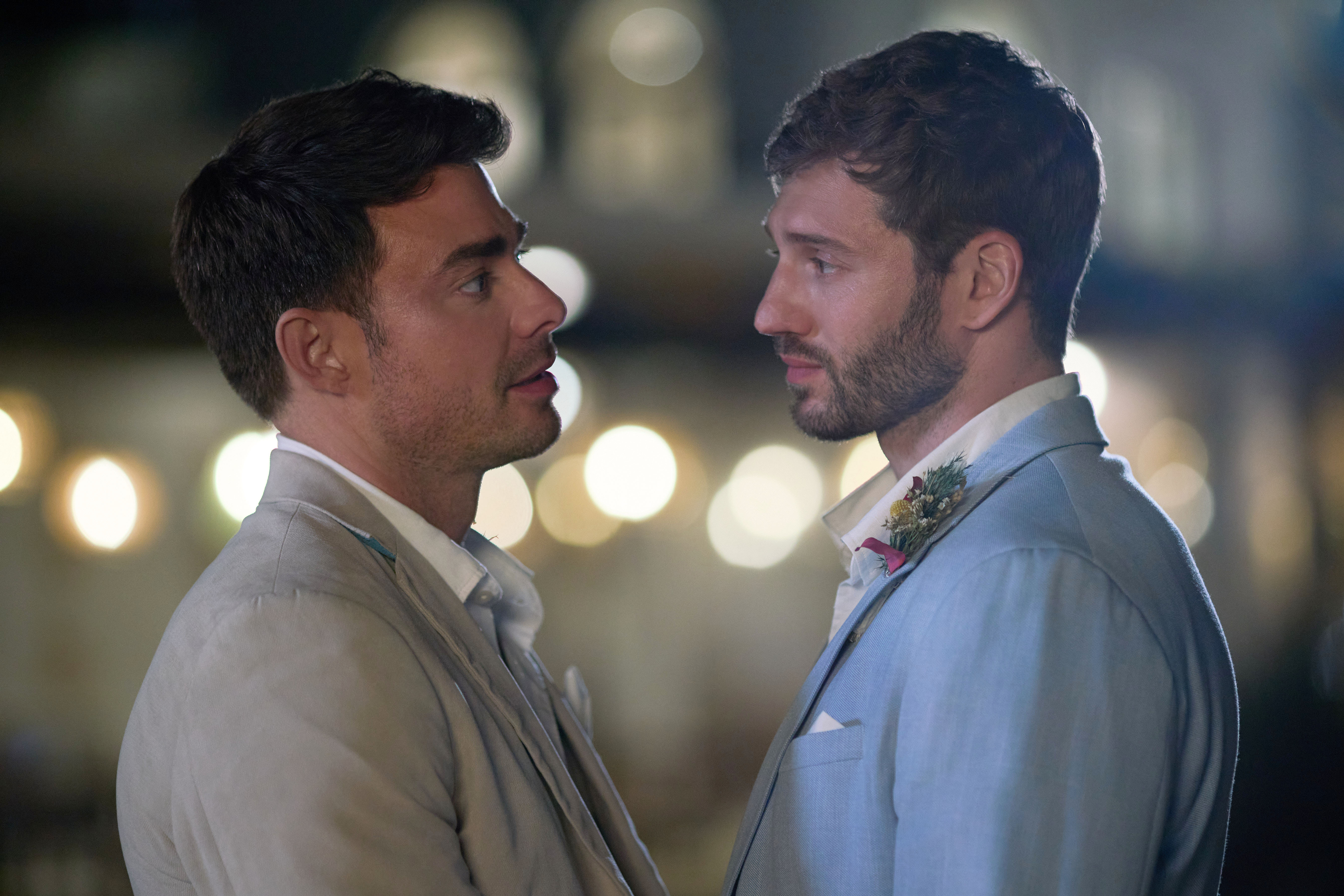
In the series’ second installment, “The Groomsmen: Second Chances,” Danny grapples with a “My Best Friend’s Wedding”-like conundrum when he’s asked to be the best man for a longtime pal, Zack (Alexander Lincoln), who is preparing to tie the knot in Greece. What Zack doesn’t know, however, is that Danny has been suppressing his own feelings for him.

From left: B.J. Britt, Jonathan Bennett and Tyler Hynes star in Hallmark's "The Groomsmen" trilogy.
From left: B.J. Britt, Jonathan Bennett and Tyler Hynes star in Hallmark’s “The Groomsmen” trilogy.

Elena Nenkova/Hallmark Media

“I got married two years ago [to television personality Jaymes Vaughan] and I had a bunch of my best friends as my groomsmen, and I’ve been in a bunch of my friends’ weddings as their groomsmen,” said Bennett, who is also a co-creator and co-producer on the trilogy. “Half my friends are straight, half my friends are gay, and we’ve always been a wolf pack.”

“Those friends are there for you when you need each other,” he continued. “But they also have an innate ability to call you out on your crap when you’re not being your best self. So I thought there was an interesting story that hasn’t been told of that male squad in the romantic comedy space.”

Bennett made his Hallmark debut in 2020 when he appeared in “The Christmas House,” the network’s first holiday-themed offering to include an LGBTQ+ storyline. Similarly, “Second Chances” is billed as Hallmark’s first to feature a gay wedding in a principal storyline.

Of course, Bennett knew he’d have to stay true to rom-com tradition by having the film end on a happy note for both Danny and Zack. But he and the rest of the creative team nonetheless looked for unexpected ways to subvert LGBTQ+ tropes.

In "The Groomsmen: Second Chances," Bennett's character (left) must work up the courage to admit his feelings for his longtime friend (Alexander Lincoln).
In “The Groomsmen: Second Chances,” Bennett’s character (left) must work up the courage to admit his feelings for his longtime friend (Alexander Lincoln).

Elena Nenkova/Hallmark Media

Given the scarcity of openly LGBTQ+ athletes in professional sports, Bennett felt he would “offer aspiration and hope” to fans by making Danny a Major League Baseball player.

“We want to make sure when we’re telling stories ― whether it’s a holiday story or a wedding story ― that there’s always a seat at the table for everyone,” he said.

With four years of Hallmark experience under his belt, Bennett is also thrilled to be mentoring would-be heartthrobs as the host of “Finding Mr. Christmas.” Airing Thursdays, the competition series finds 10 actors vying to be the leading man in an upcoming Hallmark Christmas movie, “Happy Howlidays,” starring Jessica Lowndes and due out Dec. 21.

“My dream for the show is for it to be like the early days of ‘American Idol,’ where everyone gathers around the TV together at the holidays, and everybody has their favorites that they’re rooting for,” Bennett said. As to what makes the ideal Hallmark holiday heartthrob, he noted: “They have a wit and a kindness to them. They have a whole lot of heart and charisma coming out of their ears. And, of course, they look good in a Christmas sweater.”

Watch a teaser for “Finding Mr. Christmas” below.

<div class="js-react-hydrator" data-component-name="YouTube" data-component-id="5174" data-component-props="{"itemType":"video","index":17,"contentIndexByType":1,"contentListType":"embed","code":"

","type":"video","meta":{"author":"Hallmark+ ","author_url":"https://www.youtube.com/channel/UChlrifINFnag-1txECYqyVg","cache_age":86400,"description":"Watch a preview of the Hallmark+ original series, \"Finding Mr. Christmas,\" hosted by Jonathan Bennett. Now streaming on Hallmark+","options":{"_cc_load_policy":{"label":"Closed captions","value":false},"_end":{"label":"End on","placeholder":"ex.: 11, 1m10s","value":""},"_start":{"label":"Start from","placeholder":"ex.: 11, 1m10s","value":""},"click_to_play":{"label":"Hold load & play until clicked","value":false}},"provider_name":"YouTube","thumbnail_height":720,"thumbnail_url":"https://i.ytimg.com/vi/beLuQjuv3JA/maxresdefault.jpg","thumbnail_width":1280,"title":"Preview – Finding Mr. Christmas – New Episodes Streaming Thursdays on Hallmark+","type":"video","url":"https://www.youtube.com/watch?v=beLuQjuv3JA","version":"1.0"},"flags":[],"enhancements":{},"fullBleed":false,"options":{"theme":"news","device":"desktop","editionInfo":{"id":"uk","name":"U.K.","link":"https://www.huffingtonpost.co.uk","locale":"en_GB"},"originalEdition":"uk","isMapi":false,"isAmp":false,"isVideoEntry":false,"isEntry":true,"isMt":false,"entryId":"672d1f44e4b03941587e1cb2","entryPermalink":"https://www.huffingtonpost.co.uk/entry/jonathan-bennett-the-groomsmen-hallmark-queer-representation_uk_672d1f44e4b03941587e1cb2","entryTagsList":"christmas,hallmark-channel,jonathan-bennett,@goodnews,@nbc_link,@queer_voices,@us_huffpost_now,@voices,@widget-imported","sectionSlug":"entertainment","deptSlug":null,"sectionRedirectUrl":null,"subcategories":"","isWide":false,"headerOverride":null,"noVideoAds":false,"disableFloat":false,"isNative":false,"commercialVideo":{"provider":"custom","site_and_category":"uk.entertainment","package":null},"isHighline":false,"vidibleConfigValues":{"cid":"60afc140cf94592c45d7390c","disabledWithMapiEntries":false,"overrides":{"all":"60b8e525cdd90620331baaf4"},"whitelisted":["56c5f12ee4b03a39c93c9439","56c6056ee4b01f2b7e1b5f35","59bfee7f9e451049f87f550b","5acccbaac269d609ef44c529","570278d2e4b070ff77b98217","57027b4be4b070ff77b98d5c","56fe95c4e4b0041c4242016b","570279cfe4b06d08e3629954","5ba9e8821c2e65639162ccf1","5bcd9904821576674bc55ced","5d076ca127f25f504327c72e","5b35266b158f855373e28256","5ebac2e8abddfb04f877dff2","60b8e525cdd90620331baaf4","60b64354b171b7444beaff4d","60d0d8e09340d7032ad0fb1a","60d0d90f9340d7032ad0fbeb","60d0d9949340d7032ad0fed3","60d0d9f99340d7032ad10113","60d0daa69340d7032ad104cf","60d0de02b627221e9d819408"],"playlists":{"default":"57bc306888d2ff1a7f6b5579","news":"56c6dbcee4b04edee8beb49c","politics":"56c6dbcee4b04edee8beb49c","entertainment":"56c6e7f2e4b0983aa64c60fc","tech":"56c6f70ae4b043c5bdcaebf9","parents":"56cc65c2e4b0239099455b42","lifestyle":"56cc66a9e4b01f81ef94e98c"},"playerUpdates":{"56c6056ee4b01f2b7e1b5f35":"60b8e525cdd90620331baaf4","56c5f12ee4b03a39c93c9439":"60d0d8e09340d7032ad0fb1a","59bfee7f9e451049f87f550b":"60d0d90f9340d7032ad0fbeb","5acccbaac269d609ef44c529":"60d0d9949340d7032ad0fed3","5bcd9904821576674bc55ced":"60d0d9f99340d7032ad10113","5d076ca127f25f504327c72e":"60d0daa69340d7032ad104cf","5ebac2e8abddfb04f877dff2":"60d0de02b627221e9d819408"}},"connatixConfigValues":{"defaultPlayer":"8b034f64-513c-4987-b16f-42d6008f7feb","clickToPlayPlayer":"5a777b9b-81fe-41a6-8302-59e9953ee8a2","videoPagePlayer":"19654b65-409c-4b38-90db-80cbdea02cf4"},"topConnatixThumnbailSrc":"data:image/png;base64,iVBORw0KGgoAAAANSUhEUgAAAAEAAAABCAQAAAC1HAwCAAAAC0lEQVR42mNkYAAAAAYAAjCB0C8AAAAASUVORK5CYII=","customAmpComponents":[],"ampAssetsUrl":"https://amp.assets.huffpost.com","videoTraits":null,"positionInUnitCounts":{"buzz_head":{"count":0},"buzz_body":{"count":0},"buzz_bottom":{"count":0}},"positionInSubUnitCounts":{"article_body":{"count":16},"blog_summary":{"count":0},"before_you_go_content":{"count":0}},"connatixCountsHelper":{"count":0},"buzzfeedTracking":{"context_page_id":"672d1f44e4b03941587e1cb2","context_page_type":"buzz","destination":"huffpost","mode":"desktop","page_edition":"en-uk"},"tags":[{"name":"Christmas","slug":"christmas","links":{"relativeLink":"news/christmas","permalink":"https://www.huffingtonpost.co.uk/news/christmas","mobileWebLink":"https://www.huffingtonpost.co.uk/news/christmas"},"relegenceId":5556441,"relegenceSubjectId":978615,"section":{"title":"Life","slug":"lifestyle"},"topic":{"title":"Christmas","slug":"christmas","overridesSectionLabel":false},"url":"https://www.huffingtonpost.co.uk/news/christmas/"},{"name":"Hallmark Channel","slug":"hallmark-channel","links":{"relativeLink":"news/hallmark-channel","permalink":"https://www.huffingtonpost.co.uk/news/hallmark-channel","mobileWebLink":"https://www.huffingtonpost.co.uk/news/hallmark-channel"},"url":"https://www.huffingtonpost.co.uk/news/hallmark-channel/"},{"name":"jonathan bennett","slug":"jonathan-bennett","links":{"relativeLink":"news/jonathan-bennett","permalink":"https://www.huffingtonpost.co.uk/news/jonathan-bennett","mobileWebLink":"https://www.huffingtonpost.co.uk/news/jonathan-bennett"},"url":"https://www.huffingtonpost.co.uk/news/jonathan-bennett/"}],"isLiveblogLive":null,"isLiveblog":false,"cetUnit":"buzz_body","bodyAds":["

\r\n\r\n HPGam.cmd.push(function(){\r\n\t\treturn HPGam.render(\"inline-1\", \"entry_paragraph_1\", false, false);\r\n });\r\n\r\n","

\r\n\r\n HPGam.cmd.push(function(){\r\n\t\treturn HPGam.render(\"inline\", \"entry_paragraph_2\", false, false);\r\n });\r\n\r\n","

\r\n\r\n HPGam.cmd.push(function(){\r\n\t\treturn HPGam.render(\"inline-2\", \"entry_paragraph_3\", false, false);\r\n });\r\n\r\n","

\r\n\r\n HPGam.cmd.push(function(){\r\n\t\treturn HPGam.render(\"inline-infinite\", \"repeating_dynamic_display\", false, false);\r\n });\r\n\r\n"],"adCount":0},"isCollectionEmbed":false}”>


With his television career once again in high gear, Bennett also got to fulfill a lifelong dream this year when he made his Broadway debut in the musical “Spamalot” as Sir Robin. Looking ahead to 2025, he’s eager for an opportunity to return to the stage or turn his attention behind the camera by directing his first feature film.

Meanwhile, he and Vaughan have emerged as queer role models in their own right, offering quirky and colorful glimpses of their journey as a married couple to over 1 million followers on social media.

Bennett has been pleasantly surprised by just how warmly his marriage has been embraced by legions of youngsters ― and their parents ― who may be coming to terms with their own sexuality or gender identity.

“Sharing my love for my husband unapologetically with the world has been one of the biggest honors of my life,” he said. “We don’t post pictures of us kissing because we want pictures of us kissing ― I’m not even a good kisser. We do it because we didn’t have a love that looked like ours to look up to. This way, our love can be seen by the people who need to see it.”

Share Button