Shaking from April’s sizable New Jersey earthquake traveled strangely far

When a magnitude 4.8 earthquake struck northern New Jersey’s Tewksbury township on April 5, it triggered widespread alarm. Small tremors occur sporadically in the region, but this was the biggest since 1884, when a quake of approximately magnitude 5 struck under the seabed off Brooklyn, cracking walls and toppling chimneys.

Based on existing models, the earthquake should have done substantial damage at its epicenter, but that didn’t happen. Meanwhile, relatively distant New York City shook much harder than expected, causing damage, albeit minor. Outsize shaking extended all the way to Virginia and Maine. A new study suggests why this happened, calling into question some assumptions about regional earthquake hazard.

“There was some peculiar behavior,” said study coauthor Won-Young Kim of the Columbia Climate School’s Lamont-Doherty Earth Observatory

While 4.8 is not a major quake in global terms, people in the highly populous U.S. Northeast are not used to anything that big. The U.S. Geological Survey (USGS) estimates it was felt by some 42 million people; a USGS online portal that crowd-sources first-person reports of shaking received nearly 184,000 entries — the most ever from any U.S. quake, according to a companion paper about the event. Both papers just appeared in the journal The Seismic Record.

Hours after the quake, Kim and colleagues headed to the epicenter to survey the situation. “We expected some property damage — chimneys knocked down, walls cracked or plaster fallen, but there were no obvious signs,” said Kim. “We talked to police officers, but they were not very excited about it. Like nothing happened. It was a surprising response for a magnitude 4.8 earthquake.”

Surface motion generated by earthquakes is measured on the Modified Mercalli Intensity Scale. Based on the magnitude, the quake’s depth (a fairly shallow 5 kilometers, or 2.9 miles) and area geology, existing models posit that a 10-kilometer area around the epicenter should have seen intensity VII shaking on this scale, described as “very strong.” Most well designed and built structures would probably get off without much damage, but others of lesser design or materials could collapse, especially unreinforced masonry walls and chimneys.

However, no one at or around the epicenter reported intensity VII shaking or anything close to it. Damage was limited to minor cracking in some dry wall and a few items knocked off shelves. The only exception: an already crumbling grist mill built in the 1760s of unreinforced stone, and already largely a wreck. About 3.5 miles from the epicenter, part of the mill’s facade toppled.

Usually, earthquake shaking fades out in a more or less symmetrical bull’s eye pattern from the source. But that did not happen either; stronger than expected shaking extended far out, mainly to the northeast, and to a lesser extent other directions.

In Newark, N.J, some 20 miles from the epicenter, three row houses were partly toppled, and dozens of people had to be evacuated. Residents of New York City, 40 or 50 miles away, reported intensity IV motion, with sustained vibrations of windows, doors and walls. More than 150 buildings reported minor damage, mainly superficial cracks in masonry. However, inspectors ordered two Bronx buildings to erect protective sidewalk sheds when cracks appeared in their facades, and a Brooklyn public school had to close its gym for repairs because of vertical step-shaped cracks along an interior wall. Gas and water lines developed leaks as far off as the lower Hudson Valley, and on Long Island, the front of someone’s Jeep slumped into a suddenly opened sinkhole. Even people in parts of New Hampshire, some 280 miles away, reported intensity III shaking, similar to a big truck passing by.

To understand what happened, Kim and colleagues at South Korea’s Seoul National University analyzed so-called Lg waves. These are a type of low-frequency wave of energy that bounces back and forth between the Earth’s surface and the Moho — the boundary between the Earth’s crust and the mantle, which in this area lies about 35 kilometers down. The analysis suggested that the quake took place on a previously unmapped fault that runs south to north. The fault is not vertical, but rather dips eastward into the Earth at about a 45-degree angle.

According to the analysis, the movement was rapid and complex — a circular combination of the two sides of the fault sliding horizontally against each other (known as strike-slip motion) and one side also shoving itself up and over the other (known as a thrust). Once the rupture started, it spread horizontally to the north. Usually much of the energy from such a quake takes the path of least resistance — that is, straight up, to the surface, where pressure on the rock is the least. That is what makes the epicenter the most dangerous place to be.

That was not the case here, the researchers say. Instead, much of the energy headed downward, along the fault’s dip, and continued until it hit the Moho. Then it bounced back up, emerging among other places under New York City, which was right in the way. Then the wave bounced back down and re-emerged further away in New England, somewhat weaker, and so on, until it petered out. The long-distance echoes were likely strengthened by the fact that most rocks underlying this region are hard and dense, and conduct energy efficiently, like the ringing of a bell.

The area from Philadelphia to southwestern Connecticut has seen some 500 known quakes from the 1600s to the present, but many others have almost certainly gone unnoted before modern seismic instruments came along. Most are so faint, few if any people feel them, and the vast majority of other quakes have been harmless. But the threat could be greater than previously thought, according to an earlier paper led by Lamont-Doherty seismologist Lynn Sykes.

These quakes are not caused by ongoing movements of giant tectonic plates like those in much more hazardous places like California. Rather, they emanate from ancient fault zones dating as far back as 200 million years, when what is now Europe tore away from what is now North America, cracking up the subsurface with massive earthquakes. Some of these crumbly zones are still settling and readjusting themselves, and occasionally parts of them move with a jolt.

Based on the short historical record, quakes the size of April’s or slightly larger come along roughly every 100 years. But based on the sizes of known faults and other calculations, Sykes et al. have suggested that the area could see a magnitude 6 every 700 years, and a magnitude 7 every 3,400 years. The magnitude scale is exponential, so a magnitude 6 is 10 times more powerful than a 5, while a magnitude 7 is 100 times more powerful than a 5. No one knows if such quakes have occurred in human time or could, but if one did, it would be catastrophic.

The April 5 quake has brought about a spurt of new research. In cooperation with the USGS and other researchers, Kim helped place a temporary network of dozens of seismometers near the epicenter to monitor aftershocks, which continued for weeks. These signals are being used to better map various details of the quake, and the area’s faults.

Lamont-Doherty structural geologist Folarin Kolawole and colleagues have been mapping numerous bedrock fractures near the epicenter caused by past earthquakes of indeterminate ages. These could well be millions of years old, says Kolawole, but they could also point to current, unmapped zones of weakness lurking below.

Meanwhile, Lamont-Doherty geologist William Menke is working to document possible prehistoric quakes in the more recent past. New York’s Harriman State Park, just over the border from New Jersey, is littered with giant boulders dropped onto the surface when glaciers from the last ice age melted, some 15,000 to 20,000 years ago. Many are precariously balanced in their original positions. Menke’s hypothesis: if he can calculate the earthquake force that would be required to tip the boulders over, he can rule out an earthquake of that size, at least for that time period.

Kim said that the new study suggests the need to re-evaluate how shaking from any future sizable quake may be distributed across the region. “Some that are not even that big could maybe focus energy toward population centers. If [the April] earthquake was just a little stronger, or a little closer to New York City, the effect would be much greater,” he said. “We need to understand this phenomenon and its implications for ground motion prediction.”

The study’s lead author is YoungHee Kim; the other coauthors are Sangwoo Han, Jun Yong Park and Min-Seong Seo, all of Seoul National University.


Share Button

Creating a spatial map of the sea: New research visualizes how fishing communities can change fishing habits to adapt to climate change

In a massive research project spanning five years and stretching the length of the Northeast seaboard, a Wellesley College professor is examining how various fishing communities can change their fishing habits in order to adapt to climate change.

Rebecca Selden, an assistant professor of biological sciences at Wellesley, is creating a “spatial sea map” designed to illustrate the adaptive styles of 266 fishing communities stretching across the East Coast from North Carolina to Maine. Her research, conducted with colleagues from four other institutions, was published on October 15 in ICES Journal of Marine Science.

Selden’s project is one of the first to provide detailed, high-resolution information about how individual communities could change their fishing patterns in response to climate change. Such community-level information is critical to understand which communities might be most vulnerable or resilient to changes in the distribution of species that they fish.

Climate change is changing the seascape in many ways, Selden notes. The water is changing — becoming more acidified, for example. Species are relocating in order to adapt to changing water temperatures. And the ocean is being used in new and different ways — for ocean-based wind turbines, for example.

“These changes can challenge fishing communities that rely on marine resources,” Selden says. “Many communities have diversified what they catch, or where they fish, to cope with changes in where fish are found.” But too often, we don’t understand how specific communities are adapting. “We need to understand what works in different locations,” Selden notes.

In order to better understand how individual communities are adapting, Selden helped develop a Communities at Sea (CaS) database that links historical fishing patterns at sea to port communities. This allows researchers and policy makers to quantitatively evaluate catch flexibility, catch switching, and fishing ground mobility of fishing communities in the Northeast U.S.

Her analysis shows that different communities, and different gear types, are adapting in different ways to changes in the seascape. For example, dredge fleets that specialize on scallop are highly mobile, which bodes well for being able to follow scallop as they move north or deeper. Trawl fleets, on the other hand, are more likely to maintain their traditional fishing locations, but change what they’re fishing for. Lobster trap communities in the Gulf of Maine maintained a focus on both their traditional fishing location and their traditional catch. Meanwhile, Southern New England trap fleets dealing with declines in lobster populations have shown surprising levels of catch flexibility, focusing less on lobster and more on emerging fisheries like Jonah crab and whelk.

As a result, ports that are only separated by tens of miles can have dramatically different capacities for change — and dramatically different methods of change — based on the portfolio of fleets that land there.

The resulting “spatial seascape” that Selden has created yields important community-level information that is critical to identifying which fishing communities are least able to change what they catch and where they fish. This information will help prioritize efforts to reduce barriers to diversification, develop new markets, and create policies to allow fishermen to successfully adapt to changing ocean conditions, Selden notes.

“Fishermen are not adverse to adaptation,” Selden says. “The challenges [with adaptation] tend to be associated with regulations and policies, not fishermen or fishing communities themselves.”

Some of the communities in Selden’s study are small and perhaps relatively unfamiliar — like Harwichport, Massachusetts, with less than five vessels in each of the two fleets that currently land there. Other communities in the study are larger and more well known, including New Bedford, Massachusetts, the nation’s top port in terms of total fishery revenue for the last 20 years

One goal of the Selden’s research is to draw attention to some of the smaller communities, which might otherwise be less likely to be positively affected by new policies, Selden says.

Going forward, Selden is currently working to compare the adaptive capacity of fishing communities on the U.S. East and West Coasts through collaboration with natural and social scientists at NOAA’s Northwest Fisheries Science Center.

And Selden’s big hope is that her research can help influence policy decisions. “So many fishermen have an immense capacity for change, ” she says. “It’s often regulations that are the limiting factor. By creating a complete marine spatial map of the lower 48 states, we can help people make better decisions at the local, regional and international levels.”

Share Button

Jokey reform ideas removed from NHS website

The health department says it is removing “irrelevant” posts from an online consultation.

Share Button

People Are Just Realising What The Spiky Side Of The Grater Is For, And I Never Knew

I don’t think I could go a week without using my grater. But by “using my grater,” I mean what most of us mean: using the one, coarse grating side that’s perfect for shredding Cheddar.

When I’m making a dressing or baking, the finer testing side does get some use. But the flat, wide, slicing side of my box grater has never been used ― and as for the spiky side, I won’t even touch it for fear of losing a knuckle.

If Reddit’s r/Cooking is anything to go by, it looks like I’m not alone.

Site user u/Hansekins recently posted to the forum asking “What is the fourth side of a box grater for?”

“The one that makes it impossible to hand wash the thing without drawing blood. The side that’s just covered with sharp pointy spikes that do… what, exactly?” they wanted to know.

What DOES it do?

The top comment on the post reads that it’s for “Grating parmesan, ginger, horseradish, garlic… Basically anything you want more of a paste or powder as opposed to shreds.”

But the commenter added that they “usually just end up using the small grater or a microplane for that stuff anyway.”

“You can also grate tomatoes for juice there if you don’t have a food processor,” another Redditor wrote, sharing that it can help to pulverise garlic too.

Others shared that it doubles as a nutmeg grater, which is true (though I’ve never escaped a nutmeg grating unscathed).

Many more people agreed with the hard cheese theory, to which I say, “fear not the Parmesan shard but instead the mangled hand.”

Chef Nathan Lyon confirmed on YouTube that it was historically meant for grating aged cheeses “into a fluffy powder-like substance; the kind that you’d get at the grocery store.”

Still, I’m with commenter jason_abacabb, who wrote: “I believe it exists just to rip my sponge to pieces.”

Turns out it has a name

The side is officially called a “star grater” (ironic, given that it’s usually the last cast member on the billing).

Its raspy texture, which food site The Kitchn describes as “Medieval,” can also be used for coconut, cinnamon, and chocolate.

It CAN. But if you ask us, we haven’t seen convincing enough evidence to prove it SHOULD….

Share Button

Cooper Koch Reveals His Initial Reaction To THAT Monsters Episode: ‘I Cried’

Monsters: Menéndez Brothers star Cooper Koch has revealed what his reaction was when producer Ryan Murphy presented the idea for episode five of the Netflix-topping series to him.

The latest season of the TV super-producer’s true crime series Monsters centres around Erik and Lyle Menéndez, who are both serving life sentences for killing their parents in the late 1980s.

At the time, the siblings claimed they were acting in self-defence after years of physical, emotional and sexual abuse, while the prosecution argued that the Menéndez brothers’ motivations were financial.

Episode five – titled ‘The Hurt Man’ – features a 35-minute single shot of Erik (Cooper Koch) sharing the abuse he and his brother Lyle (portrayed by Nicholas Alexander Chavez) allegedly suffered at the hands of their father José and mother Kitty Menéndez prior to killing the couple.

“I cried,” Cooper told Deadline. “Ryan told me that I got the job, and then on the same day, he told me that I was gonna have that episode. And it was always planned to be that way, it was always one scene and one shot, and it didn’t really change. The script didn’t really change at all from the first time that I read it.”

He also shared that he and co-star Ari Graynor, who plays lawyer Leslie Abramson in the series only rehearsed the scene once prior to filming.

He said: “At the end everybody was very moved and everyone was crying, including myself and including Ari. (Director) Michael just looked to us and said,‘I don’t want to touch it. I just want to shoot it.’”

Share Button

Patients to get full access to record on NHS App

Medical records, test results and letters to be available to all on NHS App in digital revolution.

Share Button

What are the symptoms of prostate cancer?

One in eight men will be diagnosed with prostate cancer in their lifetime.

Share Button

More babies were harmed in Lucy Letby’s care, new evidence suggests

BBC Panorama sees documents which show a baby’s blood sugar dropped soon after Letby came on duty.

Share Button

Obama Says Trump ‘Ignored’ Pandemic Playbook He Gave To Him

Former President Barack Obama said he gave ex-President Donald Trump a pandemic playbook when Trump took office — but he disregarded it.

“He ignored it,” Obama said during a rally for Vice President Kamala Harris in Las Vegas on Saturday. “And three years later, a pandemic hits.”

He said the Covid-19 pandemic was a “generational pandemic” and that any president would have had a hard time before noting how the United States’ death rate compared to countries like Canada that responded proactively to the global outbreak.

“But if you look at a country like Canada, their per capita death rate was 40% lower than it was here in the United States. So just do the math. That’s more than 400,000 people,” Obama said. “People’s grandmothers, people’s fathers, people’s moms who would have been alive if Donald Trump had just paid attention and tried to follow the plan that we gave him.”

He continued, saying it does matter and makes a difference to have a president who is “competent,” “cares about you” and “listens to people who are experts in these areas.”

“If you hear somebody say it doesn’t matter, it does matter,” Obama added. “And at some point, it will make a difference to them.”

In early 2020, then-Senate Majority Leader Mitch McConnell (Republican, Kentucky) claimed that the Obama administration didn’t leave any pandemic playbook. Soon after that, Ronald Klain, the White House Ebola response coordinator from October 2014 to February 2015, posted the playbook on social media, while Nicole Lurie, an Obama administration official, confirmed its existence.

Share Button

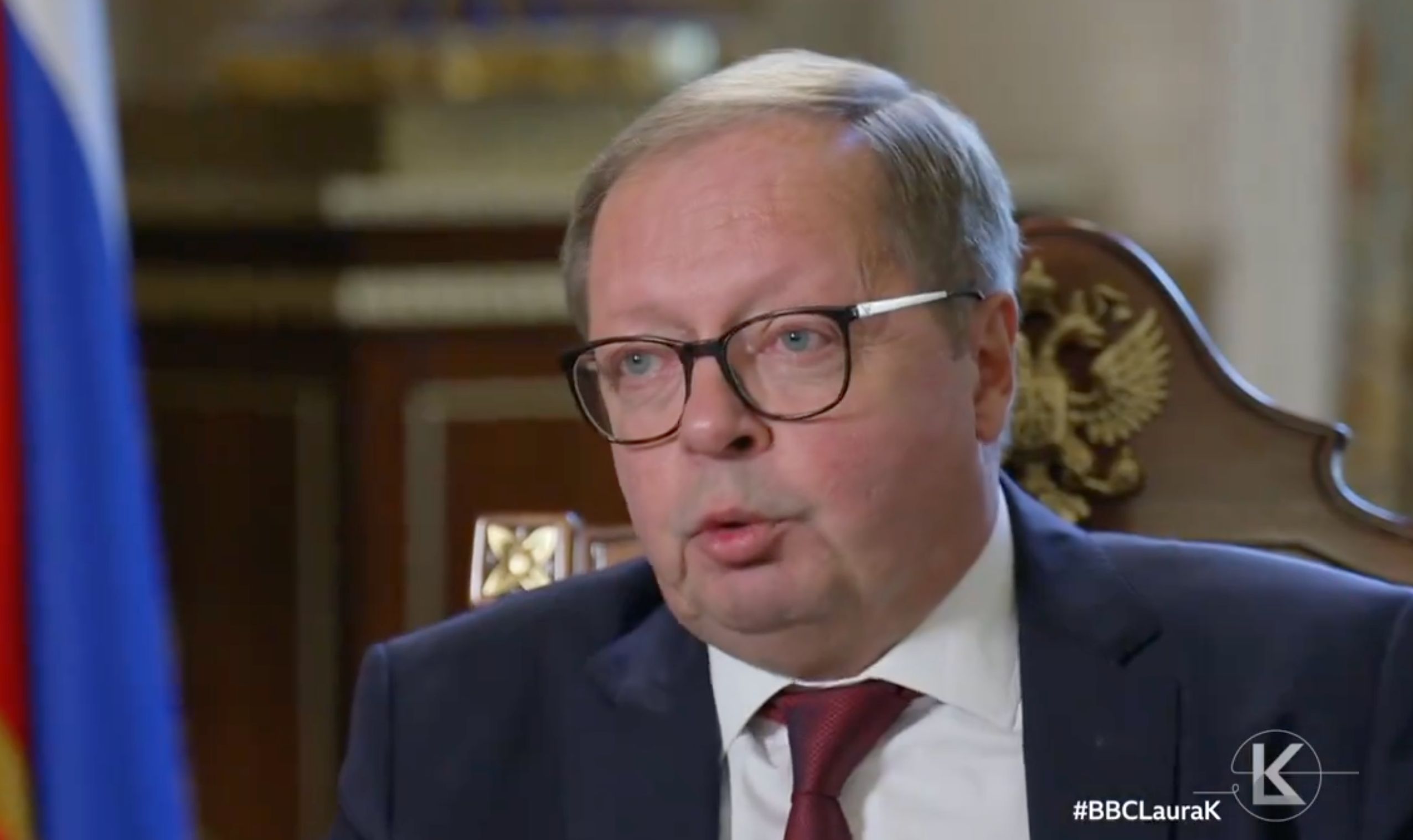
Putin’s UK Ambassador Says 1 Aspect Of Ukraine War Is ‘Worrying’ Kremlin

The Russian ambassador to the UK has claimed there was one aspect of the Ukraine war which is “worrying” the Kremlin.

Speaking to the BBC’s Sunday with Laura Kuenssberg, Andrey Kelin slammed Ukrainian president Volodymyr Zelenskyy’s supposed “victory plan,” which he has been presenting to Western allies, suggesting it was a concern.

The ambassador claimed: “What is worrying us is there is no peace in the peace plan presented by Zelenskyy. He did not want peace negotiations.

“He continues to ask for more and more Nato, European Union assistance, defence packages, anything. But nothing about negotiations at all.”

Ukraine has made it clear the war is not over until it reclaims all of its land from Russia, including Crimea, which was annexed in 2014.

But Moscow says it will only end the war when it can officially claim the Ukrainian land it currently occupies.

When Kuenssberg pointed out that Zelenskyy has said he will not negotiate with the Kremlin, Kelin smiled and said: “Fine, then he will lose more and more terrain.”

Russia currently occupies around 18% of Ukraine’s entire territory.

Ukraine did turn the tables and seize a comparably small Russian region called Kursk in August, but its troops are now slowly losing ground.

Kuenssberg also asked the ambassador about growing speculation that Russia is leaning on authoritarian states to prop up the war.

She said: “Are you comfortable, as an experienced diplomat of many decades, with having to rely on support from pariah states like North Korea and Iran?”

He said: “For you perhaps, it is pariah states – for us, it is normal people.”

The ambassador added that just because those countries have “different views” should not stop Russia having a relationship with them.

Kuenssberg then suggested: “Isn’t the truth here that you and Vladimir Putin are both sitting in grand luxury refusing to budge while thousands of civilians – Russians and Ukrainians – are suffering as a result of this conflict, which your government could bring to an end and yet you persist with it?”

He said the UK and its allies could end the war if they stopped aiding Ukraine, adding: “Stop the armament supplies, do it!”

As Kelin insisted that the war was not putting a strain on Russia, Kuenssberg then changed tactic, and asked: “Does the suffering in this war ever keep you awake at night?”

He said: “No one likes the war, and we stand for the quickest diplomatic and political settlement.”

When she asked her question again, he said: “Yes, well, sometimes I feel like and I anticipate the end of it, the quickest end of it. And I hope it will end sometime.”

Kelin also used the interview to claim the UK is waging a proxy war against Russia by supporting Ukraine, even though Putin ordered the invasion of the neighbouring European country back in 2022.

“You think we’re at war with your country?” Kuenssberg pushed.

He replied: “I think you are aggressive, that you are waging a proxy war against Russia.”

He also claimed Zelenskyy is “desperate” and “losing the conflict”.

“The end of this phase will mean the end of Ukraine,” he said, adding: “Defeat, over the course, is in view.”

As expected, Kelin’s comments were quite at odds with the most recent message coming from the UK government about the war.

On Friday, PM Keir Starmer told journalists that while the war in Ukraine “is incredibly tough, it is also true that Russia is getting weaker”.

He claimed: “This war is soaking up 40% of their budget … Last month, Russia suffered the highest daily casualty rate so far.”

Speaking at the British Embassy, Starmer said: “We’re absolutely united in our resolve, and we’ll back Ukraine for as long as it takes.”

Share Button