Actress Emilia Clarke and her mother Jenny are named in the New Year Honours for brain charity work.


Actress Emilia Clarke and her mother Jenny are named in the New Year Honours for brain charity work.

Last year, Typhoon Hinnamnor — which caused 36 fatalities — gained notoriety as the first super typhoon that developed at a high latitude as 25°N since Korea Meteorological Administration records began. This year in Osong, Chungcheongbuk-do, an unanticipated intense downpour, caused rivers to suddenly overflow, resulting in numerous casualties. Earth’s rising temperatures are triggering unprecedented typhoons, torrential rains, and other extreme weather events. Without reliable predictions of climate extremes prompted by global warming, mitigating the resultant damages remains a challenge.
Professor Seung-Ki Min and Dr. Minkyu Lee, from the Division of Environmental Science and Engineering at Pohang University of Science and Technology (POSTECH), have used a high-resolution climate model to conduct a pioneering quantitative analysis of the impact of global warming on typhoons making landfall on the Korean Peninsula. This research has been recently published in npj Climate and Atmospheric Science.
Notably, global warming is giving way to a surge in more powerful typhoons which maintain its intensity longer and thereby cause stronger damage. Accurate typhoon prediction and damage reduction necessitate better understanding of the global warming influences, for which climate model simulations with a km-scale resolution are eccential. However, studies quantifying the anthropogenic warming contribution to typhoons affecting Korea, especially research into the rainfall extremes accompanying typhoons, remain scant.
To overcome this, the research team designed a 3 km high-resolution regional climate model simulation to investigate the impact of global warming on typhoon intensity and extreme precipitation. Four extremely strong typhoons that made landfall on the Korean Peninsula between 2011 and 2020 were chosen for simulation under current climate condition and counterfactual condition without human-induced warming. To reduce the uncertainties in regional sea surface temperature changes due to global warming, they utilized diverse ocean warming patterns estimated from CMIP6multiple climate models.
The findings show that accounting for global warming from human activities augmented overall typhoon intensity and precipitation. The research team observed that the impact of warming was pronounced more strongly at maximum typhoon intensity than the average intensity. This implies more frequent occurrences of powerful super typhoons over East Asia in the future. Additionally, the area exposed to extreme rainfall generated by typhoons expanded 16 to 37 percent due to warmer climate conditions. Further, the expansion of extreme precipitation area is attributed to the strengthening of upward motion near the typhoon center and the increase in atmospheric water vapor due to the ocean surface warming.
Professor Min explained, “Our results from high-resolution climate model simulations provide conclusive evidence that global warming has amplified the strength of recent typhoons making landfall on the Korean Peninsula. Continued escalation of global warming could lead to stronger typhoons and more extensive occurrences of rainfall extremes, demanding heightened sector-specific preparedness measures.”
This study received support from the Mid-Career Researcher Program of the National Research Foundation of Korea and the Korea Meteorological Administration Research and Development Program on Climate and Climate Change Monitoring and Prediction Information Application Technology.

Of the world’s various weather phenomena, fog is perhaps the most mysterious, forming and dissipating near the ground with fluctuations in air temperature and humidity interacting with the terrain itself.
While fog presents a major hazard to transportation safety, meteorologists have yet to figure out how to forecast it with the precision they have achieved for precipitation, wind and other stormy events.
This is because the physical processes resulting in fog formation are extremely complex, according to Zhaoxia Pu, a professor of atmospheric sciences at the University of Utah.
“Our understanding is limited. In order to accurately forecast fog we should better understand the process that controls fog formation,” said Pu, who led a fog study focusing on a northern Utah valley.
Now, in a recent paper published by the American Meteorological Society, Pu and her colleagues have reported their findings from the Cold Fog Amongst Complex Terrain (CFACT) project, conceived to investigate the life cycle of cold fog in mountain valleys.
Also working on the project, funded by a $1.17 million grant from the National Science Foundation, were several other members of the U Department of Atmospheric Sciences, including Gannet Hallar and Sebastian Hoch, along with Eric Pardyjak of the Department of Mechanical Engineering, a group of scientists from the National Center for Atmospheric Research (NCAR), and Dr. Ismail Gultepe from Ontario Tech University, Canada.
Because it reduces visibility, fog poses serious hazards to the traveling public. For example, fog is the second leading cause of aircraft accidents after high winds. It leads to automobile crashes and disrupts ferry operations.
Between 1995 and 2004 in the United States, 13,720 have died in fog-related accidents.
Improving fog forecasting would make traveling more safe, Pu said.
Today, most forecasting uses a computer model known as Numerical Weather Prediction (NWP), which processes massive meteorological observations with computer models to output predictions for precipitation, temperature, and all sorts of other elements of the weather. However the current computer model doesn’t work well for fog, and Pu’s team hopes that improvements can be made using the masses of data they gathered over seven weeks in the winter of 2022 at several sites in the Heber Valley.
“Fog involves a lot of physics processes so it requires a computer model that can better represent all these processes,” Pu said. “Because fog is clouds near the ground, it requires a high-resolution model to resolve it, so we need models at a very fine scale, which are computationally very expensive. The current models (relatively coarser in resolution) are not capable of resolving the fog processes, and we need to improve the models for better fog prediction.”
Located bout 50 miles southeast of Salt Lake City, Heber Valley is nestled behind the Wasatch Mountains and framed by two major reservoirs on the Provo River.
This scenic basin is a typical mountain valley, hemmed by Mt. Timpanogos and other high peaks, with the reservoirs serving as a moisture source. The seven-week study window covered the time of year when Heber Valley is the foggiest.
Valley fog is a perfect example of how topography and atmospheric processes converge to create a distinctive weather phenomenon.
The ground is cooling overnight while denser, cooler air drops from mountain tops collecting in the valleys, in a phenomenon known as “cold air drainage.” Cooled by the ground, the dropping air temperature can approach the dew point, and if there is sufficient moisture in the air, fog begins to form, becoming the most dense around sunrise when surface temperatures are lowest.
Winter nights create favorable conditions for different forms of fog, such as cold-air pool fog, ephemeral mountain valley fog and radiative ice fog.
The Heber Valley project homed in on cold-air fog which forms in freezing temperatures below zero degrees Celsius, according to Pu. However by observing how these varying kinds of fog form and dissipate, the researchers are continuing to learn about the meteorological conditions and physical processes governing the formation of fog.
For the CFACT study, the NCAR and U team set up two major data-collecting stations, one near Deer Creek Reservoir and another a few miles up the Provo River. These are low spots in the valley, about 5,450 feet above sea level, that see the densest fog. These sites were equipped with 100-foot towers to support an array of instruments that captured various meteorological data associated with humidity, wind, visibility, temperature, even snow depths, and soil moisture. The recordings were made from both in situ and remote-sensing platforms.
Additionally, the team recorded a lesser array of data points at nine satellite sites.
During the seven-week CFACT field campaign, nine intensive observation periods (IOPs), each conducted over 24-hour periods, yielded a dataset that included high-frequency radiosonde profiles, tethered balloon profiles, remotely sensed thermodynamic and wind profiles, surface meteorological observations and microphysical and aerosol measurements.
Besides fog IOPs, the variety of non-fog IOPs provided valuable observations for understanding near-surface inversion, ice crystal formation, moisture advection and transportation, and stable boundary layers over complex terrain, all of which are essential factors related to fog formation. Comprehensive studies are ongoing for an improved understanding of cold fog over complex terrain.
The study appeared Nov. 15 in the Bulletin of the American Meteorological Society. U researchers involved with the study included Zhaoxia Pu, Sebastian Hoch, A. Gannet Hallar, Rebecca Beal, Geraldo Carrillo-Cardenas, Xin Li and Maria Garcia of the Department of Atmospheric Sciences and Eric Pardyjak and Alexei Perelet of the Department of Mechanical Engineering.

Amid the threat of dramatic sea level rise, coastal communities face unprecedented dangers, but a new study reveals that as flooding intensifies, disadvantaged populations will be the ones to experience some of the most severe burdens of climate change.
While accelerating sea level rise will result in widespread intermittent flooding and long-term inundation in many coastal communities, the paper, recently published in Nature Communications, showed that when these levels increase above 4 feet, minority populations will be disproportionately at risk of isolation.
Rising sea levels could lead to isolation by disrupting transportation networks and roads, meaning that those affected lose access to essential locations such as critical emergency services and schools.
The study further exposed that renters and older adults face a greater risk of isolation, highlighting the growing connection between historical drivers of existing social inequality and the groups that incur the most risk of climate change.
According to Kelsea Best, lead author of the study and an assistant professor of civil, environmental and geodetic engineering at The Ohio State University, the first step in better characterizing these threats is changing how researchers assess community risk, as most studies measure this by exclusively determining impacts via direct flooding. But concentrating on this sole measurement neglects more complex aftereffects of sea level rise, such as isolation, and reinforces inequality in coastal areas, Best said.
“We need to re-conceptualize how we measure who is burdened by sea level rise because there are so many ways that people might be burdened before their home is flooded,” she said.
Current reports estimate that around 20 million coastal residents in the U.S. will be affected by rising sea levels by 2030, but the paper notes that this number doesn’t include the whole impact global warming will have on certain communities and demographics.
Notably, because people need access to essential places like grocery stores, public schools, hospitals and fire stations, Best and her colleagues argue that an inability to reach these places impacts individuals just as negatively as if they were living in inundated homes themselves, and should be documented as such.
Most importantly, their results expose one of the main reasons for these vast differences in risk: A group’s risk of isolation is intimately entwined with specific road networks and where vital services are located in relation to where affected individuals reside.
They identified these disparities in risk by overlaying OpenStreetMap (OSM) road network data with National Oceanographic and Atmospheric Administration (NOAA) mean higher high water (MHHW) scenarios. These projections were then combined with recent census data to estimate the percentage of a population that would be left out or missed in estimates of who would be impacted by sea level rise if researchers only counted those who suffered direct inundation.
“If we take a one-size-fits-all approach, or a seemingly ‘neutral’ approach to understanding who gets access to safe, affordable housing and community in a world with climate change, then we’re really just exacerbating these inequities and it’s not good enough,” said Best. “We have to deliberately seek to provide access to adaptation resources to groups of people who have historically been left out and therefore have fewer resources to respond in the first place.”
The researchers showed that Hispanic populations are often overrepresented in the total citizenry for being at risk of isolation beginning at 4 feet of sea level rise, and Black populations are overrepresented after 6 feet. Alternatively, white populations are underrepresented after 5 feet of sea level rise.
But to determine when these disparities will begin to develop, Best’s team compared two long-term sea level rise scenarios: an intermediate scenario in which global sea level rise increased by a meter by 2100, and a high scenario in which that number increased to 2 meters by the same year.
Alarmingly, the study found strong evidence that these isolation effects would set in by 2120 in the intermediate scenario and as early as 2090 in the high scenario. “This timeline matters from a planning and adaptation perspective,” said Best. “Part of why we included the temporal piece is to say this issue would not be as much of a problem if we had urgent, aggressive mitigation.
“The effects of climate change are going to be further reaching and more cascading than might be directly obvious, and those effects are not going to be felt equitably,” said Best. “So we need to be thinking about those populations most at risk from the beginning and develop policies to support them.”
The work was supported by the Clark Distinguished Chair Endowment (given to study co-author Deb. A. Neimeier of the University of Maryland) and the National Science Foundation. Other co-authors were Qian He from Rowan University, Allison C. Reilly from the University of Maryland, and Mitchell Anderson and Tom Logan from the University of Canterbury.
A person dies in Scotland after an outbreak of the infection in the UK.
Onions are found in most cuisines across the world. They’re cheap, they have a good shelf life and they grow year-round. About 6.75 billion pounds of onion are produced each year just in the United States, according to Colorado State University’s food source database, and global production reaches as high as 105 billion pounds per year. You probably have onions in your pantry, and they could even be in the food you are eating right now.
But did you know onions may make a large portion of the population feel sick?
Yes, the onion and its relatives (chives, shallots and even garlic) can cause a wide range of symptoms including gastrointestinal distress, migraines and, though rare, anaphylactic shock. And yet onions are found everywhere. U.S. consumption has grown 70% since 1982, according to the National Onion Association.
Advertisement
But for some people, onions can be part of a recipe for disaster. For patients with irritable bowel syndrome, or IBS, onions are “one thing most of our patients can’t tolerate,” said Dr. Jane Muir, associate professor and head of translational nutrition science at Monash University. Onions and garlic are high in fructan, a carbohydrate found in many fruits and vegetables that many people cannot digest well and can cause bloating or diarrhoea. The Cleveland Clinic estimates that 10% to 15% U.S. adults have IBS, so that’s a lot of folks who may have issues with onion and garlic.
Some people may even have an allergic response to onion, but that is far rarer. In a patient registry maintained by the organisation Food Allergy Research and Education, “139 of 11,411 individuals (or 1.2%) self-report as having an onion allergy,” said Dr. Bruce Roberts, chief research strategy and innovation officer at FARE. While you have to take the numbers with a grain of salt since they are self-reported, a 2020 Spanish study of garlic and onions had similar results, with 1.1% of people reporting an onion and garlic allergy.
While it may be a rare allergy, it is more common as a food intolerance. “Onion and garlic are common [food intolerances] that I definitely hear” from patients, said Dr. Kara Wada, assistant clinical professor in allergy and immunology at Ohio State University. The other two common categories of food intolerances that she regularly sees are lactose intolerance and fructose intolerance.
Dr. Sai Nimmagadda, attending physician and clinical assistant professor of allergy and immunology at Northwestern University, estimated that 1%-5% of his patients have reported some kind of onion sensitivity. When asked, Wada said that figure was comparable to her practice. But the actual number of people with an onion and garlic food intolerance in the U.S. or elsewhere is not currently known due to challenges in testing for it, and is likely to be higher.
Advertisement
However, cases of food intolerance, along with food allergies, are rising according to all the doctors interviewed in this article. Given the significant amount of onions and garlic consumed, it’s not something to sniff at. The Spanish study mentioned above concluded, “Allergic hypersensitivity to garlic and onions should not be underestimated and, given their high consumption, should be included in the diagnostic food allergy battery.”
So what’s the difference between a food allergy and food intolerance? The latter is “a condition when the body is unable to digest or absorb certain nutrients,” explained Dr. Ruslan Medzhitov, professor of immunobiology at Yale University and chief scientific officer at the Food Allergy Science Initiative. The offending nutrient then builds up in the gut and draws in water, which causes bloating and diarrhoea.
Then there are allergies. These involve the immune system, which attacks the noxious food in the gut. There are two types, Roberts noted: IgE mediated response and non-IgE mediated response. The former is what most people think of as an allergy; when someone ingests, inhales or comes into contact with an allergen, the entire body reacts, involving multiple organs like your skin and your cardiovascular and respiratory systems. It’s pretty immediate and can be lethal.
Non-IgE mediated responses tend not to be quite as potent and are less likely to be life-threatening. The reaction tends to be delayed by a few hours and can cause nausea, vomiting and/or diarrhoea.
While food reactions can cause headaches, Roberts noted, “The question concerning migraines is challenging because patients can experience headaches due to sinus congestion in the case of IgE mediated food allergy or anxiety but not a true migraine. The literature suggests food intolerance is more likely to trigger a migraine.”
Advertisement
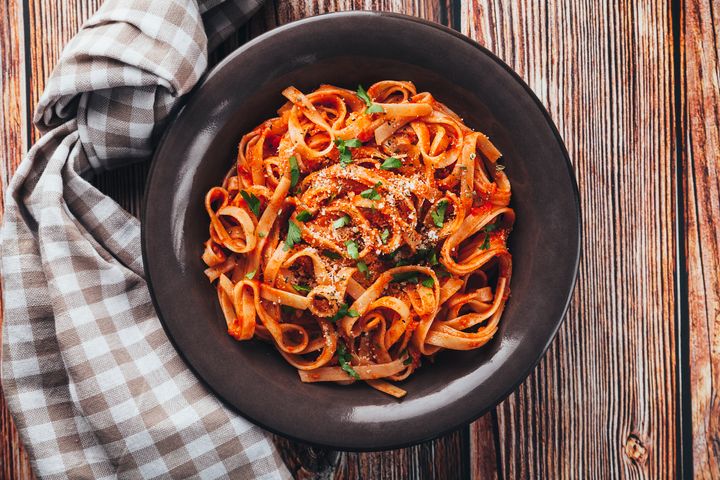
Cris Cantón via Getty Images
As to why food intolerance could cause migraines, Roberts noted that the gut-brain connection is strong. There are sensory receptors in our guts that will send up signals to the brain that “there’s something amiss,” he explained.
“And so that’s when you have things like nausea, headaches and other things,” Roberts said.
While it stinks to have a true onion allergy, researchers and medical professionals know a lot more about IgE mediated allergic reactions since they are something that can be tested for and possibly treated. Non-IgE mediated allergic response and food intolerance are a lot harder to uncover, Roberts pointed out. There’s “no reliable testing [for food intolerances] worth spending your time, energy or money on,” Wada added.
So it’s a challenge to know exactly how many people have an intolerance to onion or garlic without an easy way to evaluate for it.
On top of it all, Nimmagadda said the challenge is that “there’s a lot that we don’t understand about foods.” Food is so complex, filled with all sorts of proteins, carbohydrates, lipids and more; humans are all different, including the microbiome in our stomach. For instance, he noted, “I’ve had some patients that cannot have Chilean wine, but they’re fine with Italian wine.” And of course, there’s such a spectrum of reactions on top of it all. Wada noted that someone may have issues with fructan in the onions and garlic, or something else like the sulfites in it.
Advertisement
The symptoms and root causes of food intolerances can also differ from person to person. For instance, people with food intolerances may be able to tolerate a certain quantity of onions, or cooked onions. But when the person eats over that threshold or eats raw onions, that’s when all bets are off. Nimmagadda noted that cooking onions can degrade some of the proteins that cause people trouble. However, he said cooking food can sometimes make the reaction even stronger, such as with peanuts. (Raw peanuts are less potent than cooked peanuts.)
It’s important to note that people with a food allergy cannot tolerate any amount of the allergen.
You may not know what is actually causing your upset stomach or your migraine. It could be the sauce that you put in your favorite dish or maybe the ingredient not even listed on the restaurant menu.
So how do you figure it out? All the doctors recommended seeking medical professionals if you suspect a certain food or foods are bothering you. Nimmagadda recommends keeping a food diary so that you may be able to correlate your symptoms with the foods you eat and even the quantity of food. Working with a doctor and a reliable food allergy may help to figure out which food is problematic for your system. Perhaps it’s a single restaurant that’s causing all your digestive problems.
For people medically diagnosed with IBS, there’s the FODMAP diet, developed by Muir and her colleagues at Monash University. FODMAPs are a variety of carbohydrates that are naturally found in food that can trigger symptoms; onions and garlic are one of the offending foods.
The basic idea is that for two to six weeks you swap out high-FODMAP foods with low ones and then gradually introduce them back into your diet one at a time. Muir said, “It’s a learning diet or process where people have to learn which of their FODMAPs [are causing problems] because everyone is different.” But she noted that this diet is intended only for people medically diagnosed with IBS and collaborating with a dietitian.
Advertisement
For many people, avoiding the offending food might be the best practice, but that’s not always possible when we eat food that we haven’t cooked ourselves. Nimmagadda said you can talk to the chef about what’s in the food to get in front of any unpleasant surprises. Or maybe find restaurants that you’ve had a favourable history with. Definitely let people who cook for you know about it.
If you have been feeling less than stellar after eating, it may be time to investigate whether you have an intolerance, or worse, an allergy to onions or other food. Nimmagadda summed it up best: “Educate yourself; know your body, know your symptoms, and then seek out treatment. Get evaluated. You can find solutions. You don’t have to live with this.”

The holidays traditionally are for getting together with the people you love most. Tradition also holds that it’s the season of office parties and other semi-mandatory affairs. Whether you’re attending the next cocktail (or ugly sweater) party excitedly or begrudgingly, a good cocktail is likely to improve the evening.
While there’s nothing wrong with hot toddies or spiked eggnog (actually — I take it back, there’s plenty wrong with eggnog), an expert-designed seasonal cocktail could be a nice change of pace. Warm your bones with one of these recipes, shared by some of New York’s most impressive bars and restaurants, and give your guests the gift of a good, stiff drink.
You may have to make a trip to a bar specialty store, or, you know, the internet, to pick up some of the requisite ingredients, but we’ve included tips for substitution whenever possible. You’ll want a basic bartending set with a cocktail shaker, strainer and muddler to make these. We’ve also suggested glassware and garnishes for each cocktail, if you’re going all out. Also, flavoured syrups aren’t a bad investment — they’ll taste great in your coffee on Christmas morning.
Advertisement

Courtesy of Casa Ora
Not into eggnog? Good news: You can offer your guests something comfortingly creamy that isn’t glorified boozy custard. Ivo Diaz, the co-owner, beverage director, and chef at Casa Ora, a stylish Venezuelan restaurant in Brooklyn’s East Williamsburg, shared this recipe for a rich and delicately spiced drink that’s sure to warm up your insides.
There is some prep involved, but you can make the chicha de arroz and cinnamon syrup hours or even days before guests arrive. To make things even easier, you can grab a bottle of premade cinnamon simple syrup online or at a kitchen specialty store.
Once you have your syrup and chicha on hand, you’re really only working with three ingredients, so it should be easy enough to shake these up for guests and still enjoy your party. For a really professional look, invest in a jumbo ice tray to make cocktail bar-ready ice blocks.
Advertisement
To make your own cinnamon simple syrup:
In a pot, muddle about 3/4 ounce (by weight) of cinnamon bark, and add 2 cups of water and 2 cups of Domino superfine sugar. Bring to a boil, stirring occasionally, then cover and reduce heat to a simmer for 15 minutes. Strain with a fine strainer before storing.
To make the chicha de arroz:
Combine 16 ounces rice milk, 1 can sweetened condensed milk, 1 can evaporated milk, and 1/2 teaspoon cinnamon powder in a blender until smooth. Store in a container and keep refrigerated.
To make the cocktail
Combine cinnamon simple syrup, chicha de arroz and mezcal in a shaker with ice. Double strain into a rocks glass over a jumbo rock block and garnish with mint leaves.

Courtesy. of Ophelia
Advertisement
Treat your loved ones to a partridge in a nashi pear tree — or at least a creative and pear-flavored take on a classic whiskey sour. The Nashi Sour, by bar director Amir Babayoff of Ophelia in Manhattan’s Midtown East, features spiced winter fruit flavours frothed up with egg white.
We suggest you buy liquid egg whites rather than having to deal with cracking eggs and separating yolks while you’re trying to entertain company. For the most faithful version of this drink, try to stick to Babayoff’s suggested liquors as much as possible. Again, you can find ginger and cinnamon syrups online, if not at your local HomeGoods; or, you could go full elf and make your own.
Add all ingredients, dry shake, add ice, shake and double strain into a Nick and Nora glass. To garnish like the restaurant does, cover half of the top of the glass with a square white paper and spray or sprinkle chai powder on just half of the foam.

Courtesy of Lindens
Advertisement
If you haven’t yet had your fill of cranberry sauce (I know I haven’t), this vodka-wine spritzer by Gary Wallach, beverage director at Lindens, could be your new party signature. The bar, newly opened at the Arlo Soho in New York, serves theirs in a highball glass, dressed with an elaborate garnish of fresh thyme, lemon zest and a roll of dried cranberry leather.
If you can’t find thyme and apple liqueurs at your local liquor store, snag them online. Same goes for the spiced cranberry shrub — a traditional mixer made with sugar and vinegar for a tangy-sweet taste. You can make your own if you’re feeling ambitious. But if you’re normal, you can find inexpensive craft shrub online — here are a couple of options we found.
Once you’ve shaken all the other ingredients together, top it off with Lambrusco, a sparkling and often sweet red wine, to taste.
1 dash angostura bitters
1 teaspoon thyme liqueur
1/2 ounce spiced cranberry shrub
3/4 ounce lemon juice
1/4 ounce apple liqueur
1.5 ounces vodka (Belvedere is suggested)
Lambrusco, free pour
Optional: thyme sprig, lemon twist, cranberry fruit leather, and/or grated nutmeg, to garnish
Add all ingredients except for Lambrusco into a small cocktail shaker. Add ice and shake vigorously. Strain into a highball glass over fresh ice, top with Lambrusco and garnish. Lindens uses a thyme sprig, lemon twist, cranberry fruit roll-up and grated nutmeg.
Advertisement

Courtesy of Mala Project
From Christmas cookies to candy canes, December is the time when your sweet tooth is likely to reign supreme. If you’re hoping for a cocktail that will fulfill your candy cravings, Irene Li of New York’s MáLà Project restaurants has one that combines chocolate, peppermint — and some raspberry for good measure. You’ll probably have to buy a few new liqueurs for your stash, so consider getting nice ones that you’ll be excited to experiment with all winter.
Combine white chocolate liqueur, peppermint schnapps, raspberry liqueur, vanilla extract and vodka in a shaker. Fill the shaker with ice and shake until all ingredients are well incorporated.
Pour into a chilled rocks glass. Top off with crushed candy cane pieces and a peppermint stick or two (or three … we’re not counting).
Advertisement

Kartrite Resort
This light and fruity drink comes from the Kartrite Resort located in the Catskills in New York state, and it’s a great way to use up the last apples of the season.
Your first step is to muddle your fresh apple chunks, so if you don’t already have a muddler on your bar cart, now’s the time to pick one up. Or, you can simplify that step by just using your favourite store-bought apple cider.
And if you don’t already have St-Germain on hand, you won’t regret picking up a bottle. The herbal, elderflower-flavoured liqueur is a great cocktail staple that you’ll find uses for well into the spring. As for the garnish, Kartrite serves the Manzarita with a flaming cinnamon stick — but you can feel free to leave yours unsinged.
1 1/2 ounces blanco tequila
1/2 ounce St-Germain
1/2 ounce cinnamon syrup
3/4 ounce fresh-squeezed lime juice
3-4 small cubed apple pieces (or 3/4 ounce of apple cider)
Cinnamon stick, to garnish
In your cocktail shaker, muddle the apple. Add all remaining ingredients to the shaker with ice. Shake for 6-8 seconds. Double strain into a rocks glass over ice. Garnish with cinnamon stick and serve.





Whether you’re new to cooking or you’ve been doing it for decades, it’s entirely possible you have no idea what you’re doing in certain areas. One particular topic that home cooks struggle with is understanding the differences between parchment paper, wax paper, aluminium foil and freezer paper, and when to use which one.
And trust us, mixing them up could legitimately ruin your recipe in some cases.
What’s the difference, and which materials are interchangeable? We talked to the experts to clear up any confusion you might have. Read on for the inside scoop on exactly when to use parchment paper, aluminium foil, wax paper and freezer paper — and exactly when you shouldn’t.
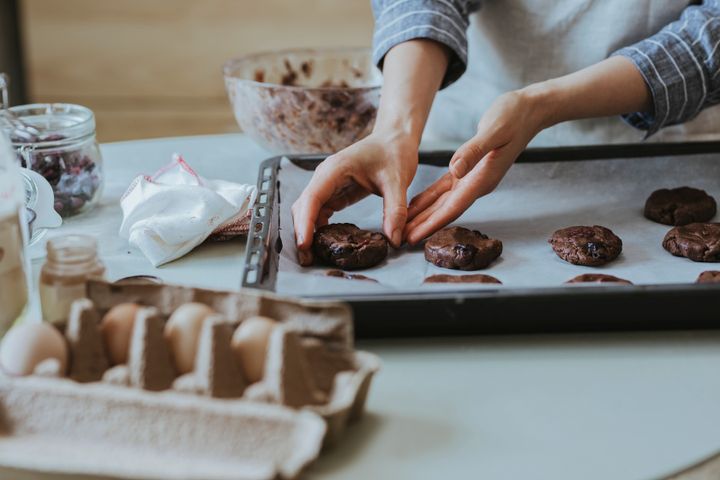
FreshSplash via Getty Images
Advertisement
Thanks to its versatility, parchment paper is the shining star of the kitchen. It’s an odourless paper made from cotton fibre and pure chemical wood pulps that’s been coated with silicone. In addition to being nonstick, it’s heat- and moisture-resistant.
Parchment can be used for many kitchen tasks, but it’s best known for acting as a liner for baking sheets and pans, helping to promote even cooking and food not sticking. And according to Laura Ritterman, the cook behind the food blog Recipe Fairy, it also makes cleanup a whole lot easier. Think: being able to slide roasted veggies, cookies, fish and more right off the baking sheet with no mess.
“You can also line parchment paper on your kitchen counter to aid in cleanup,” said Christina Musgrave, a professional recipe developer. Because it’s nonstick and moisture-repellent, you can do all of your chopping, mixing, kneading and rolling on top of a layer of parchment, then toss it when you’re done, saving you the trouble of scrubbing down your countertops later.
Despite being super-versatile, parchment paper can only be used up to a certain temperature. “You can normally use parchment paper up to around 420 degrees Fahrenheit,” Musgrave said. “Heating it over that temperature can risk it catching on fire.” For safety purposes, always know the heat limit of the brand of parchment paper you’re using while cooking.
Advertisement
As for what to use as a substitute if you find yourself out of parchment paper, that depends on what you’re planning to use it for.
“Foil can be used to help prevent food from sticking, so long as it’s well-greased,” Ritterman said. (Or, if you’re specifically using a nonstick foil.) “It’s not as good as parchment paper, but can be used in a pinch if you don’t have any.” For easier cleanup, wax paper is a good choice for covering countertops.

MirageC via Getty Images
Runner-up in the versatility department is aluminium foil, which is made of over 98% aluminum ― the balance of which consists mainly of iron and silicon for added strength and puncture resistance. During the final rolling, two layers of foil are passed through the mill at the same time. The side that comes into contact with the polished steel rollers becomes shiny, the other side dull.
This is why, despite popular belief, it doesn’t matter which side of the foil contacts your food. (The only exception to this is nonstick foil, which does have a dull side that’s nonstick ― perfect for cooking foods that are cheesy or sticky.)
Advertisement
Where aluminum foil really shines (pun totally intended) is with high-heat cooking, like grilling and broiling. Any recipes that require cooking foods at a higher temperature than your parchment paper can hack, that’s where foil comes in.
Another handy skill? “Aluminium foil helps with even cooking or baking in the oven, mitigating the burning of food before it has finished cooking,” Ritterman said. “This is great for things like casseroles, roasts or pies.”
Say you don’t want your turkey or casserole to over-brown ― make a foil tent by placing a sheet of foil over your roasting pan or casserole dish, leaving a 1-inch gap between the top of your food and the foil tent for heat circulation, then crimp the foil onto the long sides of the pan so it stays put.
To keep your pie crust from burning while the centre bakes, foil to the rescue: Take a 12-inch foil square and fold it into quarters. Cut out the centre and round off the edges so you’re left with a ring that’s two inches wide. Unfold the ring and place it over your pie, removing it for the final 20 minutes of baking time.
“Because foil easily holds its shape, you can also wrap foods (meat, potatoes) to prevent them from losing moisture as they cook, as well as make foil packs of food to pop in the oven or on the grill,” Kyrie Luke, recipe developer and blogger at Healthfully Rooted Home, told HuffPost. (It’s an especially effective strategy for more delicate foods, like veggies and fish.)
Advertisement
But you should never use aluminium foil in the microwave. “Since aluminium foil is metal, it can heat so quickly that it can cause a spark and catch on fire,” Musgrave warned.
The best replacement for foil is parchment paper — specifically, for oven cooking and making food packs. For high-heat cooking, however, aluminium foil is difficult to replace, with the closest options being grilling papers and oven and barbecue bags.
If you’re not sure whether to go with aluminum foil or parchment paper, just remember: Grill or broil, go with foil.

picture alliance via Getty Images
Wax paper is tissue paper that’s triple-waxed with a food-safe paraffin coating. It’s best known for covering countertops ― you can measure dry ingredients, such as flour, over wax paper and avoid a messy countertop during baking and cooking.
Advertisement
“It’s similar to parchment paper in that it can be used to keep food from sticking to surfaces, such as allowing chocolate-covered strawberries to harden or delicate artwork for cakes and pastries,” Ritterman said. It can even line pans for non-baked items, such as fudge or no-bake desserts to make cleanup easier.
Unlike parchment, wax paper shouldn’t be used in cooking situations that require heat. “Never use wax paper in the oven, microwave, grill or anything that conducts heat,” Luke said. “The wax will melt and it may cause a fire.”
The only exception to this rule is that wax paper can be used for lining cake pans for baking cakes. Because the cake batter completely covers the wax paper and absorbs much of the heat, the wax paper won’t smoke or melt.
The easiest way to remember whether to go with parchment or wax paper is to picture a burning candle as a reminder that wax melts. “The last thing you want is waxy food ― or a kitchen fire,” Luke said.
Freezer paper is a thicker paper that’s used for, you guessed it, freezing food. “It’s best known for wrapping meats and seafood for freezing to seal in juices and protect them from freezer burn,” Musgrave said.
Advertisement
One side of the paper is coated with either wax or plastic and provides a barrier to air and moisture that helps prolong the freshness, flavor and nutrition of your food while frozen, helping it last in your freezer for up to one year. Because the other side of the paper isn’t coated, it can be used to mark down the contents and pack date of the wrapped food.
Since freezer paper has a wax or plastic coating, it shouldn’t be heated ― otherwise, the wax or plastic will melt and ruin your food.
In a pinch, you can use heavy duty aluminium foil as freezer wrap, but because it can be torn and punctured easily, it’s best to use an overwrap, too.
“Wax paper can also replace freezer paper if you plan on eating the stored food in a short period of time,” Ritterman said. It’s not moisture-vapour resistant the way freezer paper is, though, so for longer storage times, freezer paper all the way.


The care home is put in special measures after a significant deterioration in the standard of care.
Stars and doctors hope Russell T Davies’s BBC drama Men Up can help end impotence stigma.
