Everything You Need To Know About ‘Ghost Tapping,’ The New Scam That’s Making People Lose Thousands

Tapping your phone to pay has become a common and easy way to purchase treats and gifts –– but it could also be a hidden way for fraudsters to scam you out of money.

That’s because some scammers might be “ghost tapping” and taking advantage of the tap-to-pay and mobile wallet technology when you buy goods on the street, according to a new alert by the Better Business Bureau, a nonprofit that tracks bad advertisements and customer complaints in North America.

In the scam reports, people say they unwittingly thought they were tapping to pay for legitimate purchases, only to later see they were being overcharged hundreds, and in some cases, thousands, of dollars.

In Illinois, a young man with a clipboard claimed that he was raising money for funeral expenses for a family member who had been shot and killed, according to one BBB report.

“I said I could donate $5…I handed my credit card to one of the men, who took my credit card and attempted tap-to-pay on his phone,” the victim recalled. “The interaction felt off to me, so I immediately checked my credit card accounts which both showed multiple charges for $2,496 each to a PayPal account.”

In the reports, scammers would avoid showing buyers what they were tapping for on the mobile pay terminals. That’s why asking to see the screen “to see exactly what’s happening is a great way to protect yourself,” said Melanie McGovern, the BBB’s director of public relations and social media.

‘Ghost Tapping’ Is Rare, But It’s A Good Reminder To Be On Guard
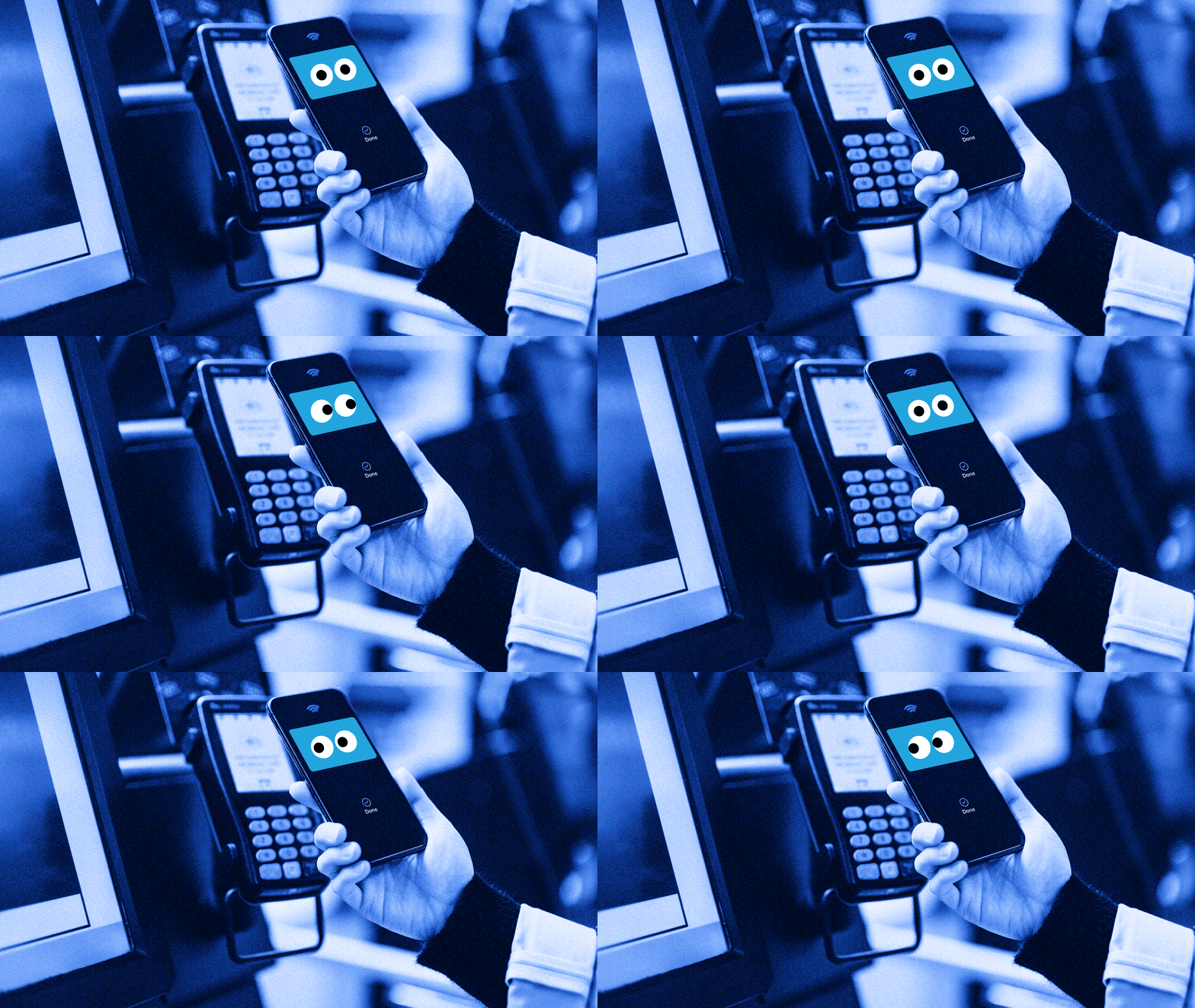
You should always double-check the amount you are being charged for, in order to avoid getting "ghost tapped."

Illustration: HuffPost; Photo: Getty Images

You should always double-check the amount you are being charged for, in order to avoid getting “ghost tapped.”

Don’t be scared to use tap-to-pay at legitimate vendors. To put this alarming scam in perspective, McGovern said her organisation has only gotten less than 10 reports of “ghost tapping” so far. But she is concerned there could be more instances during the holiday season.

During holiday craft fairs, “people have the great convenience of tap-to-pay,” she said. “So…it’s always good to make sure that you’re protecting yourself and you know exactly how much you’ve spent.”

Although it is technically possible for a scammer to “ghost tap” and use your phone’s tap-to-pay feature without you tapping, it would be highly unusual for this to happen without your knowledge. That’s because the near field communication that powers tap-to-pay technology requires a distance of four centimetres or less.

“That’s essentially the length of a paper clip,” said Michael Jabbara, senior vice president and head of payment ecosystem risk and control at Visa. “If you have any awareness of your personal space, if somebody is getting to you within that distance, you are going to kind of be aware of that, and you’re likely going to move away.“

But the idea of “ghost tapping” is a good reminder to always be alert to what’s happening on your credit cards that you upload to your phone.

Scammers “rely on the victims to not check their bank accounts until the end of the month or two months later,” Jabbara said. “My recommendation is always to do your research ahead of time, versus when you’re dealing with a [credit card] dispute.”

There’s An Easy Way To Combat Online Fraud

If you do lose money to this kind of scam, you can dispute a charge or file a consumer complaint with your local attorney general’s office.

But one of the best ways to combat “ghost tapping” ― or any kind of online payment fraud ― is to prevent it. Be vigilant about what is being charged to your phone, and by whom. Here’s how:

Turn on credit card transaction alerts.

Many fraudulent charges will get flagged before being approved by your credit card’s risk signals. But even if somehow that transaction gets approved, “You have the ability to turn on your transaction alerts that can be a ‘first line of defence’ against fraud,” Jabbara said.

That way, you can immediately know if your card made a transaction for a merchant name you don’t recognise for an amount that you wouldn’t have approved.

Always ask for a receipt.

Receipts are helpful proof of purchase if you need to later dispute a charge with your bank or credit card company.

And it’s also a good way to suss out a scammer. McGovern said a vendor telling you “I can’t give you a receipt. [My pay terminal is] broken” is a red flag that someone is scamming you.

These are a few basic but helpful ways you can unmask the ghost, and prevent them from stealing any money you haven’t authorised to spend.

Share Button

Revealed: This Age Group Of Boys Is Most Vulnerable To Online Abuse

The online world is vast – and while it can both educate and entertain kids for hours on end, there are murkier areas where they need to tread much more carefully.

New research from safety experts at McAfee has uncovered the most common online threats facing British children, including: cyberbullying, inappropriate contact and scams.

The study of over 4,300 parents found one in six say their child has been targeted by an online threat in the UK.

The highest risk group is 12-year-old boys, with almost a third (32%) being targeted.

For girls, online dangers tend to emerge later, with reports steadily climbing through the teens and peaking at age 16, where more than one in five parents (22%) say their daughter has been targeted.

What are the most common online threats facing children?

According to the research, cyberbullying or harassment from peers (48%) is the number one threat. Nearly half of UK parents say their child has experienced cyberbullying, while one in three (35%) ranking it in their top three worries.

Cyberbullying can include mean comments, exclusion from online groups or spreading harmful rumours, often through social media platforms.

Scams are also a huge problem – particularly fake social media giveaways or contests (33%), which purport to be giving away gaming consoles, smartphones or designer products.

Children are lured into clicking fraudulent links or providing personal information, with boys aged 13-15 particularly vulnerable.

Similarly, online gaming can be a hotbed for scams. Over a quarter (27%) of parents report their child has been affected by gaming-related fraud, such as fake offers for in-game currency, exclusive items or upgrades.

Scammers often pose as fellow players, using familiarity and trust to get children to share passwords or personal info.

There are also concerns about unsafe or inappropriate contact. One in four UK parents say their child has received inappropriate contact online, with girls being more frequently targeted (29% versus 21% for boys). Unknowns might try to initiate conversations with children via direct messages, chat rooms or even multiplayer gaming platforms.

And lastly, scam messages or phishing texts (21%) – designed to trick recipients into divulging sensitive information, such as passwords, bank details or personal data – are a problem.

Girls are significantly more likely to experience this (29%) than boys (14%), the study found, with those aged 16-18 most at risk.

The rise of AI-generated scams

Worryingly, parents are also noticing a rise in the use of AI-generated deepfakes and nudify technology. Nearly one in six UK parents say their child has experienced deepfake image or nudify app misuse.

Girls are facing this threat the most – 21% of parents say their daughter has been impacted, compared to just 11% for sons.

Boys are more likely to be targeted by AI-generated voice cloning scams, instead – where fraudsters use AI to mimic the voice of loved ones through phone calls, voicemails or voice notes.

Recently, experts advised families to come up with a “safe phrase” so they can tell if a phone call or message is an AI-generated scam or not.

Understandably, when children are impacted by these online threats, the emotional and psychological effects are significant and can include anxiety, academic struggles and social withdrawal.

How to keep kids safe

It’s clear parents need to be having ongoing conversations with their kids about online safety. (Check out these helpful guides from Internet Matters and the NSPCC if you need somewhere to start.)

But what else can we be doing to keep kids safe? Here are McAfee’s top tips:

  1. Pair tools with talks: Combine parental controls with regular, judgement-free conversations about harmful content, coercion or bullying so your children know they can come to you. Explain what cyberbullying and scams might look like, and that it’s okay to block or report people.
  2. Teach “trust but verify”: Show balanced digital habits yourself as children copy what they see. Show them how to pause, check sources and ask for help when something feels off – especially with AI-altered media.
  3. Talk about the risks of oversharing: Remind children never to share personal information such as their name, school, address or phone number. Encourage strong passwords and explain two-factor authentication.
  4. Set and revisit a family tech contract: Create clear boundaries with kids about screen time, online behaviour, and device use – and update them as your child grows.
  5. Keep devices secure: Ensure all devices are updated with the latest security settings and include AI-powered scam protection to help spot and flag suspicious links or manipulated content before it can do harm.
Share Button

Amazon Warns Receiving This Type Of Parcel Can Be A Scam

I was scrolling through Reddit last night when I noticed an odd-looking picture shared to r/Scams.

Site user u/Various_Ad9010 asked whether the sudden deluge of packages on their doorstep (which they hadn’t ordered) was some type of scam, and wanted to know what to do next.

Some site users suggested this was indeed a scam called “brushing.”

So, I thought I’d check whether or not this was a real thing ― and as it happens, Amazon have a whole page dedicated to the deceit.

What is “brushing”?

Amazon’s site explains that “When a customer receives a package they didn’t order, it may be a scam called ‘brushing.’”

It happens when scammers send parcels to addresses that didn’t order them. They can pick an address from pretty much anywhere.

Staffordshire police write that after a fraudster has gotten a person’s name and address, they create a fake Amazon account to which they then sell their own products.

They pay for the products, sometimes using stolen cards, the police add.

To make the scam look legit, the goods are really shipped to the unsuspecting person’s home.

“After the packages have been delivered, the scammer then writes positive reviews on their own seller accounts, using the recipient’s name,” the Staffordshire police add.

“This helps to boost their ratings and increase their visibility on the platform, in the hope of bringing about genuine sales.”

This is against company policy, as Amazon prohibits third parties from sending unsolicited packages to peoples’ homes.

What should I do if I suspect brushing?

Both the Staffordshire police and Amazon say you should report brushing scams immediately.

If you’ve asked friends and family whether they’ve sent you a gift and you’re sure nobody sent you anything unexpectedly, there are steps you can take on-site and with the UK legal system.

Amazon has a Report Unwanted Package form that you can fill in if you suspect brushing. You can also call customer service ― don’t try to return the packages.

They add investigators will need the following information:

  • Number of unwanted packages received.
  • A tracking number from at least one of the packages (found on the shipping label)
  • Photo of at least one shipping label (optional)
  • Any additional information to assist the investigation.

Meanwhile, Staffordshire police says that on top of reporting it to the e-commerce site, you can also reach out to your local police station or call Crimestoppers anonymously on 0800 555 111.

Share Button