Move Over ‘Six-Seven’. Kids Are Saying ‘Lowkenuinely’ Now

If there’s one thing we know about Gen Alpha, it’s that they low-key delight in coining a new word (or five) and the odd nonsensical phrase.

Take six-seven for example. It became a global phenomenon in 2025 thanks to social media, but it didn’t ever really mean anything. Or, at least, nobody could agree on a meaning.

Some said it meant “so-so” (as kids used it with an up-and-down hand motion), others thought it meant a tall person, or a basketball term.

In the end it just became a response that kids made at every opportunity – especially if someone (a teacher, parent, classmate) happened to mention those two numbers in a different context.

A teacher could say “turn to page 67 in your books”, for example, and the classroom would erupt into “six-sevennnnnn”.

Thankfully the bizarre phrase seems to have fizzled out, but teachers and parents are noticing that “lowkenuinely” has entered the chat instead.

What does lowkenuinely mean?

Lowkenuinely is a combination of ‘lowkey’ and ‘genuinely’, which describes expressing something sincere in a casual, laid-back way, according to experts at language platform Preply.

Essentially, it is a TikTok-era way of saying something is real or heartfelt. So, an example might be: “I lowkenuinely love this song” or “I’m lowkenuinely not going to make it through this exam”.

Kids of the internet clearly love a portmanteau (that is, blending two words together to create a new one).

Choppelganger is another recent creation hot off their keyboards, combining ‘chopped’, typically used by teens to describe someone as ugly; and ‘doppelganger’, which is a person who resembles someone else.

A choppelganger, then, is an uglier version of a doppelganger. One parent noted their kids had referred to them as “Uncle Fester’s Choppelganger”. Harsh.

There’s also been chat, clock it and glazing, as well as aura farming and crash out. Honestly, they’ve been busy.

Share Button

Parents And Experts Tackle The Tricky Topic Of Banning Under-16s From Using Social Media

After Australia made moves to ban under-16s from using social media, both the UK and France are considering a similar move.

The UK government has now launched a consultation on children’s use of technology, including social media, and said it’s seeking views from parents, young people and civil society – with a response expected this summer.

Over the weekend, more than 60 Labour MPs wrote to prime minister Keir Starmer urging him to back a ban, while members of the House of Lords are set to vote on a cross-party amendment to the Children’s Wellbeing and Schools Bill this week to raise the age of social media access to 16.

Esther Ghey, the mum of Brianna Ghey who was murdered by two teenagers, has lent her support to the amendment, saying it is a “vital step in better protecting children online”.

What do parents and experts think of a social media ban for young people?

In December 2025, a YouGov poll of 5,000 people found 39% of respondents “strongly supported” and 35% “somewhat supported” a ban on under-16s having social media accounts. In contrast, just 15% “somewhat opposed” and 4% “strongly opposed” it.

A separate survey by The Good Growth Foundation found 66% of respondents backed a social media ban for young people, while a petition calling for a ban on social media access for under-16s has been circulating in parent Whatsapp groups – at the time of writing, it had 65,000 signatures.

Dr Tracy King, is a chartered clinical psychologist who has a 13-year-old autistic daughter. She told HuffPost UK that from a parental and professional perspective, she supports stronger regulation and safeguards, but she is cautious of an outright ban.

“Social media can expose teenagers to real risks, including comparison culture, grooming, algorithm-driven distress, and constant nervous system activation,” she said.

“I see this particularly affecting neurodivergent young people, who may be more vulnerable to social overwhelm, rejection sensitivity, and online manipulation.

“At the same time, for many autistic teenagers, social media can provide connection, identity exploration, and a sense of belonging that is harder to access offline.”

The psychologist suggested a blanket ban risks “removing one of the few spaces where some young people feel socially competent or understood, without addressing the underlying issues of platform design, moderation, and digital literacy”.

What she wants most is not just restriction, but protection paired with education and realistic, age-appropriate boundaries. “That education has to extend to parents, as I see many who have no idea of online risks happening behind the bedroom door,” she added.

Lucy Whitehouse, who has a three-year-old and is CEO of sex education charity Fumble, noted that pressure should be put on social media platforms to “clean up their act”, rather than banning young people.

“Social media has a lot of negative content, but it is also the place that young people go to in lieu of any inclusive and accessible sex education at school to find answers to the questions that they have and to connect and to learn,” she added.

One month after the ban in Australia took effect there was mixed reaction from teens, according to CNBC – while some expressed relief at being free of the distraction, others admitted to finding ways to circumvent the ban.

Lee Chambers, founder of Male Allies who has three children aged 13, 11 and two, believes this would happen in the UK too: “If you ban social media, young people will find another way in.”

He also noted that it’s hard to know where a line is drawn in terms of what constitutes ‘social media’.

“Roblox is a social platform where a lot of negative content is being shared. Will the government ban this, too? What about Whatspp? When does the banning stop?” he asked.

“What we need to do is to put real regulation and rules around these platforms that the social media giants must adhere to.”

He added that young people need help navigating the online world – “it’s not something that we can just switch off, it’s everywhere, and with AI things are only going to get worse”.

The government is said to also be looking at options including implementing phone curfews to avoid excessive use and restricting potentially addictive design features such as ‘streaks’ and ‘infinite scrolling’.

Technology Secretary Liz Kendall said: “Through the Online Safety Act, this government has already taken clear, concrete steps to deliver a safer online world for our children and young people.

“These laws were never meant to be the end point, and we know parents still have serious concerns. That is why I am prepared to take further action.”

Since the Online Safety Act came into play, children encountering age checks online has risen from 30% to 47% – and 58% of parents believe the measures are already improving children’s safety online.

Nova Eden, who has three children aged 14, 11 and six, and is one of the leading voices in the Smartphone Free Childhood campaign, added: “The harm being caused to young children is a public health emergency.

“There is an urgent need for UK leaders to step up and implement meaningful, accelerated change for the next generation. It is time to prioritise children’s mental health and wellbeing over the profits of Big Tech.”

Share Button

Kids And Teen Accounts On YouTube Are Changing – Here’s What Parents Should Know

YouTube has revealed it’s changing children’s accounts in the UK to help parents keep kids safer online.

The update comes as the UK government faces growing calls to follow in Australia’s footsteps and ban social media for under-16s.

A petition to ban it has garnered 25,000 signatures (at the time of writing) and prime minister Keir Starmer has now said he’s open to the idea of a similar ban here in the UK.

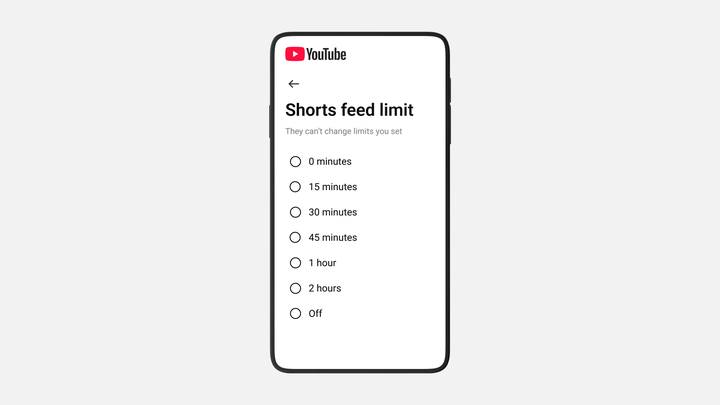
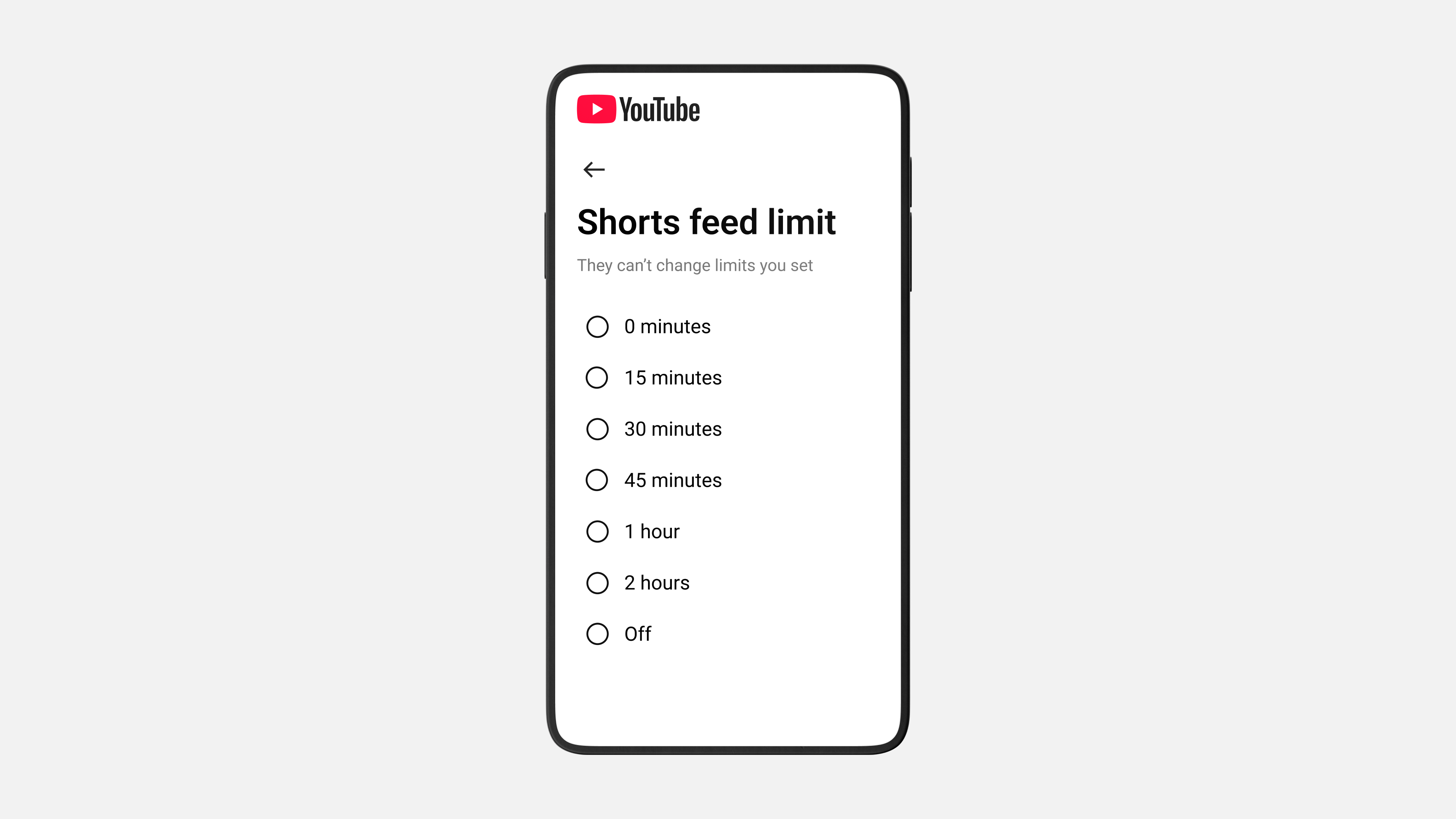
In a bid to improve the wellbeing of young users, YouTube has revealed parents will now be able to set time limits for scrolling Shorts, and will also enable caregivers to set bedtime and break reminders.

Parents will be able to set limits for scrolling Shorts

As part of the Online Safety Act, social media companies have a duty to protect children and stop them from accessing harmful or age-inappropriate content. Sites can face fines or be blocked in the UK if they don’t take protective steps.

The social media and online video sharing platform is also launching new ‘Quality Principles’ for content creators, developed alongside experts, to ensure videos created for teens are “age-appropriate” and “enriching”.

What are the quality principles?

Professor Peter Fonagy, head of the division of psychology and language sciences at UCL, which partnered with YouTube to provide evidence-based insights on adolescent development, said: “The mental health of children and young people is a global concern, and in the digital age the content teens encounter online can have both positive and negative impacts.”

He said the new quality principles will give creators a “practical, research-informed roadmap for making videos that are developmentally appropriate, emotionally safe, and genuinely supportive of young people”.

The principles include:

  • Joy, fun and entertainment: Show humour and warmth that lift teens’ moods like a day-in-the-life video or funny, self-accepting outtakes.
  • Curiosity and inspiration: Encourage exploration through creative tutorials, behind-the-scenes demos, or new hobbies that are easy to try.
  • Deepening interests and perspectives: Create deeper dives into subjects teens love, like music, gaming, or fashion, and show process, not just outcomes.
  • Building life skills and experiences: Offer relatable guidance for real-life moments, like teamwork or budgeting, to help them prepare for the future.
  • Credible information that supports well-being: Share accurate, age-appropriate information. Use trusted sources and avoid spreading misinformation.

Tell me more about the screentime limits…

YouTube said parents will be able to set time limits for scrolling Shorts – including having the option to set the timer to zero.

This gives parents flexibility to set the Shorts feed limit to zero when they want their teen to use YouTube to focus on homework, for example.

Or they could change it to 60 minutes during a long car trip to keep kids entertained.

Parents can also set custom Bedtime and Take a Break reminders.

There’s also a new account-making process

This has been designed to make it easier for parents to create a new kid account and switch between family accounts in the mobile app, depending on who’s watching, so they’re shown the most appropriate content for their age.

Dr Garth Graham, global head of YouTube Health, said: “We believe in protecting kids in the digital world, not from the digital world. That’s why providing effective, built-in tools is so essential, as parents play a critical role in setting the rules for their family’s online experiences.”

According to the social media giant, the updates will be rolling out from 14 January and will expand globally over the coming months.

Share Button

Revealed: This Age Group Of Boys Is Most Vulnerable To Online Abuse

The online world is vast – and while it can both educate and entertain kids for hours on end, there are murkier areas where they need to tread much more carefully.

New research from safety experts at McAfee has uncovered the most common online threats facing British children, including: cyberbullying, inappropriate contact and scams.

The study of over 4,300 parents found one in six say their child has been targeted by an online threat in the UK.

The highest risk group is 12-year-old boys, with almost a third (32%) being targeted.

For girls, online dangers tend to emerge later, with reports steadily climbing through the teens and peaking at age 16, where more than one in five parents (22%) say their daughter has been targeted.

What are the most common online threats facing children?

According to the research, cyberbullying or harassment from peers (48%) is the number one threat. Nearly half of UK parents say their child has experienced cyberbullying, while one in three (35%) ranking it in their top three worries.

Cyberbullying can include mean comments, exclusion from online groups or spreading harmful rumours, often through social media platforms.

Scams are also a huge problem – particularly fake social media giveaways or contests (33%), which purport to be giving away gaming consoles, smartphones or designer products.

Children are lured into clicking fraudulent links or providing personal information, with boys aged 13-15 particularly vulnerable.

Similarly, online gaming can be a hotbed for scams. Over a quarter (27%) of parents report their child has been affected by gaming-related fraud, such as fake offers for in-game currency, exclusive items or upgrades.

Scammers often pose as fellow players, using familiarity and trust to get children to share passwords or personal info.

There are also concerns about unsafe or inappropriate contact. One in four UK parents say their child has received inappropriate contact online, with girls being more frequently targeted (29% versus 21% for boys). Unknowns might try to initiate conversations with children via direct messages, chat rooms or even multiplayer gaming platforms.

And lastly, scam messages or phishing texts (21%) – designed to trick recipients into divulging sensitive information, such as passwords, bank details or personal data – are a problem.

Girls are significantly more likely to experience this (29%) than boys (14%), the study found, with those aged 16-18 most at risk.

The rise of AI-generated scams

Worryingly, parents are also noticing a rise in the use of AI-generated deepfakes and nudify technology. Nearly one in six UK parents say their child has experienced deepfake image or nudify app misuse.

Girls are facing this threat the most – 21% of parents say their daughter has been impacted, compared to just 11% for sons.

Boys are more likely to be targeted by AI-generated voice cloning scams, instead – where fraudsters use AI to mimic the voice of loved ones through phone calls, voicemails or voice notes.

Recently, experts advised families to come up with a “safe phrase” so they can tell if a phone call or message is an AI-generated scam or not.

Understandably, when children are impacted by these online threats, the emotional and psychological effects are significant and can include anxiety, academic struggles and social withdrawal.

How to keep kids safe

It’s clear parents need to be having ongoing conversations with their kids about online safety. (Check out these helpful guides from Internet Matters and the NSPCC if you need somewhere to start.)

But what else can we be doing to keep kids safe? Here are McAfee’s top tips:

  1. Pair tools with talks: Combine parental controls with regular, judgement-free conversations about harmful content, coercion or bullying so your children know they can come to you. Explain what cyberbullying and scams might look like, and that it’s okay to block or report people.
  2. Teach “trust but verify”: Show balanced digital habits yourself as children copy what they see. Show them how to pause, check sources and ask for help when something feels off – especially with AI-altered media.
  3. Talk about the risks of oversharing: Remind children never to share personal information such as their name, school, address or phone number. Encourage strong passwords and explain two-factor authentication.
  4. Set and revisit a family tech contract: Create clear boundaries with kids about screen time, online behaviour, and device use – and update them as your child grows.
  5. Keep devices secure: Ensure all devices are updated with the latest security settings and include AI-powered scam protection to help spot and flag suspicious links or manipulated content before it can do harm.
Share Button

I’m A Child Psychiatrist – Don’t Make This 1 Mistake When Talking To Teens

Raising teens can be a bit of a minefield – where once your sweet, adoring child worshipped the ground you walked on, all of a sudden they simply don’t want to know.

You might be facing more arguments, major mood and sleep changes, as well as having to become a full-time translator while your kid keeps calling everyone “chat”.

But there is one innocent mistake parents might be making in the teenage years, according to a child psychiatrist – especially if you want them to be able to open up to you.

Child psychiatrist Dr Willough Jenkins said in a TikTok video that it “might sting a little” for parents to hear, but she wants everyone to know: “If you’re doing most of the talking, you’re probably not having a conversation with your teen… that’s called a lecture.

“You want them talking more than you. That’s how you learn what they’re really thinking, and how they learn that you’re really listening.”

Her advice to facilitate more conversations with teens is simple: “Start with a question. Then pause. And really listen.”

In a separate video, the psychiatrist said one of the things that makes a successful parent is “listening more than lecturing”.

She also suggested “staying calm when things go wrong”, “repairing after you mess up” and “setting boundaries with love, not fear” are “what real success looks like”.

Therapists previously told HuffPost UK that creating a space that feels emotionally safe and low-pressured is important to help teens open up – especially if you think they might be struggling mentally.

Make conversation by asking open-ended and emotionally neutral questions and statements. You could say something like: “How’s everything going lately?” or “How are things feeling for you at school/with friends/life right now?”.

And then really listen.

BACP-accredited therapist Lauren Young also suggested resisting the urge to fix everything for teens and instead, validating their feelings and thanking them for trusting you if they come to you with a problem.

All of this can help teenagers know that you’re there for them. As BACP-accredited member and psychotherapist Debbie Keenan told us: “Sometimes, the goal isn’t to get your teen to ‘open up’ immediately, but to remind them that they’re not alone, that emotions are valid, and that you’re a reliable presence in their life.

“Trust is built in the quiet, everyday moments, often more than in the big talks.”

Share Button

Don’t PMO – How Much Gen Alpha Slang Do You Know?

Gone are the days of LMAO and CBA, nowadays kids are all about SYBAU, PMO and ATP.

Generations Z and Alpha are the creators of an entirely new language – from glazing and gurt, to tuff and six-seven.

But what on earth do the acronyms they share in social media comments and messages even mean? Here’s a quick breakdown…

SYBAU

In a video on the words kids are using this summer, teacher and content creator Mr Philip Lindsay said SYBAU – which kids are actually pronouncing as ‘SI-BOW or SI-BOO’ – is the number one word they’re using right now.

According to the teacher (and various explanations online), it’s an acronym that stands for “shut your b**** ass up”. Delightful. “They’re using it in a text form and out loud,” he added.

PMO

Nope, they’re not discussing a project management office. Generally this means “piss me off”. Although some people have noted it could also mean “put me on”.

TS

People are using TS as an abbreviation of “this shit” but some are simply using it as a replacement for “this”.

ATP

This one’s relatively simple. According to USA Today, ATP stands for “at this point”. The site adds: “Broadly, the slang term is associated with something that is happening currently or a recent development.”

But it can also stand for “answer the phone” (just to keep you on your toes).

UV

In his recent video, Mr Lindsay noted that loads of kids are talking about “checking the UV” right now – and yes, that’s exactly what you think it is, they’re discussing the sun’s ultraviolet rays.

But it’s not about keeping out of the sun, rather they’re discussing whether the UV rays are strong so they can go out and get a tan. Dermatologists are understandably worried about the health risks associated with this and advise against it.

The more you know (TMYK)….

Share Button

So, ‘Gurt’ Is A Thing Kids Say Now (And It’s Tenuously Tied To Yoghurt)

These days, you need a translator to understand half of what kids are saying.

Thanks to the popularity of social media sites like TikTok, every week children and teens are finding new phrases and memes to share and say to each other – much to the befuddlement of their parents.

From the latest baffling trend of saying “and a Black Santa napkin!” to the rise of “six-seven” and the bizarre world of brainrot characters like Ballerina Cappuccina, it can be exhausting work for parents and teachers trying to keep up with what it all means.

One of the other expressions kids are coming out with currently is “gurt”.

But what does ‘gurt’ mean?

In some parts of England, gurt means very large or great. But this isn’t what kids mean when they’re saying it.

In his weekly videos on the words kids are using in class, school teacher and TikTok creator Philip Lindsay said the meaning of gurt is “confusing”, as people seem to use it in two different ways.

The first way refers to a joke where someone says “Yoghurt” and a character called Gurt replies: “Yo”.

According to Know Your Meme (KYM), this actually dates back to 2012, but only recently took off thanks to videos on TikTok.

Mr Lindsay explained in his TikTok explainer that “in this scenario, the proper response to someone saying ‘gurt’ is ‘yo’ and vice versa, if somebody says ‘yo’ you say ‘gurt’”.

So, kind of like a greeting. Makes sense.

But that’s not where this all ends. The teacher explained that the term seems to have evolved, however, and now has “more meaning to it”.

There’s a series of videos known as “What They’re Doing Is Very Smart But Also Very Dangerous” which show cute animals “doing something very smart but also very dangerous”, as per KYM.

For example, penguins jumping from high off a massive iceberg into the sea.

So now, according to Mr Lindsay, “the meaning of gurt or gurting is to do something smart yet dangerous”.

Ultimately though, there’s no agreed meaning.

The teacher continued: “There are a bunch of definitions flying around right now on the internet about what gurt actually means, so we’ll see how this unfolds in the coming months.”

Right, I need a sleep.

Share Button

A Mobile Network Has Provided Guidelines On When Children Should Have Mobile Phones

Long gone are the days of ‘logging on’ to the internet, now we’re all interconnected via social media, our doorbells and even our food deliveries.

While there are pros and cons of this, one thing that’s unavoidable is our children’s interest in all things Online and recent studies have shown that by the age of 11 over 90% of children in the UK have their own smartphone.

Of course, this means that children have access to a wealth of information and education right at their fingertips, but it also means that their safety is potentially at risk from malicious users, harmful content and addictive social media apps.

Mobile phone and service provider EE said: “Being part of a healthy online community can be a really positive thing and lots of games, apps and websites have ways for users to get together and chat.

“However, these can also be used by malicious users who want to bully and manipulate others. Making your child aware of the warning signs of this type of behaviour can stop them falling victim to it or at least let them identify it and tell you if it happens.”

When children should get smartphones

Ahead of the new school year, EE, which is owned by BT, has set out guidelines which aim to improve children’s digital wellbeing after parents had requested guidance.

The service provider has urged that children under the age of 11 should be given phones that can be used to text and make calls but without access to the internet or social media apps.

Its corporate affairs director Mat Sears said EE wanted to help parents and caregivers “make the best choices for their children”.

He told the BBC: “Under-11s we feel should not be given access to smartphones. They don’t need the usage of a smartphone and, actually, a feature phone – or a dumb phone, as some people call them – is more suitable.”

Research from Ofcom earlier this year revealed that over half of under-13s were using social media, despite most of the big platforms having rules requiring that users are over 13.

Sears recommends that while social media is appropriate for 13-16 year olds, he recommends that parents exercise caution, saying: “We think it’s absolutely fine and OK for social media to be used [by over-13s] but various parental controls and privacy settings should be put in place, as well as screen locks for the amount of time that is being placed on these various social media sites.”

Share Button

‘My Tween Is Ruining My Marriage’

You’re reading Between Us, a place for parents to offload and share their tricky parenting dilemmas. Share your parenting dilemma here and we’ll seek advice from experts.

Parents have a lot to juggle in their own lives, as well as their children’s lives. So it’s no surprise then that when tweens (and teens) start to act out, it can feel like you’re teetering on the edge.

Ripples are felt far and wide – on your own mental health, on your relationship – the whole situation can swiftly spiral.

Such is the case for one parent, who shared their parenting dilemma on Reddit this week:

“My child is ruining my marriage. My eldest is almost a teenager and this year has been tough on her. She’s lost a lot of friends in school, has had to deal with a new sibling taking our attention and she’s got a rare pain condition. We have tried so hard to be supportive. We’ve tried giving her advice, attention, space, support, solutions and bent over backwards to be kind to her. It’s been hard though because she’s responded with an attitude that stinks and acting like she doesn’t care.

“I’m honestly at a loss because I don’t know what to do and me and my husband have had so many rows about her and her behaviour. We’ve just had a huge blow up and I honestly don’t know if we can come back from this. He’s so angry that she’s gone to do nice things today after speaking to me like shit and I was cross too and things were said that blew up. I can’t stop crying. I feel awful. I’ve failed as a mother and a wife.”

So, what can they do?

1. Be kind to yourself

Counselling Directory member Jenny Warwick says that, first and foremost, parents in this position need to prioritise themselves. “You have not failed as a mother or wife,” she says. “This is the time when you need to be kind to yourself.

“Remember, you won’t be able to help others if you feel drained and exhausted. Taking breaks for self-care is not selfish; it’s necessary.”

Family Lives, a charity supporting families, recommends that parents take time to relax; treat themselves occasionally; talk about their concerns with friends, partners or online forums; and learn techniques for coping with low mood, sadness and depression or anxiety.

2. Know that the tween period is really hard for all involved

Research actually suggests the tween period – when children are eight to 13 years old – are the hardest years of parenting.

According to parenting expert Sarah Ockwell-Smith, this is because they are much more emotionally exhausting, not to mention less rewarding than, say, the toddler years when your child still relies on you for so much and is learning a lot, too.

Warwick agrees that this period can be “particularly tricky” to manage for parents. “Part of being a tween is finding independence and forging their own path, resulting in a strong push away from their parents,” she explains.

“As far as you are concerned, this has come out of nowhere and feels personal. However, recognising this as a typical part of preteen development can make the emotional burden easier to bear.”

On top of that, she acknowledges it sounds like the daughter is going through a lot – navigating shifts in friendships, coping with a pain condition and a new sibling.

But while this might contribute to her behaviour, “none of this gives her an excuse to be rude”, adds the counsellor.

If your child appears to be particularly struggling mentally, it might be worth speaking to your GP or a mental health charity – like The Mix, YoungMinds and Relate – for further advice.

3. Remember: your daughter still needs you

When your child is pushing you away, it might be tempting to just let them – especially when their attitude towards you leaves little to be desired – but Warwick suggests the daughter needs her parents now more than ever.

That said, the way to offer support to her is very different at this stage in her life than when she was younger, she suggests.

“Helping her find solutions is much more effective than jumping in to fix things for her. This can be a hard change in approach for parents to make, but it is the way forward,” says Warwick.

At the same time, you need to prioritise yourself and help your daughter recognise that your life doesn’t revolve around her, suggests the therapist.

4. Carve out time to be with your partner

When you welcome a new child, your relationship can instantly be put on the back-burner – add wider family discord into the mix, and things get trickier.

It will undoubtedly put pressure on a romantic relationship. And, to top that off, children can sense any tension, which might prompt further behavioural changes.

“You and your husband need to be on the same page regarding parenting,” says Warwick. “It sounds like you have a lot on your plate, too, with a new child.”

Verywell Family recommends parents try the following tips to help get back on the same page:

  • Determine what the consequences are for your children breaking rules in your home and stick to them.
  • Create parenting rules together and if you don’t agree on some of them, talk it out. Then share these rules with the wider household.
  • Back each other up in front of the kids and don’t disagree with each other in front of them.
  • Listen to each other, compromise where you can, and remember you’re on the same team.

Warwick’s advice to this parent is to give the relationship some care, “as it’s much easier if you are in this together”. This means taking time to be together as a couple to maintain a connection.

“Doing this lets you devise a plan of action together and establish agreed-upon boundaries for your family,” she adds.

Help and support:

  • Mind, open Monday to Friday, 9am-6pm on 0300 123 3393.
  • Samaritans offers a listening service which is open 24 hours a day, on 116 123 (UK and ROI – this number is FREE to call and will not appear on your phone bill).
  • CALM (the Campaign Against Living Miserably) offer a helpline open 5pm-midnight, 365 days a year, on 0800 58 58 58, and a webchat service.
  • The Mix is a free support service for people under 25. Call 0808 808 4994 or email help@themix.org.uk
  • Rethink Mental Illness offers practical help through its advice line which can be reached on 0808 801 0525 (Monday to Friday 10am-4pm). More info can be found on rethink.org.
Share Button

Um, So Here Are 4 Things You Really Shouldn’t Say To Teens On Results Day

The next couple of weeks will be a mixture of anxiety and excitement for teens (and their parents) up and down the country.

On August 17, A-level, AS-level and T-level results will be revealed, while a week later, on August 24, GCSE results will be announced.

It’s a huge moment for a lot of teens who, based on their results, may then decide to continue studying, try and get a job, or even consider resits.

So, says Dr Nihara Krause, a consultant clinical psychologist specialising in teenage mental health, “how parents engage at this time can help shape motivation and confidence moving forwards”.

It’s understandable that lots of teens will be more than a little anxious about how their parents will respond to their grades – so responding positively is key, even if the outcome is not what you or they wanted, suggests the psychologist.

While we want what’s best for our children, sometimes we can easily let our own disappointment show – and when your teen is feeling pretty pants, this isn’t really going to help.

Here, Dr Krause – who is working with Talking Futures, a toolkit which helps parents instigate career conversations with their kids – shares some phrases you definitely want to avoid uttering when they receive their grades.

What not to say on results day

1. You should have revised more

In short: not a helpful comment. “This suggests disappointment in the effort put into revision and that your child has fallen short of parental expectations,” says Dr Krause.

It’s going to leave your teen feeling pretty lousy.

2. If only you had spent less time on your phone

Whilst spending time on the phone is a very common parental concern, it’s more helpful to identify what difficulties or blocks there might be in a young person applying themselves to their studies rather than focusing on time spent elsewhere, suggests the psychologist.

3. What are you going to do now with these results rather than the ones predicted?

“Avoid indicating that there are no alternatives and painting a bleak future,” says the expert.

Instead, parents might want to do a bit of research themselves, looking into further education and career options available to their child following their exam results.

This way, they can steer their teen’s focus towards their futures, no matter their results.

4. How did everyone else in your class do?

If your child is feeling rubbish about their results, this focus on how other people did probably isn’t going to help.

“Opting for a judgmental question may affect self-esteem in terms of feeling less than or, if they’ve done better, to feel ‘better than’,” says the psychologist.

5. Exams were a lot harder in my day

It’s best to avoid turning the conversation into a comparison on sitting exams when you were young, as this “minimises their success”, she adds.

What to say instead

1. I’m so proud of the effort you put into your exams

Regardless of results, it’s important to acknowledge your child’s efforts and encourage them to think about the steps they have taken to get to where they are today.

“Encourage gratitude, discourage bragging, and focus your conversations with them around next steps in their future whilst motivation is high,” she suggests.

2. Let’s focus on your strengths, rather than comparing yourself to others – how your friends did won’t impact you or your future

“There is a mistaken belief that comparison generates ‘healthy competition’,” says Dr Krause.

But she suggests focusing on what helps a young person to gain their own personal best is far more effective than comparing, as it helps them identify unique qualities and improve on these.

It also helps generate self-acceptance and positivity, while avoiding complacency, the expert suggests.

3. Let’s consider your next steps together

A problem shared is a problem halved, after all.

“Be positive about alternatives and help build confidence by showing that you are there to support them,” says Dr Krause, “by doing this you can also motivate your young person to look ahead.”

Research from Talking Futures found 65% of 13-to-18-year-olds are most likely to say their parent is the number one person in their life that they would want to support and guide them on their chosen career path.

However good timing and using the right phrases are essential to ensuring this is done constructively.

“Depending on how the young person feels about the results they have received, now might not be the best time for parents to bring up the topic of the future and next steps,” says Dr Krause.

“And even if it does feel like it’s an OK topic to discuss, parents should approach conversations with extra care – mixed emotions and feeling overwhelmed is common for both parents and young people alike at results time, so let them settle first before constructive conversation can begin.”

Here’s to a positivity-filled results day, no matter the outcome.

Share Button