The app in England and Wales will now only alert contacts from the previous two days in asymptomatic cases.


The app in England and Wales will now only alert contacts from the previous two days in asymptomatic cases.
The risk of dementia in former footballers increases according to the position they played in, says new research.
UK coronavirus cases are rising due to a variant first identified in India that spreads more easily.
Heavily touched areas like escalator handles, ticket machines and benches were swabbed for the virus.

The words of co-workers and clients can stay with you long after you leave a job and certain phrases can detonate a professional relationship, making people question whether they ever truly belonged at a company or if they can ever work with or trust a colleague again.
That’s why it’s so important to learn to identify and avoid such phrases, whether they’re obviously rude or seemingly innocuous. Here are psychologically damaging but commonly used phrases to watch out for in your work communications.
Advertisement
Mary Abbajay, president of the leadership development consultancy Careerstone Group, was once hired by a company to conduct team building. When she met the manager of the team she would work with, he told her, “With all due respect, I’ve forgotten more about team building than you’ll ever know.”
Advertisement
Abbajay ended up turning down the job as a result. “This was 15 years ago, and it stills sticks with me,” she said. “If he hadn’t said ‘with all due respect,’ I might’ve taken it differently. That’s just the icing on the cake that shows ‘I do not respect you, I think you’re wrong.’”
Along with the similar phrase “No offence …,” she said, these condescending words signal that the speaker does not respect the other person’s point of view.
Advertisement
Psychological safety is key to keeping teams together. Researchers describe it as the mental space in which employees are free to speak up, share bad news, and ask for help when they are in over their heads.
If your pattern in responding to colleagues’ requests is telling them that you are too busy or don’t have enough time, it sends a signal that the other person is not a priority and that they shouldn’t go to you when they need help.
“That person is going to be reluctant to come back to you again if there’s a problem or situation, and it may throw them off so much that they’re worried too much about taking your time and annoying you than getting what they need,” Abbajay said.
Advertisement
When managers say this, it can silence their team and make members less likely to own up to mistakes, she added.
If you’ve been in a meeting with a colleague who feels the need to reframe what you just said in their own words, then you understand the frustration of hearing this phrase. Abbajay said this is the one she dislikes the most, because it doesn’t move the conversation productively forward even if that’s the speaker’s intent.
When someone does this to you, you may jump to a conclusion like “I’m inarticulate, I’m stupid, people aren’t understanding me, people aren’t respecting it out of my mouth, so you feel like you have to say it out of your mouth,” she said. “It’s very diminishing. It lowers the other person’s status.”
Rather than rephrasing colleagues’ words, Abbajay said colleagues could simply request when they need more of an explanation in a conversation.
Lawrese Brown, the founder of C-Track Training, a workplace education company, cited the type of undermining comments that you can sometimes be the recipient of when you go against a colleague’s assumptions and expectations of how you should present yourself at work. These comments can range from microaggressions about your identity to questions about your leadership potential.
Brown said she has heard from clients who have been told they were being a “weak” leader or “seemed young.” One client was advised to change her hairstyle.
“Her manager told her people would take her more seriously if she straightened her hair,” she said. “These all fall under the umbrella of, ‘You’re being perceived as not appropriate; something about your self-presentation or the way you’re being perceived causes people to question your ability to do the job.’”
These kind of comments can get under employees’ skin and make them feel inadequate at work. “We start to feel the way we’re operating is not appropriate or effective, or we’re just conscious that it could be a knock against us,” Brown said.
Advertisement
Brown said it’s OK to note that words can be interpreted differently, but that you should be careful not to be dismissive when others disagree. “I didn’t mean it like that” is a common defensive comment that does not acknowledge how your words can be received, she said.
The goal is to recognise that your words carry weight, and can do harm. Remind yourself someone is on the receiving end of your comment, and first ask yourself, “Is it productive?” before you say it, she said.
Brown said managers commonly make the mistake of using invalidating comments such as, “Nobody else has brought this up to me” when a team or employee raises a concern. According to Brown, that can send the message: “If this is only important to you, is this worth taking seriously?”
When colleagues invalidate your feelings like this, or you do it to others, it can stop much-needed conversations from happening.
″‘You’re too emotional about this, you’re taking this personally. Other people haven’t said this.’ What you’re missing by saying this is you’re undermining the other person,” Brown said. “These are phrases, that once said, very few people have the tools to have the difficult conversation to unpack that. People just don’t say anything.“
And ultimately, when co-workers stop talking to each other, communication breaks down, mistakes are more likely to happen, tensions run higher and everyone is more on edge.
Your colleagues will “tend to be more people-pleasing, because they no longer trust their own voice, or perception of an experience, or it inhibits their ability to trust their colleagues,” Brown said. “When we don’t trust, we put more rigid processes in place, and it’s because we don’t believe that our word will be acknowledged or that our needs in environments will be met.”

You’re reading First Thing, a weekly series on HuffPost UK helping to make your mornings happier and healthier.
Does your morning exercise routine consist of working your arms by smacking the snooze button for the third time? (No shame ― sometimes you gotta do what you gotta do!)
Advertisement
It may feel like exercising at the start of the day is an impossible feat when you’re so exhausted. However, you don’t have to spring out of bed and start running a 5K to feel energised. Even a little bit of movement will go a long way when it comes to revving you up for the day.
“Moving your body when you first wake up helps your circulation and stimulates your lymphatic system,” said Jennifer Jacobs, a certified personal trainer and founder of The J Method, adding that exercise helps fluid move through your body and reduce inflammation. “As a result, you feel more energised.”
Advertisement
We asked experts to share the best energy-boosting moves that’ll help you kickstart your morning feeling loose and alert. Here are their favourites:
Advertisement

One of the reasons you may not want to drag yourself out of bed is because your body is stiff from sleeping all night. This yoga pose is a great way to kickstart blood flow and wake up, said Megan Roup, founder of The Sculpt Society.
Starting on your hands and knees, stack your shoulders over your wrists and spread your palms out wide. Pressing through your palms, tuck your toes and lift your knees, pointing your hips toward the ceiling as you press down through the heels.
“To make this stretch more active, you can pedal out the feet while you actively press into the floor or bend and straighten both legs,” Roup said. Hold the pose for 15 seconds and repeat for three to four rounds.
Advertisement
“This dynamic stretch helps to loosen up your hamstrings and your lower back more effectively than doing a static stretch, which may cause muscle spasms if your body isn’t properly warmed up,” said Theresa Marko, a board-certified orthopaedic clinical specialist in physical therapy and owner of Marko Physical Therapy.
To do this move, start by lying on the floor with knees bent and feet flat. Gently grab behind one of your thighs and straighten and bend the knee repeatedly (just make sure not to overextend your knee). This back-and-forth flossing motion will give your hamstring a stretch-and-release sensation. Do 10 repetitions on each side for two to three rounds.

“This is my go-to morning move that really wakes me up,” Jacobs said. “Choose a song that’s roughly three to five minutes and spend the duration of the song bouncing through the balls of your feet. You’ll start to increase blood flow – not to mention sneak in a quick calf workout – and may find that after the song ends your mood has improved, too.”
It may seem counterproductive that one of the stretches to wake you up resembles a move that looks like you’re sleeping, but Khalil Jones, a certified personal trainer who also trains at Rumble Boxing in Philadelphia, said this move is great for stomach sleepers. This is because it can reset the spine after having the lower back rounded forward all night. (And reducing stiffness in your back allows you to move more freely and feel more energised.)
Kneeling on the floor, spread your knees hip-width apart and bend forward to place your torso between your thighs. Lengthen your tailbone and place your hands out to the side. Hold for 15 seconds for three to four rounds. As you come out of child’s pose, do a side bend: Grab one elbow with the opposite hand over your head and lean away from the elbow. This will stretch your back and triceps and improve mobility in your upper body.

“Hip flexors are such an important muscle,” Marko said. “Tight hamstrings can tug on your lumbar spine, and this can cause pain.”
Dropping down into a half kneeling position, do a slight pelvic tilt, lunging yourself forward to stretch your hip flexors. Hold for 15 seconds, repeating for three to four rounds.
Advertisement
If you feel too tight to try this, start by lying on the floor first, knees bent and feet flat. Keep your knees together and rock your legs side to side. Next, let your knees fall all the way down to one side to get a more intense stretch on your lower back. Switch sides, holding for 15 seconds each time, and then try the hip flexor stretch again.
If you just can’t get yourself out of bed to stretch and move before you need to be productive, don’t sweat it. Nikki Chrysostomou, a licensed movement therapist and founder of Movement Integration, said you can practice this stimulating stretch anywhere ― in the car, at your desk or even on your bed.
All you need to do is inhale and exhale deeply and focus your mind on getting the breath into your sides. If it’s helpful, you can place your hands on your ribcage to help you monitor where your breath is going.
“Lateral breathing helps to stimulate the mind,” Chrysostomou said. “To do this, work on taking breath away from the stomach. Think of breathing into the back of your ribcage, into the sides of the ribs and into your armpits. This creates a bucket-handle effect, with the ribs expanding out, and can perk you up.”
First Thing is a weekly series on HuffPost UK Life giving you tips and advice on how to enjoy your mornings. Whether you’re an early bird or night owl, starting your day off right will make for a happier and healthier day. We’ll be sharing exercise advice, nutrition guidance, as well as ideas on forming new habits. (And no, the answer to a productive morning isn’t just setting an alarm for 5am!)




Cleaners and others employed by contractors should receive the same rise as NHS staff, a union says.
Psychologists say men need to be part of a group in order to vent their feelings and emotions.

PAUL ELLIS via Getty Images
Ministers have tightened up the law to raise standards for Covid tests sold privately in England – but have exempted Chinese-made tests which have cost the taxpayer billions, HuffPost UK can reveal.
New regulations from the department of health and social care (DHSC) aim to stamp out “poor quality tests” that could give the public a false sense of security and allow people to spread the virus unwittingly.
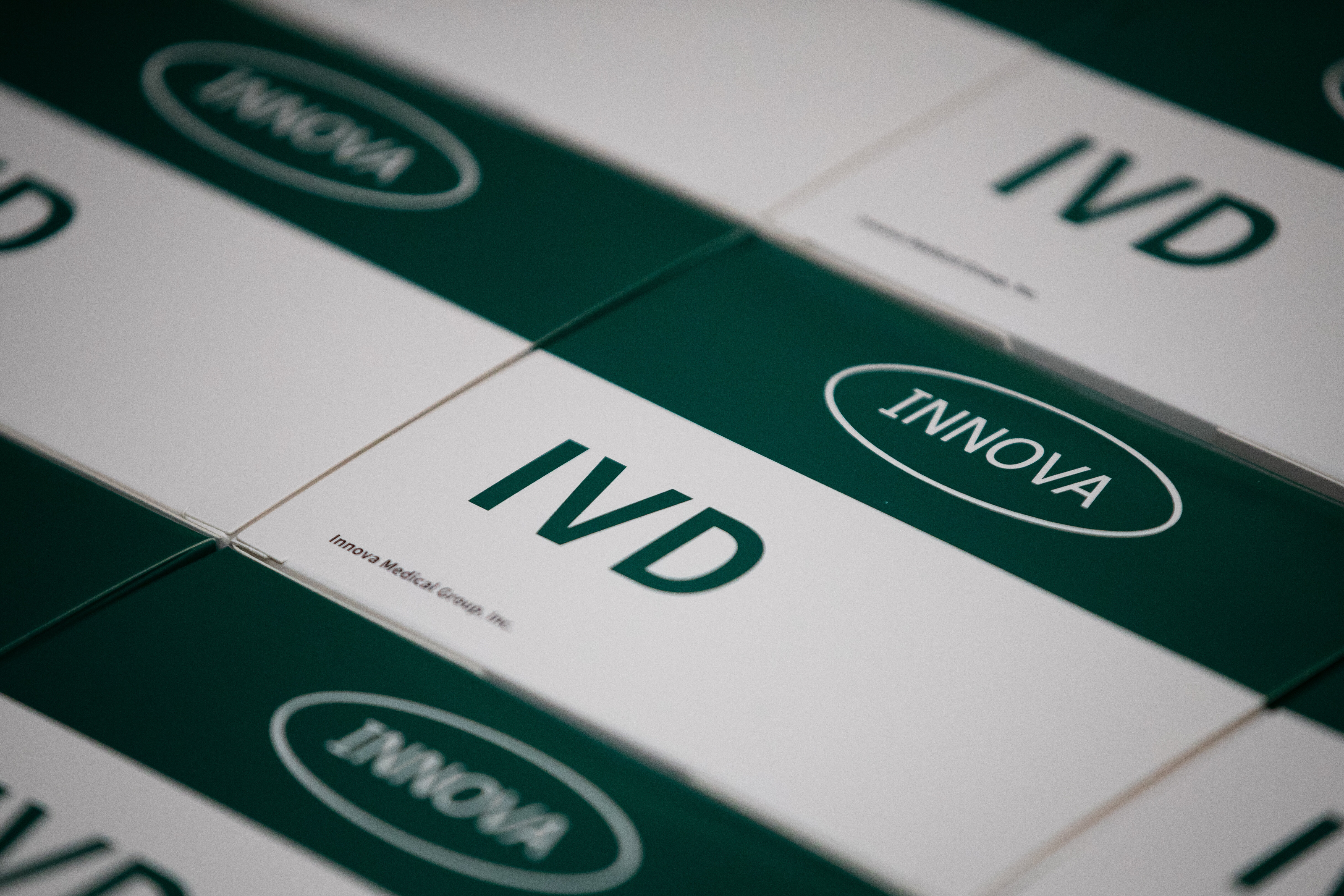
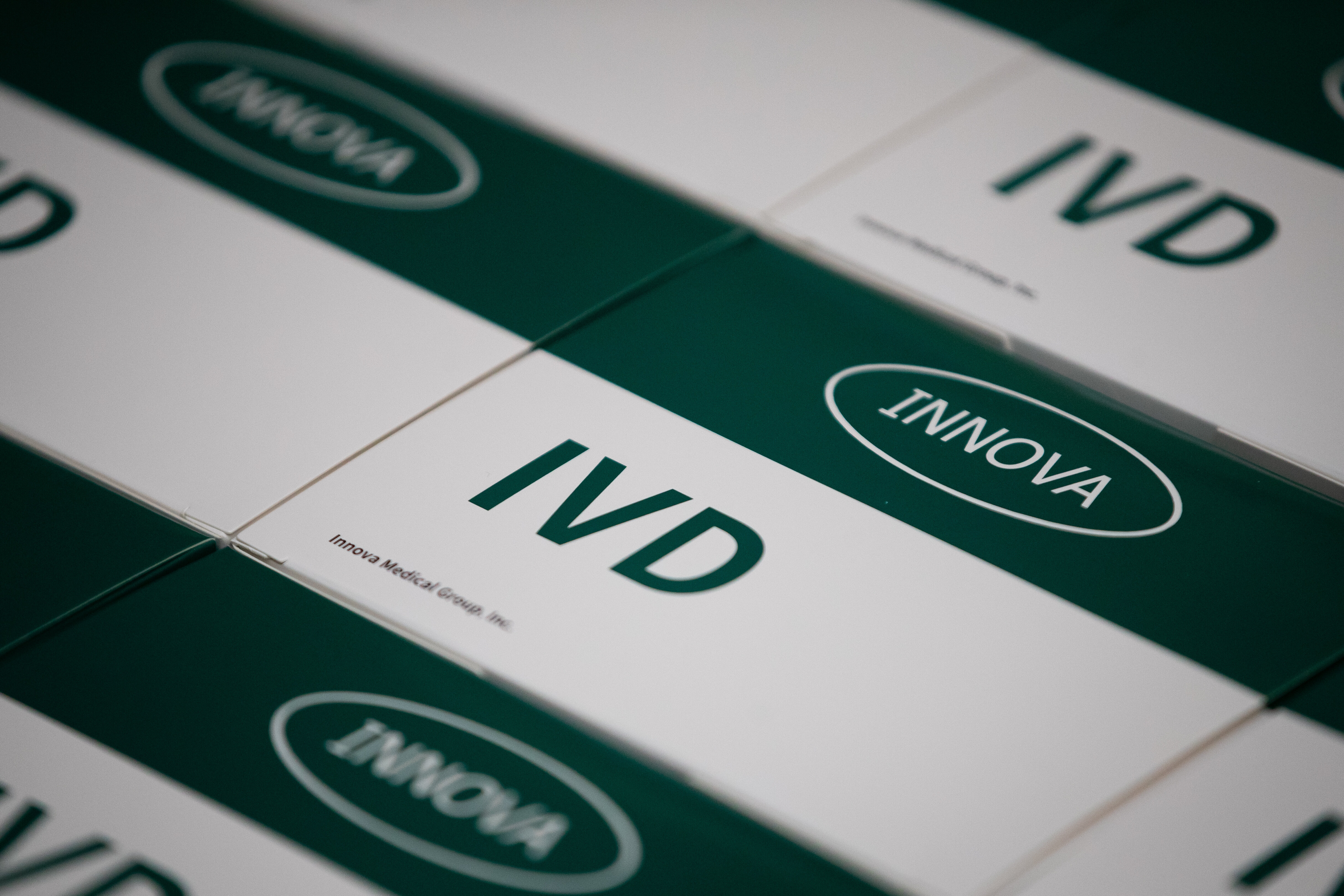
But the higher performance standards, quietly introduced this week, include a loophole that explicitly excludes lateral flow tests previously bought by the government such as those bought from Innova Medical Group at a cost of more than £3bn.
British manufacturers privately welcome the new regime as they believe their home-grown tests are cheaper and more reliable than the Innova tests.
But many in the UK bio industry question why ministers are exempting the Chinese-made devices from the same high standards.
The rules, which will kick in from September 1, have also prompted fresh suspicions that the government is moving away from giving the public and businesses free rapid tests and will instead expect them to pay for the devices commercially.
The new secondary legislation – The Medical Devices (Coronavirus Test Device Approvals) (Amendment) Regulations 2021 – gives Sajid Javid unprecedented power over which Covid tests can be sold on the open market in England.
Firms will have to pay the government £14,000 for any application and any tests not deemed up to the grade will be removed from sale by law.
Retailers, distributors and manufacturers of tests that attempt to sell unvalidated tests would face sanction.
Currently, PCR or lateral flow tests can go on commercial sale in England as long as they carry a CE mark, which means they meet EU and UK requirements, but each manufacturer designs their own data collection and analysis methods to validate them.
Under the new proposals, the government will require that “all COVID-19 tests placed on the UK market undergo a mandatory validation process”, with the same standards applied equally to allow consumers to make a fair comparison.
A new DHSC document states: “It would undermine current public health goals if people used poor quality tests that give them a false sense of security.
“In the case of a false negative, this could see an infected individual unknowingly spread the virus. Conversely false positives could require business to close and people to isolate unnecessarily.”
But an explanatory memorandum to the new legislation states that “tests supplied by government will be exempt” from the new validation process.
The memo adds that contracts agreed by the government to supply NHS hospitals “can continue to be honoured by the manufacturer even if the test has failed validation”.
This has prompted anger among UK bioscience insiders, who believe that the Innova tests would compare badly with British-made rivals and who complain that ministers have done everything to favour the Chinese-manufactured products since last year.
Innova, which is based in California and funded by a private capital group by a Chinese-born businessman, uses tests produced by Chinese Biotime Biotechnology, in Xiamen city, Fujian province.
Publicly available contracts on the government’s website shows that £3.3bn has been spent to date on the company, as part of the £37bn allocated to the controversial Test and Trace service.
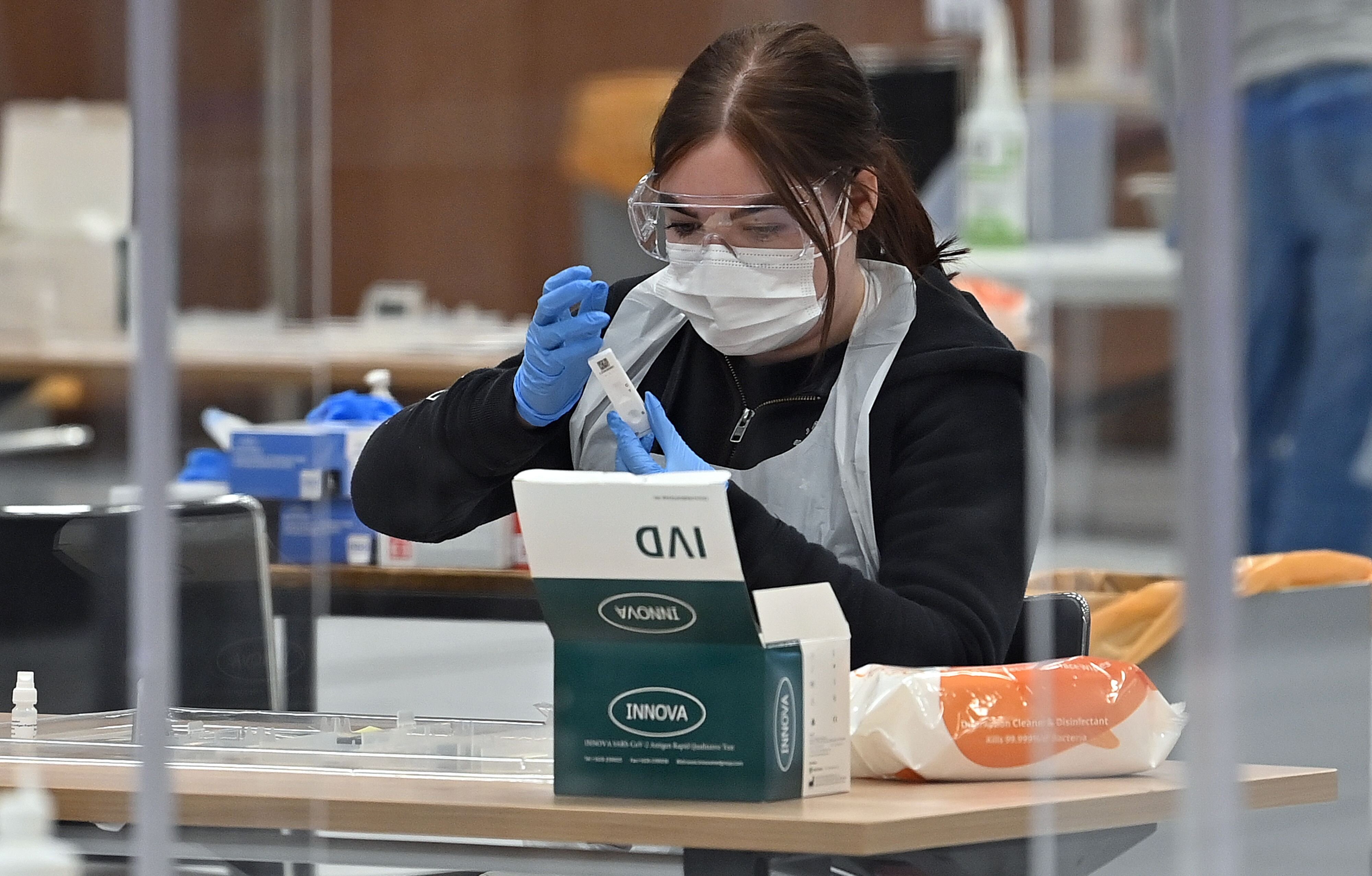
Innova’s 30-minute tests have been used for regular weekly testing of NHS and care home staff and in schools. Since April, any member of the public has also been able to order twice-a-week tests for free.
Yet concerns about cost and reliability have been raised repeatedly by critics, underscored when the US Food and Drug Administration (FDA) issued an alert about the test in June.
The FDA told Americans to “destroy the tests by placing them in the trash”, saying it had “significant concerns that the performance of the test has not been adequately established, presenting a risk to health”.
The UK’s Medicines and Healthcare products Regulatory Agency (MHRA) – which critics claim is an arm of the DHSC and not fully independent – then did its own risk assessment and found no similar action was needed here.

Aaron Chown – PA Images via Getty Images
Critics further point out that Innova’s own manufacturer’s instructions make clear the tests were designed for use only in symptomatic Covid cases, but the UK government allowed them to be used in asymptomatic cases as part of its “Operation Moonshot” plan to mass test the population.
Authorisation for the Innova test to be used by asymptomatic people at home was due to expire on June 22 but has been extended until August 28, but the new regulations have sparked hope that they can gradually be replaced by British alternatives.
But controversy dogs the Innova tests and the way the UK government has effectively taken ownership of its products. Innova branding has been dropped from the boxes used to deliver tests, replacing it with NHS branding.
Eyebrows were further raised when the DHSC decided to tweak the way in which the Innova test could be used.
Although the manufacturer’s “instructions for use” insist on the invasive and uncomfortable practice of taking a swab from the back of the throat, the government has quietly changed the rules to allow it to take swabs from the nose only.
Similarly, the original instructions for use made clear the tests were never intended for home use and were designed to be administered by a clinical professional.
The exemption for Innova from the new validation rules is seen by some British manufacturers as a way of avoiding the potential huge embarrassment of seeing their tests fail to match the standards of others, not least given large sums spent on them to date.
The legislation mandates a “desktop review” be undertaken of all Covid tests placed on the UK market and defines a set of minimum standards that these tests should meet.
One industry insider said the guidance document states that tests should achieve a minimum sensitivity rating of 95%, whereas the Innova test sensitivity rating achieved at Public Health England’s Porton Down lab was 57.5%.
One industry source said: “This means that the tests already selected won’t need to go through this exercise. It’s a disgrace. One rule for them…”
Another bioscience source said: “The UK industry was not totally confident with the way tests were evaluated for the NHS in the first place.”
Yet another said: “By appointing themselves ‘judge and jury’ of the Innova test, the DHSC has allowed itself to make fundamental changes to the Innova test’s characteristics, implementing them without any follow up Porton Down assessment.
“[These are] changes that would inevitably have had a significant detrimental impact on the test’s already underwhelming performance. Notably, to date, the government have not seen fit to publicly assess the impact of these wholesale changes.”
Shadow health minister Justin Madders told HuffPost UK: ”Given the concerns in the USA over the Innova tests and the fact they are only on a temporary approval here it does seem extraordinary that this legislation could allow Sajid Javid to let them carry on being used without being subject to the same approval processes as everyone else. Far more transparency is needed.
“This also seems to suggest that the government intends to move away from having Covid tests being provided free of charge. This has massive implications for public health and could seriously undermine efforts to reduce transmission of the virus. The government needs to come clean on whether they intend to introduce a charging regime for Covid test.”
The DHSC and the department for education raised suspicions that the distribution of free lateral flow tests could cease at the end of September, when a “review” will take place of their twice-weekly use in schools and to the wider public.

WPA Pool via Getty Images
Allyson Pollock, professor in public health at the University of Newcastle, said the bigger issue was that there was little evidence that testing of asymptomatic people – at home or in the workplace – was effective at all.
“This is about creating a market in tests which have questionable performance but above all, it’s still unknown despite the billions spent whether tests as part of a screening intervention actually help to prevent transmission,” she said.
“This isn’t a public health strategy, this is a commercial strategy. They want the public to get hooked on tests and employers to believe that testing is the way out. This is increasingly ridiculous given that the prevalence is low and falling now that immunity is being established.
“Secondary attack rates are low in the immunised population and infection likely to be mild and risks of transmission commensurately lower. Mass testing with lateral flow tests is an enormous waste of resources and it’s the antithesis of good public health.”
One key criticism of lateral flow tests is that their negative readings are being used as a “green light” to allow people to go about their daily lives, when in fact they were only ever designed as a “red light” test – when a positive reading tells people when they may have Covid and to get a gold-standard PCR test to check.
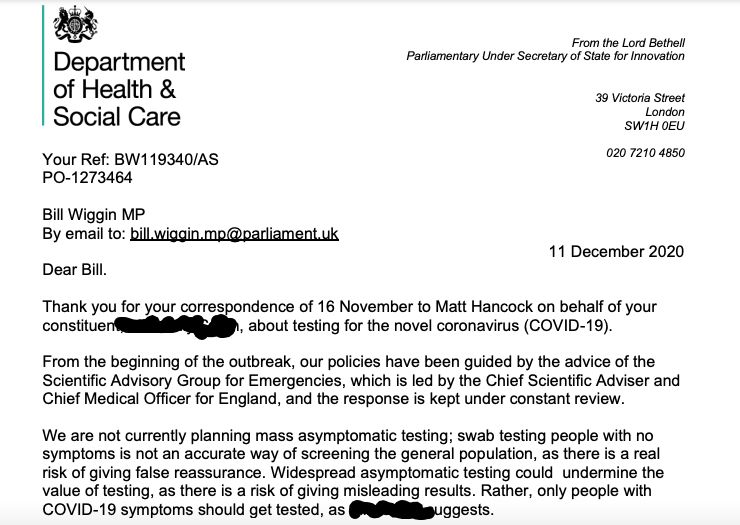
HuffPost UK has seen a letter from health minister Lord Bethell, sent last December to Tory backbencher Bill Wiggin, in which he makes clear the real risks to public health from asymptomatic mass screening.
In the letter, Bethell said: “We are not currently planning mass asymptomatic testing; swab testing people with no symptoms is not an accurate way of screening the general population, as there is a real risk of giving false reassurance.
“Widespread asymptomatic testing could undermine the value of testing, as there is a risk of giving misleading results. Rather, only people with COVID-19 symptoms should get tested.”

HuffPost UK
Alba MP Neale Hanvey, who has raised the issue of Innova’s big government contracts and the failure to use rival tests made by Scottish-based firms such as Omega Diagnostics, said the letter was telling.
“This letter supports everything that I have said to [former health secretary] Matt Hancock and to other members of the department of health, that this is a grand folly. It’s giving people false reassurance and a huge cost to the public purse for no perceivable benefit.”
Hanvey added that the new mandatory guidance for commercial tests was “a fig-leaf for the government’s misdeeds”.
“What the government needs to do now is to cease supporting tests that we know are not designed for their current use, not picking up enough infectious cases and move swiftly to open the doors for the domestic market, to get access not just to private purchase, but to NHS supplied tests. Where is the global Britain and all of this mess?”
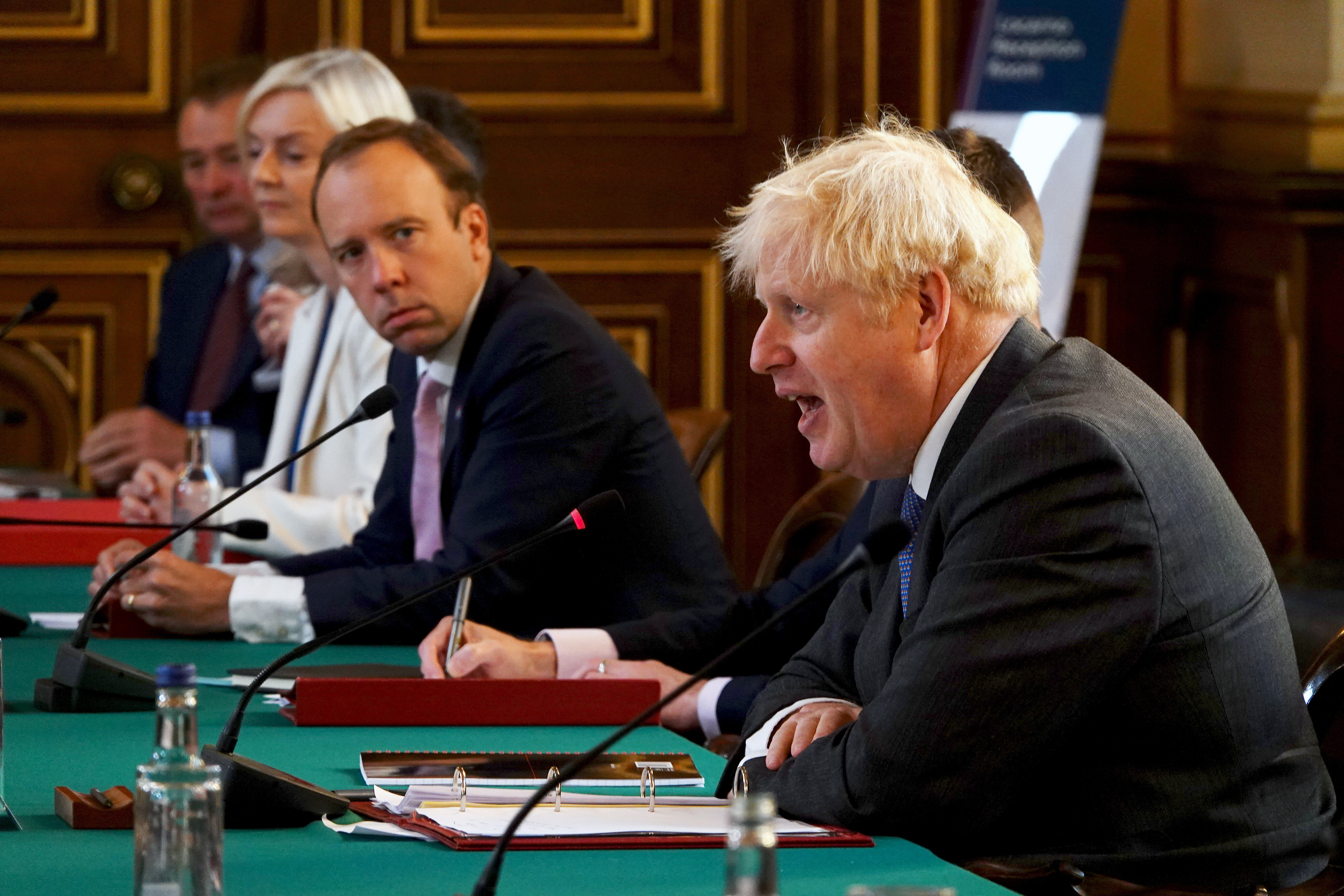
Boris Johnson has repeatedly declared that he wants home-grown rapid tests to be developed, but the UK bioscience industry has been increasingly frustrated that their tests were not approved by Porton Down labs despite other independent validation.
The UK government raised hopes earlier this year when it loaned manufacturing equipment to British companies and earmarked £1.15bn for a programme that would see rapid production. But virtually none of the money has been spent because British tests have not been approved.
One firm, Mologic, was so frustrated with the lack of validation of its tests that it threatened to sue the government. It has since been bought by the Bill & Melinda Gates Foundation and turned into a not-for-profit to help develop rapid tests to combat tropical diseases such as dengue, bilharzia, and river blindness, as well as Covid.
One UK bio industry source said: “They completely screwed the UK diagnostic industry. They invested in LFD [lateral flow device] machinery and are refusing to allow the factories to use them. Our firms are having to export world leading tests, two are in the top ten globally, while we import inferior ones.”
One bio industry source said: “I’m really unhappy that the government was signaling particularly to the UK manufacturers that we will provide you with a lot of support, and we’d like you to help us be self-sufficient in lateral flow tests by spring 2020.
“The companies all took them at their word. Then the government basically says well we didn’t actually promise we’d buy anything from you. That is a little two faced.”
A diagnostics expert said that the new commercial validation process was at least a signal that there would be a shift to getting the public to buy their own tests and that the cheaper price and better performance of British tests would mean that from the autumn “everyone will get a market share”.
“The lateral flow tests being provided to the population free of charge at the moment, at some point, people will either have to start buying themselves or employers will have to start buying them for their employees and there will be only be a certain amount that are provided free of charge.”

Dan Kitwood via Getty Images
Industry insiders believe that firms like Mologic and Omega will submit their tests under the new system and expect to get approval. “This is all in readiness for when DHSC stop giving away free tests for a lot of use cases and reopens the private market,” one said.
Some insiders believe that the Innova test was adopted by the government early in the pandemic simply because it could be provided in mass numbers and that even though its performance is “not perfect” it was “good enough for what it does”.
Defenders of the Innova test believe it can be effective at detecting high viral loads quickly, claiming there is evidence to back this up.
The DHSC has in recent months pivoted to using another Chinese-made test produced by OrientGene, which some in Whitehall believe produces more reliable results than Innova.
Doris-Ann Williams, chief executive of the British In-Vitro Diagnostics Association (BIVDA) said one problem with the new mandatory system was that it would add needless regulation when existing systems could have been updated.
“While we appreciate the government is acting with the best of intentions by introducing this legislation, we still feel a better solution would have been to amend the existing regulation so that the MHRA, who are a world leading regulator for medicines and medical devices, could have ensured the right products are available to the British population.
“However, industry is committed to working under the legislation and alongside UKAS [UK Accreditation Service] to ensure COVID antigen tests are reliable and safe.”
The government insists that its own tests should be exempt from the new mandatory testing standards in an effort to avoid duplication of previous validations.
“This is because the market validation is based on the validation DHSC has
been doing for public procurement of tests as such these two validation process are judged to be equal,” according to the explanatory memorandum accompanying the new regulations.
“As such DHSC will place tests onto to the market without undergoing the regulatory validation process conducted by DHSC to control access to
the UK market.”
A spokesperson for the DHSC said: “Private testing continues to play an important role in managing COVID-19 by supplementing and supporting NHS Test & Trace as we learn to live with this virus.
““As we ease restrictions, including for travel, the role of private testing is increasing and our regulations are ensuring consumers can be confident tests they buy give accurate results and are of sufficient quality.”
They added that private testing will continue to play a role as part of the overarching strategy for managing COVID-19.
The department believes that it is important to introduce a regulatory regime to ensure those tests available on the market are validated for performance, regardless of whether the government is also providing free tests.
A spokesperson for Innova Medical Group said: “Our tests have proven by independent studies to be very effective in detecting individuals who are considered infectious regardless of symptoms.”
They said that the latest UK test had shown it “detects nearly 100% of infected asymptomatic individuals who are considered infectious to others, and there was very little difference in the specificity between self-testing (99.1%) and testing performed or observed by a professional (99.8%)”.
“We understand FDA’s health risk concern for the US market as they have not evaluated or authorised the Innova test in the US.
“In simple terms, the regulator won’t confirm a product is safe to use until it has evaluated and authorized a product itself. None of the FDA inspectional observations concern the performance of the test.”
The company said that its test had been widely used, studied, tested, scrutinised and analysed. Its point of care test had been approved in Germany, France, Netherlands, Finland, Sweden, UK, Austria, Estonia, Finland, Israel, Malaysia, and Sultanate of Oman. Its self-test kit had been approved in Austria and the UK.

Celebrating its 15th anniversary, The Devil Wears Prada remains a cultural phenomenon that has shaped the way we view the fashion industry. Meryl Streep’s renowned portrayal of Miranda Priestly, the steely editor-in-chief of Runway magazine, is one the world won’t soon forget.
Priestly’s effortless delivery of her infamous catchphrase, “that’s all,” held a gravity that clearly depicted fashion as a high-stress, high-stakes industry with no tolerance for any hint of incompetence.
Advertisement
The Devil Wears Prada is not the only media depiction of the fashion industry as a glamorous, impenetrable space where dreams are both dashed and realised. In 101 Dalmatians, Cruella De Vil is a designer whose love of fashion drives her to criminal extremes to obtain the coat of the season.
Ryan Murphy’s Halston miniseries on Netflix recently provided insight into the designer, who was prone to grand gestures of affection and verbal abuse of colleagues, providing another trope of the misunderstood genius who’ll dispose of anyone not aligned with his vision.
Advertisement
But how accurate are these film portrayals in reality? Four fashion industry professionals shared their perspectives on what it’s really like to work in fashion.
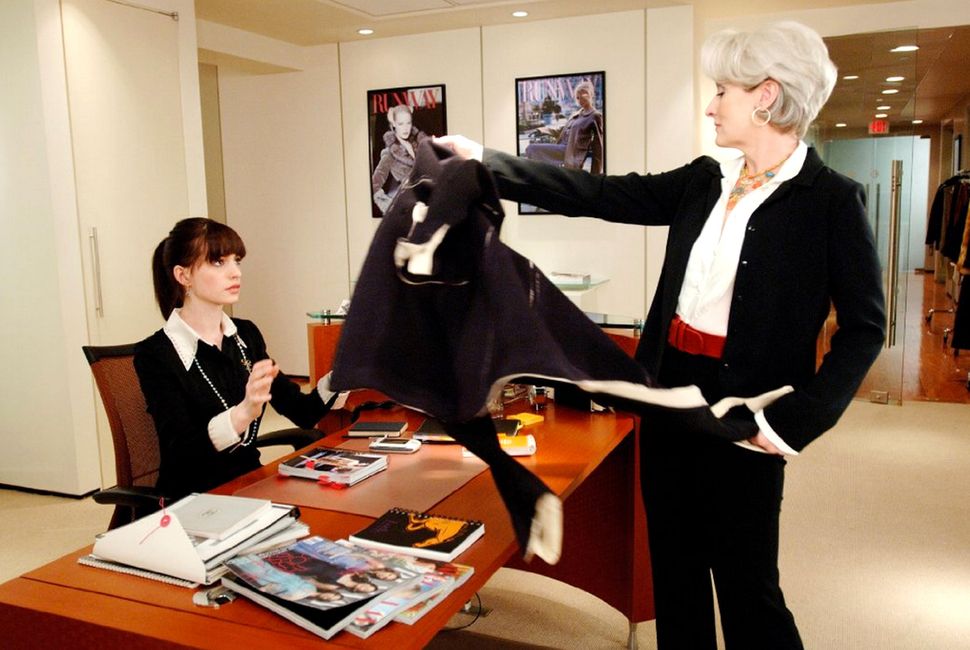
“I don’t feel like those interpretations reflect what hard work is and how you’re rewarded,” said Heather David, who has worked as in-house public relations for Balenciaga and Alexander Wang. “When I was young, my boss seemed like Miranda Priestly, criticising my work. I realised she pushed me because she saw more in me. Her pushing helped me become a better worker and leader.”
Advertisement
David described the environment at Balenciaga as “structured” and “traditional,” and said there’s a disconnect between media portrayals and the reality of fashion.
“Films show interns on a trip to Paris or using the fashion closet. I don’t think that’s realistic at all,” David said.
The fashion closet scene in The Devil Wears Prada set in motion millions of dreams that an intern could simply take a Fendi poncho and turn it into a personal wardrobe transformation. But that’s not real life. “I think people come into fashion naive and they only see these stories,” David said.
Cymone Williamson, a former publicist who worked for the brands DE Marketing and All the Rage, shared a similar sentiment. “People aren’t getting makeovers,” she told HuffPost. “I never came across anyone who had no experience and was moulded into a fashion prodigy.”
Williamson said The Devil Wears Prada thickened her skin, though. “I was prepared to be treated poorly. My experience was a mild version of what you see in movies. I was surprised I wasn’t fired when someone was having a bad day or I made a mistake.”
The Halston miniseries features tantrums and tongue-lashings galore ― there is a scene in which Halston’s career is on the decline and he storms into his atelier screaming at a designer for submitting a sketch without his approval.
Williamson said temper tantrums are not unheard of in reality. She recalled an instance with an employer in a PR showroom: “I had a male boss who was upset about losing an account. My desk was the first desk [near him], and he walked in and pushed everything off my desk. Everyone felt the wrath.”

The 2021 film Cruella touches on power dynamics between management and employees – Emma Stone’s titular character finds herself in a tense environment early on in her career, where she works with a designer who rules with an iron fist.
Recent headlines show that mistreatment of staff, by both designers and organisations, is still an issue in the fashion industry. Brands such as Refinery 29 and Manrepeller, for example, have been called out over the past few years.
Advertisement
513 designer Jerome Lamaar, also known as The Style Monk, is familiar with industry antics. Starting with Baby Phat (run by Kimora Lee Simmons) at age 15, Lamaar said his trajectory has been similar to what he’s seen on film.
“Most of it is on point. I feel my life is very Funny Face he said. In that 1957 film, Jo Stockton, played by Audrey Hepburn, is a young librarian who’s plucked from obscurity and becomes a model at the pinnacle of fashion. While this is purely movie magic, Lamaar’s 20-year career is a one-in-a-million that’s not the norm.
He recalled an instance when “a PR person who was very well known didn’t recognise me and I was visiting a friend’s show. She kicked me out from backstage, and these are the old guards that the movies depict.” He added: “It’s because they are stressed out and it happens during Fashion Week.”
Julian J. Callis, who has worked at the Nicki Minaj Collection and Ralph Lauren, explained that while many films depict young women being groomed to become the future of fashion, they mostly focus on the character getting a glamorous life makeover, and ignore the actual hard work that goes into a career in fashion. “These films don’t show the gray area of starting from the bottom and working to the top,” he explained.
So, before you submit that application to become the next intern at your favourite fashion magazine, remember that it’s not all twirling around in fashion closets and trips to Paris.