Matt Hancock says the 8 March rule change is a “first step to getting back to where we want to be”.


Matt Hancock says the 8 March rule change is a “first step to getting back to where we want to be”.

Duke researchers have been studying something that happens too slowly for our eyes to see. A team in biologist Philip Benfey’s lab wanted to see how plant roots burrow into the soil. So they set up a camera on rice seeds sprouting in clear gel, taking a new picture every 15 minutes for several days after germination.
When they played their footage back at 15 frames per second, compressing 100 hours of growth into less than a minute, they saw that rice roots use a trick to gain their first foothold in the soil: their growing tips make corkscrew-like motions, waggling and winding in a helical path.
By using their time-lapse footage, along with a root-like robot to test ideas, the researchers gained new insights into how and why plant root tips twirl as they grow.
The first clue came from something else the team noticed: some roots can’t do the corkscrew dance. The culprit, they found, is a mutation in a gene called HK1 that makes them grow straight down, instead of circling and meandering like other roots do.
The team also noted that the mutant roots grew twice as deep as normal ones. Which raised a question: “What does the more typical spiraling tip growth do for the plant?” said Isaiah Taylor, a postdoctoral associate in Benfey’s lab at Duke.
Winding movements in plants were “a phenomenon that fascinated Charles Darwin,” even 150 years ago, Benfey said. In the case of shoots, there’s an obvious utility: twining and circling makes it easier to get a grip as they climb towards the sunlight. But how and why it happens in roots was more of a mystery.
Sprouting seeds have a challenge, the researchers say. If they’re to survive, the first tiny root that emerges has to anchor the plant and probe downwards to suck up the water and nutrients the plant needs to grow.
Which got them thinking: perhaps in root tips this spiral growth is a search strategy — a way to find the best path forward, Taylor said.
In experiments performed in physics professor Daniel Goldman’s lab at Georgia Tech, observations of normal and mutant rice roots growing over a perforated plastic plate revealed that normal spiraling roots were three times more likely to find a hole and grow through to the other side.
Collaborators at Georgia Tech and the University of California, Santa Barbara built a soft pliable robot that unfurls from its tip like a root and set it loose in an obstacle course consisting of unevenly spaced pegs.
To create the robot, the team took two inflatable plastic tubes and nested them inside each other. Changing the air pressure pushed the soft inner tube from the inside out, making the robot elongate from the tip. Contracting opposing pairs of artificial “muscles” made the robot’s tip bend side to side as it grew.
Even without sophisticated sensors or controls, the robotic root was still able to make its way past obstacles and find a path through the pegs. But when the side-to-side bending stopped, the robot quickly got stuck against a peg.
Finally, the team grew normal and mutant rice seeds in a dirt mix used for baseball fields, to test them out on obstacles a root would actually encounter in soil. Sure enough, while the mutants had trouble getting a toehold, the normal roots with spiral-growing tips were able to bore through.
A root tip’s corkscrew growth is coordinated by the plant hormone auxin, a growth substance the researchers think may move around the tip of a growing root in a wave-like pattern. Auxin buildup on one side of the root causes those cells to elongate less than those on the other side, and the root tip bends in that direction.
Plants that carry the HK1 mutation can’t dance because of a defect in how auxin is carried from cell to cell, the researchers found. Block this hormone and roots lose their ability to twirl.
The work helps scientists understand how roots grow in hard, compacted soil.
Video: https://www.youtube.com/watch?v=uXwYKymTiQg&feature=emb_logo
This work was supported by a grant from the National Science Foundation (PHY-1915445, 1237975, GRFP-2015184268), the Howard Hughes Medical Institute, the Gordon and Betty Moore Foundation (GBMF3405), the Foundation for Food and Agricultural Research (534683), the National Institutes of Health (GM122968) and the Dunn Family Professorship.
Story Source:
Materials provided by Duke University. Original written by Robin A. Smith. Note: Content may be edited for style and length.
Since the first case in northern Italy a year ago the lives of Europeans have been changed forever.

A POSTECH-KAIST joint research team has successfully developed a technique to reach near-unity efficiency of SHEL by using an artificially-designed metasurface.
Professor Junsuk Rho of POSTECH’s departments of mechanical engineering and chemical engineering, and Ph.D. candidate Minkyung Kim and Dr. Dasol Lee of Department of Mechanical Engineering in collaboration with Professor Bumki Min and Hyukjoon Cho of the Department of Mechanical Engineering at KAIST have together proposed a technique to enhance the SHEL with near 100% efficiency using an anisotropic metasurface. For this, the joint research team designed a metasurface that transmits most light of one polarization and reflects the light from the other, verifying that the SHEL occurs in high-frequency region. These research findings were recently published in the February issue of Laser and Photonics Reviews, an authoritative journal in optics.
The spin hall effect of light (SHEL) refers to a transverse and spin-dependent shift of light to the plane of incidence when it is reflected or refracted at an optical interface. When amplified, it can shift light that is several times or tens of times greater than its wavelength.
Previous studies of enhancing the SHEL have involved greater light movement with little consideration for efficiency. Since enhancing the SHEL produces extremely low efficiency, studies on achieving a large SHEL and high efficiency simultaneously have never been reported.
To this, the joint research team used an anisotropic metasurface to enhance the SHEL. It was designed to enable high SHEL by transmitting most of the light from one polarization while reflecting the light from the other. By measuring the transmission of metasurface in the high-frequency region — such as microwaves — and verifying the polarization state of the transmitted light, the researchers verified the occurrence of SHEL reaching 100% efficiency.
“The very mechanisms that enhance the SHEL in most previous studies in fact lowered its efficiency,” remarked Professor Junsuk Rho, the corresponding author who led the study. “This research is significant in that it is the first study to propose a method to calculate the efficiency of the SHEL, and to increase its efficiency and enhance the SHEL simultaneously.” He added, “The SHEL is applicable in microscopic optical devices, such as beam splitters, filters and switches, and this study will improve their effectiveness.”
This research was conducted with the support from the Mid-career Researcher Program, Global Frontier Program, and Regional Leading Research Center (RLRC) Program of the Ministry of Science and ICT of Korea, and the Global-Ph.D. Fellowship of the Korean Ministry of Education.
Story Source:
Materials provided by Pohang University of Science & Technology (POSTECH). Note: Content may be edited for style and length.

Disorders of the cells’ energy supply can cause a number of serious diseases, but also seem to be connected to ageing. More research is needed on mitochondrial function to find future treatments. A new study involving researchers at Karolinska Institutet shows how an important molecule inside the mitochondria affects their function in mice and fruit flies. The study, which is published in Science Advances, adds valuable knowledge on formerly relatively unexplored protein modifications.
In each cell of the body is an organ called the mitochondrion, which converts nutrients in our food to energy. Mitochondria are an essential part of the metabolism, and when things go wrong we can develop serious diseases.
Mitochondrial dysfunction is the hallmark of a group of rare genetic disorders but can also be observed in common diseases such as diabetes, heart disease, neurodegenerative diseases and the normal ageing process.
More research is needed on mitochondria and how they communicate with the rest of the cell if scientists are to find new therapeutic approaches to improve mitochondrial function.
Researchers at Karolinska Institutet, the Max-Planck Institute for Biology of Ageing in Cologne and the University of California San Diego have now studied how the methylation of proteins affects different mitochondrial processes.
Methylation is a chemical modification in which a methyl group (CH3) is added to a molecule, thereby potentially affecting its function. S-Adenosylmethionine (SAM), also known as AdoMet, is the main methyl group donor within the cell, including inside of mitochondria.
“We’re interested in studying this particular molecule since the production of SAM changes in cancer and when we age,” says Anna Wredenberg, researcher at the Department of Medical Biochemistry and Biophysics, Karolinska Institutet.
By completely removing SAM from the mitochondria of fruit flies and mice, the researchers have been able to study which processes in the mitochondria are dependent on methylation.
“Earlier studies have shown that both SAM and cellular energy levels drop during ageing. Our study suggests a link between these two pathways by demonstrating that low SAM levels can influence mitochondrial energy production.”
The study has identified which of the mitochondrial proteins are methylated and how methylation affects them, and how these modifications might affect mitochondrial function. The researchers also demonstrate the physiological consequences of the lack of such changes. However, several questions still need answering.
“Our study has provided an indication that some modifications can be modulated by diet, but we need to continue examining if we can change the pathological process for the better,” says Anna Wredenberg. “So far we’ve only looked at protein changes, but other molecules can also be modified by intra-mitochondrial SAM. We have to study these modifications to get a better understanding of the role it plays.”
The study was financed by the Swedish Research Council, the European Research Council, the Knut and Alice Wallenberg Foundation, the Max Planck Society and the Ragnar Söderberg Foundation. There are no reported conflicts of interest.
Story Source:
Materials provided by Karolinska Institutet. Note: Content may be edited for style and length.

We were left “clapping for the UK Hun” Bimini Bon Boulash after the latest episode of RuPaul’s Drag Race UK, and it seems we were not the only ones bowled over by her Katie Price impression on Snatch Game.
In fact, so good was her send up of Pricey that Bafta has officially endorsed it.
The latest episode of the hit BBC Three reality show saw the remaining queens tasked with impersonating a host of celebrities in the iconic Snatch Game challenge.
After the show debuted on Thursday night, the meme account Love Of Huns posted a clip of Bimini’s performance on Instagram, along with the caption: “Bimini’s Katie Price is truly BAFTA worthy.”
It soon caught the attention of the official Bafta account, who very much agreed, commenting with a trophy emoji.
With the TV Baftas scheduled to happen later in the year, we’re on tenterhooks to find out if Bimini bags a nomination.
Drag Race fans are still waiting to hear what the woman herself thought of the performance, as Katie is yet to comment.
However, after the show aired, Bimini was sure to reiterate that her impression was done with a lot of love.
She tweeted: “I also ADORE AND LOVE @KatiePrice and I always have. She’s an absolute icon and I hope I did her proud.”
I also ADORE AND LOVE @KatiePrice and I always have. She’s an absolute icon and I hope I did her proud 💓
— BIMINI! (@biminibabes) February 18, 2021
The internet was lapping up Bimini’s Snatch Game, and she was trending on Twitter thanks to all the praise she was receiving.
Ok this week’s Drag Race UK ep:
– BIMINI!!! The eyes are the nipples of the face floored me and her runway look was stunning. ‘If you don’t get it straight away… read a book’ haha. She just seems so comfortable in herself without ever being arrogant and it’s such a joy to watch— jack rem x (@jackremmington) February 18, 2021
Bimini’s Snatch Game performance is exactly how it should be done. Relaxed, excellent character choice and entirely in character the whole time, prepared to volley with whatever you’re thrown. It was perfection #DragRaceUK
— Calum. (@CalumS1991) February 18, 2021
And while Ellie Diamond didn’t receive a top placing from the judges after taking off Matt Lucas’ Little Britain character Vicky Pollard, the comedian was apparently very impressed.
He tweeted: “Thank you @elliediamond101 for smashing Vicky Pollard! I’m flattered, humbled and still laughing xxx.”
Thank you @elliediamond101 for smashing Vicky Pollard! I’m flattered, humbled and still laughing xxx
— MATT LUCAS (Taylor’s Version) (@RealMattLucas) February 18, 2021
RuPaul’s Drag Race continues next Thursday, with the new episode available to stream on BBC Three from 7pm.


Prince Harry and his wife Meghan Markle have confirmed they will not be returning as working members of the royal family.
The announcement comes 12 months after they said they wanted to quit as senior royals.
Buckingham Palace said in a statement: “The Duke and Duchess of Sussex have confirmed to Her Majesty The Queen that they will not be returning as working members of the royal family.
“Following conversations with the duke, the Queen has written confirming that in stepping away from the work of the royal family it is not possible to continue with the responsibilities and duties that come with a life of public service. The honorary military appointments and royal patronages held by the Duke and Duchess will therefore be returned to Her Majesty, before being redistributed among working members of the royal family.

Getty
“While all are saddened by their decision, the duke and duchess remain much loved members of the family.”
A spokesperson for Harry and Meghan said: “As evidenced by their work over the past year, the Duke and Duchess of Sussex remain committed to their duty and service to the UK and around the world, and have offered their continued support to the organisations they have represented regardless of official role.
“We can all live a life of service. Service is universal.”
The decision was made after conversations between Harry and members of the royal family.
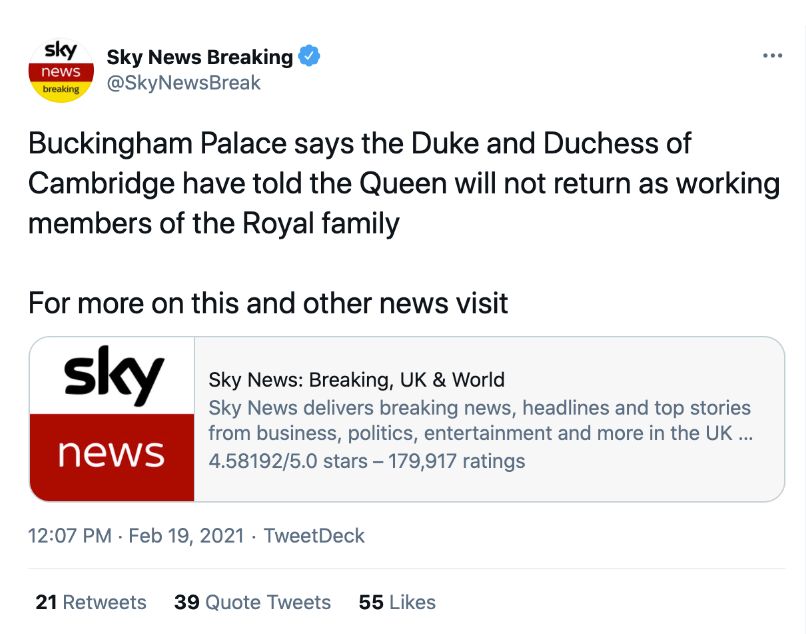
Sky News raised eyebrows by accidentally tweeting that the Duke and Duchess of Cambridge, William and Kate, had quit the royal family, which would have been considerably more surprising.
The error was swiftly corrected.
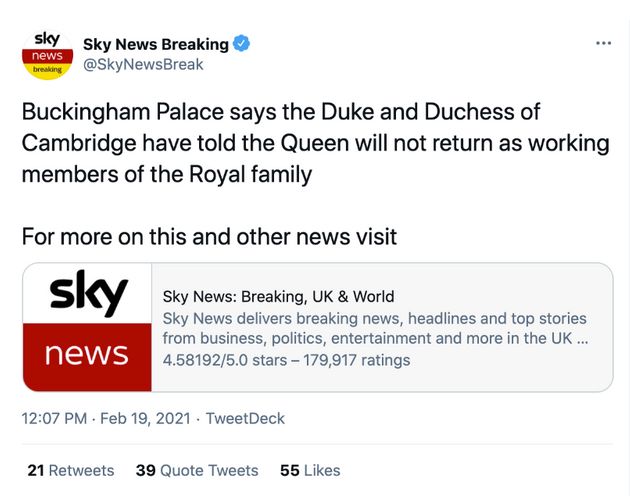
Twitter
The military, Commonwealth and charitable associations whose patronages will revert to the Queen are the Royal Marines, RAF Honington, Royal Navy Small Ships and Diving, the Queen’s Commonwealth Trust, The Rugby Football Union, The Rugby Football League, The Royal National Theatre and The Association of Commonwealth Universities.
Harry and Meghan released their shock statement on January 8, 2020, saying they intended to step down and become financially independent, but still support the Queen – a dual role that in the end was unworkable.
They have settled into a new life in the US away from the monarchy secured lucrative multimillion-pound deals with both Netflix and Spotify and established their Archewell foundation.



For the last two years, we have consistently pointed out the need for a rupture in the existing political, economic and social arrangements in Britain. The system simply is not working for the majority, and Labour needs to be clear that we are determined to bring about root and branch change.
The strategy we have adopted under Starmer’s leadership so far has simply not worked. “Constructive opposition” in a national crisis may play well with focus groups, but it is clear that seeking to gain narrow party advantage is totally inappropriate when people are dying and the hospitals are at breaking point.
But in the real world it has embedded a Tory narrative that they’ve done as well as could be expected. This is clearly untrue. Outside of Westminster, hundreds of thousands of families have lost loved ones and millions more are in financial peril due to Tory incompetence and neoliberal ideology. Yet still they cling to a stubborn lead in the polls.
While there was much in Keir Starmer’s speech on Thursday that members across the Labour party could find agreement with, it certainly didn’t feel like something which lived up to the hype. Opposing the cut to Universal Credit, refusing to back an increase in council tax and an end to the public sector pay freeze have widespread support, but are not earth-shattering pronouncements. This was an opportunity to dive headlong into the sea of challenges we face – but it felt like we merely dipped a toe in.
Our country is at serious risk of calamitous decline, and we must show how to break through to a new dawn.
Where Brexit catalysed changes in voting patterns, occurring over decades, Covid is hastening the demise of the high street, laying bare injustices in the workforce and showing the frailties of a public service network that has been wilfully neglected. This is to say nothing of the crises of our time like climate change, demographic ageing, or automation.
Problems of this magnitude can not be met with timidity. They need a bold confident Labour Party showing another way. Although we have great faith in the British people’s abilities, the truth is our country is at serious risk of calamitous decline, and we must show how to break through to a new dawn.
Invoking the spirit of the post-war government and using Marmot as a rallying call seems appropriate; the millions of people who have suffered ill health, financial distress and loneliness must be given the promise of a better future. But this has to go beyond rhetoric. In the same way as Clement Attlee’s Labour offered the opportunity for Britain to “win the peace”, the Labour of now must offer a vision of “winning the health”.
We welcome the Labour plan to issue bonds to boost savings and fuel the post-Covid recovery, which was an innovative proposal in Starmer’s speech. But it falls short of the Marshall Plan-style scale of spending which is required to deliver the stated aim of stopping the neglect of British towns and villages in held back areas.
Billionaires have raked in profits driven by the disaster that has befallen us all. A Labour Party comfortable in its own skin would have no issue calling this out.
In outlining the new contract with the British people we must be both ambitious for our country and concrete in the steps we will take. That 70% of children in poverty are in working families shows the current settlement is bust.
As we outline a new relationship with business, workers must be at the forefront of our minds. Of course Labour should not be anti-business, but neither should it be subservient to it. The pandemic has shown the best and worst elements of British business and we should be confident in saying those who have exploited the Covid crisis for a competitive edge should play no part in setting the priorities of our country. We should also be confident in saying that the public institutions that have kept our country afloat in the last year belong in public ownership.
Over the course of the pandemic as working people have seen their finances decimated, UK billionaires have raked in profits driven by the disaster that has befallen us all. A Labour Party comfortable in its own skin would have no issue calling this out and demanding a windfall tax on the profits of disaster. This could be used to fuel the renaissance that towns in all of our constituencies desperately need.
If Labour is to win again, it must remember its roots and be comfortable in articulating the anguish of communities that turned away from it. Starmer’s speech showed an acknowledgement that the previous strategy wasn’t working. We urge the leadership to look at the monolithic challenges we face, reject the triangulation of the past, and outline a path to a country that truly is the best place in which to grow up and grow old.
Ian Lavery MP is the Labour MP for Wansbeck
Jon Trickett MP is the Labour MP for Hemsworth
Laura Smith is a Labour councillor and former MP for Crewe and Nantwich


In a letter, 20 organisations say measures to tackle airborne spread of coronavirus are “inadequate”.
This does not mean none is circulating or commuters can let down their guard, the researchers say.
