Lindsay Clancy has admitted killing her daughter and two sons but has pleaded not guilty to murder, saying she was experiencing postpartum psychosis.


Lindsay Clancy has admitted killing her daughter and two sons but has pleaded not guilty to murder, saying she was experiencing postpartum psychosis.
Most of the cases were in England in recent weeks, linked to eating imported eggs, experts believe.
When a famous person dies unexpectedly, people who enjoyed their work often feel the loss deeply. The news of Hayden Panettiere’s death at 36 has particularly hit many millennials who grew up watching her performances in a way that can be hard to articulate.
Therapists and mental health experts say that reaction is completely understandable, and it says something meaningful about the generation that grew up with her.
Advertisement
“I hear this from clients all the time – that there is this confusion about why they’re crying over someone they’ve never even met,” Gina Moffa, a grief therapist and author of Moving On Doesn’t Mean Letting Go: A Modern Guide to Navigating Loss, told HuffPost.
“We have all felt it at some point with a favourite public figure. And what I say is this: Your brain doesn’t actually care whether the relationship was mutual. It bonds with what’s familiar, what’s constant, what’s shown up for you again and again, even if that showing up only ever went one direction over a TV screen or a radio.”
The clinical term that helps explain what many people are feeling right now is a parasocial relationship – a one-sided bond that the brain forms with a public figure through repeated exposure. But experts say the term doesn’t entirely capture what these connections actually feel like from the inside.
Advertisement
“If someone’s voice or presence has been an important or meaningful part of your life for years, through your breakups, your late nights trying to fall asleep, your growing up, your body doesn’t check whether they knew your name or were an actual part of your life in any reciprocal way,” Moffa said. “It only registers that this was steady, this was meaningful to me, and now it’s gone.”
Therapist Tychelle Graham-Moskowitz explained the neuroscience behind these bonds.
“Our brains process the familiar faces and voices of celebrities we come to know and love the same way they process real friends because we see them on our screens, often daily, in our own homes,” she said.
“This is partly rooted in mirror neurons, which fire when we observe someone else’s emotions and allow us to internally mimic or feel connected to what we see as we may be experiencing many of the same emotions and events in our own lives,” she continued.
Advertisement
“When we watch a celebrity on TV, these mirror neurons let us resonate with their emotions, creating a bridge of identification.”
That’s why your brain doesn’t need a two-way relationship to form a meaningful attachment. Spending formative years with a pop culture figure creates a sense of familiarity, which can foster a genuine sense of companionship.
“Whether it is music, movies, sports, television or social media, we can feel like our paths have mirrored the path of the celebrity and we have ‘grown up with them’ or they represent a particular moment or time in our lives,” said Dr. Jessi Gold, a psychiatrist and chief wellness officer at the University of Tennessee System.
Advertisement
“I think about this like, ‘Oh, that movie meant so much to me when…’ and we have feelings that associate with that movie, that time, that character, and those translate to the human who portrayed them.”
As we age as millennials, the death of celebrities shakes us out of our egocentric internal teenage feeling and forces us into the fragile reality that our own mortality is real.
– Tychelle Graham-Moskowitz, therapist
So when that celebrity dies, you might feel grief over who they were to you or that time in your life. For nostalgia-driven millennials, it can be a powerful gut punch.
Advertisement
“I do believe there is a special relationship with millennial grief of celebrities,” Moffa said. “With my millennial clients, what I notice is that the grief they experience is not really just about the person, but also about the version of themselves that existed the last time they watched them and how they felt about their own life and themselves in the world.
“These weren’t just actors and actresses – they were sitting on the couch with us as kids, shaping what we thought friendship or relationships or love looked like. So when they’re gone, part of what’s actually being mourned is that chapter of your life feeling unreachable in a new way.”
Because Panettiere was a child actor as well, many millennials literally grew up alongside her and feel her death in a deeply personal way.
Advertisement
“As we age as millennials, the death of celebrities shakes us out of our egocentric internal teenage feeling and forces us into the fragile reality that our own mortality is real,” Graham-Moskowitz said.
Public figures remind us of the passage of time and our own place within it.
“When a person who represented those memories or versions of ourselves dies, it can feel like a piece of history lost, or it can make us confront our own age more and the idea that we are getting older, our friends are getting older, and we will have more loss as a result,” Gold said. “Death reminds us that time has passed – even if part of us still feels like we were watching them on TV yesterday.”

Jon Kopaloff via Getty Images
Advertisement
Panettiere and other former child actors who have recently passed away – like Michelle Trachtenberg and Daveigh Chase – served as role models and influential peers in a sense.
“Celebrities who were present during your developmental years become part of your internal reference system,” said Chloë Bean, a licensed marriage and family therapist.
“They model resilience, sexuality, independence and aspirational qualities when you’re just starting to figure out who you are. You looked up to them in your youth for guidance and self-direction. So you’re grieving that chapter, your childhood, and the part of you that felt so connected to them.”
Advertisement
She also pointed to the role cable TV played in cementing these bonds as well.
“For many millennials, the TV was the babysitter and an escape,” Bean said. “These actresses felt like friends because they were in your home multiple nights a week, sometimes for years. You weren’t just watching them on the screen, the experience felt like you lived and grew up alongside them. Millennials compare themselves to millennial celebrities in a way that no other generation has before. We aged with them, watching them getting married, struggling, hitting their 30s and 40s.”
Other technological advancements further deepened the connection and the sense of certain celebrities as a constant, stable presence in life.
“Millennials were the first generation to have access to the internet in our homes as a regular occurrence, so not only did we see our favourite celebrities in movies, on television, in magazines and so on, but we got a chance to search more about them on the internet and eventually in the palms of our hands,” Graham-Moskowitz noted.
Advertisement
It’s safe to assume Gen Z may feel celebrity losses even more intensely due to their lifelong parasocial access as well.
“The loss of a celebrity can also be a grief trigger to other grief – other relationships we’ve lost or represent a loss of time, innocence and childhood, or even symbolise our own death or mortality,” Gold said. “And, the communal reaction on social media can also amplify the expression of it all. The grief is usually about more than just the person.”
Therapists pointed to another profound dimension in grieving Panettiere’s death.
“With Hayden specifically, I think what made this loss land so [personal] for so many people is that she wasn’t just a face we grew up watching – she used her platform to speak openly about postpartum depression and trauma and battles with drug use, at a time when very few public figures are willing to say those things out loud and be this vulnerable,” Moffa explained.
Advertisement
Indeed, Panettiere’s recent memoir and interviews added to the depth of connection.
“Unlike many celebrities who have struggled with mental health or substance abuse, Hayden was extraordinarily open about her experiences, and that kind of vulnerability results in followers truly rooting for her and wanting her to overcome these obstacles, which makes her loss even more devastating,” said licensed marriage and family therapist Becky Stuempfig.
“When someone visible says ‘me too,’ it gives people permission to stop hiding their own pain,” Moffa added. “She didn’t just play characters we loved; she showed up as herself, in her own struggle, and that kind of honesty tells people watching from their own dark moments that they’re not alone in the struggle. That can be a whole other part of the grief experience we don’t talk enough about.”
Bean captured what makes this grief so uniquely hard to put into words.
“The millennial generation will feel every celebrity passing because we grew up believing we knew them,” she said. “Social media provides intimacy and daily access, but growing up watching these actresses on shows created a fantasy that felt real. We’re grieving them like we’d grieve a friend who turned out to be a stranger, someone we only knew from one direction. That’s where the grief hits hardest, and it’s what makes it so difficult to articulate.”
Advertisement
She didn’t just play characters we loved; she showed up as herself, in her own struggle.
– Gina Moffa, grief therapist and author
If you’re feeling blindsided by how much a celebrity death is affecting you, therapists have some guidance.
“Don’t let anyone talk you out of feeling the shock and grief, because the relationship wasn’t ‘real’ in any traditional sense, or because they were ‘just a celebrity,’” Moffa said.
Advertisement
“Grief doesn’t require reciprocity to be legitimate. It only requires attachment and meaning. If someone shaped who you became, at any age, or time in your life, in any way, that grief deserves the same gentleness you’d give any other loss.”
She emphasised that you don’t need permission to feel deep sadness and loss.
“When a death is sudden and shocking, the unanswered questions and uncertainty about the death being accidental or intentional [exacerbate] the complicated nature of the grief process,” Stuempfig said. “This is very different than an anticipated dying process from a medical illness or ageing. Our brains and bodies have a harder time processing emotions when there are unanswered questions.”
Talk about those feelings with a trusted friend or family member, ideally even someone who was also a fan or can help identify these emotions.
Advertisement
“The concept of ‘name it to tame it’ can be helpful with grief as it is critically important to identify the various feelings that arise so they can be validated,” Stuempfig said.
Be mindful of social media consumption, too.
“You don’t need to read every tribute, every post, and every statement if you feel impacted,” Gold said. “You can still care about an event or person and their death, and detach and take time away from the news, if needed. You also should not feel like you have to post or comment if you don’t know what to say. You can take time to figure out your feelings about something or grieve alone, that is OK, too. You don’t have to say something to show you care.”
Remember that grief, as painful as it can be, may also be a source of social connection.
“As we mourn the deaths of our favourite celebrities, know that we collectively mourn together, much like to do when we mourn in our own family members,” Graham-Moskowitz said. “The connected space that the internet creates can bring us a sense of comfort and togetherness, where we feel seen. This can be helpful. Also, go call a friend!”
Advertisement
And when these experiences bring up heavier feelings around your own mental health, Gold encouraged reaching out.
“If any of these deaths make you think more about your own mental health, I hope you reach out and ask for help,” she said. “There are hotlines, local therapists and everything in between. You can also start with a trusted family member or friend. Just start somewhere.”
Advertisement


An outbreak of Salmonella in the UK has resulted in hundreds of people getting sick and one person dying.
More than a third of those impacted by the outbreak – thought to be linked to eating imported eggs – have ended up needing hospital treatment.
Advertisement
The majority have been able to recover without treatment, but would’ve suffered unpleasant food poisoning symptoms.
Of the cases identified by the UK Health Security Agency (UKHSA), 199 were in England (47 of which were in London and 38 in Yorkshire and Humber), six were identified in Scotland, with one case in Wales and one in Northern Ireland.
The main body of cases occurred between 6 and 29 July 2026.
Dr Damien Tully, Associate Professor at London School of Hygiene & Tropical Medicine, said the number of confirmed cases “is likely to be just the tip of the iceberg”.
Advertisement
He added: “Many Salmonella infections cause relatively short-lived gastrointestinal illness and people may recover without ever being tested.”
The UKHSA said the outbreak has been caused by S. Enteritidis, a common type of Salmonella bacteria. It’s spread via contaminated food (like eggs, poultry, meat, etc); contact with the environment, and can also spread from person-to-person.
An investigation is underway to identify the source. Of those who suffered symptoms, 114 were interviewed and completed an outbreak questionnaire. The majority (83%) reported eating food prepared outside of the home in the week prior to symptom onset.
Advertisement
There were five food businesses identified where two or more independent cases reported attending in the week prior to symptom onset. Eleven of these cases reported eating dishes made with eggs which came from multiple sources, including outside of the UK.
UKHSA said there’s no identified link to UK-produced eggs or poultry, at present, and noted a previous outbreak from 2025 was also linked to imported eggs.
Dr Kathleen O’Reilly, Associate Professor at London School of Hygiene and Tropical Medicine, said previous research estimated that less than 10% of Salmonella cases require hospitalisation, “so it seems initially concerning that 38% in this outbreak have been admitted to hospital”.
Advertisement
“As the epidemic progresses, this number might change, especially as Salmonella cases are often underreported,” she added.
Symptoms of salmonella poisoning include:
These unpleasant effects can occur roughly 12 to 72 hours after becoming infected, and can last up to a week.
The UKHSA said immunocompromised individuals and those in vulnerable groups (such as young children and older adults) can experience more severe illness as a result of it such as blood stream infections, sepsis and even multiorgan failure.
Advertisement
It’s important to ensure eggs are fully cooked before eating them.
“Hygiene while preparing food is important, especially washing hands with soap, and chopping boards, after preparation,” Dr O’Reilly said.
The expert also encouraged consumers to look at restaurant food hygiene ratings before eating out.
“If you do get ill with diarrhoea or stomach cramps, take it easy, drink plenty of fluids, and cases will often resolve after a few days,” she said.
“If the illness is in young children, elderly, or other vulnerable groups, it would be sensible to contact your GP or ring 111 to talk with a health specialist.”
Advertisement

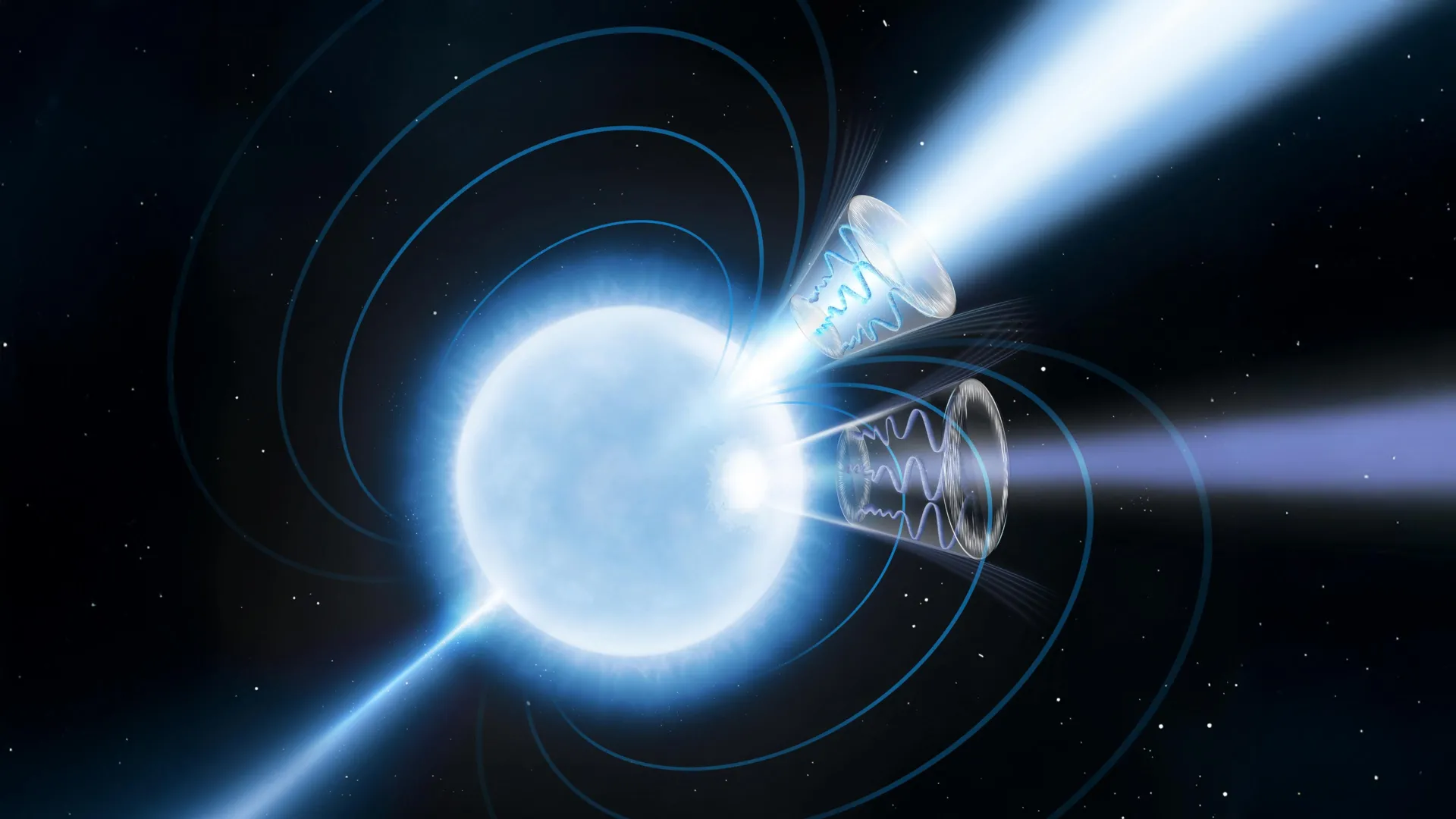
Astronomers may have found some of the strongest evidence yet for one of quantum mechanics’ strangest predictions: even apparently empty space can influence the way light travels.
Known as ‘vacuum birefringence’, the phenomenon was predicted nearly 90 years ago by Werner Heisenberg, one of the pioneers of quantum mechanics. His work suggested that a perfect vacuum is not truly empty. Instead, it should contain ‘virtual particles’ that briefly appear and disappear.
Researchers, including Dr. Marcus Lower from Swinburne University of Technology, investigated this long-standing quantum mystery by studying a magnetar, a rare type of neutron star that possesses the strongest magnetic fields known in the universe.
Their observations may represent the first detection of vacuum birefringence occurring within a magnetar’s extraordinarily powerful magnetic field. If confirmed, the result could give scientists a new way to investigate the quantum universe. The findings were published recently in Nature.
How Extreme Magnetic Fields Can Change Light
According to the theory, an exceptionally strong magnetic field can affect the sea of virtual particles associated with the vacuum. Under these conditions, the particles are expected to influence how light travels, refracting it in a specific way and producing vacuum birefringence.
Magnetars provide a rare opportunity to search for this effect because their magnetic fields are powerful enough to make the predicted quantum behavior potentially observable.
Dr. Lower was part of an international research team that studied the magnetar 1E 1547.0-5408 (or 1E1547 for short) with NASA’s Imaging X-ray Polarimetry Explorer (IXPE). The observations were supported by the NICER X-ray telescope aboard the International Space Station and Murriyang, CSIRO’s Parkes radio telescope, which is owned and operated by Australia’s national science agency.
Radio observations collected by Dr. Lower using Murriyang, followed by analysis on Swinburne’s Ngarrgu Tindebeek supercomputer, helped the researchers investigate what could be the first direct detection of this previously theoretical quantum phenomenon.
Although vacuum birefringence was predicted in the 1930s, Dr. Lower said scientists have yet to obtain a definitive detection.
“Detecting vacuum birefringence requires a magnetic field that is over 100 million times stronger than any we’ve ever made on Earth. Thankfully, nature has provided us with magnetars, which are the perfect cosmic laboratories to go looking for this effect,” Dr. Lower said.
A Magnetar With Ideal Viewing Geometry
The researchers closely followed how the radio waves coming from the magnetar changed direction as the star rotated (their ‘polarization state’). From those measurements, they determined that the magnetic and rotational axes of 1E 1547 are almost aligned. The magnetar is also observed from a nearly pole-on perspective.
Together, those characteristics give scientists an unusually favorable view for searching for vacuum birefringence around 1E 1547.
The team then found two important clues pointing toward the quantum effect. X-rays generated by the magnetar and detected by IXPE showed extremely high levels of polarization. In addition, the direction of that polarization remained tied to the magnetic field of 1E1547 in the same way seen in the radio observations.
“Because of the magnetic field’s strength, Heisenberg’s virtual particles become aligned with the direction the field is pointing,” Dr. Lower said.
“By carefully tracking the direction the radio waves and X-rays oscillate as the magnetar rotates, the team found that the alignment of 1E1547’s magnetic and rotational poles were ideal for detecting vacuum birefringence.”
Closing In on a 90 Year Quantum Mystery
If the interpretation is confirmed, the result could help physicists test how established theories of quantum physics behave under some of the most extreme conditions found anywhere in the universe.
Dr. Lower said additional observations and more advanced computer simulations could help establish whether the signal truly comes from vacuum birefringence. Those improvements should make it easier for researchers to distinguish the predicted quantum signature from other physical processes taking place around magnetars.
“With these future data on hand and our updated simulations, we may finally be able to complete the quest started by Heisenberg nearly 90 years ago.”
The paper titled “Vacuum birefringence and the polarized X-ray emission of a radio magnetar” has been published in Nature.
A little more than a century ago, Albert Einstein turned his attention from gravity itself to the fate of the entire universe. In 1917, shortly after developing his general theory of relativity, he began applying his new equations to cosmology. General relativity had transformed our understanding of gravity, so it made sense to ask what those same equations said about the universe on the largest possible scales.
Gravity was the natural place to start. On average, the universe is electrically neutral, which means electromagnetism does not dominate its large-scale behavior. Einstein also knew nothing about the strong and weak nuclear forces (to be fair, nobody did), but those interactions only operate over very short distances.
Einstein’s Unexpected Dynamic Universe
For cosmology, gravity determines how matter behaves across enormous distances. If you imagine a collection of matter representing “a universe,” Einstein’s equations can tell you how that collection should evolve.
What Einstein found surprised him. General relativity did not naturally describe a universe that remained unchanged forever. Instead, the equations pointed toward a dynamic cosmos that would either expand or contract. That conclusion conflicted with the prevailing view at the time, which held that the universe was static and had remained essentially the same throughout cosmic history.
Einstein responded by adding a “cosmological constant” to his equations, represented by the Greek letter Lambda. General relativity already allowed such a term. In simple terms, it acts like a gravitational influence built into spacetime itself, one that can exist even in otherwise empty space. Depending on its value, that effect can produce either attraction or repulsion. Einstein selected a value that counteracted the gravitational pull of matter, allowing the universe to remain stable.
That solution did not last long.
An Expanding Universe Changes Everything
Within a few years, Edwin Hubble would discover that the universe is expanding. Meanwhile, theorists such as Russian cosmologist Alexander Friedmann took Einstein’s equations more literally and developed the theoretical foundation that would help support the Big Bang theory.
Einstein eventually abandoned the cosmological constant. He would later tell friends that introducing it had been his “greatest blunder.”
Then came another major surprise.
Fast forward to 1998. Two teams of astronomers were trying to resolve a long-running disagreement over how much matter the universe contained. Different observations had produced very different estimates, with some suggesting there was relatively little matter and others indicating much more.
Astronomers already knew that the universe was expanding. Because matter produces gravity, however, that matter should have been gradually slowing the expansion. By measuring how strongly the expansion was decelerating, researchers hoped to determine how much matter was actually out there.
Instead, they discovered the opposite.
The Universe Was Speeding Up
The expansion of the universe was not slowing. It was accelerating.
The observations still indicated that the universe contained relatively little matter, but even that matter was not enough to explain what astronomers were seeing. Something appeared to be pushing cosmic expansion to proceed faster over time.
The simplest explanation was a familiar one: Einstein’s cosmological constant. A constant background effect that produces cosmic repulsion could account for the observed acceleration. Decades after Einstein had discarded the idea, his supposed mistake returned as the leading explanation for the new data.
Dark Energy Reshapes Modern Cosmology
During the 1980s and 1990s, cosmologists had developed an increasingly sophisticated framework that became known as the Standard Model of Cosmology (physicists have a penchant for calling cohesive, collaborative, consensus models “Standard”). But the discovery that cosmic expansion was accelerating meant that model could no longer stand in its existing form.
Its replacement became our current best description of how the universe has evolved since the Big Bang: LCDM cosmology.
The Lambda refers to the cosmological constant, which is also known as dark energy. CDM stands for cold dark matter, the type of matter believed to account for most of the mass in nearly every galaxy. Cold dark matter is a story of its own. Here, the focus is Lambda.
A Remarkably Successful Model With a Problem
LCDM has been extraordinarily successful. It is also surprisingly simple, relying on only a handful of adjustable parameters and a small number of assumptions within the framework of general relativity.
Despite that simplicity, the model can account for an enormous range of observations. It describes the expansion history of the universe, the appearance of background radiation, the BAO feature, the growth of galaxies, the development of large-scale cosmic structure, and much more.
LCDM has become one of the most thoroughly studied and extensively tested theories in ALL of science.
And it is almost certainly wrong.
Having life-saving cancer treatment at 21 would be hard enough for anyone, but Erin Lavery was told she may never be able to have children too.
An obstetrician says he treats women from Wales every other week at an abortion clinic in London.
Multiple children are feared to have been conceived using sperm and egg donors which were not the ones selected by the parents.

Scientists have identified the bacteria that help give three British artisan cheeses their distinctive flavors, and some of those microbes may also have potential benefits for human health.
Researchers in the Food Microbial Sciences Unit at the University of Reading tracked the microbial and biochemical changes that occurred as three locally made Oxfordshire cheeses matured. Their findings suggest that some of the bacteria responsible for developing each cheese’s unique character may also be useful to the people who eat them.
The study, published in ACS Food Science & Technology, focused on three varieties made by Nettlebed Creamery in Oxfordshire. These included a soft white rind cheese aged for a little more than a week, a washed rind semi-soft cheese that matures over several weeks, and a semi-hard cheese aged in hay for about nine months.
Helpful Bacteria Shape Flavor and Texture
Lead author Sabrina Longley, a PhD researcher in the Department of Food and Nutritional Sciences, said: “Good cheese is delicious, and the artisan varieties we studied are full of microbial life that could have benefits to your gut health.
“The aging process creates more complex aromas and textures through the work of an army of helpful bacteria. The matrix of fats and proteins in the cheese may also help protect the bacteria as they travel along the digestive tract, making cheese an excellent vehicle for delivery of probiotics to the gut.”
To follow how the cheeses changed over time, the researchers collected samples at multiple stages of maturation and analyzed both their bacterial communities and chemical composition.
All three cheeses contained bacteria with recognized probiotic potential, meaning they may help support populations of beneficial microbes in the gut. Streptococcus thermophilus, which is also commonly used as a yogurt starter, remained dominant in the semi-soft and harder cheeses throughout the maturation process. Lactococcus lactis was detected in all three cheeses from start to finish.
The washed rind cheese and hay-aged cheese also contained Propionibacterium freudenreichii. This bacterium produces propionic acid, a compound associated with anti-inflammatory properties, reduced cholesterol synthesis, and appetite regulation.
Cheese Rinds May Have Prebiotic Potential
Cheese lovers who enjoy eating the rind may have another reason to do so. The white mold Penicillium candidum, which forms the characteristic rind on the soft cheese studied, produces chitin, a dietary fiber that may act as a prebiotic.
Prebiotics serve as food for beneficial bacteria in the gut, potentially encouraging positive changes in the gut microbiota.
The hay aging process also appeared to have a striking effect on the harder cheese. As it matured, the diversity of bacterial species increased substantially. The fully mature cheese contained nearly four times as many bacterial species as the same cheese did earlier in the aging process.
Mature Cheese Contained Very Little Lactose
The researchers also found that lactose, the sugar in cow’s milk that some people have difficulty digesting, was almost entirely absent from all three cheeses once they had matured.
During fermentation, lactic acid bacteria broke down most of the lactose, leaving very little behind by the time the cheeses were ready to eat.
Sabrina Longley is also a cheesemaker at the independent Nettlebed Creamery in Oxfordshire, which part-funded the research. She is carrying out her PhD research part-time with support from a University of Reading regional bursary, a program designed to help people from the local area pursue research studies.
The researchers caution that more work is still needed. Further research (dietary intervention trials) will be necessary to determine how these bacterial populations behave and change within the gut microbiota after the cheeses are consumed, as well as what effects they ultimately have on the human body.
