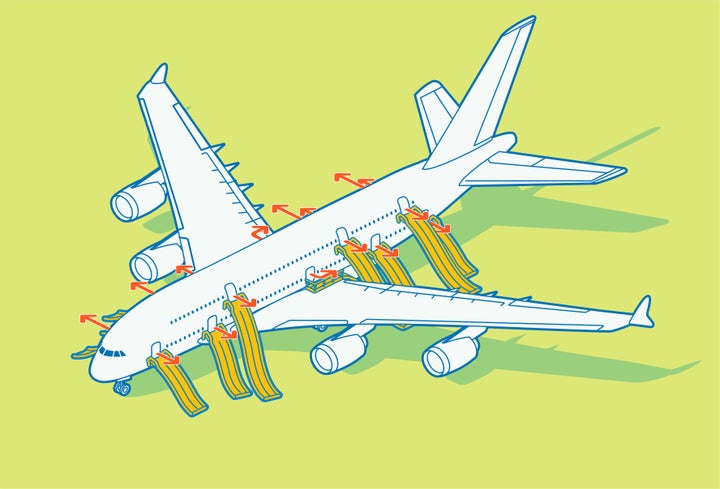
The 1 Potentially Deadly Mistake People Make During An Emergency Landing, According To Flight Attendants

Whether you travel for business or leisure, you’ve inevitably seen and heard the safety announcements ahead of departure. The information typically highlights what to do in the event of rough air, a change in cabin pressure or an emergency landing. While most people don’t like to think about the possibility of emergency landings, it’s important to know how to deal with one should it happen to you.

Last week, a video showed passengers on an American Airlines flight evacuating during an emergency landing in Denver after a problem occurred with a wheel. The video shows people going down the inflatable slide and quickly rushing off the aircraft, many of them holding their carry-on luggage. So that got us wondering one very important question — shouldn’t you leave all that behind?

Ahead, we spoke with flight attendants about emergency landings, and they highlighted one potentially deadly mistake that often happens that could cost you or other passengers their lives.

Let it go, let it go

As seen in last week’s viral video, a majority of the passengers who evacuated took some of their belongings with them, whether it was carry-on luggage or a backpack. Although you might think grabbing those items is a good idea, in the grand scheme of things, it could actually cost you or someone their life during an emergency landing.

Every second counts during an evacuation, especially when it’s a critical event like smoke in the cabin,” said Valerie Fraser, an inflight crew member for JetBlue. “Even if it takes what feels like to you 5 seconds to grab a bag, that could be 5 seconds needed to save a life behind you.”

In the event of an emergency, prioritize getting out of the vehicle safely — and leave your items behind.

anilyanik via Getty Images

In the event of an emergency, prioritize getting out of the vehicle safely — and leave your items behind.

In fact, there have actually been instances in the past where customers on board actually died because the evacuation wasn’t done quickly enough, according to Fraser. “There’s a reason why we make announcements during the safety demo to leave everything behind in the event of an emergency,” she said.

Aside from delaying the evacuation time, grabbing items from a plane before going off can also pose other hazards on board and to the safety equipment, including the inflatable slides.

“Bags can block the aisles, damage the slides or even trip someone,” said Andy L., a flight attendant who has been working domestic flights for one year (he asked to change his name for privacy reasons related to his job). “It just adds chaos in a moment where every second matters, and the focus needs to be on getting everyone out quickly and safely.”

For example, in the video from the American Airlines flight, there was a man carrying a child in one hand and luggage in the other. He lost his balance and fell on top of the child, demonstrating an instance that could have been prevented if he’d had his other hand free.

When should you take your bag?

The short answer is never. Your belongings are replaceable, but your life and that of other passengers on board are not.

It might seem tempting to grab a small bag or luggage quickly, perhaps if it has your phone, wallet or medications, but all of those items can be replaced even if it may be inconvenient or expensive.

Medical personnel are called right away, so they will have any medical supplies you might need in the immediate future,” Fraser said. “All other belongings would be returned to their rightful owners by the airline as well.”

The only real exception would be if you brought a pet on board, and in that instance, you would want to take them with you when you evacuate.

How long do you have to evacuate a plane?

According to Cora C., a flight attendant who has been working on domestic flights for the past seven years and who asked to remain anonymous for privacy reasons, flight attendants are trained to evacuate everyone off a plane, including themselves, in 90 seconds or less.

“In events like fires, that 90 seconds is the time it can take for the entire plane to become engulfed,” Cora said. “Our goal is always to get everyone off safely and quickly, and not following our commands, which always include ‘LEAVE EVERYTHING,’ prevents us from doing that.

The 90-second rule for aircraft evacuation accounts for a plane that is full and has half the number of emergency exits in operation. In theory, the process could be quicker if all of the emergency exits are available, but that may not always be the case.

Can you be fined for not following the rules?

According to Andy, the FAA can fine passengers who don’t follow safety instructions during an evacuation, like trying to take their bags or not listening to the crew. “It’s not just a suggestion, it’s a real rule, and it’s in place to keep everyone safe,” he said.

This isn’t something that happens often. However, the flight attendants said they wouldn’t be opposed to seeing it if it would incentivise people to follow instructions properly during an emergency landing.

At the end of the day, Fraser said, an emergency evacuation is usually done as a safety precaution and is not life-threatening. That said, it is still important to act swiftly and efficiently because there is a situation at hand that could escalate quickly.

The best thing you can do is stay calm, listen to the crew and move fast,” Andy said. “We’re trained for this, and we’re there to guide you every step of the way.”

Share Button

Is Labour Preparing Brits For A Tax Shock This Autumn?

Are our taxes about to go up?

That’s a question Brits will be hearing again and again ahead of Labour’s autumn Budget, where the government sets out its spending and tax plans for the year ahead.

Very rarely do ministers admit in any significant detail exactly what they have planned for the fiscal event – but early signs suggest that a tax hike just might be looming.

The occupants of 10 and 11 Downing Street are stuck between a rock and a hard place when it comes to the country’s finances right now.

Keir Starmer and Rachel Reeves promised not to increase taxes on “working people” in the run-up to the general election last year.

While the exact definition of that phrase split public opinion, Labour said it means not raising income tax, employee national insurance or VAT.

Of course, that wording came back to haunt the government at last year’s Budget when they revealed they were hiking employers’ national insurance contributions – and critics swiftly pointed out that employers are “working people”, too.

Then the National Institute of Economic and Social Research (NIESR) think tank today predicted that Reeves will need to raise taxes to close a government spending gap on course to reach more than £40 billion.

This is due to unexpectedly sluggish economic growth – GDP grew by 0.7% in the first quarter of 2025 but contracted by 0.1% in May – and higher-than-expected inflation – at 3.6% in June.

To make matters worse, when Labour made its 2024 tax promises, it also pledged to oversee a period of significant economic growth which… has not really happened.

So perhaps it is no surprise the NIESR claimed Reeves is facing “an impossible trilemma” – sticking to her fiscal rules while fulfilling her spending commitments and upholding her manifesto pledge not to raise taxes for working people.

Tellingly, the prime minister refused to reiterate his commitment not to increase “working people” taxes on Wednesday.

He told reporters he did “not recognise” the NIESR’s figures, adding: “But the Budget won’t be until later in the year – that’s when we’ll have the forecast and set out our plans.”

He also steered the conversation away from taxes, telling reporters: “What’s really important is that I’m very clear about our focus, which will be on living standards and making sure that people feel better-off, partly because more money is coming into their pocket in the first place through better wages, and partly because we’re bearing down on costs like mortgages and other costs to everyday families.”

Tory donor and former deputy chair of the party, Lord Ashcroft, took that to mean there will be “another U-turn” on Labour’s promises coming soon.

But, increasing taxes on “working people” is not the only option for the government.

Those on the Labour left are calling for a wealth tax, although cabinet minister Jonathan Reynolds called the idea “daft” just last month.

Meanwhile, professor Stephen Millard, the NIESR’s deputy director for macroeconomics, told the BBC Radio 4′s Today programme that Reeves could look at reforming the council tax system.

“Houses have not been revalued since 1991. The system is ripe for a complete reform,” he said. “The question there is whether reforming the council tax system, getting it right, would necessarily raise any additional money.

“An alternative is to replace the whole thing with a land value tax, which is much fairer and which potentially could actually raise a significant amount of money.”

But just what will Labour choose to do to fix our unsteady finances? Right now, it seems like it is anybody’s guess – including Labour’s.

Share Button

The Earth didn’t just crack, it curved. “It sent chills down my spine!”

Dramatic CCTV video of fault slip during a recent large earthquake in Myanmar thrilled both scientists and casual observers when it was posted to YouTube. But it was on his fifth or sixth viewing, said geophysicist Jesse Kearse, that he spotted something even more exciting.

When Kearse and his colleague Yoshihiro Kaneko at Kyoto University analyzed the video more carefully, they concluded that it had captured the first direct visual evidence of curved fault slip.

Earthquake geologists often observe curved slickenlines, the scrape marks created by blocks of rock moving past each other during faulting. But until now there has been no visual proof of the curved slip that might create these slickenlines.

The video confirmation of curved fault slip can help researchers create better dynamic models of how faults rupture, Kearse and Kaneko conclude in their paper published in The Seismic Record. (See video below.)

The video comes from a CCTV security camera recording along the trace of Myanmar’s Sagaing Fault, which ruptured 28 March in a magnitude 7.7 earthquake. The camera was placed about 20 meters to the east of the fault and was 120 kilometers away from the earthquake’s hypocenter.

The resulting video is astonishing. A fault in motion as never seen before — shaking followed by a visible northward slide of the land on the western side of the fault.

“I saw this on YouTube an hour or two after it was uploaded, and it sent chills down my spine straight away,” Kearse recalled. “It shows something that I think every earthquake scientist has been desperate to see, and it was just right there, so very exciting.”

Watching it over and over again, he noticed something else.

“Instead of things moving straight across the video screen, they moved along a curved path that has a convexity downwards, which instantly started bells ringing in my head,” Kearse said, “because some of my previous research has been specifically on curvature of fault slip, but from the geological record.”

Kearse had studied curved slickenlines associated with other earthquakes, such as the 2016 magnitude 7.8 Kaikoura earthquake in New Zealand, and their implications for understanding how faults rupture.

With the Myanmar video, “we set about to quantify the movement a bit more carefully, to extract objective quantitative information from the video rather than just pointing at it to say, look, it’s curved,” he said.

The researchers decided to track the movement of objects in the video by pixel cross correlation, frame by frame. The analysis helped them measure the rate and direction of fault motion during the earthquake.

They conclude that the fault slipped 2.5 meters for roughly 1.3 seconds, at a peak velocity of about 3.2 meters per second. This shows that the earthquake was pulse-like, which is a major discovery and confirms previous inferences made from seismic waveforms of other earthquakes. In addition, most of the fault motion is strike-slip, with a brief dip-slip component.

The slip curves rapidly at first, as it accelerates to top velocity, then remains linear as the slip slows down, the researchers found.

The pattern fits with what earthquake scientists had previously proposed about slip curvature, that it might occur in part because stresses on the fault near the ground surface are relatively low. “The dynamic stresses of the earthquake as it’s approaching and begins to rupture the fault near the ground surface are able to induce an obliquity to the fault movement,” said Kearse.

“These transient stresses push the fault off its intended course initially, and then it catches itself and does what it’s supposed to do, after that.”

The researchers previously concluded that the type of slip curvature — whether it curves in one direction, or in the other — is dependent on the direction that the rupture travels, and is consistent with the north to south rupture of the Myanmar earthquake. This means that slickenlines can record the dynamics of past earthquakes, which can be useful for understanding future seismic risks.

Share Button

Could RFK Jr’s move to pull mRNA vaccine funding be a huge miscalculation?

The US is withdrawing $500m for vaccines for diseases like flu and Covid. Health correspondent James Gallagher asks if it’s the right call.

Share Button

Scientists create mysterious molecule that could spark life in space

Researchers have for the first time isolated a compound that could open new doors in understanding the chemistry that supports life in space.

Ryan Fortenberry, an astrochemist at the University of Mississippi, Ralf Kaiser, professor of chemistry at the University of Hawaii at Mānoa, and Alexander M. Mebel, computational chemist at Florida International University, are part of an international team that synthesized methanetetrol for the first time. They published their research on the elusive compound in the journal Nature Communications.

“This is essentially a prebiotic concentrate — a seed of life molecule,” Fortenberry said. “It’s something that can lead to more complex chemistry if given the opportunity. Think of it like an acorn that will grow into a tree in the Grove.

“The acorn alone cannot make a tree; it requires sunlight and water and lots of other things. But it can be what starts the process.”

Methanetetrol is an ortho acid – an elusive class of compounds that are particularly difficult to isolate and study but are thought to play a key role in early life chemistry.

To mimic how methanetetrol might form in space, the researchers froze water and carbon dioxide ices to near absolute zero and exposed them to cosmic ray-like radiation. This process allowed them to release the molecule into gas form and identify it using powerful ultraviolet light.

“The detection of the only alcohol with four hydroxyl groups at the same carbon atom pushes the experimental and detection capabilities to the ‘final frontier,’ the next level beyond what could be accomplished before due to the lack of experimental and computational approaches,” said Kaiser, whose lab has been trying to isolate methanetetrol for more than five years.

Since methanetetrol has so many oxygen bonds – and because oxygen does not like to bond close to other oxygens – the compound is very unstable, meaning it is likely to break down if it is not kept in the right conditions.

“You have this compact, carbon-oxygen molecule that just really wants to go ‘boom,'” Fortenberry said. “And when it does, when you give it any kind of energy, you’ll have water, hydrogen peroxide and a number of other potential compounds that are important for life.

“It’s a like a prebiotic bomb.”

If the molecule can form in the lab, it can also form in space, the authors said. This makes the compound particularly interesting to astrochemists who are looking for potential life-supporting regions.

“While carbon is the building block of life, oxygen is what makes up nearly everything else,” Fortenberry said. “Oxygen is everywhere and is essential for life as we know it.

“So, if we can find places where methanetetrol forms naturally, we know that it is a place that has the potential building blocks to support life.”

This material is based on work supported by the National Science Foundation grants AST-2403867.

Share Button

‘Bridge’ of stray stars reveals two massive galaxies tearing each other apart

Using one of the most detailed sets of observations ever of a galaxy cluster 700 million light-years from Earth, astronomers have captured the faint glow of stray stars in the process of being ripped from their home galaxy and absorbed into another. The ‘bridge’ of diffuse light — spanning roughly a million light years between two galaxies in the cluster Abell 3667 — is the first direct evidence that the two brightest galaxies in the cluster are actively merging.

The findings also imply, the researchers say, that Abell 3667 formed from two smaller clusters, which had themselves merged around a billion years ago.

“This is the first time a feature of this scale and size has been found in a local galaxy cluster,” said Anthony Englert, a Ph.D. candidate at Brown University and lead author of a study describing the findings. “We knew that it was possible for a bridge like this to form between two galaxies, but it hadn’t been documented anywhere before now. It was a huge surprise that we were able to image such a faint feature.”

The new images of Abell 3667 were made using the Dark Energy Camera (DECam) mounted on the Víctor M. Blanco Telescope at Cerro Tololo Inter-American Observatory in Chile. Englert and two colleagues — Ian Dell’Antonio, a professor of physics at Brown, and Mireia Montes, a research fellow at the Institute of Space Sciences in Barcelona, Spain — stitched together a record-breaking 28 hours of observations taken over a span of years by DECam. The findings are published in The Astrophysical Journal.

“Because Blanco has been imaging with DECam for the past decade, there is a ton of archival data available,” Englert said. “It was just a happy coincidence that so many people had imaged Abell 3667 over the years, and we were able to stack all of those observations together.”

That extensive observation time is what made it possible to image the dim light of stray stars within the cluster. This type of diffuse light, known as intracluster light or ICL, offers a treasure trove of information about the history of Abell 3667 and the gravitational dance of the galaxies within it.

The ICL imaged by Englert and his colleagues revealed a special type of galactic merger happening in Abell 3667. Normally, Englert says, mergers that involve the largest galaxy in a cluster, called the brightest cluster galaxy or BCG, occur gradually as it steals stars from many smaller galaxies that surround it. But this new research shows something different happening in this case. Abell 3667 is actually made of two galaxy clusters, each with its own BCG, that are now merging together. The ICL bridge discovered by the researchers suggests that the larger BCG is stealing stars from the smaller one — an event known as a rapid or aggressive merger. As the two BCGs merge, so too do the smaller galaxies that surround them, making Abell 3667 the product of two merging clusters. Data from X-ray and radio frequency observations had suggested a rapid merger in Abell 3667, but this is the first optical evidence to back it up.

The appearance of intracluster light in these new images offers a tantalizing preview of what’s to come when the Vera C. Rubin Observatory becomes fully operational later this year or early next. Using a telescope twice the size of Blanco and the largest camera ever built, the Rubin telescope will perform a 10-year scan deep into the entire southern sky, a project called the Legacy Survey of Space and Time.

“Rubin is going to be able to image ICL in much the same way as we did here, but it’s going to do it for every single local galaxy cluster in the southern sky,” Englert said. “What we did is just a small sliver of what Rubin is going to be able to do. It’s really going to blow the study of the ICL wide open.”

That will be a scientific bonanza for astronomers and astrophysicists. In addition to revealing the history of galaxy clusters, the ICL holds clues to some of the most fundamental mysteries of the universe, particularly dark matter — the mysterious, invisible stuff thought to account for most of the universe’s mass.

“ICL is quite important for cosmology,” Dell’Antonio said. “The distribution of this light should mirror the distribution of dark matter, so it provides an indirect way to ‘see’ the dark matter.”

Seeing the unseeable — that’s a powerful telescope.

The Victor M. Blanco Telescope and the Vera C. Rubin Observatory are operated by NOIRLab, the U.S. national center for ground-based, nighttime optical astronomy operated by the National Science Foundation. The research was funded by NSF (AST-2108287), the U.S. Department of Energy (DE-SC-0010010) and the NASA Rhode Island Space Grant Consortium.

Image Details

  1. Jellyfish galaxy JO171
    Similar to the iconic Hoag’s Object, JO171 is an example of a ring galaxy, characterized by a completely detached ring of young stars surrounding a central old spheroid. JO171’s fall into the dense Abell 3667 galaxy cluster is stripping it of gas, creating the striking jellyfish-like tendrils seen trailing off to one side of the galaxy. Analysis of the galaxy’s stellar population and its gas and stellar dynamics shows that the origin of the ring is related to an interaction with another galaxy in the distant past, prior to its accretion onto Abell 3667. More recently, since infall into the cluster, the gas in the ring has been stripped by ram pressure, causing the quenching of star formation in the stripped half of the ring. This is the first observed case of ram-pressure stripping in action in a ring galaxy. Both of the events (accretion and stripping) caused dramatic transformations in this galaxy.
  2. Jellyfish galaxy LEDA 64246
    LEDA 64246 is another example of extended galaxy tails formed by ram-pressure stripping. Their blue glow indicates that the stripping has triggered star formation in the trails.
  3. Brightest cluster galaxy IC 4965 and infalling group
    The central galaxy in this cutout is referred to as the brightest cluster galaxy (BCG). The formation of BCGs has been an astronomical mystery for decades. The mystery has been partially answered by the detection of intracluster light, which provides evidence that BCGs generally form through the gradual stripping of stars from less massive galaxies in the cluster, which then accrete onto the BCG.
  4. NGC 6862
    NGC 6862 is a Seyfert galaxy that is partially obscured by Milky Way cirrus, or integrated flux nebulae.
Share Button

Union and government to restart talks on ending doctor dispute

BMA says there is window of opportunity in coming weeks to reach a settlement after 12 strikes.

Share Button

RFK Jr cancels $500m in funding for mRNA vaccines for diseases like Covid

Since taking office, the vaccine sceptic has made a number of changes to how vaccines are regulated.

Share Button

Medical Experts Have A Grim New Term For Targeted Attacks On Healthcare In War

Medical experts have come up with a new term to describe deliberate, systematic attacks on health services as acts of war: healthocide.

Medical practitioners have called for their fellow medics within the international community to call out this weaponisation of health and healthcare, which they believe undermines international humanitarian law.

And silence could suggest complicity, Dr Joelle Abi-Rached and colleagues of the American University of Beirut, Lebanon warned in the open access journal BMJ Global Health.

The authors pointed to the suffering seen in Gaza and Lebanon right now as examples of healthocide.

They pointed out that since Israel began its military offensive in Gaza on October 8, 2023 – following the Hamas attack the day before – an estimated 217 health workers have been killed by the Israeli Defence Forces.

Amid 68 attacks on hospitals, 177 ambulances were damaged and 237 attacks on emergency medical services took place, according to data from Lebanon’s Ministry of Public Health.

A further 986 medical workers have died since the war began.

The authors noted: “Both in Gaza and Lebanon, healthcare facilities have not only been directly targeted, but access to care has also been obstructed, including incidents where ambulances have been prevented from reaching the injured, or deliberately attacked.

“What is becoming clear is that healthcare workers and facilities are no longer afforded the protection guaranteed by international humanitarian law.”

They called for doctors to speak out, warning: “Medical neutrality is not ‘apolitical’; for us it means standing with humanity, social justice, and health-enabling policies.”

The experts also said attacks on healthcare providers have become normalised in recent years – but the ongoing conflicts have seen such strikes evolve into “the deliberate killing and/or destruction of health services and systems for ideological purposes.”

They also suggested healthocide could be taking place in El Salvador, Ukraine, Sudan and Syria.

Fears that not speaking out about wars, like that seen in Gaza, is akin to complicity have been rising lately.

Earlier this month, Tory MP Kit Malthouse warned that foreign secretary David Lammy could “end up at The Hague because of his inaction” over the war.

According to the Hamas-run health ministry in Gaza, an estimated 180 people have died so far from famine and malnutrition, including 93 children.

A total of 60,933 people in Gaza have been killed since the war began.

Back in April, Israel denied deliberately targeting a Palestinian hospital, suggesting it was targeting a “command and control centre used by Hamas” instead.

Share Button

After Reports Of ‘Cat-Sized Rats’, We Need To Know: Are UK Rats Getting Bigger?

I wasn’t expecting to read a headline about cat-sized rats while eating my lunch today – but here we are.

According to news reports, a massive rat “the size of a cat” was discovered in a person’s home in Teesside (the Mirror actually went one step further and likened it to a dog in size). The rodent was said to be a whopping 56cm long.

Meanwhile Birmingham, which has been impacted by bin strikes for weeks on end that have seen bags of waste piled high in residential areas, is also witnessing feline-sized rodents.

One resident Kim Blakeman told the BBC: “The rats are huge – they are like small cats and their tails are really chunky.”

So, are rats getting bigger?

Pest controller David Parnell suggested the cat-sized rat found in Teesside is not a one off. “The rats are getting bigger, bolder and harder to deal with,” he wrote in a piece for the Independent.

He suggested the possible increase in size we’re witnessing is due to genetics, but also what rats are eating – namely, takeaways and processed food that people are “carelessly” chucking out.

Leaving bin bags in streets is giving rats – who can easily chew through wires, so a bag won’t phase them – a free ticket to an all-you-can-eat buffet. But it’s not just that that’s causing the problem.

“The UK has created a perfect storm for rats: poor waste management, exploding takeaway culture, weak sewer infrastructure and water companies failing to maintain ageing systems,” Parnell said, suggesting rats have even crept up water pipes into people’s toilet bowls.

But Niall Gallagher, the British Pest Control Association (BPCA)’s technical manager, suggested “generally, there’s no evidence that rats are getting physically bigger on average”.

That said, every year a pest professional is bound to stumble across an “outlier”.

He told HuffPost UK: “A typical rat measures around 9 inches long (not including tail). With the proper environmental conditions, such as easy access to an open water source, food source and safe harbourage from predators, they have been known to grow to larger sizes of around 17 inches!”

How to keep rats away

Rat populations peak from August to October, so chances are you might catch a glimpse of one in the coming months. (Although hopefully they won’t be cat-sized.)

If you do want to keep them out of your home and garden, follow this advice:

1. Get rid of food and water sources

Don’t leave your BBQ leftovers out in the garden (even the bones). Clear away and wash food bowls and plates once they’ve been used.

Rats will eat “almost anything”, said Miroslav Radov, owner of garage clearance company Rainbow Rubbish removals. “Therefore, ensuring that you have eliminated any food or water sources that they could feed off is crucial.”

He added that if there’s no available food source, “rats will be less likely to reproduce, which can aid in ensuring that rat numbers don’t multiply in your property”.

2. Inspect your home for entry points

Despite growing to large sizes, rats can squeeze through very small holes (we’re talking a 15mm gap), so now’s the time to scout around for any entry points that a rat could sneak through – and seal them up.

Gallagher advises people to “plug any gaps around pipes, cables, near doors and windows with mesh or wire wool and quick-drying cement”.

“Check that inspection covers for drains are in good repair and securely closed, and that any disused pipes are sealed off,” he added.

3. Keep clutter to a minimum

While eliminating food sources and sealing entry points are crucial to keeping rats away, so too is minimising clutter in your home and garden, said Radov. This is because piles of junk can serve as a great hiding, (or worse) nesting, place for rats.

Gallagher said overgrown patches of weeds, piles of wood and debris can provide nesting sites and routes of travel for rats. He also advised to “trim back overhanging branches or climbing plants” as these can provide routes into higher roof spaces for rats, mice and squirrels.

4. Get a decent dustbin with a lid that stays on

Rats love rubbish, so if your dustbin lid is prone to blowing off in the faintest breeze, it’s time to sort it, as Gallagher said: “Rubbish bins should have a securely fitting lid which is kept closed at all times. Any food waste should be bagged before going into an outside bin to avoid attracting pests.”

5. Call for backup

If you do have a rat inside your home, it’s time to call an expert. In the event of an infestation taking hold, BPCA recommends contacting one of its members for help via bpca.org.uk/find.

Best of luck!

Share Button