Plans for the doctors’ regulator to license less-qualified health workers are under attack.


Plans for the doctors’ regulator to license less-qualified health workers are under attack.

Lee Anderson has been suspended by the Tories after he refused to apologise for claiming Islamists have “got control of” Sadiq Khan.
The party’s former deputy chairman was stripped of the Conservative whip following a furious political backlash to his comments.
Advertisement
Appearing on GB News on Friday afternoon, Anderson said the London mayor, who is Muslim, had “given our capital city away to his mates”.
Khan described the remarks as “Islamophobic, anti-Muslim and racist”, while senior Tories also condemned them.
Conservative officials initially tried to defend Anderson, with a party source telling HuffPost UK he “was simply making the point that the mayor … has abjectly failed to get a grip on the appalling Islamist marches we have seen in London recently”.
But this afternoon, a spokesperson for chief whip Simon Hart said: “Following his refusal to apologise for comments made yesterday, the chief whip has suspended the Conservative whip from Lee Anderson.”
Advertisement
The Ashfield MP later said he accepted the party “had no option” but to take the whip off him.
He said: “Following a call with the chief whip, I understand the difficult position that I have put both he and the prime minister in with regard to my comments.
“I fully accept that they had no option but to suspend the whip in these circumstances.
“However, I will continue to support the government’s efforts to call out extremism in all its forms – be that anti-semitism or Islamophobia.”
It is a dramatic fall from grace for Anderson, who was still one of the Tories’ deputy chairs last month.
He and party colleague Brendan Clarke-Smith quit so they could rebel over Rishi Sunak’s Rwanda bill.
Just a week later, he said he should have voted for the bill and wanted his old job back.
Responding to the news that he had lost the Tory whip, Labour chair Anneliese Dodds said: “Lee Anderson’s comments were unambiguously Islamophobic, divisive and damaging.
“It is right that he has had the whip removed, but the suggestion that Lee Anderson would have retained the confidence of the prime minister, simply if he apologised, is deeply concerning.
Advertisement
“These views are wrong, full stop, and there shouldn’t be conditions on removing them from your party.”
Dodds also repeated Labour’s call for Liz Truss to also lose the Tory whip over comments she made at the Conservative Political Action Conference (CPAC) in Washington DC.
The former prime minister claimed the Financial Times was “friends of the deep state”, which had worked to bring her time in Downing Street to an end.
Dodds said: “Labour is calling on the prime minister to also remove the whip from Liz Truss for her egregious and embarrassing comments about our country on the international stage and if he doesn’t then he is not serious about ridding the Conservatives of radical and dangerous views.”
NHS bosses warn of significant disruption to services in England during the five-day walkout.


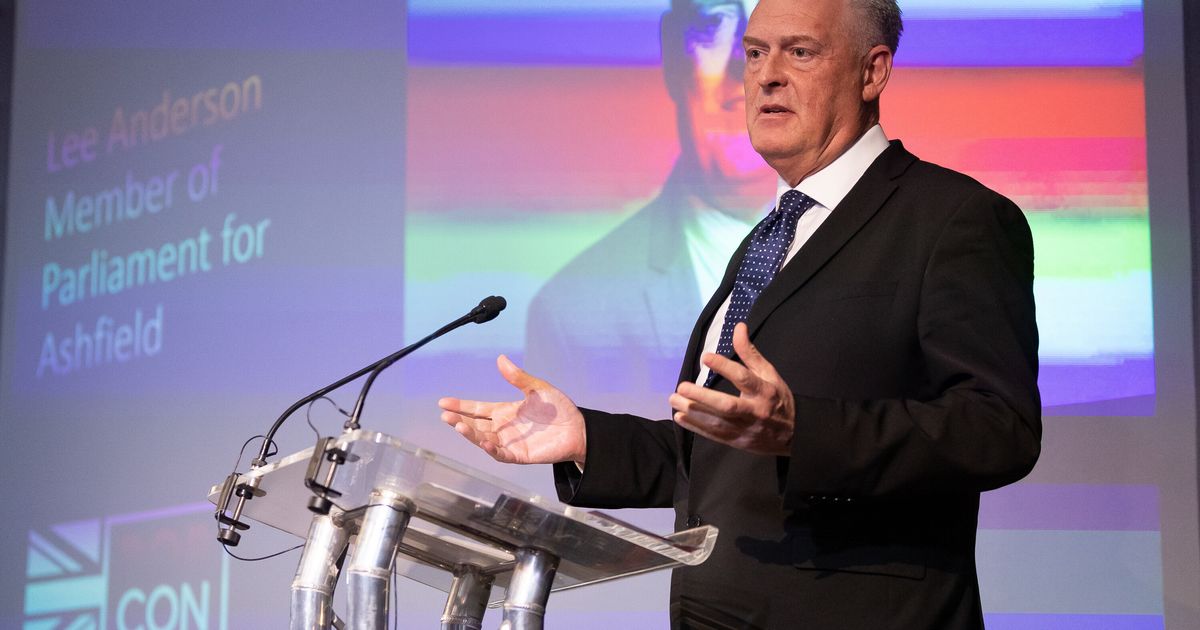
Lee Anderson is at the centre of a racism row after he claimed Islamists have “got control of” Sadiq Khan.
The former Tory Party chairman provoked a furious backlash by saying the London mayor, who is Muslim, had “given our capital city away to his mates”.
Advertisement
His comments, on GB News, were apparently a reference to the pro-Palestine marches which have taken place in London since the outbreak of the conflict between Israel and Hamas.
They came after former home secretary Suella Braverman claimed that “Islamists” are now running the country.
Anderson said: “I don’t actually believe that these Islamists have got control of our country, but what I do believe is they’ve got control of Khan and they’ve got control of London.”
He added: “This stems with Khan. He’s actually given our capital city away to his mates … beware, because if you let Labour in through the back door, expect more of this and expect our cities to be taken over by these lunatics.”
Advertisement
Labour chairwoman Anneliese Dodds said: “Lee Anderson’s comments are unambiguously racist and Islamophobic. Rishi Sunak needs to immediately remove the whip. If he is too weak, then people will take their own view of the modern Conservative Party.”
A London Labour source: “This sort of vile Islamophobia is exactly how the Tories campaigned against Sadiq Khan in 2016. Surely they will not tolerate it this time round?”
Lib Dem deputy leader Daisy Cooper said: These comments from a Conservative MP are despicable. Rishi Sunak should remove the Conservative whip. There should be no space for this in our country, let alone in parliament.”
Former Tory MP Gavin Barwell, who was also Theresa May’s chief of staff when she was prime minister, said Anderson’s comments were “a despicable slur”.
Advertisement
But a Conservative Party source defended Anderson’s comments.
He told HuffPost UK: “Lee was simply making the point that the mayor, in his capacity as police and crime commissioner for London, has abjectly failed to get a grip on the appalling Islamist marches we have seen in London recently.”
Those comments were then slammed by shadow health secretary Wes Streeting.
The row came as Liz Truss was condemned over her appearance alongside former Donald Trump adviser Steve Bannon at a right-wing conference in America.
The former PM claimed the Financial Times newspaper was “friends of the deep state” which had conspired to end her time in Downing Street after just 49 days.
Advertisement
At one point, Bannon referred to far-right activist Tommy Robinson as a “hero”, but Truss said nothing.
Sajid Javid, who served in several Tory cabinets alongside Truss, criticised her for not confronting Bannon.
Jonathan Ashworth, Labour’s shadow paymaster general, wrote to Sunak demanding he remove the Tory whip from both Truss and Anderson.
He said: “Sunak has a clear choice: show some backbone and withdraw the whip or be forever known as too weak to take them on.”
Advertisement
A spokesman for Truss did not respond to a request for comment from HuffPost UK.
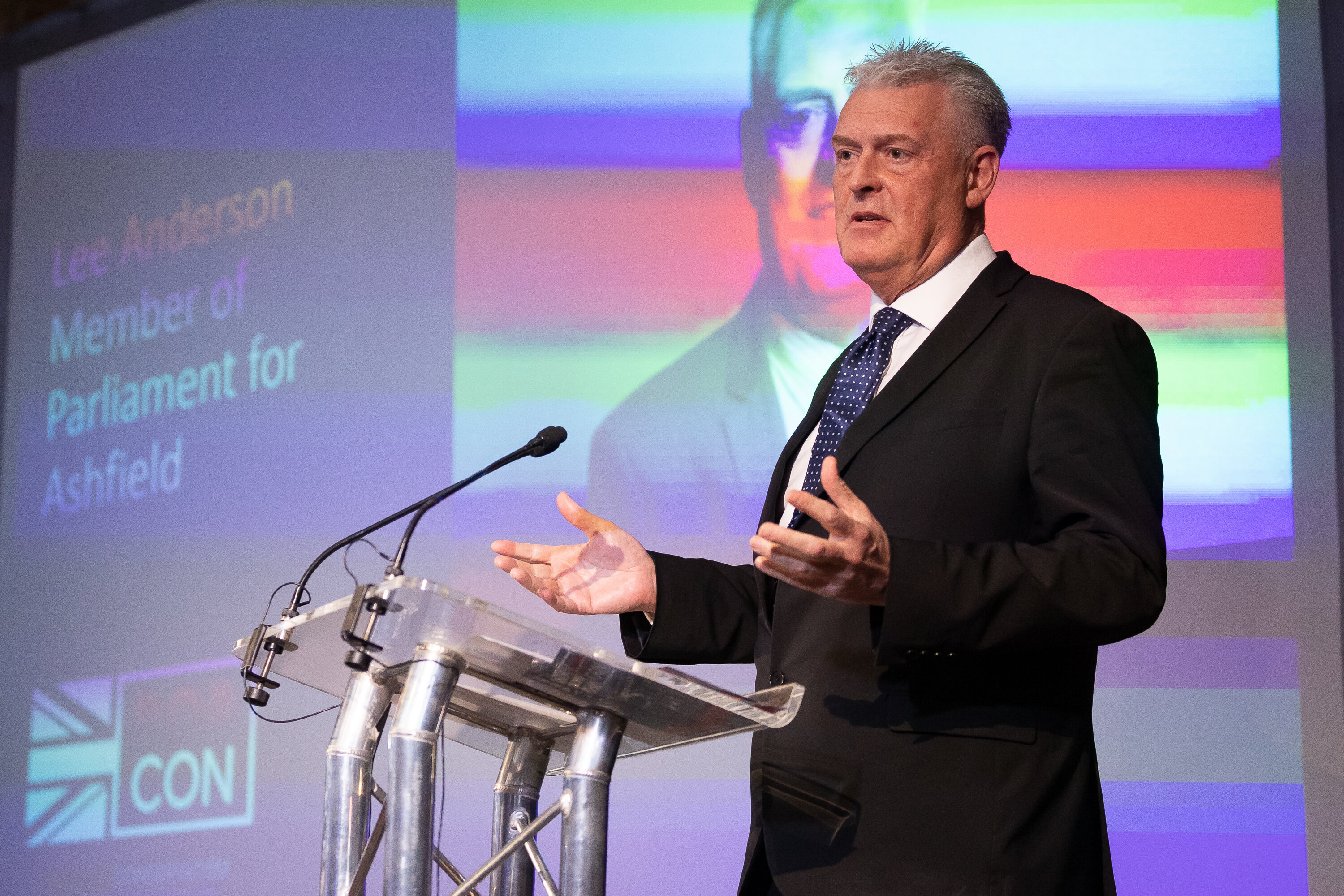
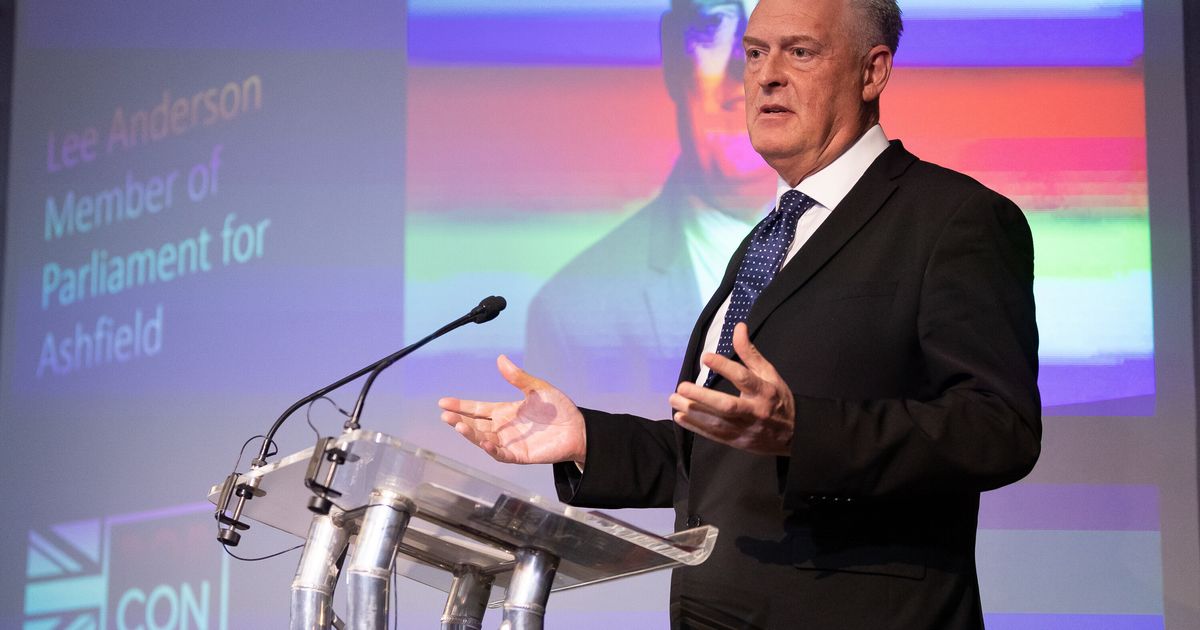
Lee Anderson is at the centre of a racism row after he claimed Islamists have “got control of” Sadiq Khan.
The former Tory Party chairman provoked a furious backlash by saying the London mayor, who is Muslim, had “given our capital city away to his mates”.
Advertisement
His comments, on GB News, were apparently a reference to the pro-Palestine marches which have taken place in London since the outbreak of the conflict between Israel and Hamas.
They came after former home secretary Suella Braverman claimed that “Islamists” are now running the country.
Anderson said: “I don’t actually believe that these Islamists have got control of our country, but what I do believe is they’ve got control of Khan and they’ve got control of London.”
He added: “This stems with Khan. He’s actually given our capital city away to his mates … beware, because if you let Labour in through the back door, expect more of this and expect our cities to be taken over by these lunatics.”
Advertisement
Labour chairwoman Anneliese Dodds said: “Lee Anderson’s comments are unambiguously racist and Islamophobic. Rishi Sunak needs to immediately remove the whip. If he is too weak, then people will take their own view of the modern Conservative Party.”
A London Labour source: “This sort of vile Islamaphobia is exactly how the Tories campaigned against Sadiq Khan in 2016. Surely they will not tolerate it this time round?”
Lib Dem deputy leader Daisy Cooper said: These comments from a Conservative MP are despicable. Rishi Sunak should remove the Conservative whip. There should be no space for this in our country, let alone in parliament.”
Former Tory MP Gavin Barwell, who was also Theresa May’s chief of staff when she was prime minister, said Anderson’s comments were “a despicable slur”.
Advertisement
But a Conservative Party source defended Anderson’s comments.
He told HuffPost UK: “Lee was simply making the point that the mayor, in his capacity as police and crime commissioner for London, has abjectly failed to get a grip on the appalling Islamist marches we have seen in London recently.”
Those comments were then slammed by shadow health secretary Wes Streeting.
The row came as Liz Truss was condemned over her appearance alongside former Donald Trump adviser Steve Bannon at a right-wing conference in America.
At one point, Bannon referred to far-right activist Tommy Robinson as a “hero”, but the former prime minister said nothing.
Advertisement
Sajid Javid, who served in several Tory cabinets alongside Truss, criticised her for not confronting Bannon.
A spokesman for Truss did not respond to a request for comment from HuffPost UK.

Parents don’t set out to raise spoiled children, but we do care for them from the time that they are helpless infants, and this can launch us into habits that involve doing lots of things for them. But as children grow, we need to ensure that they are doing more for themselves, and not expecting you — or anyone else — to cater to every one of their needs.
Some object to the idea of labelling children “spoiled.” They aren’t fruit to be tossed away, after all, and it is their behaviours, not who they are, that we don’t approve of. “Children behave in the ways they are taught,” Jeff Yoo, a licensed therapist at Moment of Clarity Health Center, told HuffPost. “I don’t like to label any kid with a negative,” he continued.
Advertisement
Yet we know that’s it not good for kids to always get what they want. “Spoiled tends to reference privileges, often without a sense of them being earned or that they’re taken for granted. We also think of spoiled children as lacking empathy,” Matt Lundquist, a psychotherapist in New York City, explained to HuffPost.
We want our children to be able to get along with others, share, show respect to adults, understand that their behaviour has consequences and not assume that they will always get their way. To encourage these attitudes and behaviours instead of “spoiled” ones, we asked experts which habits parents should avoid. Here’s what they had to say.
It makes sense for a parent to mention that a fussy baby or toddler is overtired because they missed a nap, but as kids’ get older they should be held accountable for their behaviour, even if they’re having a bad day. Lundquist recommended that parents neither make excuses for children being unkind or apologise on their behalf.
Forcing a child to apologise rarely brings about a heartfelt apology, but a quick, private conversation in which you ask a kid whether they think what they did was acceptable and how it might have made the other person feel can often inspire a child to make a genuine apology on their own.
Advertisement
It’s no secret why parents sometimes cave to their children’s demands. Breaking down and allowing for more screen time, or buying the requested item, can feel a lot easier than coping with the tantrum that may result if you stand strong and refuse. But while capitulating in this way may “win” you the battle, it can lead to you losing the war.
“It is easier to give into bad behaviour to get immediate reactions that satisfy the parents’ needs at the moment. However, the negative consequences to the child may and do last a lifetime,” Yoo said. These consequences can include poor impulse control and other kinds of dysfunction.
Because children will test boundaries, “consistency is the key,” Yoo continued. If you’ve said the iPad has to be turned off when the timer dings, stick to it every time you use this strategy. If you sometimes say this and don’t follow up, children will realise it right away.
Communicate to your child that they may have feelings about the boundary, but they still have to adhere to it. You can say, “I see you are angry about having to turn off the iPad in the middle of your game” or validate their feelings in another way without giving in to their demands.
If a child misbehaves at school, for example, and is given detention or some other consequence, it’s important to not jump in to spare the child from the consequence. (Unless your child is being discriminated against.) Doing so can signal to a child that they are special and don’t need to follow the same rules as other children, and undermines the authority of teachers or other adults who care for your kid.
Advertisement
If a child has lost a beloved item, a parent’s instinct is usually to replace it as fast as possible. But this doesn’t always give children a chance to experience their sadness. Allowing a child to have these kinds of feelings teaches them that they’re resilient and can handle tough situations.
Children also need to know that they can’t always count on immediate gratification, and they need opportunities to practice waiting.
“There’s a sense with kids who don’t experience enough limits that being unkind isn’t much of a big deal or, more problematically, that there’s something special about them that exempts them from having to do the work of kindness and caring,” Lundquist said.
While it’s true that kids can be cruel or engage in bullying, that doesn’t mean there shouldn’t be consequences for it — as well as support for the child who was hurt.
“When discipline is inconsistently used to teach rules … this fosters confusion about what is and is not acceptable,” Yoo said.
Advertisement
It isn’t easy, but sticking to your boundaries and consequences will serve your kids (and you!) best in the long run.
When you are upholding boundaries or following through with consequences, make sure your kids understand that it is their behaviour that you disapprove of — not them. You love your kids unconditionally, but when they misbehave, you call them out on it. Doing so, Lundquist said, is “an important part of children coming to tolerate, for themselves, this idea — ‘I’m pretty great, but sometimes I can be hurtful, and those are all parts of me.’”
When you do introduce a new behaviour intervention, such as a consequence or a rule, you can expect some initial difficulty, Lundquist explained. “Kids (like all of us) don’t like limits and, typically, when a limit is introduced (or there’s a new effort to really enforce a rule that’s been too loose), they’ll push back.” It can be a challenge, but parents need to remain strong in these moments and remember that “the fact that setting a limit generates intense pushback doesn’t mean it’s a bad idea,” Lundquist said.
On the other end of the spectrum, someone may hear you being effusive with your kids and warn you that you’re going to spoil them, but celebrating your children’s achievements isn’t what leads to entitled behaviour.
“There is no amount of praise … hugs and high fives that will make a child spoiled. Far too often, nurturing and praise are maligned under the umbrella of a kind of anti-spoiling strategy,” Lundquist said.
Advertisement
He emphasised the importance of kids appreciating their own complexity, and understanding that they are capable of both kind and unkind actions.
“Spoiling kids is much more about preventing kids from experiencing the unpleasant parts of themselves than doing too much supporting and celebrating what’s great about them,” he continued.
“In fact, the more the good stuff is cheered, the easier it is to absorb the hard stuff.”

Under the law backed by MPs, possession will be legal, but strict rules mean it will be complicated.
The words ‘national treasure’ are thrown around far too lightly for my liking but when it comes to Mary Berry, they absolutely apply. First appearing on our screens in the 70′s, Mary has been teaching the nation to cook and bake for longer than I’ve been alive.
My first real exposure to her was obviously Great British Bake Off where her cheeky little smiles were a perfect sidekick to co-host Paul Hollywood’s gentle snark. Racing over to my friend’s after work, we’d tuck into some pasta, share a bottle of wine and talk about whether it was too late for Mary to adopt us as her granddaughters.
Advertisement
With all of this fangirling in mind, it’s probably not a surprise to learn that I forked out for a vintage cookbook of Mary’s from 1975: “Beating The Cost Of Cooking”. It’s yellowed, bent a little in the middle and perfect.
I bought this book mostly to learn how much not only Mary’s cooking has changed over almost 50 years but how much food trends have changed in general. It’s a great read but there are some that I’m glad stayed right where they belong. In the 70s.
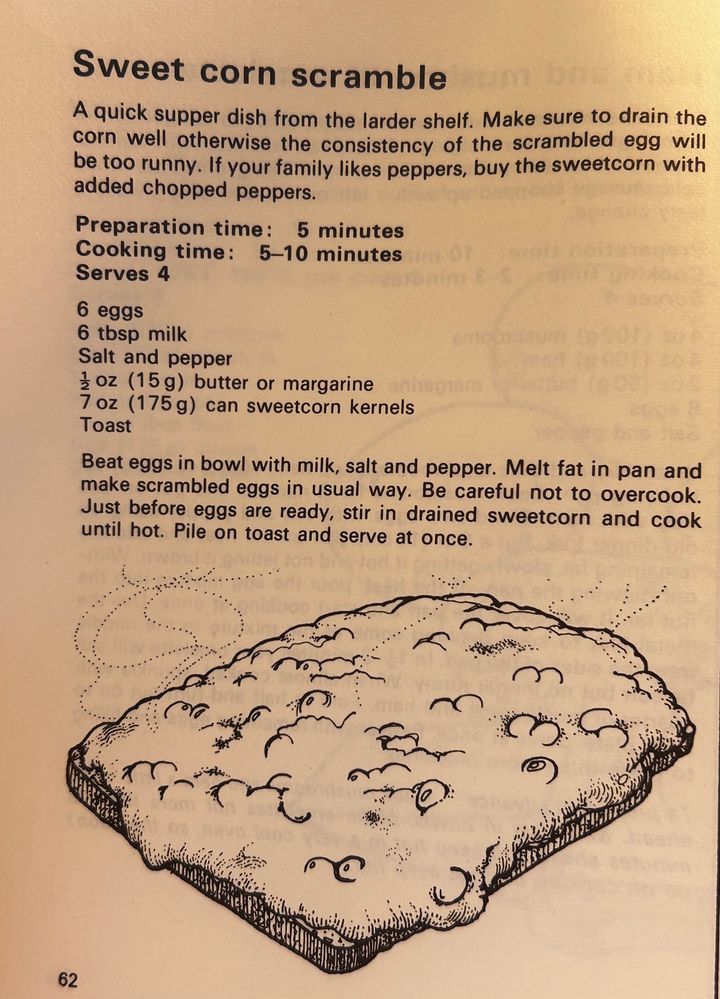
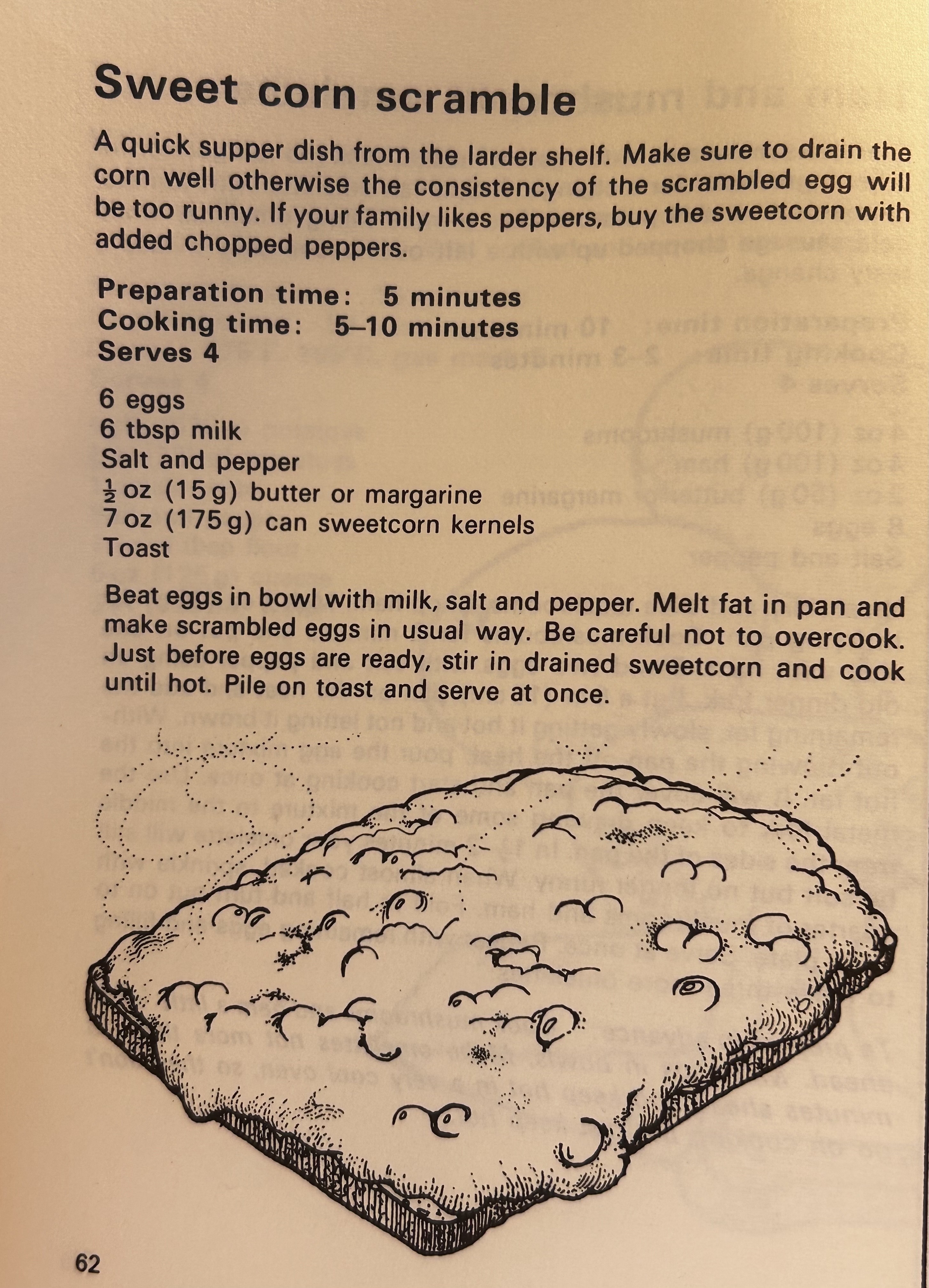
Take for example, the ‘sweet corn scramble’. I don’t know if it’s because I hate sweetcorn or because the illustration is… vile, but this one really got my stomach turning.
Advertisement
Anyway, if sweetcorn isn’t an issue for you, you can try this vintage scrambled eggs recipe from Mary herself.
You’ll need:
Then, simply beat your eggs in a bowl with milk, salt and pepper. Melt the butter in a pan and make scrambled eggs in your usual way. Just before the eggs are ready, stir in drained sweetcorn and cook until hot. Pile on toast and serve at once.
Despite this cursed illustration haunting my nightmares, I still love you Mary.


Undersea anchors of ice that help prevent Antarctica’s land ice from slipping into the ocean are shrinking at more than twice the rate compared with 50 years ago, research shows.
More than a third of these frozen moorings, known as pinning points, have decreased in size since the turn of the century, experts say.
Further deterioration of pinning points, which hold in place the floating ice sheets that fortify Antarctica’s land ice, would accelerate the continent’s contribution to rising sea levels, scientists warn.
Floating ice sheets fringe 75 per cent of Antarctica’s coastline and cover an area equivalent to the size of Greenland.
The findings are part of the first ever study of changes in the thickness of Antarctic ice shelves — extensions of land ice that float on the ocean — stretching back to 1973. Previous observations only date from 1992.
Researchers from the University of Edinburgh used satellite imagery from the NASA/United States Geological Survey (USGS) Landsat program’s fifty-year-old archive to track variations in the appearances pinning points on the ice’s surface.
Pinning points form when part of a floating ice sheet anchors itself to an elevation on the ocean floor, creating a visible bump on the otherwise smooth ice shelf surface.
Using changes in pinning points as a reliable proxy for variations in the thickness of ice shelves, the team measured changes in these features during three periods: from 1973 to 1989, 1990 to 2000 and from 2000 to 2022.
The scientists found that only 15 per cent of pinning points reduced in size from 1973 to 1989, leading to small localised pockets of thinning ice shelves.
However, a widespread acceleration and unanchoring of ice shelves from pinning points began in the 1990s in the western Antarctic Peninsula and the Amundsen Sea.
The number of pinning points that shrank increased to 25 per cent from 1990 to 2000 and 37 per cent from 2000 to 2022.
The paper, published in Nature, was funded by the Leverhulme Trust.
Lead author, Dr Bertie Miles, Leverhulme Early Career Fellow, School of GeoSciences, University of Edinburgh, said: “The switch over the past 50 years from relatively limited and regionally concentrated ice shelf melt, to much more widespread unanchoring, is striking. The ongoing concern is how many more of these vitally important pinning points will begin to melt away in the coming 50 years.”
Co-lead author, Professor Robert Bingham, Professor of Glaciology and Geophysics, School of GeoSciences, University of Edinburgh, said: “What we are seeing around Antarctica is a sustained attack by climate warming to the buttresses, that slow the conversion of ice melting, into global sea-level rise. This reinforces the need for us to take action where we can to reduce global carbon emissions.”
