Content note: the following contains sexually violent details.
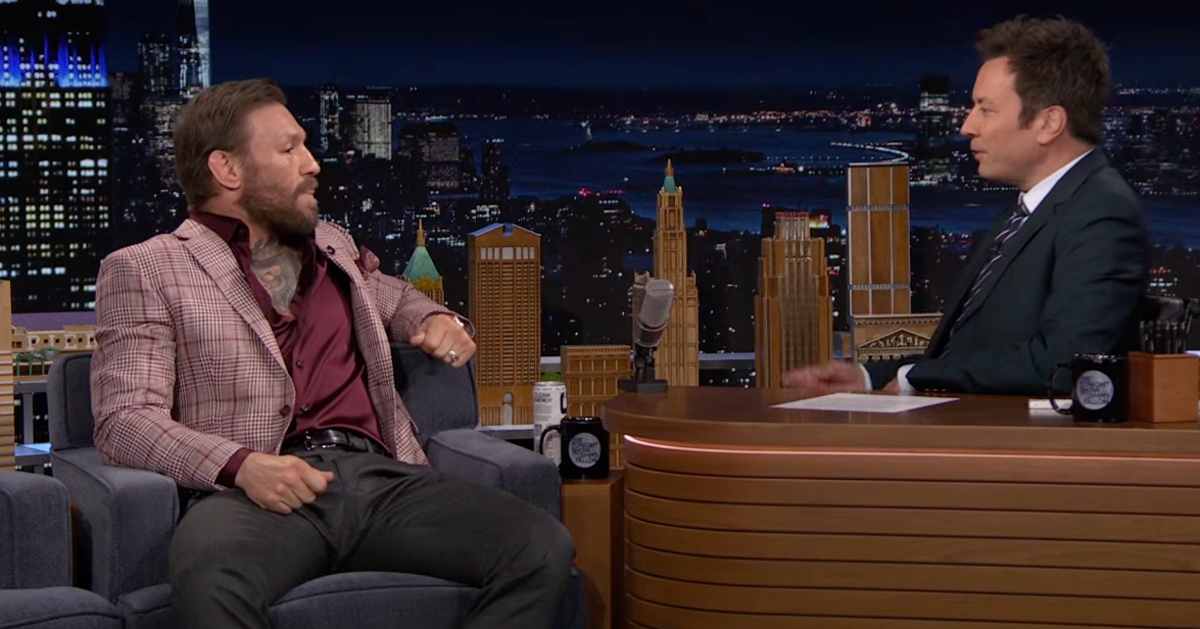
The host of The Tonight Show brought McGregor on as a guest to discuss his return to UFC.
This comes two years after the fighter was found liable by 12 jurors in a civil case after Nikita Hand accused him of raping her in a Dublin hotel back in 2018.
He was ordered to pay £206,000 in damages, though McGregor denies that he raped Hand, saying they had “fully consensual sex”.
Before the civil case, Ireland’s Director of Public Prosecutions made the decision not to bring criminal charges to McGregor due to insufficient evidence. Two later appeals weredismissed.
Now, fans have noticed that no clips of the McGregor interview have appeared on Fallon’s Instagram page, even though it took place days ago.
A comment under the talk show host’s Instagram clip, which showed his interview with Beatles star Sir Paul McCartney, reads: “Don’t want to post McGregor @jimmyfallon? Why not?”
In fact, the entire comment section under the McCartney video is filled with references to the McGregor appearance.
“Rehabilitating McGregor. I hope you’re proud of yourself,” a comment reads.
“Jimmy Fallon supports [grape emoji]ists [calling someone a “grapist” is a way of alluding to rapists online] and then hides behind other guests when called out,” another said.
“I’m struggling to find the clips of the predator on @jimmyfallon Was it deleted? It should be acknowledged and there should be an apology!” an Instagram user opined under his most recent Instagram upload.
Others say they used to be fans but have changed their mind since the McGregor interview.
“We loved you. We thought you were one of the good ones,” a former fan said.
Comments also included the mention of tampons – “Tampon. Surgically. Removed,” one reads.
During the 2024 trial, gynaecologist and forensic examiner, Dr Daniel Kane, said he had had to remove Hand’s “wedged” tampon with forceps.
HuffPost UK has reached out to The Tonight Show Starring Jimmy Fallon for comment.
For a decade, Rachel Thompson thought she’d had a fairly positive sex life. If someone had asked her if she’d ever experienced rape or sexual assault, she would have answered with a resounding: “No, I’ve been very lucky”. But in 2017, as the #MeToo movement reached its peak, the journalist started to reflect on past encounters.
One incident, when she was 19, continued to play on her mind. A guy she’d been seeing at university suggested they explore the woods together. He told her to lie down on a mound of moss. Before she knew what was happening, he’d straddled her body, sitting on her chest. The weight of him meant she couldn’t breathe. She panicked but told herself: “It’ll be over soon.” He ejaculated on her without saying a word, and they left.
Advertisement
“When I was 19, I didn’t see my experience as anything out of the ordinary,” she says. “No words sprang to mind in the aftermath of the experience – I simply had no vocabulary to express it.”
Reflecting on that night planted the seed for Thompson’s book, Rough, which explores sexual violence in the bedroom and the systems of oppression that enable it. A common theme is the suppression of one’s own trauma. Before writing the book, Thompson referred to her own experience as “bad sex” or “a grey area”, but she no longer uses those terms.
Advertisement
“That grey area did not stay a grey area for me,” she says. “I realised and came to terms earlier this year, right before my book was due, that actually, this was a sexual assault. It was pretty fucked up and it was really scary.”
Thompson has spoken to 50 women and non-binary people for the book, focusing on experiences of sexual violation that we find hard to talk about, because they don’t fit into the traditional boxes of “rape” or “violence”.
Advertisement
There’s issues like stealthing (the non-consensual removal of a condom during sex), cyberflashing (the sending of unsolicited dick pics) and non-consensual strangulation, which is a far cry from the consensual choking practised by some members of the BDSM community, with saftey precautions and safe words in place. There’s also the encounters we don’t have the words for, the moments that make women – and it is overwhelmingly women – feel a bit weird.
Catherine is among those who shared her experience with Thompson. She and a man were about to have sex for the second time. He said he didn’t have another condom, she said she didn’t have one either. He got up and said actually, he had one in the bathroom.
“In hindsight, he clearly picked our used condom out of the bin, rinsed it and reused it,” she says. “I vaguely noticed something was up at the time, but dismissed the suspicion/was too drunk to care, but thinking back that’s obviously what he did. Thinking back on the night it’s also clear that he was sober while I, although consenting, was very drunk.”
Catherine describes this encounter as something that made her “uncomfortable” during sex.
Advertisement
Abigail, another of the book’s interviewees, shares her experience of non-consensual choking. She met a guy on a dating app and everything was going great, until he unexpectedly put his hands on her throat and hit parts of her body. The experience left her confused.
“I’ve been sexually assaulted before and I was once dragged into a dark driveway by a man trying to rape me, in my head I didn’t feel like the two experiences – stranger in an alleyway and an attractive man on Bumble who texted me the next morning telling me how nice a time he had – were the same,” she says.
Abigail went on a second date with the man and asked him not to choke her again. He didn’t, but soon afterwards they lost touch. She says it took her a few months to recognise what had happened to her as sexual assault.
Supplied
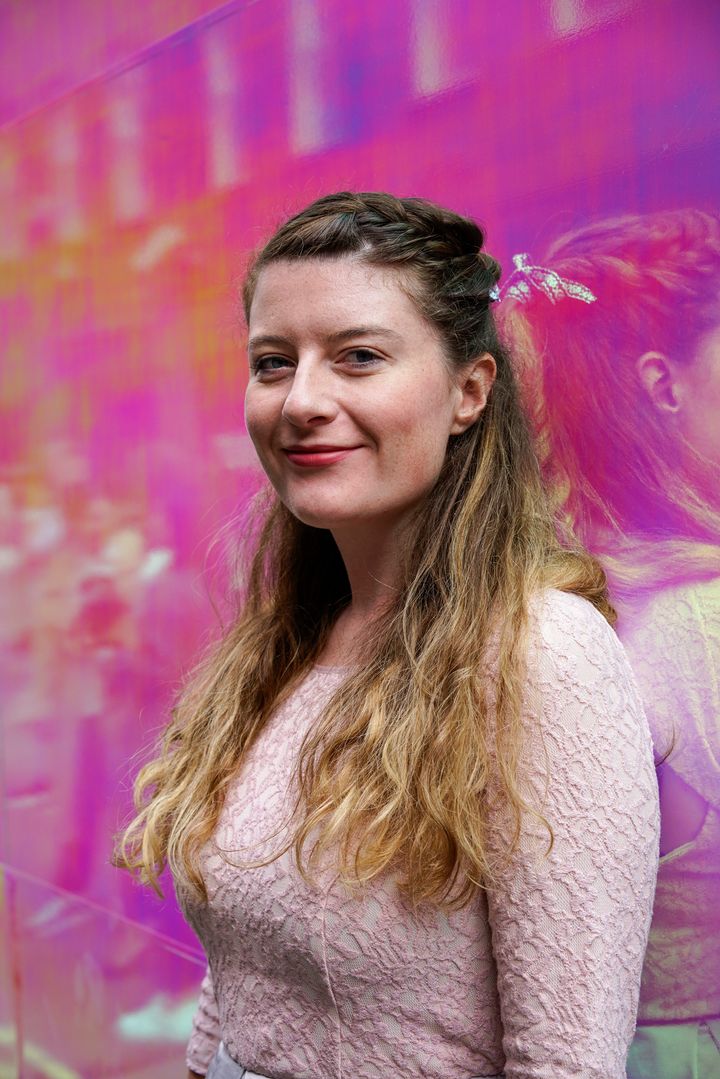
Rachel Thompson, author of Rough.
Thompson wanted to write the book “primarily for people who have experienced things that they just didn’t quite know how to put into words”. But she is clear that she doesn’t want to police the language women use on this topic either, or ban phrases such as “grey area” or “bad sex”.
“These are really personal experiences and our route to coming to terms with them and finding the words is a really personal journey,” she says. “You’re the person in charge of what you get to call your lived experiences and I don’t think we should allow anybody else to impose words or definitions on those experiences.”
Some campaigners remain concerned we don’t have the language to properly describe such encounters, and that women are being conditioned to dismiss incidences of violence.
“If you’ve learned that your sex life must include violence, it’s incredibly hard to unpick why a violent assault felt so wrong,” Fiona MacKenzie, founder of the campaign group We Can’t Consent to This, tells HuffPost UK.
“It’s so normal to blame yourself for something awful that’s been done to you – and monstrously hard when the culture says you should smile and say you enjoyed it.
“Women also see what happens when others speak out against this – we get called prudes, virgins, vanilla, sex-negative… for campaigning on this. There is no shortage of perpetrators who want women to write off being assaulted as ‘just a crap shag’.”
The campaign group has heard from hundreds of women who’ve been violently assaulted in (until then) consensual sex.
Advertisement
“Most of them have been strangled,” says MacKenzie. “Violence against women is widespread, normalised. Society’s only just begun to push back on that in recent decades,” she adds. “We should be very suspicious of anyone telling us that violence is actually liberating. There don’t need to be grey areas – the default should be that men doing violence to women is unacceptable.”
Alexandre Panier via Getty Images/EyeEm
Where is it coming from?
Porn is often blamed for the increase of violence in the bedroom and it certainly plays a part. Acts like choking, spitting and slapping are frequently shown, without any discussion on safe words and boundaries.
Such practices have been appropriated from the BDSM community, but do not reflect it; once in the mainstream, the key pillars of safety and consent are ignored. Such acts require deep trust, which is certainly difficult to establish on a first date and impossible to establish without an explicit conversation.
But porn is only part of the picture, says Thompson.
“It’s part of a landscape that also has a lack of sex education, and a lack of understanding about how consent functions, and how we should be seeking consent and negotiating consent for every individual sex act that takes place within a sexual interaction,” she says.
Brits in particular are alarmingly prudish about discussing what we do and don’t like in the bedroom, Thompson adds – and this is preventing us from establishing consent.
In the book, she hears from the anonymous sex educator @lalalaletmeexplain, who tells of one couple’s miscommunication around choking. Months into their relationship, the man asked the woman why she enjoys choking so much. She replied: “I don’t, to be honest, I do it because I thought you liked it.”
“People are getting these ideas, maybe from watching porn, and they think: ‘Oh, this is just what everyone’s doing now,’” says Thompson. “By not having the communication in those relationships and those sexual encounters, we’re not talking about what we want and what we don’t want.”
MacKenzie points out that images of sexual violence are not consigned to porn, or niche parts of the internet. She directs us to several Instagram hashtags, where images of young women with a hand around their neck are accessible in a few clicks. “Young women tell us that as tweens they learned that being strangled is an expression of passion,” she says. HuffPost UK approached Instagram for comment on this and will update with any response received.
Advertisement
When asking why this is happening, we also can’t forget that sex does not exist in a vacuum. Thompson’s book explores fatphobia, biphobia, white supremacy and transphobia – and how current systems of oppression impact our sexual experiences. It’s complex and endemic – and far too important to try to summarise in one article. But it’s clear that sex can never be an equaliser when it exists in a world of power imbalance.
What needs to happen?
On a macro level, we need systemic change to bring about sexual equality. There’s no quick-fix, but one thing that might help, is elevating all experiences of sexual violence.
“The #MeToo movement was founded by a black woman called Tarana Burke and I think she’s often erased,” says Thompson. “When the#MeToo movement exploded into public consciousness, it focused primarily on privileged white women. And that’s not to say that their stories are not valid or not worth listening to, but I think that we have to be so wary of the stories that we place at the forefront of these movements that we say speak for all survivors, because they don’t necessarily reflect all survivors.”
On a micro level, MacKenzie would like to see greater regulations of sexually violent images on social media. “We’re asking for the Online Safety Bill currently being considered by parliament to ensure that platforms stop normalising the violent assault of women – particularly those that welcome child users,” she says.
We Can’t Consent To This has already campaigned to make the use of non-fatal strangulation punishable by law as part of the 2021 Domestic Abuse Act. MacKenzie wants to see the law working in practice. “Women must be able to report choking and asphyxiation to police, and be taken seriously and not be blamed for these assaults,” she says. “We’d hope to see a significant increase in prosecutions for these assaults.”
Above all, both women want others to recognise the problems with these so-called “grey areas” of sex, and recognise that anything which makes an individual feel uncomfortable or unsafe is not “grey” at all.
The #MeToo movement may have prompted Thompson’s reflection and acknowledgment of assault, but now she thinks action is needed.
“It really raised people’s awareness about the extent of sexual violence and how widespread it is in all levels of society, but I think that we need more than awareness now,” she says, “we need action: tangible, individual change.”
HuffPost is part of Verizon Media. We and our partners will store and/or access information on your device through the use of cookies and similar technologies, to display personalised ads and content, for ad and content measurement, audience insights and product development.
Your personal data that may be used
Information about your device and internet connection, including your IP address
Browsing and search activity while using Verizon Media websites and apps
To enable Verizon Media and our partners to process your personal data select ‘I agree‘, or select ‘Manage settings‘ for more information and to manage your choices. You can change your choices at any time by visiting Your Privacy Controls.
HuffPost is part of Verizon Media. Click ‘I agree‘ to allow Verizon Media and our partners to use cookies and similar technologies to access your device and use your data (including location) to understand your interests, and provide and measure personalised ads. We will also provide you with personalised ads on partner products. Learn more about how we use your data in our Privacy Centre. Once you confirm your privacy choices here, you can make changes at any time by visiting your Privacy dashboard.
Click ‘Learn more‘ to learn and customise how Verizon Media and our partners collect and use data.
HuffPost is part of Verizon Media. Verizon Media and our partners need your consent to access your device and use your data (including location) to understand your interests, and provide and measure personalised ads. Verizon Media will also provide you with personalised ads on partner products. Learn more.
How Verizon Media and our partners bring you better ad experiences
To give you a better overall experience, we want to provide relevant ads that are more useful to you. For example, when you search for a film, we use your search information and location to show the most relevant cinemas near you. We also use this information to show you ads for similar films you may like in the future. Like Verizon Media, our partners may also show you ads that they think match your interests.
HuffPost is part of Oath. Oath and our partners need your consent to access your device and use your data (including location) to understand your interests, and provide and measure personalised ads. Oath will also provide you with personalised ads on partner products. Learn more.
How Oath and our partners bring you better ad experiences
To give you a better overall experience, we want to provide relevant ads that are more useful to you. For example, when you search for a film, we use your search information and location to show the most relevant cinemas near you. We also use this information to show you ads for similar films you may like in the future. Like Oath, our partners may also show you ads that they think match your interests.