‘Broken Doctors Can’t Fix Patients’ What Junior Doctors Are Saying On The Picket Line

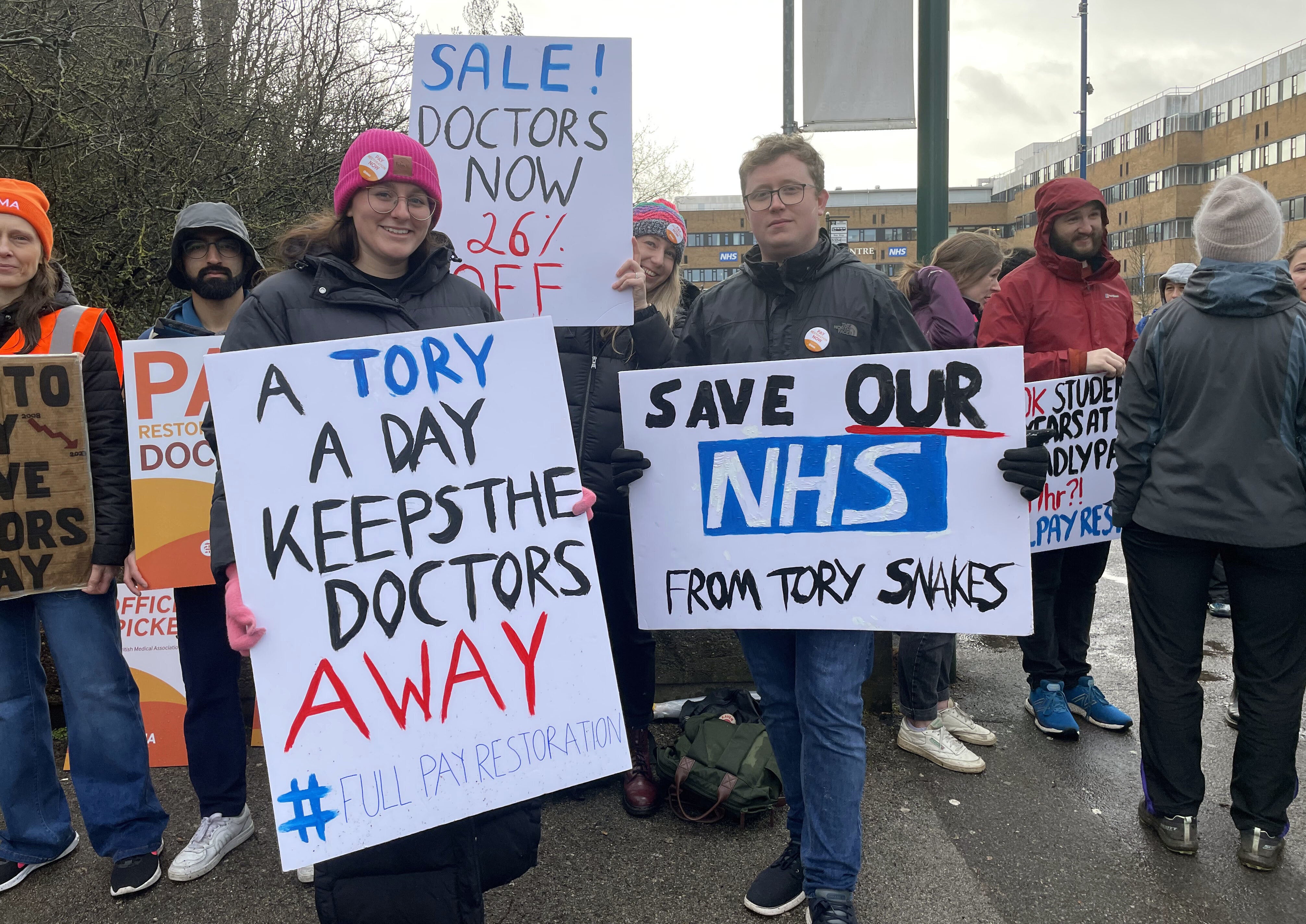
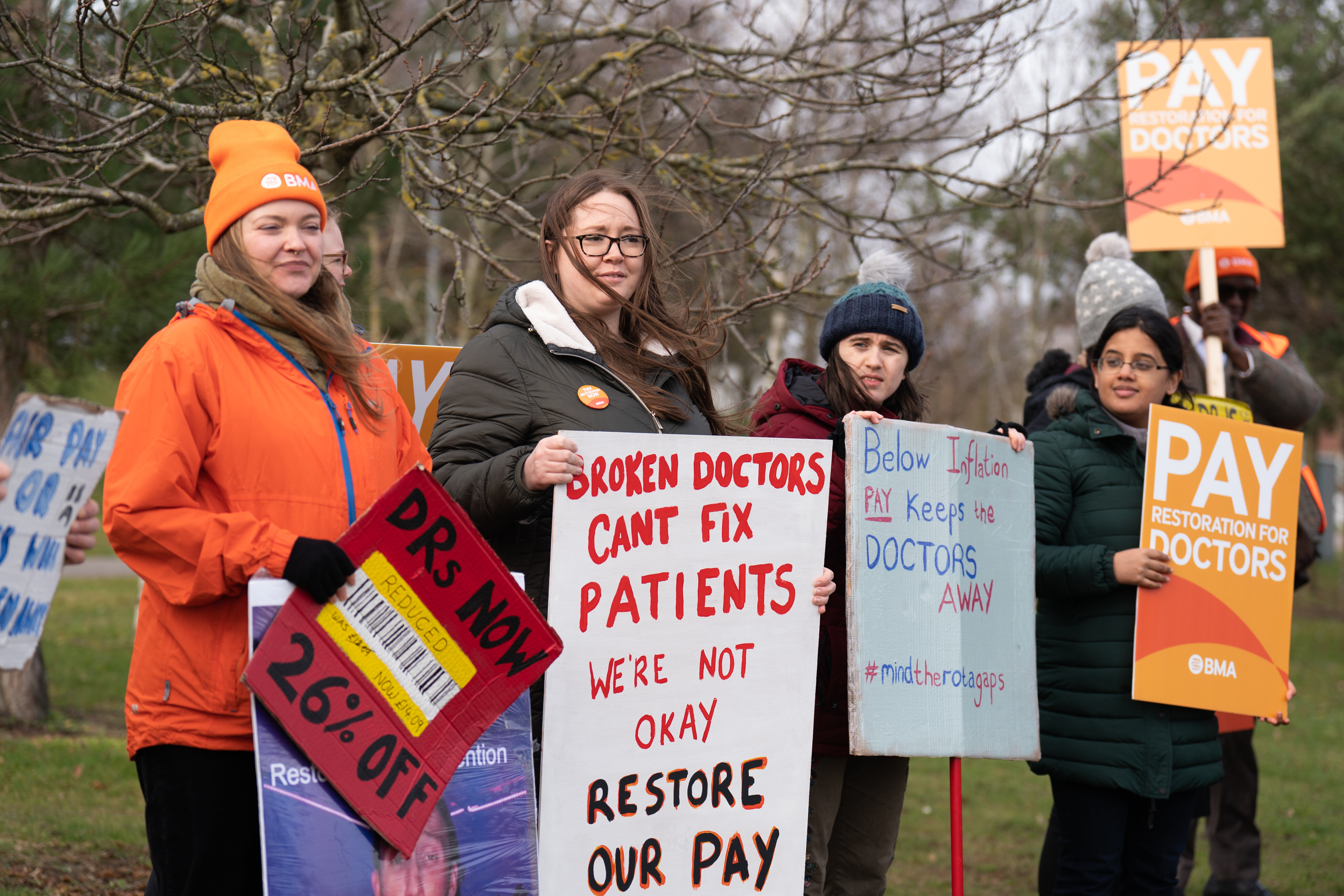
Junior doctors took to picket lines across the UK today as they began a three-day strike in their long-running pay dispute with the government.

The British Medical Association rejected a last-ditch appeal by health secretary Steve Barclay for them to enter into fresh negotiations in an attempt to avert the walkout.

The unions says junior doctors’ pay has fallen in real terms by 26% since 2008/09 and are demanding “full pay restoration”.

Professor Stephen Powis, medical director of NHS England, said it would be “the most disruptive set of industrial action days that we’ve seen all winter”.

But the striking medics say their action is necessary to force the government’s hand.

Here is what some of those striking have been saying from the picket line.

Speaking outside the Queen Elizabeth Hospital in Birmingham, junior doctor Shivam Sharma told the Press Association: “Junior doctors have faced a massive 26% real-terms pay cut over the last 15 years.

“We are not worth 26% less, we don’t do 26% less work, we don’t see 26% less patients. In fact, the work has only gotten harder.

“Currently, 50% of junior doctors are struggling to pay rent, mortgage and bills, and 50% are having to borrow money from friends and family just to make ends meet.

“If you or I were going into hospital critically unwell, we couldn’t want our junior doctor to be worrying about how they’re going to pay their bills.

“So something has to be done – we have to value doctors here if we are going to keep them.”

Paul Smith, a first-year surgical trainee at the Nottingham University Hospitals NHS Trust, said: “I started in my training post in August last year and I’ve spent £3,000 on course fees, professional fees and exams. We can claim some tax back but I’ve still got to pay that upfront.

“Me and my partner managed to save up enough money to buy a house locally and we found a hole in the roof last week.

“We’re genuinely struggling to find the money to fix that at the moment.”

Speaking from the picket line at University College Hospital in London, Rebecca Lissman, 29, a trainee in obstetrics and gynaecology, said: “I still want to work for a service that’s free at the point of use when I’m a fully qualified consultant. We want a health service that works for everyone and that’s why I’m here today.

“We can’t give people the service they deserve and see them as quickly as they need because we are so stretched.

“I want to be in work, looking after people, getting trained. I don’t want to be out here striking but I feel that I have to.”

“Junior doctors have faced a massive 26% real-terms pay cut over the last 15 years. We are not worth 26% less, we don’t do 26% less work, we don’t see 26% less patients.”

Edward Finn, an anaesthetist registrar at the Nottingham University Hospitals NHS Trust, said: “If you look at the overall cost of living, wages that haven’t kept up with that, and we don’t go out for meals, we don’t do anything.

“My wife and I are both part-time – we couldn’t afford to be full-time with the cost of childcare – but we still have to do the occasional extra shift on top of our contracted hours to keep up with things like the electricity bill.

“When you’re talking about somebody who’s been a doctor for 12 years, it’s quite sad really, isn’t it?”

Striking junior doctor Martin Whyte, on the picket line in Newcastle, said the public understood the need for the industrial action.

“We used to say anything above four hours was a breach but we have missed that target so overwhelmingly now, it’s almost not worth counting.

“These systems are failing chronically and I think the public understand that.

“They know steps have to be taken to address that, and that starts with better retention of staff and for that you need better pay. We are seeing a lot of attrition from the workforce.”

The 36-year-old said newly qualified doctors used to talk about the specialism they hoped to work in, adding: “Now when I talk to them they say ‘I’m going to go to Australia’, ‘I’m going to go to Canada’, or ‘I’m going to quit medicine all together’, because the pay relative to the work and the intensity and the hours just doesn’t add up.”

Striking NHS junior doctors on the picket line outside Norfolk & Norwich University Hospital in Norwich, as the British Medical Association is holding a 72-hour walkout in a dispute over pay. Picture date: Monday March 13, 2023.

Joe Giddens via PA Wire/PA Images

Speaking on a picket line at Leeds General Infirmary, Dr Chris Morris, doctor and British Medical Association rep, said: “It’s really reassuring when members of the public do go past honking their horns, giving us messages of support. It reemphasises why we’re doing this.”

“I don’t think anyone has taken this decision lightly. It’s the last thing we want to do as doctors but we feel that we’ve pushed into this decision by the government.”

Steve Barclay said he wanted to “engage” with the junior doctors to reach an agreement to end the strikes.

He said other health unions had agreed to hold pay talks with him and he called on the BMA to do so “as a matter of urgency”.

It marks a change of tone from December, when Barclay said he could not offer NHS staff more money.

Share Button

Oh Joy, All The Ways Our Childcare System Is A Complete Bin Fire Right Now

Britain’s childcare system is on the brink – and parents are feeling the strain more than ever.

Soaring nursery fees, staff retention issues and nursery closures are just some of the issues the sector is facing, with repercussions for childcare workers, parents and children.

Here’s a rundown of all the ways in which the system is on its knees right now – and if one thing’s abundantly clear, it’s that change must happen fast.

1. Childcare costs are horrendously expensive

A new report has confirmed what every parent already knows (and dreads) – that childcare costs are extortionate. According to charity Coram, the average annual cost of a full-time nursery place for a child under two in Britain is just shy of £15,000. To put that into context, annual university course fees are a maximum of £9,250.

Recently, parents were left reeling by news that these fees may rise by a further £1,000 this year because of the cost of living. This is on top of the fact the average costs of childcare have risen by 5.9% in the past year, according to Coram.

The TUC previously warned that the cost of early years care for a child under two could rise to £2,000 a month by 2026. But for some, this is already the case. One dad in London told HuffPost UK he’s shelling out £2,100 per month for his daughter to go to nursery four days a week.

It’s a postcode lottery for many parents. Coram’s report found there are significant differences in the cost and availability of childcare depending on where you live across England.

The average weekly cost of a part-time place for a child under two is 54% higher in inner London (£199.01) than in Yorkshire and Humberside (£129.32).

Parents in the UK face some of the most expensive childcare costs among leading economies, according to the Organisation for Economic Co-operation and Development (OECD).

There is some help available. From the age of two, children from low income families are eligible for ‘free hours’ at nursery in England, Wales and Scotland. When they turn three, all children – regardless of household income – are entitled to a certain amount of these ‘free hours’ per week.

In Northern Ireland, the picture is different again. There are no ‘free hours’ as such, but all three- and four-year-olds are entitled to a funded pre-school place of at least 12.5 hours per week during term time.

Parents who earn less than £100,000 a year can also get tax-free childcare – up to £2,000 a year – to help with childcare costs. But when the total cost of putting a child in nursery can be up to £15,000 a year, it’s still a struggle for lots of families.

Unfortunately, many women are suffering as a result of such costs. A staggering three in four mums (76%) who pay for childcare say it no longer makes financial sense for them to work, a recent report by the charity Pregnant Then Screwed found. One in four parents (26%) say their nursery bill is now more than 75% of their take-home pay.

This time last year, a survey of almost 27,000 parents with young children found the cost of childcare had driven 43% of mums to consider leaving their jobs.

The sad reality is that women are not just considering this – many do leave. A staggering 84% of the 1.75 million people who’ve given up work to care for their family are women, according to ONS data.

2. It’s actually really hard to get a spot in nursery

It’s got to the point where people are signing up for nursery waiting lists when pregnant – and sometimes even before conceiving a baby – because demand is so high. And those who don’t get ahead end up stuck without childcare, or have to make alternative arrangements, which can often make returning to work very tricky.

Joanna Corfield, head of communications and campaigns at NCT, previously told HuffPost UK they’d been hearing more and more about how working parents are having to think about childcare well in advance of when they need it.

“In some areas where demand is high and provision is low, some families are having to make decisions in the early stages of pregnancy,” she confirmed.

3. Childcare staff are (unsurprisingly) leaving for better paid jobs

With everything else that’s going on, the sector is facing staff retention issues. In October 2021, a Early Years Alliance survey on staff recruitment and retention in the early years sector in England revealed over a third of respondents were actively considering leaving the sector.

Meanwhile one in six believed that staffing shortages were likely to force their setting to close permanently within a year.

The survey also found more than eight in 10 settings were finding it difficult to recruit staff. Around half had to limit the number of, or stop taking on, new children at their setting in the six months prior to the survey.

The average salary of a UK nursery worker is £21,000 according to Totaljobs. But despite the low salary, the job is increasingly stressful – especially as staff shortages mean more pressure on those who are left behind. It’s also resulting in nurseries having to close rooms at short notice, leaving parents in the lurch.

In early years settings in England, one adult can look after three children under two years old; or four children aged two; or eight children aged three and over.

Under Liz Truss’s premiership, it was suggested these ratios could be stretched further, so staff could look after more children at one time – some parents were concerned it would pose a safety issue while members of the childcare sector suggested it would prompt even more staff to leave.

Neil Leitch of the Early Years Alliance previously told HuffPost UK that while childcare settings spend the majority of their income on staff wages, “years of government underfunding has meant that many educators are on little more than the national living or minimum wage”. Because of this, people are leaving the industry for better-paid positions in sectors such as retail and hospitality. And who can blame them?

4. Nurseries are closing at a rate of knots

Nurseries and childcare settings are also dropping like flies – and some organisations suggest it’s only going to get worse because of the cost of living.

The overall number of childcare providers in England dropped by around 4,000 between April 2021 and March 2022, according to figures from Ofsted.

In August 2022, the National Day Nurseries Association (NDNA) warned that between September 2022 and 2023, we could see record-breaking numbers of closures leading to a “catastrophic” reduction in places.

Purnima Tanuku, chief executive of NDNA, said at the time: “Most nurseries are small businesses and similar to the picture in other sectors, these are hugely impacted by rocketing fuel costs, inflation and chronic underfunding.” Tanuku added that nurseries have also had to pay “unfair business rates”.

The latest Coram survey revealed there’s been a sharp drop in childcare availability across England over the past year, with only half of local areas reporting sufficient childcare for children under two. This was a decrease of 7% on 2022.

5. Disabled children and those from low income households are impacted greatly

One of the alarming findings from Coram’s report is that less than one in five (18%) local authorities in England report sufficient childcare for children with disabilities – a 3% decrease on 2022.

The charity called for improved support for children with special educational needs and disabilities (SEND) by introducing responsive funding to improve staff skills and make more childcare places accessible.

In Britain, parents can get help with childcare costs thanks to ‘free hours’. Some parents are eligible for 15 hours free childcare a week for two-year-olds.

All three to four-year-olds in England can get 15 hours free childcare a week (for 38 weeks of the year). And some eligible parents (for example, those on benefits) of three to four-year-olds may also be eligible for 30 hours free childcare a week. It’s a similar picture in Wales and Scotland.

But nurseries are struggling to offer these funded spots. Almost half (43%) of local authorities across Britain report that some or many of their local childcare providers have reduced the number of funded early education entitlement places they can provide.

It’s no surprise this is happening as these spots have historically been underfunded. A 2022 survey by the Early Years Alliance found that for 86% of settings, funding for the three- and four-year-old early entitlement scheme does not cover the cost of delivering places – and around a third (30%) of the providers surveyed said they’re operating at a loss.

6. There isn’t actually a plan (that we know of) for sorting all of this out

While there’s been a lot of talk about how to tackle the nation’s childcare problem from various prime ministers, not much has actually happened to sort the issue so far.

In Rishi Sunak’s first speech of 2023, back in January, the prime minister revealed his educational priorities for the next two years – but his plans for childcare weren’t exactly detailed.

When a member of the press asked about the childcare sector, Sunak responded: “The government and I are completely committed to ensuring good availability and affordability and flexibility of childcare. There’s a consultation that is out at the moment, and we’re in the process of considering – about some reforms – and it wouldn’t be right for me to comment on that now.”

In December last year it was revealed that childcare will be treated as “national infrastructure” – this means local councils will be able to fund it alongside other crucial services like schools, GP surgeries and public transport.

It’s hoped the issue of childcare will be addressed at the spring budget on March 15. There have been murmurings that Sunak is considering extending the free 30 hours for childcare to all parents – not just those who are eligible because they’re on benefits. But nothing has been confirmed as of yet.

What we do know is that changes to Universal Credit will reportedly be announced at the budget, including paying parents on Universal Credit childcare support upfront and increasing the amount they can claim by several hundred pounds.

But for parents who aren’t on Universal Credit, the struggle may well continue if no additional support is provided.

Megan Jarvie, head of Coram Family and Childcare, said: “The need for reform of the childcare system is urgent. As well as eye watering bills, parents are facing widening gaps in availability of the childcare they need.

“As the Chancellor decides his budget, we urge him to recognise the value of investing in childcare – it is a wise investment, enabling parents to work and boosting the outcomes of young children.”

The charity wants to see a reformed system which “prioritises quality, guarantees a childcare place for every child, values the workforce and makes sure that parents only pay what they can afford”.

One thing’s abundantly clear: sorting out childcare should be a priority for the government, as charity Pregnant Then Screwed found 96% of families with a child under three years old are likely to vote for the political party with the best childcare pledge in the next election.

Share Button

Chinese Car Maker Rules Out UK Factory ‘Because Of Brexit’

The world’s biggest seller of electric and hybrid cars has ruled out building its first European factory in the UK because of the uncertainty caused by Brexit.

Michael Shu, the European president of Chinese firm BYD, said Britain hadn’t even made it onto the long list of potential sites.

He told the Financial Times: “As an investor we want a country to be stable. To open a factory . . . is a decision for decades.

“Without Brexit, maybe. But after Brexit, we don’t understand what happened.

“The UK doesn’t have a very good solution. Even on the long list we didn’t have the UK.”

Instead, BYD are looking to build a factory in Germany, France, Spain, Poland or Hungary.

Shu’s comments come after French president Emmanuel Macron hit out at the “consequences of Brexit” at a summit with Rishi Sunak.

He also said the effects of quitting the EU had been “under-estimated” before the 2016 referendum.

The decision to quit the EU has also been blamed for a labour shortage which has forced the government to relax visa rules for foreign workers.

Ministers to plug huge gaps in the job market by starting with looser rules for the building industry, according to the Financial Times.

A number of occupations will be added to the “shortage occupation list” which eases recruitment from abroad.

The list allows companies to obtain visas for staff paid on a lower threshold of £20,480 a year because the salary currently needed to obtain a “skilled worker” visa is £25,600.

Labour MP Stella Creasy told HuffPost UK: “British workers are losing jobs and opportunities hand over fist not being able to work in the EU or for companies that want to work with the EU because of the post Brexit visa situation, whilst the UK’s inability to build a functioning immigration and asylum system is holding back our economy at a time when vacancies are at over a million.

“We need urgent reform of the whole visa system to ensure we tackle not just shortages in the UK labour market but also opportunities for all as part of kickstarting growth in our economy.”

Share Button

BBC ‘Caved To Tory Pressure’ By Axing Gary Lineker, Says Labour’s Rachel Reeves

The BBC “bowed to pressure” from the Tories by axing Gary Lineker from Match of the Day, Rachel Reeves has said.

The shadow chancellor said the corporation should reverse its decision, which triggered a mass revolt which threw its sports coverage into chaos.

Reeves also pointed out that BBC chairman Richard Sharp, who has donated huge sums to the Conservatives, has kept his job despite his role in Boris Johnson securing a loan of up to £800,000.

The BBC announced on Friday that Lineker was “stepping back” from presenting Match of the Day this weekend over a tweet criticising the government’s migrant crackdown.

He said some of the language being used by ministers was like “Germany in the 1930s”.

On Sky News this morning, Reeves said: “Whether you agree with Gary Lineker’s tweets or not, and I wouldn’t have used that language, I think that it is perfectly reasonable that you can present the football commentary on the BBC at a weekend.”

Referring to Richard Sharp, she added: “He is still in his job. Gary Lineker isn’t able to present the football commentary? I think there is a sense of proportionality here.

“The Tories obviously put a huge amount of pressure on the government to get rid of Gary Lineker, I don’t remember those same Tory MPs crying about impartiality when those revelations about Richard Sharp came out.”

Appearing on Sunday with Laura Kuennsberg on BBC One, Reeves said: “The BBC have clearly come under immense pressure from the Conservative Party to take Gary Lineker off air.

“I think it is a shame that the BBC has bowed to that pressure. I would urge the BBC to reconsider this decision, because I think it has now gone totally out of proportion.”

Meanwhile, Lineker’s son, George, has said his dad will not back down over the row.

He told the Sunday Mirror: “Dad is a good man, a good human, and I’m proud of him for standing by his word. That’s why he was pulled off the show – because he wouldn’t apologise. But he will always speak up for people who don’t have a voice.

“He is passionate about helping refugee charities – he took in two refugees who he is still in touch with and trying to help.

“It means a lot to him to stand up for people whose only hope is to escape a country with only the clothes on their back. That’s why he’s been so firm.

“Will he go back to Match of the Day? I think so – he loves Match of the Day. But he won’t ever back down on his word.”

BBC director general Tim Davie, who took the decision to suspend Lineker, said he was seeking a resolution to the dispute, but insisted he will not resign over his handling of the affair.

He said: “I think my job is to serve licence fee payers and deliver a BBC that is really focused on world-class, impartial landmark output – and I look forward to resolving this situation and looking forward to delivering that.”

Share Button

Gary Lineker’s Son Insists Presenter ‘Won’t Ever Back Down On His Word’ In BBC Row

Gary Lineker’s son has said his father would not “back down on his word” and believes the sports presenter will return to Match Of The Day.

In an interview with The Sunday Mirror, the former England player’s eldest son George claimed his father had been “a bit disappointed” by the BBC asking him to step back from hosting Saturday’s Match Of The Day after he compared the language used to launch a new Government asylum seeker policy with 1930s Germany in a tweet.

However, he said his father had been “overwhelmed by the support” of fellow pundits who had withdrawn from various BBC sports shows in solidarity with him, particularly his MOTD co-presenters Ian Wright and Alan Shearer.

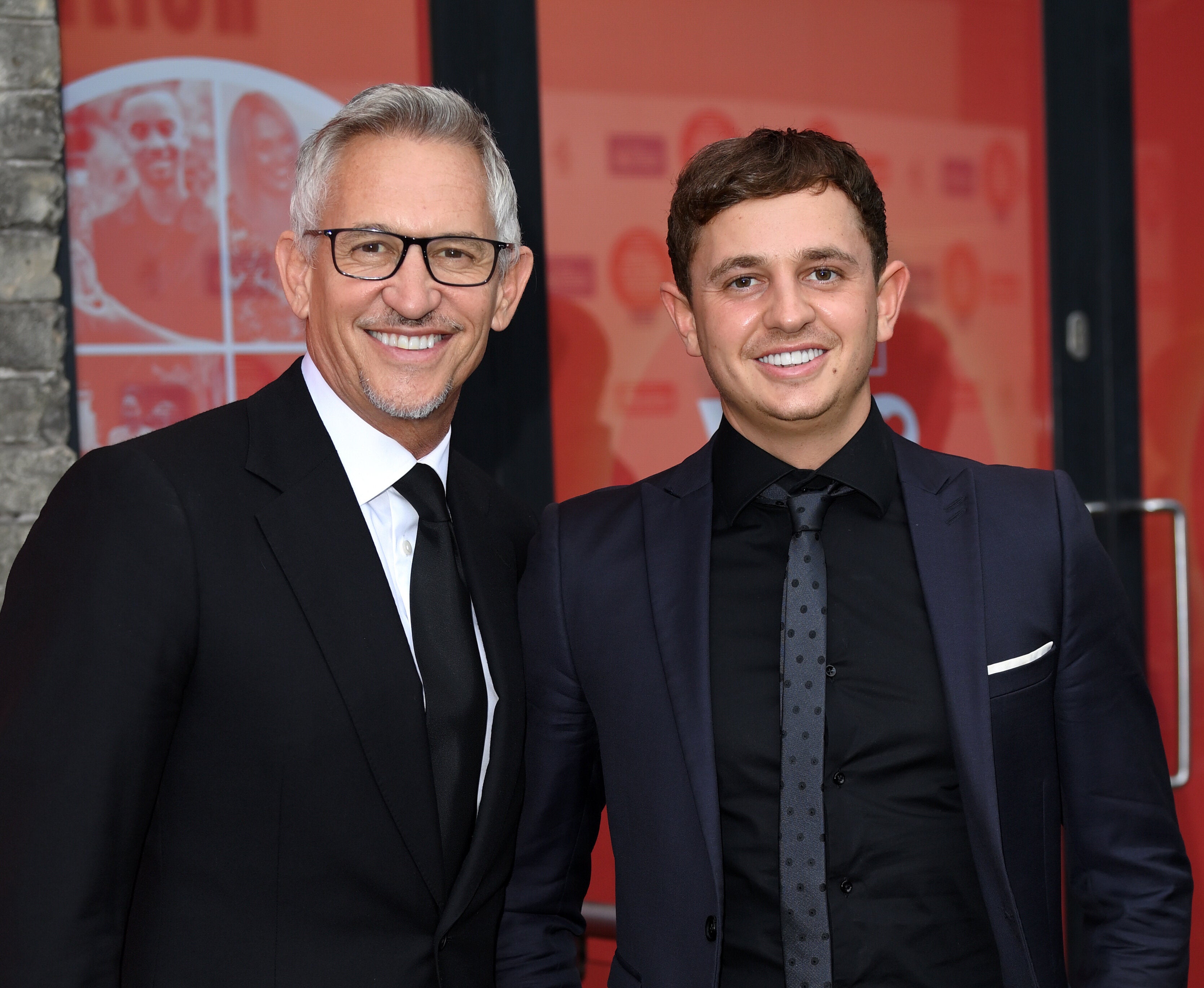
(L-R) Gary Lineker and son George Lineker

Karwai Tang via Getty Images

George Lineker told The Sunday Mirror: “Dad is a good man, a good human, and I’m proud of him for standing by his word. That’s why he was pulled off the show – because he wouldn’t apologise. But he will always speak up for people who don’t have a voice.

“He is passionate about helping refugee charities – he took in two refugees who he is still in touch with and trying to help.

“It means a lot to him to stand up for people whose only hope is to escape a country with only the clothes on their back. That’s why he’s been so firm.

“Will he go back to Match of the Day? I think so – he loves Match of the Day. But he won’t ever back down on his word.”

Saturday’s Match Of The Day aired for only 20 minutes and did not include accompanying commentary or analysis from pundits or even its famous theme tune – instead broadcasting only short highlight clips of the day’s matches.

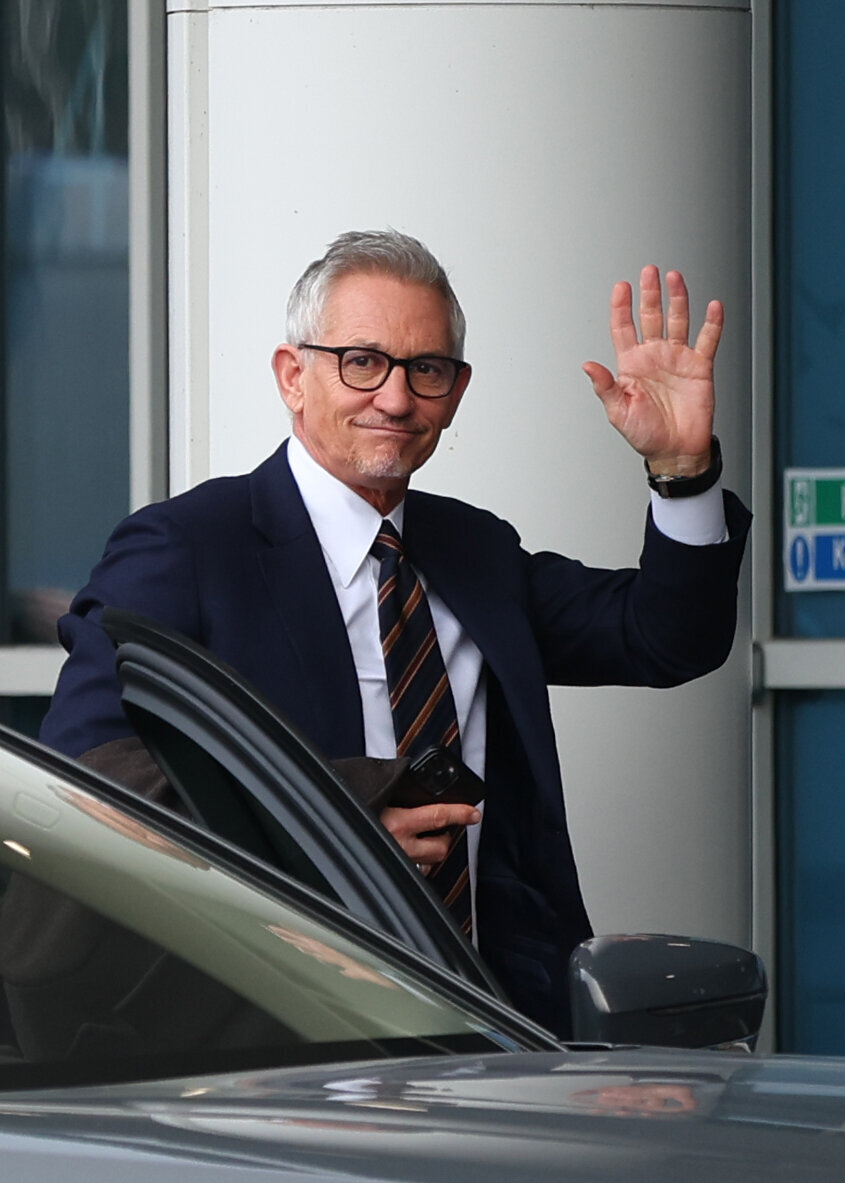
Gary Lineker waves to fans as he arrives prior to the Premier League match between Leicester City and Chelsea FC at The King Power Stadium on March 11, 2023 in Leicester, United Kingdom. (Photo by Marc Atkins/Getty Images)

Marc Atkins via Getty Images

Ahead of the show starting, a continuity announcer said: “Now on BBC One, we’re sorry that we’re unable to show our normal Match Of The Day including commentary tonight. But here now is the best action from today’s Premier League matches.”

Several of the broadcaster’s other football shows were pulled at the last minute on Saturday as more presenters and reporters withdrew, with neither Football Focus nor Final Score airing – while 5 Live’s radio coverage was radically altered throughout the day.

The BBC director-general apologised for the disruption caused to the broadcaster’s sports programming, but confirmed he will not resign over the Lineker impartiality row.

Tim Davie told BBC News in Washington, DC on Saturday: “I’m very sorry for the disruption today. It’s been a difficult day and I’m sorry that audiences have been affected and they haven’t got the programming.

“As a keen sports fan, I know like everyone that to miss programming is a real blow and I am sorry about that.

“We are working very hard to resolve the situation and make sure that we get output back on air.”

The director-general said that he would not go into too much detail about the discussions being had, but that “everyone wants to calmly resolve the situation”.

“I would say Gary Lineker is a superb broadcaster. He’s the best in the business, that’s not for debate,” he added.

“To be clear, success for me is: Gary gets back on air and together we are giving to the audiences that world-class sports coverage which, as I say, I’m sorry we haven’t been able to deliver today.”

Mr Davie also said that he does not feel this is about “left or right” politics, but about the corporation’s ability to balance free speech and impartiality, adding: “We’re fierce champions of democratic debate, free speech, but with that comes the need to create an impartial organisation.”

Asked if he would resign as “there are many people in the UK that simply do not trust you”, Mr Davie said: “Absolutely not.

“I think my job is to serve licence fee payers and deliver a BBC that is really focused on world-class, impartial landmark output – and I look forward to resolving this situation and looking forward to delivering that.”

Share Button

Jason Momoa’s Cheeky Approach To Flogging His Line Of Merch Gets A Big Reaction From Fans

Jason Momoa took a rather inventive approach to helping sell his new clothing line – and it’s gone down very well with fans.

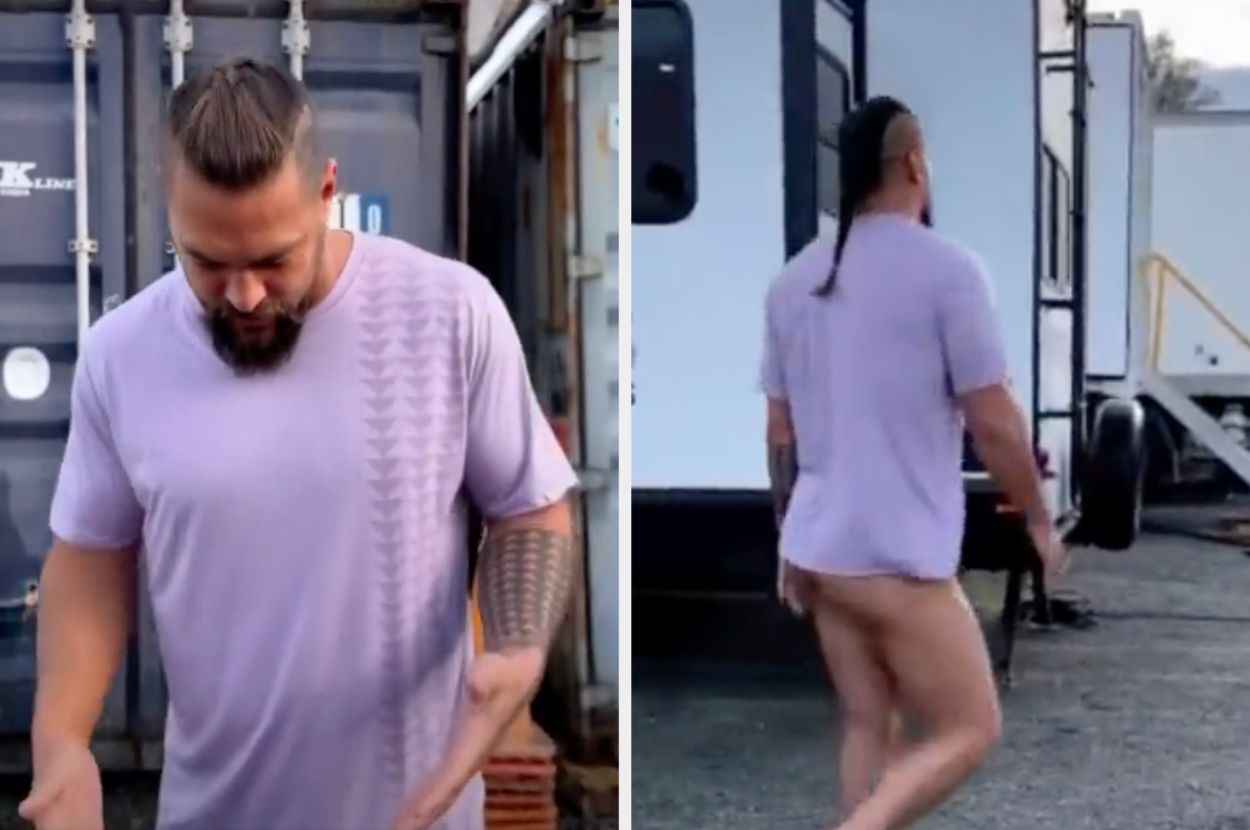
Posting a short clip on his Instagram, the Aquaman star was seen sporting a new t-shirt from his line with So iLL, commenting: “We’ve got all-new shirts in, we’ve got purple, we’ve got pink, we’ve got lavender, we’ve got black.”

“Check it out,” he added as the camera panned down. “It matches the shoes. You know what I’m saying? Looking good.”

At that point, it was revealed that Jason had paired his colourful t-shirt and flip-flops with a traditional Hawaiian malo, laughing to himself as he walked off screen.

The cheeky display got a big reaction from fans in the comments, with one highlighting the clip as an example of “how to break the internet in less than ten seconds”.

“Can instagram tell how many times i watch any particular reel??” one of Jason’s followers questioned, while another agreed: “1.6m views and 1.5m of them were me.”

Another comment read: “Q: How many times did you watch this? Me: Yes.”

Meanwhile, one fan wrote: “This is very smart marketing BRAVO… you got our attention.”

Summing up the mood, another said: “I need Jesus and from the looks of these comments some of y’all do too.”

Jason was born in Hawaii, and previously shared his love of the traditional malo when he stripped down to one during an interview on Jimmy Fallon’s US talk show last year.

“I actually don’t like wearing clothes anymore,” the Fast X star insisted at the time. “I’m in that every day. I wear it all the time.”

Share Button

Alex Scott Confirms She Won’t Host Football Focus In Solidarity With Gary Lineker

Football Focus host Alex Scott has announced she will not be hosting the BBC Sport show this week, in solidarity with Gary Lineker.

After the announcement the previous evening that Match Of The Day would be going ahead without presenters or pundits, Scott tweeted on Saturday morning: “I made a decision last night that even though I love my show and we have had an incredible week winning an SJA [Sports Journalism Award] for Football Focus that it doesn’t feel right for me to go ahead with the show today.”

“Hopefully I will be back in the chair next week,” she added.

While reports claimed that sports presenter Kelly Somers was being drafted in as a replacement for the former Lioness, she later clarified on Twitter: “Just to confirm I won’t be on BBC television today.”

Following this, Sky News reported that Football Focus would not be airing at all on Saturday. HuffPost UK has contacted the BBC for comment on this.

Jason Mohammad has also revealed he will not be presenting this week’s edition of the Saturday afternoon sports show Final Score:

A number of Gary Lineker’s colleagues have said they will not be appearing on Match Of The Day on Saturday, after the BBC confirmed the former striker would be “stepping back” as host.

Lineker became embroiled in a public row earlier this week, over his response to a Home Office video – in which home secretary Suella Braverman shared the government’s plans to stop migrants crossing the Channel on small boats – saying the language used was “not dissimilar to that used by Germany in the 30s”.

A BBC spokesperson said on Friday: “The BBC has been in extensive discussions with Gary and his team in recent days. We have said that we consider his recent social media activity to be a breach of our guidelines.

“The BBC has decided that he will step back from presenting Match of the Day until we’ve got an agreed and clear position on his use of social media.

“When it comes to leading our football and sports coverage, Gary is second to none. We have never said that Gary should be an opinion free zone, or that he can’t have a view on issues that matter to him, but we have said that he should keep well away from taking sides on party political issues or political controversies.”

Following the BBC’s announcement, MOTD presenters including Ian Wright and Alan Shearer said they would also not be appearing on the show this week, in a show of support for their colleague.

It’s since been revealed the show will go ahead without any presenting team, guest pundits or, apparently, commentators.

The Professional Footballers’ Association has also said its members will not be required to speak to BBC Sport following their matches this weekend:

Share Button

9 Things I Won’t Do After Working As A Nanny

There are 2.2 million domestic workers in the U.S., and a lot of them are nannies.

Nannies have busy, demanding jobs with tasks that can completely vary from family to family. They may be responsible for driving children to school, making meals or live-in caregiving.

Nannies work in private homes, often putting them outside of public view, so their critical roles in families and society can be undervalued and exploited. Misunderstandings can happen between what parents think they want in a nanny and the reality of what it’s actually like to employ or be one.

That’s why HuffPost reached out to nannies for what they think about working for families and the biggest “won’ts” they have learned. These are their hard-earned lessons.

Responses have been edited for clarity and length.

1. I won’t accept money under the table

boonchai wedmakawand via Getty Images

“I’ve been in the industry for over 25 years now. And I remember when I first started, that was the big thing: People paying you under the table and not paying their taxes.

“I remember even working for a family and they were lawyers, so they figured out how to get around it. I was like, ‘I can’t buy a car because I don’t have any proof of income,’ because I got paid in cash. … It was really weird. At the time, I was young and I did not understand the whole business of it. It definitely was done and it’s still done even though it’s illegal. People still try to pay you under the table.

“On a bigger scale, when COVID happened, so many nannies who were getting paid under the table couldn’t file for unemployment. It’s a big ‘no’ for me.” — Kimberly C. Brown, the CEO of the Nanny Kim on the Go consulting agency in Jersey City, New Jersey.

2. I won’t be paid less than a liveable wage

“About 10 years ago, I took a nanny job that paid $200 a week, so a lot of the stuff that I post [on TikTok] is based on real experiences that I have gone through within the last 10 years.

“A lot of people undermine our education and our professionalism because they assume it’s a little girls job. I am a professional and I have tons of education, and it is not comparable to being a teenager [babysitting].” — Coco in Scottsdale, Arizona. (Coco’s last name has been withheld for privacy reasons.)

3. I won’t forbid a nanny from answering a phone or leaving the house

puttapon via Getty Images

“I would never tell the nanny they can’t take the child outside or can’t answer their phones at work. People have to realise that nannies work during the day when most calls come in.

“A lot of people, they feel like nannies need to be ‘on’ all the time. That could be exhausting and wear your nanny out really quick. [I would never] assume that they don’t have emergency calls that may come in.

“I’ve definitely had that at work or at a job where they’re just like ‘Oh, I don’t want you to answer the phone for anybody but us’ or ‘I don’t want you to have your phone on at all.’

“I’ve worked with families where they won’t give me a key to the house, because they don’t want me to go in and out. They don’t want me to take the kid to the park. I just sit in the house all day with them until they come back. And that’s just not normal.” — Brown.

4. I won’t assume a nanny is a housekeeper

“I am more than happy to help out and I understand that managing their home is part of my position, but it’s not my job to scrub your baseboards. It’s not my job to wash your windows. It’s not my job to clean out your pantry and your fridge. I’ve even been asked to take the dog to the vet or come over if I have a day off, let’s say, and they say something along the lines of ‘We don’t need you today, but we just need you to stop by and water the plants.’ Something like that, to me, is inappropriate. I live an hour away, and I’m not going to drive an hour to water your plants.

“This job is very weird because you can be family with your bosses. It’s strange. You don’t want to be treated like any ‘regular-degular’ employee, because if I wanted to do that I would work at a day care.” — Coco.

5. I won’t contradict a family’s decisions

“As a nanny, I won’t contradict my employers, even in the smallest ways. Parents deserve to be respected in their absence, and my role is to be a supportive team member.

“I may offer advice or information, but ultimately will defer to the parents’ judgment. As long as the children are safe, I follow the guidance and preferences of my bosses when making decisions in their household.” — Amber Sembly in Atlanta.

6. I will not work without guaranteed hours in my contract

“An issue that I’ve seen happen to other nannies and even to myself as well a couple times is a family will hire you, they’ll say whatever hours they need, say it’s Monday through Friday, 8 to 5. Those are the set hours you’re going to base your life around, you’re going to keep your schedule open. But then every once in a while, the parent might get home early. But that affects your pay at the end of the day. So those guaranteed hours just keep you safe in case they do send you home early.

“Vacations — that’s a big one as well, especially with spring break coming up right now. [The family I work for is] going out of town with the kids for spring break, but I’m still getting paid for that week because of my guaranteed hours in my contract.” — Maiya Mosley in St. Louis.

7. I will not hire a nanny without meeting them

“If I were to hire child care, whether it’s short-term or long-term, I would definitely make sure my kids are comfortable with them and do a trial, even a few hours or so. Luckily for me, I’ve never had any issues. But I always think it’s crazy when people are like ‘OK, come over tomorrow night and watch them.’ And I’m like: ‘OK, you haven’t even met me yet. Are you sure?’

“Calling references, too — you want to do your due diligence. Luckily I have very good references and kids really like me, but I would never message someone on an app and be like, ‘You sound great, come over tomorrow.’” — Teniya Renee in Boston.

8. I will not arrive home late

Westend61 via Getty Images

“I wouldn’t come home late. Obviously, it happens, but I would definitely let the nanny know ‘Hey, I’m running behind,’ because nannies also have things to do after work. Being a nanny can often seem like, to a family, that you’re beholden to them. That’s a big one that comes up for nannies.” — Danny Rosenthal, the owner of United Nanny Agency in Chicago.

9. I will not assume a nanny knows what I need

cako74 via Getty Images

“Most families don’t realise that hiring a nanny means opening a small business in their home. Families have a huge learning curve … [and] hardly ever set expectations or explain how to accomplish the tasks they have set out for them to do. Families have no idea that they prefer their clothes folded a certain way or that they prefer one brand of paper towel over another — that’s real — but every family is particular. Very particular.

“If you want a nanny to do something, you need to show them. If you want a nanny to buy something, you need to tell them what brand, what store and which aisle. Years of experience means a nanny is capable of learning how to work with a family, but it doesn’t mean they know how to do everything the way you like it.” — Rosenthal.

Share Button

I Got AI Portraits. When You See Them, You Might Understand Why They Make Me Uneasy.

I was scrolling my Facebook feed one sleepless night when a post by a fellow member of a women’s business group caught my eye. She was sharing her new headshots, and they were, well, gorgeous.

She looked healthy and radiant ― the soft natural light perfectly illuminating her glowing skin ― and she seemed both professional and approachable at the same time.

I’d recently been comparing headshot packages from photographers in my area, and this woman’s photos were exactly what I was looking for: polished, elegant, well-composed. I decided to pin a few of her pics to my headshots board on Pinterest so I could show them as inspiration to my own photographer when I finally selected one.

But when I looked at her caption again, something else about it grabbed my attention: the price tag. Her beautiful headshots ― a gallery of 35 unique images in total ― had set her back just $25.

I definitely needed to know more.

I clicked to expand the full text of her post and took a minute to actually read what she wrote. It turned out her photo shoot wasn’t a “shoot” at all. Instead, these images were produced by artificial intelligence (AI). She explained that she uploaded 20 pictures of herself to a website and two days later received a link to a gallery of images of herself ― but not herself ― in various settings and styles of attire.

Her photos had been generated by a process in which real images of a subject are used to create a data set from which new images can be derived. Once this data has been collected and a “model” has been generated, which includes an infinite number of details about a person’s physical appearance, an endless array of artificial images can be created in that person’s likeness. The “person” spawned from this accumulation of data can then be dressed in different clothing, styled in different ways and placed in different locations. They can also have different makeup, hair colours, jewellery and other accessories… all while retaining the features of the original subject. At least in theory.

Curious, I clicked on my Facebook contact’s profile photo to see what she typically looks like. It was kind of amazing. The AI photos did in fact look like her ― made up, well lit, well dressed and maybe retouched a little. Basically they looked like her on a good day, in a great space and with a bit of post-production magic applied.

Now I was genuinely intrigued. The $25 price was a tiny fraction of the quotes I’d received from local photographers I’d reached out to, and while I am a big advocate of shopping locally and supporting other creatives, I was launching a new venture and it wasn’t yet producing revenue. I needed stopgap photos to use on my website and social feeds until I was actually earning money and could to hire a real photographer. I decided I was willing to risk $25, and I clicked through my FB buddy’s original post to the website of the company that had created her photos.

Like her, and likely thousands of other people, I uploaded my own images to the site, carefully following the instructions to select pictures that show my face in good light and from a number of angles so that the AI could create a model that was as detailed and realistic as possible. Once I was happy that I’d given the AI all the tools it needed to re-create me, I hit the submit button. Then I waited.
The company promises delivery within 48 hours. Starting at around the 40-hour mark, I started refreshing my email compulsively, every 10 minutes or so, to see if the gallery link had arrived when I wasn’t looking. I was so anxious to see what the new and improved me would look like! Would she be wearing my style of clothing, and how do they decide what clothes to put the “model” in anyway? Would she have my laugh lines, or does the AI edit out what it sees as “imperfections”? Would she really look like me ― like, “fool-my-dad look like me”? ― or would I be disappointed and have to chalk up a $25 loss to the cost of starting a new business? So many questions!

I had momentarily forgotten that I was waiting to meet the new me when I was half-awake and clicked on my email in the middle of the night. There it was: a link to a downloadable zip file labeled “Your Gallery.” My heart sped up. I couldn’t unzip the file on my phone, so I hauled myself out of bed, into my robe and downstairs to my office to open it on my computer. There was no way I was waiting until morning.

There, sitting at my desk at 3am, I opened up the gallery and clicked on the first thumbnail.

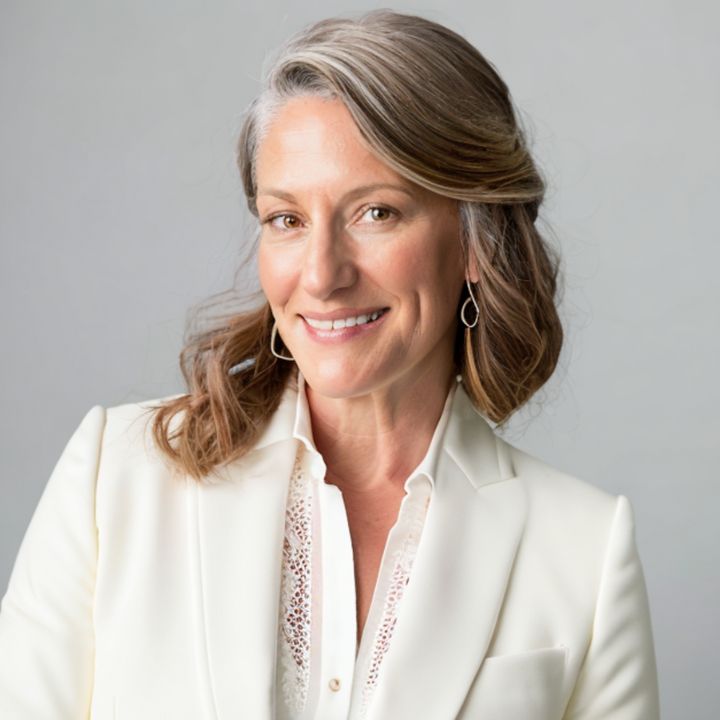
An AI-generated photo of the author.

Courtesy of Natasha Dworkin

An AI-generated photo of the author.

It was me, sort of. I was wearing a crisp white linen blazer and tasteful jewellery. My hair was swept into a sophisticated updo. My ears were adorned with a pair of modern, geometric earrings. My smile said “Hello there. I’m kind. And professional. And also very stylish.” It was like the person who I might have become had I followed my 19-year-old self’s dream of being an interior designer.

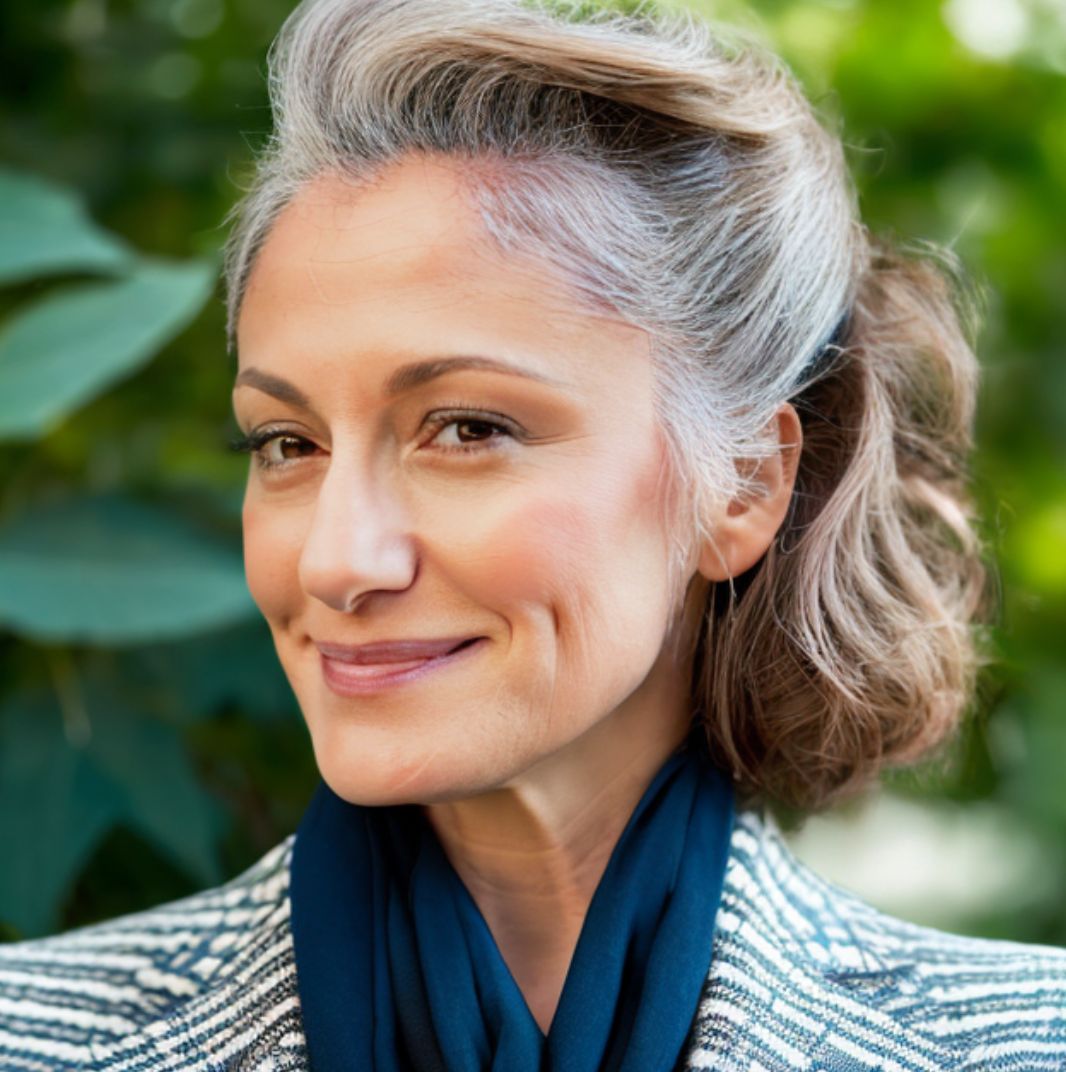
I clicked on the second photo. In this one, I was outdoors, glancing toward the horizon with a wise, knowing look. I wore a lush floral halter dress, and my tousled hair was subtly tinted in burgundy. I was lithe and tanned. This was the me who traveled the world with only a backpack before settling in Bali as a yoga teacher.

In the third and fourth images I am a confident, driven lady boss. I appear smart and strong, yet emotionally intelligent, the CEO of a major international conglomerate that also has a social conscience ― known for its fair labor practices, sustainable product lines and generous parental leave.

It went on like this as I continued to peruse my gallery of doppelgänger Natashas, each one decidedly me but also decidedly not me. It was a me I didn’t recognise, wearing clothes I hadn’t seen before, in places I’d never been.

In a way, she was intoxicating ― 35 little windows into alternate versions of my life, reflecting different choices, different turns taken, different worlds inhabited. She was also just a little bit better than me. I mean that in the way that we always look better in our headshots or any studio photos thanks to optimal conditions and a skilled photographer, but this person was also better better.

She didn’t just look better. She wasn’t just dressed better. She had done better in life. She’d done better keeping her waistline trim after the baby. She’d taken up a real skincare routine earlier than I had. She’d secured the book deal and been offered the promotion and she’d gotten the guy. She’d done the right things at the right times, and everything had worked out for her. She was golden. Golden Me.

An AI-generated photo of the author.

Courtesy of Natasha Dworkin

An AI-generated photo of the author.

I somewhat sheepishly posted one of the photos of Golden Me — the one that, from my point of view at least, looked the most realistic, the most believable, on Facebook. I didn’t say anything about it ― I just benignly swapped out my profile pic. I wanted to see what would happen.

Within minutes my feed was blowing up. “Gorgeous!” said one friend. “Look at you!” said another. “Absolutely stunning.” “You look amazing.” “Beautiful woman!” declared friends who’d known me since childhood. My dad loved the image. They all believed Golden Me was actually me. Mission accomplished. Right?

Not so much. I started to feel weird about this other me. On the one hand, I wanted people to think the photo was real, and it felt kind of good when they did. On the other hand, it felt dishonest.

Every one of us must wonder from time to time ― especially those of us who have arrived in life’s middle years ― what our experience might have been like, what we might have been like, if we’d taken a different road, stayed in a particular relationship, left another, taken up a certain hobby or followed another career path. We’ve all surely questioned our choices from time to time, had regrets, thought wistfully about the what-ifs and the could-have-beens.

Meeting Golden Me was like looking at the digital embodiment of the answers to all those questions. All the mes that could have been, maybe even should have been, and that certainly are not.

And putting one of those pictures out into the world where my friends and family could marvel at it felt like presenting a facade to people who already love me as I am. Why would I trade that love and acceptance for social media points and a couple of minutes of feeling like I’d somehow won the best-self lottery?

An AI-generated photo of the author.

Courtesy of Natasha Dworkin

An AI-generated photo of the author.

The fact is that all the choices I’ve made and all the roads I’ve taken may not have led me to the executive suite of a multinational company or to a tropical Balinese yoga studio, but they’ve led me to the version of myself that I am today: mama to the sweetest little boy ever, user of my gifts to help others, community builder, loving friend, loyal daughter, budding gardener, deep thinker.

And that me, with her laugh lines and her amateurish makeup and her postpartum body, is pretty darn golden, too. In our own photos ― our real photos of our real selves ― lie our stories: moments in time captured, life’s details memorialised to be looked at later and remembered.

What would I say when my son looks at an image of Golden Me and asks where I was when that photo was taken, who I was looking at or what I was smiling about? What are we left with if the pictures, the moments, the memories and the stories aren’t real?

We’re left with pixels.

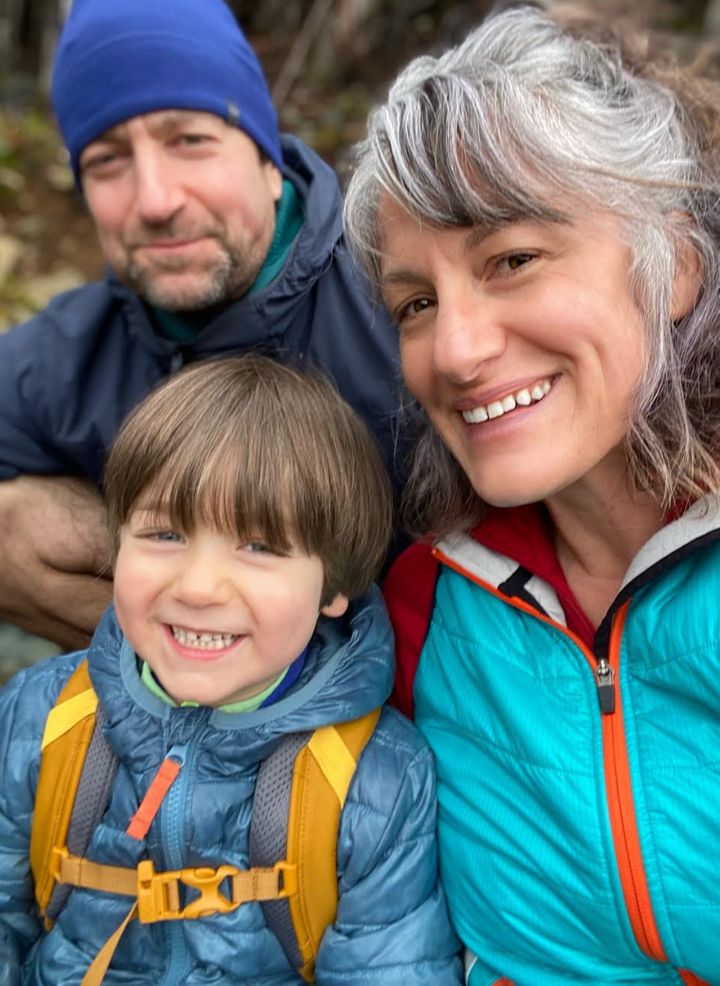
I quietly changed my profile picture back to a real one, a selfie taken just weeks ago on the land where I grew up, wearing my favourite cozy poncho. When my son looks at that photo years from now, he will know without even thinking about it that it was taken in the place I love most in the world. He’ll see my smile and the cool forest breeze blowing my hair, and he’ll recognise it all. He’ll recognise me.

I resolved to chalk this experience up not as a loss but, like so many other things in life, as a lesson. And $25 to discover that I like the real me, my real life, my real story ― even with all its tarnished bits ― more than I do some gilded fantasy version of it is, in my opinion, money well spent.

The author, naturally, with her family.

Courtesy of Natasha Dworkin

The author, naturally, with her family.

Natasha Dworkin is an agency founder and strategic storyteller. For more than 20 years she has helped her purpose-driven clients tell their stories, amplify their impact and change the world. She now leverages her professional expertise with her personal experience, becoming a first-time mom at the age of 46, to help other midlife women make transformative change in their own lives. Connect with her at midlife.mom and on Instagram at @midlife.mama.

Share Button

The White Lotus Star Lukas Gage Speaks Out On Chris Appleton Romance Reports

It was recently reported that the American actor – known for playing Dillon in the hit HBO series, as well as his roles in Euphoria, Love Victor and You – was in a relationship with Chris, who is known for his work with stars like Kim Kardashian and Jennifer Lopez.

The pair have also shared pictures on social media on holiday together in Mexico, and walked the red carpet at the Vanity Fair and TikTok’s Vanities: A Night for Young Hollywood event in Los Angeles earlier this week.

Lukas was asked about their photos in Mexico in an interview with The New York Times, who suggested people believed the snaps to be a “relationship announcement”.

He did not confirm the reports, and said he was still working out the “weird line” of what to keep private.

“If they want to think that, they can,” he said. “I’m a pretty open book about most things in my life, but I have a problem with the culture of everyone needing to know everybody’s business and nothing can be sacred.

“It’s a weird line that I’m still trying to figure out.”

Following the publication of the interview, Chris shared a screenshot of it on his Instagram Story and wrote: “Hot & talented @lukasgage.(sic)”

He also commented on a post of Lukas’ promoting the interview, saying he was “proud” alongside a heart emoji.

Share Button