You’re reading Love Stuck, where trained therapists answer your dating, sex and relationship dilemmas. You can submit a question here.
In a long-term relationship, you might start to feel like you’re doing everything with your partner. Concerts, parties, restaurants, trips, it can get to a point where you automatically bring your ‘other half’ everywhere.
Advertisement
Which is why some people in relationships try to regain their independence, like this week’s reader: Collin.
“I would like to travel with a friend of mine to Portugal for a surf trip without my wife,” Collin says. “She is having an issue with me going without her for various reasons. I am not sure how to navigate this issue in our 30-year marriage. We have not travelled independently much before.”
Collin doesn’t mention any issues with his wife, but he wants to have more solo experiences. Is this a problem?
“Your decision to holiday without her may raise some insecurities in your wife, which she may not feel able to voice,” Lord says.
Advertisement
“This is not to suggest that your decision is wrong, or in some way harmful to her, but taking the time to gain some insight into why she has an issue would be helpful to you both.”
Lord adds that Collin has mentioned that he hasn’t done much independent travelling before, so after 30 years of marriage, a desire to travel without her may come as a surprise to his wife.
“Whilst we may like to believe that our partner will happily accept all our wishes with support and understanding, our actions can sometimes impact upon our partners’ feelings in a way we may not expect,” Lord adds.
“Your wife may feel a sense of rejection if you have always holidayed with her in the past, but this time have chosen to take a friend.”
Why might his wife have an issue with him travelling without her?
Counselling Directory member Georgina Smithasks Collin if there’s been a breach of trust, have the couple had to navigate infidelity? “If so, then it would be a big ask to request solo travel, depending on the circumstances and the couple’s timeline of difficulty,” Smith adds.
Advertisement
“Even if lack of trust is not an obvious issue, I would be encouraging the husband to explore those ‘various reasons’ with her and discuss together how he may provide reassurance around her insecure feelings around this trip.”
Counselling Directory member Victoria Jeffries believes that Collin’s wife is feeling insecure at the idea of him leaving her. “It could be she views this as some form of abandonment.”
“I would hazard a guess that this runs deeper with your wife; it may be that at some point in her life (most likely her childhood) she felt excluded or abandoned by those she loved, and therefore you taking a trip without her is triggering those feelings for her,” Jeffries adds.
“This may seem far-fetched (and possibly even unfair on her part), however it is not uncommon for painful feelings from the past to suddenly arise from seemingly ordinary circumstances such as a spouse simply wanting to take a surfing trip with a friend.”
What practical tips would you give this reader?
Smith encourages Collin’s wife to communicate all of her concerns and fears around this solo trip. ″Communicate and compromise on ‘ground rules’ – how often will the couple talk while he is away, what is acceptable behaviour like staying out til late and around the opposite sex for example,” Smith adds.
Advertisement
She also suggests making plans for another trip as a couple might help, so Collin can avoid the sense that his wife is ‘missing out’ and have a chance to reconnect. “Using empathy and good listening skills is key – try to understand the feelings behind her words. Having an issue with the trip will be about her feelings of discomfort, not just to be difficult.”
Jeffies also emphasises talking to his wife and exploring her concerns. “It may also be a good idea to explain why this trip is important to you (presuming it is),” she says. “It could be that your wife isn’t fully taking into consideration what this means for you.”
Love Stuck is for those who’ve hit a romantic wall, whether you’re single or have been coupled up for decades. With the help of trained sex and relationship therapists, HuffPost UK will help answer your dilemmas. Submit a question here.
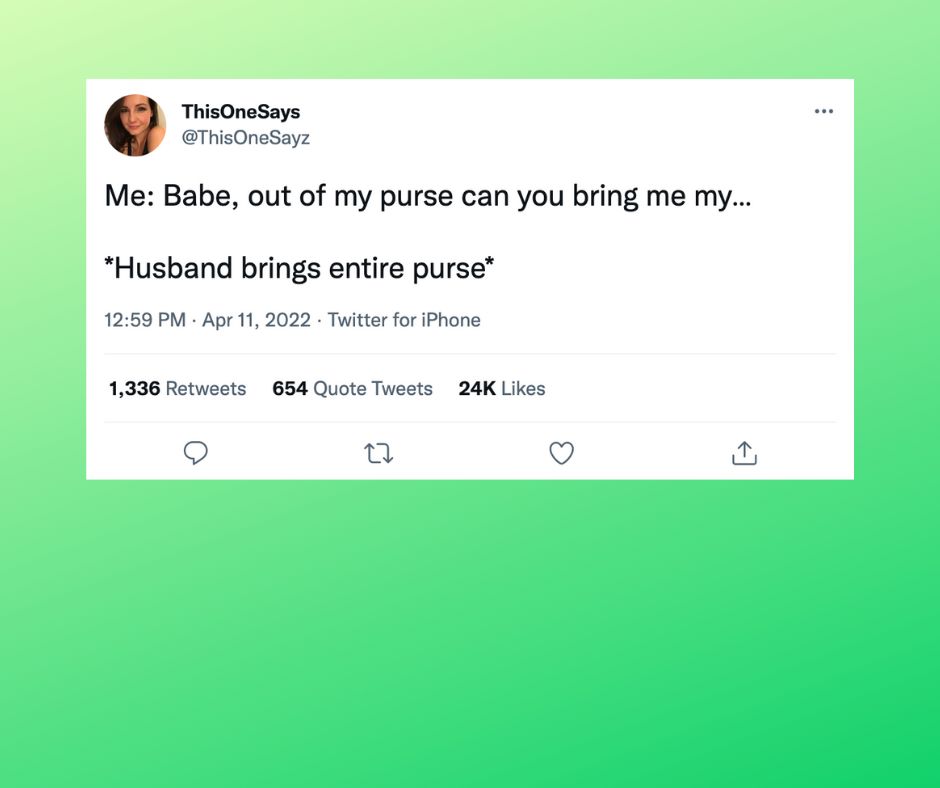
And somehow the spouses of Twitter continue to find humor in the minutiae of married life ― and sum it up perfectly in no more than 280 characters.
Every other week, we round up the funniest marriage tweets of the previous 14 days. Read on for 24 new, relatable ones that will have you laughing in agreement.
Here’s something few of us are brave enough to admit about long-term relationships: We don’t always end up with our first choice.
Sometimes, we settle for “second best” ― and usually, that’s OK.
Advertisement
Technically, we’re all someone’s “second choice,” at least if your partner ever had an ex whom they intended to be with long term. Yes, that means you may be your current S.O.’s second choice without realizing it. (Sorry for waking up and choosing chaos with this article!)
That slightly uncomfortable relationship subtext was made explicit in the most recent season of “Love Is Blind,” Netflix’s notoriously messy dating show where singles meet through a wall, fall in love and propose without ever seeing each other.
One of the couples, Jarrette and Iyanna, became engaged after Jarrette failed to secure a “yes” from his first choice, a contestant named Mallory. (Bear in mind, he had an easy chemistry with both women, arguably to an equal degree.)
After sitting with the fact that her would-be fiancé had basically proposed to another woman before proposing to her, Iyanna said “yes.” (She’d also gotten reassurance from Jarrette that what he felt for her was genuine.)
Advertisement
Iyanna and Jarrette were one of the few couples whose storyline ended in marriage, and a year later, they certainly seem to be happy and in love, at least going by their recent interviews, the reunion show and their many loved-up Instagram posts.
Still, many fans of the show felt discomfited by how it all played out.
“IYANNA, DON’T BE A SECOND CHOICE,” tweeted “Never Have I Ever” actor Maitreyi Ramakrishnan. “STAND YOUR GROUND.”
Advertisement
Others pointed out that there was actually something hyperrealistic about the reality show romance. (A reality show giving us realism? Since when!?)
“As much as I dislike Jarret [sic] not picking my Iyanna first, people forget that in reality some of us are actually someone else’s second choice, we just don’t know,” writer Dami “Oloni” Olonisakin tweeted, to a refrain of “sad but trues.”
The problem with ‘The One’
Why are so many of us icked out by the idea that people will end up with their “alternate picks”? (Outside of the fact that the language of “second choices,” “backup plans” and “alternate picks” is, admittedly, pretty icky.)
Maybe it’s because we’re eternally, hopelessly, wedded to our belief in soul mates. Personally, I think the sooner you disabuse yourself of the idea that you have exactly onesoul mate wandering the Earth looking for you, the sooner you can date with clear eyes and intention and actually find a decent person.
There’s not just The One. There’s The Ones ― people who, with enough physical chemistry and mutual effort, could be perfect, loving, long-term partners for each of us. (Singles especially should embrace the plurality of The Ones ― the odds are in your favor!)
Kate Stoddard, a marriage and family therapist at Wellspace SF, agrees that people’s ideas about soul mates set them back.
“I think this ancient narrative of ‘the one’ ― or ‘first choice,’ if we wanted to put it in those terms ― can be really problematic to modern couples,” she told me. “It’s also why people feel uncomfortable about second choices.”
“‘The One’ presumes that there is one person that can fulfill the heart’s desire, and we will ‘just know’ when we meet them, when really, there’s a lot that goes into how we select our partners,” she said.
We have to look for physical attraction, of course, but also an intellectual and emotional connection. Then there’s the considerably less sexy stuff: logistical things like family values, political/religious compatibility and for some folks, socioeconomic status.
Advertisement
“The One” isn’t always the one who can provide you with emotional stability in the long run. Those first-round picks aren’t always the most stable, especially if you grew up in a household with emotionally unavailable or fragile parents. It’s all too common to mirror that in young adulthood by seeking out emotionally unavailable partners.
“If you haven’t assessed and addressed early wounds, you may look for a partner that repeats a generational pattern,” said Akua K. Boateng, a psychotherapist and owner of Boateng Consulting. “If this is true, your first choice could be more harm than good even if you’re passionate about them. Your second choice may be more stable.”
As one man said in a viral Twitter thread about second choices in 2018, “My greatest loves didn’t necessarily go hand in hand with being the best relationships.”
If anything, shows like “Love Is Blind” and even “The Bachelor,” for all its myriad problems, have demonstrated how complicated it is to figure out the most compatible partner for you, said Samantha Burns, a millennial dating coach and author of “Done With Dating: 7 Steps to Finding Your Person.”
“It’s hard to decide who you love or want ‘the most’ because people make us feel different ways and elicit different versions of us, and those feelings are constantly changing, intensifying or decreasing,” she said.
If your first choice is unavailable ― emotionally unavailable, geographically, or in any other way ― or doesn’t bring out the best in you, there’s nothing inherently wrong with choosing someone of quality who is available to you. You just need to be willing to leave person No. 1 in the past.
“Choosing someone else who is available doesn’t mean you’re ‘settling,’” Stoddard said.
<img class="img-sized__img portrait" loading="lazy" alt="Generally speaking, there's nothing wrong with choosing someone else who is available to you if that person possesses all the qualities you’re looking for in a long-term partner, Stoddard said.” width=”720″ height=”720″ src=”https://www.wellnessmaster.com/wp-content/uploads/2022/04/people-marrying-their-second-choice-is-more-common-than-you-think-3.jpg”>
CSA-Printstock via Getty Images
Generally speaking, there’s nothing wrong with choosing someone else who is available to you if that person possesses all the qualities you’re looking for in a long-term partner, Stoddard said.
People who married their ‘second choice’ sound off
Peter, a 33-year-old construction worker, certainly doesn’t feel like he “settled” with his wife of five years, Ann.
The proverbial “one that got away” for him was his high school sweetheart, Sharon. The two met at a bowling tournament in eighth grade. Over strikes and spares, they hit it off almost instantly.
Advertisement
“Back then, we were talking daily, at night into the wee hours of the a.m.,” Peter, who like others in this story, asked to use his first name only to protect his privacy. “We just got each other.”
Unfortunately, college got in the way of their early-aughts romance: Sharon was headed off to a school in North Carolina while Peter went to Rutgers in New Jersey.
Even 500 miles away, Sharon kept her spell-like hold on Peter.
“Like, even when we knew we weren’t going to be together and that life changes, I could never fully unclasp from her grasp even if I wanted to,” he said. “She knew the vulnerabilities of me that I never let anyone know for a long time.”
At some point in his freshman year of college, Peter knew he’d have to distance himself from Sharon or he’d never be able to find someone else or even fully enjoy college life. He wrote her one final email and cut off all contact.
After allowing himself a period of “healing” ― “at the time my idea of healing was the whole, ‘the best way to get over someone is to get under someone else,’” Peter joked ― he ended up meeting Ann, his future wife.
The relationships he formed with both women couldn’t be more different.
Sharon “will forever be part of who I am,” Peter said, but the relationship was untenable. It didn’t have legs, and not just because of the physical distance. Young and in love (and more than a little naive), Peter relied on Sharon and their relationship as his sole source of happiness.
“Maybe I was just a sucker in love but she could tell me to jump and I’d ask ‘how high?’” he said. “I was a people pleaser when I was young. After that and seeing how I put so much of my happiness in the hands of someone else, I refused to do that ever again.”
With Ann, he’s self-contained and happy on his own, but even happier in her company ― the gold stamp of a solid, healthy relationship.
Advertisement
“We are the yin to each other’s yangs,” he said. “We complement each other so well, and we feed off each other’s energies. But we also recognize our individualities and understand that at the end of the day, the only person responsible for your happiness is yourself. Ann taught me that and I’m so grateful.”
“When people threw the words marriage or a family with Ann, I never flinched or got anxious. I had a sense of calm flowing through me. That’s how I knew.”
– Peter, a 33-year-old construction worker who technically married his second choice
There’s a common belief, famously referenced in an episode of “Sex and the City,” that men will marry whoever is around once they decide to settle down ― but that wasn’t the case for Peter.
The marriage had nothing to do with happenstance, timing or distance: Nothing like “Ann was there and Sharon wasn’t.”
“It wasn’t even that I wanted to get married, actually,” Peter said. “It was more that I wanted to spend the rest of my life with Ann.”
“When people threw the words marriage or a family with Ann, I never flinched or got anxious,” he added. “I had a sense of calm flowing through me. That’s how I knew.” (And if you’re curious, Ann knows about Sharon.)
Others are less sentimental about ending up with their second choice, like Aether, 30, a married woman who gave up on her first choice after they shared a chaotic whirlwind romance.
“My ex is honestly someone I find to be ineligible for marriage with anyone — especially with myself,” she told HuffPost. “The attraction was one of a series of trauma bonds. I’ll just say it’s easier to control your enemy when you’re sleeping with them.”
After some relationship missteps ― Mr. Ineligible For Marriage being a big misstep ― Aether realized that what she wanted most in a partner is someone who’s “reasonable and rational.”
“And in this world, we seldom find such people,” she said.
“While we wouldn’t have a marriage based on true love, we would have friendship, mutual respect, and had similar values for raising a family. So, in the end I suppose I threw in the towel so to speak and settled.”
– Jason, a 48-year-old hydrologic engineer
Of course, not everyone feels at peace about not ending up with their first choice. Jason, a 48-year-old hydrologic engineer, still wonders what might have been if he’d pursued the co-worker he fell deeply in love with at his summer job in college.
Jason, who asked to use a pseudonym, sensed that the woman, Jennifer, also had a crush on him, but nothing ever happened between them. The timing was always off ― one of them was always coupled up when the other was single.
After college, Jason relocated to another state and threw himself into his career and pursuing a graduate degree. He put his love life on the back burner, though in that decade of singledom, he dated a friend on and off. The friend tried to push a relationship on him, but Jason never felt that same heady rush of feelings for her like he did for Jennifer.
Still, his mid-30s were approaching, and he wanted to be a dad. His friend was also eager to start a family.
Advertisement
“I thought she would be a great mother,” Jason said. “While we wouldn’t have a marriage based on true love, we would have friendship, mutual respect, and had similar values for raising a family. So, in the end I suppose I threw in the towel, so to speak, and settled.”
Fourteen years into marriage ― tough years filled with a miscarriage and his wife’s cancer scare, but also happy ones thanks in large part to their adopted son ― Jason still regrets having settled.
“My wife and I rarely fight or argue and don’t appear miserable but I’m not really happy and I don’t think she is either,” he said. “It’s like a type of purgatory for a relationship; more of a business partnership.”
He still thinks about Jennifer, whom his wife doesn’t know about ― at least not as a concrete person with a name. Jason suspects that his wife knows he “settled for her.”
He and Jennifer sporadically kept in touch, even after she married someone else. One year, when Jennifer was in the same town for a work conference, they decided to meet up.
“In the end, she confessed that she had settled as well,” Jason said. “Turns out she had always felt the same. Tragic we both now have marriages and families. Not that I would have ultimately made the cut, but I still wondered what if.”
CSA Images via Getty Images
“I caution against quickly jumping into a relationship after a breakup or if you’re still pining for someone,” said Sarah Spencer Northey, a marriage and family therapist based in Washington, D.C.
How to make sure your ‘second choice’ is the best choice, according to a marriage therapist
Obviously, there’s a spectrum of outcomes when you marry your runner-up: You could be entirely fulfilled and in love like Peter, indifferent to your circumstances like Aether, or disheartened and openly questioning like Jason.
If you’re questioning your decision, it may mean that you didn’t give yourself adequate time to heal from your first choice’s rejection, said Sarah Spencer Northey, a marriage and family therapist based in Washington, D.C.
“I caution against quickly jumping into a relationship after a breakup or if you’re still pining for someone,” she told HuffPost.
Advertisement
“I try to normalize for clients that there are two big stages to getting over an ex,” she said. “One: getting over an ex to a point where you feel stable on your own, and two: getting over an ex to the point where you feel stable in a relationship with another person.”
That said, the therapist thinks it’s unrealistic to tell someone to remain single until they’re 100% over their ex: “Can you ever be 100% over someone who was a big part of your life?”
For most folks, feeling as though you “settled” with a successive partner is a fleeting feeling, Spencer Northey said.
“It’s important not to feed into the idea that the person you end up with is your ‘second choice,’” she said. “When things get tough in your current relationship, it’s easy to idealize the ex as the one you should really be with, but that is seldom the case. ‘The one that got away,’ got away for a reason.”
Ultimately, making it work with the person you love now boils down to two things: actively choosing them and reassuring yourself that relationships can last if both people prioritize each other and put in the work.
In time, your second choice naturally becomes your first choice, your best choice, hopefully for the rest of your life if that kind of monogamy is what you’re after.
That’s what happened for happily married Peter, though he admits he’s not a “what-if” type of person.
“I keep my focus on my relationship and marriage more than thinking about the past,” he explained.
In the end, he said, “I think I did get my first choice because the woman I married is the only woman I ever associated the word ‘marriage’ with. With Ann, I’m happy, fulfilled and content, even if she wasn’t my initial ‘first choice.’”
How did you meet your partner? Chances may be, online. But if you’re planning to get married, there may be some bad news in store.
Couples who meet online are more likely to divorce in the first stages of marriage, according to a survey.
Advertisement
The charity Marriage Foundation found that divorce is six times more likely for those who met through dating apps and other online forms compared to people who met at university or through friends and family.
But don’t fret too much – the statistics for getting divorced are actually pretty low.
Advertisement
LeoPatrizi via Getty Images
The charity’s research of 2,000 married couples found that people who met online since the year 2000 had a 12% chance of getting divorced in the first year of marriage. In comparison, the figure was much lower for people who met socially – with a possibility of 2%.
But, just in case you were about to get cold feet, remember that a 12% chance of divorce isn’t particularly high – it’s just that others have a lower chance of separating.
Advertisement
The reason being for the vast difference may be our social connections, said The Marriage Foundation.
When people meet via friends and family, their social networks support them through the initial stages – your loved ones are likely to introduce you to people who have some interests and common ground.
In contrast, couples who meet online have relatively limited information about one another, and this may result in their later demise.
Harry Benson, the research director at Marriage Foundation, said the results are “troubling”.
Advertisement
“It suggests that in the early years of marriage, couples who meet this way might lack sufficient social capital or close support networks around them to deal with all the challenges they face when compared to those who met via friends, family or neighbours,” he said.
“Over time this disparity disappears, but the question is why does it exist in the first place?”
Savanta ComRes, the market research consultancy which carried out the survey, said online couples have a disadvantage as they have to start from scratch.
They said: “Our findings in no way undermines or diminishes the vital role of online dating. But it does highlight the greater risks and difficulties of getting to know a relative stranger where reliable sources of background information and subsequent social support are less readily available.”
HuffPost is part of Verizon Media. We and our partners will store and/or access information on your device through the use of cookies and similar technologies, to display personalised ads and content, for ad and content measurement, audience insights and product development.
Your personal data that may be used
Information about your device and internet connection, including your IP address
Browsing and search activity while using Verizon Media websites and apps
To enable Verizon Media and our partners to process your personal data select ‘I agree‘, or select ‘Manage settings‘ for more information and to manage your choices. You can change your choices at any time by visiting Your Privacy Controls.
HuffPost is part of Verizon Media. We and our partners will store and/or access information on your device through the use of cookies and similar technologies, to display personalised ads and content, for ad and content measurement, audience insights and product development.
Your personal data that may be used
Information about your device and internet connection, including your IP address
Browsing and search activity while using Verizon Media websites and apps
To enable Verizon Media and our partners to process your personal data select ‘I agree‘, or select ‘Manage settings‘ for more information and to manage your choices. You can change your choices at any time by visiting Your Privacy Controls.
HuffPost is part of Verizon Media. We and our partners will store and/or access information on your device through the use of cookies and similar technologies, to display personalised ads and content, for ad and content measurement, audience insights and product development.
Your personal data that may be used
Information about your device and internet connection, including your IP address
Browsing and search activity while using Verizon Media websites and apps
To enable Verizon Media and our partners to process your personal data select ‘I agree‘, or select ‘Manage settings‘ for more information and to manage your choices. You can change your choices at any time by visiting Your Privacy Controls.
HuffPost is part of Verizon Media. Click ‘I agree‘ to allow Verizon Media and our partners to use cookies and similar technologies to access your device and use your data (including location) to understand your interests, and provide and measure personalised ads. We will also provide you with personalised ads on partner products. Learn more about how we use your data in our Privacy Centre. Once you confirm your privacy choices here, you can make changes at any time by visiting your Privacy dashboard.
Click ‘Learn more‘ to learn and customise how Verizon Media and our partners collect and use data.
HuffPost is part of Verizon Media. Click ‘I agree‘ to allow Verizon Media and our partners to use cookies and similar technologies to access your device and use your data (including location) to understand your interests, and provide and measure personalised ads. We will also provide you with personalised ads on partner products. Learn more about how we use your data in our Privacy Centre. Once you confirm your privacy choices here, you can make changes at any time by visiting your Privacy dashboard.
Click ‘Learn more‘ to learn and customise how Verizon Media and our partners collect and use data.
HuffPost is part of Oath. Oath and our partners need your consent to access your device and use your data (including location) to understand your interests, and provide and measure personalised ads. Oath will also provide you with personalised ads on partner products. Learn more.
How Oath and our partners bring you better ad experiences
To give you a better overall experience, we want to provide relevant ads that are more useful to you. For example, when you search for a film, we use your search information and location to show the most relevant cinemas near you. We also use this information to show you ads for similar films you may like in the future. Like Oath, our partners may also show you ads that they think match your interests.