What Happy Vs Unhappy Married Couples Bring Up Most In Sex Therapy

About 20% of Brits say they feel somewhat sexually incompatible with their partners; a factor you might think determines their levels of happiness.

But speaking to HuffPost UK, sex therapist and intimacy coach Leigh Norén said that “oftentimes unhappily married couples and happily married couples bring up the same sorts of issues in sex therapy”.

What tends to be different, though, is how they present and the causes behind their concerns.

What do happy vs unhappy married couples bring up most in sex therapy?

Both groups often come in to discuss “mismatched libidos, erectile unpredictability and orgasm issues,” the sex therapist said, “but the sexual problems affect the couples in different ways”.

Among happy couples, there might still be a lot of physical, but non-sexual, affection, she added.

They’ll also have, “A lot of emotional connection. But it’s no longer translating into sex for various reasons.

“For instance, they might feel more like roommates than lovers because their identities have become enmeshed. They act like a collective and do everything with one another, as opposed to being two individuals who have chosen to live together and have both separate and joint lives.”

Meanwhile, for unhappy married couples, “mismatched libidos or a sexless marriage might have come about because of different views of sex, or because one partner is responsible for the mental load and has started to feel resentful. When sex has become a chore for one of the partners, it can quickly escalate into high conflict or avoidance.

“When that avoidance becomes the norm, it moves from avoiding sex to avoiding anything that could ‘send the wrong signal’, so physical intimacy lessens over time, leading eventually to the erosion of emotional intimacy, too”.

How you talk about sex matters, too

It’s not just the topics themselves that matter, Norén told us. How you talk about sex can reveal a lot, too.

“Oftentimes, unhappily married couples struggle communicating at all about sex, just as they might do about other things in their relationship. There’s often a sense of one of the partners being ‘in the right’, and the other being ‘in the wrong’ about how they function sexually,” she said.

“Perhaps the high desire partner says stuff like ‘it’s not normal to never want sex’, and the partner with low desire says ‘all you care about is sex’… Fundamentally, the unhappy couples aren’t on the same team, whereas the happily married ones tend to be more on the same team.”

Happily married couples tend to find communication a lot easier and less likely to follow rigid scripts about what a “good” sex life should look like, she continued.

Though it’s not always that black and white, she added: “whenever any couple comes to sex therapy, there is usually a part of the sexual problem that is negatively affecting the relationship”.

How can I improve my relationship and communication around sex?

It sounds a little obvious, Norén said, but talking openly about sex with your partner is “usually one of the first and best steps to take if you want a happier marriage and sex life.

“Just like the rest of us, our sexuality evolves over time, meaning what once turned your partner on might not anymore, and as we age, our genitals tend to get less sensitive.”

Letting things fester can cause resentment and blame.

Educating yourself about sex can help, too. “We know surprisingly less than we think we do about things like how libido really works, and common sexual difficulties in relationships and why they come about. The more we know, the less likely we are to spin into anxiety over it, and the more likely we are to solve it quicker.”

And lastly, the sex therapist said, don’t be afraid to try something new.

Step out of your comfort zone from time to time. For instance, yes, you may love oral sex, but what happens if you try something else that feels slightly intimidating but also exciting?

“You’ll likely find it infuses a bit of humour into your sex life, a bit of vulnerability that can be really gratifying, and a bit of spice that can make you more aroused,” the expert advised.

Share Button

I Write Thrillers. I Never Saw the Plot Twist Coming In My Own Marriage.

I have always prided myself on having a sixth sense for deception, an ability to spot the lie buried in the casual comment or the discrepancy in a story that exposed what someone is working to hide. I figured that’s what made me a great thriller writer.

In 16 books published over 25 years, I’d been constructing elaborate plots where people led double lives and hid horrible truths with both blatant lies and simple misdirection.

My protagonists were always law enforcement – inspectors and detectives, a medical examiner – sharp-eyed women trained to see through shiny veneers to notice the small inconsistencies that eventually cracked the case.

And yet, for two and a half years, I missed the most obvious plot twist of my life: my husband was having an affair with his massage therapist.

The irony isn’t lost on me. Somedays, the irony is suffocating.

It was a Friday afternoon in December 2022 when I found out. Our kids were home from college for the holidays, and our family was preparing to head to Mexico to join my sister and her family for a week of sun, sand and margaritas.

I discovered his affair not through any brilliant investigative work nor the careful attention to detail I so prided myself on. Instead, the discovery came from a charge on a credit card statement – a session with a couples counsellor we hadn’t seen in almost a decade – that caused an uncomfortable pit in my stomach.

I sometimes wonder whether the appearance of that pit meant that suspicion had been planted before then – whether there was a part of me, deep and buried, that sensed the rot beneath the carefully maintained façade.

When I reached out to my husband, his phone was turned off. For more than two hours, the pit grew as he remained unreachable and our adult children began to sense something was wrong. When his phone finally came back online, I confronted him with the charge and asked what was going on.

“I’m almost home. Let’s talk then,” he responded. So casual. So calm.

When he arrived, he asked if we could talk without the kids.

“What’s going on?” I demanded when we were alone. “I’m not in love with you anymore,” he said in the same tone you might mention the oil light has come on in the car.

“Who are you in love with?” I asked.

Love was energy; it didn’t just dissipate into the ether. It went somewhere else.

“There’s no one else,” he told me.

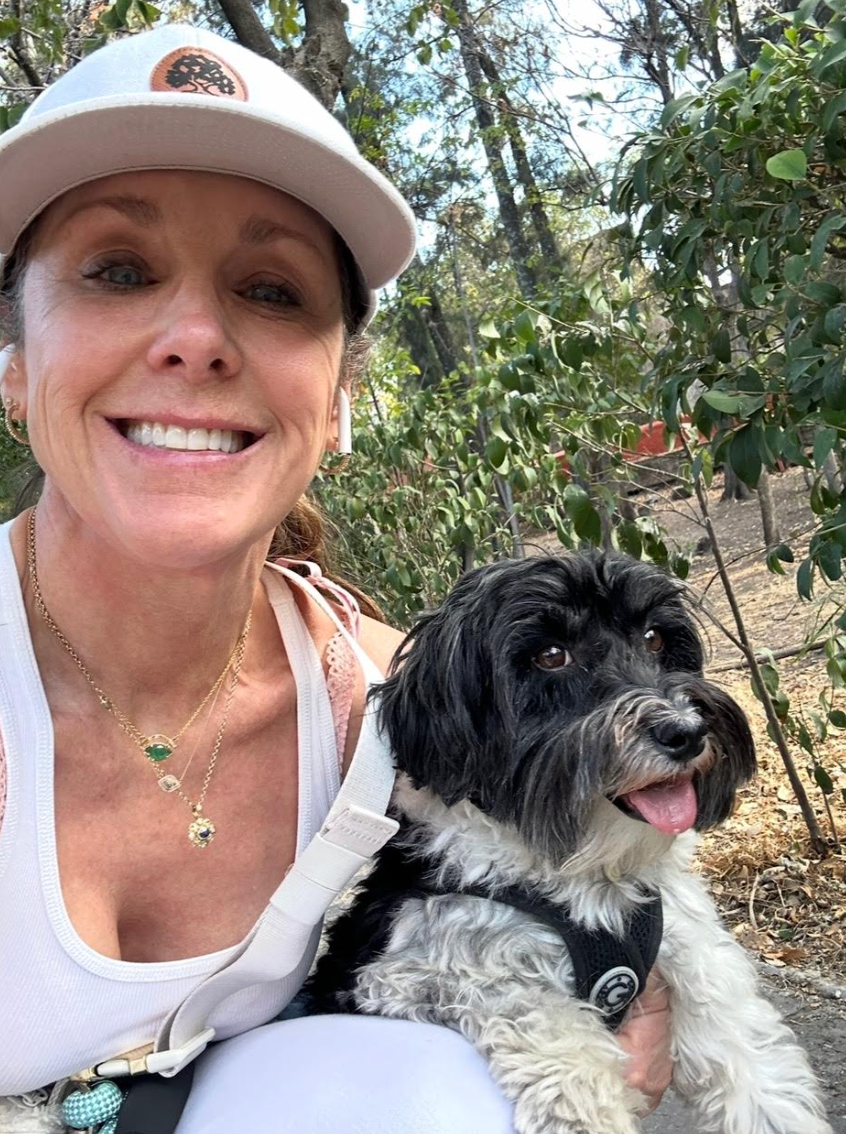
The author and Georgie in San Miguel de Allende, Mexico, in 2025

Courtesy of Danielle Girard

The author and Georgie in San Miguel de Allende, Mexico, in 2025

He acted normal for the next 24 hours. In weak imitation, the kids and I tried to act normal, too, to prepare for our trip and the small Christmas celebration we planned before leaving.

The following morning, Christmas Eve, we were set to depart for our vacation when I woke at 4am with the memory of something my husband said when our friends divorced: “A man never leaves his marriage unless there’s someone waiting for him.”

I roused him at 4:04am and asked again, “Who are you in love with?” When he didn’t answer, I started to guess. I got it in two. On the first guess, he protested loudly. On the second, he went silent.

That was answer enough.

“How long?” I asked. If I’d written the scene, I like to think I’d have been more creative, but creativity evaporated in the panic of that moment.

I shouldn’t have been surprised that he lied again. It took more than three weeks to get him to admit that the relationship had been going on for almost two and a half years. Three years later, there are details that never quite squared and lies that were never ironed out.

As a thriller writer, I’ve spent countless days imagining the worst things people can do to each other. I’ve sat in coffee shops and on airplanes and at my desk and invented murders, betrayals, psychological torture.

I’ve been inside the heads of liars and manipulators and people who destroy others without remorse. That experience made me believe I understood human darkness with a clarity others lack. But understanding it for the benefit of a story and living through it are entirely different things.

The author at Shakespeare and Company, Paris, in 2024

Courtesy of Danielle Girard

The author at Shakespeare and Company, Paris, in 2024

For days after I found out, I moved through my life like a stranger. Every object felt suspicious, every memory potentially false. Had he been thinking about her when we were in Nashville for my birthday the month before? Was he texting her from our bed when I was in the kitchen and setting up the coffee machine for the next day? How many times had he said “I love you” while mentally planning his next Friday massage appointment?

“Really? Your massage therapist?” I asked once, during one of those miserable circular conversations where nothing gets resolved and everything gets worse. “A 50-year-old man and his massage therapist. It’s so cliché.”

The comment clearly stung, as if I’d insulted his creativity rather than his fidelity.

“We were friends first. She listened to me,” he said.

“I listen to you,” I said like a petulant child.

“You’re in your office, working, or you’ve got your nose in a book for the podcast.”

He wasn’t entirely wrong.

Once our kids had left for college, I’d shifted my focus to my writing and working harder than ever as my career took off. I’d stopped working on the marriage. My shiny new toy was the book; his worked out the kinks in his neck, ones put there by 30 years with me.

That December, I was neck-deep in a manuscript about a detective investigating a pregnant surrogate who goes missing. It was a book I’d been so excited about six months earlier, one I’d been confident was my darkest, most psychologically complex book yet.

After I learned my husband’s secret, I couldn’t write a word.

Every time I sat down at my desk, I’d cry or stare at the blank page, wondering why I bothered. What did these pretend murders matter? What did my clever plot twists signify when I’d missed the biggest one in my own life?

Beyond the logistical fears about my own future was another terrifying realisation: I no longer wanted to write the detective book. Overnight, I’d lost interest in stories about detectives solving crimes, justice being served through shootouts and the court system, about the bad guys getting caught and punished. Suddenly, those seemed too neat, too fake, like fairy tales and not the Grimm’s variety.

Real betrayal, I learned, doesn’t get solved in 300 pages. Real deception doesn’t wrap up with a satisfying twist where everything makes sense and the protagonist emerges stronger and wiser. Real betrayal sits there, ugly and unresolved, in the middle of your life while people take sides and you fill the garage with items you once cherished and no longer want to see.

I started thinking about the kinds of stories that had never interested me – messy ones where the protagonist doesn’t figure everything out and there are no clear villains, just people making terrible choices for complicated reasons. Stories set in the ugly places I’d never wanted to go until now.

When I found my way back to the page, I rewrote the surrogate story, cutting the point of view from the detective, and placing the biological mom at its centre with her best friend from high school as the surrogate who vanishes four days before the baby is due.

In this new version, the story focuses on these women who were friends in high school and the complications of their long, intense friendship.

Though there is a big moral question at the centre of the book, as well as a fun, juicy plot, it was the interactions between the characters themselves that allowed me to explore the messy reality of life that I was living through while writing.

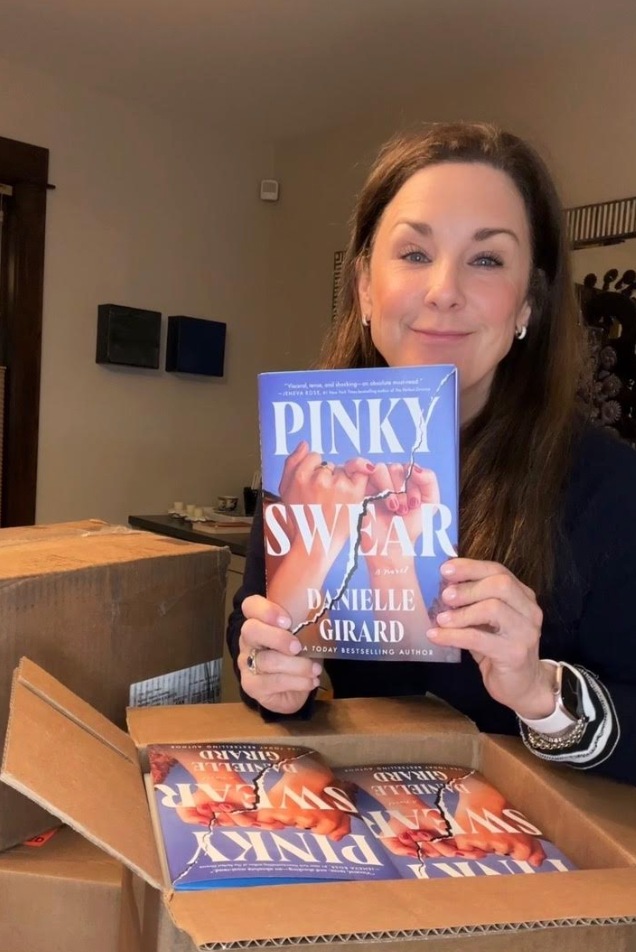
My divorce was finalised at the end of 2023, a few months after I got a new agent, six months before my agent sold that book, Pinky Swear, at auction for release earlier this year. It was the hardest book I’ve ever written and the best.

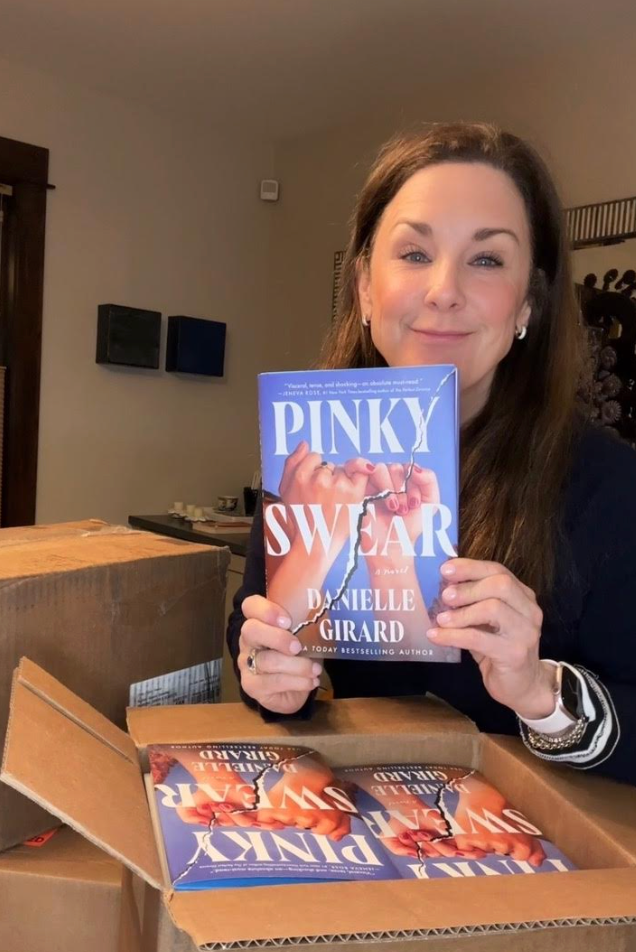
The author at home with "Pinky Swear"

Courtesy of Danielle Girard

The author at home with “Pinky Swear”

The one I’m writing now is trickier, more complicated. It’s about a woman who discovers her husband’s long affair with a massage therapist.

My husband was married to a thriller writer for almost 30 years. This can’t come as a surprise to him. Still, this is not a memoir. There’s a murder, for starters. But there are echoes from my own experience in the details, like the secrets that begin small and seem harmless … until they’re not.

While the main character is not me, the protagonist is walking in my own, uncomfortable shoes, trying to construct a narrative to make sense of chaos, and working to find a path forward when the narrative crumbles.

Every time I drive downtown, I scan the cars, the street, the store or restaurant for my ex-husband and his girlfriend. I still haven’t seen them together, though I know that they are. I wonder what I’ll feel when I do – a fresh wallop of despair? Closure? I have run the scenario a hundred times, and I still don’t know.

What I do know is that the writing I’m doing now feels like what I should be doing. Not because detective fiction isn’t important or valuable, but because I’d been using it as a way to imagine I could manage the outcome and somehow avoid the terrible things that happen to people who I imagined weren’t as studious or as prepared.

For months, I’d been plotting elaborate lies and deceit in that first draft of Pinky Swear while missing the simple, stupid truth: that the person sleeping next to me was a stranger. That I was so good at inventing characters for mysteries, I’d forgotten to be curious about the one I’d married.

I see now what those books were really about: control. The illusion that if you’re smart enough, observant enough, careful enough, you can see the betrayal coming. You can solve the crime. You can write your way to safety.

But you can’t. Life isn’t a thriller, and there’s no genius detective who’s going to figure it all out – no satisfying final chapter where all the pieces fit. At least, not in my life. Instead, there are just little clues I recognised far too late about the person I thought I knew becoming someone I never knew at all.

The book I’m working on now – the one about the woman who discovers her husband’s two-and-a-half-year affair with his massage therapist – will be called Happy Ending.

It won’t be neat or easy, but it might be happy. I hope it will be.

Danielle Girard is the USA Today bestselling and award-winning author of several novels, including the Annabelle Schwartzman series and Pinky Swear. She is also the creator and host of the Killer Women Podcast, where she interviews the women who write today’s best crime fiction. A graduate of Cornell University, Danielle received her MFA in creative writing at Queens University of Charlotte, North Carolina. When she’s not traveling, Danielle lives in the mountains of Montana.

Do you have a compelling personal story you’d like to see published on HuffPost? Find out what we’re looking for here and send us a pitch at pitch@huffpost.com.
Share Button

My Senior Dog Couldn’t Walk Anymore. Before She Died, She Led Me To My Husband.

“JUST BRING BACK MY MAYAAAAAAAA,” I sobbed into the phone to my then-boyfriend of two years, Tom.

He had just left our East London apartment for a two-hour journey to the specialty vet hospital, where our 13-year-old paralysed chiweenie waited to be picked up. Housebound with Covid, I waited impatiently for him to return with the love of my life.

Tom knew that Maya had always been my soulmate. She had been at my side since I was 19 and going to college in Greenwich Village. She gently snorted in my bag as I snuck past security into my film class, where a treat from my professor awaited her. Bouncy and bright, Maya romped through the city with me, often drawing adoration from passersby for her cuteness.

We were inseparable. I would wake to the surge of traffic or the rumble of street construction below, Maya nuzzled into my dark hair. Up we went to the coffee shop’s takeout window, where, surprise, surprise, more treats were ready for her taking. On the subway, to friends’ houses, on road trips across state lines, and on flights home to sunny, smoggy Los Angeles, Maya came along every step of the way.

During Hurricane Sandy, it was Maya and me against the world. No power, no running water. Maya and I traipsed along the Westside Highway at twilight, a Blessed Virgin Mary candle ablaze as a torch, walking past what felt like a post-apocalyptic downtown.

Maya even moved across the pond with me to London when I turned 30 – a reset after a five-year relationship abruptly ended.

She first moved in with my mum, who FaceTimed me at least four times a day while I spent the longest three months of my life waiting for her to arrive.

When she finally did, I felt whole, like I could exhale and lean into my new London chapter.

A few months later, Maya, almost 12, lost mobility in her back legs. I placed her in a leather duffel bag (unzipped, of course), threw in some blankets and rushed into the November night to the same specialty vet hospital, which would become our refuge for the next three years.

Still in my yoga pants and sweatshirt from that afternoon, the only thing I could think about was getting Maya better. I kept reassuring her, “It’s OK, it’s going to be OK,” even though I was ultimately reassuring myself. Stroking her soft face and trying to keep the tears back, I knew our lives would never be the same.

“Intervertebral disc disease,” the neurologist said. “She needs a spinal fusion immediately.” With only a 50% chance of regaining movement in her hind legs, I began to prepare for whatever came next.

Maya glowed in her new neon pink set of wheels. She zipped along the Hackney Canals with even more flair than before, drawing even more smiles in her new form than she had on four legs.

It was during this period that I met Tom. We both swiped right, and I planned for him to meet Maya on our third date. By then, I had accumulated a handful of dog sitters for her. While she could be home alone for up to four hours, for special nights out, I needed backup.

Maya was still figuring out her new self and was scooting all over the apartment in her white puffy diapers. As soon as I brought Tom up to meet her, Maya had an accident all over a floor pillow. Embarrassed, I began to apologise.

“It is not a bother,” he laughed as he picked her up. “Come on, you. Let’s get you cleaned up,” he cooed as he reached for the kitchen roll.

It was at that moment that I knew Tom was here to stay. During lockdown, he would drive from the other side of London and spend the entire weekend with us, giving Maya baths, making a duvet fort for her so we could watch The Twilight Zone, and going for long walks with Maya rolling beside us. He would even adorn her with origami crowns. My plus-one became a plus-two.

Tom and Maya in our yard in London, December 2020.

Photo Courtesy Of Jordan Ashley

Tom and Maya in our yard in London, December 2020.

On our first family holiday in summer 2020, we rented a cottage in the Cotswolds, where Maya rolled in green fields sprinkled with cows grazing. When she grew tired and needed a rest, Tom would scoop her up in his arms, like a bride being carried over the threshold, and blow on her face to cool her down.

When the three of us finally moved in together, our priority was securing a ground-floor apartment so Maya could come and go with ease. Our entire existence centered on Maya. It was never just Tom and me, but rather the three of us, moving as an imperfect unit into this new, cohesive life together.

As our love deepened, Maya’s age began to catch up with her. Despite being the ultimate roller girl, more health issues began to pile on: hyperparathyroidism, myoclonic seizures, pancreatitis and blindness. During this time, she would be up all night, distressed, howling and crying.

We took turns, surviving on three hours of sleep, our collective mental health wearing down, yet we persevered. On these late nights, I would turn on sound bath playlists, sing to her and do everything in my power to keep her settled on the futon we had set up in the living room. We would not give up on our Maya.

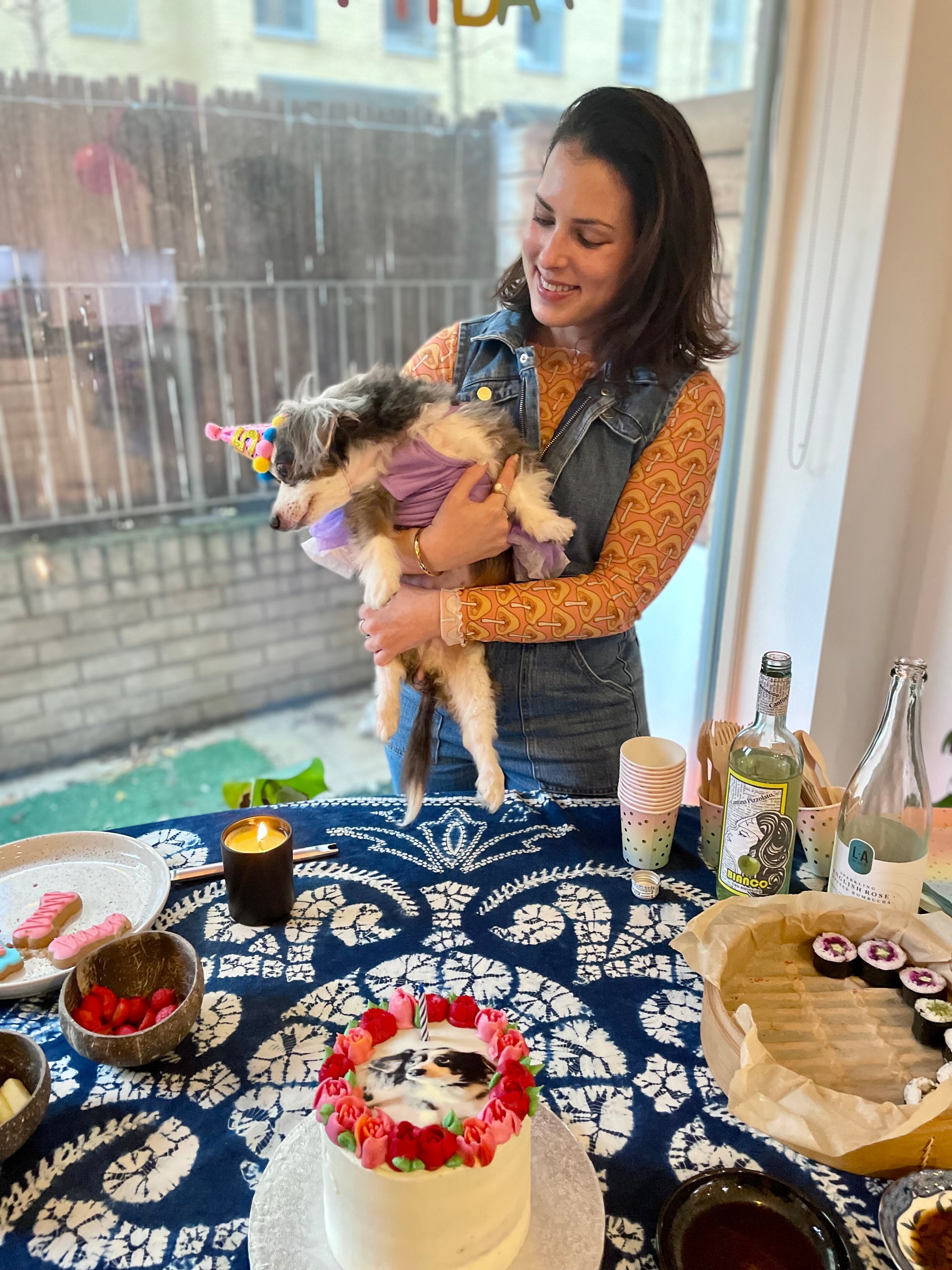
In January 2024, we celebrated her 16th birthday together. Our only measure of time was her comfort. As long as she was still eating, still bright-eyed and not in pain, we kept going. She had traded in her wheels for a stroller, and we pushed her everywhere, her head poking out to take in the breeze.

Maya was on a cocktail of medication, and our lives revolved around the rituals of caring for her – giving her syringes of medicine, hiding pills in peanut butter, cooking for her. She was a metronome, and our lives played to her rhythm.

Maya flew home with me that spring. By now, she could not be left alone, so it was easier to travel with her to ensure round-the-clock care. During this time, I felt Maya’s clock was running out.

Maya's 15th birthday party in London, February 2024.

Photo Courtesy Of Jordan Ashley

Maya’s 15th birthday party in London, February 2024.

I knew an engagement was just around the corner. I had found the ring in his sock drawer, and I kept saying how important it was to me to have Maya at our wedding. She would be the bouquet, as I dreamed of carrying her down the aisle.

Tom would not be marrying just me; he would also be making a vow to her.

Within 48 hours of returning to the UK, Maya was rushed to the emergency vet because she could no longer breathe on her own. We began Googling videos on how to build an oxygen chamber at home from a plastic storage container. Tom found all the parts we would need and was ready to pick up the oxygen tank when the call came. It was time.

We sat with her on our laps for five hours, crying as we looked through all the photos of our many adventures over the years: Maya gliding in Williamsburg, a soggy Tom holding an even soggier Maya after a lake dip, Maya in her skulls and crossbones sweater, us singing happy birthday to her. And then my worst fear finally happened. Her spirit had grown too big for her now very tired body.

I was devastated. I don’t remember getting into the car or Tom driving us home. He held my hand and, through his own tears, led me into our now very empty apartment. Even though he was tucking me into bed and telling me to try to rest, I felt truly alone for the first time in 16-and-a-half years.

The engagement came six weeks later, while I was waiting for a taxi to Heathrow to fly back to New York. It would be the first time I would be in the city without her. Maya’s vet gave me an envelope of bluebells to plant in her honour. On that solo trip back to NYC, I walked down Sixth Avenue, turned left onto 13th Street, and stood in front of the apartment where Maya and I first became inseparable.

Maya's representation at the author's wedding in the Cotswolds, July 2025.

Photo Courtesy Of Jordan Ashley

Maya’s representation at the author’s wedding in the Cotswolds, July 2025.

Maya had always been my constant, my heartbeat outside my body. Losing her was like losing a piece of myself, the glue that held my world together. Kneeling, I spread some dirt beneath a tree and scattered the seeds.

Across the ocean, I knew my person was waiting for me. His love for Maya over those four years was one of the greatest acts of devotion I had ever witnessed. Our love for her and the shared grief of her absence would now be a journey Tom and I would navigate – together.

Jordan Ashley, Ph.D., is a writer and the founder and executive director of Souljourn Yoga Foundation, a nonprofit creating transformational yoga retreats that support girls’ education worldwide. Learn more at souljournyoga.com.

Do you have a compelling personal story you’d like to see published on HuffPost? Find out what we’re looking for here and send us a pitch at pitch@huffpost.com.

Share Button

A Couple Asked Me To Help End Their Marriage. They Didn’t Expect A 30-Year-Old Secret To Come To Light.

“You made a sex tape?!”

Susannah turned to her husband, Ron, mouth agape. He looked down, his cheeks reddening.

“It was right after college. I was experimenting,” he mumbled, twisting in his seat. “No big deal.”

As a couples therapist, I am always looking for how to mend the frayed edges of a relationship, but Susannah and Ron were different: they had come to my office to end their marriage.

I practice what I call breakup therapy — a short-term treatment I developed for couples who want to end their relationships without bitterness.

The premise is counterintuitive: instead of looking forward toward separate futures, we look backward at the relationship itself. It’s structured to look at the beginning, middle and end of their time together with exercises that focus on both their gratitude as well as their resentment.

The work culminates with the couple crafting a shared narrative about their union and literally writing it down – a story of what worked and ultimately what did not. Then, I ask them to sign it. In this way, they resolve the many unanswered, and often unasked, questions that can trap couples in recriminations and keep them from moving on.

The idea was born from my own bitter divorce. After my split, I was plagued by questions that repeated on an endless loop in my brain: “What was I thinking?”; “Why didn’t I see that red flag?”; “What is wrong with me – I’m a therapist and I should have seen what was happening.”

Then, one day, my therapist asked me a different question: who was I when I decided to marry? Suddenly, my internal feedback loop stopped.

“You’re asking me who I was, not why I married him?” I said, skeptically.

“Yes, I am,” she answered. “Marriages can be as much about identity as they are about a union. What were you trying to solve — or avoid — by marrying him?”

The question unlocked something for me. I’d been full of anger at myself, but I hadn’t really taken responsibility for my own actions. With her help, I crafted a story that I could hold onto about what function the marriage had served for me. Truly owning my choices helped me have more compassion for myself and less anger. The most startling realisation? When I had created a story that hung together, the nagging questions ended for good.

I have seen this same process unfold for many couples. But often, in the course of these sessions, new things surface.

“Susannah?” I said, surprised to hear the hurt in her voice. “This feels like a big deal for you. Why is that?”

Ron and Susannah had not been the most willing subjects for breakup therapy. During our first session, Ron blurted out: “You’re like a medical examiner doing autopsies on dead relationships! Your scalpel hurts. I don’t think you know what it feels like to be humiliated.”

“I wouldn’t be so sure,” I answered softly. “I have a teenager.”

Ron was not mollified.

“This feels stupid,” he said on another occasion. “She’s done, I accept that. What is there to say? This feels like horseshit.”

“See what I’m working with here?” Susannah said, throwing up her hands and shifting away from Ron on the couch. “I knew he wouldn’t take this seriously.”

“No, he’s right,” I said. “If it’s really true that you fully accept and understand her decision, Ron, then this is horseshit. But is that true?”

His silence was all the answer I needed.

Over the next few sessions, we went over how they’d fallen in love (“It just made sense, we fit”); the birth of their three children (“The unit held us together”); the unraveling of their connection (“We were ships in the night for as long as I can remember, but then one day I woke up and just wanted more from life”).

We mapped the patterns their marriage had fallen into over the course of three houses, two cross-country moves and their children’s exodus from home. It was a saga spanning decades.

Then, in our fourth session, Ron mentioned the sex tape.

“Something about this is landing hard on you,” I said to Susannah, her mouth still ajar. “Why?”

“Yeah, why?” Ron echoed.

Susannah paused and looked out the window.

“It’s that you … you tried something that – I don’t know – was out there … bold and different.”

A tear welled in a corner of her eye.

“It’s not you. You’re not brave! Or, at least you haven’t been with me, not in all these years together.”

Then she began to cry. Ron and I looked at one another.

“Susannah?” Instantly, I regretted breaking the silence.

“All this time, I decided you just couldn’t try new things,” she managed after a while. “I gave up.”

Ron put up his palms. “What is happening?” he said, exasperated.

“But if you can do that …” she continued. “What was it? Did I just not ask? Did I build my life around a lie?” She looked lost. “Was it that you never really loved me enough?”

She turned back to Ron and banged her fist on the couch.

“I did ask! I asked you to look at porn together when we stopped having sex, to take classes with me, to go on that whale-watching tour. … You just ignored me!”

This time, I held my tongue.

“Is that a thing?” she went on, turning to me. “That you can reach the end of a relationship and not even have known what was possible?”

“I made that tape 30 years ago,” Ron blurted out. “She’s upset over something I did when I was a totally different person!”

This was the impasse that I had expected, that arrives in most of my breakup therapy work – the moment when two people realise that as well as they think they know each other, there are things they don’t know or have lost track of. It’s my job to help them hold that bitter realisation. Then it’s my job to help them arrive at forgiveness or some kind of reconciliation – if not with each other, then with what happened to them.

“It was 30 years ago, Ron,” I said. “But you aren’t a different person. You’re the same person, and she’s wondering why you couldn’t have been that with her.”

I turned to Susannah and said, “You have a right to be hurt, but were you truly honest with him? Did you give him the space and the safety and the encouragement to be that person? Do you think you both can forgive each other for what you weren’t?”

It was three weeks before they appeared again in my office, having canceled two sessions in between appointments.

“I was stirred and moved by what happened here last time,” Susannah began. “When we left, I thought: Maybe there’s enough left between us?”

Ron’s eyes were downcast.

“But I realised I can’t,” she said. “I just can’t open up that part of me with him anymore. I want … I need this divorce.”

I nodded. “Ron? How do you feel?”

“I can see where we are … I’m not fighting it.” His voice broke. “I’m just really sad.”

Often it requires some kind of shock to break through the built-up layers of anger, resentment and disappointment in a couple in order to illuminate the cracks in their relationship – something true that has been avoided or left unsaid. In this case, it was the surprise of an ancient transgressive act that lay bare how little they knew each other and how misaligned they’d become.

Susannah moved closer to Ron on the couch and laced her fingers with his.

“You guys seem calmer – closer. Tell me what you are feeling,” I said.

I knew something about that calm after the storm. After my own divorce, we had maintained an uneasy truce for years, until one long car ride after dropping our daughter at camp. As we rode in silence, I suddenly remembered my therapist’s question: Who was I when I decided to get married? For the next two hours, we talked over that question and everything else, and together realised how lonely we had been — two Israelis who, instead of understanding why we had both chosen to leave, had clung to each other and to a shared language. Before long, we were laughing as we had not laughed since the early days of our marriage.

“So, where do we go from here?” Ron asked me in their last session.

“Well, in my experience, when a marriage ends, a different relationship can sometimes be created,” I said. “That’s up to you guys. All endings are sad, but not all endings have to leave you broken. There’s an opportunity here to get to know each other in a different way. And …” I leaned forward to make eye contact with each of them “… to know yourselves better.”

After they left, I sat quietly in my chair for a while. I allowed myself to remember that moment in my therapist’s office when I realised that I had been using my marriage to escape a question I had been avoiding and what a relief it had been to finally face it.

When a sex tape from decades ago unlocks two people’s grief, it’s not so much about the end of the road as it is about the roads never taken – the versions of a marriage they never tried. It is a sad moment, but also a generative one.

They’d come to me to bury their marriage. What they found instead was a way to know each other – maybe for the first time in years – even as they said goodbye.

Note: Names and some details have been changed to protect the identities of the individuals appearing in this essay.

Sarah Gundle, Psy.D., is a psychologist in private practice and an assistant professor at the Icahn School of Medicine, Mount Sinai Medical Center. She is currently writing a book about breakups. You can find her on Instagram @dear_dr_sarah.

Do you have a compelling personal story you’d like to see published on HuffPost? Find out what we’re looking for here and send us a pitch at pitch@huffpost.com.

Share Button

I Fell For A Man 28 Years Older Than Me. Here’s Why Our Marriage Works So Well.

I was only 8 when an older man first caught my attention. It was during “The Parent Trap” that I felt an illicit flutter when Dennis Quaid’s Nick Parker reclined, chest hair exposed, while Meredith Blake, played by Elaine Hendrix, sat on his lap, stroking the tuft of hair.

Throughout my adolescence, there was a rotating list of older men who caught my eye: George Clooney, Russell Crowe, and my parents’ friend Raúl, whose salt-and-pepper beard made me dizzy. I wanted a man who’d been around long enough to have stories — someone whose confidence I could run my fingers through.

But even still, I hadn’t planned on marriage, let alone marrying a man nearly three decades my senior. And then I met Christopher.

The first time I heard his voice, I was hunched over a laptop at Frothy Monkey, a coffee shop in Nashville, the city where we both were living at the time.

“Want to join our book club?” he asked the server.

I turned and saw a man with silver-streaked hair sitting with an older woman with a brightly printed sweater, both of them smiling at the server. I approached their table to ask if I could join. The two of them — Christopher and Dorinda, I found out — were so excited to have a new member that they offered to let me pick the first book.

Every Thursday, we met at Frothy Monkey. We read books like “Migrations” by Charlotte McConaghy, “Planes Flying Over a Monster” by Daniel Saldaña París, and “Poor Things” by Alasdair Gray. We didn’t always have the same taste in books, but we could spend hours talking about them. I felt a pull toward Christopher after he helped me take my car to the shop when I got a flat tire. I knew he was older than me, but I wasn’t sure of his age. I only knew I left each meeting starving for the next.

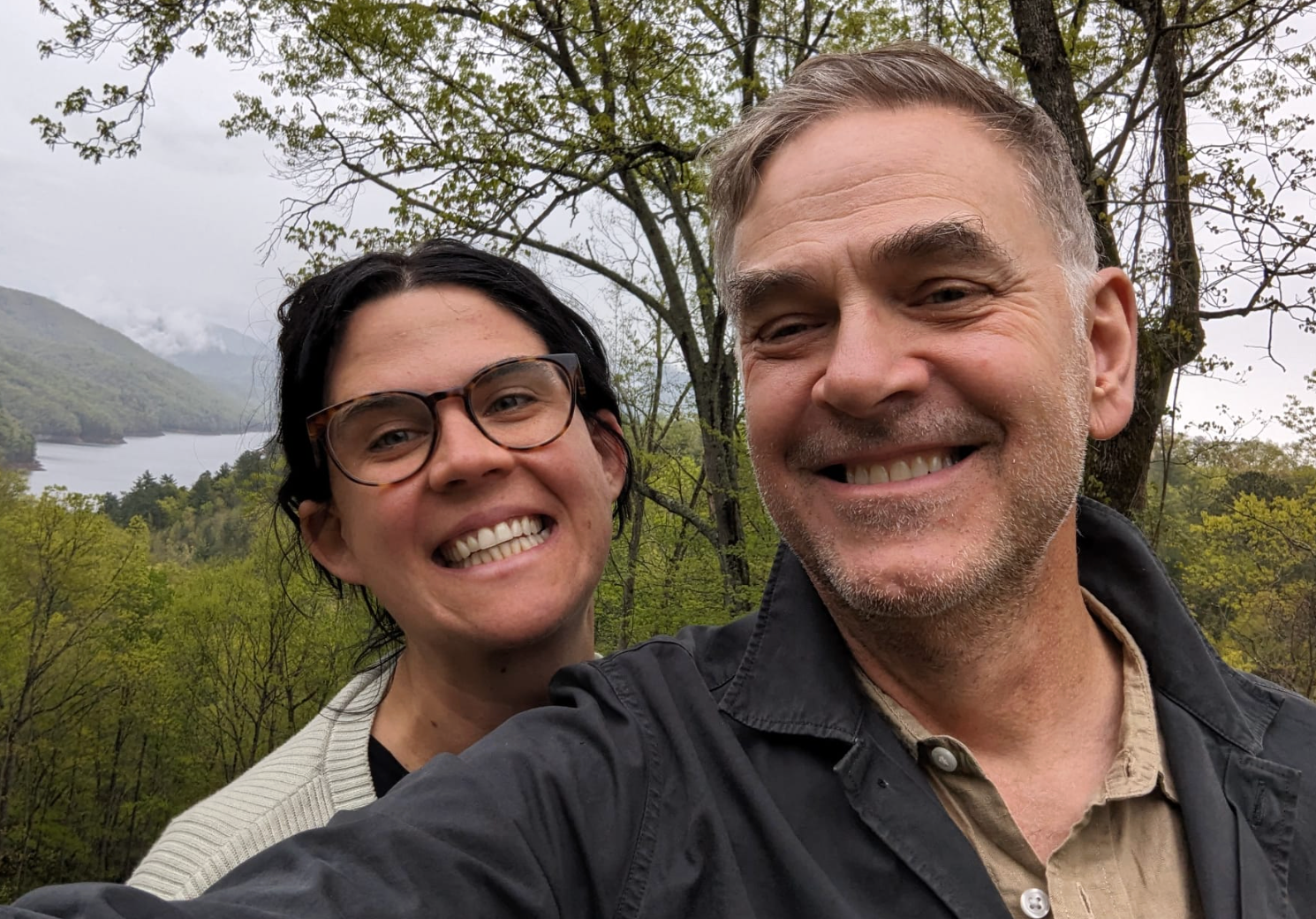
The author and Christopher on a road trip from Asheville, North Carolina, to Nashville.

Courtesy of Nicole Reed

The author and Christopher on a road trip from Asheville, North Carolina, to Nashville.

I wasn’t actively seeking an older man, but, then again, I wasn’t necessarily seeking anything. I had dated men in their 30s and 40s when I was in my 20s. At the time, the age gap was too noticeable. These men either had young kids or they were fresh out of a divorce. I had been using dating apps at that time and my age range was set from 32 to 60, but I had little luck and decided to get off them. My friend Kelcey and I printed out date cards with brief bios and our phone numbers, and we passed them out at bars. We wanted a real-life meet-cute.

Around the same time, Christopher and I began to spend time together outside the book club, mostly dinner and drinks at his favourite restaurants. I always insisted on paying for myself — I didn’t want him to think I was looking for a sugar daddy (not that there’s anything wrong with that — it just wasn’t what I was looking for).

We had so much more in common than two people of different generations; we both had lived in Arabic-speaking countries, were in creative fields, and were very (very) anti-Trump. Christopher checked off traits that I wanted in a partner: well-traveled, artsy and liberal. But even though we had been spending a lot of time together, I couldn’t tell if we were heading to friends or flirtation. I was growing impatient and knew I needed to find out one way or another.

I invited him to my house for Thanksgiving for an intimate meal with my parents, cousin and friend. During dinner, I found out Christopher was actually in his 60s and that he had been married for 16 years. Was I shocked? Yes. But it wasn’t a deal-breaker. It excited me because it meant he wasn’t afraid of commitment — that was until my mom asked him if he would ever get married again, and he replied, “Hell no!” I couldn’t tell exactly what I felt for him yet, but when I heard him say that and I felt a twinge inside of me, I suspected I was falling for him.

Not long after, I decided to go on a weekend trip to Shaker Village in Kentucky and invited Christopher to go with me. I hoped being away from our everyday lives would give me the boost of confidence I needed to make a move and finally figure out what there was between us — if anything. We booked separate rooms, but as we were unloading the car and dropping off his bags to his room, I kissed him. There was no buildup: I simply walked over, wrapped my arms around his waist, and kissed him. He kissed me back.

“I was really hoping you would do that,” he admitted.

Afterward, he pulled out an additional key to his room and handed it to me.

The night we kissed, Christopher explained that I had to be the one to make a move because he respected me and wanted to make sure he was reading the signs correctly.

The author and Christopher at sunrise off of South Georgia Island.

Courtesy of Nicole Reed

The author and Christopher at sunrise off of South Georgia Island.

I saw Christopher in a new way that weekend. He was the one who initiated conversations that others I had been with shied away from. I was no stranger to moving quickly in relationships, so when we cuddled up in bed the next night, I had every intention of having sex with him because I wanted to know if we were physically compatible. Before we were intimate, he asked me about STIs — something I’ve never had anyone do. We confirmed that neither of us was sleeping with other people. We left the weekend agreeing that if we were to go on dates with other people, we would be transparent about it, but neither of us saw other people after that.

Christopher was initially self-conscious about holding hands or kissing in public. He said women would give him this look, like how dare you take advantage of this younger woman? I never noticed. It didn’t bother me. Once Christopher saw how confident I was around him, he loosened up too.

My concerns didn’t stem from the knee-jerk pop-culture associations people often make the moment they learn I’m 28 years younger than Christopher. No, I’m not concerned that he’ll dump me for someone younger once I “get too old.” I know he loves me because I’m me, not because of how old I am.

My worries boiled down to longevity — in years and in novelty. At the age of 62, were there any firsts left for him to share with me? What would our future look like when he got older? Would the age gap be noticeable when it came to our hobbies and interests?

And though I have some anxiety about what happens when Christopher gets older, he isn’t the only one aging in this relationship. I, too, will go through changes, including menopause. Though he’s older than me, that doesn’t mean that he will necessarily die first — though statistically, he will — but ultimately, that’s not something I spend my time worrying about.

A few weeks after our first kiss, we were lying in a hotel bed in Denver.

“I almost bought a ring,” Christopher told me.

“I would say yes if you asked,” I told him.

“So should we … get married?”

In previous relationships, we both had played it safe. This time around, we were in love. We didn’t want to talk ourselves out of what we had. When I told my parents we were getting married — ideally in a few months — they were more worried. They said they weren’t uneasy about the age gap — even though Christopher is only five years younger than my dad — but the speed at which we were moving concerned them. However, as they spent more time with Christopher, their initial hesitation gave way to a realisation of how much we love each other and they gave us their blessing.

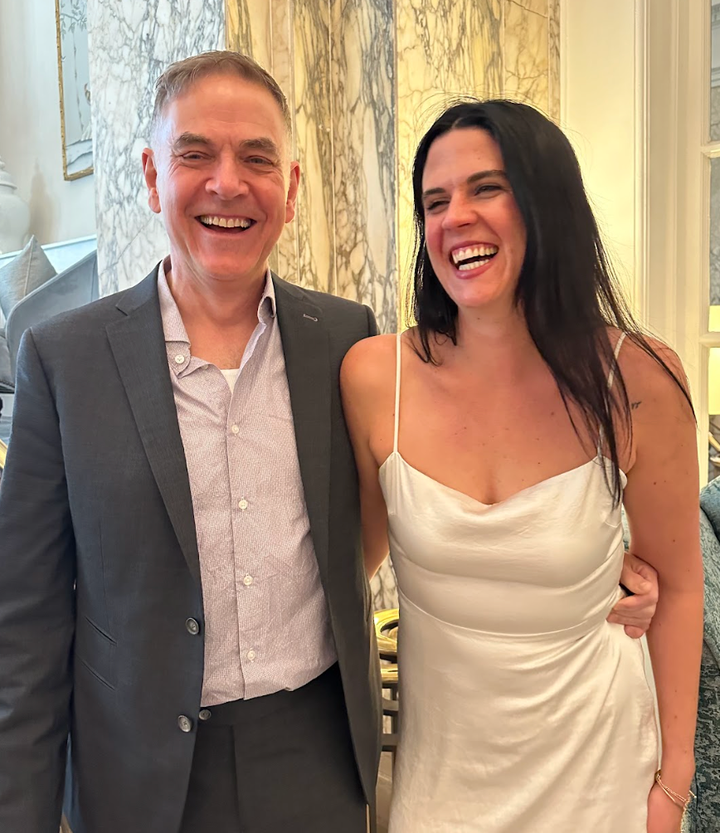
The author and Christopher in Nashville on their wedding day.

Courtesy of Nicole Reed

The author and Christopher in Nashville on their wedding day.

Not everyone was quite as supportive.

“Won’t it be weird bringing him around your friends? What if you decide you want kids? What’s it going to be like in 20 years?” My friend Kelcey fired off. She wasn’t the only one with questions. But others could see how happy I was and welcomed Christopher into their worlds. My friend Jessica and Christopher have the same music taste and bonded over bands I had never heard of. Drew chatted with him about politics while Christopher made silly faces at Drew’s 1-year-old son. My cousin and Christopher have inside jokes, like calling each other the wrong names, which was their lighthearted way of poking fun at my dad, who referred to Christopher as “Steven” for the longest time.

Before I met Christopher, I knew I wasn’t interested in having children, and he was happy with the three grown children he already had. We both loved what opportunities a child-free life could bring us: taking vacations whenever we wanted, not having an obligation to live in an any particular city, and extra income to spend on travel. He offered to get a vasectomy, and I happily got off birth control.

Being with someone older also means they’ve seen a lot. That time I needed to rush off the subway because I thought I was about to shit my pants? It didn’t faze Christopher a bit. When I got that bump on my ass and I didn’t know what it was, he took a picture and offered to pop it for me when it was ready. With people I dated previously, I often felt that I needed to impress them. I was self-conscious of my body. Early on, when Christopher and I were still new in bed together, I was on my period and he didn’t care.

Having a nearly 30-year age gap means we know different things. We have different passions and experiences. It’s not just him — the more experienced one — teaching me. I’ve introduced him to silicon instead of single-use bags, kink in the bedroom, and “Legally Blonde” (he has the “bend and snap” down). Christopher and I are both Virgos; we tend to be serious and care what other people think, but it’s much easier to play, to be silly, when you’re not alone. I told him the theory about how dogs look like their owners, and now we can’t pass a dog and their human without comparing the two. He’s taught me about brutalist architecture, introduced me to my new favourite kitchen tool, the mouli grater, and one of my new favourite podcasts, “The Ezra Klein Show.” Sometimes he’ll reference a film, and he’ll be surprised I never saw it, until he remembers I was 2 when it came out.

The author and Christopher in Austin, Texas.

Courtesy of Nicole Reed

The author and Christopher in Austin, Texas.

We’ve had candid conversations about how our age difference could impact our sex life, what our financial future looks like, and balancing our life with my parents, who are also aging. Our therapist helped us map our short-, medium-, and long-term goals. We planned what we could by setting up a joint banking account, making a will, and having weekly “state of the unions,” a designated time for us to discuss finances, weekly schedules, and anything else on our minds.

Since our marriage in March 2024, we’ve had to navigate a series of traumatic deaths — four in one year — the end of my parents’ 36-year-old marriage, and we’ve made a major move from Nashville to New York. Nothing has been too much for Christopher. He’s stuck by my side — not just because he’s already experienced it all, but because he loves me.

We’ve had so many firsts as a couple: the first time he ever used a vibrator on someone. Our first time visiting Antarctica. The first time either of us has lived in New York. I couldn’t believe that at 63 years old he had never had an apple cider doughnut. Turns out, there are plenty of firsts left for us to share. It took falling for someone much older to realise that time doesn’t make love more real — or less worth it. And age isn’t a reason to be afraid of falling.

Christopher often tells me, “I’ve never loved anyone the way I love you.” The same is true for me.

Nicole Reed is a Brooklyn-based writer. She is currently pursuing her master’s in happiness studies and working on her first-person essay collection that explores her marriage in relation to her parents’ gray divorce. You can read more of her work at www.nicolelouisereed.com.

Do you have a compelling personal story you’d like to see published on HuffPost? Find out what we’re looking for here and send us a pitch at pitch@huffpost.com.

Share Button

‘I Cancelled On My Friend’s Wedding. Is He Taking The P*ss With His Response?’

Gulp-inducing news for the newly-engaged – it turns out the average cost of a wedding in the UK is currently around £23,250.

Which, I’m sure, makes the roughly 20% of guests who don’t show up despite RSVP-ing yes quite a challenging issue to reckon with.

But if you’re put in that frustrating situation, what are you meant to do about it?

Well, Redditor u/KeyManufacturer9764 says his friend had a pretty simple solution: when the poster cancelled on his pal’s wedding, he asked for cold, hard cash.

We asked Zoe Burke, leading wedding expert at Hitched.co.uk, and founder of Etiquette Expert, Jo Hayes, what they thought of the move.

The original poster (OP) cancelled last-minute

The Redditor, who introduced his friend to his now-wife, shared that he’d fully intended to attend and had booked a hotel.

But due to an “important work visitation” in France, he cancelled the wedding. In the comments, OP said he stated he wouldn’t be coming 12 hours before he’d have travelled, and 48 hours before the wedding itself.

“I know how insanely annoying it is with people cancelling, especially weddings late on, but I had no option for my future business, and [the work] will massively help me financially,” he continued.

He offered to send his wedding gift to his “disappointed” friend’s home address. And while sharing his details, the friend reportedly said: “By the way, as you’ll be missing the food, can you send the money to cover [your] empty spot, which is £95 per head”.

The poster said that the price is “taking the p*ss” for what he sees as a simple meal, and asked, “AITA if I question it or do I just send the money and stop complaining?”

The move is “valid”

Speaking to HuffPost UK, wedding expert Burke said: “I do think that it is valid to charge people who cancel at the very last minute”.

Despite the poster’s comment about the price of the meal “taking the piss”, she explained that “the average wedding guest costs couples £261, [so] it makes sense that they would want to recoup some of the costs – because they could have invited someone else if they’d had more notice”.

She continued, “It’s really poor etiquette, unless it’s a medical emergency or something that you know really cannot be avoided.

“It’s not just the fact you’re putting the couple out of pocket, but so many other things will be put out too; the table plan, the wedding favours, the personal touches that go along with being a guest at a wedding – it’s so much more than just not turning up for dinner.”

Etiquette expert Hayes agreed that “few people, with any level of decency, would pull out of a wedding with such late notice.”

Still, she said that in general – not in this specific case – “Bridal couples do well to have grace for their guests in such instances, and simply absorb the cost”.

Share Button

This 1 Child Psychology Lesson Will Make You A Better Parent – And Improve Every Relationship You Have

Want to be a better parent, friend or colleague?

There’s a simple lesson from psychologists that you can adopt right now to improve your relationships – no matter the age of the person who is confusing or upsetting you. It’s the difference between assuming the best or the worst in people, also known as the most or least generous interpretations.

“Most of us jump right to an ‘LGI’: the least generous interpretation,” said Becky Kennedy, a clinical psychologist and author of Good Inside: A Guide to Becoming the Parent You Want to Be, who has helped to popularise these terms.

That’s because we likely grew up with people who taught us “to associate bad behaviour with bad intentions or being a bad person,” Kennedy said.

Even trained psychologists like Kennedy deal with this impulse. “When my child snaps or ignores me, my brain automatically goes to: ‘They’re being defiant. They don’t respect me.’”

“I’ve had to train myself to pause and ask: ’What’s the most generous interpretation here? Maybe they’re tired. Maybe they’re overwhelmed. Maybe they don’t yet have the words for what they’re feeling, and so their out-of-control behaviour is the only way to let me know what’s going on.“

It can take some time, but once you learn to make this switch, you might be surprised by how differently you see every toddler tantrum – or miscommunication by a friend or partner.

“That tiny mindshift changes everything,” Kennedy explained. “It doesn’t mean I excuse behaviour. … Ironically, we have to understand a behaviour to help someone change their behaviour.”

Why ‘most generous interpretation’ works so well with adults and kids

Are you practicing an "MGI" or an "LGI"? It can make all the difference.

VioletaStoimenova via Getty Images

Are you practicing an “MGI” or an “LGI”? It can make all the difference.

“MGI isn’t just a parenting trick – it’s a life skill,” Kennedy said, because it forces us to separate who someone is from what they are doing and put their behaviours in perspective. When you use it on kids, you get to be the curious, empathetic adult you want kids to grow up to be.

“Kids learn: People can get it wrong sometimes, and there’s often more going on for someone than meets the eye,” Kennedy said. “Because when you help your kid realise they can be curious about their behaviour instead of meeting it right away with judgment and blame, curiosity is what allows them to reflect and move forward in a productive way – whereas shame and blame keep us frozen and make it very difficult to change.”

And it applies to adults, too. With couples, using a more generous interpretation of someone’s behaviour can help bridge divides after doubts and betrayals.

“When I work with couples in therapy, I will ask clients directly: ‘Do you detect malice in what your partner is saying?’” said Brendan Yukins, a licensed clinical social worker and relational therapist at The Expansive Group. “Often when we directly ask ourselves if we think someone is doing something on purpose, we see that ‘LGI’ is an illusion that our brain is casting to protect us from being harmed again. Realising that someone else is trying their best to love us can lead to deep, meaningful healing.“

And it also makes us see “bad friend behaviour” with more understanding eyes. Kennedy gave the example of a friend being late to meet up with you. In this case, the least generous interpretation is to think, “She doesn’t value my time,” and feel judged and distant as a result.

But what if you took the “most generous interpretation” approach? If instead you think, “‘She might be juggling a lot today,’ you’re more likely to feel connected and understood,” Kennedy said.

Once you embody this mindset, you can help be the change you wish to see in others.

It’s OK to use the ‘least generous interpretation’ sometimes, too

Your least generous interpretation is a neurological connection that gets hardwired every time you think the worst of someone. Yukins said it’s “an expression of our anxiety in trusting others.” That’s why it’s good to challenge these negative beliefs.

“If you are able to disrupt the signal, even a little bit, it gives your brain a fraction of a second to catch itself before going into an anxiety spiral,” he said.

“In my own life, I use ‘abducted by aliens’ when someone’s late for a meeting,” Yukins said. “It takes me out of the drudgery of everyday and introduces a playful element that keeps my brain open to interpretation.”

Of course, sometimes it’s more than OK to stop giving adults the benefit of the doubt, especially when they continually disrespect or mistreat you.

“Cycles of abuse or neglect often feature a hurtful person who insists that others continue to give them MGI even when they deserve LGI,” Yukins said.

He noted that if you suspect someone is purposefully hurting you, this is when it’s all right to set boundaries and reclaim your time: “Maybe leave the last text you sent without a follow-up, or schedule a self-care night if they seem hesitant to put you on their schedule.”

MGI is a muscle you can build every day for your wellbeing

Many kids and adults have good intentions that our brains overlook. Using an MGI mindset helps you learn this for yourself.

“The key is not deceiving your brain into trusting everyone,” Yukins said. “Rather, it’s to use MGI over and over again until you find through your own research that most people have the best intentions.”

It won’t just help with how you view others. It will help you be more gentle and understanding with yourself as well.

“Our natural inclination if our trust has been broken is to assume the worst of others,” Yukins said. But when we keep jumping to the worst conclusion of people’s behaviours, “Eventually, we will begin to distrust our own intentions. This can make the world smaller.”

And the great part of this psychology lesson is how you can start using it right away.

Kennedy equates MGI to a muscle. “We have to work it out and build that muscle in calm moments to have a greater likelihood of being able to flex it in the heat of the moment,” she said.

Share Button

7 Sneaky Signs Of Resentment In Relationships

Over the course of a relationship, you’ll likely encounter complex and difficult emotions, from jealousy to grief to shame. All sorts of feelings can test a couple’s bond, but one of the more stealth yet destructive emotions is resentment.

“Resentment in a relationship can be toxic and harmful if left unaddressed,” Damona Hoffman, host of The Dates & Mates Podcast, told HuffPost. “It often builds up over time when one or both partners feel hurt, ignored or misunderstood.”

Often in relationships, there’s resentment around unequal division of labor or feeling unappreciated.

“It can begin to occur due to imbalances in your relationship, such as one partner carrying more of the mental load, whether it’s pressure to manage parenting, financial or domestic responsibilities,” said Samantha Burns, a couples therapist and relationship coach.

Resentment can manifest in subtle ways that aren’t always super apparent to your partner – or even to yourself. HuffPost asked Hoffman, Burns and other experts to share some of the sneaky signs of resentment in relationships.

Changes in communication

“Pay attention to shifts in communication and in how you express yourselves and react to one another,” said Tracy Ross, a licensed clinical social worker specialising in couples and family therapy. “Is there more sarcasm, more edginess or a negative tone?”

Take a look at what might be happening beneath the surface if you detect changes in the tone, frequency or style of your communication with your partner.

“Signs of resentment can be insidious and small verbal and nonverbal behaviours, such eye-rolling, sighing, criticising, a general lack of respect or value for your partner’s opinions or actions, and invalidation that overtime builds up and overtakes many of your interactions,” Burns said.

Passive-aggressive comments, subtle digs, scoffing and belittling what the other person says can all point to resentment. There could be a sense of moodiness or short closed-end statements that cut off actual conversation as well.

Keeping score

“Partners harbouring resentment may start keeping track of each other’s mistakes or past wrongdoings, using them as ammunition in future conflicts,” Hoffman said.

Sometimes this score-keeping is unspoken, while in other situations it might be more explicitly expressed.

“Someone might be bringing up past grievances frequently, focusing on tit-for-tat,” said Mabel Yiu, a marriage and family therapist and founding director of Women’s Therapy Institute.

There might also be a sense of tracking who is contributing more to keeping things running smoothly or working harder.

“You might feel as if you constantly have to sacrifice your own wants and needs,” said April Henry, a licensed marriage and family therapy associate at Millennial Life Counseling. “You lack empathy for them or their excuses.”

Avoiding spending time together

“It’s healthy for couples to have their own interests and friends they see separately, but if one or both partners seem to be finding excuses to avoid another or get out of spending solo time together, that’s a big red flag,” Hoffman said.

Ask yourself if you’re feeling withdrawn or emotionally disconnected from your partner. Maybe you aren’t interacting as much as you used to.

“Are you avoiding certain conversations or spending time together? Are you making excuses for being less available?” Ross said.

Criticism and blame

“According to Dr. John Gottman, criticism is one of the biggest signs of trouble in a relationship,” Hoffman explained.

Indeed, his “four horsemen” of a relationship apocalypse are criticism, contempt, defensiveness and stonewalling.

“Are you feeling more critical of your partner’s family, close friends, work situation – and do you find yourself judging, complaining or nitpicking – or vice versa?” Ross asked. “Do you find yourself feeling superior – ‘what is wrong with him/her? I would never do something like that.’ Do you feel contemptuous instead of mildly annoyed when your partner is late, or doesn’t clean up, or any number of small things?”

Take note if the way you deal with conflict and differences has shifted to a more critical approach.

“Another sign of resentment is blaming – making the other person the scapegoat for their unhappiness,” Yiu said.

Complaining behind their back

In addition to frequently nitpicking or complaining to your partner about things they do, a sign of resentment might involve how you talk about your partner to other people.

“Do you find yourself complaining behind your partner’s back, assuming the worst instead of the best of a particular miscommunication or conflict?” Ross said.

A little venting to your friends here and there is fine, but pay attention if it starts to feel excessive. Are you only talking about your partner as though they’re a terrible person?

“Oftentimes when someone is resentful in a relationship, they may have less empathy for their partner,” said Rachel Needle, a licensed psychologist and co-director of Modern Sex Therapy Institutes.

Resentment has a tendency to bubble to the surface in one way or another.

Maria Korneeva via Getty Images

Resentment has a tendency to bubble to the surface in one way or another.

Emotional outbursts or coldness

“Resentment is clever in the way it masks itself as anger,” Henry said. “You may think you’re upset with your partner for not unloading the dishwasher, but soon realize the gradual build-up of unmet expectations has actually turned to resentment. Resentment may have crept its way into your relationship if you find yourself in a continuous loop of feeling increasingly irritable around them.”

Resentment can manifest in emotional outbursts or cold behaviour as those pent-up feelings are released. Resist the urge to boil these deeper issues down to pure anger or sadness.

“You may find an increase of conflict about small things that always seem to come back to a larger past issue, feelings of disgust and disdain and feelings of overwhelm and high stress,” said Alysha Jeney, a relationship therapist and founder of Modern Love Counselling.

“Oftentimes resentment is a reaction of being overly stressed – being in the fight, flight or freeze part of our nervous system – for an extended period of time and not knowing how to come back to the parasympathetic nervous system of rest and digest. We feel exhausted, stressed and need help, but sometimes don’t know how to get it.”

This can make us more easily angered or annoyed by our partners. We may even villainise them because we don’t feel seen, heard or supported, which could activate inner wounds from our past.

“You might begin to assume that your partner is intentionally trying to anger, annoy or upset you, instead of giving them the benefit of the doubt – which leads to you interacting defensively and perpetuating the negative dynamic,” Burns said.

A change in intimacy

“Resentment can affect physical and emotional intimacy, causing a decline in affection, sex, and emotional connection,” Hoffman said. “I find that couples who get to the point of resentment have actually had a slowing or lack of intimacy for months or even years.”

One or both of you might pull away both emotionally and physically and show less interest in intimacy.

“Ask, are you less interested in sex, affection, being close?” Ross said. “And of course all of this can be true in the reverse as well. Maybe you notice what you’re getting from your partner doesn’t feel quite the same – less tolerance, more distance, less connecting, less prioritising one another.”

Whether you’re experiencing a sense of physical and emotional distance, increased criticism or a temptation to keep score, just remember that resentment does not have to mean the end of a relationship.

“If you detect resentment in your relationship, talk about it as soon as possible,” Needle urged. “As soon as you sense an issue, communicate about it rather than let something fester or an issue go unresolved.”

In addition to fostering healthy communication, she recommended working on forgiveness, gratitude, compassion and finding a middle ground to deal with resentment. If resentment continues to affect your relationship, seek the help of a mental health professional.

Share Button

Is ‘Marital Hatred’ Really Normal? I Asked Experts

“What is ‘normal marital hatred’?” podcast host Tim Ferriss asked on his show recently.

Therapist Terry Real, who coined the term, explained: “The essential rhythm of all relationships is harmony, disharmony, and repair… when you’re in that dark phase, you hate your partner.

“That’s OK. It’s part of the deal… don’t sweat it. You can get through it.”

I have to confess, though I’m not married, I’ve never once felt I hated my long-term partner. I felt a little shocked by the term, but maybe I’m missing a trick?

So, I spoke to Dr Carolina Estevez, a clinical psychologist at SOBA New Jersey, and BACP-registered psychotherapist Daren Banarsë, who owns a private practice in London, about whether the term is as wild as I find it.

Hatred is a strong word, but flickers of frustration are normal

“You can love someone deeply and still have moments where you think, ‘Wow, you are driving me absolutely nuts right now,’” Dr Estevez said.

“That doesn’t mean your relationship is falling apart – it usually just means you’re two people who spend a lot of time together and deal with life’s stress side by side.”

Then, she explained: “There is also relationship OCD, where someone gets stuck obsessing over their relationship, like questioning if they love their partner or panicking when things are not perfect.”

It’s very intense and can be “distressing” – you should seek expert help if you suspect you have it.

Banarsë agrees that “momentary, intense frustration or anger towards a partner is surprisingly common and normal in healthy relationships,” adding he often sees couples “catastrophising” these moments.

“The myth of constant marital bliss can create unrealistic expectations, where any conflict is mistaken for evidence that something is fundamentally wrong,” he added.

How can I tell if my “marital hatred” is concerning?

Both experts agree that flat-out, long-lasting “hatred” is a red flag.

“If those negative thoughts start piling up or turning into constant resentment or emotional distance, that is when it is worth paying attention,” Dr Esteves shared.

″‘Marital hatred’ – if we are talking about those occasional flashes of annoyance or ‘I need five minutes away from you’ – can be part of a normal, functioning relationship [but] when those feelings take over or go unspoken for too long, they become a problem.”

For Banarsë, “the concerning threshold isn’t whether negative feelings occur, but rather their pattern, duration, and impact”.

He explains: “When contempt becomes the dominant emotion, criticism outweighs appreciation, or when negative thoughts lead to emotional withdrawal lasting weeks rather than hours, these are legitimate warning signs.”

So, while he wants to dispel the “myth of perpetual harmony” in marriage, he also suggested regular, overwhelming “hatred” for your spouse is not “normal”.

Share Button

‘I Stopped Splitting Rent With My Husband After 1 Sentence From My Mother-In-Law. Did I Overreact?

Cheating isn’t just limited to romantic partners, experts say – “financial infidelity,” or lying about or concealing money-related issues, can sting just as much.

It can take the form of fibbing about debt, secret spending, and even lying about your secret wealth.

It seems Redditor u/Hexylpuff is going through the latter struggle.

Writing to r/AITAH (Am I The Asshole Here), the 31-year-old asked: “AITAH for finding out I’ve been unknowingly paying rent to my husband and his mom for TWO YEARS?”

So, we spoke to William “Bill” London, a divorce attorney and partner at Kimura London & White LLP, about how to talk money with your spouse.

The couple have been married for two years

The original poster (OP) says she married her husband “Brian” two years ago.

The pair moved into a flat supposedly rented at a discount from a “family friend” after their wedding, and have always split bills evenly. This includes both rent and utilities.

For the poster, this costs about £530 a month (admittedly an amazing deal for a rental).

But OP says that at a barbecue recently, she overheard her mother-in-law say, “It’s nice getting rent from Brian’s place” and “how smart they were to keep it in the family.”

On confronting her husband, OP says she found out her mother-in-law owned the flat and that Brian’s name is also on the papers.

“He never told me. Just let me keep paying rent for two years like a clueless roommate,” she shares.

Apparently, he never told her because “she never asked.” Her husband said she was “overreacting” because the “rent” was so reasonable.

But the poster feels blindsided, saying, “It’s not just the money, it’s the secrecy.”

She ends: “I told him I won’t keep paying until we talk about a fair setup. Now he’s acting like I’m the problem.”

“It crosses the line from privacy to deception”

London tells HuffPost UK that financial strain ends more marriages than most of us realise.

“While every couple sets their own financial boundaries, I believe that in a marriage – especially one involving shared expenses – full financial transparency is not just healthy, it’s essential,” he adds.

In this case, the lawyer thinks that, “When a partner consciously misrepresents important fiscal information to the other, as by pretending to have non-existent housing costs, it crosses the line from privacy to deception.”

This can destroy the trust needed for a healthy marriage, he continues.

“Married couples are expected to be transparent about important financial information,” he advises.

“This doesn’t mean total merging of their finances or the disclosure of all trivial expenses, but hiding ownership of a mortgage-free property and asking a spouse to share in imaginary financial burdens is manipulative behaviour needing a direct confrontation.”

In other words, OP hit the nail on the head when she said the money isn’t the main issue – it’s about respect, trust, and honesty.

Share Button