Overshooting climate targets could significantly increase risk for tipping cascades

“We show that the risk for some tipping events could increase very substantially under certain global warming overshoot scenarios,” explains Nico Wunderling, scientist at the Potsdam Institute for Climate Impact Research and lead-author of the study to be published in Nature Climate Change. “Even if we would manage to limit global warming to 1.5 degrees after an overshoot of more than two degrees, this would not be enough as the risk of triggering one or more global tipping points would still be more than 50 percent. With more warming in the long-term, the risks increase dramatically.”

“To effectively prevent all tipping risks, the global mean temperature increase would need to be limited to no more than one degree — we are currently already at about 1.2 degrees,” Jonathan Donges, Co-Lead of the FutureLab on Earth Resilience in the Anthropocene at PIK adds. “The latest IPCC report is showing that we’re most likely on a path to temporarily overshoot the 1.5 degrees Celsius temperature threshold.”

Emergence of at least one tipping event increases with rising peak temperatures

To arrive at these results, the scientists, together with co-authors from the Earth Commission — a group of leading scientists convened by Future Earth — used different global warming overshoot scenarios with peak temperatures from two to four degrees and applied these to a set of four interacting tipping elements: the Greenland Ice Sheet, the West Antarctic Ice Sheet, the Atlantic Meridional Overturning Circulation AMOC, and the Amazon rainforest. The researchers applied a risk analysis approach based on millions of model simulations to reflect the uncertainties in relevant parameters such as the uncertainty in critical temperature thresholds as well as interaction strengths and interaction structure. Such an amount of simulations would be computationally too expensive to do based on fully coupled Earth System Model simulations. For the different overshoot scenarios, the research team then analyzed the risk of crossing critical thresholds and the potential for triggering cascading interactions between the four elements, depending on the magnitude and duration of the overshoot as well as the warming remaining on the long-term.

“We found that the risk for the emergence of at least one tipping event increases with rising peak temperatures — already at a peak temperature of three degrees Celsius, more than one third of all simulations showed a tipping event even when overshoot durations were limited strongly. At four degrees Celsius peak temperature, this risk extends to more than half of all simulations,” explains Nico Wunderling.

Tipping mechanisms under warming overshoots

“Especially the Greenland and the West Antarctic ice sheet are at risk of tipping even for small overshoots, underlining that they are among the most vulnerable tipping elements. While it would take a long time for the ice loss to fully unfold, the temperature levels at which such changes are triggered could already be reached soon,” says Ricarda Winkelmann, Earth Commissioner and Co-Lead of the FutureLab on Earth Resilience in the Anthropocene. “Our action in the coming years can thus decide the future trajectory of the ice sheets for centuries or even millennia to come.” The other two tipping elements considered in the study, the AMOC and Amazon rainforest, have higher critical temperature thresholds. Yet, they would react much faster once the tipping process has started. Therefore, it is much more difficult to stop their tipping process once initiated by a temporary global warming overshoot.

Current mitigation policies are expected to lead to 2-3.6 degrees Celsius of global warming by the end of this century. “This is not enough. Even though a temporary temperature overshoot would definitely be better than reaching a peak temperature and remaining there, some of the overshoot impacts may lead to irreversible damages in a high climate risk zone and this is why low-temperature overshoots are key here,” explains Jonathan Donges. Ricarda Winkelmann adds: “Every tenth of a degree counts. We must do what we can to limit global warming as quickly as possible.”

Story Source:

Materials provided by Potsdam Institute for Climate Impact Research (PIK). Note: Content may be edited for style and length.


Share Button

In some U.S. zip codes, young men face more risk of firearm death than those deployed in recent wars, study finds

The risk of firearm death in the U.S. is on the rise: in 2020, firearms became the leading cause of death for children, adolescents and young adults. Yet the risk is far from even — young men in some U.S. zip codes face disproportionately higher risks of firearm-related injuries and deaths.

To better understand the magnitude of the gun violence crisis and put it in perspective, researchers at Brown University and the University of Pennsylvania compared the risk of firearm-related death for young adult men living in the most violent areas in four major U.S. cities with the risks of combat death and injury faced by U.S. military personnel who served in Afghanistan and Iraq during active periods of war.

The results were mixed: The study, published in JAMA Network Open, found that young men from zip codes with the most firearm violence in Chicago and Philadelphia faced a notably higher risk of firearm-related death than U.S. military personnel deployed to wartime service in Afghanistan and Iraq. But the opposite was true in two other cities: The most violent areas in New York and Los Angeles were associated with much less risk for young men than those in the two wars.

In all zip codes studied, risks were overwhelmingly borne by young men from minority racial and ethnic groups, the study found.

“These results are an urgent wake-up call for understanding, appreciating and responding to the risks and attendant traumas faced by this demographic of young men,” said Brandon del Pozo, an assistant professor of medicine (research) at Brown’s Warren Alpert Medical School and an assistant professor of health services, policy and practice (research) at the University’s School of Public Health.

Del Pozo conducts research at the intersection of public health, public safety and justice, focusing on substance use, the overdose crisis, and violence. His recently released book, “The Police and the State: Security, Social Cooperation, and the Public Good,” is based on his academic research as well as his 23 years of experience as a police officer in New York City and as chief of police of Burlington, Vermont.

“Working as a police officer, I witnessed the toll of gun violence, and how disruptive it was for families and communities,” del Pozo said. “It stood out to me that the burden was not distributed evenly by geography or demographic. Some communities felt the brunt of gun violence much more acutely than others. By analyzing publicly available data on firearm fatalities in cities and in war, we sought to place that burden in sharp relief.”

At the same time, del Pozo said, he and the other study authors were responding to oft-repeated inflammatory claims about gun violence in American cities.

“We often hear opposing claims about gun violence that fall along partisan lines: One is that big cities are war zones that require a severe crackdown on crime, and the other is that our fears about homicides are greatly exaggerated and don’t require drastic action,” del Pozo said. “We wanted to use data to explore these claims — and it turns out both are wrong. While most city residents are relatively safe from gun violence, the risks are more severe than war for some demographics.”

Illustrating the magnitude of the firearm crisis

To conduct their analysis, the researchers obtained information on all fatal and nonfatal shootings of 18- to 29-year-old men recorded as crimes in 2020 and 2021 in Chicago; Los Angeles; New York; and Philadelphia — the four largest U.S. cities for which public data on those who were shot were available. For New York, Chicago and Philadelphia, they used shooting death and injury data sets made public by each city; for Los Angeles, they extracted firearm death and injury data from a larger public data set of recorded crimes. Data were aggregated to the zip code level and linked to corresponding demographic characteristics from the U.S. Census Bureau’s 2019 American Community Survey.

The researchers acquired wartime combat-related mortality and injury counts for the conflicts in Iraq and Afghanistan from peer-reviewed analyses of U.S. military data covering the years 2001 to 2014 for the war in Afghanistan and 2003 to 2009 for the war in Iraq, both of which were periods of active combat. Because there is limited data about the risks of serving in different military units at different times during the Afghanistan and Iraq wars, the researchers considered the mortality and injury data of a single, de-identified Army brigade combat team engaged in combat during a 15-month period of the Iraq War that involved notably above-average combat death and injury rates at a time considered to be the height of the conflict.

The analysis included 129,826 young men residing in the four cities considered in the study.

The researchers found that compared to the risk of combat death faced by U.S. soldiers who were deployed to Afghanistan, the more dangerous of the two wars, young men living in the most violent zip code of Chicago (2,585 individuals) had a 3.23 times higher average risk of firearm-related homicide, and those in Philadelphia (2,448 people) faced a 1.9 times higher average risk of firearm-related homicide. Singling out the elevated dangers faced by the U.S. Army combat brigade in Iraq, the young men studied in Chicago still faced notably greater risks, and the ones faced in Philadelphia were comparable.

However, these findings were not observed in the most violent zip codes of Los Angeles and New York, where young men faced a 70% to 91% lower risk than soldiers in the Afghanistan war across fatal and nonfatal categories.

When the researchers looked at the demographics of the young men in the zip codes studied, they determined that the risk of violent death and injury observed in the zip codes studied was almost entirely borne by individuals from minority racial and ethnic groups: Black and Hispanic males represented 96.2% of those who were fatally shot and 97.3% of those who experienced nonfatal injury across all four cities.

In the study, the researchers make the point that the risk of firearm death is not the only thing that young men living in violent U.S. zip codes have in common with young men at war.

“Exposure to combat has been associated with stress-inducing hypervigilance and elevated rates of homelessness, alcohol use, mental illness and substance use, which, in turn, are associated with a steep discounting of future rewards,” they write. “Our findings — which show that young men in some of the communities we studied were subject to annual firearm homicide and violent injury rates in excess of 3.0% and as high as 5.8% — lend support to the hypothesis that beyond the deaths and injuries of firearm violence, ongoing exposure to these violent events and their risks are a significant contributor to other health problems and risk behaviors in many U.S. communities.”

Del Pozo added that the health risks are likely even higher for people in cities, because they need to face their “battles” every day over a lifetime, as opposed to military personnel in a tour of duty in Afghanistan, which typically lasted 12 months. The study results, del Pozo said, help illustrate the magnitude of the firearms crisis, a necessary understanding to municipalities seeking to formulate an effective public health response.

“The findings suggest that urban health strategies should prioritize violence reduction and take a trauma-informed approach to addressing the health needs of these communities,” del Pozo said.

Other Brown contributors included Dr. Michael J. Mello, a physician and researcher at the Warren Alpert Medical School and the Injury Prevention Center at Rhode Island Hospital.

The study was supported by the National Institute on Drug Abuse (K01DA056654) and the National Institute of General Medical Sciences (P20GM139664).

Share Button

New sensor uses MRI to detect light deep in the brain

Using a specialized MRI sensor, MIT researchers have shown that they can detect light deep within tissues such as the brain.

Imaging light in deep tissues is extremely difficult because as light travels into tissue, much of it is either absorbed or scattered. The MIT team overcame that obstacle by designing a sensor that converts light into a magnetic signal that can be detected by MRI (magnetic resonance imaging).

This type of sensor could be used to map light emitted by optical fibers implanted in the brain, such as the fibers used to stimulate neurons during optogenetic experiments. With further development, it could also prove useful for monitoring patients who receive light-based therapies for cancer, the researchers say.

“We can image the distribution of light in tissue, and that’s important because people who use light to stimulate tissue or to measure from tissue often don’t quite know where the light is going, where they’re stimulating, or where the light is coming from. Our tool can be used to address those unknowns,” says Alan Jasanoff, an MIT professor of biological engineering, brain and cognitive sciences, and nuclear science and engineering.

Jasanoff, who is also an associate investigator at MIT’s McGovern Institute for Brain Research, is the senior author of the study, which appears today in Nature Biomedical Engineering. Jacob Simon PhD ’21 and MIT postdoc Miriam Schwalm are the paper’s lead authors, and Johannes Morstein and Dirk Trauner of New York University are also authors of the paper.

A light-sensitive probe

Scientists have been using light to study living cells for hundreds of years, dating back to the late 1500s, when the light microscope was invented. This kind of microscopy allows researchers to peer inside cells and thin slices of tissue, but not deep inside an organism.

“One of the persistent problems in using light, especially in the life sciences, is that it doesn’t do a very good job penetrating many materials,” Jasanoff says. “Biological materials absorb light and scatter light, and the combination of those things prevents us from using most types of optical imaging for anything that involves focusing in deep tissue.”

To overcome that limitation, Jasanoff and his students decided to design a sensor that could transform light into a magnetic signal.

“We wanted to create a magnetic sensor that responds to light locally, and therefore is not subject to absorbance or scattering. Then this light detector can be imaged using MRI,” he says.

Jasanoff’s lab has previously developed MRI probes that can interact with a variety of molecules in the brain, including dopamine and calcium. When these probes bind to their targets, it affects the sensors’ magnetic interactions with the surrounding tissue, dimming or brightening the MRI signal.

To make a light-sensitive MRI probe, the researchers decided to encase magnetic particles in a nanoparticle called a liposome. The liposomes used in this study are made from specialized light-sensitive lipids that Trauner had previously developed. When these lipids are exposed to a certain wavelength of light, the liposomes become more permeable to water, or “leaky.” This allows the magnetic particles inside to interact with water and generate a signal detectable by MRI.

The particles, which the researchers called liposomal nanoparticle reporters (LisNR), can switch from permeable to impermeable depending on the type of light they’re exposed to. In this study, the researchers created particles that become leaky when exposed to ultraviolet light, and then become impermeable again when exposed to blue light. The researchers also showed that the particles could respond to other wavelengths of light.

“This paper shows a novel sensor to enable photon detection with MRI through the brain. This illuminating work introduces a new avenue to bridge photon and proton-driven neuroimaging studies,” says Xin Yu, an assistant professor radiology at Harvard Medical School, who was not involved in the study.

Mapping light

The researchers tested the sensors in the brains of rats — specifically, in a part of the brain called the striatum, which is involved in planning movement and responding to reward. After injecting the particles throughout the striatum, the researchers were able to map the distribution of light from an optical fiber implanted nearby.

The fiber they used is similar to those used for optogenetic stimulation, so this kind of sensing could be useful to researchers who perform optogenetic experiments in the brain, Jasanoff says.

“We don’t expect that everybody doing optogenetics will use this for every experiment — it’s more something that you would do once in a while, to see whether a paradigm that you’re using is really producing the profile of light that you think it should be,” Jasanoff says.

In the future, this type of sensor could also be useful for monitoring patients receiving treatments that involve light, such as photodynamic therapy, which uses light from a laser or LED to kill cancer cells.

The researchers are now working on similar probes that could be used to detect light emitted by luciferases, a family of glowing proteins that are often used in biological experiments. These proteins can be used to reveal whether a particular gene is activated or not, but currently they can only be imaged in superficial tissue or cells grown in a lab dish.

Jasanoff also hopes to use the strategy used for the LisNR sensor to design MRI probes that can detect stimuli other than light, such as neurochemicals or other molecules found in the brain.

“We think that the principle that we use to construct these sensors is quite broad and can be used for other purposes too,” he says.

The research was funded by the National Institutes of Health, the G. Harold and Leyla Y. Mathers Foundation, a Friends of the McGovern Fellowship from the McGovern Institute for Brain Research, the MIT Neurobiological Engineering Training Program, and a Marie Curie Individual Fellowship from the European Commission.

Share Button

Hunter-gatherer social ties spread pottery-making far and wide

Analysis of more than 1,200 vessels from hunter-gatherer sites has shown that pottery-making techniques spread vast distances over a short period of time through social traditions being passed on.

The team, which includes researchers from the University of York and the British Museum, analysed the remains of 1,226 pottery vessels from 156 hunter-gatherer sites across nine countries in Northern and Eastern Europe. They combined radiocarbon dating, together with data on the production and decoration of ceramic vessels, and analysis of the remains of food found inside the pots.

Their findings, published in the journal Nature Human Behaviour, suggest that pottery-making spread rapidly westwards from 5,900 BCE onwards and took only 300-400 years to advance over 3,000 km, equivalent to 250 km in a single generation.

Professor Oliver Craig, from the University of York’s Department of Archaeology, said: “Our analysis of the ways pots were designed and decorated as well as new radiocarbon dates suggests that knowledge of pottery spread through a process of cultural transmission.

“By this we mean that the activity spread by the exchange of ideas between groups of hunter-gatherers living nearby, rather than through migration of people or an expanding population as we see for other key changes in human history such as the introduction of agriculture.”

“That methods of pottery-making spread so far and so fast through the passing on of ideas is quite surprising. Specific knowledge may have been shared through marriages or at centres of aggregation, specific points in the landscape where groups of hunter-gatherers came together perhaps at certain times of the year.”

By studying traces of organic materials left in the pots, the team demonstrated that the pottery was used for cooking, so the ideas of pottery-making may have been spread through shared culinary traditions.

Carl Heron, from the British Museum, said: “We found evidence that the vessels were used for cooking a wide range of animals, fish and plants, and this variety suggests that the drivers for making the pottery were not in response to a particular need, such as detoxifying plants or processing fish, as has previously been suggested.

“We also found patterns suggesting that pottery use was transmitted along with knowledge of their manufacture and decoration. These can be seen as culinary traditions that were rapidly transmitted with the artefacts themselves.”

The world’s earliest pottery containers come from East Asia and may have spread rapidly eastwards through Siberia, before being taken up by hunter-gatherer societies across Northern Europe, long before the arrival of farming.

This research is funded by the European Research Council (ERC) under the European Union’s Horizon 2020 research and innovation programme.

Story Source:

Materials provided by University of York. Note: Content may be edited for style and length.

Share Button

Pat Cullen: Who is the RCN nursing union boss leading strikes?

The general secretary of the nursing union has led the first nationwide strikes in the profession’s history.

Share Button

Health Secretary Steve Barclay keen to focus on next year’s NHS pay deal

The UK is facing a wave of strike action over pay, including by nurses and ambulance workers.

Share Button

Two years after Covid food still tastes rotten

Thousands of people who had coronavirus face yet another Christmas with the smell disorder parosmia.

Share Button

Exclusive: Soaring Cost Of Living Causing Mental Health Crisis, Official Figures Show

The cost of living crisis is “heaping misery” on households this Christmas, with the poorest families twice as likely to suffer from depression.

A survey carried out by the Office for National Statistics (ONS) this autumn showed people’s mental health is suffering as a direct result of rising energy bills and double-digit inflation.

Food bank co-ordinators say many families feel “excluded” from Christmas this year because they can’t afford to take part in school parties or trips. Many are facing poverty for the first time.

The poorest 20% of households are twice as likely to have moderate or severe depression compared to the richest 20%, the survey found, while over a quarter of renters now have moderate depression.

The ONS also found that those struggling to afford energy bills are five times more likely to suffer from depression on a moderate or severe level and that those who were forced to spend less because of the rising cost of living were twice as likely to have moderate depression.

Last year, 18 million days were lost to mental illness, making it the biggest driver of economic inactivity in the UK. The days lost are estimated to have cost the economy £117 billion a year.

Rosena Allin-Khan, Labour’s shadow cabinet minister for mental health, said Liz Truss’s mini budget in September, which sent the financial markets into freefall and led to an increase in mortgages rates, had contributed to the crisis.

She said Labour would abolish so-called “non-dom” status — which allows foreign nationals living in the UK to avoid paying tax in this country on their overseas earnings—- and spend the money on the NHS instead.

“The disastrous economic policies of successive Conservative governments are heaping misery on millions this Christmas — but Christmas has come early for non-doms,” she told HuffPost UK.

“Labour has a plan to transform mental health services and prioritise prevention, by recruiting 8,500 staff in our first term, guaranteeing treatment starting within a month, providing access to a mental health professional in every school and a mental health hub in every community,” Allin-Khan said.

Charlotte White, who helps coordinate a foodbank in Wandsworth, said she had noticed an increase in people seeking support for their wellbeing through the foodbank.

“Many guests are struggling with their mental health, facing poverty for the first time as they suddenly find themselves unable to heat their homes and feed their families,” she said.

“More and more people are seeking support through our onsite wellbeing service.

“As Christmas approaches, I know that many of our families will be feeling particularly anxious. Whether it is paying for their child to attend the school Christmas party, school Christmas outing or buying a Christmas jumper for the non-uniform day, this year many will feel excluded.”

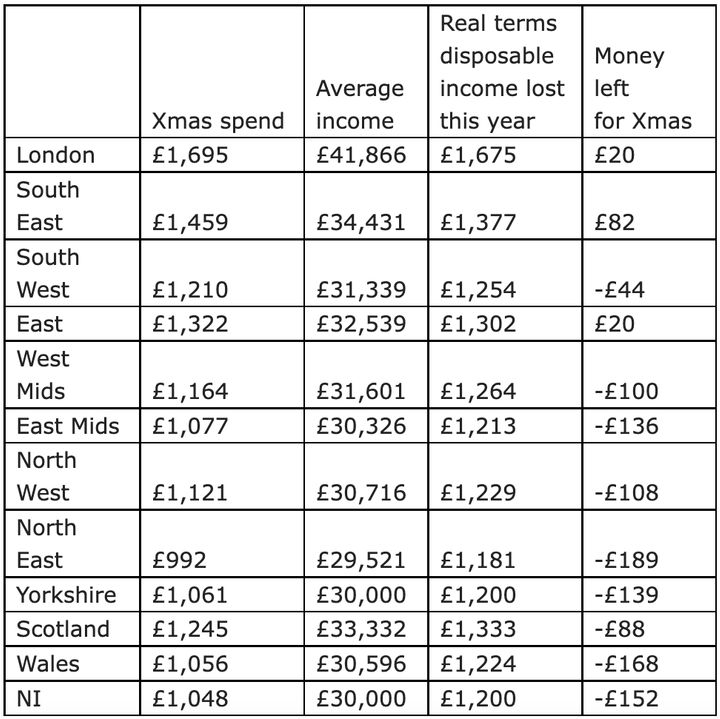
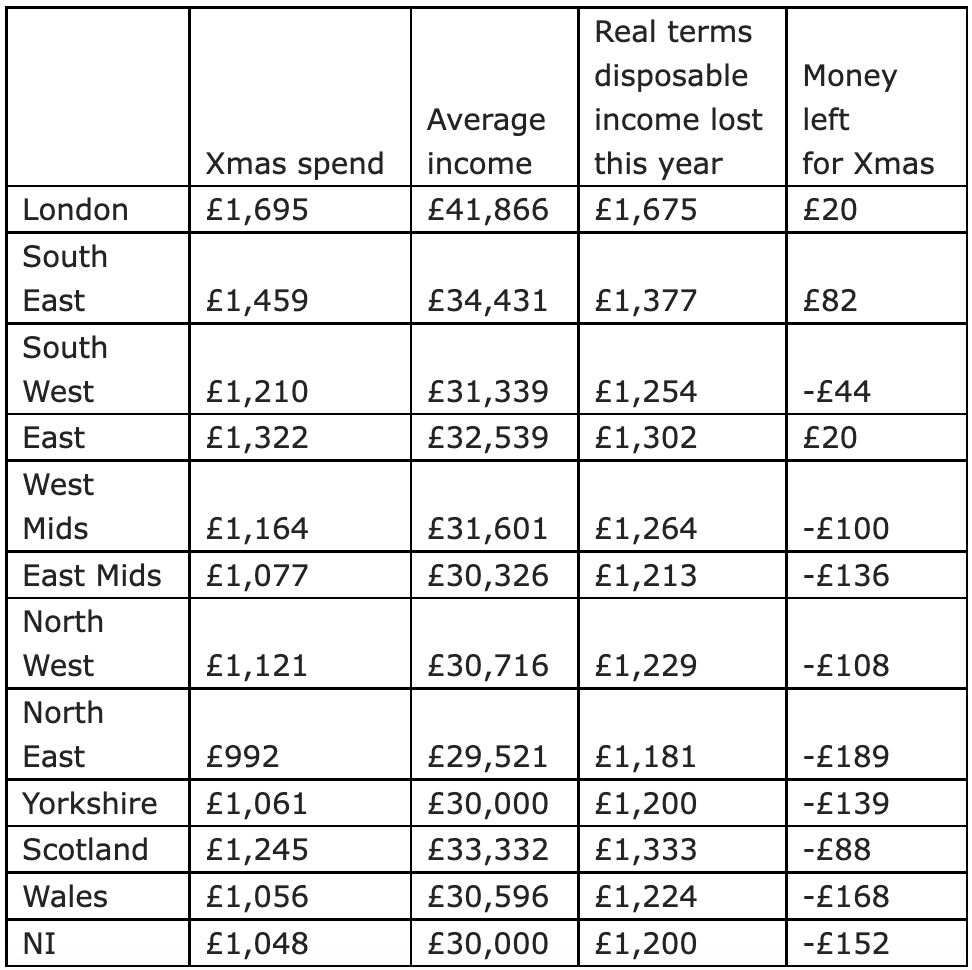
Separate analysis from Statista found that people living in the North East of England had the least money left to spend over Christmas after losing £189 of their disposable income this year.

They were followed by households in Wales, who will lose £168 and those in Northern Ireland who will lose £152.

Statista/Labour Party

One user at Little Village, a baby bank which operates across London, said Christmas this year would be “very, very difficult”.

“Christmas will just be a normal day,” they said.

“I can’t really afford to celebrate how I used to. I can’t afford gifts for the children, it’s very sad. My daughter will be even more sad. We won’t eat anything special.”

A Treasury spokesperson said: “We understand the impact that global price rises are having here in the UK and the toll that can take on people’s mental health.

“That’s why tackling inflation is this government’s number one priority, with a plan to more than halve inflation next year, and the typical household will save more than £900 as we hold down energy bills this winter.

“Over 8 million vulnerable households have received £1,200 in additional cost of living support this year, with a further £26 billion support package on the way next year – on top of increasing benefits in line with inflation, which is worth £11 billion to working age households and people with disabilities.

“It’s also vital that people can access mental health support during this challenging time, which is why have invested £500 million this year to expand provision of mental health services and address waiting times, as well as committing to an additional £2.3 billion in funding each year by 2024.”

Share Button

Dating Expert Shares How To Get Over The End Of A Situationship

The famous saying may go “it is better to have loved and lost than never to have loved at all”, but clearly poet Alfred Lord Tennyson had never been in a situationship.

Yup, a situationship, defined as “a romantic or sexual relationship that is not considered to be formal or established” can be absolute brutal when it comes to an end, but why?

Fortunately dating and relationship coach Sabrina Bendory has come to the rescue on TikTok to explain why it hurts so damn much and how to bounce back with your self-esteem still in tact.

“Getting out of a situationship can sometimes be harder than getting over a long term relationship because it’s the death of potential,” the pro explained to her 145k followers.

“Potential always looks so much prettier than reality and it also gives this added level of pain that [the other person in the situationship] didn’t even want to give it a real shot to see what was there.”

Sound familiar? You’re certainly not alone. But before you send that huge ranting text to the other person, Bendory has some steps to follow in order to move on with your head held high (even though everything hurts like hell).

1. Accept that they weren’t your person

It sounds cliched but Bendory really talks sense – the right person will want to be with you.

“You didn’t do anything wrong here, there just wasn’t enough in the first place and that’s not a loss – not everyone’s a match and that’s okay,” she urges.

2. Be kind to yourself

Yup, it’s really easy to start being hard on yourself and think you’re being OTT by being hurt but honestly, you’re only making things harder for yourself – you’re allowed to be sad.

Bendory explains: “I know you feel stupid for being so sad that it’s over, but your hurt is valid – this was a loss and loss is painful.

“You felt excited about something and then disappointed when it didn’t come to be – who wouldn’t be disappointed by that?”

And before you start blaming yourself for the end of the situationship, put the brakes on.

“It’s not what happens to us but the stories we tell ourselves about what happened that determines whether we suffer or whether we grow – if you say to yourself ‘well he left me because I’m not good enough’ then that will become wired in and that becomes part of your story,” she adds.

By repeating these thoughts and making it a part of your story, you’ll carry this narrative straight into your next relationship, Bendory warns, so rather than be mean to yourself, you can assert over and over that it didn’t work out because the person wasn’t right for you.

3. Ask yourself ‘what did I learn here?’

As painful as disappointment is, every time you’re faced with it, you’re given a chance to pause and reflect on what you’ve learnt.

“You felt an intense pull to the other person – but why? What did they represent to you, what needs did they fulfil?” asks Bendory.

“When we feel this intense magnetic pull towards someone else, it’s usually more than us than it is about the other person.”

Oooof – hard truths much?

4. Fill your life up

If you’re guilty of obsessively thinking about the other person now that the situationship has drawn to a close – that’s okay, but it’s time to help yourself.

Bendory explains: “Obsession grows in vacant space – if you keep obsessing over what went wrong, then you need to stop, you will just keep driving yourself crazy.

“You didn’t do anything wrong, there just wasn’t enough there to sustain a relationship. Instead of dwelling redirect your focus onto something else, think about something you’re excited about or something that brings you joy.”

Post-situationship self deprecation? We don’t know her.

Share Button

‘I Want To Move To New Zealand, But My Husband Wants To Stay’

You’re reading Love Stuck, where trained therapists answer your dating, sex and relationship dilemmas. You can submit a question here.

In a relationship, you won’t always share the same desires as your partner. Your partner might want to go on holiday for two weeks whilst you’d prefer if the holiday was for seven days. Perhaps you want to have three children but your partner wants to have one.

Or you want to move to another country, but your partner doesn’t think this is the best idea. This is the issue for this week’s reader. Harriet.

“I’m a 73-year old woman and want to move to New Zealand where my daughter and granddaughter live. My husband of 30 plus years wants to stay. Do I go or do I stay?” she asks.

Should she make the move to New Zealand without her partner? Or should she stay in the UK?

Counselling Directory member Kirsty Taylor suggests that Harriet considers the pros and cons of moving her life across the world without her husband. “It might be useful to actually make a list of all the reasons to go, and all the reasons to stay,” she adds.

What would you say to this reader?

“There can be strong emotional reactions when someone you love dearly is moving far away, and it’s a very normal response to consider if life would be better being nearer to those you love the most,” Taylor says.

“However, there is a long marriage and partnership to consider here too. I would like the reader to reflect on her marriage and how much it means to her, to have a good honest period of reflection on what she wants her future to look like and who she most wants to be in it.”

Counselling Directory member Paula Coles thinks it’s understandable that Harriet would want to live closer to her grandchildren. However she says “it’s important that lots of thought should be out in to huge decisions such as this, partly because it affects many individuals in both the nuclear and extended family systems.”

Coles is also curious about Harriet’s current life. “Is she perhaps feeling a lack of purpose that she hopes the daughter and granddaughter can give her?

“How might she also find purpose in her current life through friends and activities, which for many have been dreadfully affected by the pandemic and the strain that has put on many people in the last few years.”

How can she weigh up if she should move away?

Taylor thinks Harriet could benefit from a little bit of space and time to really consider this decision. “It might be useful for her to write a list of all the pros of moving to New Zealand and then all the cons of this decision.

“I think the reader could map out her future by writing it down. She could spend some time imagining what she wants from the rest of her life – will living near her daughter without her husband give her enough joy to sustain a life away from her husband? What does her daughter imagine this life to look like?”

It could put a strain on the relationship if Harriet relies on her daughter for all of her social needs.

“Has there been some conversation about the practicalities of this decision if she goes ahead with it, in terms of finance, where to live, healthcare, leaving friends, potentially living alone?” Taylor asks.

“Ultimately, the gut is our guide to decision making. The reader needs to be clear about what her gut is telling her. Regardless if the decision might cause some pain and difficulty, her gut might already have the answer.”

How can she deal with this issue with her partner?

Ultimately, Harriet needs to have a long discussion with her partner. “She could try and find out his reasons for not wanting to go, and see if there is a way to come to a mutual agreement or to manage his fears and worries about a move and find a way to make a plan together,” Taylor says.

Taylor believes that she should have an honest and truthful conversation with her husband about why she is considering to move. “There may be a bigger issue in the relationship that needs some gentle navigation.”

Her desire to move could also be a sign of deeper unhappiness or frustration. “People often look at their lives at certain points and want to make some changes,” Taylor adds.

“There may be a way of finding a middle ground – half a year in NZ, half a year in the UK. Ultimately, this issue needs some careful and considered navigation to come to an outcome that makes sense for the reader’s future happiness.”

Love Stuck is for those who’ve hit a romantic wall, whether you’re single or have been coupled up for decades. With the help of trained sex and relationship therapists, HuffPost UK will help answer your dilemmas. Submit a question here.

Share Button