Feeling Drained? You’re Probably Dealing With ‘Energy Leakage.’ Here’s What To Know.

When thinking about the ways you spend your energy, what comes to mind are likely the things that are commonly known as “draining” — work, commuting, running errands, the list goes on.

But there are smaller, everyday moments that can be just as depleting. Those are what Melissa Urban, the co-founder and CEO of Whole30 and New York Times bestselling author of “The Book of Boundaries: Set the Limits That Will Set You Free,” calls “energy leakages.”

According to Urban, energy leakage — while not a clinical phrase — is “the invisible ways that we spend energy throughout the day that leaves us feeling drained.”

She noted that “every interaction you have, whether you’re meeting your mum for lunch or replying to a social media comment … is an energetic exchange and sometimes those exchanges can leave you feeling really invigorated and positive and restored … but, in other times … you just feel depleted, you feel anxious, you feel overwhelmed, you feel frustrated.”

In other words, interactions that result in energy leakage are those interactions that consume “more energy than they’re giving back,” Urban said.

So, if you are dealing with a friend who always treats you like a therapist or are getting upset when scrolling through photos of an ex, you may be dealing with energy leakage.

Here are some unexpected ways you’re draining your energy and what to do about it.

Your phone and social media are huge sources of energy leakage.

According to Urban, your phone and social media are major culprits of energy leakage. “It feels effortless to just lie in bed and scroll and post or leave a comment or follow comments down the rabbit hole,” she said but “that is an energetic exchange.”

And, most of the time, you are not getting any energy back after looking at social media — especially when you’re comparing your life to someone else’s on Instagram, checking a toxic social media account or reading hateful comments.

Think about it: Do you ever feel better after social media stalking? Probably not.

Kids can be draining, too.

As wonderful as they are, kids can be a reason for energy leakage, too, Urban said.

“Kids are needy, they need things all the time, and they don’t have the processing for you to be like, ‘Dude, I need a minute,’” she said.

When kids need something, they need something. And that’s OK (you can’t exactly tell a 4-year-old to make their own dinner), but there are ways you may be adding to this energy leak.

You may be expending extra energy on your child (like many parents can’t help but do) — for example, frequently checking in with your child when they’re quietly playing, or asking if they need a snack or water when they’re content, Urban noted. In the end, you’re putting more pressure on yourself in this moment when, really, your child is just fine.

Beyond kids, specific people in your life can be ‘energy vampires.’

“I think everyone knows what it feels like to leave a conversation with that person who is an ‘energy vampire,’” Urban said. “You just feel like they sucked all the life out of you.”

These could be colleagues who constantly complain to you about work or family members who need a lot of support (but don’t give any support back).

There’s probably someone in your life who fits the “energy vampire” mould; signs include leaving an interaction completely depleted or exhausted.

Urban noted that this can be especially tough for those who have people-pleasing tendencies. You may feel like it’s extra hard to deal with energy vampires because they just take and take and take.

Staying angry about things that should be left in the past is another culprit.

How many times have you been cut off in traffic and let it ruin your entire afternoon?

This, Urban said, is another major driver of energy leakage: “That’s energy you are spending on something that isn’t even real anymore” — it happened in the past.

The same goes for holding grudges along with anything that puts our energy in the past or future, she noted, so things like rehearsing disaster and negative self-talk, too.

Certain people in your life may unknowingly drain your energy.

Solskin via Getty Images

Certain people in your life may unknowingly drain your energy.

Energy leakage is related to a feeling of mindlessness.

Alayna L. Park, an assistant professor of psychology at the University of Oregon, told HuffPost that the concept of energy leakage reminds her of mindlessness — the opposite of the popular practice known as mindfulness, which she defined as “paying attention to the present moment.”

Mindlessness is what Park describes as going on autopilot.

“Going on autopilot isn’t always going to drain your energy,” but a lot of the reasons we experience energy leakage — checking our phones, scrolling social media, agreeing to an event you don’t want to attend — happen because our minds are on autopilot, she added.

“We’re just kind of going through our day without always having an intention in mind,” Park said, and that can be particularly damaging when it comes to activities that exhaust you.

There are ways to help combat this feeling.

“If you know you’re about to do something that’s draining, [give] yourself a small reward afterward,” Park said. This way, you’ll have something to look forward to during a draining activity or interaction.

The reward doesn’t have to be huge. It can be something simple like going for a short walk after a meeting with someone who drains your energy or rewarding yourself with a piece of chocolate after going through a situation that led to a feeling of energy leakage.

Park also suggested setting a timer for activities that lead to energy leakage. For example, if you want to scroll social media but know it depletes your energy, you can set a time limit so you won’t just be endlessly scrolling.

Or, if there’s someone in your life who depletes your energy (and you still have to see them … like a colleague, for example) you can limit your meetings with this person to 30 minutes and remind yourself that “I can do anything for 30 minutes, even if it’s unpleasant,” Park added.

But, how much time you need to restore your energy will vary.

Urban said it’s important to know where you draw your energy from — if you’re introverted (meaning you recharge from time alone) or extroverted (you gain energy from spending time with other people) — in terms of handling your energy leakage.

If you don’t know if you’re an introvert or extrovert, “you can use Susan Cain’s super simple introvert-extrovert model,” to determine how you get your energy, Urban added.

“If you’re extroverted where being around other people makes you feel energised, you might need less quiet or alone time to restore energy leakage,” Urban said, “and you might want to choose to spend time specifically with the people who you know make you feel energised.”

For those who are introverted, you will likely need a lot more alone time to restore your energy, she noted.

Keep track of what makes you feel this way.

You may not know exactly what drains your energy, and that’s OK, Park said. If you notice you are dealing with this feeling of energy leakage at the end of every day, make a point to take note of your actions in the days to come.

To decipher what is making you feel this way, pay attention to your actions, emotions and physical sensation, she said.

When it comes to emotions, when we are on the path to feeling drained, “we might notice we’re a little more irritable than usual, or down or anxious,” Park said. Additionally, you may notice that your heart is racing or your face feels hot, she said.

Another major sign? If you’re going about your day and not doing necessary self-care tasks like working out or keeping your home in order, you may be dealing with energy leakage, too.

If any of this rings true, take a step back and think about the tasks or interactions in the day that could have led to this moment.

“An issue I see a lot it almost seems like this all or nothing — you’re fine and then you notice, ‘Oh, I’m really drained right now,’” Park said, “It can be helpful to catch before you hit the ‘I’m completely drained right now.’”

It’s important to set boundaries.

“Setting boundaries is a huge and important factor in energy leakage — you want to set boundaries with friends, family members, co-workers or co-parents who are overstepping your capacity,” Urban said.

This can include telling someone that certain topics are off-limits, that you don’t want to take part in gossip or that you will leave a conversation if it turns mean.

Boundaries look different for everyone and should address the need that your energy leakage is trying to show you — so if something makes you feel drained or anxious, you probably need to establish some boundaries.

While boundary-setting can be tough, setting boundaries is “immediately going to allow you to reclaim some of that energy,” Urban said.


Share Button

Grocery Prices Have Finally Dipped – What Does That Mean For Christmas?

Grocery prices have finally fallen (slightly), but sadly your Christmas dinner still isn’t looking any cheaper.

According to new research from data insights company Kantar, the cost of the traditional Christmas dinner for four people has increased by 9.3% compared to last year, up to £31.

Shoppers will have to spend an additional £60 in December just to buy the same items as last year, too.

But – looking on the bright side – that’s still less than general food bills at the moment.

Groceries overall are 14.6% more expensive than they were 12 months ago (down from 14.7% inflation in October).

This is the first time there’s been any drop at all in price for 21 months, suggesting inflation may finally be easing.

Even so, Kantar has noted that the sale of mince pies and Christmas puddings have fallen year-on-year.

Presumably this is because consumers are cutting down on their seasonal purchases ahead of the official festive periods towards the end of the month.

Interestingly, the football World Cup has not inspired a sudden splurge either.

Take-home beer sales only increased 5% to £230 million – even then Kantar believes this is due to increased prices, rather than a rise in the number of purchases

Discount supermarkets, Aldi and Lidl, have both opened up new stores across the country in the last three months though. An extra 1.5 million households now shop at Aldi compared to 2021.

As head of retail and consumer insight at Kantar, Fraser McKevitt, explained: “As we move into the busiest time of the year for supermarkets, there are signs that the pace of grocery price inflation is easing off slightly.”

But, he added that the research shows “just how much rising prices are impacting people at the tills and in their daily lives”.

December is still expected to be the largest ever month for take-home grocery sales as inflation and festive spending kick in.

Supermarkets are set to take more than £12 billion for the first time.

McKevitt added: “We’re seeing yet more evidence of the coping strategies shoppers are adopting to mitigate rising costs, and in particular own-label sales are growing at pace, now up 11.7% year on year.”

He said the cheapest value own-label lines have increased by 46.3% too – but people still want treats around this time of year, triggering the increase in premium own-label sales up by 6.1% to £461 million in November.

Share Button

‘My Daughter Couldn’t Speak Until She Was Six, But She Knew Exactly What She Wanted To Say’

In My Story, readers share their unique, life-changing experiences. This week we hear from Rachael Kent, who’s 40 and based in south Yorkshire.

When my daughter was 18 months old, she was still making baby babble noises. It was like she was trying to make sense of different things, but it was just noises that came out of her mouth. She couldn’t form words.

Freya-Rose started a preschool group at two and when I saw her in that environment with other children her age, I realised she was going to need some intervention to help her with her speech.

She was referred to speech and language therapy – we did group sessions to begin with and she tried so hard. She’d get frustrated because she knew exactly what she wanted to say, but it just didn’t come out.

As she grew up, other kids would shy away from her. They’d call her the baby because of the fact she’d make sounds like ‘ba ba ba’ all of the time, even when she was trying to talk. You could see it hurt her because she’s a very expressive child. She can’t hide anything that well.

At the park, kids would go near her but the second she opened her mouth and all these strange noises came out, you’d see them look and then move away – and she’d just be stood there. That was heartbreaking to watch.

Every now and again you’d come across another child who didn’t mind or care that she couldn’t speak and they’d go on the roundabout together.

But it got to the stage where as a parent I used to think: is it really worth taking her up to that park and watching her look so disheartened because nobody wants to talk to her?

I would always say to other parents: if they see a child like that, don’t pull your kid away from them, don’t make a big issue out of it as if they’ve got something wrong with them. Get them to ask questions because that’s how they’re going to learn and how they’re going to be more accepting of kids that are a little bit different and talk in a different way.

When Freya moved to nursery, she had another speech and language assessment and they decided they were going to come in weekly to work with her.

The nursery had to do 15-minute sessions with her every day and then we did 15-minute sessions with her at home. You can’t just rely on the actual therapist coming in, like it’s going to be some sort of magic thing. As a parent you have to put that work in too, constantly helping them. It’s got to be a team effort between everybody to keep it going.

Because she was really struggling to make herself understood, we taught her Makaton and she picked the signs up really quickly. We already knew Makaton because Freya’s older brother Alex, who’s now 21, has autism, ADHD and epilepsy – and we’d used it to communicate better with him when he was younger.

We’re very lucky Freya is a really placid child, so even when she couldn’t speak we only ever had two or three incidents where she got frustrated at other children.

But the rest of the time she would keep trying to show you over and over again – and as a parent that’s really upsetting when you find out your child’s been doing that. She’d be there with tears in her eyes, welling up, because she so desperately wanted everyone to know what she was saying.

She’d go into her own little shell: most of the time she’d play alongside other children, but not actually with them because she didn’t know how to tell them what she wanted to do.

As a parent, you do hit those low points where you think: are they ever going to get that speech or is she going to have to fumble her way through life?

She’d have several accidents at school because she couldn’t tell them she needed the toilet and she’s the sort of child that will not go unless she’s told that she can go. Or she wouldn’t do her school work – and it wasn’t because she didn’t want to, but because she couldn’t get the lid off the pen. It can bring a lot of frustration. It complicates so much when you take away someone’s speech.

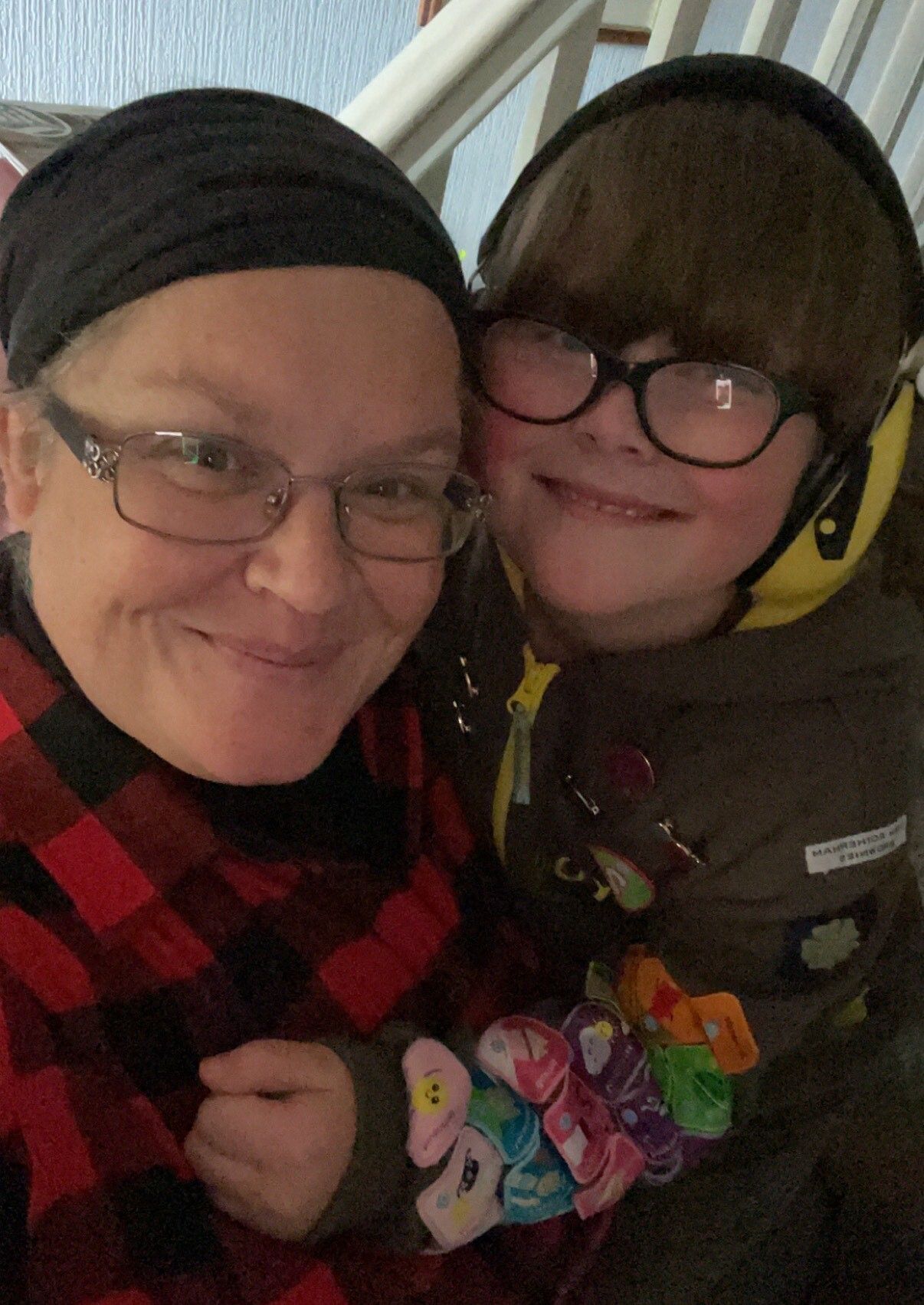
Rachael and her daughter Freya-Rose

Rachael Kent

Rachael and her daughter Freya-Rose

Freya was diagnosed with a speech sound disorder, which means she knows what she wants to say, but her brain doesn’t send the right signals for her mouth to make the movements of different sounds.

The speech and language team said about getting her into groups to try and encourage speech through social interaction. She wasn’t allowed to attend after school clubs, because they said she needed 1-2-1 support and they didn’t have the staff to facilitate it.

I’d gone to Brownies and Guides when I was younger and had adored my time with them, so I approached our local Rainbow group and explained the whole situation. They hadn’t got any experience of someone that didn’t speak, but they were willing to learn.

The first time I took her, I asked them if they wanted me to stay and they said: ‘No, let’s see how she gets on.’ I made them some visuals and gave them a crash course in the signs Freya used and we’ve never looked back.

"It was the best feeling ever."

Rachael Kent

“It was the best feeling ever.”

The third week of Rainbows she came out with the biggest grin on her face. She dragged me to the door, pointed inside and she signed to me: ‘My friends.’

It was the best feeling ever. She had the odd friend outside of school but that was more because I was friends with their parents, not because they’d chosen to come and see her. She never really said ‘that’s my friend’ until she went to Rainbows. She couldn’t wait to put her uniform on each week.

Sometimes you can take children to groups and they’ll – for want of a better word – tolerate them if they’ve got any additional needs. I had that experience with her brother at a few groups we went to when he was growing up. But Freya just 100% belongs. The other girls walk in and she gets big hugs off everyone. If she’s looking unsure, someone is always there to grab her hand and take her to where she needs to be.

When Freya was about five, a speech and language specialist worked solidly with her, in addition to us and her school doing the speech and language sessions as well, and she slowly started saying two- or three-word sentences.

We kept building on that and then by the time she was six we were getting pretty much full sentences where you recognised at least 90% of the words that she was saying.

Freya-Rose is now eight and has been diagnosed with autism, a moderate intellectual disability, and PICA – in addition to her speech sound disorder.

She’s been in Brownie’s for 12 months, after finishing Rainbows, and completed all her interest badges within six months of being there. She’s absolutely flying.

She even went away for a full weekend with them and they set an entire chalet up with symbols for fridge, bedroom, etc.

"They’ve helped her confidence grow so much."

Rachael Kent

“They’ve helped her confidence grow so much.”

She had the best time and they’ve helped her confidence grow so much – she’s gone from being that girl who would just sit and smile at everybody to someone that, when questions are asked, her hand will go up and she’ll try to answer stuff.

This week she’s narrator number five in her school nativity. I saw two of the school staff and they said: ‘Wait until you see it, make sure you’ve got tissues because we sat and cried through the entire practice when she stood up there with a microphone and said her lines.’

She’s got four pages and a couple of sentences on each page to read out. She’s not 100% clear all of the time, but compared to where she was before, it’s just amazing.

To find out more about Girlguiding and each of its four sections: Rainbows, Brownies, Guides and Rangers, visit girlguiding.org.uk.

Rachael was interviewed by Natasha Hinde and her answers were edited for length and clarity. To take part in HuffPost UK’s My Story series, email uklife@huffpost.com

Share Button

More diagnostic hubs to tackle NHS waiting lists in England

A taskforce has also been set up to unlock spare beds and theatres in the private sector.

Share Button

Warming climate spurs harmful oxygen loss in lakes

Rondaxe Lake in Herkimer County, New York,represents classic Adirondack Park waters. But over the last quarter-century, Rondaxe — like thousands of lakes in temperate zones around the world — has been losing a global-warming battle to maintain oxygen in its waters.

New research from Cornell University and Rensselaer Polytechnic Institute shows a continually warming world is leading to extended, late-summer weeks of water stratification, which prompts oxygen deprivation in the water — provoking conditions called hypoxia (low oxygen) and anoxia (no oxygen) — and negative consequences for fish and other species.

The work published Dec. 6 in the journal Global Change Biology.

“Lakes with dissolved oxygen losses strongly outnumber those with gains,” said lead author Stephen Jane, a postdoctoral fellow at the Cornell Atkinson Center for Sustainability. “At large scales, aerobic organisms are losing available habitat as warming of lakes continues. This is particularly the case for organisms that rely on well-oxygenated cool waters deep in lakes to survive warm periods.”

Jane and his colleagues examined about 25 years of data available for more than 400 lakes — mostly from the United States — to identify dissolved oxygen loss. In addition to Rondaxe Lake, the group studied New York’s Neversink (Sullivan County) and Cannonsville (Delaware County) reservoirs, and Jockeybush and Sagamore lakes (Hamilton County).

In temperate climate lakes, the researchers found that the amount of low oxygen water is increasing by 0.9% to 1.7% per decade on average and found that the volume of lake water lacking oxygen has increased by more than 50% from three decades ago.

Reducing oxygen in lake water can have many effects. For example, anoxic portions of the water column might see a buildup of methane — a powerful greenhouse gas. Nutrients such as phosphorus from agricultural fertilizer, released from unsettled lake sediment, may enter the water column, which increases the likelihood of harmful algal blooms.

In a typical July or August, a lake surface may be about 70 degrees, while the lake bottom may be around 40 degrees. “Water temperature and density are related,” Jane said. “So it becomes a situation where basically you have oil and vinegar, where strong water temperature differences between layers causes resistance to mixing — which is stratification.”

The result is that oxygen from the atmosphere is prevented from replenishing dissolved oxygen in deep waters, Jane said. Because winter ends sooner than it did decades ago, seasonal stratification is starting earlier and ending later.

These stratification changes lead to more time for deoxygenation — the interruption of the natural oxygenation process — for deep-water habitats, he said.

“We show here that as warming is continuing, the amount of time that lakes exhibit stratification is increasing and this leads to increases in the amount of low-oxygen water in lakes,” said co-author Kevin Rose, associate professor at Rensselaer Polytechnic Institute, Troy, New York. “The bad news is that given projected warming rates, we’ll likely see even greater increases in the amount of oxygen-depleted water in lakes in the future.”

Funding was provided by the National Science Foundation and by Cornell Atkinson.

Story Source:

Materials provided by Cornell University. Original written by Blaine Friedlander, courtesy of the Cornell Chronicle. Note: Content may be edited for style and length.

Share Button

How neurons regulate their excitability autonomously

Nerve cells can regulate their sensitivity to incoming signals autonomously. A new study led by the University of Bonn has now discovered a mechanism that does just that. The German Center for Neurodegenerative Diseases and the Max Planck Institute for Neurobiology of Behavior were involved in the work. The results have now been published in the journal Cell Reports.

Anyone who has ever sent a voice message with a cell phone knows how much the volume matters: Shouting into the microphone results in a distorted and unclear recording. But whispering is not a good idea either — then the result is too quiet and also difficult to understand. That is why sound engineers ensure the perfect sound at every concert and talk show: They regulate each microphone’s gain to match the input signal.

The neurons in the brain can also fine-tune their sensitivity, and even do so autonomously. A new study led by the University of Bonn and the University Hospital Bonn shows how they do this. For this purpose, the participants investigated nerve cell networks that also play a role in vision, hearing and touch. The stimulus first travels to the so-called thalamus, a structure deep in the center of the brain. From there, it is then conducted to the cerebral cortex, where it is further processed.

Each neuron adjusts itself

“The neurons in the cerebral cortex are stimulated by the signals from the thalamus to generate action potentials,” explains Prof. Dr. Heinz Beck from the Institute of Experimental Epileptology and Cognition Research at the University Hospital Bonn. “These are short voltage pulses that are then transmitted to other sites in the brain. For that to work well, the neurons have to adjust to the intensity of the excitatory signals.”

For example, they need to dial down their sensitivity if the incoming stimuli were very strong. “We have now discovered that a specific enzyme called SLK plays a role in this process,” says Beck, who is also spokesperson for the Transdisciplinary Research Area “Life and Health” at the University of Bonn. “It enables neurons to individually calibrate their own excitability.” Which is somewhat like having no sound engineer: Instead, the microphones would automatically adjust their sensitivity so that the recording is neither too quiet nor overamplified.

“In this mechanism, special nerve cells play an essential role, the so-called interneurons,” explains Dr. Pedro Royero from Beck’s research group. He earned his doctorate with this study in the Max Planck International Graduate School and performed most of the experiments. Interneurons send inhibitory action potentials to excited neurons. In a way, they turn the knob that reduces their sensitivity. “The SLK now determines how much this regulator can be adjusted by the interneurons, that is, how strong their inhibitory effect is.”

There are two different types of interneurons. Some are activated directly by incoming impulses from the thalamus. They already inhibit the neurons while these are simultaneously excited by the thalamus. Another type, in contrast, is only switched on by the activity of the neurons in the cerebral cortex — i.e. the very neurons they are supposed to inhibit afterwards. So they are part of a negative feedback loop. “Interestingly, the SLK is not active in this feedback inhibition, but only in the first case,” Royero points out.

New insights into the development of diseases

The researchers were also able to show that certain genes are activated during sensitivity adjustment. They now want to investigate their role in the process in more detail. This is also interesting because the balance between excitation and inhibition is extremely important for brain function. This can be seen, for example, in epilepsy: The characteristic seizures result from overexcitation of large areas of nerve cells. In fact, studies show that in some epilepsy patients, less SLK is found in neurons than normal. Perhaps the study will therefore also contribute to a better understanding of the disease mechanisms.

Participating institutions and funding:

In addition to the University of Bonn and the University Hospital Bonn, the German Center for Neurodegenerative Diseases (DZNE), the Max Planck Institute for Behavioral Neurobiology — caesar and the University of Sidney were involved in the work. The study was funded by the German Research Foundation (DFG), the European Research Council (ERC) and the Bonfor Fellowship Program of the University Hospital Bonn.

Story Source:

Materials provided by University of Bonn. Note: Content may be edited for style and length.

Share Button

‘Unwinding’ chromosomes: A unique perspective on determinants of chromosomal width

Chromosomes are a highly condensed form of DNA and are crucial for cell division. During mitosis, chromosomes ensure that the genetic material is equally divided among the daughter cells. Interestingly, the dimensions and degree of DNA condensation in mitotic chromosomes vary from organism to organism. How this is regulated — i.e., what factor governs mitotic chromosomal formation and dimensions — remains a mystery.

A team of researchers led by Dr. Yasutaka Kakui from Waseda Institute for Advanced Study, Waseda University; Frank Uhlmann at the Chromosome Segregation Laboratory, The Francis Crick Institute; and Toru Hirota, from the Division of Experimental Pathology, Cancer Institute of the Japanese Foundation for Cancer Research, set out to decode this enigma.

How did it all start? For Kakui, it was his fascination for chromosomes that motivated him to take up this research. “How is genomic DNA stored within cells? This is an ancient, unsolved question. To expand our knowledge of how cells accurately pass on genetic information to successive generations, we need to understand the molecular basis for chromosome formation.” And that is what drove this study, the findings of which have been published in Cell Reports.

During mitosis, DNA undergoes significant compaction to form chromosomes. A large protein ring complex called condensin plays a key role in the compaction process. It binds at specific sites on DNA and compresses it by forming loops. So, scientists know that condensin is crucial for DNA compaction, which is closely related to chromosomal dimensions — with thicker chromosomes being more compacted. They also know that the pattern of condensin-binding sites is species-specific. But the exact role of condensin and chromatin contacts in determining chromosomal dimensions is, as yet, unclear.

The researchers explored various facets of condensin and chromatin contacts to address the questions at hand. They employed Hi-C and super-resolution microscopy to analyze the correlation between mitotic chromatin contacts and chromosomal arm length in both budding and fission yeasts, S. cerevisiae and S. pombe, respectively. Conclusive evidence was found indicating that the distance between chromatin contacts is directly proportional to arm length in both interphase and mitosis. Hence, shorter arms have short range contacts and longer arms have long range contacts. This was found to be species-specific.

Now, longer distances of chromatin contacts lead to larger chromatin loops, both of which are indicators of wider chromosomal arms. The authors thus investigated both budding and fission yeasts to conclude that within a species, longer chromosomal arms were always wider. Motivated by the successful observation in the yeasts, they extended their study to human cells, to find the same correlations. “We made the unexpected discovery that longer chromosomal arms are always thicker throughout eukaryotic species, which helps us understand how mitotic chromosomes form during cell divisions,” explains Kakui. Their study would be the first to conclusively establish that chromosomal arm length determines mitotic chromosome width.

This study has provided unique insights into mitotic chromosomal structure that challenge the current perspectives on mitotic chromosome formation. Kakui summarizes, “Our findings would open a novel way to avoid chromosome miscarriage, a probable cause for the formation of cancer cells and/or birth defects such as Down syndrome, through controlling mitotic chromosome structure. This can potentially change medical treatments for cancer therapy and/or fertility treatments.”

Story Source:

Materials provided by Waseda University. Note: Content may be edited for style and length.

Share Button

Strep A schools may be given preventive antibiotics

The drugs would be used to stop more cases of the bacterial infection that has killed some children.

Share Button

Ambulance staff to strike on 21 December

Services across England and Wales affected, but life-threatening calls will be responded to.

Share Button

How To Successfully Secure Working From Home (Even If Your Boss Is A Dinosaur)

New government legislation allows employees the right to request flexible working from the time they start a new job. The move is being received well by unions, who advised minsters to do more in relation to making flexible working a norm.

Millions of Brits all over the UK are currently working flexibly, this includes people working from home, compressed hours, job sharing, flexitime and part-time and term-time only working.

The government announced on Monday that it would introduce legislation which will give employees the right to ask for flexible working arrangements as soon as they start a job. Previously, you could only make a request after 26 weeks.

Now, you can do it straight away. A request can be made every year and employers have up to three months to respond.

As well as helping those who want to work from home, the government said around 1.5 million low paid workers such as students, carers and gig economy employees would benefit from this legislation, because it would let those workers take on a second job if they desired.

Tray Durrant, executive director of PA recruiter, Bain and Gray, believes the new move will be a good thing for employees. “It will prompt discussion and iron out the working arrangements from day one, which can only be a good thing for both sides and ensure hybrid working arrangements are clear cut. It is already part of the dialogue for our candidates when looking for new roles,” Durrant says.

Though the move will be important for employees, some people shared that they’d feel uncomfortable asking for flexible working options in a job interview as they fear the response, according to a TUC survey.

However, Durrant thinks it’s important that this is covered during the interview process. “This should set the stage for the future working arrangements,” Durrant adds. “It’s crucial during any interview process that all elements are considered by both parties, and establishing the ground around flexible working arrangements would be anticipated by the employer.”

Equally, there are some who might feel anxious about approaching their current employer about the topic of flexible working. But Durrant says “whether or not someone is intimidated, communication is paramount”.

More than a quarter (26%) of businesses have reported an increase in questions regarding flexible working at interview stage. UK workers increasingly expect flexibility as a given, with some going so far as to say they’d be more likely to continue working for their employer if they were able to work overseas as part of their current job.

So, what’s the best way to make a WFH request?

“Employees need to think through the benefits of presenting their case for home working, which might be easier for some roles than others,” says Durrant. “Highlight clear tasks where the focus is individual and where undertaking these duties makes more makes more sense in an uninterrupted environment.”

Alison Blackler who is a mind coach understands that bringing up the topic of flexible working can be difficult if your manager isn’t keek on the idea. Blackler share’s three tips to when making a working from home request:

  1. Prepare what you want to say, get as much factual information to present, for example, the length of time saved travelling and have the key pointers written down. This helps you get all your points over, keeps you on track and therefore reduces overwhelm and fluster.
  2. Make sure that time has been planned into the managers diary and state what you want to talk about ‘flexible working’. Be brave and clear – being up front helps everyone with expectations. It is also tempting to try to ask casually, which can catch the manager off guard and therefore get an unwanted response. This also helps you prepare yourself for the conversation
  3. Remember, these conversations usually go better than we imagine in our minds. We often dread them and make them into much bigger deals. Rehearsal also helps the mind so that it is not new and it is much easier.

This also goes for employees who feel pressured to work in the office, despite being offered hybrid working options. “If this becomes a problem for the employee, the individual should bring it up with their manager and ask for clear guidelines on the company policy and on their role,” Durrant shares.

“Again, communication is paramount to set parameters and ensure there is clarity around the role and the number of days in the office.”

Employees certainly want hybrid to stay – 15% of businesses are already receiving increased requests to work from anywhere, Totaljobs reported. Meanwhile 15% are getting questions about four-day working weeks.

Around 16% of companies have improved flexible working options in order to retain staff aged over 50, according to Totaljobs. And only 12% of companies citied “managing flexible working patterns” as one of the major challenges facing businesses in Q3 2022, suggesting most are getting used to the idea). Instead, cost of living (55%) and retaining staff (26%) were the principal concerns.

Share Button