Why Is The Rochdale Grooming Gang Leader Not Being Deported?

The Rochdale grooming gang leader has been released from prison – and, despite previous promises, is currently set to avoid deportation.

Shabir Ahmed’s victims were told in 2012 that he would be deported after serving his sentence for 30 child rape and sexual offences charges.

However, it now appears that he will not be sent to Pakistan, where he was born, despite being stripped of British citizenship.

There’s been a furious response to the revelation, with multiple critics calling for an urgent change to the law.

Here’s what we know so far.

What Has Happened?

Ahmed was one of nine men in the Rochdale grooming gang convicted of serious offences against five girls – some of whom were as young as 12.

They were given alcohol and drugs before being gang-raped.

He was jailed for 19 years but has now been released on licence, according to the BBC.

He will be forced to live at accommodation with 24-hour staffing and he will be subject to an “exclusion zone” around Rochdale.

Ahmed had dual British-Pakistan citizenship up until his conviction, when his British conviction removed.

However, documents sent to one of his victims this week showed he cannot be deported due to provisions of the Immigration Act 1971.

Having arrived in the UK before 1973, and having lived in the UK for at least five years before his deportation was considered, he is able to stay in the UK.

“There are two problems here,” skills minister Jacqui Smith told LBC. “Number one, there are a very small number of people who came to this country over 50 years ago from Commonwealth countries where the law doesn’t allow them to be deported.

“And, secondly, of course, in order to deport somebody, the country to which you are going to deport them needs to be willing to take them.

“We’ve removed this man’s British citizenship. He’s a Pakistani citizen.

“But there is also work that needs to happen in order to persuade Pakistan to take him back.”

Has There Been Extensive Backlash?

Labour MP for Rochdale Paul Waugh told the Daily Telegraph that ministers should look at changing the law.

He said: “The people of Rochdale want him booted out of the country.”

Labour MP Jim McMahon for Oldham West, Chadderton and Royton said Ahmed is a “very dangerous individual” who poses a “real, present danger”.

“It’s now been confirmed that he will not be allowed to return to either Oldham or Rochdale, but nevertheless that period has really been quite traumatic for many people,” he said.

Shadow home secretary Chris Philp told the Today programme: “He’s a vile rapist who didn’t just organise the rape of young girls as young as 12 years old.

“He actually ran a gang, doing it on a huge scale. He should be kicked out of the country, deported back to Pakistan, and the law needs to be changed.”

The Conservative MP said he will be proposing an amending in the coming months to change the Immigration Act 1971.

What Does The Government Say?

Home secretary Shabana Mahmood is understood to be looking into the case and all options are being looked at.

The spokesperson said: “The government will always consider all options in these vile cases.”

A spokeswoman from No.10 said: “Ahmed’s horrific crimes were at the heart of the grooming gangs scandal that represents one of the darkest moments in our country’s history.

“He will rightly be on the sex offenders register for life, ordered to stay away from his victims and banned from contacting any child or young person.

“His every movement will be tracked, forced to wear an electronic tag and, on this specific case, we cannot deport someone who is protected by the 1971 Immigration Act.

“These were the same provisions which have protected many individuals caught up in the Windrush crisis.”

Labour MP Andy Burnham, who is expected to succeed Keir Starmer as prime minister in a matter of weeks, has said his government would explore “all possible options” to close the loopholes.

He wrote on X: “Like everyone, I want this vile criminal out of the country. Victims must come first. I will ask the Home and Foreign Secretaries to review all possible options – and they should consider nothing is off the table.”

In 2022, when he was Greater Manchester mayor, Burnham called on the Tory government to do “everything within [its] power to deport grooming gang members”.

Listen to Commons People, the podcast that makes politics easy. Every week, Kevin Schofield and Kate Nicholson unpack the week’s biggest stories to keep you informed. Join us for straightforward analysis of what’s going on at Westminster.

Share Button

How to deal with excessive sweating

How to deal with excessive sweating

Share Button

Tiny magnetic waves could unlock quantum computers the size of a penny

A team of physicists has overcome a major obstacle in quantum computing by dramatically increasing the lifetime of magnons, tiny magnetic waves that can carry quantum information. The researchers extended their lifespan from just a few hundred nanoseconds to as long as 18 microseconds, nearly 100 times longer than previously achieved. The advance could eventually help make ultra-compact quantum computers, potentially as small as a 1-cent coin.

The international research team, led by Andrii Chumak of the University of Vienna, also uncovered an important insight. They found that the lifespan of magnons is not ultimately limited by the laws of physics, but by the quality of the material they travel through. Their findings were published in Science Advances.

What Are Magnons?

Magnons are tiny waves of magnetization that move through magnetic solids. They can be compared to ripples spreading across a pond after a stone is dropped into the water. Unlike photons, which travel through empty space or optical fibers, magnons remain inside magnetic materials.

Because their wavelengths can shrink to just a few nanometers, magnon-based circuits could potentially fit onto chips no larger than those already found in smartphones. Magnons also interact naturally with other fundamental quasiparticles, including phonons and photons, making them attractive building blocks for hybrid quantum systems and quantum metrology.

Solving the Magnon Lifetime Problem

For years, one of the biggest challenges facing magnon technology has been their extremely short lifetime. Since they could survive for only a few hundred nanoseconds, they disappeared far too quickly to reliably store or transfer quantum information.

The new study changes that picture. By increasing magnon lifetimes to as much as 18 microseconds, the researchers turned these once fleeting signals into long-lasting carriers of quantum information. Their performance now approaches the timescales needed for practical quantum technologies and makes magnons comparable to the superconducting qubits used in today’s leading quantum processors.

How the Researchers Achieved the Breakthrough

The breakthrough resulted from combining two important techniques.

First, instead of using conventional uniform magnons, the team generated short-wavelength magnons. These are naturally less sensitive to tiny defects on the crystal’s surface, which had shortened magnon lifetimes in previous experiments.

Second, the researchers cooled ultra-pure spheres of yttrium iron garnet (YIG) to just 30 millikelvin inside a mixed-phase cryostat. At temperatures only a fraction of a degree above absolute zero, the thermal processes that normally destroy magnons are effectively frozen out.

Materials, Not Physics, Set the Limit

Perhaps the most surprising discovery was identifying what now limits magnon lifetimes.

By testing three YIG spheres with different levels of purity, the researchers found a clear pattern. The purer the crystal, the longer the magnons survived. Even the least pure sample outperformed every previous experiment.

The results suggest that future improvements depend primarily on advances in materials science rather than overcoming an unavoidable law of nature. As researchers develop even purer magnetic materials, magnon lifetimes may continue to improve.

Why This Matters for Quantum Computing

With lifetimes reaching 18 microseconds, magnons become much more than temporary signals. They could serve as reliable quantum memory devices and low-loss communication channels that move quantum information across a chip.

The researchers say magnons could eventually connect hundreds of qubits through a shared pathway, creating a long-sought “quantum bus” that would help scale future quantum computers. Because magnons naturally interact with many different quantum systems, they could also act as universal translators, allowing technologies that normally cannot communicate with one another to work together.

The study is based on experiments carried out by Rostyslav Serha during his doctoral research. The project was led by the University of Vienna in collaboration with the University of Colorado, Colorado Springs, and research institutions in Germany, the United States, and Ukraine. Coauthor Kaitlin McAllister participated through the Vienna Doctoral School in Physics, which provides internships for outstanding master’s students from around the world.

Share Button

Scientists reveal what really happens when water is trapped in tiny spaces

Water has been studied more than almost any other substance, yet scientists have long debated a surprisingly simple question: What happens to its chemistry when it is squeezed into spaces only a few molecules wide?

Those tiny spaces exist throughout nature and technology, including nanoscale pores, membranes, and biological channels. A new study has now found that the answer is more nuanced than researchers once believed, helping resolve years of conflicting results.

Why Water Splitting Matters

One of water’s defining chemical properties is its ability to split into two charged particles: H3O+ (the hydronium ion) and OH (the hydroxide ion). This process determines pH, which measures how acidic or alkaline (basic) a solution is, and plays a central role in acid-base chemistry. It influences everything from the enzymes that keep your cells functioning to the reactions that occur inside batteries.

Scientists wanted to determine whether confining water to spaces just billionths of a meter across changes how readily this splitting occurs.

Their findings, published in Science Advances, suggest that the apparent chemical reactivity of nanoconfined water depends strongly on factors such as density, pore size, wall flexibility, and surface chemistry.

“When we compared systems under equivalent thermodynamic conditions — specifically at the same chemical potential (the quantity that determines whether a reaction proceeds), the effect of confinement largely disappeared. In other words, the confinement alone does not intrinsically change water’s reactivity. This explains why experiments over the past decade have produced contradictory results,” said Xavier R. Advincula, the study’s lead author.

“The contradictions in the literature were largely because scientists were comparing systems at different effective pressures or densities without realizing it.”

Machine Learning Reveals the Missing Piece

To explore the problem, the researchers relied on machine learning simulations that reproduce quantum mechanical accuracy while allowing them to study a much broader range of conditions than traditional computational methods.

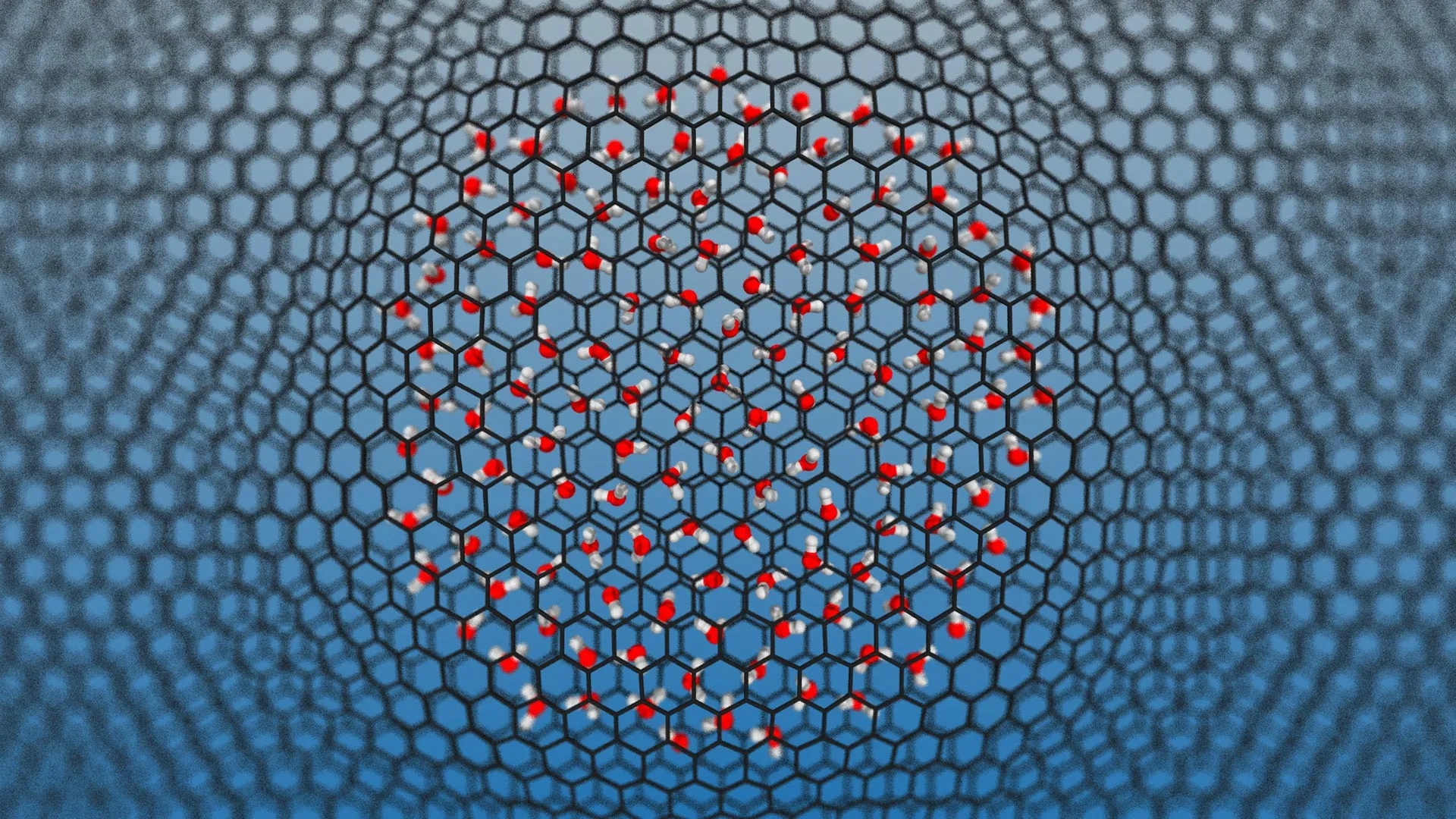
The team examined water trapped between sheets of graphene and hexagonal boron nitride (hBN). Although both materials are only one atom thick and share a similar structure, their surface chemistry is very different.

The simulations also revealed that water droplets confined between these materials experience extremely high internal pressures. Water trapped between graphene or hBN sheets can reach pressures of several gigapascals, similar to those found deep inside Earth, even though no external force is applied.

Instead, the pressure develops naturally because of van der Waals attraction between the atomically thin layers. While the force between individual atoms is weak, it becomes remarkably strong across the large surface area of two dimensional materials, pulling the sheets together and compressing the water trapped between them.

Pressure, Not Confinement, Drives Water Reactivity

The researchers found that these intense pressures greatly increase the splitting of water molecules.

However, when they compared confined water with ordinary bulk water exposed to the same pressure, both behaved in essentially the same way. This showed that the increased reactivity comes primarily from pressure itself rather than confinement alone.

“What surprised us most was how much of the apparent confinement effect could be explained by thermodynamics. Once pressure and chemical potential are properly accounted for, a great deal of the complexity simply falls into place,” said Prof Angelos Michaelides, of the Yusuf Hamied Department of Chemistry at the University of Cambridge.

Surface Chemistry Still Plays an Important Role

Although simply squeezing water into tiny spaces does not inherently make it more reactive, the surrounding material can still influence its chemistry.

In water droplets confined by hBN, hydroxide ions (OH ) that formed around the edges bonded chemically with the surrounding material. This stabilized the ions, lowered the energy required for water to split, and increased the amount of dissociation.

The same effect was not observed with graphene because its chemically inert surface does not participate in the reaction.

The results show that the material surrounding confined water can actively shape its chemical behavior.

“This research provides a new framework for understanding water chemistry at the nanoscale and helps reconcile a decade of apparently conflicting studies,” said Dr. Christoph Schran, of the Theory of Condensed Matter Group at the Cavendish Laboratory.

“More importantly, the work offers a practical design principle for engineering nanoscale chemical environments. Rather than focusing solely on the size of pores or channels, we can tailor water reactivity by choosing a confining material whose surfaces interact with the products of water dissociation and by controlling the pressures generated within confined spaces.”

Potential Applications in Energy Technology

The findings could have important implications for technologies that depend on confined water, including hydrogen fuel cells, batteries, ion selective membranes, and catalytic systems.

Next, the researchers plan to study more realistic environments that include defects and edges commonly found in practical materials. They also hope to compare their predictions with laboratory measurements using advanced spectroscopic and nanofluidic techniques.

At the same time, the team is screening large families of two dimensional materials and surface chemistries to identify combinations that can either enhance or suppress water reactivity for specific technological applications.

Share Button

Scientists create quantum sound device that could transform communications

Researchers at McGill University have developed a new quantum device that generates tiny sound-like particles called phonons at temperatures just above absolute zero. The advance could help pave the way for phonon lasers, a technology with potential uses in communications, medical diagnostics, and advanced sensing.

“Modern communication is largely based on light, including electromagnetic waves and electrical currents. In a medium such as oceans, sound can travel, whereas light and electrical currents cannot,” said Michael Hilke, Associate Professor of Physics and study co-author. “In the human body, sound waves can also be a useful tool.”

The device was designed and tested by researchers at McGill University and the National Research Council of Canada, while the material used in the device was synthesized at Princeton University.

How Fast Electrons Produce Quantum Sound

The team created the device using a two-dimensional crystal that confines electrons to a channel only a few atoms wide. When an electrical current pushes the electrons through this ultra-thin pathway at high speeds, the electrons release their excess energy as bursts of sound-like vibrations known as phonons.

The researchers found that these phonons can be generated in predictable, controllable patterns, an important step toward practical devices that rely on precisely manipulating sound at the quantum level.

Cooling Unlocks Unusual Quantum Behavior

The experiments were carried out at temperatures ranging from about 10 milli-Kelvin to 3.9 Kelvin. At these extremely low temperatures, electrons behave in a much more orderly way, making it easier to observe quantum phenomena, where matter acts like waves rather than ordinary particles.

“At absolute zero temperatures – that is, the world of quantum physics – no sound is created unless electrons travel collectively at the speed of sound or above,” Hilke explained. “Earlier work had observed related effects as electron speeds approached the sound barrier. Our study goes further by pushing the system well beyond that point and showing that existing theories need to be reassessed by considering that electrons can be very hot even if the host crystal is close to absolute zero temperature.”

Toward Faster Communications and Medical Technologies

The next phase of the research will investigate building the device from other materials, including graphene, which could allow it to operate at even higher speeds.

According to Hilke, future versions of the technology could contribute to faster communication systems, more sensitive detection tools, improved methods for studying biological materials, and advanced medical technologies.

“Phonons are hard to generate and harness in a controlled way, so we are exploring new regimes. At a broad level, this is about how electrical current and energy moves and is converted inside advanced electronic materials,” he said.

Study Details

The findings were published in Physical Review Letters in a paper titled “Resonant magnetophonon emission by supersonic electrons in ultrahigh-mobility two-dimensional systems,” by Michael Hilke et al.

The research was funded by the Natural Sciences and Engineering Research Council of Canada and the Fonds de recherche du Québec — Nature et technologie.

Share Button

Great ape laughter reveals a hidden origin of human speech

A new study from the University of Warwick suggests that the rhythm of human laughter has remained surprisingly consistent for at least 15 million years. By comparing the laughter of humans and other great apes, researchers uncovered evidence that this ancient vocal pattern may offer valuable clues about how human speech gradually evolved.

Humans are not the only primates that laugh. Chimpanzees, bonobos, gorillas, and orangutans all produce laughter, but scientists have long wondered how those vocalizations changed over millions of years and whether they could reveal anything about the origins of human language.

To investigate, researchers analyzed laughter recordings from four orangutans, two gorillas, three bonobos, four chimpanzees, and four humans. Their study, published in Communications Biology, examined 140 separate laughter sequences.

Despite the differences between species, the team found a striking similarity. Every species produced laughter with evenly spaced rhythmic intervals between successive sounds.

The researchers believe this shared rhythmic pattern originated in a common ancestor that lived around 15 million years ago. They propose that the basic structure has remained remarkably stable throughout the evolution of all living great apes.

Dr. Chiara De Gregorio, Honorary Research Associate, Department of Psychology, University of Warwick said: “How did humans evolve the remarkable ability to speak? Speech leaves no fossils, and complex language exists only in our own species. But we’ve found a 15-million-year-old clue in an unexpected place: our laughter. Unlike speech, laughter is shared by all living great apes. By comparing how different species laugh, we can see that a basic rhythmic structure has remained unchanged since our last common ancestor. That’s extraordinary.”

Human Laughter Became More Flexible

Although the underlying rhythm appears to have stayed the same, human laughter has become faster, more varied, and far more adaptable than that of other great apes.

People can consciously adjust when and how they laugh depending on the situation. A spontaneous laugh triggered by tickling differs from a polite laugh during a meeting, a nervous laugh after making a mistake, or contagious laughter shared among friends. While each serves a different social purpose, they all retain the same basic rhythmic foundation.

According to the researchers, this growing ability to control vocal timing likely developed gradually over the course of great ape evolution. That increasing level of vocal control, including over laughter, may have provided one of the essential building blocks that eventually made human speech possible.

A Window Into the Evolution of Speech

Because spoken language leaves no direct fossil evidence, scientists have few ways to trace its earliest origins. Laughter, however, is evolutionarily much older than speech and remains common to every living great ape, making it a rare opportunity to study how vocal communication evolved.

Dr. Adriano Lameria, Associate Professor, ApeTank, Department of Psychology, University of Warwick said: “It is impossible to assess the precursor forms of language directly from our extinct ancestors. Laughter, being evolutionarily older and having remained shared between all living great apes, provides a rare evolutionary window into the vocal transformations that unfolded across hominid evolution until the first humans appeared on scene. Contrary to the classic notion that the first humans suddenly acquired vocal control capacities remarkably different from their predecessors, laughter evolution tells us that humans lay on a continuum, a prolongation of vocal control capacities that were already being cumulatively honed in for 15 million years.”

Share Button

This Smudge-Proof Eye-Liner ‘Glides On, Even Over My Wrinkled Eyelids’ — And It’s Still At Its Prime Day Price

Last week, Urban Decay’s 24/7 Glide-On waterproof eyeliner pencil was a Prime Day smash with HuffPost readers. Made with Vitamin E and jojoba oil, it applies “smooth as butter,” even over mature and textured skin, before drying into a smudge-proof liner that will last all day. Reviewers in their 60s and 70s love the stick for being “very soft on old eyelids,” gliding over wrinkles without “overemphasizing” or bleeding into fine lines. While it’s typically a luxury product, it’s still on sale with its Prime Day 40% off discount, at Amazon and Ulta, making it closer to a drugstore buy than the luxury eyeliner it truly is.

A modern take on a classic favorite, this blendable stick comes in tons of colors and can be used in oh, so many ways…

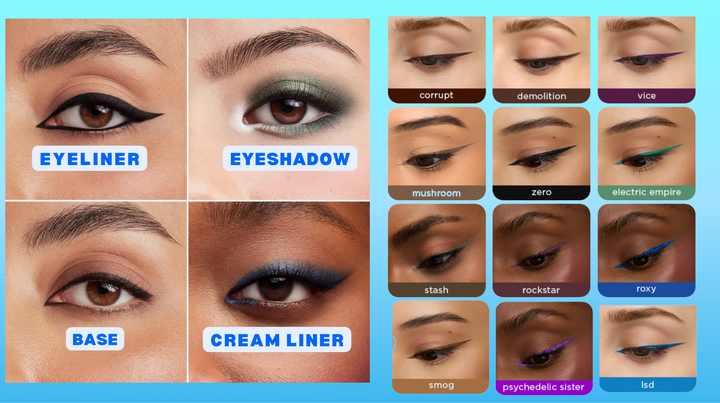
Don’t be fooled by its straightforward packaging; this eyeliner pencil is versatile. You can find it in dozens of colors, from neutrals to neons, and apply it as a traditional eyeliner, a cream liner or even an eyeshadow. The huge color selection is ideal for creative looks and everyday glam alike, offering hues for all sorts of tones and tastes.

“I use the smoke gray because the black is too dark for my 65+ years,” shopper Sharon wrote. “Bourbon is a stunning deep brown with subtle warm undertones,” another said. “Softer and more versatile than black but still bold enough to define your eyes.” Many love the shade Rockstar, a dark matte purple, for adding “depth without looking harsh.”

Shoppers celebrate how creamy the formula is, giving superior pigmentation and staying power without feeling chalky or dry.

The formula is designed to go on smoothly, giving you time to blend and adjust as needed. But, “once it sets, it stays put,” Cris writes, not fading or transferring through the day. “It truly glides on…no tugging, no skipping, no fighting with a dry pencil that gives up halfway through your lash line,” they added. “The texture feels more like a beautiful gel in pencil form, and the color payoff is rich and deep from the first swipe…If you’re tired of eyeliners that dry out, drag, or crumble, this one is such a relief to use.”

“Gorgeousss, slides perfectly and doesn’t smudge easily,” Maya wrote. “I have so many black eyeliners, and I’m really picky, this one is one of my favs.”

And it’s LOVED by reviewers with mature skin.

Another selling point for this 40% off stick — it’s a dream to use over wrinkles or texture. A 60-year-old reviewer calls it “the Goldilocks of eye pencils,” for how easily it applies to so many skin types.

“I’ve tried so many different eyeliners suggested for mature eyes & this one so far has been the best,” shopper Vickie said. “It goes on fairly smooth considering I’m 75 & the skin on my eyelids isn’t smooth.”

Others agree the product “goes smoothly over my wrinkle lines,” “lasts well without smearing,” and “was easy to put on under glasses.” “Pushing 60 and this works great on old tired skin,” Donna wrote. “This liner is so soft and smooth on my eyelids,” another 68-year-old reviewer said. “I wish that I had found this years ago! I love the color!!”

Reviewers love this hydrating eyeliner pencil for gliding on with ease and staying on all day. Read more 5-star Amazon reviews and grab one for its Prime Day price of 40% off.

“Best and most pigmented eyeliner ever! I absolutely L❤️VE the variety of colors and it goes on as smooth as butter. I’ve been a customer for years and I will continue to be a customer.” — MRJax1968

“I’ve used [the shade] Rockstar for years and turned other green eyed people on to it. It stays on, isn’t too harsh on my 60 year old eyelids or anyone else’s and is the Goldilocks of eye pencils. I know the color recommend chart doesn’t point green eyes people to it, but I promise it’s perfect ! Not weird, classy and easy to work with.” — Joni K.

I’m a 68 year old woman. This liner is so soft and smooth on my eyelids! I wish that I had found this years ago! I love the color!!” — LuAnn Principe

“An Eyeliner That Acts Like a Gel, Not Chalk. This eyeliner is exactly what I’ve been missing. It truly glides on…no tugging, no skipping, no fighting with a dry pencil that gives up halfway through your lash line. The texture feels more like a beautiful gel in pencil form, and the color payoff is rich and deep from the first swipe. The shade Rockstar is a gorgeous dark purple that adds depth without looking harsh, and it applies smoothly and evenly every time. If you’re tired of eyeliners that dry out, drag, or crumble, this one is such a relief to use. Once it sets, it stays put. You have just enough time to smudge if you want a softer look, but after that it locks in and lasts all day without transferring or fading. It’s comfortable to wear and doesn’t feel dry on the lash line, which I really appreciate. It’s creamy, intensely pigmented, and easy to apply — a perfect option if you want long-wearing color without the chalky struggle.” — Cris Hidalgo

“I’ve tried so many different eyeliners suggested for mature eyes & this one so far has been the best. It goes on fairly smooth considering I’m 75 & the skin on my eyelids isn’t smooth. Overall I like it very much.

Update: After using it for this month, yes, I’m loving it still. Had a problem figuring out how to sharpen it but found the NYX sharpener works great. Much less expensive than the one from Urban Decay, which, by the way, isn’t available on Amazon. Wonder why not?” — Vickie

Or maybe you want eyeliners for mature skin for under $10? Yup, we have a list for that too. Check out these favs loved by reviewers with mature skin, courtesy of HuffPost Shopping.

Nordstrom

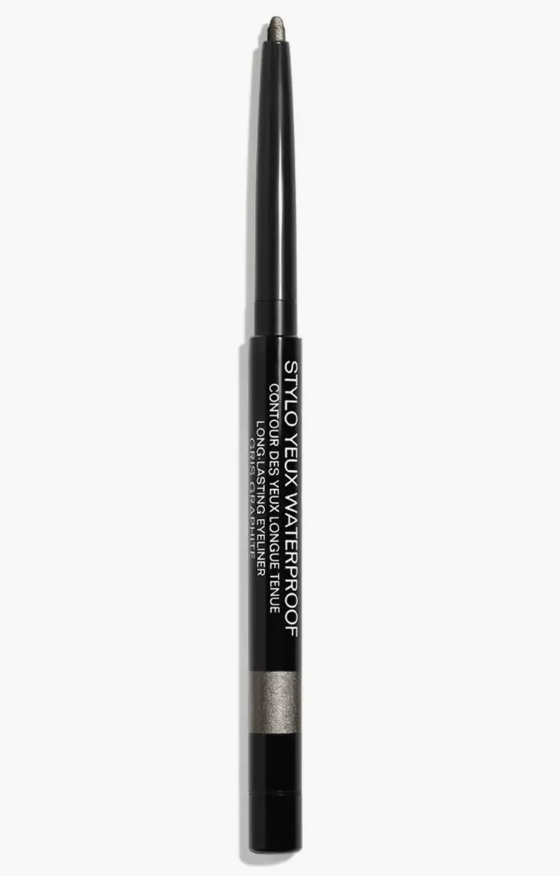
Best luxury brown: Chanel waterproof long-lasting eyeliner

A little softer than a black liner while still being eye-catching, this waterproof, smudge-proof liner is resistant to water, humidity and oil. It has a an easy-twist compartment with a retractable tip that’s not strenuous to put on and will help the product stay in play. Reviewers say the product is soft and easy to apply on mature skin without being super smudgy.

Promising reviews: “I purchased the 20-Espresso color to replace the one I have been using. As a mature woman, black is not for me. The espresso is easily applied and stays in place. It is dark enough without being stark, like the black color. The one it is replacing seemed to last quite a long time, probably 3 months at least. I recommend this product and color whether you are mature or just wanting a change of pace black.” — sasaru

“This eyeliner in ANY color should be a staple in your makeup drawer. I was a HUGE sceptic of CHANEL products but I switched because my skin has become more “mature” wow, nothing disappoints, especially the eyeliner, I bought in black, blue, and this rose color. Wow, perfect for summer! I Am olive complexion.” — MUST TRY

I am over 70 so I tried espresso color. Easy to apply and not as stark as pure black. It lasts all day and no smudging. Worth the price for this quality product.” — CCCS

Amazon

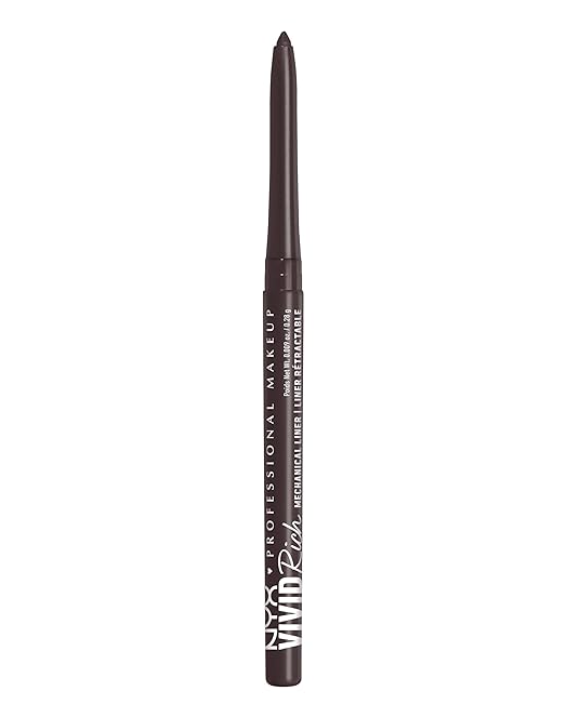
Best drugstore brown: NYX vivid rich mechanical eye pencil

With the glide of a liquid formula with the ease and precision of a stick, this twisting retractable pen is creamy and long-lasting. Heat and humidity-proof, it won’t bleed as you’re wearing it, giving you definition for hours on end.

Promising review: “The color is soft and rich. It glides on smoothly. I’m 70 years old but it’s easy to control the fine tip. The color is beautiful for an older woman. I highly recommend this color and this pencil.” — LB

“I have been wearing eyeliner since I was a teenager and I can say with 100% confidence that this is by far the best eyeliner I have ever used. I’m a pencil girl so I can’t speak much about liquid. But this goes on really nice and doesn’t pull or tear at my aging skin. It lasts all day under normal conditions and has stayed on for hours in the water. Love the bronze color with the tiny sparkles. It’s the only liner ibhave purchased in several years now. And the price… FAHGEDABOUDIT! 5 STARS across the board.” — Vanessa L. Knight

Amazon

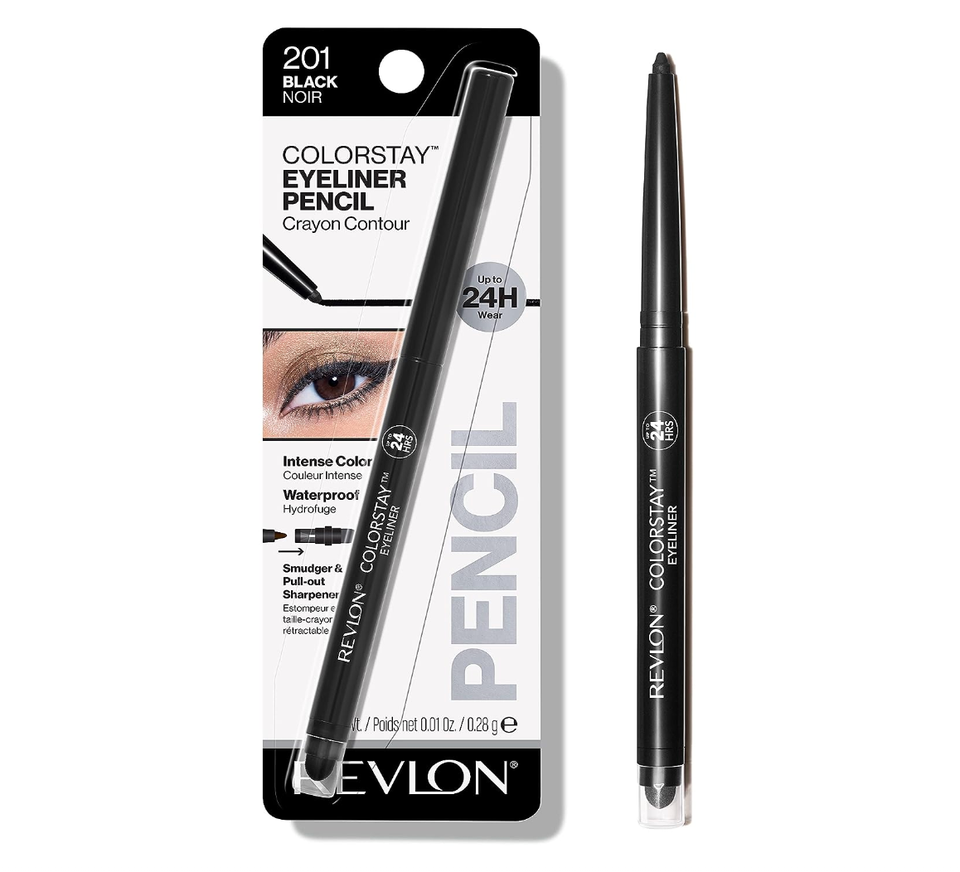
Best waterproof: Revlon pencil eyeliner

Another drug store classic that has earned plenty of praise, the Revlon Colorstay eyeliner has a built-in sharpener and smuger at the bottom to make your life even easier. It’s waterproof, creamy, easily drapes over your skin and lasts for up to 24 hours.

Promising review: “I’m old and have crepey skin everywhere including around my eyes. I needed a soft pencil as powder shadows were irritating my eyes. This pencil does the trick. It’s not smudge proof or water resistant, but I don’t care about that.” — M

“I originally purchased at Target/Walmart but found a better deal here on Amazon. I wear department store cosmetics, but none of the pencil liners compare to this one – this one really stays and does not smudge. I’ve recommended it to many of my friends who ask how my liner stays on so nicely. It’s easy to apply, and comes off easily with my face wash, but you don’t get creases and it doesn’t bleed into crows feet. Hope they never stop making this because I tried all the expensive and drug store pencils. Goes on like liner, but is a pencil with a smudger on one end.” — GOLDEN GIRL

The Real Deal: We use deal trackers and commerce experience to sift through “fake” hike-and-drop deals and other deceptive sales tactics. Products will usually be rated at least 4 stars with a minimum 15% discount. (And when there’s an exception, we’ll tell you why.)

Share Button

The Internet Won’t Let Jimmy Fallon Forget His Conor McGregor Interview

Content note: the following contains sexually violent details.

The host of The Tonight Show brought McGregor on as a guest to discuss his return to UFC.

This comes two years after the fighter was found liable by 12 jurors in a civil case after Nikita Hand accused him of raping her in a Dublin hotel back in 2018.

He was ordered to pay £206,000 in damages, though McGregor denies that he raped Hand, saying they had “fully consensual sex”.

Before the civil case, Ireland’s Director of Public Prosecutions made the decision not to bring criminal charges to McGregor due to insufficient evidence. Two later appeals were dismissed.

Now, fans have noticed that no clips of the McGregor interview have appeared on Fallon’s Instagram page, even though it took place days ago.

A comment under the talk show host’s Instagram clip, which showed his interview with Beatles star Sir Paul McCartney, reads: “Don’t want to post McGregor @jimmyfallon? Why not?”

It has racked up over 13,000 likes as of the time of writing.

In fact, the entire comment section under the McCartney video is filled with references to the McGregor appearance.

“Rehabilitating McGregor. I hope you’re proud of yourself,” a comment reads.

“Jimmy Fallon supports [grape emoji]ists [calling someone a “grapist” is a way of alluding to rapists online] and then hides behind other guests when called out,” another said.

Still more simply wrote Nikita Hand’s name over and over.

Similar responses have been shared under his more recent Trump, “password” game, and Milly Alcock videos on social media.

“I’m struggling to find the clips of the predator on @jimmyfallon Was it deleted? It should be acknowledged and there should be an apology!” an Instagram user opined under his most recent Instagram upload.

Others say they used to be fans but have changed their mind since the McGregor interview.

“We loved you. We thought you were one of the good ones,” a former fan said.

Comments also included the mention of tampons – “Tampon. Surgically. Removed,” one reads.

During the 2024 trial, gynaecologist and forensic examiner, Dr Daniel Kane, said he had had to remove Hand’s “wedged” tampon with forceps.

HuffPost UK has reached out to The Tonight Show Starring Jimmy Fallon for comment.

Help and support:

Share Button

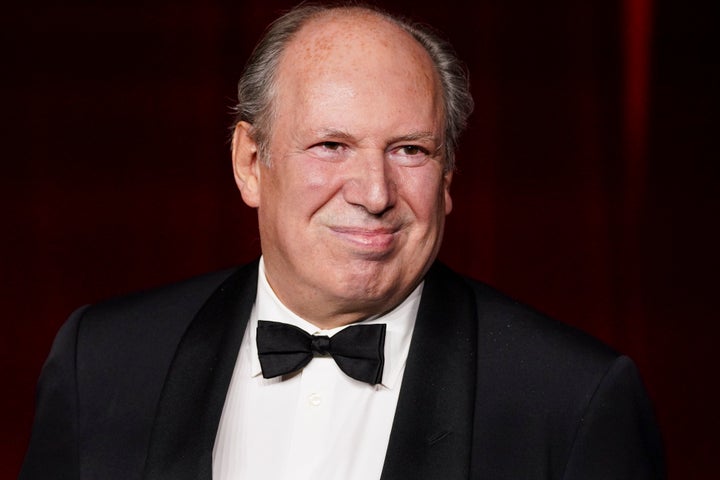
Hans Zimmer Almost Never Scored The Lion King — Until He Spoke To His Daughter

I’m going to be honest – I didn’t even realise the legendary composer Hans Zimmer was behind The Lion King’s famous soundtrack until I heard him talk about it on Classic FM.

Not only did he work on the 1994 classic, but he actually won an Academy Award for Best Original Score (alongside two Grammies and a Golden Globe) for his contribution.

Still, he shared on Classic FM that he had been reluctant to take the role at first.

“I didn’t want to do Lion King, you know, cartoons – why am I doing cartoons?” he recalled.

Hans Zimmer
Hans Zimmer

via Associated Press

Until 1994, the composer’s work had appeared in live-action classics like Thelma & Louise, Rain Man, A World Apart and Driving Miss Daisy.

“And, oh my God, they might turn [the songs] into musicals. I don’t really like musicals,” the film legend said he thought at the time.

However, Zimmer changed his mind because his daughter, who was six at the time, had never been able to go with him to the premiere of any of the movies he’d worked on, because “all the movies with Ridley Scott are not necessarily child-friendly”.

So he agreed to make the film – but when he sat down to write, more family matters came up for Zimmer.

“My dad died when I was six years old, and here I am sitting in front of this cartoon, and it’s about the death of a father – with fart jokes, admittedly,” he revealed.

“And I realise… it’s a complete lie that children get over this stuff. They don’t get over it, they just find out really clever ways of hiding this stuff.”

The composer shared he couldn’t “hide” his feelings anymore, and “I basically wrote a requiem for my dad, and it became a really serious piece.”

That made it “deeper than your normal cartoon,” both for him and The Lion King’s viewers.

Zimmer has since been credited in mutliple other Disney titles (including Pirates Of The Caribbean, and, perhaps even more surprisingly still, Muppet Treasure Island).

Share Button

Experts Explain Why You Sneeze When You Walk Outside

I don’t have hay fever, but based on how I react to walking outside on a hot day, I’d forgive you for believing I do.

For some reason, getting off the train into the sun, opening my door onto a ray-soaked street, and even leaving a tree’s shadow into a bright spot triggers a huge, eye-watering sneeze – and until now, I had no idea why.

But it turns out it might be my genes, per the Cleveland Clinic.

It sounds like I’m experiencing a “photic sneeze reflex,” also known as “autosomal dominant compelling helio-ophthalmic outburst syndrome” (ACHOO syndrome – teehee).

What is a “photic sneeze reflex” or ACHOO syndrome?

An extract from Medical Genetics Summaries says that “Affected individuals report a ‘prickling sensation’ or sneezing in response to a bright light.”

It’s elicited by going from a darker area to an area of brighter light (like stepping into sunlight from indoors), or simply having a bright light shown to you.

This can be “uncontrollable.”

How common is it to sneeze at bright lights?

“About one in four individuals who already have a prickling sensation in their nose will sneeze in response to sunlight, but ‘pure’ photic sneezing is far less common,” Medical Genetics Summaries shared.

If one parent has the condition, their child has a 50% chance of developing it.

But the Cleveland Clinic says we don’t know exactly how many people have the condition.

On average, they add, it seems to be about 15-30% of us: white people, especially white women, may be more likely to have the trait.

What causes sneezing on exposure to bright lights?

It’s a genetic issue, but we don’t know yet which genes are responsible.

It happens because of a misfiring in a facial nerve that goes from your eyes to your nose. The constriction of your pupils as your eyes adjust to the light triggers the sneeze.

Is sneezing at bright lights dangerous?

It can be if you’re operating heavy machinery or driving: “for example, exiting a road tunnel on a bright day.”

Pilots might need to be more cautious, too.

How can I stop sneezing at bright lights?

There’s no cure for ACHOO syndrome, but you can make the journey from darker spots into lighter areas easier on the eyes.

Shielding your eyes with a hat or sunglasses might help.

And the Cleveland Clinic recommends we “Use the ‘transverse philtral pressure technique,’ which involves applying pressure to the area between your nose and your lips.

“If you’re doing it right, it should look like you’re giving yourself a moustache with your finger,” they said. This may interrupt the sneezing signal.

I’m learning so much more about myself than I expected today…

Share Button