HuffPost is part of Oath. Oath and our partners need your consent to access your device and use your data (including location) to understand your interests, and provide and measure personalised ads. Oath will also provide you with personalised ads on partner products. Learn more.
How Oath and our partners bring you better ad experiences
To give you a better overall experience, we want to provide relevant ads that are more useful to you. For example, when you search for a film, we use your search information and location to show the most relevant cinemas near you. We also use this information to show you ads for similar films you may like in the future. Like Oath, our partners may also show you ads that they think match your interests.
HuffPost is part of Oath. Oath and our partners need your consent to access your device and use your data (including location) to understand your interests, and provide and measure personalised ads. Oath will also provide you with personalised ads on partner products. Learn more.
How Oath and our partners bring you better ad experiences
To give you a better overall experience, we want to provide relevant ads that are more useful to you. For example, when you search for a film, we use your search information and location to show the most relevant cinemas near you. We also use this information to show you ads for similar films you may like in the future. Like Oath, our partners may also show you ads that they think match your interests.
HuffPost is part of Oath. Oath and our partners need your consent to access your device and use your data (including location) to understand your interests, and provide and measure personalised ads. Oath will also provide you with personalised ads on partner products. Learn more.
How Oath and our partners bring you better ad experiences
To give you a better overall experience, we want to provide relevant ads that are more useful to you. For example, when you search for a film, we use your search information and location to show the most relevant cinemas near you. We also use this information to show you ads for similar films you may like in the future. Like Oath, our partners may also show you ads that they think match your interests.
HuffPost is part of Oath. Oath and our partners need your consent to access your device and use your data (including location) to understand your interests, and provide and measure personalised ads. Oath will also provide you with personalised ads on partner products. Learn more.
How Oath and our partners bring you better ad experiences
To give you a better overall experience, we want to provide relevant ads that are more useful to you. For example, when you search for a film, we use your search information and location to show the most relevant cinemas near you. We also use this information to show you ads for similar films you may like in the future. Like Oath, our partners may also show you ads that they think match your interests.
If you often find yourself rebelling against your own goals, your goals aren’t rebellious and edgy enough for you.
You’re trying to set goals like everyone else, but you’re not like everyone else, so stop trying to fit in. Start setting goals that you’re not allowed to set. Turn your rebelliousness into motivational fuel by setting goals that are edgy and rebellious to begin with. Otherwise you may find your goals way too boring and unmotivating, and you’ll eventually quit.
Do you give yourself enough latitude to explore rebellious or edgy goals?
Even though some of the stuff I did when I was younger was a bit crazy, I often found edgy goals easier to achieve because they were so much fun.
Here are some simple rebellious goals I achieved during the early 1990s:
Steal every bottle of White-Out from the UC Berkeley student store in one day (many dozens of bottles).
Steal a $40 ping pong paddle from a locked cabinet of a sporting goods store.
Go out for a day of shoplifting with a friend till we filled the back of his pickup truck with stolen appliances. (We ended up filling much of the cab too, even having large boxes on our laps as we drove back.)
Find a way to consistently steal items with sensors on them.
Learn to count cards at BlackJack and play in the casinos in Vegas, including getting all of my meals comped.
I kept running into a conflict whereby someone would punish my edgy fun and try to set me straight, including four arrests. What gives?
Eventually I’d had enough punishment and tried to straighten myself out. But that didn’t work either. I felt like a shell of myself. Trying to make meaningful progress in life felt like pushing through molasses. Without sufficient edginess I couldn’t stay consistently motivated. There would have to be extreme time pressure and some kind of threat for me to get much done, and even then I couldn’t always motivate myself to push through.
If you’re the type of person who got into trouble when you were younger, always getting punished for this and that, why are you trying to play it straight today? If you struggle to achieve relatively straightforward goals, perhaps you’re not the kind of person who can play it straight and expect to succeed. Perhaps you’re too much of a rebel for that strategy to work.
The key breakthrough was when I asked a simple question:
What can I do that feels edgy, rebellious, and fun but isn’t illegal?
What might be against the rules? What might push some boundaries? What would have some element of risk?
I figured there must be some interesting goals I could pursue that would feel edgy but still be legal. I could still break some rules and have fun doing so.
Eventually this led me to achieve some goals that felt edgy but weren’t illegal, such as:
Graduate from college in 1.5 years instead of 4 years
Retain my freedom, and never be anyone’s employee again after graduating college
Turn blogging into a viable business, starting at a time when most people didn’t know what blogging was, and those that did mostly thought of it as personal journaling with no viable business model
Knowing how to set edgy goals served me well, and to this day I still love projects and pursuits that feel edgy to me. If there’s no edge, then what’s the point of doing them?
Here are some more recent accomplishments from the past few years, all of which had an element of edginess to them:
Create and launch an online club where members encourage each other to step up their ambition and their heart-alignment
Do a 40-day water fast while making daily YouTube videos of the experience
Create a highly original 60-day audio program in 60 days about a different way of relating to life, the universe, and everything.
Do a six-in-seven (earn $100K+ in 7 days or less)
Marry a delicious Canadian, and import her permanently 😉
If I try to set and achieve a “normal person” goal, the goal will suffocate me. And if you’re reading my blog right now, I seriously doubt that you’re a normal person either.
If a normal person would look at your goals and think they’re cool, that isn’t cool at all. A normal person should look at your goals and exclaim, “The horror! The horror!”
If no one thinks that your goals are too edgy or too rebellious or just plain weird, you’re playing the game of life without enough risk and fun.
Consider this standard: A good goal for you will torment a normal person.
Stop being so damned obedient all the time.
Where’s the fire?
If your current goals aren’t inspiring you, take the old goal list and burn it.
When you have a good goal, the goal ignites you like a match lighting a torch, and that torch keep burning long enough to drive that goal across the finish line. If you keep feeling that you must push yourself with low motivation, your goal probably sucks. Throw out that goal – just give up – and set a goal that has more fire in it. Stop going for security, and go for character growth instead.
People think that risk is a bad thing that they should avoid. So they often set goals that they could easily achieve if they were motivated enough. And then ironically they can’t feel motivated enough.
Look at your goals and ask which ones you could easily achieve if you were 100% motivated to achieve them, all day every day, until you crossed the finish line. If you realize you could definitely achieve every goal by that standard – that the only think stopping you is putting in the time and having enough motivation to keep taking consistent action – I suggest that’s a weak goal. It means there isn’t much character growth and edginess in the pursuit.
Instead, set goals that even if you were 100% motivated to achieve, you’re still not sure how you’re going to pull off that goal. In order to achieve the goal even with sky high motivation, you’re still going to have to stretch yourself, such as by developing new skills, new strategies, and new connections. You’re going to have to expand your previous limitations in order to achieve the goal.
The fire comes from knowing that even if you do your absolute best with daily perfect motivation, you may still fail. Success isn’t guaranteed. Just to have a shot at success, you have to do your best and then some.
Even if you don’t always succeed in achieving such goals, the experience of feeling ignited is so much more fun that trying to be normal.
As you work on an edgy goal, you grow as a person, and that growth is immensely rewarding. That’s the real treasure to be found. The goal is like a MacGuffin in a story – a plot device. The goal exists to help drive the story forward, but the story of how the goal is achieved is often a lot more interesting than the final achievement of the goal.
Perhaps it’s time to make a new list of goals for yourself. Bring the edginess back. Set goals that are against the rules. Set goals that people will tell you that you’re crazy to pursue. Set goals that no one else would care about but you. Set goals that look scary but also like they’d be a hell of a lot of fun. Set goals that you’re not sure you can achieve even if you had 100% consistent motivation to pursue them. Set goals that would torment a normal person.
HuffPost is part of Oath. Oath and our partners need your consent to access your device and use your data (including location) to understand your interests, and provide and measure personalised ads. Oath will also provide you with personalised ads on partner products. Learn more.
How Oath and our partners bring you better ad experiences
To give you a better overall experience, we want to provide relevant ads that are more useful to you. For example, when you search for a film, we use your search information and location to show the most relevant cinemas near you. We also use this information to show you ads for similar films you may like in the future. Like Oath, our partners may also show you ads that they think match your interests.
Many people fail with 30-day challenges, usually not making it past the first week. And the #1 reason for failure is that they didn’t make a crystal clear commitment to do a specific activity for all 30 days.
Giving your mind a clear enough commitment is a key to success with 30-day challenges. Committing to 5 minutes per day of a specific activity in a specific location at a specific time of day is usually a lot more effective than a vague commitment to “do some exercise” each day.
A clear commitment is binary. Either you did it or you didn’t. There’s little or no wiggle room to give yourself credit for non-compliance.
If you say you’re going to “exercise for 30 days in a row” then does walking count? What about cleaning? Decluttering? Grocery shopping? If you racked up some credits on your Apple Watch for moving a bit, will you count that as your exercise for the day? If you were to ask 10 different people if you’ve successfully completed your challenge for the day, would they always agree? If it’s not certain that every reasonable person would agree, your challenge definition is probably unclear.
If your definition of success is vague, it’s almost a given that you’ll see your standards slip as you go, and within a week or two, your 30-day challenge will have faded completely. Then you’ll beat yourself up for not being disciplined enough.
Lots of people have never completed even one 30-day challenge. And they think it’s due to a lack of discipline. It often is, but not in the way you might think.
When I do a 30-day challenge, most of the discipline happens before Day 1. It’s the mental discipline to clearly decide on the parameters and make a real decision to do the challenge. I get myself to the point of being all-in before I start. The discipline happens in the pre-challenge setup work. This may also include enlisting social support and clearing out any naysaying influences. If I’ve decided to do the challenge, I’ll do it, but my brain needs to understand the nature of the commitment before I feel like I’m all-in. I need to set myself up to succeed in advance. If I don’t frame the challenge properly, I’ll fail at it just like everyone else.
I also understand the long-term importance of nailing these challenges. If I get good at them, I can leverage these challenges to kick off many new explorations, build new skills, create new habits, and more. The long-term payoffs for success are huge. For instance, I’ve been vegan for 22+ years because I started with a challenge to go vegan for just 30 days. Similarly, if you keep stringing yourself along with one failed challenge after another, you’re setting yourself up for decades of disappointment. So if you’re going to do these, stop kicking your ass on Day 10 when you realize you’ve already quit. And pre-kick your ass 10X harder before you even begin Day 1.
When you’re doing a 30-day challenge, honoring your commitment has to be one of the most important parts of your life. If you keep stringing yourself along with failure after failure, you’re hurting your future self.
When people succeed with a 30-day challenge, the success happened mentally and emotionally before Day 1 even started. There’s usually clear evidence that a real commitment has been made. It’s the difference between telling a friend “let’s get together sometime” versus agreeing to meet at a specific time and place and being absolutely certain that you’re going to show up.
Think of it like a legal contract. You want the details of the agreement with yourself to match the overall intention. A contract that merely says “let’s agree to do some stuff this month” is likely to go nowhere. Same goes for a B.S. declaration like “work on my social skills” or “improve my productivity.” If your intention is so vague that I can’t accurately predict what you’ll be doing each day, you probably won’t make it past the first week.
Write down your 30-day commitment before you begin. Then rate it on a 1-10 scale, where a 1 is super vague like “improve my finances,” and a 10 is clear language suitable for a legal contract. In my experience most people won’t score higher than a 3 with this rating. They’ve set themselves up to flake in advance, just the way any flake would: Let’s get together sometime. Sure, let’s do that.
At least 80% of success with a 30-day challenge happens before Day 1. Did you fully commit to a clear and specific activity? Was it defined well enough that a lawyer would approve of the clarity and specificity?
Sometimes I need to play it safe when a challenge can be risky, and I give myself an out if I think I need it. I did that with the water fasting challenge. It didn’t feel safe to 100% commit to many days with no food, so I made a list of potential problems to familiarize myself with the danger signs, and I gave myself room to quit if I perceived that my health was at risk. I had no significant problems though and ended up going for 40 days. A legal contract can have these kinds of exemptions too. So it’s fine to practice risk management when there are practical risks to consider.
When you gain enough experience with these challenges, and you can trust that your internal standards will be high enough, you can sometimes use a more vague definition and get away with it. But even so, it’s still usually better to be specific.
Think of your contract with yourself as the floor (not the ceiling) of what you’re going to do. You can always outperform the specs of a contract. But when you have a rough day, you may sometimes do only the minimum, so make sure that minimum is good enough to satisfy you and get some decent results. You can do more when you’re feeling up to it.
Whenever you attempt to make a change in your life patterns, some part of your brain is going to resist. It expects the old patterns to continue, and it freaks out a bit when the input changes. That’s normal. But you’d better be aware of the existence of this part of yourself, and you need to intelligently compensate for it. A good way to do that is with a clear commitment that’s fully understood. This helps your brain get into sync with the new expectations before you begin. If those expectations are fuzzy, your brain won’t successfully get past this freakout period, and it will use whatever wiggle room you permit it to pull back to your old reality, even if that reality wasn’t serving you well.
When you fail at a 30-day challenge, there’s a reason for it. For most people that reason for failure could have been spotted at the start of Day 1: the lack of a clear and committed decision. They flaked on the challenge before it even started, and there’s little chance of making it past the first week. They didn’t do what it took to succeed in advance.
Actually doing a 30-day challenge tends to be very rewarding, motivating, and fun – if you’ve set it up correctly. The discipline required to complete such a challenge isn’t as much as it seems – again, if you’ve set it up correctly.
My favorite 30-day challenges have been those that introduced me to new modes of living. They expanded my possibility space. They permanently shifted my relationship with reality. Some are still paying dividends years or even decades after I did them.
HuffPost is part of Oath. Oath and our partners need your consent to access your device and use your data (including location) to understand your interests, and provide and measure personalised ads. Oath will also provide you with personalised ads on partner products. Learn more.
How Oath and our partners bring you better ad experiences
To give you a better overall experience, we want to provide relevant ads that are more useful to you. For example, when you search for a film, we use your search information and location to show the most relevant cinemas near you. We also use this information to show you ads for similar films you may like in the future. Like Oath, our partners may also show you ads that they think match your interests.
HuffPost is part of Oath. Oath and our partners need your consent to access your device and use your data (including location) to understand your interests, and provide and measure personalised ads. Oath will also provide you with personalised ads on partner products. Learn more.
How Oath and our partners bring you better ad experiences
To give you a better overall experience, we want to provide relevant ads that are more useful to you. For example, when you search for a film, we use your search information and location to show the most relevant cinemas near you. We also use this information to show you ads for similar films you may like in the future. Like Oath, our partners may also show you ads that they think match your interests.
As I noted in last week’s post on self-trust, I’ve been thinking about the next 20-25 years of my life and what regrets I might have if I don’t make certain changes soon. This may surprise you, but one of my biggest regrets in life is that I never learned to play a musical instrument.
Why Music?
Music is a form of self-expression that I’d love to explore and add to my repertoire of long-term skills. I love listening to music, and I often feel that there are ideas I’d love to express musically, but I lack the skills to do so.
I’m friends with many musicians, and I love watching them perform live. I often feel envious of their skill. Well… it’s not exactly envy per se. It’s more this recognition that I could invest in this skill path as well, and I’d surely enjoy the rewards if I did so.
I keep sensing that there’s a lot of opportunity to connect music with personal growth. Obviously it would be a growth experience to learn how to play. But I also see opportunities in how music could be used to express certain ideas and feelings that aren’t as suitable for writing and speaking.
When I was younger, I had to work a lot on building the courage to express myself, even when I had the technical skills to do so. With music it’s not about the courage but rather the skill set. I’m very comfortable on a stage due to lots of public speaking experience, so I think that comfort level could serve me well when it comes to exploring music. I often feel like I’m missing out a major aspect of what can be expressed from a stage without the ability to express some ideas musically. I see friends who weave together speaking and music, and it just seems like such a delicious and meaningful combo.
I would love to be able to do a live event where we incorporate live music as we go, including something I wrote – and not hurt people’s ears. I’d love to have another way to help people tune in to their own insights and feelings. I’d also love to invite other musicians at the event to come up on stage and share their music as well. I think that could add much more liveliness, fun, and co-creativity to these experiences.
Just as I can tune in to inspired ideas for new articles, I sometimes get song ideas as well. But I don’t know how to give them form and substance. I might pick up a melody that I can hum, but I don’t know how to play the same sequence on an instrument, and I sometimes have some lyrics running through my mind as well. So I’d like to build the skills that would allow me to express these inspirations as well.
I’ve also been helped a lot by music. Sometimes it inspires and energizes me. Sometimes I find it comforting. I remember feeling a special kind of healing from listening to R.E.M.’s “Everybody Hurts” during a particularly dark time when I was younger. I’m sure I’m not the only one. I would so love to gain the skills to create a song like that. I just don’t think that expressing “Everybody Hurts” as an article or a speech would have the same impact.
I often find myself thinking musically about other areas of life too. When mapping out the flow of Conscious Growth Club’s structure over the course of a year, I thought about the rhythm, tempo, and beats, like a year-long song where each week is a different measure. I’ve gained a lot of value from this approach, and I see great potential for developing better musical intelligence.
So that’s my why.
Which Instrument?
Learning guitar appeals to me more than other instruments right now. Guitars have also been popping up in my reality a lot lately, so I also feel like I’ve been getting some extra nudges to go in that direction. I could learn multiple instruments down the road, but for now I feel drawn to focus on just one for a while.
I have many friends who can play guitar very well, including one who is world-class and has played at Carnegie Hall multiple times. I feel like the presence of so much talent is inviting me to at least get started. It just looks like so much fun once you reach a decent level of skill.
I also like the casual nature of an acoustic guitar. Just grab it and play anywhere. Sit outside on the back patio, and just play. Bring it on a road trip.
I’ve never owned a guitar before, and I don’t know how to play one at all. So my starting point is that of a total newbie.
I know from experience that the early phase of learning a skill can be a bit of a slog. You have to learn the basics first. That’s fine. I can be patient. I’ve already been through this long-term learning process with other skills.
With time and practice, I’ve learned how to express any thought through writing and speaking. I’d love to learn how to express inspired ideas musically too.
Getting Started
Last week in the Conscious Growth Club forums, I shared my intention to start learning guitar, and I asked some newbie questions. There are many musicians in the group, so this was a good first step. By sharing the intention, I invited other people to add extra energy to the intention. The early feedback and encouragement also helped me feel more committed to the idea. Sharing an idea makes it more real.
I realized that if I could create a consistent thread of action on this, starting now, my future self would be immensely grateful for it. I want my future self to have this skill set, even if it takes many years of practice. I see him playing music and still having fun with it 20 years from now.
On Saturday morning I awoke with an inspired idea to go out and get a guitar and look into lessons. I had previously tried browsing online for one, but there were so many choices and options that I didn’t understand yet. I figured that a better way to lean into this was to go to a local guitar store. So Rachelle and I went to Guitar Center shortly after it opened.
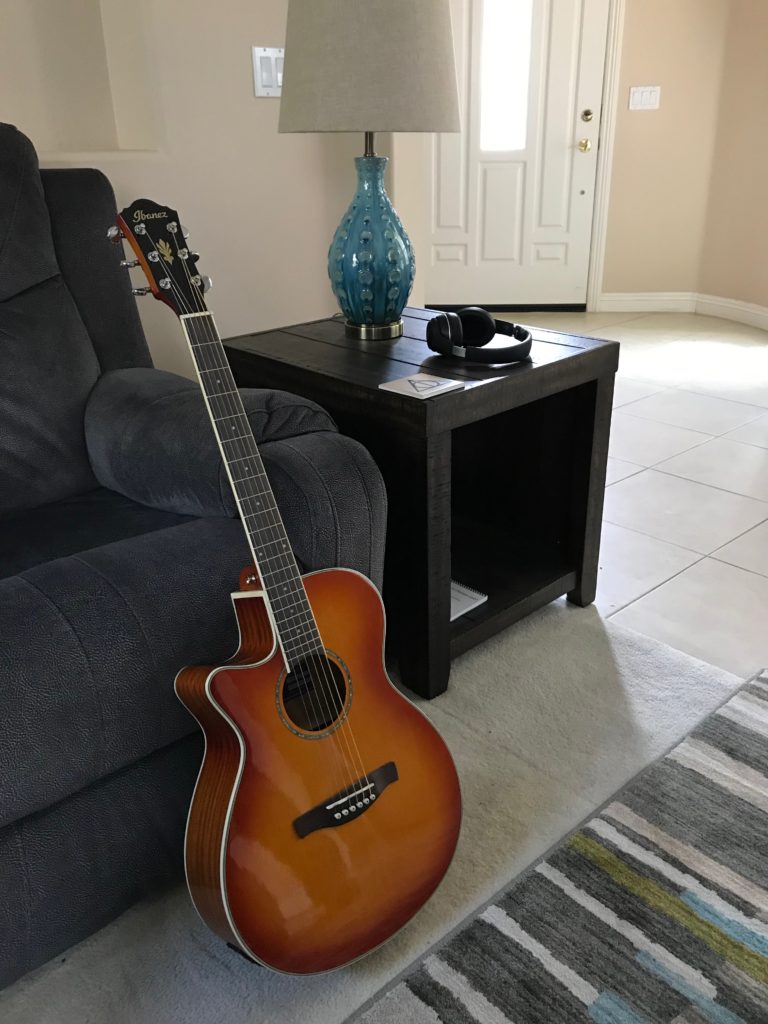
There were dozens of acoustic guitars in the store, but there were only two left-handed ones. The first one I didn’t really like, but the second one I liked a lot. So that was an easy choice.
Here’s my new guitar. It’s an acoustic-electric model.
The experience of buying my first guitar felt like picking a wand at Ollivanders Wand Shop, where the wand picks the wizard. I feel like this guitar picked me. Of course it probably wanted a left-handed wizard, so its options were narrowed too. I like the symmetry of that.
Thanks to this being Memorial Day weekend, it was also on sale. 🙂
The universe helped me out even more though. Shortly before we were going to leave, I was commenting to Rachelle that I don’t even know how to tune a guitar, and a guy behind us (who turned out to be a guitar teacher at the store) overheard my remark and spontaneously showed me how to do it. He used a free app called “Guitar Tuna,” but the guitar also has a built-in battery-powered tuner, which I later learned to use.
We got to chatting, and I told him I was starting out with zero experience and that I was interested in lessons too. He immediately offered to teach Rachelle and me how to play the song “Happy Birthday,” so we went into a private teaching room and had a free lesson, which was fun.
I liked his enthusiastic teaching style, so I signed up for lessons on the spot. I’ll be doing weekly lessons every Saturday, starting June 1st. So that’s perfect to align with the June monthly challenge in Conscious Growth Club. The theme for our June challenge is overcoming procrastination. So my commitment is that in addition to doing the lessons, I’m also going to practice every day for at least the month of June.
The teacher’s name is Max. He’s 42 years old. And he’s been playing guitar since age 10 and teaching since age 15. He also performs in live shows and works at a recording studio. Music is basically his life.
So now I have a guitar, a very upbeat instructor, and I already learned to play a simple song. It only took one morning to really get things rolling. I’m a lot further along than I was when I woke up that morning, and there’s some nice momentum carrying things forward.
I learned that for beginners, developing calluses is an early part of the experience. So even before I know how to play any chords (other than E minor), I’ve already started doing 10 minutes per day of pressing on the strings with my fingers, just enough that they start feeling tender but not so much as to create blisters. I’m also practicing tuning the guitar since that’s about the only skill I know so far.
With just a few hours of action, I feel like I’ve switched dimensions. Now I get to explore the dimension where I learn to play guitar, which sounds like a fun and rewarding path.
What’s Your Preventable Regret?
What will you likely regret 20-25 years if you don’t put something into motion today? If you commit yourself and lean in with courage, could you get some momentum going and switch dimensions in a few hours, much like I did with creating this thread of learning guitar?
What could you do today to add a new thread of skill-building to your life, such that your future self will be beaming you the energy of gratitude and appreciation?
At least start by sharing your intention with people who will encourage you and add some positive energy to it, so it starts to feel more real. And if you don’t have people in your life like that, then you have some extra clarity on what it’s costing you to maintain an unsupportive social circle… and what you stand to gain by upgrading this area of your life.