A smartphone sensor, much like what is used in GPS systems, might be a way to determine whether or not someone is intoxicated after consuming marijuana, according to a new study by the Rutgers Institute for Health, Health Care Policy and Aging Research.
According to the study, published in Drug and Alcohol Dependence, which evaluated the feasibility of using smartphone sensor data to identify episodes of cannabis intoxication in the natural environment, a combination of time features (tracking the time of day and day of week) and smartphone sensor data had a 90 percent rate of accuracy.
“Using the sensors in a person’s phone, we might be able to detect when a person might be experiencing cannabis intoxication and deliver a brief intervention when and where it might have the most impact to reduce cannabis-related harm,” said corresponding author, Tammy Chung, professor of psychiatry and director of the Center for Population Behavioral Health at the Rutgers Institute for Health, Health Care Policy and Aging Research.
Cannabis intoxication has been associated with slowed response time, affecting performance at work or school or impairing driving behavior leading to injuries or fatalities. Existing detection measures, such as blood, urine or saliva tests, have limitations as indicators of cannabis intoxication and cannabis-related impairment in daily life.
The researchers analyzed daily data collected from young adults who reported cannabis use at least twice per week. They examined phone surveys, self-initiated reports of cannabis use, and continuous phone sensor data to determine the importance of time of day and day of week in detecting use and identified which phone sensors are most useful in detecting self-reported cannabis intoxication.
They found that time of day and day of week had 60 percent accuracy in detecting self-reporting of cannabis intoxication and the combination of time features and smartphone sensor data had 90 percent accuracy in detecting cannabis intoxication.
Travel patterns from GPS data — at times when they reported feeling high — and movement data from accelerometer that detects different motions, were the most important phone sensor features for detection of self-reported cannabis intoxication.
Researchers used low burden methods (tracking time of day and day of week and analyzing phone sensor data) to detect intoxication in daily life and found that the feasibility of using phone sensors to detect subjective intoxication from cannabis consumption is strong.
Future research should investigate the performance of the algorithm in classifying intoxicated versus not intoxicated reports in those who use cannabis less frequently. Researchers should study reports of intoxication using tools that law enforcement might use showing a stronger correlation with self-reported cannabis use.
Study authors include faculty from Stevens Institute of Technology, Stanford University, Carnegie Mellon University, University of Tokyo, Japan, and University of Washington, Seattle.
Story Source:
Materials provided by Rutgers University. Original written by Nicole Swenarton. Note: Content may be edited for style and length.
Strictly Come Dancing fans were loving the fact that a certain A-list celebrity could be seen in the studio audience during Saturday night’s show.
Dame Emma Thompson was among the Strictly audience during the first live show of the series, showing her support for her husband Greg Wise, who is among the 15 stars competing in the BBC dance show this year.
After Greg and his partner Karen Hauer’s first dance of the competition, Claudia Winkleman pointed out that “your wife and daughter are in the audience”.
The cameras then cut to Emma and the couple’s 21-year-old daughter Gaia, with the Cruella star jokingly mouthing: “She’s the wife, I’m the daughter.”
It wasn’t just during Greg’s time on camera that Emma could be spotted enjoying a night out in the Strictly studio, though.
Because of her eye-catching pink jacket (and the fact she was seated directly behind Craig Revel Horwood for most of the night), the much-loved star could be seen throughout the episode, and Strictly viewers were absolutely loving it:
Emma Thompson mouthing that she’s the daughter, and the daughter is the wife is the reason we love her, right?! #Strictly
Something absolutely wonderful about the fact Oscar winner Emma Thompson is currently sitting only a matter of metres away from Zainab Masood from Eastenders. #Strictly
Although he was about to sign up for a lucrative film contract, it was chatting to Emma that convinced him to say yes to Strictly, with the star of Sense & Sensibility and The Crown coming in joint fourth place for his first routine of the series.
David M. Benett via Getty ImagesGreg Wise and Emma Thompson
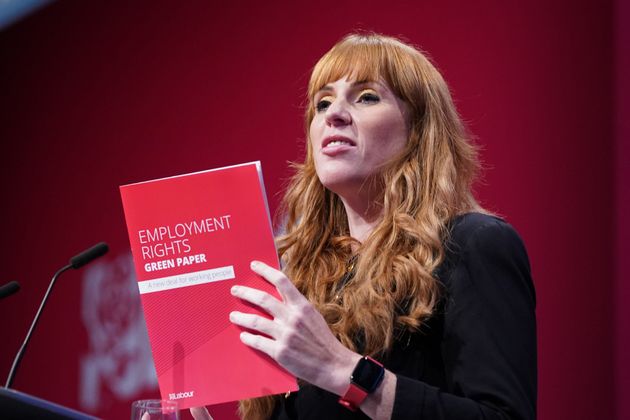
Stefan Rousseau – PA Images via Getty ImagesLabour deputy leader Angela Rayner speaks at the Labour Party conference in Brighton.
Angela Rayner has defended calling Tories “scum” last night, saying it was her “street language”.
The deputy leader of the Labour Party launched an attack on Conservatives calling them “scum, homophobic, racist, misogynistic”.
She made the comments at a reception for Labour members in the north west of England at the party’s annual conference in Brighton.
The comments sparked a backlash from Tory MPs but Rayner stood by her words this morning, saying it was “post-watershed”.
She told Sky’s Trevor Phillips on Sunday: “That was post-watershed as we’d say, with a group of activists at an event last night.”
Rayner said she was trying to get across in her “passionate way” the frustration and anger people feel over Boris Johnson’s comments and actions.
The senior MP said she would only apologise if Johnson said sorry for his past comments that she claimed were “homophobic, racist and misogynistic”.
Pressed on her comments, Rayner said she was talking about members of the cabinet.
She added: “Anyone who leaves children hungry during the pandemic and can give billions of pounds to their mates on WhatsApp, I think that was pretty scummy.
“Now that is a phrase, and let me contextualise it, it’s a phrase that you would hear very often in northern working class towns that we’d even say it jovially to other people.
“We say it’s a scummy thing to do. And that to me is my street language as you would say – about actually it’s pretty appalling that people think that’s okay to do.”
I’m sure this went down well in the room but when voters look at the party that has had both female PMs, with half of the great offices of state filled by women, half by BAME, most diverse government, more gay ministers than Labour ever had etc
Last night Rayner said: “I’m sick of shouting from the sidelines and I bet you lot are as well. We cannot get any worse than a bunch of scum, homophobic, racist, misogynistic, absolute vile…Banana Republic, vile, nasty, Etonian…piece of scum.”
Labour leader Sir Keir Starmer said the tirade was “not language that I would have used”.
He told BBC’s Andrew Marr Show it was a matter for Rayner whether she apologised but said he would speak to her about it.
“Angela and I take different approaches and that’s not language that I would use,” he said.
Asked if she should apologise, Starmer said: “That’s a matter for Angela… but I would not have used those words. I will talk to Angela about it later on.”
Labour former shadow chancellor John McDonnell rowed in behind Rayner, saying: “We’ve all been there, late at night, getting very angry about what’s going on. What I like about Angie Rayner is that she’s human.
“She may well drop herself in it, just as I have time and time again, but she’s human and she has human emotions and when you get angry about something sometimes the language that you use might be over the top.”
Dan Kitwood via Getty ImagesStarmer was quizzed about Rayner’s comments on the BBC’s Andrew Marr show.
However, transport secretary Grant Shapps called on Rayner to apologise and said her comments were “absolutely appalling”.
The cabinet minister said: “There’s no place in public life for that sort of language, that sort of behaviour. I saw that she had described herself as being somebody who wanted to see a kinder kind of politics back in 2019. I’m very sorry that seems to have disappeared.”
He added: “I think it would be befitting if she actually just apologised, rather than talked around the subject.”
Tory MP Alec Shelbrooke told HuffPost UK: “It once again shows that Labour have nothing to offer the north other than bitter and nasty comments against those who northern voters elected over an out of touch Labour Party, who still show that instead of recognising the issues that people want addressed, would rather stoop to the actions of the defeated play ground bully. Labour continue to show that the true party of the workers is the Conservative Party.”
Foreign Office minister James Cleverly also hit back, tweeting: “I’m sure this went down well in the room but when voters look at the party that has had both female PMs, with half of the great offices of state filled by women, half by Bame, most diverse government, more gay ministers than Labour ever had etc they’ll know she’s talking crap.”
The Great British Bake Off winner and his professional partner are the first pairing made up of two male dancers to ever compete in the long-running BBC series.
During Saturday night’s live show, they delivered their first routine of the new season, performing an intense Tango to Blue Monday by New Order.
The two took to the floor in matching black tuxedos, and won over the judges, who gave them an impressive 30 points of a possible 40.
BBC/Guy LevyJohannes Radebe and John Whaite on the Strictly dance floor
John and Johannes’ score put them in joint second place on the leaderboard on the night, alongside Olympian Adam Peaty and his partner Katya Jones.
The pair also received glowing reviews from those watching along on social media:
Just stunning, chills
Obviously very glad and grateful this has happened now, but think of all the dances like this we’ve missed over the years, the show didn’t implode, hellfire did not rain down, it really was that simple https://t.co/E4fnYUGx0l
don’t mean to be dramatic but seeing john and johannes on strictly! is just! i remember watching it every year as a child never thinking i’d be allowed to join in because i’d want to dance with a man and to see this!!!! over the moon tbh #Strictly
In 2004, at the age of 14, I felt oddly represented by Julian Clary being openly out on strictly. Tonight I hope that same feeling is with someone else that age or younger and is more than heightened watching John & Johannes ❤️🧡💛💚💙💜🤎🖤 #Strictly#SCDpic.twitter.com/7NnJXwbG2j
The message John and Johannes are sending out to the world, the example they are setting, is so much bigger than #Strictly What they’re doing for the queer youth watching at home, particularly queer youth of colour, is just phenomenal. I’m just beaming 🥺🥰
Loved it! Johannes is 🔥 and so lovely to see the other celebrities being so supportive of the first male same-sex pairing with a standing ovation. Representation on prime time matters still. #Strictly
John and Johannes also got the seal of approval from celebrities including Steps singer Ian “H” Watkins, who previously competed as part of Dancing On Ice’s first ever same-sex partnership.
The two landed not just the highest score of the night for their Jive routine, but the highest score for any week one performance since 2005.
At the end of Saturday night’s show, there was no public vote, with all 15 of the celebrities making it through to next week, after which viewers will help determine the two stars who end up in the first dance-off of the series.
Find out how the cast gets on when Strictly returns to our screens on Saturday night at 6.45pm.
It’s no secret that GB News got off to a bumpy start when it debuted in June, with former chairman Andrew Neil detailing some of the behind-the-scenes drama that blighted his time with the station in a new interview following his departure.
In a new interview with the Daily Mail – during which he reportedly broke down in tears – Andrew spoke out about his time at GB News, explaining that working at the station brought him “close to a breakdown”.
Referring to GB News’ many technical blunders, he recalled: “Live TV is stressful at the best of times but not knowing whether or not the technology would work…
“It just got worse and worse. At one stage, we were waiting to go on air and the whole system went down. It had to be rebooted and we only managed it with 15 seconds to spare. That stress was just huge. It meant you couldn’t think about the journalism. You were just constantly wondering: ‘Will we make it through the hour?’.”
GB NewsAndrew Neil speaking live on GB News
He continued: “By the end of that first week, I knew I had to get out. It was really beginning to affect my health. I wasn’t sleeping. I was waking up at two or three in the morning.
“I had a constant knot in my stomach. When I did wake up I’d feel fine, then remember all the problems I had with GB News and this knot would come and wouldn’t leave me for the whole day.”
Referring to some of the station’s specific issues, he stated: “The studio had four areas. One was the digital wall, another was the breakfast table area – which I thought looked rather good – the other was the sofa, which looked like a Habitat sofa we’d picked up off a skip in Notting Hill, and the fourth, which was where I did my show from, was so black I had to take my jacket off and wear a white shirt.”
“We only had a floor manager because I’d insisted,” he claimed. “We were meant to operate our own autocue and do our own make-up. It makes student TV look well-financed.”
PAAndrew Neil posing with the on-air GB News team after its launch night
Andrew added that despite broadcasting from “the most diverse, multi-ethnic city in the world”, the team was not able to provide appropriate lighting for people of colour.
“I raised the issue that the reputational damage we were risking was monumental,” he told the Mail. “I said it was a disaster. There were endless things and, by the second week, things weren’t getting any better. Some things were getting worse. It was terrible.
“I came off air one night and I looked straight at [GB News’ CEO Angelos Frangopoulos], I said: ‘This is a disaster and it’s my reputation that’s on the line’.
“That’s what really did me in the end – and it’s my own stupidity for getting into it – the fact that everybody saw my face on the tin. It was Andrew Neil’s channel. That’s what everyone talked about.
“What nobody knew was [before the June launch] in March, April, May… my face was still on the tin but I had no say over what was going into the tin. That’s what was unsustainable for me.”
Leon Neal via Getty ImagesGB News has had a tumultuous few months since its launch in June
In leaving GB News, the Mail reports that Andrew “walked away from a £4 million contract”, though he insisted: “It was a big decision but I frankly couldn’t care if it was £40 million. This would have killed me if I’d carried on.”
A statement from GB News issued to the Daily Mail said: “As with all companies, decision-making rests with the board, and GB News is no different. As a member of the board, Andrew had the same rights and abilities to raise concerns, and he was privy to all decisions.”
Their spokesperson added: “The board allowed Andrew time off over the summer to recharge his batteries. He subsequently asked to leave and the board agreed to this request. The terms of his departure were properly negotiated and documented, with Andrew taking legal advice throughout.
“The fact that he has chosen to ignore these terms and make his departure unnecessarily contentious and public is a decision he will have to live with.”
HuffPost UK has contacted GB News for additional comment.
In tandem with the relentless reports of higher temperatures, extreme weather, natural disasters and depleted resources saturating your newsfeed, you may find yourself experiencing an uptick in anxiety, depression and existential dread – better known as eco-anxiety.
A 2020 poll by the American Psychiatric Association found that more than two-thirds of Americans (67%) are somewhat or extremely anxious about the effect of climate change on the planet while more than half (55%) are somewhat or extremely anxious about how climate change affects their own mental health.
Advertisement
Though not an official clinical diagnosis, the American Psychological Association defines eco-anxiety as “a chronic fear of environmental doom.” Eco-anxiety is just as real as any other form of anxiety in that it typically involves the same physical and emotional sensations.
“It’s even more real, in a sense, because the problem triggering the anxiety symptoms is objectively real and massive in scale,” Erica Dodds, chief operating officer of the Foundation for Climate Restoration, told HuffPost. “There used to be more distance between any one person and the world, but now it feels like every problem in the world is right in our living rooms with us.”
Like other forms of anxiety, eco-anxiety can affect anyone, and to varying degrees. “Some people might be proactive in taking measures to protect the planet’s resources, while others might feel so powerless to stop the degradation of the environment they can’t handle thinking about it at all,” Dodds said.
No matter where you fall on the eco-anxiety spectrum, the steps you take to recognise your symptoms and improve them will likely be advantageous for the planet, too. Where to begin? See if any of these eco-anxiety symptoms sound familiar and use the expert-backed strategies provided as fuel for positive change.
Advertisement
1. You’re in a persistent state of anticipatory anxiety
Our animalistic need to feel safe operates on the most primitive level. “When we don’t feel safe, we naturally scan our environment to detect any hint of threat,” Carla Marie Manly, a California-based clinical psychologist and author of Joy From Fear told HuffPost.
When a threat like climate change is continuously felt yet isn’t readily discernible in the present moment, you may end up with chronic anticipatory anxiety. Because anticipatory anxiety is future-based, the best way to counteract it is to reconnect with the present moment, starting with a few deep breaths to calm your over-revved sympathetic (“fight or flight”) nervous system.
“Keep a rock, dried flower, twig or other natural object around that you can look at and touch when you’re feeling overwhelmed,” said Holly Schiff, a licensed clinical psychologist based in Greenwich, Connecticut. “This acts as a grounding technique.”
Advertisement
2. You feel guilty about not doing more to reduce your carbon footprint
Odds are your guilt stems from all-or-nothing thinking — you consider your actions as successes or failures, and there’s no gray area. Meanwhile, the grey zone is where many of our daily actions land.
“Recognising this maladaptive thought pattern is the first step toward alleviating guilt and shame related to your feelings of personal responsibility for your carbon footprint,” Tyson Lippe, a psychiatrist at Heading Health in Austin, Texas, told HuffPost.
Learn to acknowledge the positive decisions instead of focusing on how much more you could have done. “By ignoring everything less than 100%, it becomes easy to feel your efforts will always be in vain,” Lippe said. “One setback or shortcoming doesn’t negate the rest of your efforts toward ensuring our planet’s health.”
Because the brain is hardwired to remember negative instead of positive experiences, documenting your achievements can keep your efforts in perspective.
“Constructing a record of accomplishments provides an easy way to review them and remind yourself that you made a difference,” Lippe said. “This method provides positive reinforcement and a way to override our propensity to focus on our shortcomings.”
3. You deeply regret choices that harmed the environment
Regret can be both constructive and destructive – and it’s important to learn the difference.
“A normal and desirable part of life is learning new information as we grow and change,” Lippe said. “But becoming aware of the unforeseen consequences of our acts and assessing past behaviour in the light of new knowledge can lead to being excessively self-critical.”
The next time you find yourself in a regret spiral, pause to notice if you’re now engaged in more eco-friendly behaviours. If you are, focus on all you’re doing now to change the world for the better.
Advertisement
Regret about your past environmental impact might also be a signal from your psyche that you’re not currently taking care of the planet. If that’s the case, “use the regret to create new behaviours that will make a positive, if small, difference,” Manly said. Think: using reusable produce and grocery bags, trying waterless cleaning products, shopping sustainable beauty brands and more.
Oscar Wong via Getty Images
Doomscrolling news about climate change can reinforce anxiety without being productive.
4. Your doomscrolling is getting out of hand
Compulsive actions emanating from eco-anxiety – like doomscrolling for the latest climate change tragedies and grim predictions – often occur in conjunction with hyper-focused, obsessive thoughts, which stem from a lack of internal safety and control.
“Such behaviours are the mind’s way of coping with the stress and anxiety of feeling powerless,” Manly said. “Seeking relief, the mind becomes stuck in ruminative patterns.”
Consider setting limitations on the daily or weekly time spent examining eco-associated information if you find yourself worrying excessively. “Being situationally aware is good; being overwhelmed is not,” Lippe said.
Another option would be to balance the scales: For every doom-filled piece of information you consume about the environment, find another on the latest successes and innovations, or hope-filled intel you can translate into action.
“It’s far more helpful and uplifting to channel the time researching climate change to doing something about it,” Manly said. “You’ll feel far more empowered and better about yourself if you switch gears to take action.”
5. You feel extremely resentful when other people do things that damage the planet
One of the key messages around climate change is that a collective effort is essential to rectify what’s happening to the environment.
“This means everyone’s individual and moral responsibility is engaged, and our response to climate change is based on cooperation,” Lippe said. “Resentment occurs as a result of perceived violation of this moral contract.”
Advertisement
Although it’s a subconscious emotional response, it can be draining and contribute to negative thought patterns. “A helpful way to combat resentment is to first recognize it, then consciously deflect resentment in favour of acceptance,” Lippe said.
You can’t control how eco-friendly other people’s habits are — only your own. Lead by example and educate where possible.
“Resenting others for not doing their part isn’t helpful,” Manly said. “However, modelling eco-friendly actions has the potential to inspire change in others, one person and situation at a time.”
6. You’re paralyzed by being overwhelmed as you build eco-friendly habits.
Because of the urgent reasons behind your desire to build eco-friendly habits, you might find yourself taking on too much too fast. “This makes maintaining those changes exhausting, and you burn yourself out,” Lippe said.
Intermittent and small tweaks are more tolerable than sudden, large ones and can lead to compounding changes, much like rolling a snowball down a hill.
“If feelings of overwhelm make you feel stuck, create a can-do calendar as a guide to monthly macro-changes supported by micro-changes,” Manly said.
In the first month, for example, your main goal might be to focus on shopping for fresh, local groceries that require less packaging – which might involve micro-goals like biking to the farmer’s market, sharing a box of fresh veggies with neighbours or planting a winter garden.
During the second month, your main goal might be to use less energy, and your micro-goals may be setting the heater no higher than 68 degrees, turning off lights when leaving the room and taking shorter showers.
“Making small, sustainable micro-changes can strengthen your resolve and your relationship with the environment,” Manly said.
Advertisement
japatino via Getty Images
Intense fear about potential extreme weather events could be a sign that your eco-anxiety needs to be addressed.
7. You’re phobic about extreme weather
A phobia is a fear that’s out of proportion with the danger it represents. “However, recent events, including wildfires and floods, have surpassed the scale of what we’ve experienced before and is blurring the boundaries between fear and phobia,” Lippe said.
Fears – and fear’s close relatives, anxiety and phobias – can leave us paralysed, but being stuck in fear only does more harm.
“Constructive fear (the side of fear that guides us to make healthy change) simply asks that we look at what we can do as individuals to shift the situation for the better,” Manly said.
If you’re feeling bogged down by destructive fear (the fear that keeps us feeling stuck and paralysed), assess the situation and do one small thing that makes a difference, such as making a donation to a charity that helps people affected by wildfire.
“When you practice this behaviour pattern, you’ll notice your fears subside because you’re taking action to create healthy change,” Manly said. “Sometimes that’s the best and only thing we have the power to do.
If your fear is a result of personally experiencing a natural disaster, it might be part of a post-traumatic stress disorder: “Seeking out professional support for diagnosis and treatment is advisable,” Lippe said.
8. You have a serious case of existential dread.
You might feel like no matter how hard you try to help the planet, it’s never enough, so you avoid taking proactive steps because they seem to make so little difference. This, paradoxically, forces you to confront the incredible scale of the problem.
“There are many approaches to decrease one’s own carbon footprint ― choosing to bike rather than drive, eating less meat, having fewer children ― but ultimately the problem is beyond the scale of individual actions,” Dodds said.
This can also help you make peace with the fact that you can’t do everything. “I find it helpful to network and see firsthand that other people are working on issues I care deeply about but don’t have the time to contribute to,” Dodds said.
You can also make small recurring donations to organisations working in areas you care about or subscribe to their newsletters to keep yourself engaged with their causes.
9. You have meltdowns about how climate change is affecting wildlife
A few weeks ago, Dodds was marvelling over a photo on Instagram of gorgeous whales sleeping underwater together — until she noticed the text accompanying the picture was describing the decimation of whale populations and its devastating effect on other species.
“In an instant, I went from awe to anguish,” she said.
The changes to our climate have been attracting so much social and media attention, especially lately, increasing the barrage of agonising information about the climate and ecosystems. Cue despair.
If you find yourself stuck in grief or immersed in one meltdown after another, take action to protect wildlife. “Most people do feel better when they’re actively engaged in fixing the problems that are causing them anxiety,” Dodds said.
Whether you volunteer at a turtle sanctuary, donate money to support animals affected by wildfires or plant bee-friendly flowers, “every action you take that’s positive can be deeply cathartic,” Manly said.
10. You struggle to plan for the future
Advertisement
When a person’s eco-anxiety becomes harmful, it’s often driven by a sense that the future is now uncontrollable and unpredictable.
“This can lead them to feel numbed out and hopeless,” Aimee Daramus, a Chicago-based licensed clinical psychologist and author of “Understanding Bipolar Disorder, told HuffPost. “They start asking questions about the meaning of having a family and career, or the worth of human life if we’re so easily swept away by increasingly common fires and hurricanes. Is life just going to get harder?”
Taking action on ecological issues can help fight the helplessness and numbness. “Start with actions that feel manageable, no matter how small, because that success will help motivate further action,” Daramus said.
If the hopelessness wins out more often than you do, eco-anxiety can be treated like any other type of anxiety and depression, using modalities like cognitive behavioural therapy, dialectical behaviour therapy, and acceptance and commitment therapy.
“Eco-anxiety support groups are also forming online,” Daramus said, such as The Good Grief Network.
11. You experience physical symptoms
Eco-anxiety can manifest in a variety of physical ways, such as insomnia, panic attacks, digestive issues and lack of focus.
Sometimes these symptoms can be due to an acute stressor and may resolve on their own — but when they become intolerable or chronic, it’s important to determine if they’re due to a medical condition, such as a mood disorder.
“If your symptoms have been linked to excessive worrying, it may be necessary to speak with a counsellor or therapist, begin medication or engage in other treatment modalities to improve your health,” Lippe said.
Much like developing good sleep, food and fitness habits, adopting an eco-friendly lifestyle should be looked at as an ongoing effort. And when you take good care of yourself, you’re much better equipped to take better care of the planet.
Researchers at Rochester Institute of Technology are part of a new study that could help unlock the potential of superfluids — essentially frictionless special substances capable of unstopped motion once initiated. A team of scientists led by Mishkat Bhattacharya, an associate professor at RIT’s School of Physics and Astronomy and Future Photon Initiative, proposed a new method for detecting superfluid motion in an article published in Physical Review Letters.
Scientists have previously created superfluids in liquids, solids, and gases, and hope harnessing superfluids’ properties could help lead to discoveries such as a superconductor that works at room temperature. Bhattacharya said such a discovery could revolutionize the electronics industry, where loss of energy due to resistive heating of wires incurs major costs.
However, one of the main problems with studying superfluids is that all available methods of measuring the delicate superfluid rotation bring the motion to a halt. Bhattacharya and his team of RIT postdoctoral researchers teamed up with scientists in Japan, Taiwan, and India to propose a new detection method that is minimally destructive, in situ, and in real-time.
Bhattacharya said the techniques used to detect gravitational waves predicted by Einstein inspired the new method. The basic idea is to pass laser light through the rotating superfluid. The light that emerged would then pick up a modulation at the frequency of superfluid rotation. Detecting this frequency in the light beam using existing technology yielded knowledge of the superfluid motion. The challenge was to ensure the laser beam did not disturb the superflow, which the team accomplished by choosing a light wavelength different from any that would be absorbed by the atoms.
“Our proposed method is the first to ensure minimally destructive measurement and is a thousand times more sensitive than any available technique,” said Bhattacharya. “This is a very exciting development, as the combination of optics with atomic superflow promises entirely new possibilities for sensing and information processing.”
Bhattacharya and his colleagues also showed that the light beam could actively manipulate supercurrents. In particular, they showed that the light could create quantum entanglement between two currents flowing in the same gas. Such entanglement could be useful for storing and processing quantum information.
Bhattacharya’s theoretical team on the paper consisted of RIT postdoctoral researchers Pardeep Kumar and Tushar Biswas, and alumnus Kristian Feliz ’21 (physics). The international collaborators consisted of professors Rina Kanamoto from Meiji University, Ming-Shien Chang from the Academia Sinica, and Anand Jha from the Indian Institute of Technology. Bhattacharya’s work was supported by a CAREER Award from the National Science Foundation.
From inside the womb and as soon as they enter the world, babies absorb information from their environment and the adults around them, quickly learning after birth how to start communicating through cries, sounds, giggles, and other kinds of baby talk. But are a child’s long-term language skills shaped by how their brain develops during infancy, and how much of their language development is influenced by their environment and upbringing?
Following dozens of children over the course of five years, a Boston University researcher has taken the closest look yet at the link between how babies’ brains are structured in infancy and their ability to learn a language at a young age, and to what degree their environment plays a role in brain and language development.
The new research, described in a paper published in Developmental Cognitive Neuroscience, finds that the brain’s organizational pathways might set a foundation for a child’s language learning abilities within the first year of life. These pathways are known as white matter, and they act as the connectors between the billions of neurons — called gray matter — that comprise the brain tissue. This allows for the exchange of signals and for all of the different tasks and functions we need to perform, as well as all of the biological processes that sustain us.
“A helpful metaphor often used is: white matter pathways are the ‘highways,’ and gray matter areas are the ‘destinations’,” says BU neuroscientist and licensed speech pathologist Jennifer Zuk, who led the study. Zuk, a College of Health & Rehabilitation Sciences: Sargent College assistant professor of speech, language, and hearing sciences, says the more someone does a certain task, like learning a new language, the stronger and more refined the pathways become in the areas of the brain responsible for that task, allowing information to flow more efficiently through the white matter highways. Recent evidence suggests that white matter most rapidly develops within the first two years of life, according to Zuk.
In addition to white matter development, scientists have long known that the environment also plays an important role in shaping a person’s language abilities, Zuk says. But many uncertainties remain about whether nature or nurture is more dominant in determining the makeup of white matter and how well a baby learns to communicate.
In their study, Zuk says, she and her colleagues sought answers to several specific questions: from very early on, to what extent does predisposed brain structure play a role in development? Does the brain develop in tandem with language, and is the environment ultimately driving the progress of both? And to what extent does brain structure in early infancy set children up for success with language?
advertisement
To investigate this, Zuk and Boston Children’s Hospital researcher and study senior author Nadine Gaab met with 40 families with babies to take images of the infants’ brains using magnetic resonance imaging (MRI) and gather first-of-its-kind data on white matter development. No small feat, considering the babies needed to be sound asleep to allow for crisp capture of their brain activity and structure using MRI.
“It was such a fun process, and also one that calls for a lot of patience and perseverance,” says Zuk, who had to master the challenge of getting 4-to-18-month-old babies comfortable enough to snooze through the MRI process — the loud sounds of an MRI could be very disruptive to a sleeping baby. “There are very few researchers in the world using this approach,” she says, “because the MRI itself involves a rather noisy background…and having infants in a naturally deep sleep is very helpful in accomplishing this pretty crazy feat.”
It’s also the first time that scientists have used MRI to look at the relationship between brain structure and language development in full-term, typically developing children from infancy to school age.
One important white matter pathway the researchers looked at using MRI is called the arcuate fasciculus, which connects two regions of the brain responsible for language production and comprehension. Using MRI, the researchers measured the organization of white matter by looking at how easily water diffuses through the tissue, indicating the pathway’s density.
Five years after first rocking babies to sleep and gently tucking them inside an MRI machine, Zuk and her collaborators met up with the children and their families again to assess each child’s emerging language abilities. Their assessments tested each one’s vocabulary knowledge, their ability to identify sounds within individual words, and their ability to blend individual sounds together to understand the word it makes.
advertisement
According to their findings, children born with higher indications of white matter organization had better language skills five years later, suggesting that communication skills could be strongly linked to predisposed brain structure. But, Zuk says, this is only the first piece of a very complicated puzzle.
“Perhaps the individual differences in white matter we observed in infancy might be shaped by some combination of a child’s genetics and their environment,” she says. “But it is intriguing to think about what specific factors might set children up with more effective white matter organization early on.”
Although their findings indicate a foundation for language is established in infancy, “ongoing experience and exposure [to language] then builds upon this foundation to support a child’s ultimate outcomes,” Zuk says.
She says this means that during the first year of a child’s life “there’s a real opportunity for more environmental exposure [to language] and to set children up for success in the long term.”
Zuk and her research partners plan to continue investigating the relationship between environmental and genetic components of language learning. Their goal is to help parents and caretakers identify early risk factors in language development in young children and determine strategies for strengthening babies’ communicative skills early on in life.
Mechanical engineering researchers at Michigan Technological University have created a way to make a 3D-printable nanocomposite polymeric ink that uses carbon nanotubes (CNTs) — known for their high tensile strength and lightness. This revolutionary ink could replace epoxies — and understanding why its properties are so fantastic is a first step toward its mass use.
3D printing, also known as additive manufacturing, is more versatile and efficient than casting. It adds a material with precision, often in complex geometries, with considerably less excess to cut away. Adding low-dimensional nanomaterials such as CNTs, graphene, metal nanoparticles and quantum dots allows 3D-printed materials to adapt to external stimuli, giving them features such as electrical and thermal conductance, magnetism and electrochemical storage.
But 3D printing using plastic, metal or something else entirely isn’t new. What Tech researchers have done differently is use polymer nanocomposites (made of epoxy, carbon nanotubes and nano-clay) and a printing process that doesn’t sacrifice functionality. The junction of material type and morphology — size, shape, structure — in polymer nanocomposite inks is the ultimate in form meeting function.
The exploration of process, morphology and properties of polymeric inks is the subject of an article recently published in the journal Additive Manufacturing by Parisa Pour Shahid Saeed Abadi, an engineer who explores the interface of materials, mechanics and medicine, and graduate student Masoud Kasraie.
Abadi and Kasraie point out that before researchers can sprint off to the races using polymeric inks, they must first learn to walk. The first step is digging into the intersection of the macro scale (how our eyes see a material performing) and the nano scale (what we can’t see, but know is occurring).
Building Understanding Before Market Share
While polymer nanocomposites and 3D-printing products and services both have billion-dollar market values, nanomaterial 3D printing only has a market value of approximately $43 million, Abadi noted.
advertisement
“For national prosperity and sustaining global leadership in manufacturing, the gap between the real-world applications of 3D printing and nanomaterials versus nanomaterial 3D printing needs to be closed,” Abadi said. “The gap exists due to lack of control of nanocomposite properties in the 3D-printing process, because we don’t fully understand the process-morphology-property relationship.”
The bottleneck is understanding the complex interplay between the macro-scale mechanics of 3D-printing processes and the nano-scale mechanics and physics of nanocomposites. Abadi and Kasraie’s research seeks to loosen the bottleneck by exploring the relationship between 3D-printing process parameters and nanomaterial morphology in nanocomposite printing inks, which is the most important but least explored piece of the puzzle.
The Many Benefits of Nanomaterial Ink
Moving beyond the science of nanocomposite ink, the material holds great promise because of its many functionalities. One advantage of 3D printing is near-complete control over the final product’s shape.
The conductivity of Abadi and Kasraie’s nanomaterial ink is an exceptionally handy trait that gives the printed epoxy the potential to double as electrical wiring — whether in a circuit board, an airplane’s wing or in 3D-printed actuators for guiding catheters in blood vessels. Another useful trait of the nanocomposite polymer ink is its strength.
advertisement
“In comparison with steel and aluminum, we see 80% weight reduction with epoxy composite with same strength,” Kasraie said.
Finally, in the medical field and aerospace and electronics industries, where defects and damage can spell big trouble, the nanocomposites serve a safety function.
“When something breaks, a tiny crack starts from a microscale defect and progresses until it breaks the entire structure,” Abadi said. “Nanocomposite features make bridges in those cracks and don’t let the cracks grow. This is one of the mechanisms through which carbon nanotubes increase the mechanical strength of the material.”
Property-to-weight ratio, electrical conductivity, increased strength and ease of application are just a few of the many promising reasons why polymer nanocomposite inks will likely replace traditional epoxies.
The Etruscan civilization, which flourished during the Iron Age in central Italy, has intrigued scholars for millennia. With remarkable metallurgical skills and a now-extinct, non-Indo-European language, the Etruscans stood out from their contemporary neighbors, leading to intense debate from the likes of the ancient Greek historian Herodotus on their geographical origins.
Now, a new study by a team of scholars from Germany, Italy, USA, Denmark and the UK, sheds light on the origin and legacy of the enigmatic Etruscans with genome-wide data from 82 ancient individuals from central and southern Italy, spanning 800 BCE to 1000 CE. Their results show that the Etruscans, despite their unique cultural expressions, were closely related to their italic neighbors, and reveal major genetic transformations associated with historical events.
An intriguing phenomenon
With an extinct language that is only partly understood, much of what was initially known about Etruscan civilization comes from the commentary of later Greek and Roman writers. One hypothesis about their origins, the one favored by Herodotus, points to the influence of ancient Greek cultural elements to argue that the Etruscans descended from migrating Anatolian or Aegean groups. Another, championed by Dionysius of Halicarnassus, proposes that the Etruscans originated and developed locally from the Bronze Age Villanovan culture and were therefore an autochthonous population.
Although the current consensus among archaeologists supports a local origin for the Etruscans, a lack of ancient DNA from the region has made genetic investigations inconsistent. The current study, with a time transect of ancient genomic information spanning almost 2000 years collected from 12 archaeological sites, resolves lingering questions about Etruscan origins, showing no evidence for a recent population movement from Anatolia. In fact, the Etruscans shared the genetic profile of the Latins living in nearby Rome, with a large proportion of their genetic profiles coming from steppe-related ancestry that arrived in the region during the Bronze Age.
Considering that steppe-related groups were likely responsible for the spread of Indo-European languages, now spoken around the world by billions of people, the persistence of a non-Indo-European Etruscan language is an intriguing and still unexplained phenomenon that will require further archaeological, historical, linguistic and genetic investigation.
advertisement
“This linguistic persistence, combined with a genetic turnover, challenges simple assumptions that genes equal languages and suggests a more complex scenario that may have involved the assimilation of early Italic speakers by the Etruscan speech community, possibly during a prolonged period of admixture over the second millennium BCE,” says David Caramelli, Professor at the University of Florence.
Periods of change
Despite a few individuals of eastern Mediterranean, northern African, and central Europeanorigins, the Etruscan-related gene pool remained stable for at least 800 years, spanning the Iron Age and Roman Republic period. The study finds, however, that during the subsequent Roman Imperial period, central Italy experienced a large scale genetic shift, resulting from admixture with eastern Mediterranean populations, which likely included slaves and soldiers relocated across the Roman Empire.
“This genetic shift clearly depicts the role of the Roman Empire in the large-scale displacement of people in a time of enhanced upward or downward socioeconomic and geographic mobility,” says Johannes Krause, Director at the Max Planck Institute for Evolutionary Anthropology.
Looking at the more recent Early Middle Ages, the researchers identified northern European ancestries spreading across the Italian peninsula following the collapse of the Western Roman Empire. These results suggest that Germanic migrants, including individuals associated with the newly established Longobard Kingdom, might have left a traceable impact on the genetic landscape of central Italy.
In the regions of Tuscany, Lazio, and Basilicata the population’s ancestry remained largely continuous between the Early Medieval times and today, suggesting that the main gene pool of present-day people from central and southern Italy was largely formed at least 1000 years ago.
Although more ancient DNA from across Italy is needed to support the above conclusions, ancestry shifts in Tuscany and northern Lazio similar to those reported for the city of Rome and its surroundings suggests that historical events during the first millennium CE had a major impact on the genetic transformations over much of the Italian peninsula.
“The Roman Empire appears to have left a long-lasting contribution to the genetic profile of southern Europeans, bridging the gap between European and eastern Mediterranean populations on the genetic map of western Eurasia,” says Cosimo Posth, Professor at the University of Tübingen and Senckenberg Centre for Human Evolution and Palaeoenvironment.