What makes a classic dad joke? Some might say one that’s fundamentally unfunny. But we have more appetite than you’d expect for the cringe.
Ahead of National Tell-A-Joke day on August 16, Moonpig has surveyed the nation on our true feelings about dad jokes – as well finding the ones that actually land. It turns out that dad jokes make a lot of us warm and fuzzy with nostalgia and some even manage to make us laugh, rather than groan.
Advertisement
Almost half (49%) of those surveyed said they find dad jokes funny – not so bad, then – although the older you are, the less likely you are to find your own dad funny. Surprisingly, 64% of Gen Z say their dad makes them laugh, compared to 36% of those over 55.
Jasmin Merdan via Getty Images
As to which city takes the dad joke crown, the fathers of Liverpool are funniest (or at least have the most appreciative audiences), followed by Cardiff and Birmingham in the top three. And when it comes to low tolerance, neither Norwich or Brighton has much time for dad jokes, calling them “annoying” or even “disgusting”.
Advertisement
Of course, we all know the obviousness of the punchline is what makes a dad gag iconic, nor does a good(/bad) pun go amiss, which may explain why so many old classics make the following list of the nation’s favourites.
1) What do you call a boomerang that doesn’t come back?
Advertisement
2) Why do Dads take an extra pair of socks when they go golfing?
In case they get a hole in one.
3) What’s the best time to go to the dentist?
Advertisement
Tooth-Hurty.
4) A ham sandwich walks into a bar and orders a beer.
The bartender says, “sorry we don’t serve food here.”
5) What did the ocean say to the beach?
“Nothing, it just waved.”
6) “Dad, did you get a haircut?”
“No, I got them all cut.”
7) My wife asked me to stop singing ‘Wonderwall’ to her.
As part of my garage decluttering project this summer, I refactored and upgraded my hardware tools. I thought some readers might enjoy seeing the before and after pics of this part of the project, especially since it’s easy to see the changes visually.
I hadn’t personally selected or bought most of my old tools. They were almost entirely hand-me-downs from my dad and grandfather, most of them decades old. A few items I picked up at swap meets last century. The overall collection was a mishmash of ugly items with some redundancy, consisting of odds and ends that other people no longer wanted.
While most of these tools were technically functional (if I lower my standards for defining the word functional), my inner relationship with this assortment of tools was pretty blah. I typically saw this collection as ugly and disorderly baggage from the past.
Did these tools spark joy? That’s an easy no. Actually it’s an easy hell no. With few exceptions this felt like someone else’s tool collection, not really my own. So I saw an opportunity to remake this part of my life in a more deliberate way.
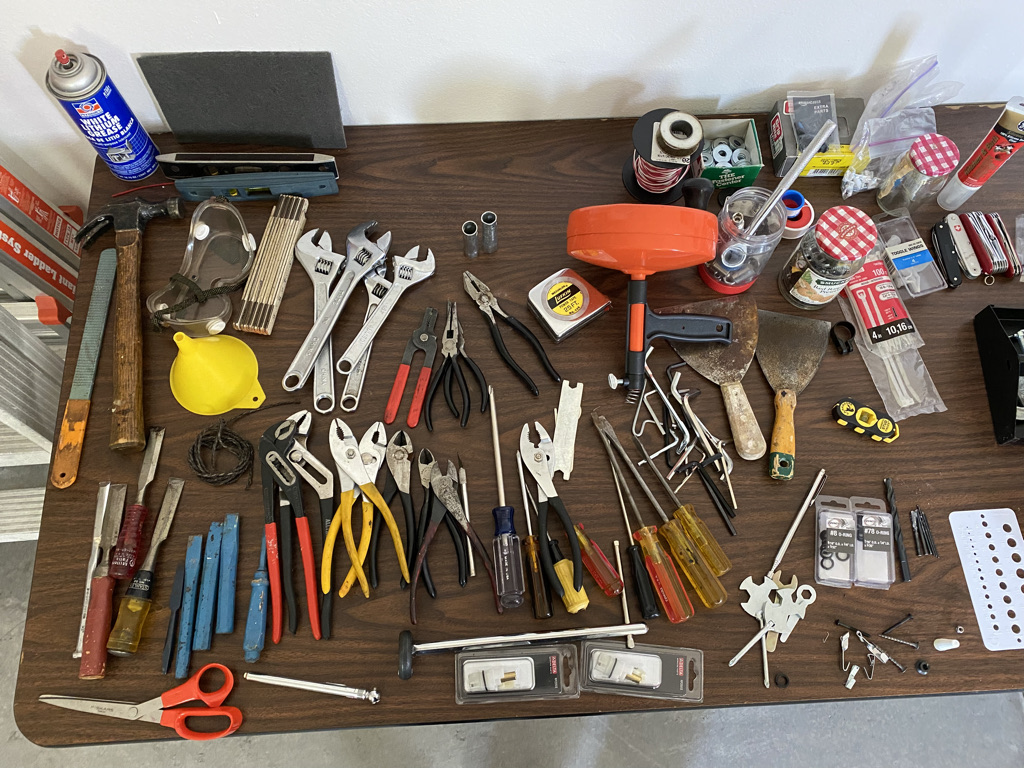
When I began sorting through these tools, I learned that I had 17 different hex wrenches (aka Allen wrenches) but only in 6 different sizes. I had two 10″ adjustable wrenches and two 8″ adjustable wrenches, none of which were good at holding their positions when used, so I had to keep my thumb on the adjuster when using them. I had a bunch of crusty wood chisels that I’ve never used in my life. In a long line of male relatives, apparently I’m the first who isn’t into making his own furniture.
Many items were coated in substances that were last seen in Voldemort’s rez pot… if you were to remove baby V and simmer the soupy remains into a thick sludge, smear it on tools, and then bake at 450º F for 35-45 minutes.
It’s possible that some of these tools might violate California’s Prop 65 if they were sold today, not necessarily from what they were originally made of but from whatever has coated them over the years.
Old Tools
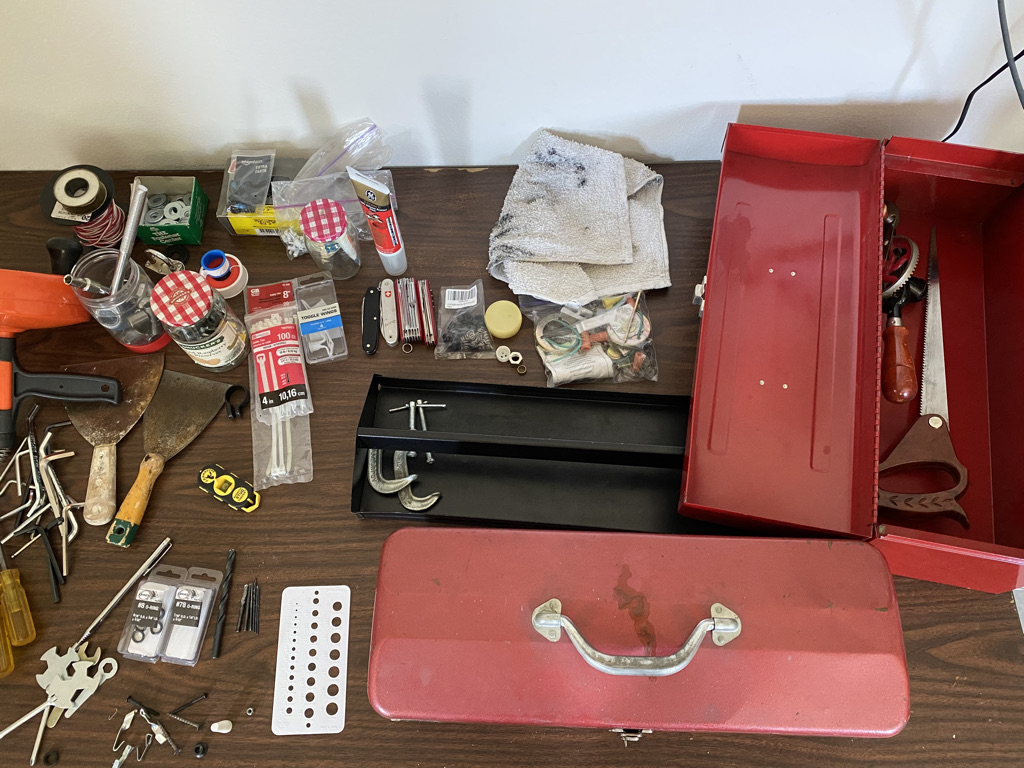
Here are some pics of the old collection. Welcome to the Island of Misfit Toys!
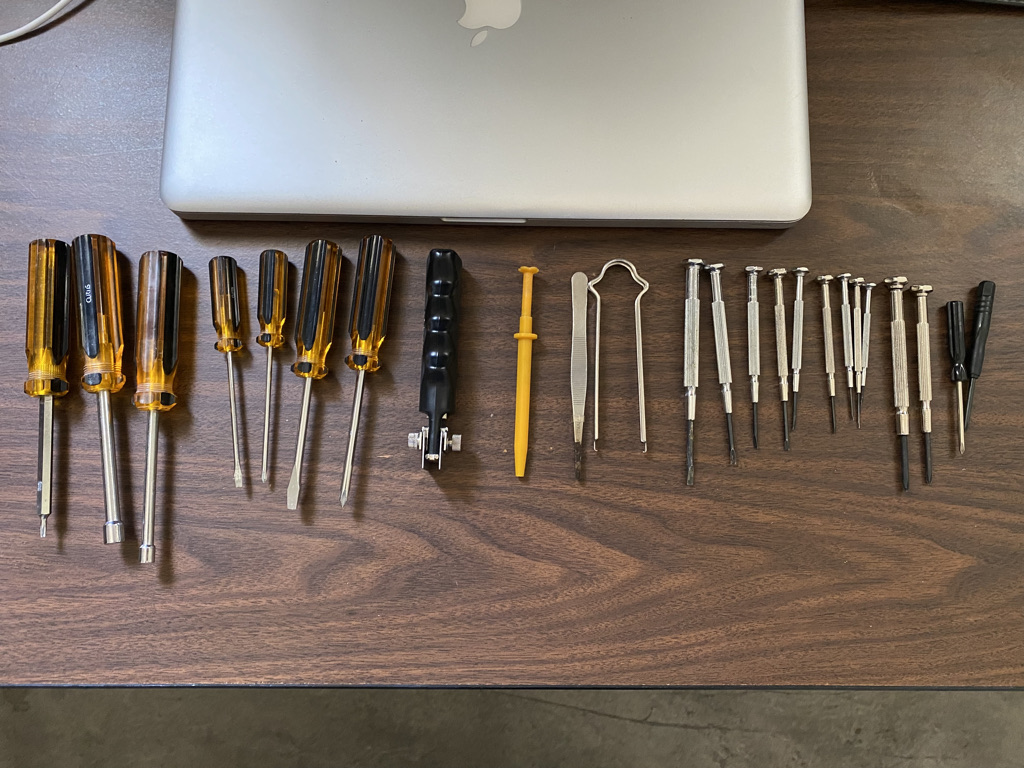
I remember using these small screwdrivers (below) when I built my own PC in 2004.
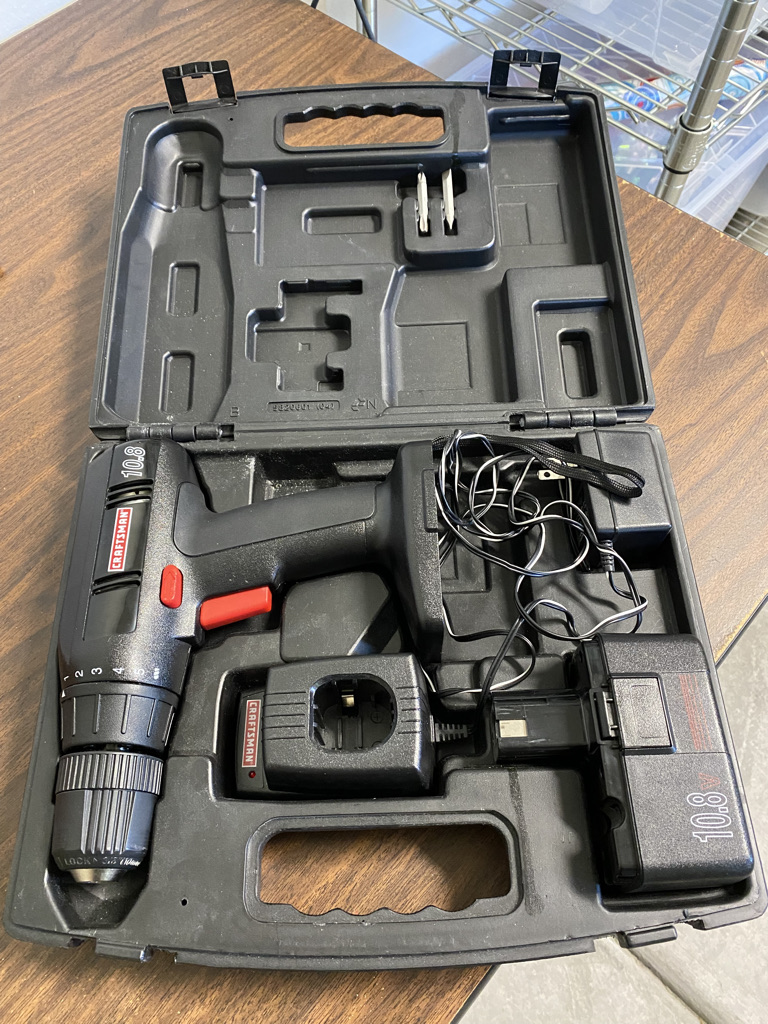
This old power drill’s battery keeps its charge for just a few minutes, and it’s so slow that I can only use it on drywall… maybe particle board on a good day. If I ever want to use it, I always have to charge the battery first since the battery won’t hold a charge in storage.
I’d normally feel a mild sense of dread whenever I had to use this drill, so sometimes I’d prefer to use an ancient hand-crank drill instead. That hand drill wasn’t a great choice either since it was designed for right-handers, and I’m a leftie, so I either have to use it right-handed or turn the drill in a way that feels unnatural for me. That isn’t so good for safety reasons.
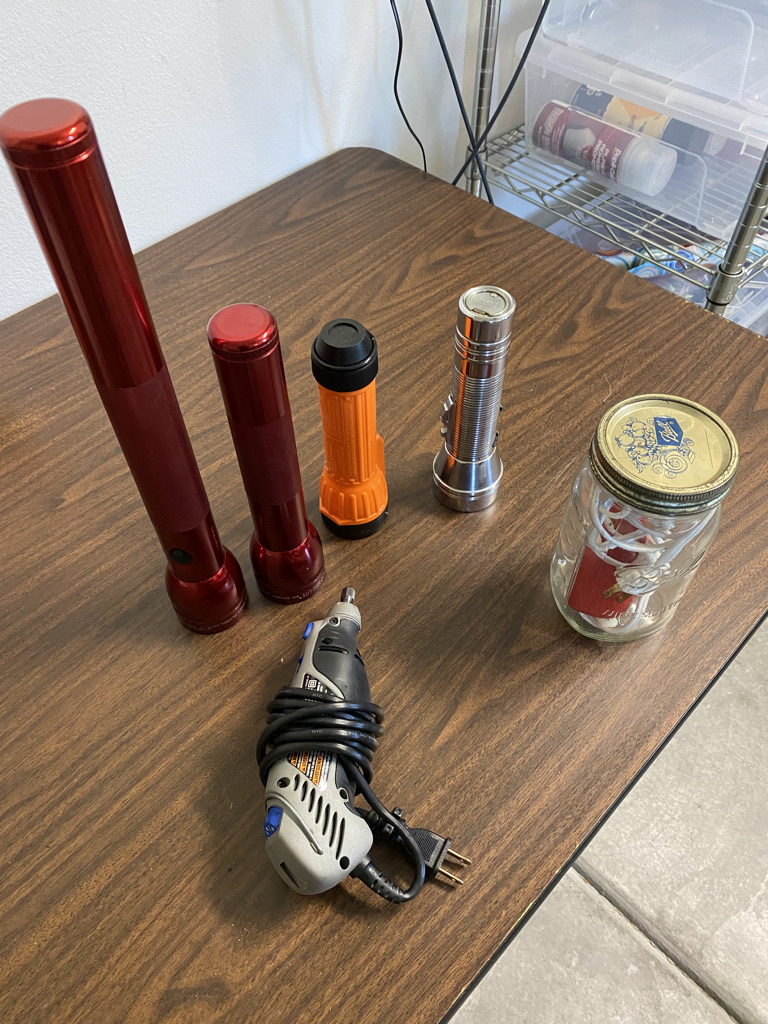
Here are some old flashlights, an etcher that I’ve never used, and a plug-in drill that only takes tiny bits.
Remember when Maglites were cool? Yes – the 80s. Admittedly I bought those myself… couldn’t resist the 2-pack. And I did at least use them a lot.
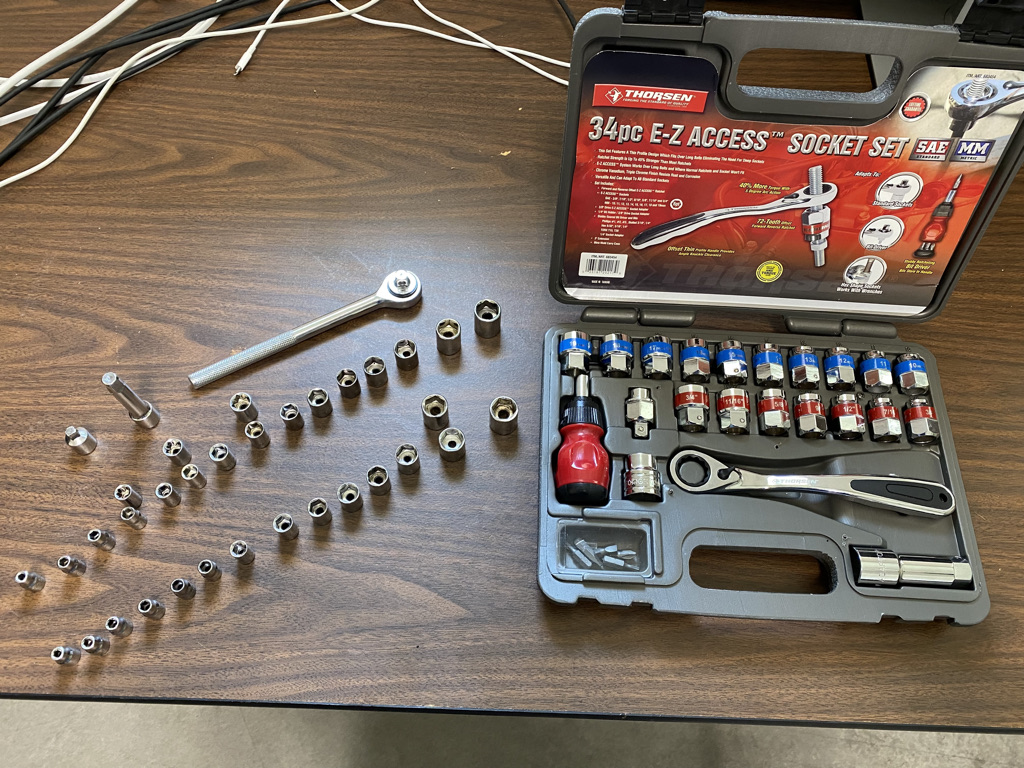
I had 2 old socket wrench sets, neither of which I liked. One had a broken extender – the small metal ball bearing fell out of it, so it wouldn’t stay in place.
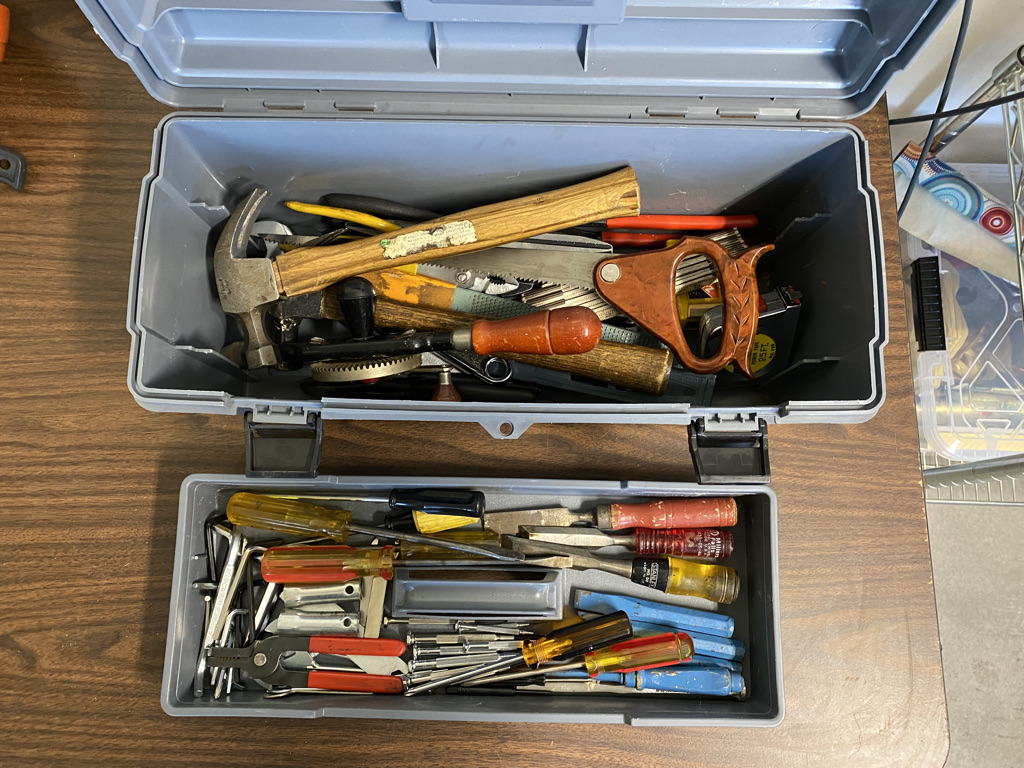
At the bottom of this toolbox was a gooey substance I couldn’t identify – I think that substance may have moved by itself one time, and I’m pretty sure it would emit light on Tuesdays.
I didn’t love these old metal toolboxes, but at least they were functional. My dad is from Indiana, so I’m sure the Indy 500 toolbox was something he bought.
Almost all of the old items have been sorted and donated (and cleaned to the extent possible without resorting to magic). Hopefully they’ll be appreciated by someone somewhere.
Starting Fresh
I decided to start fresh by building a tool collection that I would like, based on the kinds of projects I typically do around the house and garage. I spent a good bit of time researching the latest tools and decided what would be a good fit.
I’m not an auto mechanic or a carpenter, so I don’t need the most amazing or durable items, but I didn’t want dirt cheap items that were likely to disappoint me. I wanted tools that I would like and appreciate, both when I saw them and when I used them. So I used appreciation as my main standard for making selections. I kept asking, “Am I likely to appreciate this?”
I wanted to compile a set of tools that would feel abundant and empowering but not excessive for my needs. I appreciate abundance but not to the point of ridiculous excess. I didn’t replace some items with equivalent tools if I sensed that I would probably never need those types of tools (such as wood chisels). If I felt I would later regret a purchase, I avoided it.
I made a few mistakes and did some returns / exchanges, but overall I’ve been pleased with my initial picks. I’ve only had a chance to test some of these tools so far, but I look forward to a healthy relationship with them for many years to come.
I got most of these items via Amazon, and some I picked up locally at Lowe’s, Home Depot, and Costco.
New Tools
Here are some pics of the new tools I gradually acquired. After decades of used tools, I wanted to start with fresh energy.
I got new 3 new tape measures (two 16’ and one 12’), all self-locking. I tend to use these a lot, so I got one for my home office, one for the garage (toolbox), and one for upstairs.
Why aren’t all tape measures self-locking? When do you ever want to pull it out and have it immediately slide back into the housing? When I pull mine out, I want it to stay long and strong by default… till I’m ready to release it.
There are two new 12-piece ratcheting wrench sets (SAE and metric) and a new Dewalt socket wrench set (with SAE and metric sockets in a nice case). Between those is a universal socket – I tried it out, and it works surprisingly well. I love these wrench sets. This might be a tad overkill for my needs, but it’s really nice to have the perfect size for any job instead of having to over-rely on an adjustable wrench that might slip.
I got two sets of Allen wrenches (SAE and standard) that include nice rubbery holding cases to keep them organized by size. I like tools that self-organize with some sense of order or symmetry – they just seem smarter to me.
I got a new 16 oz mallet, which is nice for situations when a steel hammer might be too harsh.
I added new eye protection goggles (to replace the old ones that looked like something I used in high school chemistry). These fit nicely with or without glasses, and they’re anti-fogging.
I got two good utility knives – okay, just one knife is new, and the other I had bought previously. I liked the previous one so much that I decided to add another, so I could keep one in the house and one in the garage. I tend to use these a lot.
I got 9″ and 16″ levels, both magnetic. The smaller one has a built-in ruler. The larger one is nice for marking off spots for hanging a painting or poster. I considered getting a 24″ one, but that seemed like overkill, and I like that the 16″ one still fits in the toolbox.
In the back left, there are two LED flashlights. both of which are WAY brighter and much smaller and lighter than my old flashlights. They use AAA batteries instead of the D batteries in the Maglites, so they’re more energy efficient too. These flashlights lights have 3 brightness settings, and the beams can tighten or widen just by twisting the top. I actually got 4 of these since a 2-pack was only $10. I keep one in the garage, one in the car, and two in the house. They feel very solid, made of “military grade” aluminum (whatever that means).
There are also 2 rechargeable LED work lights (picked up at Costco on sale for $10 off the pair). These are nice and bright, and they have built in stands, hooks, and strong magnets, so they’re very versatile to position. Each light also has a built-in USB charger, so it can be used as a battery to charge a phone or other USB device as well – I don’t need that feature while at home, but it could be handy on a camping trip.
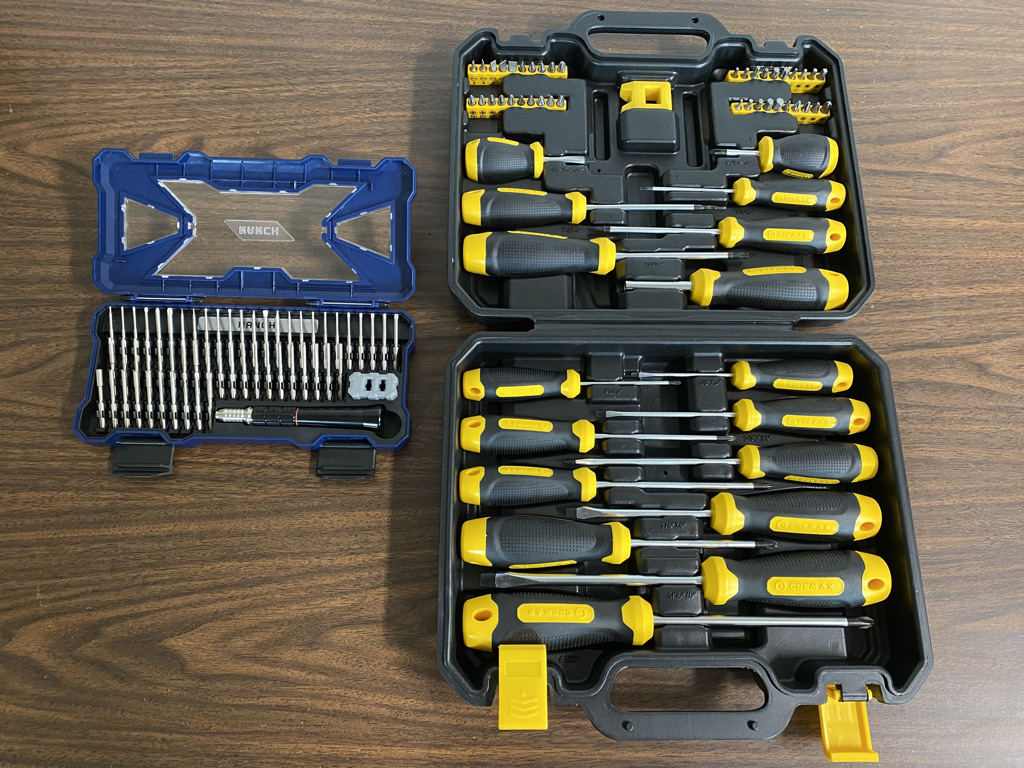
I got two new screwdriver sets, each with 57 pieces and their own storage cases. The left one is a precision set for working with small screws like on electronics or eye glasses. It has many different kinds of bits. I like that each bit has a long shaft, and the handle has a built-in extender as well, which is good for screwing in deep holes. I will never use all of these bits, but it feels nice to have such a good collection in a compact space – an excellent replacement for my old set.
The set on the right has nice grippy handles, and I like that it sorts the screwdrivers by type and size. It also includes many other assorted bits at the top of the case (which can be used with a power drill as well).
Both kits come with a magnetizer / demagnetizer, so you can magnetize or demagnetize the tips.
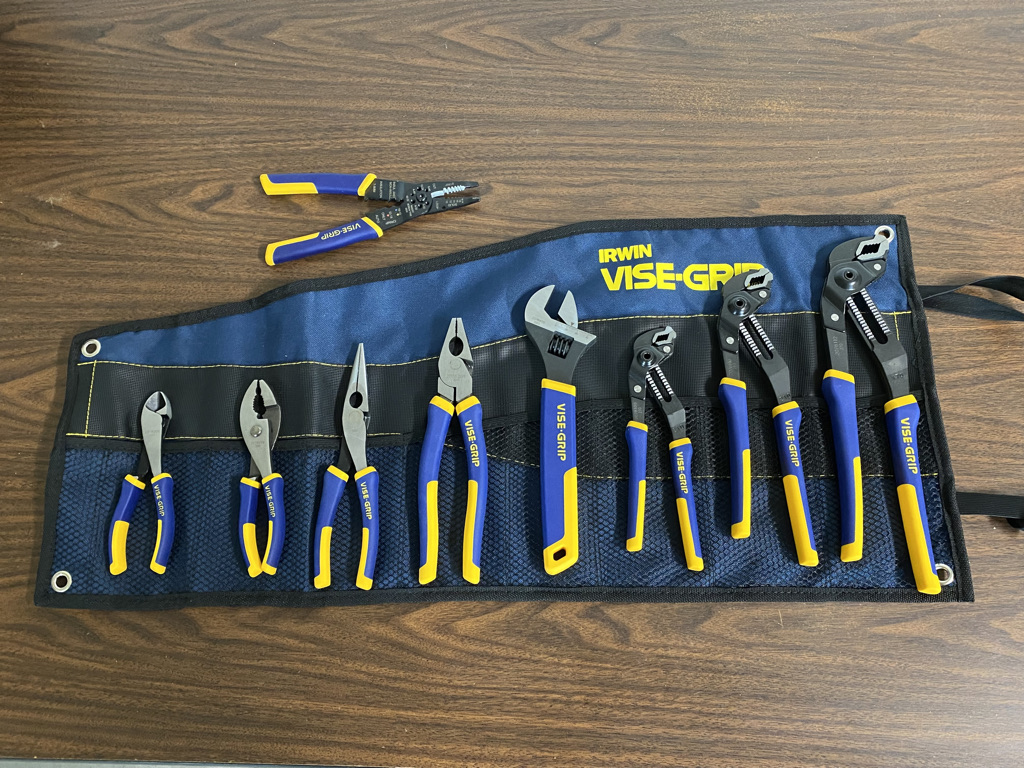
I love this set of pliers and wrenches. It comes with a strong cloth carrying case with pouches for each tool, and it easily rolls up and has elastic straps to secure it into a nice bundle. I prefer to put the tools in a toolbox though for faster access. Unlike my old adjustable wrenches, the adjustable wrench in this set is very good at holding its position.
I also added a new wire stripper, which is capable of cutting screws too.
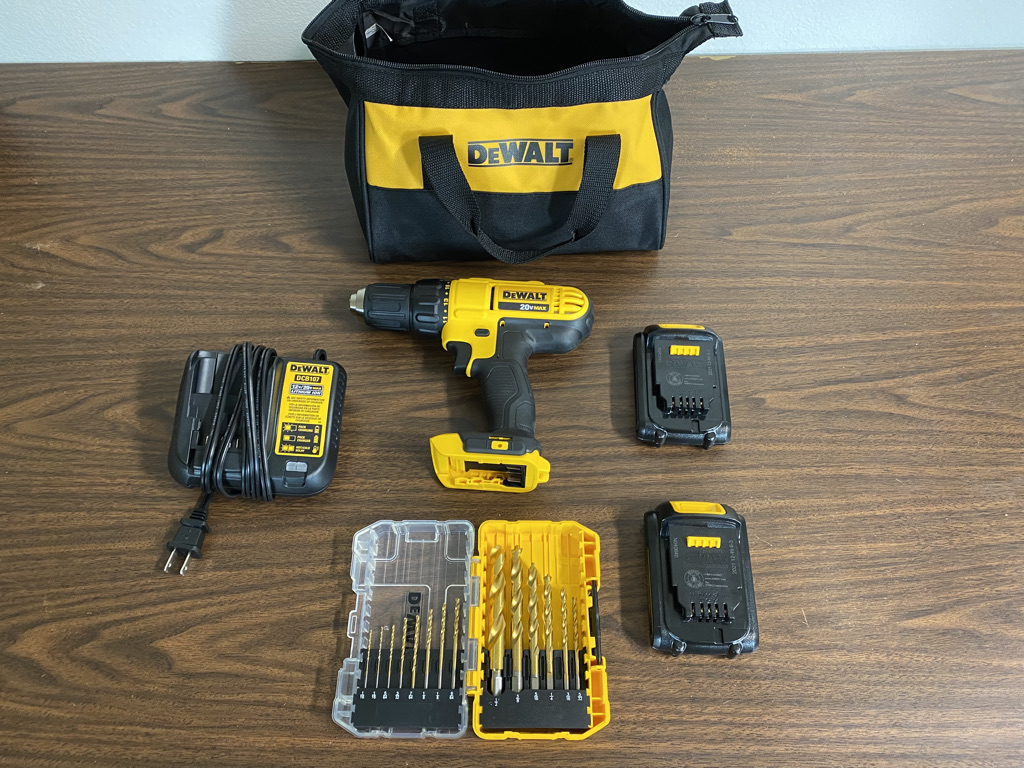
This new Dewalt power drill / driver is so nice. It comes with 2 rechargeable batteries, each of which should last for hours. Apparently these batteries can hold their charge for 18 months when not in use, so I can simply pop in a battery and use this drill without having to charge it first. Two batteries is overkill for my needs, but that’s what the set came with.
I also picked up a set of 14 titanium drill bits, which seem way nicer than the few sad drill bits I previously had.
This drill comes with a nice carrying bag that fits everything shown with room to spare.
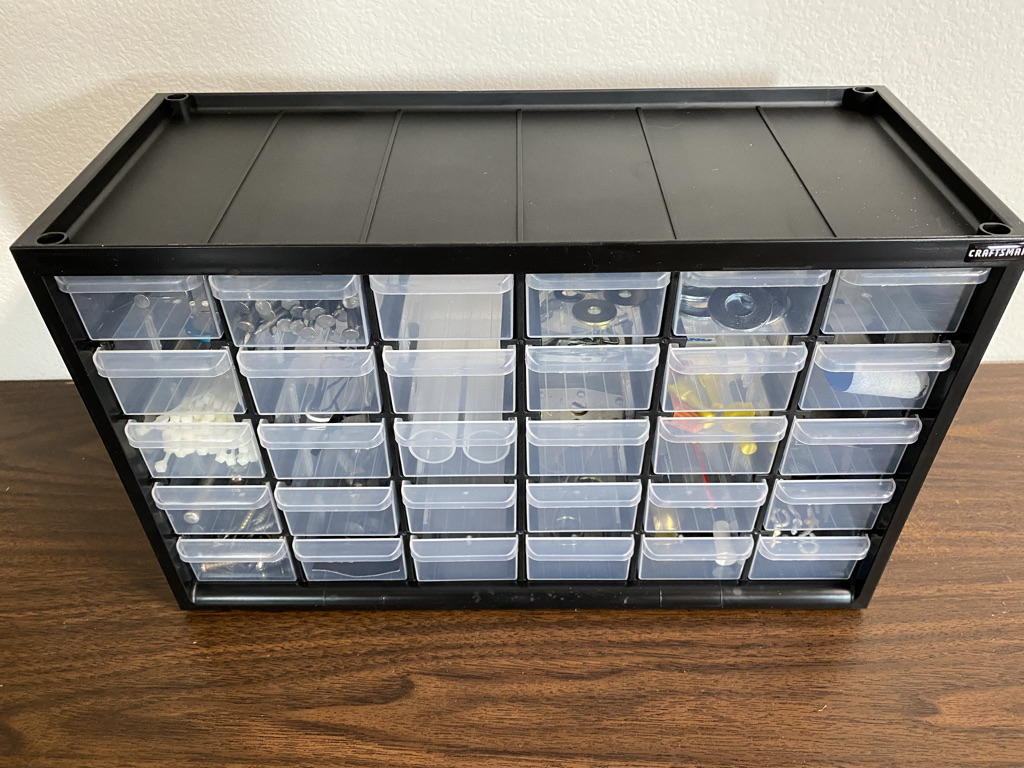
This small 30-drawer cabinet is great for storing odds and ends like nails, screws, washers, zip ties, etc. No more mega jar with everything mixed together.
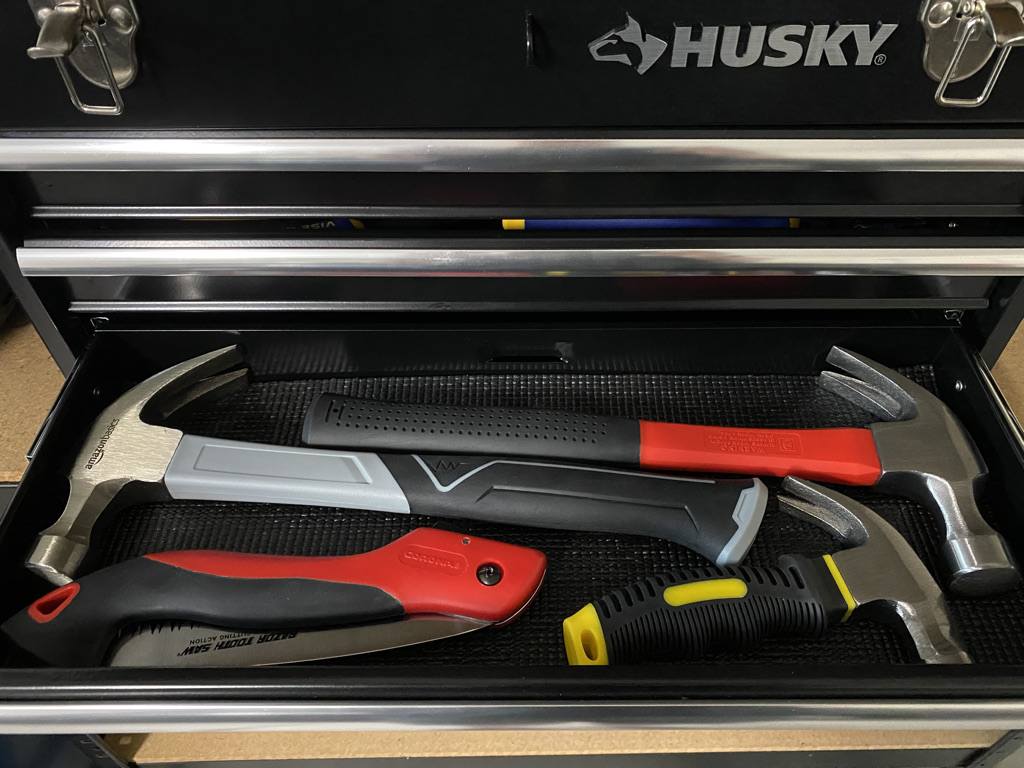
I replaced two crusty wood-handle hammers (both of which had tops that were coming loose) with these fiberglass-handle hammers: a 20-oz hammer, a 16-oz hammer, and a small stubby hammer.
In the same drawer is a 7″ folding hand saw (useful for trimming small branches). I’ve never needed a power saw or chainsaw.
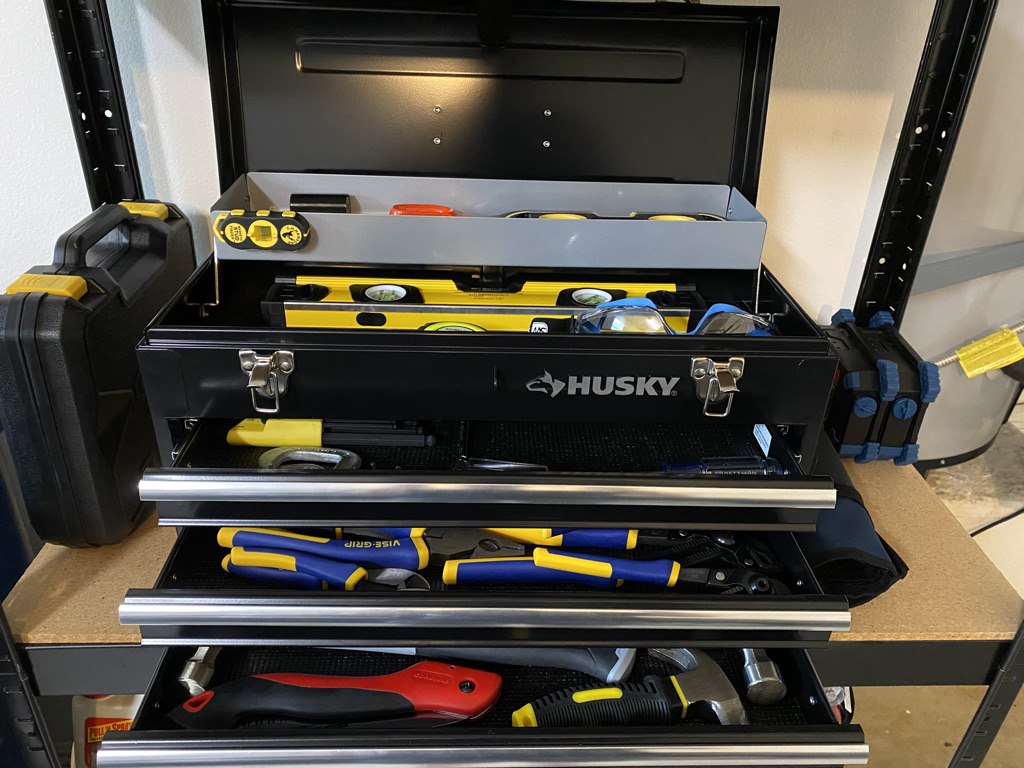
Here’s my new toolbox. I got one larger one to replace the three smaller boxes I had previously. It has a top area and 3 drawers. I added some padded drawer liners to it, so the drawers are lined with a soft but durable material. It’s like all of the tools now rest on a thin yoga mat.
Somehow it feels like giving the tools a nice home with cushy padding is a nice way to show them respect and appreciation. This is surely better than how I treated my old tools. I even talked to the new tools to welcome them into my home. In my journal this week, I wrote a private letter saying goodbye to my old tools, releasing their energy back to the simulator.
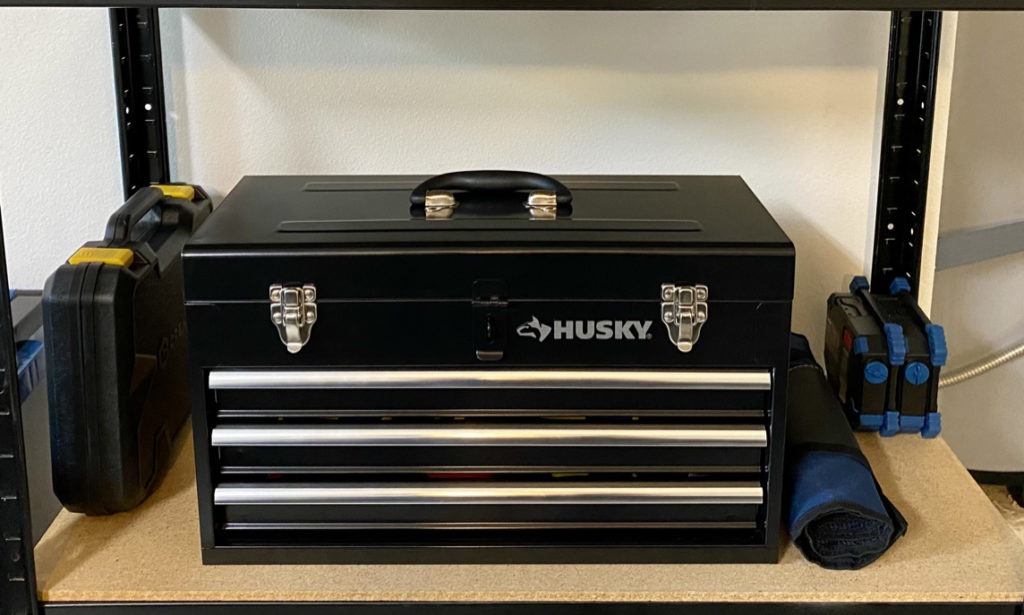
This is what the toolbox looks like when closed. It’s about 12″ tall. Not bad for $50. The drawers open and close very smoothly too. I don’t intend to carry it around, so this is its permanent home on a shelf in my garage.
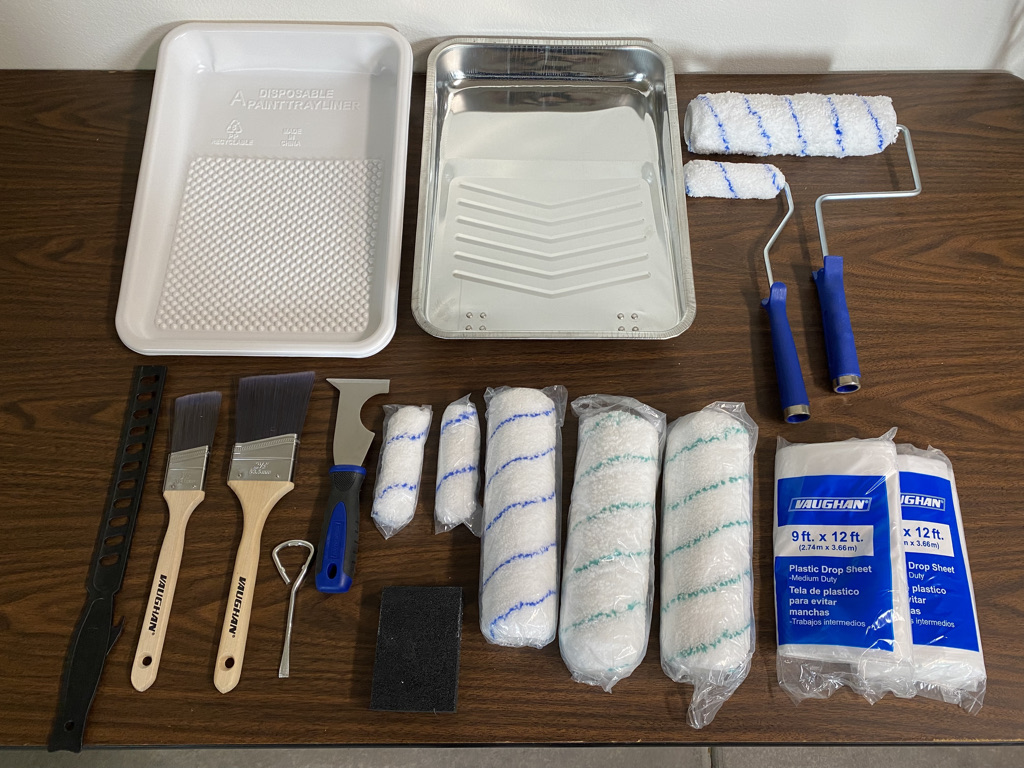
I also got this painting set, which I keep elsewhere in the garage. It’s currently $15 at Costco.
I bought two new fire extinguishers, one for the house and one for the garage as a backup. I had some old ones in my house that apparently expired in 1999 (seriously). The new ones say they’ll last for a good 12 years, so I wonder if the old ones were from the 80s – that is possible.
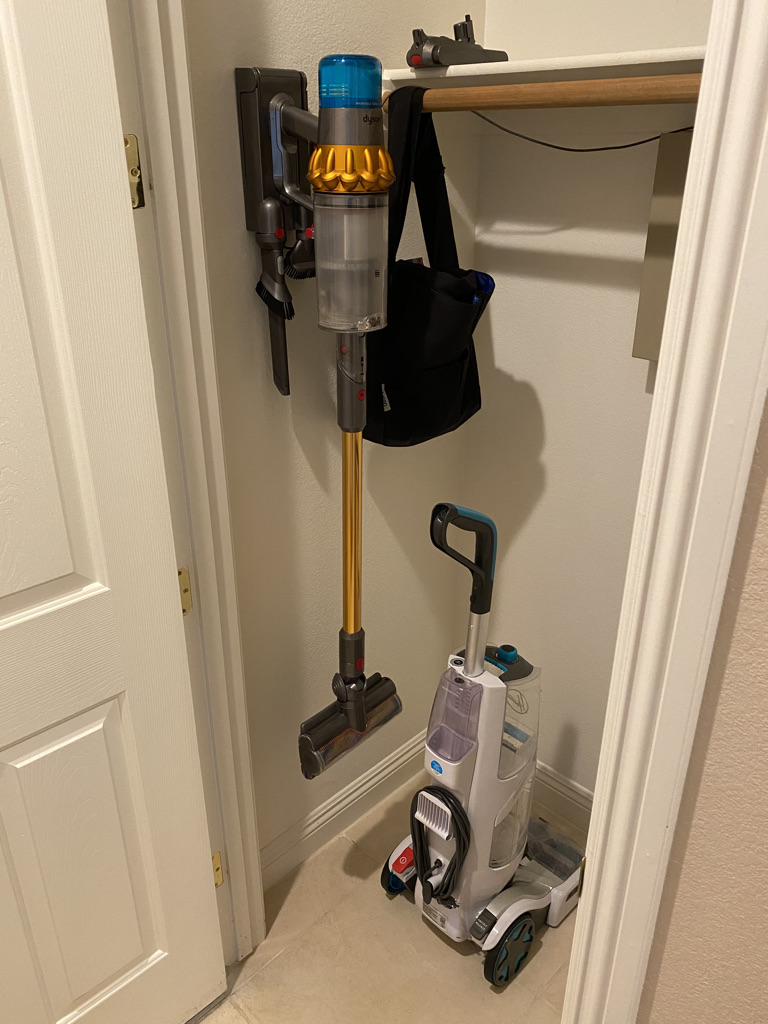
We’ve been making some other upgrades too this summer to help keep the house in better shape. Here’s a new Dyson V15 Detect vacuum that I got in June. I like it so far and picked up an extra battery for it. It’s the first Dyson I’ve ever owned, and I dare say that it’s even fun to use. Previously I was using a Roomba, but it’s not nearly as powerful as the Dyson. I like that the transparent bin easily shows what’s being sucked out of the carpet. This fairly recent model also has a display that shows the particle count of what it’s picking up (actually 3 different counts for different particle sizes). That feature seems like mostly a gimmick, but I still find it very satisfying to see the numbers go up, especially when it passes 1 billion. Having a vacuum that provides this extra visual feedback makes other vacuums seems a lot dumber… like what are they trying to hide by not sharing their performance data?
At least I now know for sure that Roomba is shit… at least as far as actual cleanliness goes.
On the floor there’s a new Hoover Smartwash+ carpet cleaner – I’ve tested it on one room so far, and it worked really well. I like that it automatically washes when I push it forward and dries when I pull it back, so there’s no need to hold down a trigger. It’s very easy to use. This combo of the new vacuum and carpet cleaner is nicely transforming the floors in my house.
This is the kind of project that I always could have put off by telling myself that there are more important things to do. But it felt good to finally do it.
I like and appreciate the new tools. I like that I no longer have to deal with the old misaligned mess of tools that I had before. I like that I took my time with this project and did it patiently, without rushing, and free of deadlines.
I especially like that I got the framing right before I started, so I was able to take action with ease. I felt nicely motivated the whole way through and even had fun with it. While doing the tools research, I learned some things I didn’t know before, so it was educational as well.
I framed this as an upgrade project – an invitation to completely transform my old tool collection into a new collection that I would henceforth appreciate. Purge the energy of disgust and irritation, and replace it with gratitude.
So there was an inner journey from having a poor relationship with my tool collection to discovering how to create a positive and healthy relationship. This permanently changes how I feel towards a small (but not insignificant) slice of my reality. Now every time I enter the garage and notice the different toolbox and tools, I feel differently. There’s a newfound sense of ease and even a little excitement. And admittedly there’s a little bit of discomfort since I’m still getting to know the new tools, but I imagine that will pass in time.
This also changes how I relate to home maintenance projects going forward. Now those projects seem a little more attractive because I look forward to using the nice new tools. Yesterday I noticed a loose screw on a towel hangar in the laundry room, and I happily grabbed one of the new screwdrivers to fix it, which felt more rewarding than I expected.
One key that I found is the importance of maintaining the right pacing. I can’t rush because that just makes such a project feel stressful, and I will doubt my decisions if I try to decide too quickly. It’s best to do the research patiently and then let my mind incubate some options till I have a strong sense of clarity. I held off on buying items when I was in doubt about what to get.
On the other hand, I can’t go too slowly either since then the energy of the project will die on me. I have to keep nudging it forward day by day to maintain a sense of progress. On a single day, I might figure out one or two items, like which screwdriver set to get. But over the course of a few weeks, all of those little decisions add up to a bigger transformation.
Think about some area of life where you’ve been tolerating misalignments. Could you undertake a complete transformation of that part of life, gradually chipping away at the misalignments one by one and upgrading or replacing them with changes that you’d appreciate?
What if you allowed such a project to take as long as it needs to take with no deadlines or time pressure? Could you approach it as an exploration and a learning experience, doing whatever you need to do to make reasonably good decisions at each step, so day by day you’re advancing towards a bigger transformation that you’ll really appreciate?
Remember that you don’t have to make perfect decisions in order to create significant improvement. I can’t say that I have the perfect tool set for me, but it’s a clear improvement over what I was dealing with before, and that’s good enough to call it done.
Celebrities have been sharing some dirty secrets – about their own hygiene habits.
It all started when Ashton Kutcher and Mila Kunis confessed that they don’t bathe daily. The pair told the Armchair Expert podcast that other than washing important parts of their bodies, they don’t shower every day, and this approach is something they’ve extended to their children.
Advertisement
Kunis told host Dax Shepard: “I don’t wash my body with soap every day. I wash pits and t*** and holes and soles… When I had children, I also didn’t wash them every day. I wasn’t the parent that bathed my newborns – ever.”
Kutcher agreed by saying: “If you can see the dirt on them, clean them. Otherwise, there’s no point.”
Advertisement
Other celebs soon joined the debate, with Jake Gyllenhaal admitting: “More and more I find bathing to be less necessary.” But we all breathed a sigh of relief, when Dwayne “The Rock” Johnson reassured us showering is still cool, telling fans: “I’m the opposite of a ‘not washing themselves’ celeb.”
Their antics have sparked an online debate about hygiene and whether we should be taking a shower every single day. Considering the past year has focused on staying clean and trying not to get Covid-19, we asked a leading expert how much washing is enough.
Advertisement
stevecoleimages via Getty Images
Professor Sally Bloomfield from the London School of Hygiene and Tropical Medicine actually agrees with Kunis and Kutcher. “I think it’s important that we don’t wash every single day,” she tells HuffPost UK.
“The skin is our barrier and it’s evolved and developed to have properties that sustain that barrier function, against the ingress of disease and toxins and so forth so it wasn’t developed to be washed every day.”
Washing our skin every day can wash off natural oils and upset the natural balance and the essential properties of the skin, Bloomfield adds. She knows bathing is a source of personal comfort, but doesn’t see washing every day as necessary.
Similar to Kutcher and Kunis, Bloomfield thinks we should be washing specific parts of our body every day. “Most of our body odours come either from the armpits or the anal area and they can be quite well controlled by washing those sensitive areas daily without having to bathe the whole body,” she says. “If it’s very hot and you’re sweating, then you will want to rinse off the salts and make yourself feel comfortable again. Obviously, personal hygiene is important for controlling odour.”
Advertisement
How about it when it comes to preventing diseases such as Covid-19? Since Covid is an airborne transmitted disease, Bloomfield says you don’t need to wash your entire body, only your hands. “It’s controlled by good hand hygiene and hand contact hygiene. You’re only getting it on your hands, you’re not getting on your whole body. There’s no point in washing your whole body because the risks of transmission via your body are very, very small, all you need to do to prevent transmission of infection, is by keeping it off your hands and prevent your self-touching.”
The only way we get some infections is by touching our mouth, nose, and face. Other infections are caught by a breakdown in the body such as cuts or grazes. So overall, Bloomfield doesn’t see any health benefits to having a daily shower.
Those are the facts, but we won’t be ditching bath time just yet. Sorry, Dr Bloomfield.
This month marks 18 years since one of the most entertaining films to leave Walt Disney Pictures graced our cinema screens – Freaky Friday.
It showcases a mother-daughter duo – played by Lindsay Lohan and Jamie Lee Curtis – who switch bodies once a spell takes effect, with unexpected consequences.
A remake of Disney’s previous 1976 and 1995 adaptations, the 2003 family comedy was a major success, with many young people and their parents finding it hilariously relatable to their lives in one way or another.
To mark Freaky Friday’s milestone anniversary, we’ve uncovered 13 facts you probably didn’t know about it.
DisneyLindsay Lohan and Jamie Lee Curtis in Freaky Friday
1. Lindsay’s character was originally supposed to be a goth
When the Parent Trap star read the original script, she thought Anna’s character was a bit too scruffy. “There was nothing there, no one can relate to the character when she’s really goth,” she told Vanity Fair in 2006.
To recreate her own envision, LiLo turned up to the audition dressed extremely preppy, which worked to her benefit as the character was rewritten.
2. The shots in the opening credits are actual photos of Jamie Lee Curtis and her daughter Annie Guest
DisneyJamie Lee Curtis and her daughter Annie Guest
We all love a fake snapshot or two at the beginning of a film, but who knew the photos at the start of Freaky Friday actually captured true moments from Jamie Lee’s real life.
One sees her daughter as a toddler laying on her mother’s back, with her arms tightly placed around her neck.
3. Lindsay had to give Jamie Lee precise lessons on how to say ‘shut up’
During a promotional interview on YouTube, the True Lies actor admitted to needing help from her then-teenage co-star with the specific way she said ‘shut up!’
“There’s a way she says shut up that I couldn’t get. She had to give me a ‘shut up’ tutorial because it’s a very specific way,” she said.
Jamie Lee, who was raising 16-year-old daughter Annie Guest at the time, claimed that starring in this film with a young person helped her see things from her child’s point of view.
“I think I probably have a judgmental bitch badge that I put on because I can be harsh, and I think that walking a mile in some very uncomfortable teenage shoes gave me the opportunity to see what it’s like on the other side,” she said.
4. Gwen Stefani was offered a role as a member of the band
Paul Archuleta via Getty Images
According to IMDB, the US singer was offered a role as a member of Anna’s band, but sadly we didn’t get to see that happen – although we think she would have been a perfect addition to that cast.
5. Michelle Trachtenberg was supposed to be Anna
MICHAEL TRAN via Getty Images
The Ice Princess star was first to be cast as the mouthy teenager, but had to back out of the project due to her her contract with Buffy the Vampire Slayer, where she played Dawn Summers.
This was actually the second film Michelle turned down in which LiLo later landed the lead gig – the first being The Parent Trap in 1998, in which Lindsay made her name.
6. Kelly Osbourne also auditioned for the role
Denise Truscello via Getty Images
The star, known for her family reality show The Osbournes, was also offered the part of Anna after auditioning, but had to pull out after her mother Sharon was diagnosed with cancer.
Kelly later described how people told her it was the biggest mistake of her career, due to the success of the film.
7. Lindsay’s mum made an appearance in the movie
Disney
LiLo’s mum Dina can be seen in the final scene where Anna is dancing with Jake. Dina is in the background dancing with an older man, but there is an awkward moment where she is seen looking directly at the camera.
8. The famous Anna and Tess collision scene is similar to a scene in Bewitched
Anna and Tess’ idea to collide at full force in an attempt to reverse the spell is similar to a scene in 1966′s Bewitched: Divided He Falls, where Darrin is split into two people and Endora suggests he do the same to break the spell.
However, in this scene, the trick had the desired effect.
9. Lindsay had her first on-screen kiss in Freaky Friday
Disney
In a behind the scene YouTube clip, Lindsay admitted that the kiss she shared with co-star Chad Michael Murray was the first she had done on screen.
10. Lindsay went on to win three awards for the movie
Freaky Friday quickly became a Disney fan favourite in the early 2000s and Linday took home three awards for her performance of both Anna and Tess Coleman.
At the 2004 Teen Choice Awards, she won Choice Breakout Movie Star and Choice Hissy Fit. She then added to that at the MTV Movie Awards, receiving the Best Breakthrough Award in 2004.
11. The film paid homage to Jamie Lee Curtis’ mother
A character named Mr Bates appears in the film as a tribute to the actor’s mother, Janet Leigh who is best known for her performance in the 1960 film Psycho.
Mr Bates is a reference to Norman Bates’ character in the classic movie.
12. A member of the band Orgy instructed Jamie on how to play the guitar for the last scene
Moviestore/Shutterstock
Orgy, an American rock band formed in 1994, offered up one of their members to teach Jamie Lee how to play the guitar, and although the actor practiced making the concert scene look as authentic as possible, a studio musician dubbed over the guitar solo in the finished film.
13. Freaky Friday is based on Mary Rodgers 1972 novel of the same name
Rodgers’ story was adapted many times, including the original Disney version in 1976.
In 2020, it was the source for the movie Freaky, which focuses on a teenage girl who unintentionally swaps bodies with a middle-aged male serial killer.
You are reading Anywhere But Here, our summer-long series on travel at home and abroad, serving up the information and inspiration you need.
When we see a beautiful field of flowers, it makes us want to do one of two things: pick them or post a pic of them.
Advertisement
Well, we’re in luck, as it’s the Flower Farmers’ Big Weekend from August 13-15 – an invitation for flower lovers to meet growers from across the UK, explore their fields, pick an arm (or posy) full, where allowed – and generally learn what goes on behind the scenes to produce these incredible blooms.
In fact, the PYO (pick-your-own) flower scene is only growing in popularity in this country, so much so that the team at holidaycottages.co.uk have rounded up some of the prettiest flower fields to visit over the summer months.
Advertisement
Try not snapping this lot to the gram – we know you won’t be able to resist.
1. Dahlia Beach, Millets Farm, Oxfordshire
Advertisement
Millets Farm claims to be the UK’s largest pick-your-own spot for dahlias – very much the flower of the moment. As well as PYO, the farm runs workshops, such as a guide to growing borders, which takes place on the pink double decker Dahlia Beach bus.
2. Strawberry Fields, Lifton, Devon
Lifton Farm marks the changing of the seasons with an evolving range of pick-your-own experiences from strawberries to maize to sunflowers to pumpkins. August is very much sunflower time – and the farm shop is also worth a visit.
Strawberry Fields, Lifton, Devon, PL16 0DE
Advertisement
3. Flower Fields at Wyke Manor Estate, Worcestershire
As well as more sunflowers, the main attraction at Wyke Manor Estate is the Confetti Field, which is harvested to create petal confetti every summer. Check out the virtual field online first to plot your day.
Wick, Pershore, Worcestershire WR10 3NZ
4. Vine House Farm, Lincolnshire
Vine House Farm’s main business is bird food, but their sunflower fields are also spectacular and best seen in August. Don’t miss the shop and cafe too.
Main Road, Deeping St Nicholas, Spalding PE11 3DG
5. Blooming Green, Kent
Blooming Green’s pick-your-own haven is open every Saturday between June and October, and is particularly popular with those doing a DIY wedding. Flowers don’t get much fresher and the tea and cake is also rated very highly.
Loddington Farm, Linton, Maidstone ME17 4AG
6. Cairnie Fruit Farm, Fife
Advertisement
Cairnie Fruit Farm spans 120 acres of Scottish countryside and is open between June and September to visitors. It’s hard to pick what to pick: succulent berries and cherries or sunflowers and other blooms from the beautiful fields of Fife.
Cairnie, Cupar KY15 4QD
Travel is the story of our summer. The rules (and traffic lights) are always changing, but one thing’s clear, we dream of being Anywhere But Here. This seasonal series offers you clear-headed travel advice, ideas-packed staycation guides, clever swaps and hacks, and a healthy dose of wanderlust.
Thousands of COVID-19 cases and deaths in California, Oregon, and Washington between March and December 2020 may be attributable to increases in fine particulate air pollution (PM2.5) from wildfire smoke, according to a new study co-authored by researchers at Harvard T.H. Chan School of Public Health.
The study is the first to quantify the degree to which increases in PM2.5 pollution during the wildfires contributed to excess COVID-19 cases and deaths in the U.S. It was published online August 13, 2021, in Science Advances.
“The year 2020 brought unimaginable challenges in public health, with the convergence of the COVID-19 pandemic and wildfires across the western United States. In this study we are providing evidence that climate change — which increases the frequency and the intensity of wildfires — and the pandemic are a disastrous combination,” said Francesca Dominici, Clarence James Gamble Professor of Biostatistics, Population and Data Science at Harvard Chan School and senior author of the study.
In 2020, at the same time the nation was contending with the COVID-19 pandemic, huge wildfires swept across the western U.S., including some of the largest ever in California and Washington. Wildfires produce high levels of fine particulate matter (PM2.5), which has been linked with a host of negative health outcomes, including premature death, asthma, chronic obstructive pulmonary diseases (COPD), and other respiratory illnesses. In addition, recent studies have found a link between short- and long-term exposure to PM2.5 and COVID-19 cases and deaths.
The researchers — from Harvard Chan School, the John A. Paulson School of Engineering and Applied Sciences at Harvard University, and the Environmental Systems Research Institute in Redlands, Calif. — built and validated a statistical model to quantify the extent to which wildfire smoke may have contributed to excess COVID-19 cases and deaths in California, Oregon, and Washington, three states that bore the brunt of the 2020 wildfires. They looked at the connection between county- and daily-level data on PM2.5 air concentrations from monitoring data, wildfire days from satellite data, and the number of COVID-19 cases and deaths in 92 counties, which represented 95% of the population across the three states. The researchers accounted for factors such as weather, population size, and societal patterns of social distancing and mass gatherings.
The study found that from August 15 to October 15, 2020, when fire activity was greatest, daily levels of PM2.5 during wildfire days were significantly higher than on non-wildfire days, with a median of 31.2 micrograms per cubic meter of air (µg/m3) versus 6.4 (µg/m3). In some counties, the levels of PM2.5 on wildfire days reached extremely high levels. For instance, from September 14 to September 17, 2020, Mono County, Calif., experienced four days in a row with PM2.5 levels higher than 500 µg/m3 as a result of the Creek Fire. Such levels are deemed “hazardous” by the U.S. Environmental Protection Agency.
advertisement
Wildfires amplified the effect of exposure to PM2.5 on COVID-19 cases and deaths, up to four weeks after the exposure, the study found. In some counties, the percentage of the total number of COVID-19 cases and deaths attributable to high PM2.5 levels was substantial.
On average across all counties, the study found that a daily increase of 10 µg/m3 in PM2.5 each day for 28 subsequent days was associated with an 11.7% increase in COVID-19 cases, and an 8.4% increase in COVID-19 deaths. The biggest effects for the COVID-19 cases were in the counties of Sonoma, Calif., and Whitman, Wash., with a 65.3% and 71.6% increase, respectively. The biggest effects for the COVID-19 deaths were in Calaveras, Calif., and San Bernardino, Calif., with a 52.8% and 65.9% increase, respectively.
When the researchers looked at individual wildfire days and at individual counties, they found that Butte, Calif. and Whitman, Wash. had the highest percentages of total COVID-19 cases attributable to high levels of PM2.5 during the wildfires: Among the total number of COVID-19 cases that occurred in these counties, 17.3% and 18.2%, respectively, were attributable to high levels of PM2.5. Butte, Calif. and Calaveras, Calif. had the highest percentages of total COVID-19 deaths attributable to high levels of PM2.5 during the wildfires: Among the total number of COVID-19 deaths that occurred in these counties, 41% and 137.4%, respectively, were directly attributable to high levels of PM2.5.
Across the three states studied, the cumulative number of COVID-19 cases and deaths attributable to daily increases in PM2.5 from wildfires was, respectively, 19,700 and 750, the study found.
“Climate change will likely bring warmer and drier conditions to the West, providing more fuel for fires to consume and further enhancing fire activity. This study provides policymakers with key information regarding how the effects of one global crisis — climate change — can have cascading effects on concurrent global crises — in this case, the COVID-19 pandemic,” said Dominici.
Co-first authors of the study were Xiaodan Zhou of the Environmental Systems Research Institute and Kevin Josey from the Department of Biostatistics at Harvard Chan School. Leila Kamareddine of the Department of Biostatistics at Harvard Chan School also contributed, as did Miah C. Caine and Loretta J. Mickley from Harvard’s John A. Paulson School of Engineering and Applied Sciences, and Tianjia Liu from Harvard’s Department of Earth and Planetary Sciences.
Funding for the study came from the Environmental Protection Agency (grant 83587201-0), the National Institutes of Health (grants R01ES026217, R01MD012769, R01ES028033, 1R01AG060232-01A1, 1R01ES030616, 1R01AG066793-01R01, 1R01ES029950, and 5T32ES007142), the Alfred P. Sloan Foundation, and the Vice Provost for Research-Harvard University.
For years, researchers at the Harvard John A. Paulson School of Engineering and Applied Sciences (SEAS) have engineered metasurfaces to manipulate light based on its polarization state. That research has contributed to advances in polarization technology — but metasurface technology has proven more powerful than even the researchers themselves realized.
Now, researchers have uncovered hidden potential in these metasurfaces and, in a new paper, demonstrated optical devices that manipulate light’s polarization state with an unprecedented degree of control.
“This research shows that the ability to switch between holographic images that need not be limited to just two polarization states,” said Federico Capasso, the Robert L. Wallace Professor of Applied Physics and Vinton Hayes Senior Research Fellow in Electrical Engineering at SEAS and senior author of the paper. “Our new metasurface can encode an unlimited number of holographic images or manipulate light in virtually infinite number of directions based on a very large number of polarization states.”
The research, published in Science Advances, demonstrates a new way to control polarized light with metasurfaces. This new approach — in which the researchers can engineer a holographic image with a polarization-tunable response across the image itself — could lead to applications in diverse fields including imaging, microscopes, displays, and even astronomy.
“This advancement is general and could be applied to almost any kind of optical system that uses polarized light,” said Noah Rubin, a postdoctoral fellow at SEAS and first author of the paper. “Specifically, this suggests that metasurfaces could be used in new types of laser systems whose output light could be engineered based on light’s polarization state, or perhaps even in telescope systems where similar types of optics are already being used to aid in the detection of Earth-like exoplanets.”
“Holography has always been a popular technique to record and display information,” said Aun Zaidi, a graduate student at SEAS and co-lead author of the paper. “We have taken a fundamental principle of holography and generalized it in a way that greatly expands the information capacity of this rather old technique.”
Next, the researchers aim to understand these devices better, including how they could be used in real-world applications.
The Harvard Office of Technology Development has protected the intellectual property relating to this project and is exploring commercialization opportunities.