A genome of photosynthetic animals decoded

Plants, algae and some bacteria are able to perform photosynthesis, which is the process of transforming sunlight energy into sugar. Animals are generally unable to use this process to acquire energy, but there are a few known exceptions to this. Some sea slugs take up chloroplasts from the algae that they consume into their cells. These chloroplasts retain their ability to perform photosynthetic activity within the animal cells for several months, and thus provide them with photosynthesis-derived nutrition. This process is called “kleptoplasty,” and it has attracted much attention due to its amazing uniqueness in making animals photosynthetic for over 50 years.

A pressing question is how these sequestered chloroplasts retains their photosynthetic capability without algal nuclei. Since the genome of the algal nucleus encodes most of the proteins required for photosynthesis, chloroplasts isolated from algal cells instantly lose their photosynthetic capability. Nevertheless, algae-eating sea slugs retain this photosynthetic capability for months. There have been numerous debates about the mechanisms underlying the phenomenon of sequestered chloroplasts retaining photosynthetic capabilities over the long term. A widely accepted hypothesis accounting for kleptoplasty is the horizontal gene transfer of the photosynthesis genes from algae to sea slug.

A team of researchers at the National Institute for Basic Biology (NIBB), in addition to collaborators from seven other Japanese institutions, have published the genome of the sea slug, Plakobranchus ocellatus type black, in eLife. “Since the sea slug is a non-model organism, its genome analysis was very tough in comparison to model organisms such as the mouse and the fruitfly. Furthermore, there was no high-quality genetic information for them. This situation consequently hindered the verification of the hypothesis of algae-derived horizontal gene transfer,” said Shuji Shigenobu, a genome scientist and professor at NIBB who is the corresponding author of the paper, “But we succeeded in accurately revealing the genome information of the sea slug.” Scientists are ready to settle the arguments concerning the horizontal transfer of algal genes to the animal nucleus based on newly unveiled genome data. “We looked at the genome very carefully, but we found no evidence of photosynthetic genes encoded on the sea slug genome, ” he said.

“We are embarking upon a new challenge to answer the question: how does the sea slug retains this function without horizontal gene transfer?,” said Taro Maeda, the first and co-corresponding author of the paper. “Our genome data also provides clues to this. We have found several candidate genes related to the long-term maintenance of photosynthetic activity. These genes related to protein metabolism, oxidative stress tolerance, and innate immunity should be subsequently highlighted in future studies.”

The mechanisms underlying kleptoplasty are still elusive. Further understanding of this phenomenon may lead us to innovative biotechnologies, which, for example, could bestow photosynthetic abilities to other various animal cells in the future.

Story Source:

Materials provided by National Institutes of Natural Sciences. Note: Content may be edited for style and length.

Share Button

High-ranking hyena mothers pass their social networks to their cubs

Hyenas are a highly social species, living in groups that can number more than 100. But within their clans, there is order: A specific matrilineal hierarchy governs societies in this species where females are dominant to males.

While researchers have intensively studied the social structure of hyenas and other animals, it’s only recently that scientists have begun to investigate how this structure arises. A new study led by Penn biologists, which relies upon 27 years of detailed observations of hyena social behavior collected by researchers at Michigan State University, pulls back the curtain on how social order comes to be.

Their findings show that hyenas inherit their mother’s social networks, so their social connections resemble their mother’s. However, offspring of higher-ranking individuals more faithfully replicate their mother’s interactions, winding up with social networks that more closely resemble their mother’s than do offspring of females that rank lower on the clan’s social ladder. The team reported their findings in the journal Science.

“We knew that the social structure of hyenas is based in part on one’s rank in the agonistic hierarchy, which we know is inherited from mothers” says Erol Akçay, a study coauthor and associate professor in Penn’s School of Arts & Sciences. “But what we found, that affiliative, or friendly interactions, are also inherited, hadn’t been shown.”

“This is a very simple process of social inheritance that we show works very, very well,” says Amiyaal Ilany, a senior lecturer at Israel’s Bar-Ilan University. “Individuals that were born to higher rank are more accurate in their inheritance, and they have good reason to do so. It fits well with what is already known about inheritance of rank. There are very strict rules about what place you sit in the hierarchy if you are a hyena.”

The work builds on a theoretical model of social network inheritance Akçay and Ilany developed in 2016. According to that simple framework, animals establish their networks by “social inheritance,” or copying their mother’s behaviors. The model fit well with snapshots of real-world social networks from not only hyenas but also three other social species: bottle-nosed dolphins, rock hyrax, and sleepy lizards.

In the new work, the team aimed to refine their model to better understand the intricacies of social inheritance in hyenas. They were fortunate to have a robust dataset collected by Akçay and Ilany’s coauthor, zoologist Kay Holekamp of Michigan State University, consisting of 27 years of detailed accounting of a clan’s social interactions.

“We realized we could use that dataset to directly test our model, to see if social ties are inherited or not,” Akçay says.

Field biologists from Holekamp’s research group had meticulously tracked how hyenas in a clan interacted, including who spent time with whom as well as the social rank of each member. To do so, researchers spent months getting to know each member of the clan by sight.

“They are there year-round, every day, identifying individuals by their specific spot patterns and other characteristics,” Ilany says.

These observations allowed Akçay, Ilany, and Holekamp to map out hyenas’ social networks based on which individuals spent time close together.

“This use of proximity to track social networks isn’t possible with humans, as two strangers might randomly get into an elevator together,” Ilany says. “But with hyenas, if one individual gets within a few meters of another, that suggests that they have a social connection.”

With this picture of each individual’s social affiliations in hand, the researchers compared the social networks of mothers to their offspring. “We developed a new metric to measure social inheritance, to track how faithfully an offspring’s network reproduces its mother’s network,” Akçay says.

Hyena cubs stick close to their mothers for the first couple years of life, so the networks of mothers and their offsprings were quite similar to start. However, the researchers noticed that even as the young stopped spending so much time in close proximity to their mothers they still sustained quite similar networks, particularly for female offspring, who generally remain members of the clan for life. “We have data in some cases showing that the network similarity between mothers and offspring, especially female offspring, was still very high after six or so years,” says Ilany. “You may not be seeing your mother as often, or she even may have died, but you still have similar friends.”

This pattern was especially strong for the higher-ranking mothers, for whom social inheritance was the strongest in the group.

“That is kind of intuitive because things like that happen in human society as well,” Akçay says. “It happens so much we take it for granted. We inherit social connections, and there’s a lot of social science research that shows that this has a huge influence on people’s life trajectory.”

Offspring of lower-ranking mothers were less likely to reproduce their mother’s social networks, perhaps trying to compensate for their more lowly origins by associating with a greater variety of individuals.

There is no genetic inheritance of rank or close associates in this species, so in Holekamp’s opinion one of the most remarkable things about the phenomenon documented here is that the youngsters’ relationships with their mothers’ close associates are all learned very early in life. One explanation for why inheritance of social networks works better for high- than for low-ranking hyenas may be that low-ranking females tend to go off on their own more often to avoid competition with higher-ranking hyenas, so their cubs have fewer learning opportunities than cubs of high-ranking females.

Mother-offspring pairs with more similar social networks also lived longer, the team found. This effect on survivorship may owe to the fact that offspring who spend more time with their mothers and thus replicate their social networks benefit from the increased care.

Social rank also had an effect on survivorship and reproductive success.

“Rank is super important,” says Akçay. “If you’re born to a lower-ranked mother, you are less likely to survive and to reproduce.”

The researchers note that social network inheritance likely contributes to a group’s stability and also has implications for how behaviors are learned and spread through groups.

The study also underscores how factors other than genetics hold sway in key evolutionary outcomes, including reproductive success and overall survival. “A lot of things that are considered by default to be genetically determined may depend on environmental and social processes,” says Ilany.

Share Button

Backstreet Boys’ AJ McLean Says Last Heartbreaking Interaction He Had With Britney Spears ‘Wasn’t Her’

The Backstreet Boys’ AJ McLean is speaking out in support of Britney Spears, slamming her conservatorship as “insane” and revealing the moment he last saw her that broke his heart.

In an interview this week with Andy Cohen on SiriusXM alongside fellow BSB member Nick Carter, AJ called the conservatorship that’s been controlling Britney’s life and finances since 2008 “asinine,” “insane” and “completely brutal.”

Britney recently spoke out on her own behalf for the first time since 2019, telling a court during a hearing last month that the conservatorship was doing her more harm than good and asked that it end.

During an emotional 20-minute speech, Britney explained how the conservatorship had such a grip on her life that her conservators wouldn’t allow her to remove her IUD so she could have a child with boyfriend Sam Asghari.

Addressing that specific issue, AJ says that “really irks him.”

Getty

AJ McLean and Britney Spears

“That, to me, is physical abuse. Just the whole thing to me is just, it’s grotesque. I pray for her. I really feel in my heart that she’s going to break free of all of this, and I really hope that she does. She’s a sweetheart,” he said, before adding that the pop sensation is “pretty much” his neighbour.

The 43-year-old went on to say that he sees Britney out and about often because they go to the same shopping centre in Los Angeles.

“There’s this amazing cupcake shop that she goes to that I go to,” he said. “The last time I saw her, it broke my heart. Last time I saw her, she was with a gentleman. I’m assuming it was security and/or maybe a driver.”

AJ explained that he was buying cupcakes for a birthday party for one of his daughter’s friends when he spotted Britney: “I went in, she was there, she looked right at me and I was like, ‘Hey, it’s AJ.’ And she just kind of had this glass face. Like, she just didn’t know who was there. It took her a minute. And then she realised it was me, and we hugged and we talked for a brief moment, but I could just see that this wasn’t her. Like, I’m not looking at the person I knew from years and years ago.” 

He added that he doesn’t think the conservatorship is “fair” or “right,” and added: “Free Britney!”

Previously, AJ has been vocal about backing Britney and showing support for her on various forms of social media. On TikTok, AJ told fans, “This shit has gone on long enough! Let my girl live her life And be free to be who she is!”

Share Button

Sex/Life’s Sarah Shahi Weighs In On Divisive Ending To Netflix’s Raunchiest Show

Warning! This article contains major Sex/Life spoilers.

Sex/Life star Sarah Shahi has weighed in on the show’s divisive finale, admitting she didn’t see the ending coming. 

The eighth episode of the saucy Netflix series sees Billie embark on an affair with her ex Brad after months of fantasising about the wild sex life they used to have. 

Sarah, who plays Billie, said she was surprised to see her character betray her husband Cooper – something that has divided viewers. 

Netflix

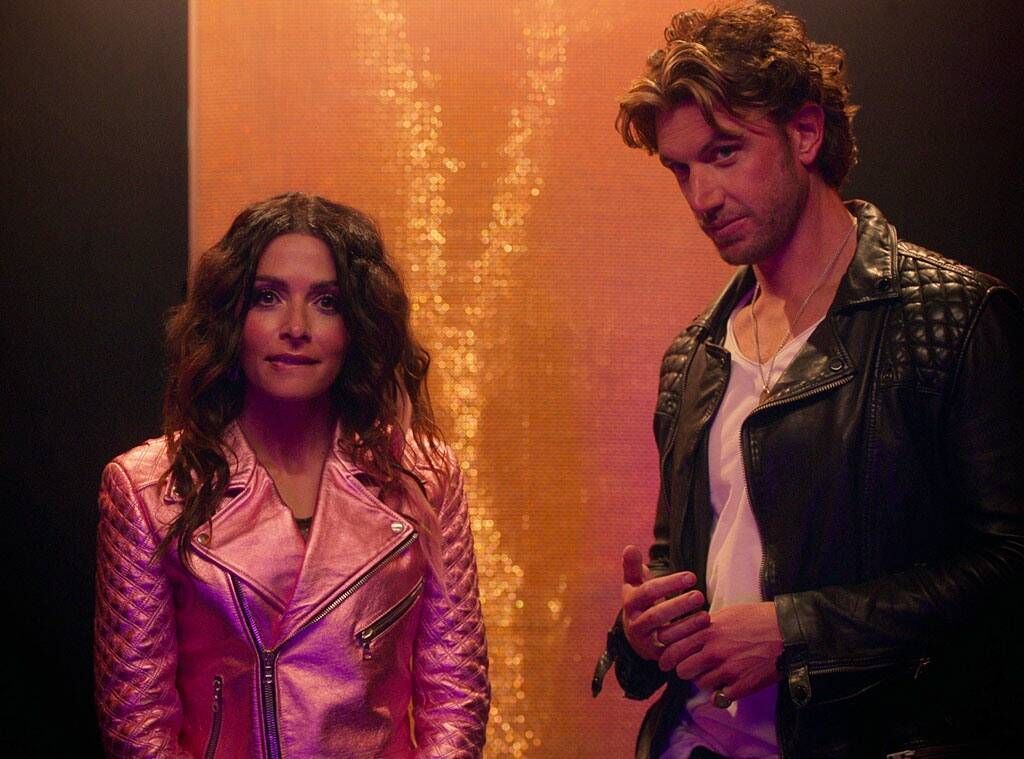
Sarah Shahi and Adam Demos as Billie and Brad in Sex/Life

Speaking to E! News, she said: “My jaw was to the ground pretty much at the end of every episode. But, I definitely didn’t expect for it to go there because, you know, you keep hearing Billie over and over again, and she says, ‘I love my husband.’”

Responding to some accusations that Billie’s decision is selfish, Sarah continued: “She’s not ignoring her children, she’s not ignoring the needs of her husband. There is just a part of her that’s missing, and she’s really struggling trying to feel it again.”

Admitting she loved the finale, Sarah added: “For me, what it comes down to is having the guts to say I want more and going after that. And that doesn’t make you a bad parent to want that. You can still be a wife and a mom and be a sexual goddess at the same time.”

Netflix

The love triangle between Brad, Billie and Cooper is central to Sex/Life

While a second series has not yet been confirmed, Sarah – who is in a real-life relationship with Adam Demos, who plays her on-screen lover Brad – said that if Sex/Life does return, fans should expect “the fantasy will continue in some way or another, because it sure is fun to watch”.

The raunchy US dramedy has risen to the top of Netflix’s most-watched chart since its release last month, and has taken the internet by storm – part in thanks to a gasp-inducing full-frontal scene in the third episode. 

Sex/Life is available to stream on Netflix now.

Share Button

‘Virginity-repair’ surgery set to be banned

Plans to outlaw the practice in England and Wales have been tabled in Parliament.

Share Button

National Food Strategy: Tax sugar and salt and prescribe veg, report says

Boris Johnson says he will consider the proposal, but finds the idea of extra taxes on people unattractive.

Share Button

Medics fear surge in winter viruses alongside Covid

A potential triple whammy of viruses prompts calls for more testing to reduce spread this autumn.

Share Button

The 10 Funniest Kids’ Jokes Of 2021, According To The Beano

A Dundee primary school class has been crowned the UK’s funniest with a topical joke about face masks.

Class 5B from Forthill Primary School entered the Beano’s annual competition to find Britain’s Funniest Class, and came out on top with their timely submission joke winning 21.7% of the public vote.

And the gag goes as follows.

“What did the face mask say to the mouth?” “Let me cover for you!”

The joke was one of 10 shortlisted by a panel at the DC Thomson comic before the public decided which they found funniest. Beano’s Mike Stirling presented the class at Forthill with the official trophy, alongside a bundle of goodies including Beano subscriptions for all the children.

“We’ve learned our greatest gags have always come from kids themselves and Britain’s Funniest Class has schooled us yet again, raising some much-needed chuckles in classrooms,” he said.

Beano’s favourite kids jokes of 2021

1. Forthill Primary School: “What did the face mask say to the mouth? Let me cover for you!”

2. Greystones Primary School: “What did the teacher say to the comic lover as a punishment? There will Beano comics for you.”

3. St John the Baptist Primary School: “Where’s the best place to take a dog for a walk? Leeds.”

4. Upton Meadows Primary: “Knock knock. Who’s there? Justin. Justin who? Justin time to read Beano.”

5. Bradford Christian School: “What did Minnie change her name to when Rubi’s ‘Growth Ray’ experiment went wrong? Minnie the Shrinks!”

6. Hampton Hill Junior School: “Why did the mobile phone go for an eye test? Because it lost its contacts!”

7. Howardian Primary School: “What did the pen say to the rock? Nothing, because pens can’t talk.”

8. Uffculme Primary School: “What does a scary panda say? Bam boooooooo!”

9. Finton House School: “What is the coldest Christmas food? Pigs in blankets.”

10. Porthcawl Primary School: “Why didn’t the robber steal Bea’s sweets? Because no one would stoop that low!”

Share Button

Can Boris Johnson Bridge The Gap Between The Tories And The England Team?

You’re reading The Waugh Zone, our daily politics briefing. Sign up now to get it by email in the evening.

It was Wednesday, just after noon and, in an imposing building overlooking the Thames in Westminster, the questions on football and racism were coming thick and fast.

But the venue was not the House of Commons and the speaker was not the prime minister. In the fortified bowels of MI5’s Thames House HQ, director general (aka the ‘DG’) Ken McCallum was answering queries from the media, including yours truly.

Whereas PMQs thrives off the bearpit jeers and cheers, DGQs is an altogether more sober affair, befitting its annual rather than weekly schedule. Yet when McCallum was asked about the problems of online extremism and the impact on young black men in the national team, he sounded more eloquent than many politicians.

At almost exactly the same moment that Boris Johnson was squirming under Keir Starmer’s prosecutorial glare, the domestic spymaster was unambiguously praising the England football team for their conduct over the past few weeks.

And he explicitly compared his own behind-the-scenes team with the one that performed on Europe’s biggest stage last weekend. “As I watched the penalty shootout on Sunday night,” he said, “I was very aware that I’ve got experience, MI5 has got experience, of watching capable, brave young people of all races, giving their all for their country.”

He went on to say that racism was strongly associated with extreme right wing terror groups whose activity has in recent years become a daily, significant part of his agency’s work. And he clearly meant it when he declared: “I’m proud of many of the people in MI5 today, working to deal with the terrorist threat that is fuelled in important ways by toxic racism”.

Even the most determined culture warrior would find it difficult to argue that McCallum, the youngest DG in the agency’s history, is some kind of “woke” Marxist. The Security Service, just like the England football team, benefits from diversity in a very practical sense as well as a symbolic sense. Looking like the nation it serves is a necessity, not ‘PC gone mad’.

But the contrast between the ease with which McCallum spoke about race, and the discomfort of the PM on the same topic just a few hundred yards away, could not have been more stark.

As Starmer marshalled the evidence of senior ministers’ mixed messaging on booing players who ‘take the knee’, Johnson could tell his usual “vaccines-vaccillation-remoaner” distraction technique wouldn’t work.

With Priti Patel having said booing the team was “a choice”, with No10 having said the PM “fully respects” the right of those booing to “make their feelings known”, even the later U-turn was too late to use as a defence. The real problem was that Johnson resembled the wonky trolley of Dominic Cummings’ image.

Drawing a culture war dividing line only works if you don’t keep hopscotching over it yourself. Put another way, “wedge” issues (as the Americans call them) are a bit pointless if they end up giving the instigator a political wedgie (as we British would call it). If they noticed at all, the minority of voters who think booing is ok may have been simply been confused by the PM’s shifting stance.

He did have one concrete policy announcement in his back pocket, namely extending football ground banning orders to be triggered by online as well as offline offences. Yet even that welcome development was obscured by the bigger row over the gulf between the Tory party and the England team.

And when a Tory MP heckled that footballer Tyrone Mings was a “Labour party member” they managed to undermine rather than help the PM’s case (“I do not want to engage in a political culture war of any kind”). Aside from anything else, failing to praise working class black and white kids who go on to become self-made millionaires sounds a strangely un-Tory thing to do.

With key ministers attacking footballers for “gesture politics”, why would any player want to take part in the real gesture politics of visiting No.10 in future? If the whole booing issue and taking the knee issue had not been weaponised by some ministers, Johnson could even have said his own cabinet team mirrored the diversity of the England team and was stronger as a result.

Perhaps the most revealing remark of the week however came not in PMQs but in Tory backbencher Natalie Elphicke’s private message to colleagues: “They lost – would it be ungenerous to suggest Rashford should have spent more time perfecting his game and less time playing politics.”

Note that Elphicke didn’t say “we lost”, she said “they lost”. Despite her subsequent apology, that word “they” was possibly as damaging to the Tory brand as any explicit racist epithet could have been. It exposed a gap between some in her party and the national team in a brutal fashion, just when any normal politician would want to celebrate their achievement.

It’s that gap, which is implicitly also a gap between a party and the public, that worries some Conservatives dismayed by the culture war rhetoric. It’s also why any future visit to No.10 of the England team (to promote our World Cup bid, for example) is now freighted with tension. Maybe MI5 down the road could act as a neutral venue.

Share Button

‘Neuroprosthesis’ restores words to man with paralysis

Researchers at UC San Francisco have successfully developed a “speech neuroprosthesis” that has enabled a man with severe paralysis to communicate in sentences, translating signals from his brain to the vocal tract directly into words that appear as text on a screen.

The achievement, which was developed in collaboration with the first participant of a clinical research trial, builds on more than a decade of effort by UCSF neurosurgeon Edward Chang, MD, to develop a technology that allows people with paralysis to communicate even if they are unable to speak on their own. The study appears July 15 in the New England Journal of Medicine.

“To our knowledge, this is the first successful demonstration of direct decoding of full words from the brain activity of someone who is paralyzed and cannot speak,” said Chang, the Joan and Sanford Weill Chair of Neurological Surgery at UCSF, Jeanne Robertson Distinguished Professor, and senior author on the study. “It shows strong promise to restore communication by tapping into the brain’s natural speech machinery.”

Each year, thousands of people lose the ability to speak due to stroke, accident, or disease. With further development, the approach described in this study could one day enable these people to fully communicate.

Translating Brain Signals into Speech

Previously, work in the field of communication neuroprosthetics has focused on restoring communication through spelling-based approaches to type out letters one-by-one in text. Chang’s study differs from these efforts in a critical way: his team is translating signals intended to control muscles of the vocal system for speaking words, rather than signals to move the arm or hand to enable typing. Chang said this approach taps into the natural and fluid aspects of speech and promises more rapid and organic communication.

“With speech, we normally communicate information at a very high rate, up to 150 or 200 words per minute,” he said, noting that spelling-based approaches using typing, writing, and controlling a cursor are considerably slower and more laborious. “Going straight to words, as we’re doing here, has great advantages because it’s closer to how we normally speak.”

Over the past decade, Chang’s progress toward this goal was facilitated by patients at the UCSF Epilepsy Center who were undergoing neurosurgery to pinpoint the origins of their seizures using electrode arrays placed on the surface of their brains. These patients, all of whom had normal speech, volunteered to have their brain recordings analyzed for speech-related activity. Early success with these patient volunteers paved the way for the current trial in people with paralysis.

Previously, Chang and colleagues in the UCSF Weill Institute for Neurosciences mapped the cortical activity patterns associated with vocal tract movements that produce each consonant and vowel. To translate those findings into speech recognition of full words, David Moses, PhD, a postdoctoral engineer in the Chang lab and one of the lead authors of the new study, developed new methods for real-time decoding of those patterns and statistical language models to improve accuracy.

But their success in decoding speech in participants who were able to speak didn’t guarantee that the technology would work in a person whose vocal tract is paralyzed. “Our models needed to learn the mapping between complex brain activity patterns and intended speech,” said Moses. “That poses a major challenge when the participant can’t speak.”

In addition, the team didn’t know whether brain signals controlling the vocal tract would still be intact for people who haven’t been able to move their vocal muscles for many years. “The best way to find out whether this could work was to try it,” said Moses.

The First 50 Words

To investigate the potential of this technology in patients with paralysis, Chang partnered with colleague Karunesh Ganguly, MD, PhD, an associate professor of neurology, to launch a study known as “BRAVO” (Brain-Computer Interface Restoration of Arm and Voice). The first participant in the trial is a man in his late 30s who suffered a devastating brainstem stroke more than 15 years ago that severely damaged the connection between his brain and his vocal tract and limbs. Since his injury, he has had extremely limited head, neck, and limb movements, and communicates by using a pointer attached to a baseball cap to poke letters on a screen.

The participant, who asked to be referred to as BRAVO1, worked with the researchers to create a 50-word vocabulary that Chang’s team could recognize from brain activity using advanced computer algorithms. The vocabulary — which includes words such as “water,” “family,” and “good” — was sufficient to create hundreds of sentences expressing concepts applicable to BRAVO1’s daily life.

For the study, Chang surgically implanted a high-density electrode array over BRAVO1’s speech motor cortex. After the participant’s full recovery, his team recorded 22 hours of neural activity in this brain region over 48 sessions and several months. In each session, BRAVO1 attempted to say each of the 50 vocabulary words many times while the electrodes recorded brain signals from his speech cortex.

Translating Attempted Speech into Text

To translate the patterns of recorded neural activity into specific intended words, the other two lead authors of the study, Sean Metzger, MS and Jessie Liu, BS, both bioengineering doctoral students in the Chang Lab used custom neural network models, which are forms of artificial intelligence. When the participant attempted to speak, these networks distinguished subtle patterns in brain activity to detect speech attempts and identify which words he was trying to say.

To test their approach, the team first presented BRAVO1 with short sentences constructed from the 50 vocabulary words and asked him to try saying them several times. As he made his attempts, the words were decoded from his brain activity, one by one, on a screen.

Then the team switched to prompting him with questions such as “How are you today?” and “Would you like some water?” As before, BRAVO1’s attempted speech appeared on the screen. “I am very good,” and “No, I am not thirsty.”

The team found that the system was able to decode words from brain activity at rate of up to 18 words per minute with up to 93 percent accuracy (75 percent median). Contributing to the success was a language model Moses applied that implemented an “auto-correct” function, similar to what is used by consumer texting and speech recognition software.

Moses characterized the early trial results as a proof of principle. “We were thrilled to see the accurate decoding of a variety of meaningful sentences,” he said. “We’ve shown that it is actually possible to facilitate communication in this way and that it has potential for use in conversational settings.”

Looking forward, Chang and Moses said they will expand the trial to include more participants affected by severe paralysis and communication deficits. The team is currently working to increase the number of words in the available vocabulary, as well as improve the rate of speech.

Both said that while the study focused on a single participant and a limited vocabulary, those limitations don’t diminish the accomplishment. “This is an important technological milestone for a person who cannot communicate naturally,” said Moses, “and it demonstrates the potential for this approach to give a voice to people with severe paralysis and speech loss.”

Co-authors on the paper include Sean L. Metzger, MS; Jessie R. Liu; Gopala K. Anumanchipalli, PhD; Joseph G. Makin, PhD; Pengfei F. Sun, PhD; Josh Chartier, PhD; Maximilian E. Dougherty; Patricia M. Liu, MA; Gary M. Abrams, MD; and Adelyn Tu-Chan, DO, all of UCSF. Funding sources included National Institutes of Health (U01 NS098971-01), philanthropy, and a sponsored research agreement with Facebook Reality Labs (FRL), which completed in early 2021.

UCSF researchers conducted all clinical trial design, execution, data analysis and reporting. Research participant data were collected solely by UCSF, are held confidentially, and are not shared with third parties. FRL provided high-level feedback and machine learning advice.


Share Button