Tracking down the asteroid that sealed the fate of the dinosaurs

Geoscientists from the University of Cologne have led an international study to determine the origin of the huge piece of rock that hit the Earth around 66 million years ago and permanently changed the climate. The scientists analysed samples of the rock layer that marks the boundary between the Cretaceous and Paleogene periods. This period also saw the last major mass extinction event on Earth, in which around 70 percent of all animal species became extinct. The results of the study published in Science indicate that the asteroid formed outside Jupiter’s orbit during the early development of our solar system.

According to a widely accepted theory, the mass extinction at the Cretaceous-Paleogene boundary was triggered by the impact of an asteroid at least 10 kilometres in diameter near Chicxulub on the Yucatán Peninsula in Mexico. On impact, the asteroid and large quantities of earth rock vaporized. Fine dust particles spread into the stratosphere and obscured the sun. This led to dramatic changes in the living conditions on the planet and brought photosynthetic activity to a halt for several years.

The dust particles released by the impact formed a layer of sediment around the entire globe. This is why the Cretaceous-Paleogene boundary can be identified and sampled in many places on Earth. It contains high concentrations of platinum-group metals, which come from the asteroid and are otherwise extremely rare in the rock that forms the Earth’s crust.

By analysing the isotopic composition of the platinum metal ruthenium in the cleanroom laboratory of the University of Cologne’s Institute of Geology and Mineralogy, the scientists discovered that the asteroid originally came from the outer solar system. “The asteroid’s composition is consistent with that of carbonaceous asteroids that formed outside of Jupiter’s orbit during the formation of the solar system,” said Dr Mario Fischer-Gödde, first author of the study.

The ruthenium isotope compositions were also determined for other craters and impact structures of different ages on Earth for comparison. This data shows that within the last 500 million years, almost exclusively fragments of S-type asteroids have hit the Earth. In contrast to the impact at the Cretaceous-Paleogene boundary, these asteroids originate from the inner solar system. Well over 80 percent of all asteroid fragments that hit the Earth in the form of meteorites come from the inner solar system. Professor Dr Carsten Münker, co-author of the study, added: “We found that the impact of an asteroid like the one at Chicxulub is a very rare and unique event in geological time. The fate of the dinosaurs and many other species was sealed by this projectile from the outer reaches of the solar system.”

Share Button

‘Played Like A Fiddle’: Ministers Slammed As Union Announces More Strikes Despite Pay deal

Ministers have been criticised after a rail union announced a further wave of strikes just a day after agreeing a pay deal with the government.

Aslef, which represents train drivers, said the latest industrial action, which will see walkouts hitting LNER services on 22 days up until November, is in relation to a two-year dispute over their members’ working conditions.

It is unrelated to the 15% wage increase over the next three years which the union negotiated with transport secretary Louise Haigh.

Nevertheless, the timing of Aslef’s announcement is embarrassing for the government, which has pledged to end the strikes which have hit the railway network in recent years.

A Department for Transport spokesperson said: “This is extremely disappointing for passengers. The transport secretary has called on both Aslef and LNER to get around the table and work in good faith to resolve this dispute and as quickly as possible.”

Shadow Commons leader Chris Philp told Times Radio: “Clearly the Labour’s trade union paymasters have played them like a fiddle.

“The first rule of negotiation is if you make an offer, in this case a pay offer, you make sure that everything that needs to be settled and agreed is agreed at the same time. You don’t leave things undone, as this Labour government has clearly done.”

Tory leadership contender James Cleverly said: “The Labour government has been played by its union paymasters. This latest wave of strikes will be devastating for families who rely on train travel to see their loved ones.”

Aslef general secretary Mick Whelan said: “The continued failure of the company to resolve longstanding industrial relations issues has forced us into this position.

“We would much rather not be here. But the company has brutally, and repeatedly, broken diagramming and roster agreements, failed to adhere to the agreed bargaining machinery, and totally acted in bad faith.”

In a statement, LNER said: “Our priority focus will be on minimising disruption to customers during the forthcoming Aslef strikes, which sadly will continue to cause disruption and delays.

“We are surprised and disappointed to hear this news following recent constructive conversations. We will continue to work with Aslef to find a way to end this long running dispute which only damages the rail industry.”

Share Button

It’s a rave: Underground acoustics amplify soil health

Barely audible to human ears, healthy soils produce a cacophony of sounds in many forms — a bit like an underground rave concert of bubble pops and clicks.

Special recordings made by Flinders University ecologists in Australia show this chaotic mixture of soundscapes can be a measure of the diversity of tiny living animals in the soil, which create sounds as they move and interact with their environment.

With 75% of the world’s soils degraded, the future of the teeming community of living species that live underground face a dire future without restoration, says microbial ecologist Dr Jake Robinson, from the Frontiers of Restoration Ecology Lab in the College of Science and Engineering at Flinders University.

This new field of research aims to investigate the vast, teeming hidden ecosystems where almost 60% of the Earth’s species live, he says.

“Restoring and monitoring soil biodiversity has never been more important.

“Although still in its early stages, ‘eco-acoustics’ is emerging as a promising tool to detect and monitor soil biodiversity and has now been used in Australian bushland and other ecosystems in the UK.

“The acoustic complexity and diversity are significantly higher in revegetated and remnant plots than in cleared plots, both in-situ and in sound attenuation chambers.

“The acoustic complexity and diversity are also significantly associated with soil invertebrate abundance and richness.”

The latest study, including Flinders University expert Associate Professor Martin Breed and Professor Xin Sun from the Chinese Academy of Sciences, compared results from acoustic monitoring of remnant vegetation to degraded plots and land that was revegetated 15 years ago.

The passive acoustic monitoring used various tools and indices to measure soil biodiversity over five days in the Mount Bold region in the Adelaide Hills in South Australia. A below-ground sampling device and sound attenuation chamber were used to record soil invertebrate communities, which were also manually counted.

“It’s clear acoustic complexity and diversity of our samples are associated with soil invertebrate abundance — from earthworms, beetles to ants and spiders — and it seems to be a clear reflection of soil health,” says Dr Robinson.

“All living organisms produce sounds, and our preliminary results suggest different soil organisms make different sound profiles depending on their activity, shape, appendages and size.

“This technology holds promise in addressing the global need for more effective soil biodiversity monitoring methods to protect our planet’s most diverse ecosystems.”

Share Button

Hailstone library to improve extreme weather forecasting

A University of Queensland library — full of hailstones instead of books — is helping researchers to better understand and predict damaging storms.

Dr Joshua Soderholm, an Honorary Senior Research Fellow from UQ’s School of the Environment, and lead researcher PhD candidate Yuzhu Lin from Penn State in the US, have found storm modelling outcomes change significantly when using real hailstones.

Key points:

  • Researchers are measuring and scanning samples for a global ‘hailstone library’
  • Storm simulations using 3-D modelling of real hailstones show it behaves differently than spherical hail shapes
  • Data from the hail library could lead to more accurate storm forecasts

“People tend to think of a hailstone as a perfect sphere, like a golf ball or cricket ball,” Dr Soderholm said.

“But hail can be all sorts of weird shapes, from oblong to a flat disc or have spikes coming out — no two pieces of hail are the same.

“Conventional scientific modelling of hail assumes spherical hailstones, and we wanted to know if that changed when non-spherical, natural hail shapes are used.”

Ms Lin said they found the differences were dramatic.

“Modelling of the more naturally shaped hail showed it took different pathways through the storm, experienced different growth and landed in different places,” Ms Lin said.

“It also affected the speed and impact the hail had on the ground.

“This way of modelling had never been done before, so it’s exciting science.”

Dr Soderholm said building a ‘hailstone library’ was critical to further fine-tuning hailstorm simulations.

“This is effectively a dataset to represent the many and varied shapes of hailstones, to make weather modelling more accurate,” he said.

“Our study used data from 217 hail samples, which were 3-D scanned and the sliced in half, to tell us more about how the hailstone formed.

“This data is now part of a global library, as we try and get a really clear picture of hailstone shape and structure.”

Dr Soderholm said the research has significant potential.

“At the moment, the modelling is specifically for scientists studying storms, but the end game is to be able to predict in real-time how big hail will be, and where it will fall,” he said.

“More accurate forecasts would of course warn the public so they can stay safe during hailstorms and mitigate damage.

“But it could also significantly benefit industries such as insurance, agriculture and solar farming which are all sensitive to hail.”

The research paper was published in the Journal of the Atmospheric Sciences.

Dr Soderholm is also a Research Scientist at the Australian Bureau of Meteorology.

Some hail samples for the UQ data set were provided by Higgins Storm Chasing.

Share Button

Nigel No Mates: How The Tory Leadership Hopefuls Are Running A Mile From Farage

It was all so different less than a year ago.

At the Conservative party conference in Manchester last year, Nigel Farage was in attendance, albeit in his capacity as a GB News presenter.

Nevertheless, he looked very much at home as he danced with Priti Patel at a late-night party, the pair of them bellowing out Frank Sinatra’s ‘I Love You, Baby’.

Ten months later, however, the mood has changed. Since then, Farage has made his political comeback as leader of Reform UK, and even managed to become an MP at the eighth attempt.

He heads up a five-strong Reform contingent on the opposition benches, alongside the 121 Tories who survived Labour’s landslide general election victory.

There is a school of thought in some right-wing Tory circles that the party needs to reach an accommodation with Farage – who has spoken of mounting a “takeover” of the Conservatives – in order to take on Keir Starmer.

But this week it became clear that whoever succeeds Rishi Sunak, that will not happen.

Even Farage’s former dance partner Patel, who is never confused for a Tory wet, has made it clear that the former Ukip boss is persona non grata.

An ally said in June: “Priti has dedicated over 20 years to the Conservative Party. No one with such a record would welcome someone to the party who has repeatedly stood against Conservatives.”

James Cleverly – described to HuffPost UK by a source in a rival camp as “underpriced” in the leadership stakes – also made it clear to the Daily T podcast that he saw no place in his party for Farage.

“The difference between Boris [Johnson], for example, and Nigel is Boris has never said that he holds an ambition to destroy the Conservative Party,” the former home secretary said.

“I think that is a very significant difference to my open offer to Conservatives who might want to come back into frontline Conservative politics and someone who’s basically said that he wants to destroy my party.”

Robert Jenrick, seen as Kemi Badenoch’s main challenger to be the standard bearer for the Tory right in the contest, has also ruled out allowing Farage into the party, despite previously saying he was “not opposed” to such a move.

Polling by Savanta and seen by HuffPost UK shows why, for now at least, the leadership hopefuls are right to distance themselves from the Reform UK leader.

Farage’s net favourability rating with the public is a derisory minus 19 – lower than every Tory candidate bar Patel, who languishes on minus 30.

Among Tory voters his rating is zero, while among Lib Dems – millions of whom the Conservatives need to win back in 2029 – it is minus 52.

Chris Hopkins, Savanta’s political research director, said: “Conservative leadership candidates must first endear themselves to the current Conservative voter base which, while considerably smaller in number now than they would’ve expected two years ago, isn’t all that enamoured with Nigel Farage, according to our research.

“Courting Farage, therefore, is counterintuitive for Conservative leadership candidates at the moment, and risks letting a fox into the henhouse for no obvious gain.

“But I also think there has also been a wider acceptance that winning back Reform UK voters is neither particularly easy, nor enough. Even if everyone who voted Reform in 2024 and Conservative in 2019 hadn’t switched, the Conservatives still would’ve got a pasting at the election.

“Any new leader needs to expand the Conservative coalition to include former Lib Dem and Labour voters, and younger voters as well. The best way to do that will be by appearing competent and not in it for themselves – no mean feat from the opposition benches.”

One Tory aide said: “Farage has made it his business to ‘destroy’ the Tory party at every opportunity. Why on earth would you want someone who hates you to join the party in the hope it would succeed?

“You wouldn’t let vegans run the BBQ and hog roast, would you?”

A source on one campaign team told HuffPost UK: “The way to beat Farage is to eat his lunch. We need to come up with a firm, realistic offer to the country on how we will bring down immigration.

“That will push him further to the extremes, which is where he makes mistakes.”

A Reform UK spokesman, however, was sanguine at the Tory opposition to their leader.

He said: “It’s like six lepers telling a healthy man that he cannot join their colony. Why on earth would he want to?”

Share Button

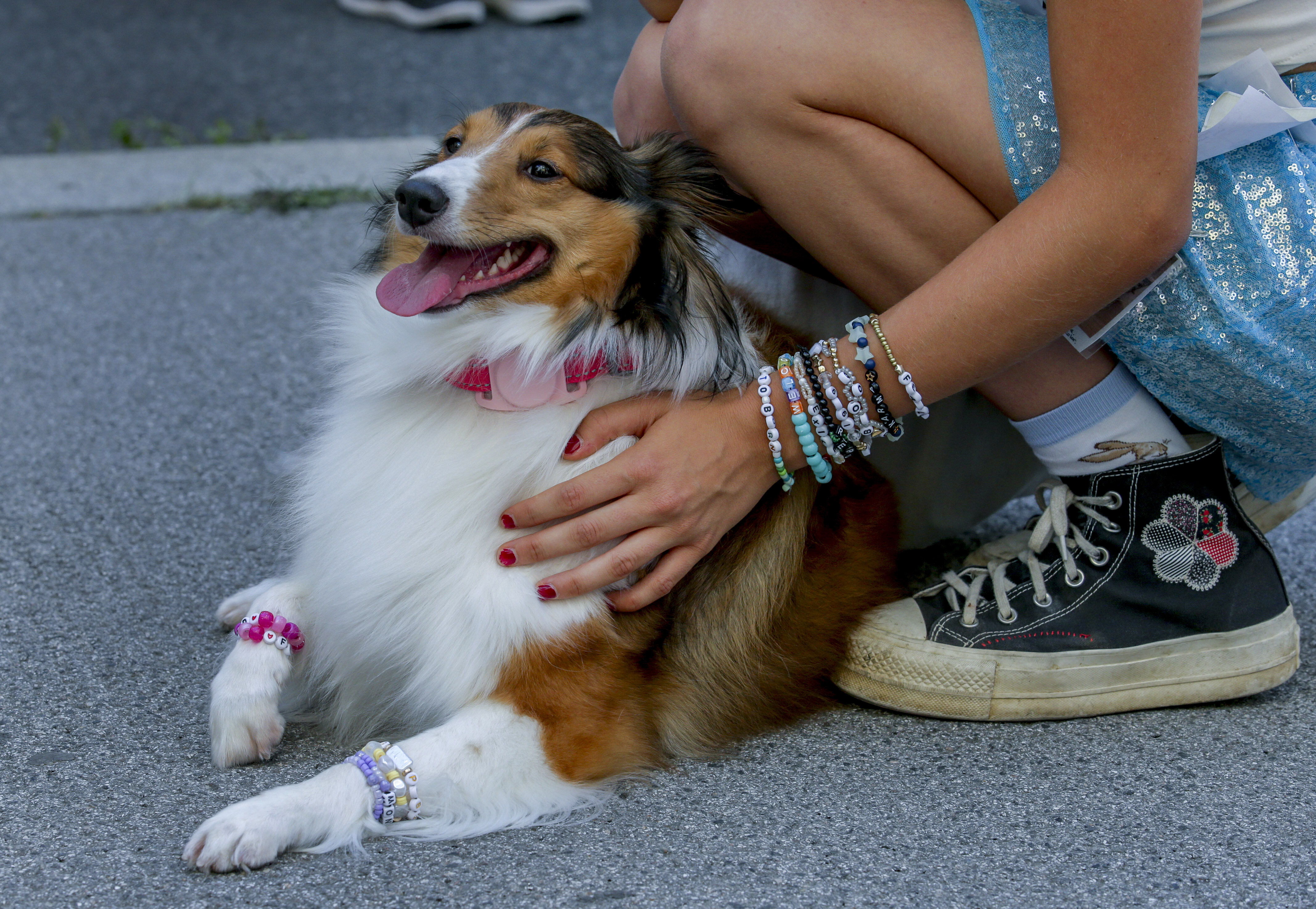
The 1 Health Advantage Dogs May Give Their Owners

Ah, dogs. We love them so much at HuffPost UK that we can’t stop writing about ’em ― we’ve already shared, for instance, the annoying behaviour all dog owners should encourage when taking their furry friend for a walk.

We’ve revealed the non-tail-wagging signs your dog is really happy, too.

But what about what your canine does for your health?

On a recent episode of gut health company ZOE’s podcast, co-founder Jonathan Wolf interviewed Dr. Gideon Lack, a professor of paediatric allergy at King’s College London.

He said that though they’re absolutely not definitive, “there are two studies now showing that babies who are born into a home with a dog have about a 50% reduced chance of developing food allergies.”

Does having a dog definitely halve my kid’s chances of getting food allergies?

No, and Dr. Lack doesn’t claim it will.

Jonathan Wolf had the same question, to which the professor responded, “No, that is an observational association. It’s not evidence.”

To get true evidence, you’d have to randomly give half of a group of pregnant women dogs and not give the other half one.

That would be a “randomised intervention,” meaning scientists would add dogs into participants’ lives at random rather than simply looking at those who already have one.

Those who own a dog already could do so for external reasons that might affect the results (like having a bigger house and maybe being richer, or being more rural, etc.).

Dr. Lack says a true scientific trial on the topic is hard to do, though he hopes to run a randomised “Bow Wow study” one day.

However given the data we do have, Dr. Lack says, “At the moment, we just have observation, but they’re pretty compelling observations.”

One such study found “that exposure to dogs and farm animals during the first year of life reduces the risk of asthma in children at age 6 years.”

“This all goes back to the hygiene hypothesis, getting in contact with a whole host of bacterial flora,” the professor added.

Is there any other way to reduce the risk of allergies?

Seemingly, yes (good news for those of us in small apartments or with dog allergies).

We’ve written before about an extensive study that found that giving children who are at risk of developing a peanut butter allergy the offending food regularly, especially when very young, seems to reduce allergy rates by 71%.

In the ZOE podcast, Dr. Lack talked about the same idea.

“I would say in babies with eczema as early as three to four months of life, start introducing them to peanut, egg, milk, the common food allergens,” he said.

“Regularly, frequently, not large amounts of time, small amounts of time, but so that they get enough over a week and continue that every week,” he added.

So, more dogs and more peanut butter sandwiches… sounds good to me.

Share Button

Travellers advised to consider mpox vaccine

There is concern about a new strain of the disease that has been spreading in parts of Africa.

Share Button

Infected blood compensation payouts on the way

Ministers promise first payments by the end of the year with some victims entitled to more than £2m.

Share Button

Blind cavefish have extraordinary taste buds

Over thousands of years, cavefish evolved and lost their vision, earning the moniker “the blind cavefish,” but some cavefish also developed an inordinate number of taste buds on the head and chin.

In a new study, now published in the Nature journal Communications Biology, scientists at the University of Cincinnati have determined when the taste buds start to appear in areas beyond the oral cavity. The study was supported by the National Science Foundation.

To begin, blind cavefish evolved in cave ponds in northeastern Mexico. They are pale pink and nearly translucent compared to their silvery counterparts that live in surface rivers and streams. While cavefish have the faintest outline of eye sockets, the surface fish have enormous round eyes that give them a perpetually surprised expression.

Despite the many obvious physical differences, the two fish are considered the same species.

“Regression, such as the loss of eyesight and pigmentation, is a well-studied phenomenon, but the biological bases of constructive features are less well understood,” says the article’s senior author UC professor and biologist Joshua Gross, whose laboratory is dedicated to the study of evolution and development of cave-dwelling vertebrates.

Although scientists in the 1960s discovered that certain populations of blind cavefish had extra taste buds — on the head and chin — there was no further study of the developmental or genetic processes that explain this unusual trait, says Gross.

To determine when the extra taste buds appear, Gross and his research team looked at the species Astyanax mexicanus, including two separate cavefish populations that dwell in the Pachón and Tinaja caves in northwestern Mexico, known to have the additional taste buds.

The research team found that the number of taste buds is similar to the surface fish from birth through 5 months of age. The taste buds then start to increase in number and appear on the head and chin in smatterings, well into adulthood, at approximately 18 months.

Cavefish can live much longer than 18 months in nature and captivity, and the authors suspect even more taste buds continually accumulate as the fish get older.

While timing of taste bud appearance was comparable for the Pachón and Tinaja cavefish populations, some differences were evident with respect to density and timing of expansion, says Gross. The other surprising discovery from this study, says Gross, is the genetic architecture of this trait: “Despite the complexity of this feature, it appears that more taste buds on the head are controlled mainly by only two regions of the genome.”

The increase correlates with the time that the cavefish stop eating other live foods for sustenance and start to pursue other food sources, Gross says, such as bat guano. Equally fascinating, he says, is that the expansion may occur in other cave locations where there are no bat populations.

With more taste buds, he says, the cavefish have a keener sense of taste, “which is likely an adaptive trait.”

“It remains unclear what is the precise functional and adaptive relevance of this augmented taste system,” says Gross, which has led the team to begin new studies that focus on taste, by exposing the fish to different flavors such as sour, sweet and bitter.

Share Button

Researchers observe ‘locked’ electron pairs in a superconductor cuprate

For the past century since their discovery, superconductors and their mysterious atomic properties have left researchers in awe. These special materials allow electricity to flow through them without any energy loss. They even allow trains to levitate.

But superconductors typically only work at extremely cold temperatures. When these materials are heated, they become ordinary conductors, which allow electricity to flow but with some energy lost, or insulators, which don’t conduct electricity at all.

Researchers have been hard at work looking for superconductor materials that can perform their magic at higher temperatures — perhaps even room temperature someday. Finding or building such a material could change modern technology, from computers and cell phones to the electric grid and transportation. Furthermore, the unique quantum state of superconductors also makes them excellent building blocks for quantum computers.

Now, researchers have observed that a necessary characteristic of a superconductor — called electron pairing — occurs at much higher temperatures than previously thought, and in a material where one least expects it — an antiferromagnetic insulator. Although the material did not have zero resistance, this finding suggests researchers might be able to find ways to engineer similar materials into superconductors that operate at higher temperatures. The research team from SLAC National Accelerator Laboratory, Stanford University, and other institutions published their results August 15 in Science.

“The electron pairs are telling us that they are ready to be superconducting, but something is stopping them,” said Ke-Jun Xu, a Stanford graduate student in applied physics and paper co-author. “If we can find a new method to synchronize the pairs, we could apply that to possibly building higher temperature superconductors.”

Out-of-sync electrons

Over the past 100 years, researchers have learned a lot about how exactly superconductors work. We know, for instance, that for a material to superconduct, electrons have to pair off, and these pairs must be coherent — i.e., their movements must be synchronized. If electrons are paired but incoherent, the material might end up being an insulator.

In superconductors, the electrons act like two reticent people at a dance party. At first, neither person wants to dance with the other. But then the DJ plays a song that both people like, allowing them to relax. They notice one another enjoying the song and become attracted from afar — they have paired but have not yet become coherent.

Then the DJ plays a new song, one that both people absolutely love. Suddenly, the two people pair and start to dance. Soon everyone at the dance party follows their lead: They all come together and start dancing to the same new tune. At this point, the party becomes coherent; it is in a superconducting state.

In the new study, the researchers observed electrons in a middle stage, where the electrons had locked eyes, but were not getting up to dance.

Cuprates acting oddly

Not long after superconductors were first discovered, researchers found that the thing that got electrons paired up and dancing was vibrations in the underlying material itself. This kind of electron pairing happens in a class of materials known as conventional superconductors, which are well understood, said Zhi-Xun Shen, a Stanford professor and investigator with the Stanford Institute for Materials and Energy Sciences (SIMES) at SLAC who supervised the research. Conventional superconductors work at temperatures typically close to absolute zero, below 25 Kelvin, in ambient pressure.

Unconventional superconductors — such as the copper oxide material, or cuprate, in the current study — work at significantly higher temperatures, sometimes up to 130 Kelvin. In cuprates, it is widely believed something beyond lattice vibrations helps pair up electrons. Although researchers aren’t sure exactly what’s behind it, the leading candidate is fluctuating electron spins, which cause the electrons to pair and dance with a higher angular momentum. This phenomenon is known as a wave channel — and early indications of such a novel state were seen in an experiment at SSRL about three decades ago. Understanding what drives electron pairing in cuprates could help design superconductors that work at higher temperatures.

In this project, scientists chose a cuprate family that had not been studied in depth because its maximum superconducting temperature was relatively low — 25 Kelvin — compared to other cuprates. Even worse, most members of this family are good insulators. To see the atomic details of the cuprate, researchers shined ultraviolet light onto material samples, which eject electrons from the material. When the electrons are bound, they are slightly more resistant to being ejected, resulting in an “energy gap.” This energy gap persists up to 150 Kelvin, suggesting that electrons are paired at much higher temperatures than the zero resistance state at about 25 Kelvin. The most unusual finding of this study is that the pairing is the strongest in the most insulating samples.

The cuprate in the study might not be the material to reach superconductivity at room temperature, around 300 Kelvin, Shen said. “But maybe in another superconductor material family, we can use this knowledge for hints to get closer to room temperature,” he said.

“Our findings open a potentially rich new path forward,” Shen said. “We plan to study this pairing gap in the future to help engineer superconductors using new methods. On the one hand, we plan to use similar experimental approaches at SSRL to gain further insight into this incoherent pairing state. On the other hand, we want to find ways to manipulate these materials to perhaps coerce these incoherent pairs into synchronization.”

This project was supported in part by the DOE’s Office of Science. SSRL is a DOE Office of Science user facility.


Share Button