Most dog owners would love to spend every minute of every day with their pups. Alas, life gets in the way of that for many of us, which means trying to maximise whatever time we have together.
But what about when we want to get frisky with another human? Should we let our four-legged friends stay in the room? Or is it better to separate ourselves from our dogs before we start stripping down?
“When [my boyfriend] Benji and I have sex, we don’t let [our dog] Jumi on the bed, but he’s in the bedroom, and I feel a little bit weird about it,” Michelson admitted. “I feel like he doesn’t exactly know what we’re doing. What do you think about this from a behaviour standpoint?”
Levine said this is a common question she often gets from pet owners.
“For most dogs, it just doesn’t matter,” she said. “If they’re not bothered by it, it doesn’t matter at all. Dogs don’t have this hang-up like people do about things. They sort of live in the moment.”
Advertisement
However, there are some behaviours that signal a dog should not be present
“Where we shouldn’t have the dog in a room when people are having sex is when the dog tries to intervene,” Levine told us.
“There are lots of dogs who have a little bit of FOMO … like when people are like hugging, the dog wants to join in and so the dog is just like, in a happy way, ‘Hey! What’s going on here?’ and that just ruins the mood.”
Other pups might be uncomfortable for a more worrisome reason.
“There are also dogs who will get very distressed because of the sounds that are being made [during sex],” she said. “They may interpret some of those sounds as aggression [happening to] you, and then it’s not fair to the dog to have them in the room for that.”
Advertisement
Levine advised giving our furry friends a treat or a toy – either in the room or in another room – to keep them occupied until we’re done getting busy.
We also tackled a question from a listener about a similar – yet very different – scenario.
“We recently adopted a new dog and he loves to lick our older dog’s penis,” the listener said. “What’s going on there? And is there any downside to this or should I just let them go at it?”
Advertisement
“There are different reasons a dog may lick another dog’s penis,” Levine said. “It may be that there are just so many good odours in [that area] that they’re attracted to that.”
She also noted that they might be enjoying a taste that is present on or around the dog’s genitals.
“We want to make sure the dog doesn’t have like some sort of yeast infection or something in there that’s making it more attractive to the other dog,” she said.
What about the dog who is letting his friend lick him? “If he’s allowing this, he probably just thinks it feels good, or it does feel good,” she explained.
Advertisement
Levine told us she wouldn’t be worried about the behaviour if it’s happening “here and there”, but if it’s ongoing, it could cause problems.
“The concern about it going on for too long or too frequently is it’s possibly setting up for an infection in the penis that’s being licked.”
We also chatted with Levine about how to address unwanted barking, why some dogs get more aggressive as they get older, what to know before you let dogs and kids play together and much more.
Have a question or need some help with something you’ve been doing wrong? Email us at AmIDoingItWrong@HuffPost.com, and we might investigate the topic in an upcoming episode.
If I told you a recent study showed that a majority of modern dog species have wolf DNA, you’d probably mutter something along the lines of “shocker: fork found in kitchen”.
Except that the research, published in Proceedings of the National Academy of Sciences (PNAS), found that just two-thirds of modern dogs have detectable wolf DNA – and it is likely not an ancient remnant from their wilder ancestor, from which they separated tens of thousands of years ago.
Advertisement
Instead, it seems that the gene may have come from more recent interbreeding between dogs and wolves within the last few thousand years.
In fact, the study reads, “Ancient [dog] genomes from the Roman era… show no evidence of wolf ancestry… nor has wolf ancestry been detected in ancient dogs in the Arctic or the pre-colonial America”.
Still, study co-author Logan Kistler, a curator of archaeobotany and archaeogenomics at the National Museum of Natural History, told AFP this doesn’t mean “wolves are coming into your house and mixing it up with your pet dog”.
Advertisement
What are some “wolfish” dog traits?
In a statement, the study’s lead author, Audrey Lin, said: “Modern dogs, especially pet dogs, can seem so removed from wolves, which are often demonised.
“But there are some characteristics that may have come from wolves that we greatly value in dogs today and that we choose to keep in their lineage.”
Some characteristics often linked to high-wolf DNA breeds, the study reads, include:
Suspicious of strangers
Independant
Dignified
Alert
Loyal
Territorial,
While lower-wolf DNA breeds were more associated with being:
Easier to train
Eager to please
Courageous
Lively
Affectionate.
Traits like obedience, intelligence, being good with children, dedication, calmness, and cheerfulness seemed evenly distributed among both groups.
Advertisement
This study stressed, though, that these associations, which came from kennel clubs, could not definitely be linked to wolf genes themselves.
Which dog breeds are the most and least ‘wolfish’?
This research found that Czechoslovakian and Saarloos wolfdogs have the most detectable wolf DNA (up to 40%).
Advertisement
The great Anglo-French tricolour hound had an impressively high percentage for a “breed” dog – 4.7-5.7% – while Shiloh shepherds have 2.7%.
The Tamaskan, bred in the UK in the ’80s, has 3.7% wolf ancestry. Even chihuahuas have 0.2%, which, Lin joked, likely “makes sense” to their owners.
Surprisingly, bigger breeds like St Bernards have zero wolf DNA. The same goes for the Neapolitan mastiff and bullmastiff.
Advertisement
In general, detectable wolf ancestry is higher for bigger dogs and dogs bred for certain jobs, like Arctic sled dogs, “pariah” dogs, and hunting dogs.
But on average, terriers, gundogs, and scent hounds have lower wolf DNA.
As Kistler shared in a statement: “Dogs are our buddies, but apparently wolves have been a big part of shaping them into the companions we know and love today.”
Just like baby names, dog names ebb and flow in popularity each year depending on pop culture, traditions and more.
One year, you may run into dozens of dogs named Ollie at the dog park, just for lots of pups named Luna to appear a few years later.
Advertisement
This year, though, many dog owners stuck to certain trending names, according to a report from online pet supply retailer and pharmacy Chewy, which uses data from the profiles users make for their pets to determine pet name trends and name popularity throughout the country.
When signing up for an account, users input the name of their dog, their pet’s birthdate and the type of dog they have, Ciara Lavelle, pet expert at Chewy, told HuffPost via email.
“By looking at this aggregated information, we can see which dog names are trending and celebrate the most popular picks of the year,” Lavelle said.
Advertisement
According to this year’s data, the top 10 dog names for both male and female dogs are:
Bella
Luna
Daisy
Lucy
Max
Charlie
Bailey
Cooper
Buddy
Sadie
Getty Images
Charlie and Luna are among the most popular dog names of the year.
Beyond the top 10, names like Cheeto, Brisket and Elphaba are also becoming more popular.
Even if your pup’s name doesn’t fall within the top 10 most popular, there’s a chance their moniker is still part of a larger movement.
According to Lavelle there are some “really fun dog name trends” going on this year; for example, food-inspired names are growing in popularity. “Cheeto and Pickles both rose about 25% in popularity since 2024, and Brisket is up 68%,” Lavelle said.
Advertisement
The popularity of the film “Wicked,” the first part of which was released in November 2024, also inspired some pup names, she noted. The name Elphaba, which is the name of the Wicked Witch of the West (played by Cynthia Erivo), has grown in popularity by 200% since last year, along with its nickname Elphie. The name Glinda, which is the name of the Good Witch (played by Ariana Grande), has grown by 175% this year.
A few other pop-culture names were favored this year, too. “Plenty of pups were named in homage to Ozzy Osbourne, who passed away earlier this year. We’re seeing a 15% bump in dogs named Ozzy,” Lavelle said.
The popularity of this past season of “The White Lotus” also inspired 2025 dog names. “Remember the ‘Piper, no!’ meme from the last season of ‘The White Lotus’? We can’t prove there’s a connection, but Piper as a pet name is up 33% since last year,” added Lavelle.
Advertisement
What to keep in mind when naming your pet, according to an expert.
Naming your dog can feel like a tall task. Will it match their personality? Do they look like their name? Or does it sound too much like your nephew’s name?
“You can take inspiration from just about anything as you’re naming your dog — their color, their personality, or your favorite movies or musicians,” Lavelle said.
If you need some inspiration beyond the name’s Chewy has identified this year, American Kennel Club has a helpful list of ideas, including unique names, trending names and classic ones. (Storm, JoJo, Scout, Zeke, Kona and Jax are just several of the names on this list.)
Advertisement
It is important to remember that your dog’s name isn’t something that only your pup will hear. “You’re going to be yelling it at the dog park and responding to it at the vet’s office, so if you decide on something silly, be prepared to own it,” Lavelle said.
As long as you pick a respectful, not-offensive name, you really can’t go wrong.
“No matter what you choose, your dog will love it,” said Lavelle — “because it’s how they’ll be called by their favourite person.”
Four years ago, I woke up in an ICU in Thailand. My liver was failing. I was drinking three bottles of wine a day, chasing it with whiskey, and swallowing handfuls of Valium. I wasn’t trying to numb the pain anymore – I was trying to kill myself. I just didn’t have the guts to do it all at once.
Moving to Thailand was supposed to be my big fix. Back in Ireland, I’d built and sold a successful media company with 40 staff members across three cities. On paper, I was doing well.
Advertisement
In real life, I was a wreck. I’d been a functioning alcoholic for years, hiding behind client meetings, late nights, and a culture where drinking hard was seen as normal. I was burned out, lost, and clinging to the hope that sunshine and distance might change something.
It didn’t.
In fact, Thailand made it worse. The freedom, the quiet, the time – it gave my addiction space to grow. With no structure around me, I lost the plot completely. I drank until I blacked out, every day, for months. I was surrounded by beaches and blue skies, but I wanted to disappear.
The ICU stint scared me straight. It was rock bottom. I left the hospital and never touched a drink again. I woke up and realised I had two options: keep going and die, or stop and face everything I’d been running from. That was the day I quit. I haven’t had a drink since.
Advertisement
But getting sober was just the start. I needed something bigger to hold onto. Something that gave the days shape.
That’s when the dogs came in.
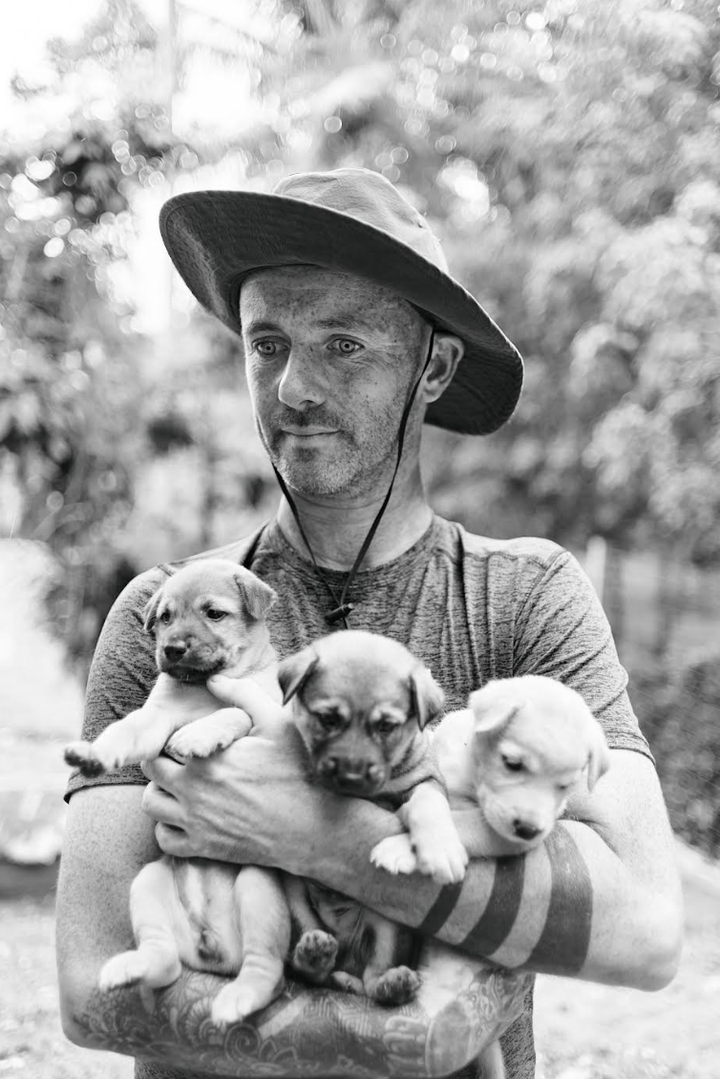
At first, it was just a couple of strays I saw around the island. They were sick, mangy, limping. I left out some food. The next day, more showed up. Then more. Before I knew it, I was feeding dozens – then hundreds. The need was overwhelming. Thailand has millions of street dogs, and most of them are barely surviving.
Nobody else seemed to be doing much. So I figured maybe I could.
What started as something to keep me busy became the centre of my life. Today, I run a sanctuary called Happy Doggo. We feed more than 1,200 dogs every day. We rescue the ones that have been hit by cars, dumped, abused, and left to die. We also fund the sterilisation of thousands a month, which helps stop the suffering before it starts.
Advertisement
These dogs have been through the worst, but they still want to trust. They still look at you with hope. That guts me every time.
One dog in particular changed everything.
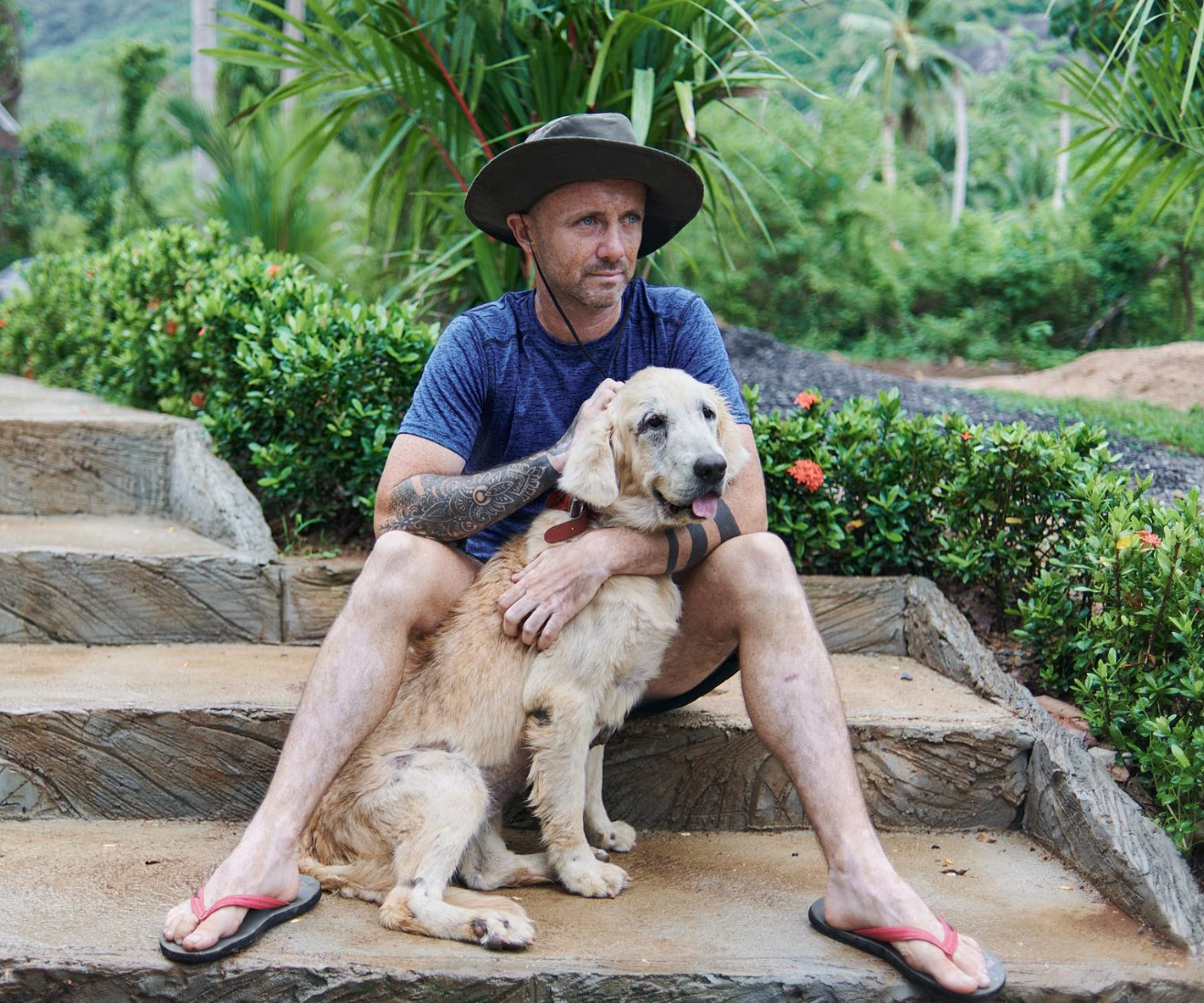
Her name is Tina.
I got a WhatsApp message one day – a photo from someone I didn’t know. It showed a dog chained under a shack up in the mountains. She was skin and bones, her fur was matted, and she was lying in her own filth. Her eyes were what really got me: broken, but still alert. I’ve seen a lot of rough cases, but this one hit different.
I called Rod, my Aussie mate who helps with rescues, and we drove up into the hills. When we found her, she didn’t move much. Her chain was short, the ground was hard, and her body looked like it had given up. But when I reached out, she leaned into my hand. No fear. No flinching. Just surrender.
Advertisement
The locals weren’t fussed. They said she was old, or maybe hit by a car. They didn’t argue when I asked to take her.
Courtesy of Niall Harbison
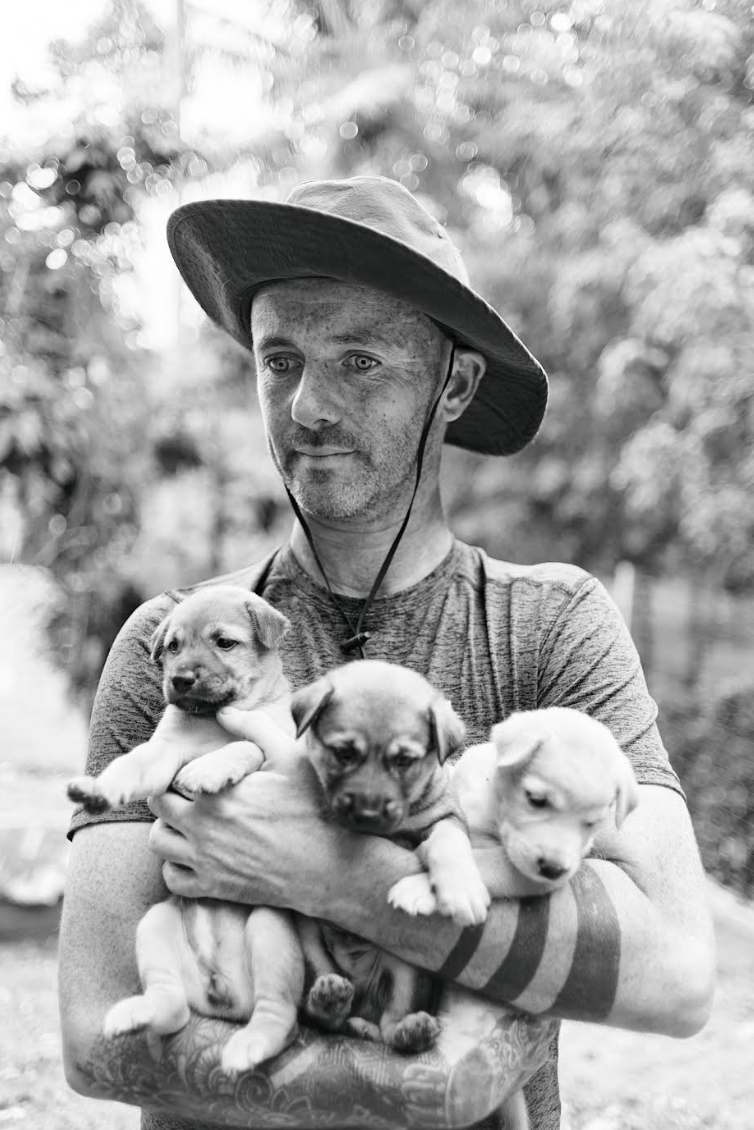
The author with rescue puppies in Thailand in 2023.
The vet didn’t sugarcoat it. Tina was riddled with parasites, she was anaemic, and her kidneys weren’t great. But the shocker was she was a golden retriever. You don’t see many of those on the streets here. The vet reckoned she’d been used for breeding, over and over, and then dumped when she couldn’t deliver any more litters. Used, then thrown away.
Advertisement
That night, I wanted to give Tina something good. A proper meal. Real food. Something she hadn’t had in a long time.
It nearly killed her.
At the time, I didn’t know that starving dogs can’t handle big meals right away. Within an hour, her stomach ballooned. She started struggling to breathe. I freaked out. My colleague Valeria knew what it was – bloat – a deadly condition where the stomach fills with gas and can twist. If it’s not treated fast, they will die.
We didn’t have a vet on hand. It was just us, a needle, and a lot of panic. Valeria stuck the needle in and released the gas. It hissed out like a pressure cooker, and I thought, maybe, just maybe, we’d bought her a bit more time.
Advertisement
That night, I sat beside Tina listening to her breathe. I thought about the times I nearly died – all the nights I’d wanted it to end – and here I was, doing everything I could to keep this broken little dog alive.
Over the next few days, Tina stayed close. She slept in my bed. Ate tiny meals. Slowly, her fur started growing back. Her eyes softened. She wagged her tail. One day, after a bath, a tuft of hair stuck up like something out of an ’80s music video. I looked at her and thought, You’re Tina Turner.
That’s how she got her name.
Courtesy of Niall Harbison
The author with Tina in Thailand in 2023.
Advertisement
Tina became the face of Happy Doggo. People connected with her story – and I think it’s because we all love a comeback. I certainly do.
She reminded me of myself. Shackled. Exhausted. Written off. But still here. Still trying.
Before all this, I thought success meant money, nice things, a big exit. I had those, and I was miserable. Now, I go to sleep knowing I’ve helped someone survive another day – even if that someone is covered in fleas and chewing my flip-flop. I’ve never felt more grounded.
Sobriety gave me my life back. But the dogs gave me a reason to live it.
People ask why I do this – why I spend my days scooping poop, chasing donations, running around after sick animals. The answer’s simple: because someone has to. And because, somewhere along the way, they saved me, too.
Advertisement
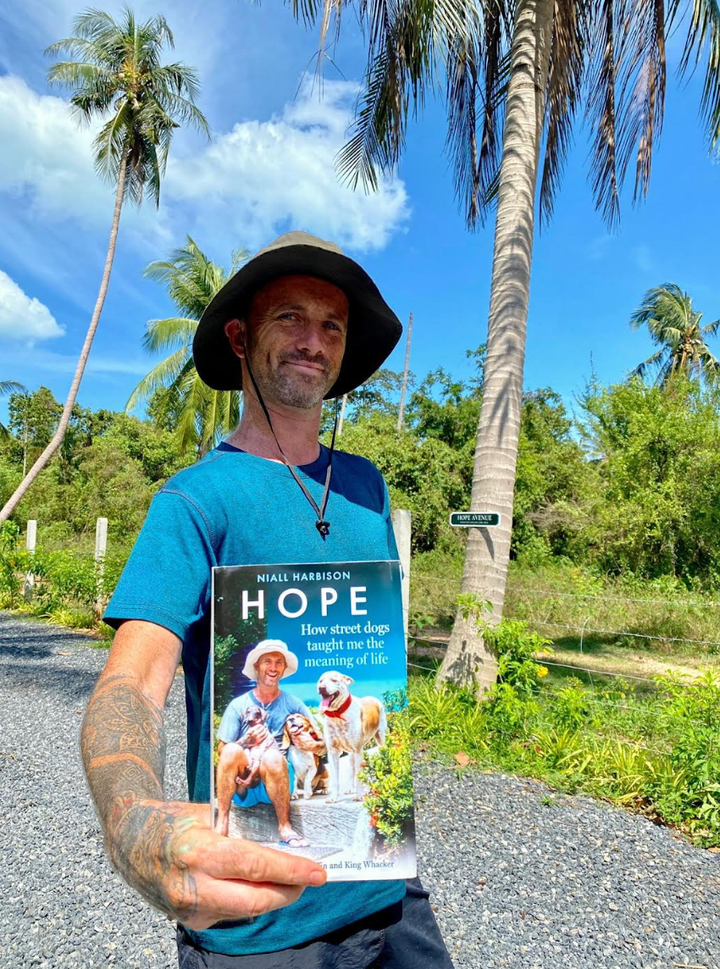
I wrote a book about Tina – and about all of this. It’s called Tina: The Dog Who Changed the World. It’s her story, but it’s mine as well. A story about getting knocked down, and choosing to get up again. About how the smallest life can give you the biggest reason to keep going.
There are 500 million street dogs in the world. I’ve made it my mission to save half of them. Sounds mad, I know. But I believe in impossible things now.
I believe a dog can save a man’s life. And I believe Tina wasn’t just a dog. She was the start of everything.
There is nothing worse than coming home from a busy work day, putting down your bag, and walking into the kitchen to see the contents of the bin are quite simply… all over the place.
Then your pooch looks at you with those sweet eyes and their tail wagging and you just cannot stay mad at them, even if their favourite hobby is nothing short of disgusting.
Advertisement
Why do they do it, though? Especially if there isn’t actually any food in there? Is it for the love of the game?
They may feel like our furry babies but in reality, these domesticated pups still have a little wildness in their bones.
The experts added: “Our pampered pets have inherited the wolves’ keen sense of smell and scavenging tendencies, making ‘playing’ with rubbish a favourite pastime for some.
Advertisement
“Wild wolves also roll in strong-smelling substances, such as faeces, to mask their scent when they’re hunting.”
This will also sound familiar for dog owners who find themselves regularly scrubbing fox poo off their dog’s paws (and coat). Lovely.
Keep your dog out of rooms containing bins unless supervised, using doors or baby gates as barriers.
Use bins with secure, childproof lids that cannot be easily knocked off by your dog.
Anchor outdoor wheelie bins to walls or fences and add catches to prevent your dog from tipping them over (remember to release catches on bin collection day to avoid issues).
If your dog tends to go after other people’s bins during walks, consider using a well-fitting muzzle and keep them on a lead when near bins.
When I met Zoe, an 85-pound, deaf American bulldog with different coloured eyes, I knew she was my companion. Seeing her pumpkin-shaped head in my rearview mirror as I drove with her away from the Los Angeles rescue gave me a sense of, “There you are!” as though I’d found someone I’d been searching for for years without realising it.
When my then boyfriend — let’s call him Jax — met Zoe, he had the opposite reaction. “We can’t keep her,” he said, backing away from us toward our living room wall.
Advertisement
Wait, what? His words didn’t compute. Where I saw my sweet, furry friend, Jax saw a monster.
Through difficult conversations, I learned that Jax’s time in a community gripped by generational violence and dog fights led him to associate certain breeds with trauma. It didn’t matter that Zoe stayed calm around him.
Jax said he would try to make it work with Zoe, but couldn’t seem to stay in the house for more than one night with her in it. Within a week, it was clear that Zoe would never be welcome.
Jax owned the home, and I’d only recently moved in, so all I felt I could do was make sure Zoe had a safe place where she was welcome. I sobbed, driving her back to the rescue, and hyperventilated after. “If she ends up with no place to go, call me,” I’d pleaded with the rescue manager. “I would come back for her. I’d figure it out.”
Advertisement
Maybe there was a loving home waiting for her around the corner, I told myself. That thought did little for my heartache, but it kept me from falling apart completely.
Jax and I attempted to carry on, but our experience with Zoe seemed to shed light on our differences that now felt like incompatibilities. He needed things to stay spotless and orderly. I needed my own space to be creative, without stressing over any mess I might make. He enjoyed discotheques and nightlife. I prefer sunrise hikes and turning in early. When he told me he wasn’t yet ready to share my attention, even with a dog, I appreciated his honesty. Meanwhile, I wasn’t willing to sacrifice my independence. Or, I realised, not care for a dog.
“I think we rushed into living together,” I told Jax, which started a heated argument. The conflict strengthened my qualms. So instead of slowing things down, we broke up.
Advertisement
After weeks of searching, I found a guest house in my price range that allowed dogs, then contacted the rescue and learned that Zoe was still available. The news gave me a full body exhale.
“She’s protective and doesn’t always like men,” Zoe’s adoption materials read. Works for me, I thought, signing the agreement.
When Zoe met Mike, my kind, funny and brilliant-without-being-intimidating neighbour, she rushed toward him. I panicked. How protective was she? Rather than attack, Zoe placed her front paws on Mike’s shoulders, like a canine hug.
Advertisement
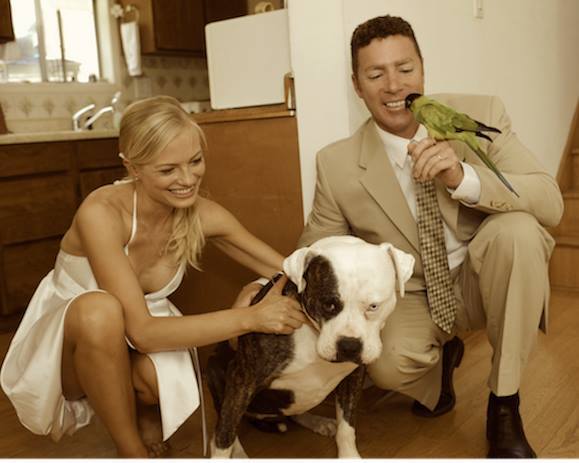
Within two years, Mike and I got married on the steps we met on. Our wedding party consisted of Zoe, Mike’s parrot Wombley, and our dear friends’ senior beagle Eunice Petunia. When Eunice rolled up in her pink stroller with our rings strapped to her back, I lost it.
Stefanie Keenan
The writer with her husband and Zoe on their wedding day.
I’m not alone in having chosen a pet over a partner. When I posted about my experience on social media, over 40 people responded with similar experiences.
Advertisement
Ashley, a school principal in Oklahoma, realized her two large, mixed-breed dogs may be a dealbreaker with her partner when an argument erupted over whether or not the dogs would be allowed on the bed once they all lived together.
“They were here before him,” she told me. “I wasn’t kicking them out of their bed!” Beyond that, he didn’t understand her responsibility to them. “He’d want me to impulsively take an overnight trip, without a sitter or boarding lined up, and get annoyed when I’d say I couldn’t,” she said.
She called it quits when her partner took a job in a rural town. “We would have lived over two hours away from our primary care veterinarian, and 1 1/2 hours away from any 24/7 veterinary emergency rooms,” Ashley said. “That was a hard no for me.”
Advertisement
Jeanne Cross, owner and licensed therapist at EMDR Center of Denver, has helped people navigate breakups related to disagreements about animals. “A pet can contribute to a breakup when disagreements arise about pet care, responsibilities or lifestyle compatibility,” she said. “One partner may want a pet-free home due to allergies or a demanding schedule, while the other insists on keeping the pet.” Conflicts can also arise when one person is “significantly more invested in the pet,” she added.
A pet may even give people the courage to leave a harmful relationship. T., an office employee in California who preferred to remain anonymous, was in a relationship that seemed healthy and happy at first. Over time, frequent arguments gave way to abuse by T.’s boyfriend.
On a smoldering, triple digit day, T. returned home to find a skinny, tick-covered dog that had recently had puppies, lying down under her boyfriend’s truck. He told her he’d known about the dog but ignored her, not even offering water.
Advertisement
“During my search for her owner and trying to get her to lead me to her puppies, my boyfriend said, ‘Just leave her alone,’” T said. “So eventually I had to call Animal Control to pick her up. When they were walking her to the truck, she turned around and looked at me, and my heart just broke.”
Besotted with the dog, T. decided to visit her at the shelter daily until she was spayed and available for adoption. Then, T. took her home. “I had never experienced so much happiness and joy,” she said of that day. “She very quickly became my heart-and-soul dog.”
T.’s boyfriend, who at one point threw garbage at the dog, soon became her ex. “I felt guilty and heartbroken for my dog being brought into that situation,” she reflected. “I hadn’t cared about my own well-being, but I cared about hers… She saved me from a horribly abusive relationship, and I will forever be grateful for her because of it. We saved each other.”
Advertisement
Relationship experts agree that choosing a pet over a partner can be the right decision. But there is a “wrong” motivation, according to Melissa Legere, a licensed marriage and family therapist and clinical director of California Behavioral Health: choosing the pet out of spite.
“If a couple breaks up and one of them insists on keeping the pet…just to hurt the other person, that’s not fair to anyone, especially the pet,” she said. “Doing this turns the pet into a pawn, which isn’t good because pets are supposed to be loved and looked after, not used as a way to get back at someone.”
Approached with genuine care, however, the decision has major benefits: “When you choose the pet, you put its well-being first and can make sure it’s in a stable, loving environment where its needs will come first,” said Legere. “Sometimes, this can be the most responsible and compassionate choice.”
Advertisement
Choosing a pet can also lead to strengthened self-compassion. Ashley, who parted with her ex two years ago, remains happily single. She’ll approach any new relationship differently. “One thing [choosing my dogs over a partner] taught me is that my ideal partner will value and prioritise the same things I do,” she said. “Someone that loves me shouldn’t be asking me to kick the canine loves of my life out of my bed after years of them sleeping with me, or to move somewhere that could leave them without [life-saving] veterinary care.”
The day of our wedding, Zoe started to limp. When a specialist revealed the cost of the surgery she needed, we looked at each other in agreement. Our honeymoon plans turned into a “Zoe-moon,” as we rehabilitated her in our living room for two months. All considering, I wouldn’t have had it any other way.
Ah, dogs. We love them so much at HuffPost UK that we can’t stop writing about ’em ― we’ve already shared, for instance, the annoying behaviour all dog owners should encourage when taking their furry friend for a walk.
But what about what your canine does for your health?
On a recent episode of gut health company ZOE’s podcast, co-founder Jonathan Wolf interviewed Dr. Gideon Lack, a professor of paediatric allergy at King’s College London.
Advertisement
He said that though they’re absolutely not definitive, “there are two studies now showing that babies who are born into a home with a dog have about a 50% reduced chance of developing food allergies.”
Does having a dog definitely halve my kid’s chances of getting food allergies?
No, and Dr. Lack doesn’t claim it will.
Jonathan Wolf had the same question, to which the professor responded, “No, that is an observational association. It’s not evidence.”
To get true evidence, you’d have to randomly give half of a group of pregnant women dogs and not give the other half one.
That would be a “randomised intervention,” meaning scientists would add dogs into participants’ lives at random rather than simply looking at those who already have one.
Advertisement
Those who own a dog already could do so for external reasons that might affect the results (like having a bigger house and maybe being richer, or being more rural, etc.).
Dr. Lack says a true scientific trial on the topic is hard to do, though he hopes to run a randomised “Bow Wow study” one day.
However given the data we do have, Dr. Lack says, “At the moment, we just have observation, but they’re pretty compelling observations.”
One such study found “that exposure to dogs and farm animals during the first year of life reduces the risk of asthma in children at age 6 years.”
“This all goes back to the hygiene hypothesis, getting in contact with a whole host of bacterial flora,” the professor added.
Advertisement
Is there any other way to reduce the risk of allergies?
Seemingly, yes (good news for those of us in small apartments or with dog allergies).
We’ve written before about an extensive study that found that giving children who are at risk of developing a peanut butter allergy the offending food regularly, especially when very young, seems to reduce allergy rates by 71%.
“I would say in babies with eczema as early as three to four months of life, start introducing them to peanut, egg, milk, the common food allergens,” he said.
“Regularly, frequently, not large amounts of time, small amounts of time, but so that they get enough over a week and continue that every week,” he added.
So, more dogs and more peanut butter sandwiches… sounds good to me.
Sign up and we’ll email you a daily dose of lifestyle stories, covering sex, relationships, health, wellness, money, and green living.
Successfully Signed Up!
Realness delivered to your inbox
By entering your email and clicking Sign Up, you’re agreeing to let us send you customized marketing messages about us and our advertising partners. You are also agreeing to our Terms of Service and Privacy Policy.
If you’re a pet owner, you likely had a lot of fun (or frustration!) naming your pet. Do you go silly and call them something like pancake or do you go aggressively normal and name them something along the lines of Barry?
The choices are endless and while it obviously isn’t anything like naming a child, there is a certain weight to it as you are literally naming an animal that lives in your home.
Advertisement
It’s all very surreal if you think about it too much – which you shouldn’t.
Anyway, it turns out that in France, your choices are a little more limited as there are actually naming conventions around naming dogs over there. Sacre bleu!
The rules for naming dogs in France
In a recent video on her TikTok account, travel influencer Roya did a skit of two people discussing a dog and the year in which he was named. In the skit, the ‘French’ person assumed that her dog Peanut was born in 2019 because his name begins with the letter ‘P’.
It turns out that the dog was born in 2020 and, therefore, should have been named something beginning with the letter ‘R’.
Is this all making sense to you?
Yeah, same, I was a little lost. So I did some digging to find out what exactly was behind this convention.
Advertisement
According to Connexion France, this actually goes back to 1926. Since then, dog owners who hoped to register their pedigree dogs have had to name their dogs in accordance with the Société Centrale Canine in its Livre des Origines Français (LOF) which means naming them from the letter of the year they were born.
This is because the Société Centrale Canine has responsibility for keeping track of the genealogy of pedigree dogs and this rule was brought in to simplify the listings of these pups as sometimes owners would delay registering their dog at birth, making registers not-quite accurate, with older dogs appearing after younger dogs.
Since the introduction of this rule, the letters for each year have cycled through the alphabet with some exceptions. The letters K, Q, W, X and Y are left out due to the scarcity of names.
As for the French dog name letter for 2024? It’s V! As one commenter said on the original TikTok, “Can’t wait to name my dog Vulva this year ❤️”
Sign up and we’ll email you a daily dose of lifestyle stories, covering sex, relationships, health, wellness, money, and green living.
Successfully Signed Up!
Realness delivered to your inbox
By entering your email and clicking Sign Up, you’re agreeing to let us send you customized marketing messages about us and our advertising partners. You are also agreeing to our Terms of Service and Privacy Policy.