Why Do So Many People In Old Art Have A Long Second Toe?

Did you know that the (admittedly more recent) Statue of Liberty, the Venus de Milo, the Ancient Roman Boxer at Rest, and the Ancient Greek Laocoön and His Sons share a foot quirk in common?

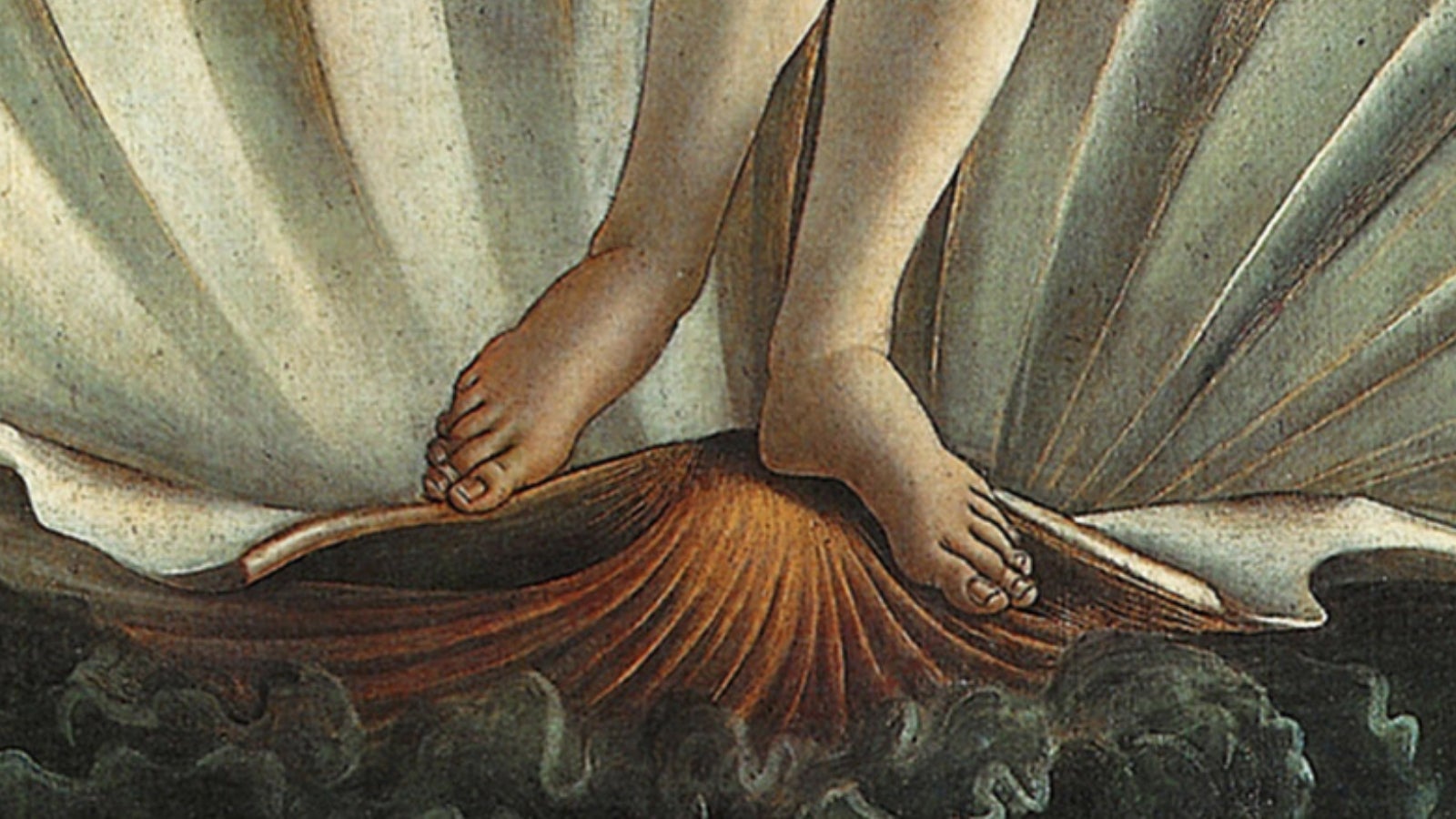
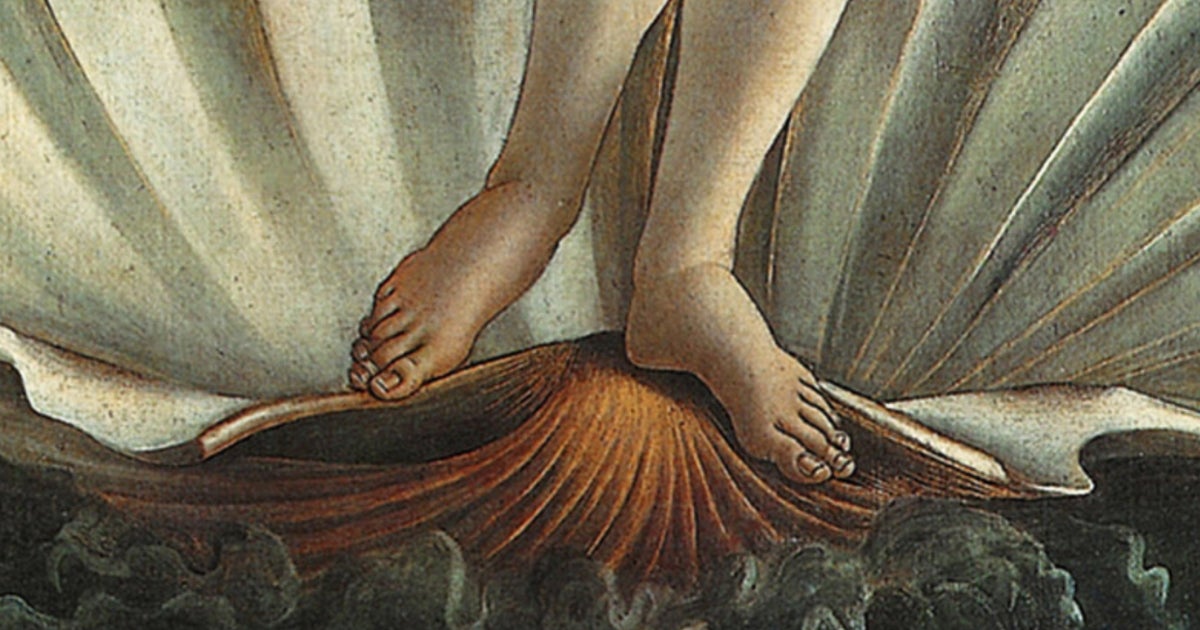
In all of these iconic works of art, the characters depicted have second toes longer than their big toe – a phenomenon sometimes called “Morton’s toe”. The feature is also seen in Botticelli’s The Birth of Venus and da Vinci’s famous Vitruvian Man.

It’s a quirk that’s been noted as far back as 1897, when a writer for the Boston Medical and Surgical Journal noted that in “early Greek art, where there is any attempt at careful modelling of the toes, the first toe is separated from the second, and in most instances the second toe is represented as somewhat longer than the first”.

Morton’s toe wasn’t really a “thing” in Ancient Egyptian art, though, Atlas Obscura added. That suggests it became a trend that stuck in the West.

So what’s going on?

Why might “Morton’s toe” be so present in ancient art?

Hands up: the short answer is, we don’t know for sure. But theories abound.

“Morton’s toe” affects anywhere from 4-30% of the global population.

The condition is sometimes called “Greek foot”, because over time, it’s become associated with Greek people.

That might explain its presence in predominantly Ancient Greek art – except that evolutionary geneticist Dr John H McDonald told USA Today, “I haven’t seen any evidence that so-called ‘Greek foot’ is more common in Greece than anywhere else”.

Another theory is that a longer second toe better fitted Greek ideals of beauty because it was more closely aligned with the mathematical rules of the Golden Ratio.

But not everyone thinks those numbers quite run, including in Da Vinci’s Vitruvian Man, where the famous fella’s second toe on his upper right leg extends to perfectly touch the curve of the surrounding circle.

Then, there’s the copycat theory

There’s another option, too: simple repetition.

Whether some influential artists thought the feature was especially pleasing or just happened to use a model with Morton’s toe, there’s the chance that it was adopted by some of the greats and then endlessly aped.

“Many Roman statues have Greek feet, simply because the artists drew inspiration from one another,” Atlas Obscura posited.

A document from the US National Parks Service (NPS) seems to say the same thing: “As Roman statues sometimes are copies of the Greek originals, the Roman statues often have ‘Greek’ feet.”

Indeed, the person who created the Statue of Liberty, whose second toe is longer than her first, was pretty open about his Ancient Greek, Egyptian, and Roman inspiration.

“On her Greek/Roman feet, open sandals… define [the Statue of Liberty’s] heritage from the earliest days of civilization – we see her Morton’s toes,” the NPS added.

Share Button

Here’s The Real Reason Those ‘AI Time Machine’ Pictures Went Viral

Internet trends come and go. It’s as simple as that, especially on TikTok.

But with over 44 million views, the #aitimemachine trend that went massively viral on TikTok in November and December is still going, spreading to Twitter and Instagram, too.

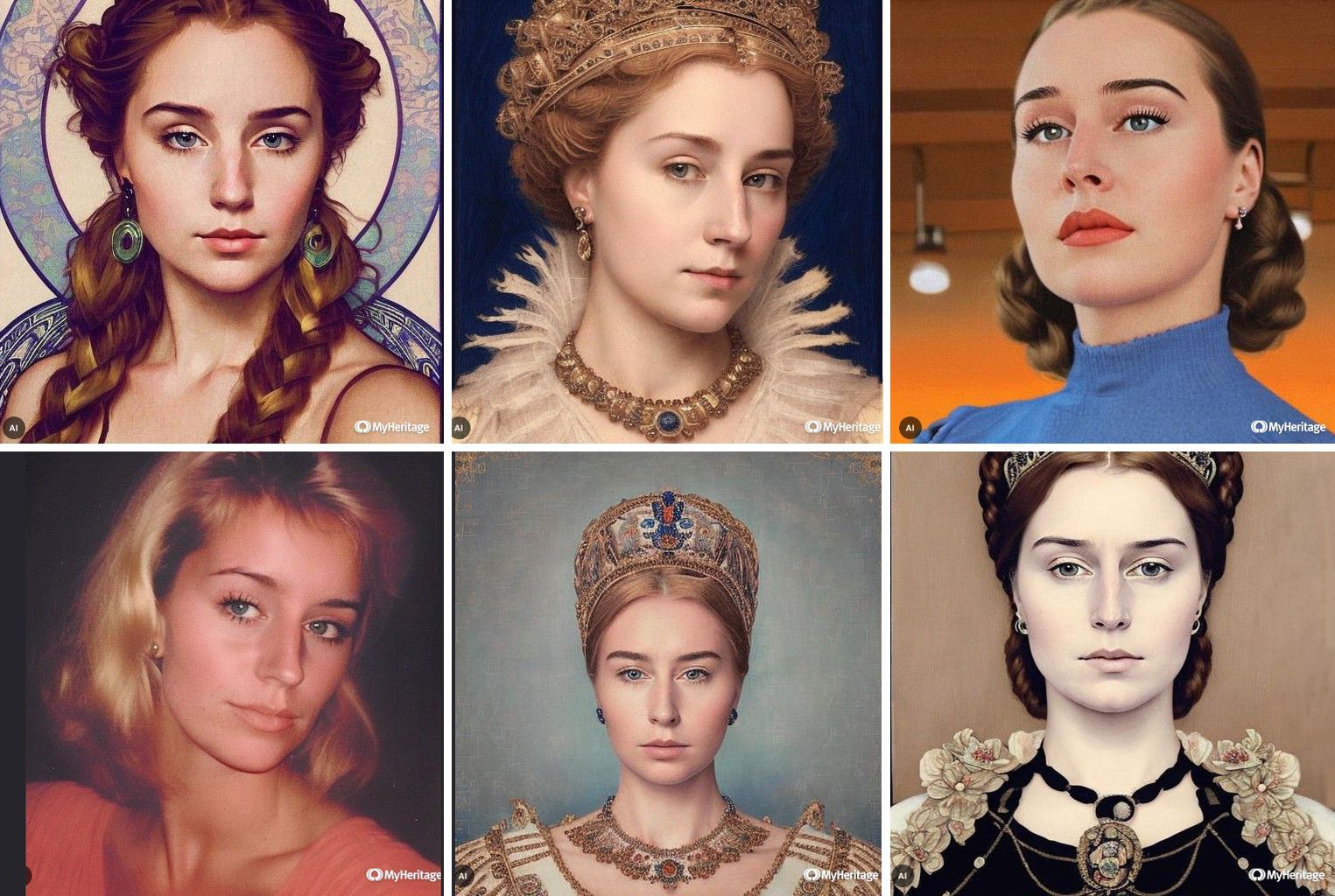
Users upload photos of themselves to the genealogy platform MyHeritage, which for $10-$18 (£8.15- £14.68)transforms the images into digital portraits in the style of famous paintings and “historical figures” like an ancient Greek, a Viking or a sultan.

Many TikTok users say the images made them feel beautiful and more confident in their unique features, even those they usually feel self-conscious about.

“I usually dislike my key features (thin lips, weak chin [and] soft jawline) but I kinda want to cry at these,” @coreyisnothome wrote in a TikTok video that went viral with over 300,000 likes and 2.5 million views. “I’ve never felt so beautiful,” said user @marymargaret14.

Student Savannah Caughey explained in her own viral TikTok video that she always felt insecure about her nose, but the Time Machine images made her change her mind.

“This trend allows people to connect with a part of themselves that is not distinguished by modern-day beauty standards,” she told HuffPost, adding that “the images allowed me to see myself in another light.”

“I learned to see that I have more of a classic beauty than a modern one, and this trend allowed me to feel confident and happy with that,” she said.

The MyHeritage program produces images that resemble drawings and paintings that imitate real art. Could that be why people feel so beautiful in their images?

Portraiture dates back at least to ancient Egypt, and throughout history portraits were used to showcase wealth and power. “I think it’s important to know that humans have been creating portraits for thousands of years; it’s really not a new phenomenon,” said Ella Raphëlle Dufrene, a French-Haitian American visual artist and registered art therapist.

Before photography, portraits were also a way to be remembered after death — physical proof of someone’s life. But in the selfie era, when it’s easy to capture your own image with the click of a button, the AI Time Machine images combine the digital world and the love of portraiture humans have had for centuries.

If there’s anyone who can speak about people’s love of portraits, especially in the form of paintings, it’s Melbourne, Australia-based artist Rebekka Lord-Johnson, who specialises in photorealistic and hyperrealistic drawings and paintings.

She went viral on TikTok for creating live wedding paintings in which real-life couples and their wedding celebrations become the subjects of her art. She has more than 500,000 followers and 32 million views on TikTok, where she posts the work she describes as “family heirlooms.” “It’s a family portrait, essentially,” said Lord-Johnson.

In her opinion, the AI Time Machine trend went viral because art is a celebration of uniqueness. People are generally excited to see themselves in images resembling art.

“I think when you see yourself in the context of an artwork, when you’re a part of making an artwork, your recognisable features, and your recognisable face is part of the whole painting that makes everything beautiful, I think it can really capture and feature your uniqueness,” she said.

Lord-Johnson said that art has the opposite effect of social media, which promotes beauty standards that have people trying to look extremely similar to one another in order to feel beautiful. By contrast, art celebrates each person as they are, no filters needed.

But while images from the AI Time Machine might resemble art, she said, they aren’t really. “It’s almost like a filter to me, like an Instagram filter,” Lord-Johnson said. “It’ll adjust your features to current beauty standards or standards of beauty back then, historically. So people aren’t actually seeing themselves, necessarily.”

In her experience, people do feel prettier when they see themselves in artwork. In a painting, a person’s uniqueness is highlighted and appreciated in a way that’s not commonly experienced, which many people find refreshing.

The couples Lord-Johnson works with, for example, often express how beautiful they feel in her paintings. Not only are they seeing themselves portrayed as they are, but “there’s a lot of emotion behind what I do,” she said. “When I create a work of art, a lot of love and attention goes into that painting.”

But if the AI Time Machine creations can’t really be interpreted as art, why are people feeling beautiful? “I think people are seeing themselves as beautiful because they’re seeing themselves in a different context,” Lord-Johnson said.

Dufrene offered a similar theory. “I do think that it’s because of the fact that they’re being turned into an ‘artwork’ that it’s increasing their sense of beauty,” she said. “But if we think of the origins of the word ‘portrait,’ coming from old French ‘portraire,’ which means to draw, reveal or expose, the AI portraits are allowing people to play a role, to reveal a more beautiful or empowered part of themselves. What that’s really telling me is that people are longing for a sense of wonder, play and creativity in their lives.”

“If you think of a little girl dressing up as a princess, we all have that inner child that wants to feel fantastical, wonder and play,” Dufrene said. She explained that when people see themselves as famous paintings and historical figures, it may help them to tap into their inner child — which might be why people are so drawn to this trend.

“We have a lack of playfulness, wonder, and spontaneity in our own lives,” she said. It’s not often that people exercise their will to play, like by creating digital portraits of themselves that resemble art and feel fantastical and special.

“People are really stressed out, especially after Covid,” Dufrene said. “Many people work 9-5 day-to-day jobs, where they’re doing these redundant activities that don’t necessarily explore their creativity and bring out their sense of play, and I think that can kind of dull our sense of self.”

It’s understandable, then, that people felt beautiful participating in the AI Time Machine trend (and thankfully, given facial recognition and online privacy concerns, the company says it does not save the photos that users upload).

As internet fads come and go, Dufrene said, there are many ways of exercising our inner child in our day-to-day lives, as well as increasing our own sense of beauty through art. If we have the means, of course, we can contact artists we admire to create a portrait, or we can do it ourselves with an art therapist. It’s also possible to add more play to your life by yourself; your inner child lives wherever you want them to.

“Playing dress up, creating a storyline, there are many ways that we can push it a little bit more,” Dufrene said. “Paint it. Dress up. Create a story.”

Share Button

These Soothing Illustrations Are The Perfect Balm For Overwhelmed Mums

Motherhood is full of conflicting emotions. It can be beautiful and joyful and fun, but it can also be demanding and confusing and overwhelming at the same time.

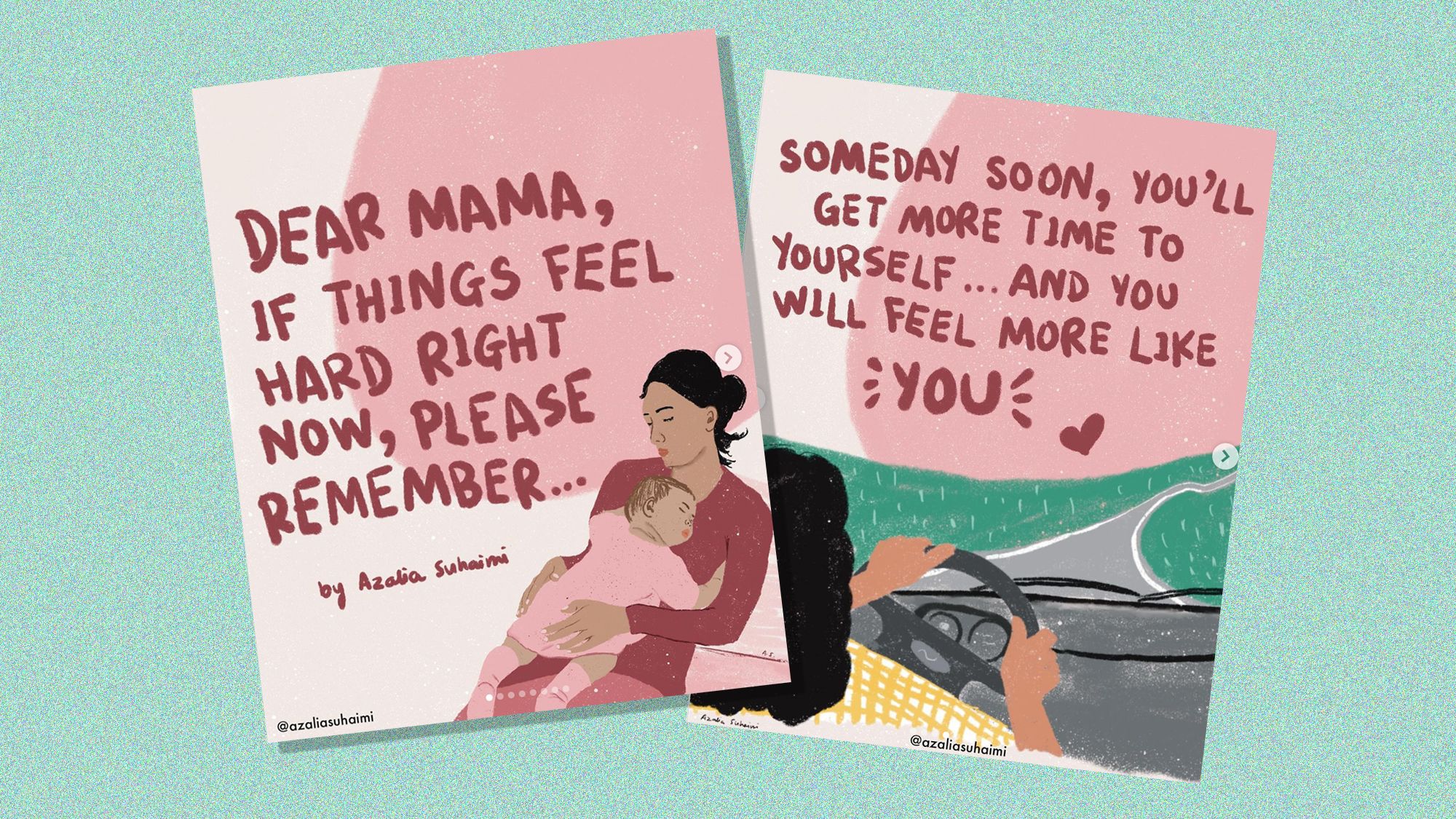
In artist and poet Azalia Suhaimi’s illustrations, the Malaysia-based mother of two offers comforting reminders to parents navigating these ups and downs.

Many of her illustrations, which she shares on her Instagram account, @azaliasuhaimi, begin with the words “Dear Mama.” But she said they apply to dads and other caregivers, too.

“My artworks are titled ‘Dear Mama’ as they mostly began as love letters to myself, like self-reminders on a bad day,” Suhaimi told HuffPost. “When I decided to share them with the world, I then began building a community of like-minded mothers, all of whom I have really loved connecting and exchanging stories with.”

Suhaimi started her Instagram account several years ago when she was “going through the postpartum blues.” At that time, she would share her own photography with poetic captions that talked honestly about motherhood.

“I scrolled through social media and saw all these picture-perfect Instagram photos of mothers enjoying their new babies,” she said. “I felt weird and alone and left out, like I was the only one struggling with these difficult feelings while every other mother out there seemed to be having the best time of their lives.”

Then, during the Covid lockdowns, she took a digital art course online and began creating illustrations for her posts.

In her work, she enjoys capturing the raw and real moments of parenthood, raising awareness of maternal mental health issues and offering solidarity to other parents in the thick of it.

Suhaimi’s kids are now ages eight and four. She said this is her favourite phase of motherhood so far.

“I can finally sit a bit and reflect on all the lessons I’ve learned from the struggles of early motherhood the past few years. And you can see these reflections on my artworks.”

As an artist, Suhaimi hopes to make parents feel less alone in their own journeys, whatever they’re going through.

“Parenthood is hard and messy as it is, so it’s nice to have solidarity, and a safe space where we can talk about the hard things without being judged and where our feelings are validated,” she says. “And I hope my artworks provide that safe space.”

Another important part of Suhaimi’s message is reminding parents to give themselves more grace.

“Some of my darkest moments of parenthood were really made darker simply because I wasn’t kind to myself,” she said. “I easily judged myself and concluded myself as a bad mom when what I faced was simply just a bad day.”

For Suhaimi, learning to practise self-compassion made “a whole lot of difference” in how she parents her kids and in her motherhood experience.

“So I hope that my artwork can help remind other parents and myself too – I still need the reminder – to practise self-compassion,” she says.

To see more of Suhaimi’s work, you can follow her on Instagram or visit her website. Below, check some of her heartfelt illustrations.

Share Button

29 Tonnes Of Carrots Have Been Dumped At Goldsmiths College Campus

HuffPost is part of Verizon Media. We and our partners will store and/or access information on your device through the use of cookies and similar technologies, to display personalised ads and content, for ad and content measurement, audience insights and product development.

Your personal data that may be used

  • Information about your device and internet connection, including your IP address
  • Browsing and search activity while using Verizon Media websites and apps
  • Precise location

Find out more about how we use your information in our Privacy Policy and Cookie Policy.

To enable Verizon Media and our partners to process your personal data select ‘I agree‘, or select ‘Manage settings‘ for more information and to manage your choices. You can change your choices at any time by visiting Your Privacy Controls.

Share Button