HuffPost is part of Verizon Media. We and our partners will store and/or access information on your device through the use of cookies and similar technologies, to display personalised ads and content, for ad and content measurement, audience insights and product development.
Your personal data that may be used
Information about your device and internet connection, including your IP address
Browsing and search activity while using Verizon Media websites and apps
To enable Verizon Media and our partners to process your personal data select ‘I agree‘, or select ‘Manage settings‘ for more information and to manage your choices. You can change your choices at any time by visiting Your Privacy Controls.
When you explore something new, you’re exploring relative to a previous baseline.
When you explore a new diet, your baseline is your previous way of eating.
When you explore a new travel-rich lifestyle, your baseline is your previous stay-at-home lifestyle.
When you explore a new relationship and you weren’t in a relationship right before, your baseline is being single.
Your default baseline is your normal, usual, routine, or expected experience in that particular area of life. Your baseline is your status quo.
But does that have to be your baseline?
If exploration is relative to your baseline, what would happen if you changed your baseline first?
Moving Your Baseline
We can compare the year 2020 to the previous baseline of 2019. That comparison will surely make the COVID situation stand out. We could also compare 2020 to the baseline of 2015, and that may serve to further highlight the political differences. And if we used 1943 as our baseline, the year 2020 might seem like a relatively quiet and peaceful year.
It makes sense to interpret change relative to what came immediately before, but in the context of personal growth, you have the ability to change what comes before your explorations. You have the ability to redefine and establish new baselines.
You can use your current circumstances as your point of reference for further exploration. But you also have the power to establish very different baselines and to use those as your jumping-off points for further exploration. As it turns out, this can be immensely valuable.
For instance, if you want to travel throughout another country for an extended period, you could first establish a temporary “home base” in that country, such as by renting an apartment in one city there. Then you could use that base for further explorations, such as by taking excursions and trips to other parts of the country, always returning back to your new base each time. You base lets you live like a local for a while, giving you a different point of reference when exploring, so you aren’t in perpetual tourist mode.
Practical Explorations
Sometimes it’s easier, more useful, or more meaningful to explore from a different baseline instead of your usual default.
Here are some examples to get your mind churning on some possibilities:
Suppose you want to find your ideal wake-up time. You could start experimenting from your current baseline. Or you could become an early riser first, such as by getting up at 5am consistently. Make that your new baseline. See how that feels for a month or two. Then explore with different wake-up times to see how they perturb your results.
If your usual wake-up time is 9am, and you experiment with earlier wake-up times like 5am, 5:30am, or 6am, you may not notice much difference between them. But if you first establish 5am as your new baseline, you’re very likely to notice how different it feels in your body to get up at 5:30 or 6am. You’ll also have a new perspective on how it feels to stay up late.
Getting up at 5am consistently is my baseline. If I do any further sleep experiments, that’s my starting point. If I get up at 6am one morning, I’m sleeping in late because 5am is normal. If I experiment with doing anything “first thing in the morning,” it means I’ll be doing it before the sun comes up.
Suppose you want to improve your diet. You could experiment from your current diet, but that may not be nearly as useful as establishing a healthier baseline first. If your current diet is so-so, and you add in some healthier foods or subtract some unhealthy ones, you may not notice much difference. Add some celery and blueberries, and it may not even matter.
But suppose you establish your baseline to be a vegan, whole foods diet – no animal products and no processed foods. Then you experiment around that, such as by adding back some of the items you were having before, one at a time to see how each one affects you. See how some crackers affect you. See how your body responds to caffeine. See how some cheese affects you (if you even find it appealing anymore). This will give you much more clarity about which foods are helping you and which are hurting you.
The cleaner, simpler, and purer your dietary baseline is, the easier it is to discern how different foods affect you and whether those affects are positive or negative.
I went wheat-free for many weeks and then had some wheat pasta this week. I noticed the difference in my body shortly afterwards, experiencing minor cold-like symptoms, mild congestion, and some brain fog for a few hours. I also felt extra calm and peaceful shortly after I ate it. If I eat wheat regularly, I don’t usually notice any reactions, but if I experiment against a wheat-free baseline, I can see how it affects me more easily.
What’s your baseline for cleanliness and order in your home? If you live in a cluttered environment, you may not even notice the results of some modest organization improvements. But if your baseline is to keep your place neat and tidy by default, then some minor tweaks may have noticeable affects.
Declutter Your Baseline
One nice improvement you can make is to declutter your baseline. You’ll often learn more by simplifying and cleaning up your baseline first, and then see what happens when you add complexity.
If, however, you start with a complex situation and shift from one form of complexity to another, or from complexity to relative simplicity, it’s hard to identify clear and crisp lessons. You won’t be able to tell which specific changes are having the biggest impact. You won’t know where the key leverage points are.
It’s hard to tell what’s dragging you down or holding you back when your entire baseline is filled with issues that could be contributing to those affects. It could take a long time to isolate and identify problems when you have a dozen overlapping problems interacting with each other. But if you could first establish a relatively problem-free baseline, then you could selectively add back some complexity and immediately see when you cross back into problem space.
Upgrade Your Baseline
Another empowering way to use baselines is leverage them to elevate your routine experience, so you’re always returning to a pretty good default situation.
How happy are you with your current baselines in these areas?
Relationship situation
Social life
Diet
Exercise habits
Cleanliness
Productivity
Workspace
Income generation
Hobbies
Entertainment
Hygiene
Reading and education
Living situation
Travel
Creative expression
Raising your baseline takes time, but it’s a worthwhile investment. While it’s wonderful to have peak experiences now and then, you’ll spend a lot of your life living at your default baseline. So even if it takes a huge amount of effort to raise that baseline, it’s well worth it.
When I think back about some of the best decisions I’ve ever made, they often involved changes to my baseline in some area of life. They involved significant lifestyle adjustments, and some took years to reach, but they continue to provide ample rewards.
It’s especially wise to raise your baselines to the point where your everyday experience includes appreciation. A good question to ask yourself is: Do I appreciate my baseline in this area of life?
For instance, my income generation baseline is that I make money from fun, creative, inspiring, growth-oriented projects that improve people’s lives. Many years ago my old baseline included stress, scarcity thinking, acts of desperation, and focusing way too much on money instead of happiness, flow, caring, and trust. Notice that my current baseline is simpler and cleaner than the old one, especially without the clutter of stress, worry, and desperation – so much wasted energy. Note that trust, caring, and fun are much simpler – they do take more courage to implement, but they do not require more complexity.
Consider how much we complicate our lives just to avoid the simplicity of courage. What if courage was your baseline?
If you don’t like your baseline that much, why are you still there? Maybe it’s time to stop framing it as your current default. Be willing to drop a baseline that isn’t serving you well. A good baseline is a jumping-off point for further exploration, but it’s also a decent place to hang out between experiments.
Today is the final day of NaNoWriMo. I added about 2000 more words to my novel-in-progress this morning. My final word count for the month came in at 55,051 words. The challenge of NaNoWriMo (National Novel Writing Month) is to write 50,000 words of a new novel in 30 days, so I exceeded this target by about 10%.
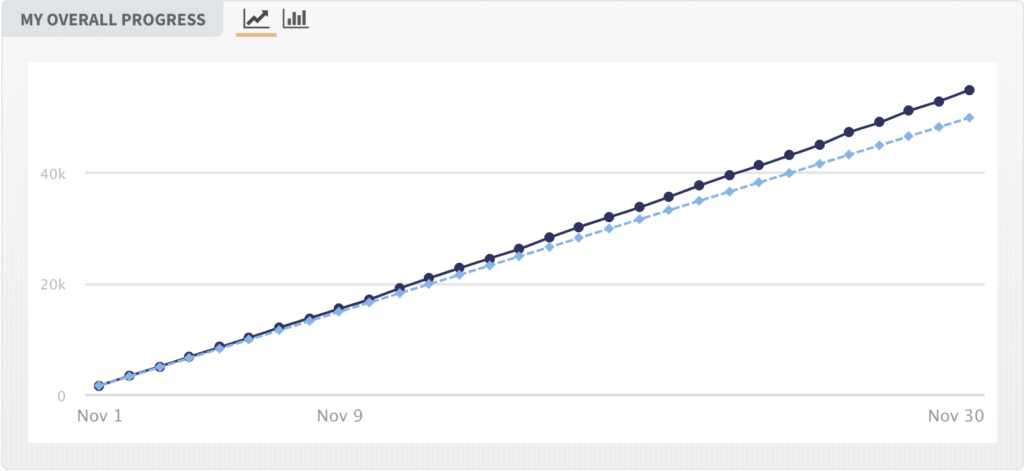
Here’s my daily progress log, showing my total word count (darker color) versus the daily pacing needed to hit 50K words (lighter color).
I surpassed the target pacing by a small amount on Day 1 and then padded my lead every day afterwards. It felt good to always be a little bit ahead throughout the challenge. I knew that if I just maintained this steady pacing, I’d never need to do any catch-up writing at the end.
Before starting this challenge, I learned that a major reason people fail at NaNoWriMo is that they fall behind in the first couple of weeks, and then they feel disheartened when facing the extra effort needed to catch up. Even skipping one day means you’ll have to write more in the remaining days. Most people who fall behind give up and don’t complete the challenge. This is an easily preventable point of failure.
My strategy was to approach this as a daily challenge, which plays to my strengths. I’ve done lots of 30-day challenges where I practice a specific behavior for 30 days in a row. In this case the desired behavior was to add at least 1667 words to my novel each day. If I just focused on that, the monthly goal would be accomplished too. It’s just typing after all.
Here’s what my daily word count looked like for all 30 days.
As you can see, I was pretty consistent throughout the month.
I averaged 1835 words per day, which works out to an extra 10% per day. Once I passed the 1667 words for the day, I kept writing till I felt like stopping, such as when I got to the end of a scene. If I felt like stopping but I wasn’t at 1667 words yet, I took a short break and then continued writing.
Final Reflections
This was a wonderful personal growth experience, and I’m glad I did it. The novel isn’t done and will need a lot of work to finish, but the daily writing got me well into the project.
I don’t have a completed book yet, and it would take a lot more work to drive this towards a version ready for publishing, but NaNoWriMo got me moving forward with meaningful progress. It helped me turn a mere idea into something a lot more tangible.
At this point I don’t have a completed story. I’ve written a first draft of many scenes. I have several well-developed characters. I have a well-structured three-act story with interesting plot twists. But there are still many more details to work out.
This is a very rough first draft. I’d say it’s not bad for a month’s work. I estimate that I averaged about 75 minutes per day of writing time (including thinking about what to write). I’m very pleased with how far I got for about 40 hours of effort. There was also some incubation time when I’d be thinking about characters or plot ideas while doing unrelated tasks.
The “words are cheap” mindset worked very well. It’s easy to throw words onto the screen, read them back the next day, and learn something useful. I’ll end up throwing away much of what I wrote this month, and I don’t lament that at all. Everything I wrote helped in some way. Each day I gained more clarity about the story, the characters, and the world. Even when what I wrote seemed like a chaotic mess, it still felt like forward progress.
Other writers have said that you write the first draft for yourself, not for anyone else. I adopted that mindset from Day 1, and I found it very helpful. I didn’t expect to show this early draft to anyone, not even Rachelle. So I just wrote whatever came to mind. It was my own personal exploration of the ideas and possibilities, nothing more. By framing it that way, I felt totally free to experiment and to make lots of mistakes. This helped me figure out what kind of story I wanted to tell. I let the words flow without any concern about who might read them.
One clear gain was that I understand my characters so much better than when I first started. Now I can write their words and actions much more easily, as if they tell me what they would say and do in every situation. So the writing got easier as I went along. The first few days were the most challenging; after that it was smooth sailing.
Another gain was that my “why” for writing this story improved as I kept writing. Around halfway through the month, I developed a stronger sense of purpose for why I wanted to write and share such a story. I had a more compelling answer to the questions: Why bother with this project? What’s the point? Who would want to read this? My purpose was more exploration-based in the beginning, but by the end I felt like I was creating something I really wanted to share with the world to see how it landed with people. I had a clearer sense of the story’s potential impact.
This was similar in some ways to designing a new video game from scratch, but the medium is very different. I liked how easy it was to explore the characters, story ideas, and world without having to deal with tech constraints. I could play around with any ideas I could imagine. I really enjoyed that type of experience – it was like pure play.
Most days I looked forward to my writing sessions. I didn’t experience much inner resistance after the first week, and that small resistance was just due to being too green at this type of writing. I think having lots of nonfiction writing experience – and a healthy willingness to make plenty of mistakes – was helpful. I never had writer’s block. I could connect with inspired ideas for fiction writing as easily as for nonfiction articles or courses.
Next Steps
I’m going to set aside the novel writing and coast into a more relaxed December since I want to focus on other aspects of life for the rest of the year. That includes finishing up my one-year daily blogging challenge, which has 31 days left to go.
Stephen King recommends setting aside a novel for at least 6 weeks after writing the first draft and then coming back it to fresh. He says it’s wise to get some distance from the story, so you can see it with fresh eyes before you start editing.
My first draft isn’t good enough that I can just edit it into a finished book. It’s way too messy for that, especially since there are a lot of scenes I’ll need to cut or rewrite differently. I’m still going to set this aside for 6+ weeks, probably until after our next deep dive is complete, but my next steps will different than Stephen King’s.
Sometime next year I’d like to revisit this novel project, re-read everything I wrote, and then begin working on a second draft. I’d like to do a round of more detailed plotting before I add more words to the book. I think the story would benefit a lot by clarifying the scene-by-scene layout.
The pantser approach was great for getting started since it helped me map out the possibility space for the story by writing a lot of scenes. Now I have enough understanding of the story and that characters that a good next step would be to map out the scenes for the story in the right order. I’d also like to fill out character and location sheets to fine-tune the characters and settings. Then I can write the second draft.
It’s going to be a long process, and I’m not in a rush to race through this. I do want to see this through to publishing. It’s an original story with some fun characters that I think people would enjoy reading. I might approach this project as a series of 30-day challenges to push it forward through different stages of development.
I’m especially happen that I framed NaNoWriMo in a way that made the experience enjoyable, especially by always being ahead of schedule. This makes me eager to re-engage with the novel when I’m ready. There are other priorities I want to engage with next, so I’m happy to put this aside for now, but I do look forward to getting back into it with fresh eyes.
Our Next Deep Dive
My first big priority for 2021 is to launch and develop our new creative productivity deep dive, which is tentatively called Amplify. This is for people who do creative work and want to increase their productive output. It’s also for people who’d like to get into a better creative flow. You could think of it as a course in how to be a prolific creator who publishes frequently. How can you express yourself creatively year after year without burning out?
I have tons to share about this topic that I believe would be unique and different from anything else out there. I’ve gone through many books and courses on creativity and on productivity, but I still haven’t seen really good coverage regarding connecting the dots between creativity and productivity. It’s like creativity is play, and productivity is work. There’s a lot of conflicting advice that treats creativity as inherently unproductive and productivity as inherently uncreative.
What if you want to excel at both together? What if you want to be a fountain of creative expression?
How can you be super creative and highly productive without sacrificing too much on either side? How can you get into the flow of creating and publishing – and stay there consistently without burning out?
There’s a lot to unpack here, and I’m convinced that this is an area where I can add some real value to people’s lives. I’ve created and published across many different media: articles, videos, podcasts, a book, video games, music, live events, and more. This year I’ve published something new every single day, adding hundreds of thousands of words to my collective work, which is already well into the millions of words, not counting translations into other languages.
I love to keep exploring new media too, such as I just did with NaNoWriMo. Partly I did NaNoWriMo as an experiment to test some of the ideas for this upcoming deep dive.
I’d love to do this new deep dive co-creatively too, like we did with our previous ones, so the lessons will be created as we go, designed for the specific needs of the people who enroll.
I haven’t decided on the exact the format yet. My intuition says it will likely be something different from our previous courses, perhaps a combination of live interactive parts along with structured audio lessons. People loved the audio format of Submersion and Stature, and there was also something special about the live sessions that we did for Deep Abundance Integration. So I’m thinking of merging those for the new deep dive. Would that appeal to you?
I’ll share more info on this new deep dive next year as we get closer to launching it. We’ll be launching it during the first quarter of 2021. I tend to get an intuitive ping when the timing is right for launching. In the meantime, I’d like to clear my plate of some other projects first, mostly on the personal side.
I crossed the 50K-word NaNoWriMo finish line yesterday morning, writing 51,262 words in 28 days, so I achieved this goal 2 days ahead of schedule.
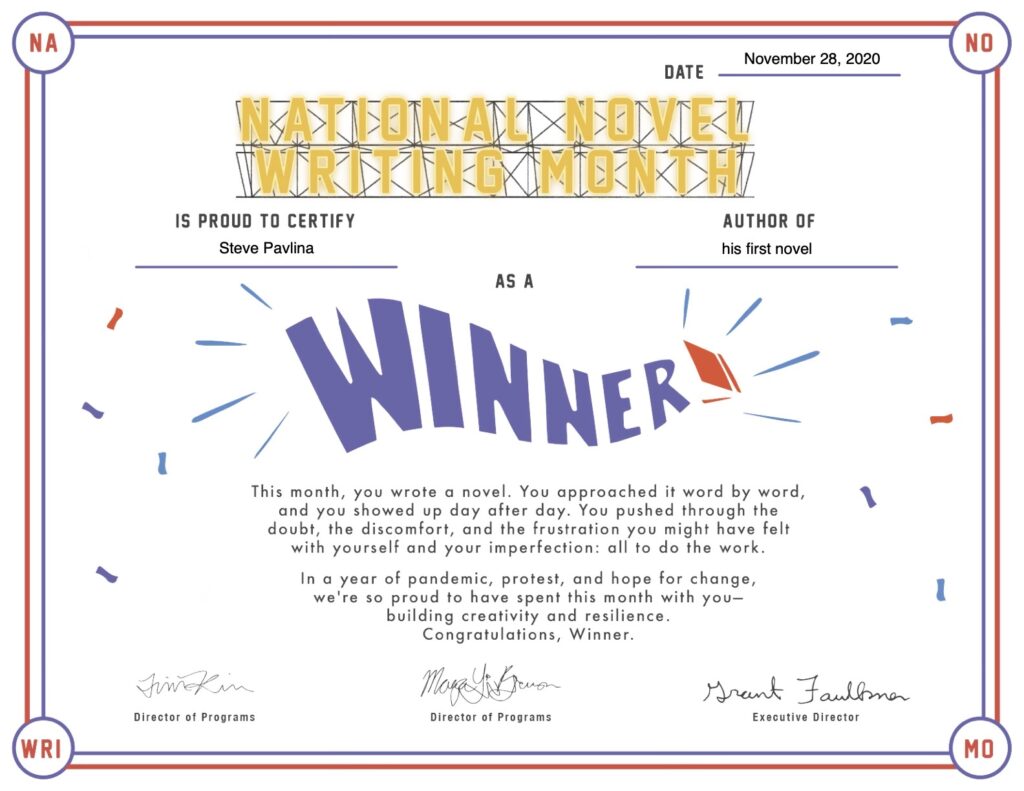
When I updated my word count yesterday, I received a congratulatory video, a bunch of links to claim the NaNoWriMo “prizes” (discounted promotions for various writer tools and services), and this completion certificate.
The way I framed this goal, however, was to add at least 1667 words per day to the novel for the full 30 days, so I didn’t stop after 28 days. After this morning’s writing session (Day 29), the novel is at 53,007 words. So tomorrow I’ll likely land around 55K words for this 30-day challenge.
Completing NaNoWriMo
This was my first NaNoWriMo and certainly a good year to do it. It was a great way to get started on a fiction book. I’m way further along now than I would have been if I hadn’t signed up for Nano. It’s been a rewarding experience overall.
One aspect I found less exciting than I expected was connecting with the Nano community. I thought it would be cool to connect with other novelists during Nano, but I felt a bit disconnected from that aspect of the experience. I didn’t feel like connecting with other writers while working on my novel. I browsed through some of the community posts but largely found it to be a distraction from actual writing, so most days I just did the writing on my own.
I enjoyed the challenge more when I stuck with introvert mode. It may be nice to connect with other writers before or after Nano, but I wasn’t inspired to do that while in the midst of figuring out the novel. I felt more motivated to connect with the characters I was developing.
I had no trouble feeling motivated to write each day. I didn’t write at same time each day, but I normally got each day’s writing done before 10am, often before 8am.
Most people who sign up for Nano don’t finish, but I never had any doubt that I’d do it. I do my best to win 30-day challenges in my mind before Day 1, and Nano was no different. The same goes for 365-day challenges like my 2020 daily blogging challenge (which is more than 90% done now). If you combine the blogging with the Nano writing, I probably wrote around 75K words this month.
Overall the combined writing experience flowed pretty well. Some days I blogged first and then did Nano, some days I flipped the order. But usually I finished both in the morning. Last Monday and Tuesday, I also did some batch blogging, queuing up several posts in advance, so I could enjoy the 4-day holiday weekend with a bit less daily writing – that was extra nice.
Leveraging the Fundamentals
One thing I love about having a career focused on exploring personal growth is how much time I have to spend practicing the fundamentals and how nicely that investment pays off over time.
This helps me leverage what I’ve learned to explore something new and be relatively productive from the start – and have fun doing it. Even when I’m a total newbie diving into an area where I have tons to learn, it feels like I have some extra advantages going in. A big one is just knowing that I can trust myself to follow through.
I expect to run into some difficulties or surprises along the way, and I also expect that I’ll be able to handle them. I’ll take action, persist, and learn as I go. I’m not afraid of failure, and I don’t tend to have issues with perfectionism. I prefer to just go, explore, and experience.
I like to play life the same way I like to play video games. Rachelle and I are about halfway through the new Zelda game, Hyrule Warriors: Age of Calamity, and I like that the game rewards my style of play – Rush in headfirst and slash away at every obstacle like there’s nothing to fear. We also pace ourselves, playing a little bit each day instead of rapidly binging through the whole thing.
The point of playing games is to have fun. This is a good way to approach life experiences too, including writing a novel.
I saw so many people in the Nano community struggling in ways that aren’t specific to writing. They struggle with personal development basics like setting clear goals, establishing productive habits, adopting empowering frames, creating confidence, eating healthfully, and so on.
But most of all, they struggle with making the journey fun, engaging, and rewarding each day. They inject far more suffering into the experience than necessary. Then they try to exert more discipline to push through that self-created drag, which can be very draining. I saw a number of “I give up” and “I’m quitting” updates along the way, and it looked to me that those people had already lost before Day 1. They approached the challenge in a way that was doomed from the start.
I saw plenty of uptightness in the Nano community. Some participants got bogged down in over-analysis and perfectionism. I think they could progress faster if they lightened up and learned to reframe failure as part of the fun. Some play the game so tightly that they prevent much of the joy of discovery from flowing through. It’s like playing a video game with someone who’s deathly afraid of losing a life, so they make the game more work than fun.
I actually found it stressful to read some of the community posts, but it was a good reminder that a long-term investment in personal growth fundamentals really does pay nice dividends. When you don’t practice the fundamentals enough, you’re likely to experience a lot of friction whenever you try to do something outside your comfort zone.
Practicing the fundamentals isn’t always sexy, but it helps us grow stronger, more capable, and more flexible. What good does it do to train up your writing skills if you can’t get yourself to apply those skills consistently? What if you lack the courage to create something unique that adds value to people’s lives? What if you aren’t able to handle criticism?
You can soak up domain-specific knowledge and skills, but what’s the point if you can’t get yourself to use it to create results?
This Nano experience helped me appreciate just how valuable it is to keep investing in the fundamentals. They grant access to new life experiences that would otherwise seem too far out of reach.
HuffPost is part of Verizon Media. We and our partners will store and/or access information on your device through the use of cookies and similar technologies, to display personalised ads and content, for ad and content measurement, audience insights and product development.
Your personal data that may be used
Information about your device and internet connection, including your IP address
Browsing and search activity while using Verizon Media websites and apps
To enable Verizon Media and our partners to process your personal data select ‘I agree‘, or select ‘Manage settings‘ for more information and to manage your choices. You can change your choices at any time by visiting Your Privacy Controls.
One way to shift your character – and your life – in a new direction is to set a goal that’s incompatible with the limitations of your current character.
In other words, set a goal that you would would never set. Then work diligently to pursue and achieve that goal.
Thinking you can’t do something because it’s out of character for you is still just a thought. You can change your thoughts, but sometimes it’s easier to change your actions and behaviors and let you thoughts play catch-up. Sometimes thoughts of who you are just get in your way and slow you down.
When you try to change yourself at the level of thought first, sometimes that works, but other times it will just lead you into a circular trap of thinking, thinking, and more thinking – and never actually doing, exploring, and experiencing.
Pay special attention to where you have desires that you tend to quickly suppress, especially with respect to ambitious goals and lifestyle experiences.
What experiences are other people having that you secretly envy?
What do you secretly daydream about doing or experiencing, but you could never tell anyone?
Have you ever thought about pulling one of those crazy ideas out of the dream space and setting it as a real goal to accomplish? Other people have already done that.
There’s something transformational about writing down a goal that doesn’t feel like you.
I encourage you to try this: Write down some goals that you would never set as goals. If you have a system for tracking your goals and projects, add those new goals to that systems. Create stub projects for them. Slot them right alongside your other goals. Notice how this feels. Does it seem unreal? A bit edgy perhaps? Realize that you could actually achieve those goals. You could make them real. They don’t have to just haunt you in the idea space.
One example is starting a business. Some people grow up believing that they aren’t cut out to run a business. Having been an entrepreneur myself since 1994 and having met hundreds of other entrepreneurs, I can tell you that a lot of people feel that way. Many still feel that way even after they’ve been entrepreneurs for years. Lots of people don’t think they’re cut out for it, even after doing entrepreneurial activities for 10 or 20 years. So if you have doubts about whether or not you can do this, join the club – you’re way more compatible with this goal than you think.
It’s odd that even after years of doing something regularly, it can still take a while for a person’s self-image to catch up. People think they need to meet some arbitrary standard of achievement before they can claim certain labels. But the labels don’t matter that much anyway. The actions and the results matter a lot more.
Another example would be to have sexual experiences that you feel are beyond you. For some it’s losing their virginity. For others it’s having a threesome or participating in an orgy. For still others it’s having a regular sex partner with whom there’s a strong mutual attraction.
If you’d like to have a lifestyle or sexual experience that you haven’t had yet, it should be on your goals list, written down plain as day. It doesn’t matter if you don’t see yourself as “that kind of person.” Add it to your goals anyway. Take action and use your problem-solving skills to move the goal forward, just like any other.
The notion that anything is beyond you is just a thought pattern. It’s not the actual truth. There are plenty of people who are less intelligent, competent, and attractive than you are who regularly experience what you rule out. You’re probably putting some of them on a pedestal; if you met them in person, you might be far less impressed.
That’s what nudged me to set a lot of stretch goals. I met people who achieved some of my stretch experiences, and I realized that a lot of them aren’t the amazing people I assumed they were. They’re just people.
When I started ruling in those kinds of experiences at least at the level of goals that I could freely set, that made all the difference. That made my mind do a double-take: Wait… we’re actually setting these as goals? Ummm… okay, why the hell not? This could get interesting!
When you set an incompatible goal as a real goal, it pushes your brain to start asking some really good questions that you should be asking, like these:
Is this goal really impossible for me?
Is this goal really incompatible with who I am? Does it have to be?
Why can’t I pursue this now?
Could I become the kind of person who could have this experience?
If so-and-so can have this experience, why not me?
Do I want this? Can I admit that to myself?
Why am I so afraid of this goal?
Are there people who would regard my resistance and hesitation as silly, unnecessary, or cowardly?
Are there people who’d encourage me to go for it if they knew the whole truth about my thoughts and feelings on this?
If I could be sure that this reality is a simulation, would I let myself have this experience?
The goals you’ve ruled out will often be the most fun, the most growth-oriented, the most motivating, and the sexiest. They’ll also be the scariest because you’ll have to stretch who you think you are to get there. That’s good. An empowering goal ought to stretch your self-image. It ought to challenge you. It ought to push your buttons.
Take a possibility you’ve been dismissing, and just try setting it as a real goal. Put it on your goals list. Then let yourself feel the resistance and self-doubt. Call it ludicrous if you must. And then say: Yeah, okay, there’s some resistance, hesitation, self-doubt, shame, fear, and so on. But I still kinda want it. It would still be an awesome experience to have. Then let the goal remain on your list. Just keep looking at it when you see your other goals and projects. Just keep leaning into the realization that you could actually do it.
My novel is at 41,347 words now. I’m averaging about 1800 words per day, on pace to hit 50K words on November 28.
I recently decided to tackle the most challenging part, which was to figure out the Q factor and how I’m going to end the story in Act 3. I opted to just start writing to see what came through even though I didn’t have a good idea when I started.
What is the Q factor? The Q factor is a reference to the Q character in James Bond. It’s when Bond is given some gadget early in the story that he can use to escape a difficult trap later on, like a pen that houses a laser beam that can cut through bars. Q is the character who gives him those gadgets. A Q factor in a story is a callback to something earlier that the main character can use to solve a major problem later on. An example is when Obi-wan reminds Luke to “use the force” while attacking the Death Star in Star Wars.
I’ll have to toss out most of what I wrote for this part, but it led me to see a better way to frame the story so I can bring it to a strong and compelling close. I’d been considering a certain change for a while but wasn’t sure if I should do it, but now I think it’s the right way to go. I basically have to change up which character I define as the protagonist.
There are two main characters who are in almost every scene together, so the previous scenes I wrote still work regardless of which character I intend to be the protagonist. But I’m only seeing a good way to end the story if I reframe which one I’d label as the protagonist. Then it gets pretty interesting. It’s a bit unusual, but I think it’s more promising overall.
It’s similar to the framing in the movie Avengers: Infinity War. The protagonist is actually Thanos, not the Avengers. Even though he’s the bad guy, the story is really about his journey, and the Avengers keep antagonizing him along the way. Thanos benefits from the amazing Q factor at the end that lets him seize victory from the jaws of defeat – the Time Stone. If you’ve also seen the movie Doctor Strange, then there’s an extra nice payoff for that particular Q factor.
It still feels like the most important thing I’m doing for this first draft is to figure out the characters and their motivations. Secondly I’m exploring story possibilities in the form of scenes that could happen. I’m gradually building a jumbled tree of messy branches that may all connect to the same trunk, but the final story isn’t going to include every branch. I still have to explore enough of the tree to grasp where the most interesting branches are. The final story I actually write will be a small subset of the story possibilities that I’ve explored.
I like using a mostly pantser approach for this first draft. It’s good to have so much flexibility in how I approach this since I don’t already have a clear grasp of the story I’m telling. I know some of the major pieces but not all of the minor ones. It’s useful to throw more words onto the screen each day and then read them back the next day. I’ll end up throwing most of these words away, but they’re helping me to discover a compelling story within the possibility space.
The USA just reached 10 million reported COVID infections earlier this month. Now it’s beyond 12.5 million and is on track to hit 14 million by the end of the month. It’s been estimated that at least 3 million people are probably infectious right now, and many don’t know it because they’re asymptomatic. The real number could be a lot higher.
A few days ago we hit another new high: 204K new cases in one day. This is after just recently breaking 100K for the first time.
Deaths are still ticking up as well, now around 2K per day. I imagine that’s going to be a lot higher in December.
In some U.S. states, the infection rate is so high that even with a modest-sized family gathering, it’s likely that at least one attendee is infected.
Some places that were previously doing contact tracing have abandoned the practice because they can’t keep up with all of the cases.
In my state of Nevada, the Governor just tightened up some restrictions because the infection rate is surging here too. A couple of months ago, we were seeing 250-500 new cases per day. Now it’s around 2000 per day with a recent high of 2416. And the infection rate here is modest compared to what some places are currently seeing. Even so, a major hospital still had to convert a parking garage into overflow space for COVID patients, and it’s already being actively used.
This Thanksgiving will be the last one for many people who aren’t intelligent, informed, or caring enough to cancel family gatherings this year. Millions of people are heading for an avoidable trap.
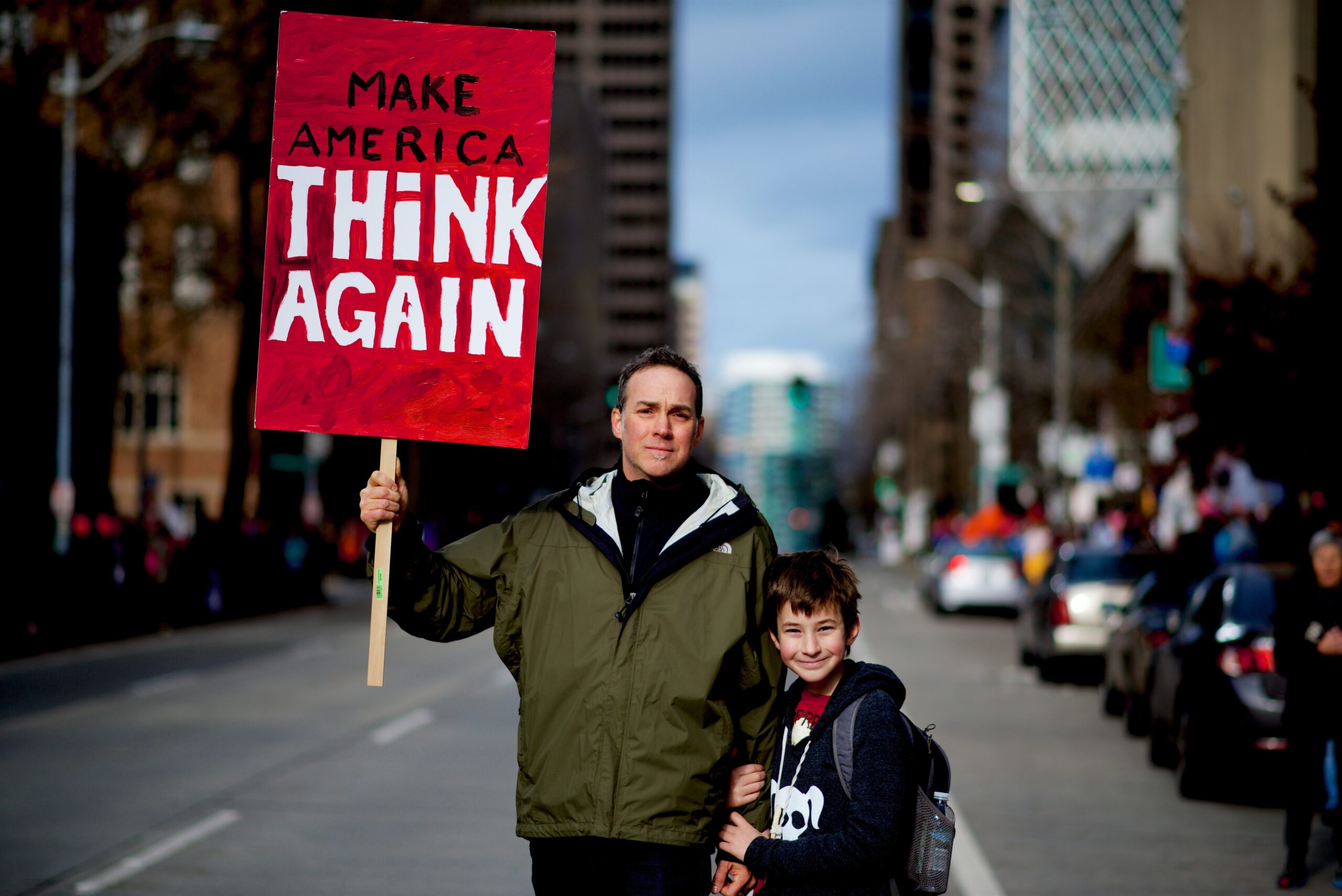
If you intend to host or attend a family Thanksgiving event this year, think again and cancel those plans. It isn’t safe. Such behavior is incredibly reckless right now.
If you have some intractable and clueless relatives, would you rather see them terribly disappointed, terribly sick, or peacefully dead (after being unable to breathe for a while)?
A few weeks from now, a lot of people will be crying and wishing they’d made a different decision. Don’t be one of them.
Sometimes the right decision isn’t to seize an opportunity but to avoid a calamitous mistake. Remember that you’ll have the memory of what you do this Thanksgiving for the rest of you life. No matter what you decide, you’ll carry that memory into 2030, 2040, and beyond. Which memory do you want?
You only control one side of this decision. You don’t get to control reality’s responses. And reality is clearly queuing up a big lesson for a lot of people, namely that it doesn’t respect fools.
If this is all just common sense to you – and it absolutely should be – please also do your part to actively and vehemently discourage your friends and family from having family gatherings during this time.
I know from years of experience that while my readers tend to be very smart and sensible, many have relatives who are… how shall I put this… dumb as a stump. If that’s your situation, then here’s your chance to put your personal development investments into practice. Let’s see that fancy courage you’ve been working on all these years. Get aligned and stay aligned with truth. Don’t be loyal to ignorance and denial, even if you share some blood with it.
I can assure you that no one will die from our Thanksgiving, and no animals will be harmed either. Rachelle and I are staying put, and no one is coming over.
Use your brain and don’t be stupid this year.
There will be another time. Not this year.
If you need to use it as such, this article also doubles as a permission slip to skip Thanksgiving this year.
HuffPost is part of Verizon Media. We and our partners will store and/or access information on your device through the use of cookies and similar technologies, to display personalised ads and content, for ad and content measurement, audience insights and product development.
Your personal data that may be used
Information about your device and internet connection, including your IP address
Browsing and search activity while using Verizon Media websites and apps
To enable Verizon Media and our partners to process your personal data select ‘I agree‘, or select ‘Manage settings‘ for more information and to manage your choices. You can change your choices at any time by visiting Your Privacy Controls.
HuffPost is part of Verizon Media. We and our partners will store and/or access information on your device through the use of cookies and similar technologies, to display personalised ads and content, for ad and content measurement, audience insights and product development.
Your personal data that may be used
Information about your device and internet connection, including your IP address
Browsing and search activity while using Verizon Media websites and apps
To enable Verizon Media and our partners to process your personal data select ‘I agree‘, or select ‘Manage settings‘ for more information and to manage your choices. You can change your choices at any time by visiting Your Privacy Controls.