Emma Raducanu Congratulated By Royalty, World Leaders And Entertainment World Following Stunning US Open Victory

The Queen has led a wave of tributes to Emma Raducanu following her “remarkable achievement” in winning the US Open.

The British teenager, who arrived in New York last month with a ranking of 150th and just one Grand Slam appearance to her name, beat Canadian teenager Leylah Fernandez in straight sets in Saturday’s final.

In a statement, the Queen wrote: “I send my congratulations to you on your success in winning the United States Open Tennis Championships. 

“It is a remarkable achievement at such a young age, and is testament to your hard work and dedication.  I have no doubt your outstanding performance, and that of your opponent Leylah Fernandez, will inspire the next generation of tennis players. I send my warmest good wishes to you and your many supporters.”

TIMOTHY A. CLARY via Getty Images

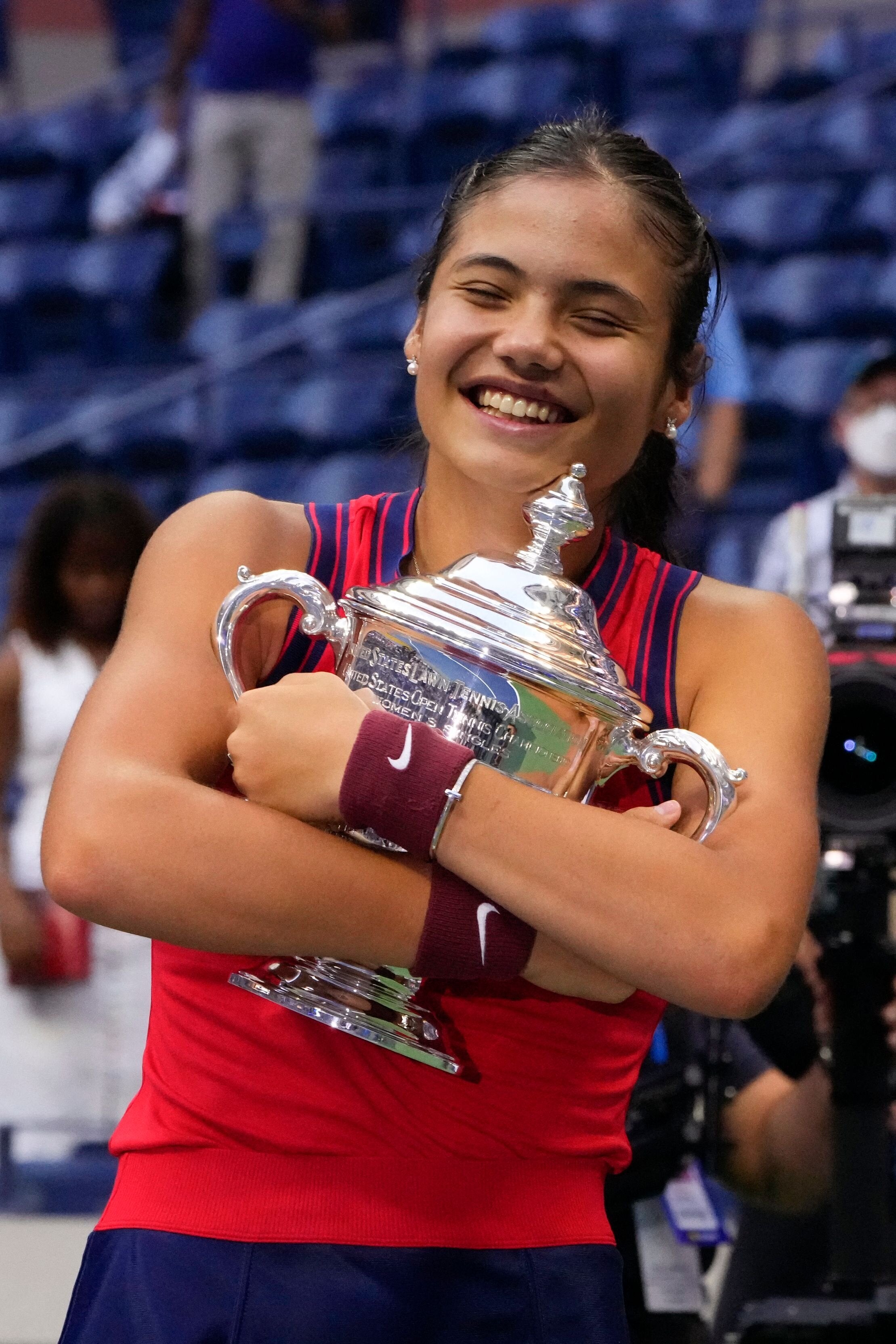
Britain’s Emma Raducanu celebrates with the trophy after winning the 2021 US Open Tennis tournament women’s final match against Canada’s Leylah Fernandez.

Following her win, Emma said: “You say, ‘I want to win a Grand Slam.’ But to have the belief I did, and actually executing, winning a Grand Slam,” Emma said, “I can’t believe it.”

Until three months ago, Emma had never played in a professional tour-level event, in part because of the pandemic and her parents’ insistence that she complete her high school degree.

“My dad is definitely very tough to please,” the 18-year-old said with a smile following her victory. “But I managed to today.”

Emma also put a smile on the faces of many famous Brits, who rushed to congratulate her on social media…

Emma is the first female qualifier to reach a Grand Slam final, let alone win one, and is the first woman to win the U.S. Open title without dropping a set since Serena Williams in 2014.

Emma, who was born in Toronto and moved to England with her family at age 2, is also the first British woman to win a Grand Slam singles trophy since Virginia Wade at Wimbledon in 1977.
Share Button

12 Ways Therapists Are Personally Coping With Covid Anxiety (Again)

When the Covid-19 pandemic broke out in early 2020, we asked therapists and other mental health practitioners to share coping mechanisms for dealing with our weird new normal and mounting anxiety about the coronavirus.

Now the world is (somehow) entering the 19th month of the pandemic, and we’re calling on them again.

As the Delta variant of the virus continues to spread, infecting high numbers of unvaccinated people in the US in particular, we could use some therapeutic advice to help dial down our anxieties.

Below, mental health practitioners across America share how they’re coping with so much uncertainty, and the techniques they personally use when they start to worry about Covid getting bad again.

I remind myself this isn’t my first Covid rodeo.

“In times like these, I remind myself: I am not a pro at living through a pandemic, but I am not a novice, either. I remind myself that I can take precaution and maintain the way I have been for over a year. I can do the best that I can. My best is enough.” ― Akua Boateng, a psychotherapist in Philadelphia

I practise gratitude.

“It’s always helpful to focus on what we can control, but focusing on what we are grateful for is transformative. Practising gratitude always helps my anxious worries melt away. When the world feels uncertain, I love to physically write down on paper all the things I’m grateful for that come to mind, no matter how big or small. This small gratitude practice helps me shift my thinking away from ‘powerless’ to ‘powerful,’ from feeling like a victim to feeling like a victor. (As a mental health professional, I know that gratitude rewires our brains’ thought patterns for the better!) And in the moments my mind seems to want to cling extra-hard to anxiety, I take the opportunity to call a friend and share what’s on my mind. Connecting with another human being for a little compassion and empathy is always a good idea!” ― Therese Mascardo, a psychologist and founder of Exploring Therapy

I let myself process all my emotions about Covid: the good, the bad and the ugly.

“I personally give myself permission to name and experience the wide range of emotions stemming from the current pandemic and new variant; these feelings range anywhere from grief, anger, helplessness to hope. I let these feelings run through me and also share my thoughts and feelings with my support system of family and friends. This reminds me that I’m not alone with what I am experiencing.” ― Alyssa Mancao, a licensed clinical social worker in Los Angeles

“I practise regular self-validation and self-compassion, meaning that I allow and accept the emotions that show up with kindness, and without allowing self-judgment and self-criticism to prevail. Emphasis on ‘practice’ here, not perfection. At the end of the day, we’re all humans going through a shared traumatic experience together. I allow myself space to take time for myself, consider what I’m capable of, workload-wise (aware that I have the privilege to do that), and recalibrate and adjust as these times ahead change.” ― Brooke Huminski, a psychotherapist in Providence, Rhode Island

I limit the amount of Covid news I consume.

“What helps me to manage my Covid anxiety is to set limits and boundaries around the information that I am consuming. That can look like only watching the news for 10 minutes per day and not constantly refreshing my feeds. It is also helpful to set boundaries with friends and family in terms of sharing news stories, fatality rates and other information that can affect my mood. Simply stating, ‘Hey, I appreciate you wanting to keep me in the loop of what is going on, but these articles are creating more anxiety for me.’ Especially since we are all managing a climate in which there are so many opinions and an influx of false information spreading, it is important to filter what you are consuming and set boundaries.” ― Aaliyah Nurideen, a licenced clinical social worker in New Jersey

"[I] set limits and boundaries around the information that I am consuming," one social worker tells HuffPost. "That can look like only watching the news for 10 minutes per day and not constantly refreshing my feeds."

“[I] set limits and boundaries around the information that I am consuming,” one social worker tells HuffPost. “That can look like only watching the news for 10 minutes per day and not constantly refreshing my feeds.”

I ground myself in nature.

“Even though all I want to do after a long day of sessions is collapse on my couch and eat Cheez-Its, I force myself once or twice a week to the beach where I can put my feet in the sand and listen to the waves. Take an evening walk or sit on my back patio and listen to the birds chirping.” ― Jennifer Chappell Marsh, a marriage and family therapist in San Diego

With so much out of my control, I’m focusing on what I can control.

“To me, the key to handling worry (whether it’s about Covid or anything else) is to make decisions about what I can actually control and then redirect my attention to what I’m actually doing with my time in the present moment. So if worry comes up about the latest COvid news, for instance, I might take some brief time to decide if I want to update any personal decisions I’ve made about activities or precautions in my life related to COvid. That should be a relatively quick thing (lingering for too long in decision-making mode is bad for anxiety), and then I try not to analyse questions I can’t actually answer, like ‘When will this end?’ or ‘Will I get Covid?’ Those questions are impossible to answer with certainty, so instead of trying to eliminate the uncertainty, I allow the uncertainty to exist and redirect my attention towards whatever activity I am actually doing with my time in that moment. Basically what I’ve just described there is mindfulness and acceptance of uncertainty, which are proven effective strategies for anxiety and worry.” ― Michael Stein, a psychologist in Denver specializing in anxiety and obsessive-compulsive disorder

“In grappling with my own Covid anxiety, I’ve worked on more actively accepting uncertainty. This means recognising when things are outside of my control, and gently encouraging myself to release any attempts I’m making to control those things. At the same time, I’m also staying mindful of the things that are still within my control – even if they feel small. We all make numerous decisions throughout the day – from what we eat, to what we wear, to who we interact with ― and reminding myself that I have choice in all of those things helps me to stay connected to my sense of agency in the world and my own capacity as a human being.” ― Madison McCullough, a psychotherapist in New York City

I try to meditate every day.

“I’ve committed to a morning and evening meditation practice. Even if I only have five minutes, it really grounds me as I enter the day and night. Insight Timer is a fantastic free app that provides a variety of meditations to meet your personal needs.” ― Aimee Martinez, a psychologist in Los Angeles

I try not to overextend myself.

“I’m a psychologist and a human: I have to contend with the same rush of emotions when I see the news stories involving loss, the politicisation of the virus and vaccine, and ‘business as usual’ even in the face of crisis. What has helped me over the past 19 months is figuring out what is in the locus of my control: that is, how can I not take blame for national events and focus more on what is more proximal to me? For example, just because I do an interview urging vaccinations on CNN does not mean I should see a spike in appointments the next day. What I can do, however, is check in on the one person I had a conversation with about vaccinations, to see how I can support their decision with evidence and love. But sometimes even checking in [on] other people can be a big source of frustration. That means limiting my locus just to myself: Am I wearing a mask? Am I sleeping and eating right? Have I sent loving messages to those around me? Just those seemingly small check marks can reduce the anxiety I have about exposure, increased risk, or supporting my loved ones.” ― Riana Elyse Anderson, a psychologist and assistant professor at the University of Michigan School of Public Health

“I’ve committed to a morning and evening meditation practice," one social worker says.

“I’ve committed to a morning and evening meditation practice,” one social worker says.

I’m practising radical acceptance.

“Right now, I am practising radical acceptance (a distress tolerance skill). I have accepted the uncertainty of the situation, which doesn’t mean I like it or want it, but means I have chosen to say to myself, ‘This just is what it is and I cannot control this situation. I am focusing on what I can control.’ I focus on having a relaxing morning routine and doing things that relieve stress every day.” ― Rebecca Leslie, a psychologist in Atlanta

I lean into my hobbies.

“Arkansas is a Covid hot spot, so my Covid policies are self-care via masking, doing only telehealth sessions with clients, being vaccinated, and going out only when necessary, though I walk in nature for an hour daily with my dogs. To stay challenged, I’m learning two new hobbies ― knitting and woodworking. Bottom line, there’s a lot of lemonade that can be made from pandemic lemons.” ― Becky Whetstone, a marriage and family therapist in Little Rock, Arkansas, and co-host of “Curly Girls Relationship Show”

I seek harmony.

“When Covid became a thing, my big focus was on creating balance in my life. I worked hard at balancing being a great therapist, being my most present self to my two toddler children, being a listening ear to my medical colleagues working on the front lines, being an anchor to my extended family as they grieved the loss of several family members and friends, and taking the baton from my husband as he took on the lion share of pandemic parenting. This time around, I seek harmony. I am striving to live in the flow of my life by establishing routines, permitting myself not to follow routines, creating structures in my life, and allowing myself room to move within those structures. Less abstractly, I am listening more to what I need to be there for others. I am also accepting the limitations to my excellence. I am not here to find balance in all the many responsibilities and goals I have. I am here to live my life to the fullest, which means living in the flow of the good, bad, and blah days.” ― Dana Crawford, a psychologist and cultural bias consultant in New York City

I remind myself I’m doing all I can to stay safe.

“When I begin to feel anxious, as we all do ― often triggered by something I heard on the news, or a notice from my child’s school about another infection ― I fall back on cognitive behavioral tools. I remind myself of the statistics with this virus. Despite the high infection rate and the virulence of the delta virus, the death rate is still low. I remind myself that I am doing all I can do by following medical advice. I choose to put the rest of my worry on a shelf. I also choose to enjoy this present moment and not allow my fear to steal it from me. I will often repeat this to myself a few times, add some deep breaths and distract myself with a healthier thought, and I’m on my way again.” ― Zoe Shaw, a psychotherapist, relationship coach and author of “A Year of Self-Care”

Share Button

Coronavirus: PM set to unveil Covid Winter Plan for England

The plan will include contingency measures that would come into force if the NHS was under pressure.

Share Button

Jennifer Aniston Breaks Down In Tears During Ellen DeGeneres Show Appearance

An emotional Jennifer Aniston broke down in tears as she helped Ellen DeGeneres launch the farewell season of her daytime chat show.

The final run of The Ellen DeGeneres Show, which is coming to an end after the upcoming 19th season, begins airing next week and a sneak-peek sees the former Friends star among the guests.

It’s a full-circle moment for the actor, who was the first ever star to appear on the show when it launched in 2003.

In the teaser clip, Jennifer breaks down in tears as she walks out to greet the host in front of a fully masked studio audience.

“What the hell? This is not supposed to be emotional. God dang it,” Jennifer says.

Warner Bros

Jennifer Aniston

Jen then jokes she had barely left the house in two years, before taking Ellen to task about the state of a welcome mat she gifted her when the show first started.

Late night host Jimmy Kimmel will be the first guest on the final season of The Ellen DeGeneres Show, with actress Tiffany Haddish, Kim Kardashian West and social media stars Charli and Dixie D’Amelio also appearing.

The final series of Ellen’s show comes in the wake of July 2020 reports of a “toxic” work culture on the show.

BuzzFeed News spoke with 36 anonymous ex-staffers, all of whom shared stories of the improper treatment they experienced or witnessed on set. Three producers left the show amid the allegations of “sexual misconduct and racially insensitive remarks.”

Warner Bros

Jennifer Aniston and Ellen DeGeneres

After that report, Warner Bros. said parent company WarnerMedia launched an investigation that revealed “some flaws in the show’s daily management.” The studio also said it was “disappointed that the primary findings of the investigation indicated some deficiencies related to the show’s day-to-day management.”

Before the workplace scandal, Ellen was one of the most popular personalities on US TV, known for her “be kind” mantra, often taking part in lavish giveaways or acts of charity.

Last year, she apologised to staff but denied the claims of a toxic workplace environment were the reason she is ending her chat show.

Share Button

A Place In The Sun: 25 Behind-The-Scenes Secrets As Revealed By The Show’s Presenters

After 21 years on our screens, A Place In The Sun is one of the UK’s longest running – and most loved – shows.

During the pandemic it has been the perfect escapist telly as the presenters hop around the world with house hunters on the lookout for the perfect home from home.

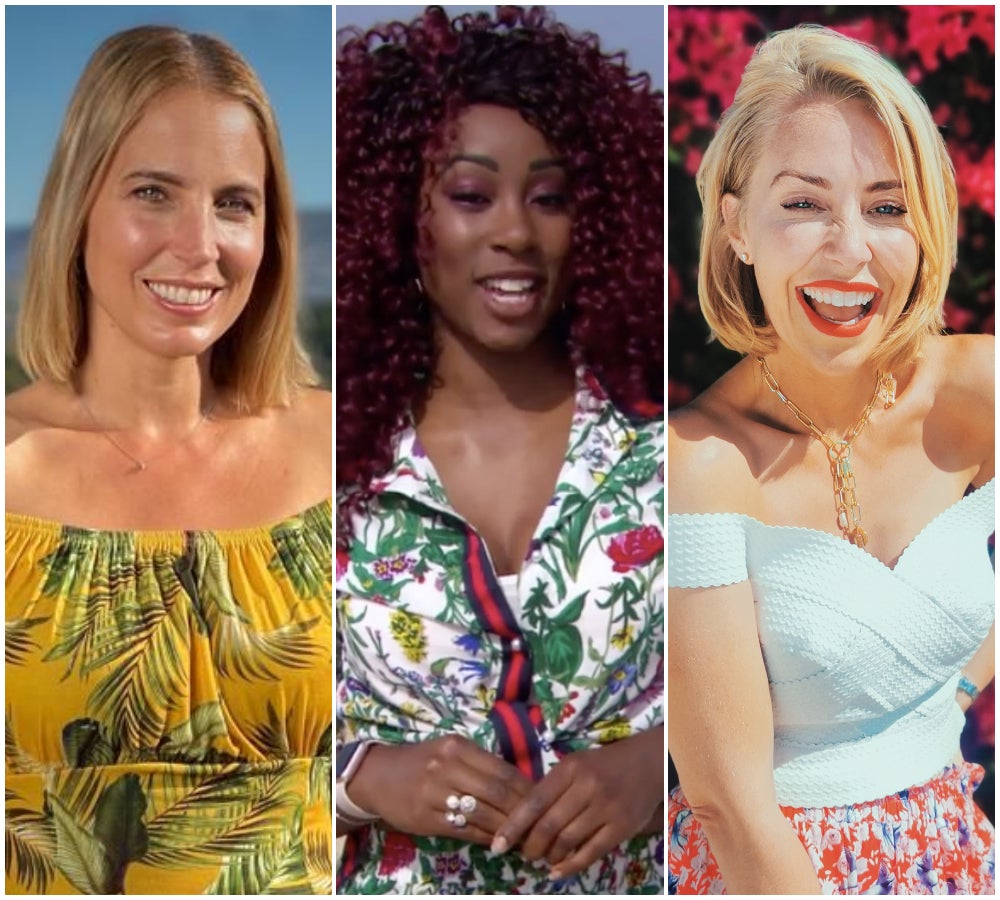
HuffPost UK caught up with three of its hosts – Jasmine Harman, Scarlette Douglas and Laura Hamilton – to find out if it really is as glamorous as it looks (it isn’t) and discovered lots of other behind-the-scenes goss too (we have a feeling Jasmine won’t be working with horses ever again).

There’s no such thing as a typical day of filming 

Laura Hamilton: “We have a running joke that as soon as the cameras start rolling you’re guaranteed to have an angle grinder, someone will start hoovering their apartment, there’ll be a leaf blower or if we’re on a golf course they’ll start mowing the greens!”

Channel 4

Laura Hamilton

Behind the scenes it’s not all that glamorous

Jasmine Harman: “People think it’s more like a holiday, which isn’t strictly true, because even though we’re travelling it is still work. I remember when I first got the job I was like ‘my god this is an absolute dream come true’, and I’m nearly 18 years in now and I still love it. But it is work.” 

The show is recced the week before filming starts

Laura Hamilton: “There’s a team behind the scenes that work incredibly hard as well as the production team back home. They’re the ones who do a lot of research.”

Filming each property takes longer than people expect

Jasmine Harman: “It takes a couple of hours to film each property. We usually see one or sometimes two in a day. It’s great for the house hunters as they get to spend a good long time in the properties. If you were going round with an agent you’d be in and out in 15 minutes.” 

BRIAN J RITCHIE

Jasmine Harman

The house hunters spend longer than a few minutes in the properties they view

Laura Hamilton: “It’s not just in and out in two minutes as you see on TV, which is fantastic for anyone that comes on the show because they really get to spend time in each property.”

There are back-up properties

Laura Hamilton: “Sometimes properties sell before we have a chance to show them so we have to go out and try and find another one.”

There isn’t a hair or make-up team

Jasmine Harman: “We do it all ourselves. As you’ve probably noticed Johnny (Irwin) and Ben (Hillman) and the guys are really good at doing their own make-up (laughs).”

Brexit hasn’t put people off buying abroad

Laura Hamilton: “Obviously there’s a change in how much time you can spend there, but predominantly the people that come on A Place In The Sun are looking to buy a holiday home, and being able to spend three months in six in your holiday home is quite a lot of time. “

It might not look it, but it really is hard work

Scarlette Douglas: “It’s 47 minutes of footage  but to get all that footage it takes four and a half days to film standing in the sunshine. I know it sounds woe is me, but standing with no sunglasses, no hat, with the sun on you – it’s difficult. And I know that (fellow presenter) Jasmine has passed out once when she was pregnant because it’s not a joke, it’s very hard work.”

Filming back-to-back episodes can take its toll

Laura Hamilton: “There have been times when I’ve finished one episode and I’m interviewing the couple about their property search and you accidentally call them the names of the previous week’s house hunters. You’re like ‘I’m so sorry!’ That’s happened to me once or twice.”

The presenters often encounter some unexpected sights

Jasmine Harman: “Sometimes we’ve had to shoot around people (laughs). You’ll walk into a room and find an elderly relative in the bed! Things like that have happened on more than one occasion. There have been a lot of times when we go into a property and have to clean it. That’s always fun when you’re picking people’s dirty pants off the floor. Most people make the effort if they know we’re coming to film, but now and again we do get the odd one which is in a bit of a mess.”

The hosts become like a security blanket for the house hunters

Laura Hamilton: “Buying abroad is a big thing. It’s lovely for people to know that we’re there and we’ve got their back. At the same time, it sounds crazy, but it’s an amazing thing for me and the other hosts of the show as well. It is a huge thing in people’s lives and I’m such an emotional person… if I’m making an offer on a house I get goosebumps even when I’m in 36 degree heat!”

Channel 4

Laura Hamilton

There are strict rules on what you can and can’t wear on the show

Jasmine Harman: “As we film over a period of a week we have to wear the same clothes. It’s pretty unpleasant if you’re somewhere really hot! You’re not allowed to black or white, or spots or stripes, or check or geometric patterns. A lot of people turn up with those glasses that go dark in the sun. You’re not allowed to wear them either because you can’t see what someone is thinking. It’s tricky if I’m trying to gauge if they like a property or not, but also because you can see reflections of the crew in the dark glasses.”

There have been some regretful outfit choices

Scarlette Douglas: “I’ve had quite a few embarrassing outfits. When I look back I think ‘what was I thinking!’ The one when I had my bright pink socks on and purple sandals and purple hair to match! I’m not gonna lie, at the time I loved it but looking back I don’t think I should’ve worn that outfit! But if I was to think about wearing it again I’d like to think someone around me would say something.”

Even the presenters are surprised at the prices some of the house hunters get their properties for

Laura Hamilton: “Sometimes I’m upfront with the house hunters and say ‘this is ridiculous’. But at the end of the day I’m representing them so I can offer my advice but it’s their money and I have to go with whatever they want me to offer.” 

Yes, the presenters and house hunters have been locked out

Laura Hamilton: “There have been some funny times when we’ve been outside the property and the wind has blown the door shut and the keys have been in the property and we’re all locked outside with the cameras inside!”

The presenters have to wear the same outfit for a week 

Laura Hamilton: “We don’t film the show in one day. We make it look like that so I’m always trying to pick an outfit that I can hand wash in my hotel room and will dry overnight.” 

The crew and presenters are a close knit bunch

Jasmine Harman: “We’ve known each for so long. Both of my children have godparents that are soundmen from the show.” 

Sometimes the hosts revisit places they have house-hunted before

Jasmine Harman: “Last week I was filming in the Costa Tropical in Spain and that brought back memories because I filmed one of my first shows there. That was where my husband and I had our very first date in a pizzeria. Last week he had some time off work and he came out and we went back to the restaurant, which was still there! When we walked in, there’s an Italian man who runs it, and he said ‘ahhh, you still want the diavola, extra spicy?’ He still remembered our order from all those years ago! It was like going back in time.”

The presenters have to do their own laundry

Scarlette Douglas: “I’ve got this big hand washing soap bar so I do all that and I’ve got a little fabric softener and I rinse it all out in the bath and because it’s usually so hot put it out to dry on the balcony. I know the house hunters are told to bring two of the same outfit.”

Channel 4

Scarlette Douglas

Filming is often a family affair

Jasmine Harman: “During the school holidays I’ve been able to have my children with me which has been really nice as I wouldn’t want to go away and leave them for long stretches of time. So if they’re not at school then they can come along. After filming I’ll go and give the kids some dinner and put them to bed. They have a holiday while mummy goes out to work.”

There have been some creepy properties featured on the show

Laura Hamilton: “I was once in a house in France and the sound man was like ‘I’ve got bad vibes about this place, it’s haunted’. We didn’t see anything but when someone says that you’re just like ‘oh god, really?’. Nobody saw anything but places like that in the middle of France, you think, well they could be. I wouldn’t want to have been there late at night on my own!”

Things don’t always go to plan (especially when working with animals)

Jasmine Harman: “There was one really bad one where I was milking a cow. It was so bad. The house hunters wanted a farm or a small holding. Anyway, the cow had a dodgy tummy and while I was milking this poor cow it swished its tail and it hit me straight in the face so I had horrible cow poo on my face. That was pretty bad. That was a low (laughs).”

Channel 4

Jasmine Harman

There have been some hairy moments too

Jasmine Harman: “I once vomited inside my helmet when I was filmed on a microlight. That was pretty gross. Honestly, the pilot was like Tom Cruise in Top Gun. He was so handsome. And I was so embarrassed. I get motion sickness and being on this microlight proved too much for me. I couldn’t get the helmet off! It was not a pleasant sight.”

Filming isn’t without its risks

Scarlette Douglas: “We were filming somewhere in Sicily and my Producer Director chose a place to do an opening chat on a beach but what he thought was a beach was actually dried seaweed. So we’re stood on this dried seaweed which doesn’t smell good either, and then he just starts sinking because it was over quicksand!

“So he starts going down and he has the camera, I start laughing and get my phone out to start filming and he’s like ‘someone help me’. So the camera guy manages to get the camera and he’s still just sinking! The camera guy and sound guy had to drag him out and he was just covered all the way up to his chest with dried seaweed and quicksand. I was just there laughing and filming him. I was absolutely cackling along with the house hunters. I bring that up all the time and he’s like ‘do you always have to mention the quicksand?’”

Share Button

10 Of The Most Scenic Urban Walks In The UK

You are reading Anywhere But Here, our summer-long series on travel at home and abroad, serving up the information and inspiration you need

If there’s one thing that lockdown has made us value more, it’s going for a walk. Part of the joy in walking is discovering new and scenic areas – and you don’t have to live in the countryside to enjoy a beautiful stroll.

New research from Premier Inn has revealed the most picturesque urban walks in the UK, by analysing the walks in big towns and cites with the most Instagram photos per kilometre.

London was revealed as having some of the most picturesque urban walks, with four of the top five Instagrammed walks being located in the city.

London’s Parkland Walk was found to be the most Instagrammed overall. It stretches from Finsbury Park to Alexandra Palace and measures just under five kilometres in length. It has 2,131 hashtags per kilometre of the route and follows the course of an old railway line, with several points where you can take a good picture for the gram, including sculptures and graffiti artwork.

In second place with over 850 hashtags per kilometre is the Queen’s Walk in Southbank, London, and Regent’s Canal Walk also in London ranks in fourth place, with 447 hashtags per kilometre of its 14.5km route.

Other routes outside of London include The Forth and Clyde Canal Towpath in Scotland, which ranks in 8 place with 193 hashtags per kilometre, whilst routes in Durham and Leeds rank in 9 and 10 places.

Want to find other scenic routes in the UK? Here’s the top 10 in full:

1. Parkland Walk, London, 2131 hashtags per KM

2. The Queen’s Walk, Southbank, London, 856 hashtags per Km

3. Bath City Walk, Somerset, 820 hashtags per KM

4. Regent’s Canal Walk, London, 820 hashtags per KM

5. Thames Path, London, 349 hashtags per KM

6. Derry City Walls Walk, Londonderry, 343 hashtags per KM

7. Cambridge Colleges Walk, Cambridgeshire, 234 hashtags per KM

8. Forth & Clyde Canal Towpath, 193 hashtags per KM

9. Durham (River Banks & Maiden Castle), 182 hashtags per KM

10. Leeds, (Civic Centre & Canal), 129 hashtags per KM

Travel is the story of our summer. The rules (and traffic lights) are always changing, but one thing’s clear, we dream of being Anywhere But Here. This seasonal series offers you clear-headed travel advice, ideas-packed staycation guides, clever swaps and hacks, and a healthy dose of wanderlust.

Share Button

GPs say shortage of doctors puts safe care at risk

The Royal College of GPs says a failure to recruit enough doctors has put services under pressure.

Share Button

Gut flora composition and function may impact susceptibility to konzo, a neurological disease caused by world staple crop cassava

Differences between gut flora and genes from konzo-prone regions of the Democratic Republic of Congo (DRC) may affect the release of cyanide after poorly processed cassava is consumed, according to a study with 180 children. Cassava is a food security crop for over half a billion people in the developing world. Children living in high-risk konzo areas have high glucosidase (linamarase) microbes and low rhodanese microbes in their gut, which could mean more susceptibility and less protection against the disease, suggest Children’s National Hospital researchers who led the study published in Nature Communications.

Konzo is a severe, irreversible neurologic disease that results in paralysis. It occurs after consuming poorly processed cassava — a manioc root and essential crop for DRC and other low-income nations. Poorly processed cassava contains linamarin, a cyanogenic compound. While enzymes with glucosidase activity convert starch to simple sugars, they also break down linamarin, which then releases cyanide into the body.

“Knowing who is more at risk could result in targeted interventions to process cassava better or try to diversify the diet,” said Eric Vilain, M.D., Ph.D., director of the Center for Genetic Medicine Research at Children’s National. “An alternative intervention is to modify the microbiome to increase the level of protection. This is, however, a difficult task which may have unintended consequences and other side effects.”

The exact biological mechanisms underlying konzo disease susceptibility and severity remained poorly understood until now. This is the first study to shed light on the gut microbiome of populations that rely on toxic cassava as their primary food source.

“While the gut microbiome is not the sole cause of disease given that environment and malnourishment play a role, it is a required modulator,” said Matthew S. Bramble, Ph.D., staff scientist at Children’s National. “Simply stated, without gut microbes, linamarin and other cyanogenic glucosides would pose little to no risk to humans.”

To understand the influence of a detrimental subsistence on the gut flora and its relationship to this debilitating multifactorial neurological disease, the researchers compared the gut microbiome profiles in 180 children from the DRC using shotgun metagenomic sequencing. This approach evaluates bacterial diversity and detects the abundance of microbes and microbial genes in various environments.

The samples were collected in Kinshasa, an urban area with diversified diet and without konzo; Masi-Manimba, a rural area with predominant cassava diet and low prevalence of konzo; and Kahemba, a region with predominant cassava diet and high prevalence of konzo.

“This study overcame many challenges of doing research in low-resource settings,” said Desire Tshala-Katumbay, M.D., M.P.H., Ph.D., FANA, co-senior author and expert scientist at Institut National de Recherche Biomédicale in Kinshasa, DRC, and professor of neurology at Oregon Health & Science University. “It will open novel avenues to prevent konzo, a devastating disease for many children in Sub-Saharan Africa.”

For next steps, the researchers will study sibling pairs from konzo-prone regions of Kahemba where only one sibling is affected with the disease.

“Studying siblings will help us control for factors that cannot be controlled otherwise, such as the cassava preparation in the household,” said Neerja Vashist, Ph.D. candidate and research trainee at Children’s National. “In this work, each sample had approximately 5 million DNA reads each, so for our follow-up, we plan to increase that to greater than 40 million reads per sample and the overall study cohort size. This study design will allow us to confirm that the trends we observed hold on a larger scale, while enhancing our ability to comprehensively characterize the gut microbiome.”

Story Source:

Materials provided by Children’s National Hospital. Note: Content may be edited for style and length.

Share Button

New technology designed to genetically control disease-spreading mosquitoes

Leveraging advancements in CRISPR-based genetic engineering, researchers at the University of California San Diego have created a new system that restrains populations of mosquitoes that infect millions each year with debilitating diseases.

The new precision-guided sterile insect technique, or pgSIT, alters genes linked to male fertility — creating sterile offspring — and female flight in Aedes aegypti, the mosquito species responsible for spreading wide-ranging diseases including dengue fever, chikungunya and Zika.

“pgSIT is a new scalable genetic control system that uses a CRISPR-based approach to engineer deployable mosquitoes that can suppress populations,” said UC San Diego Biological Sciences Professor Omar Akbari. “Males don’t transmit diseases so the idea is that as you release more and more sterile males, you can suppress the population without relying on harmful chemicals and insecticides.”

Details of the new pgSIT are described September 10, 2021, in the journal Nature Communications.

pgSIT differs from “gene drive” systems that could suppress disease vectors by passing desired genetic alterations indefinitely from one generation to the next. Instead, pgSIT uses CRISPR to sterilize male mosquitoes and render female mosquitoes, which spread disease, as flightless. The system is self-limiting and is not predicted to persist or spread in the environment, two important safety features that should enable acceptance for this technology.

Akbari says the envisioned pgSIT system could be implemented by deploying eggs of sterile males and flightless females at target locations where mosquito-borne disease spread is occurring.

“Supported by mathematical models, we empirically demonstrate that released pgSIT males can compete, and suppress and even eliminate mosquito populations,” the researchers note in the Nature Communications paper. “This platform technology could be used in the field, and adapted to many vectors, for controlling wild populations to curtail disease in a safe, confinable and reversible manner.”

Although molecular genetic engineering tools are new, farmers have been sterilizing male insects to protect their crops since at least the 1930s. United States growers in the 1950s began using radiation to sterilize pest species such as the New World Screwworm fly, which is known to destroy livestock. Similar radiation-based methods continue today, along with the use of insecticides. pgSIT is designed as a much more precise and scalable technology since it uses CRISPR — not radiation or chemicals — to alter key mosquito genes. The system is based on a method that was announced by UC San Diego in 2019 by Akbari and his colleagues in the fruit fly Drosophila.

As envisioned, Akbari says pgSIT eggs can be shipped to a location threatened by mosquito-borne disease or developed at an on-site facility that could produce the eggs for nearby deployment. Once the pgSIT eggs are released in the wild, typically at a peak rate of 100-200 pgSIT eggs per Aedes aegypti adult, sterile pgSIT males will emerge and eventually mate with females, driving down the wild population as needed.

Beyond Aedes aegypti, the researchers believe the pgSIT technology could be directed to other species that spread disease.

“… This study suggests pgSIT may be an efficient technology for mosquito population control and the first example of one suited for real-world release,” the researchers say. “Going forward, pgSIT may provide an efficient, safe, scalable, and environmentally friendly alternative next-generation technology for wild population control of mosquitoes resulting in wide-scale prevention of human disease transmission.”

The complete list of paper co-authors: Ming Li, Ting Yang, Michelle Bui, Stephanie Gamez, Tyler Wise, Nikolay Kandul, Junru Liu, Lenissa Alcantara, Haena Lee, Jyotheeswara Edula, Robyn Raban, Yinpeng Zhan, Yijin Wang, Nick DeBeaubien, Jieyan Chen, Hector Sanchez C., Jared Bennett, Igor Antoshechkin, Craig Montell, John Marshall and Omar Akbari.

Funding for the research was provided by a DARPA Safe Genes Program Grant (HR0011-17-2-0047); the National Institutes of Health (R01AI151004 and R56-AI153334); the U.S. Army Research Office (cooperative agreement W911NF-19-2-0026 for the Institute for Collaborative Biotechnologies); and the Innovative Genomics Institute.

Share Button

The mystery of the flexible shell

An international research team with participation of the Paul Scherrer Institute PSI has revealed a secret about a marine animal’s shell: The researchers have deciphered why the protective cover of the brachiopod Discinisca tenuis becomes extremely soft in water and gets hard again in the air. The study appears today in the journal Nature Communications.

The brachiopod Discinisca tenuis lives on the west coast of Africa.I It has a mineral-rich shell that protects it from harmful environmental influences. Bathing the shell in water leads to a structural change in the material: The flat, hard shell becomes so flexible that it can even be folded up without breaking. With the help of the Swiss Light Source SLS, the researchers have deciphered exactly how this transformation takes place.

The phenomenon was discovered by chance a few years ago by Fabio Nudelman, a materials chemist currently at the School of Chemistry, University of Edinburgh in Scotland. Maggie Cusack, who was recently appointed president of Munster Technological University in Ireland, had provided Nudelman with shells of the brachiopod Discinisca tenuis, which originally came from Namibia. When he wanted to wash the hard object, it suddenly became soft and flexible in contact with water. The shell had absorbed liquid and thereby changed its structure. The process was reversible: When the shell dried, it became hard and brittle again.

Together with colleagues from six countries, Nudelman set out to discover what exactly takes place during this unexpected transformation. “In its composition, the shell resembles bone,” he explains. “But bone doesn’t change its structure when it gets wet.” The same goes for clams: If the animals need to adapt the properties of their shell to different environmental conditions, they normally have to rework the material in a lengthy and energetically costly process, by resorbing and redistributing minerals. It doesn’t work simply through the absorption of water.

Hybrid material with a special trick

It was so-called cryo-tomography, performed at the Swiss Light Source SLS, that “opened the door to reveal the secret,” says Johannes Ihli, a PSI researcher at SLS. With this technique, the researchers examined the material as if under a very high-resolution microscope, and in fact at extremely low temperatures. “At room temperature it would not have been possible, since the high-energy X-ray light would immediately alter the sensitive shell structure,” Ihli explains.

The brachiopod’s shell, which is no more than half a millimetre thick, consists of a hybrid material: mainly inorganic mineral in which organic polymers made from proteins and sugars are embedded. Bones, clam shells, and teeth are structured in a similar way out of a mixture of organic and inorganic material. The mineral that constitutes the main component of the shell is a type of fluoroapatite — similar to the material that makes up the enamel of our teeth.

Tiny nanocrystals of this material are arranged in layers. Nudelman compares it to brick walls: “In this analogy, the bricks are the nanocrystals, and the mortar between the bricks consists of organic molecules such as chitin and proteins.” As the researchers observed, this “mortar” can absorb large amounts of water, causing it to swell up. Through the storage of water, it changes its structure: It becomes soft, and the bricks become movable with respect to each other. “Then water acts like a lubricant between the individual nanocrystals,” Ihli explains. “The crystals can then slip against each other.” Through this movement, the shell becomes flexible. The researchers found a network of pores in the shell that was especially effective in guiding water inside and rapidly distributing it throughout the material.

Evolutionary advantage

Discinisca tenuis lives in large clusters in tidal zones on the coast where, depending on the tide, the animals are exposed to strong waves or calm waters. The researchers speculate that it is probably advantageous if the animals can quickly adapt the softness or hardness of their shell to the respective situation: “This could prevent damage to the shell and thus be a key to the animals’ survival,” they write in the study. The phenomenon may even be more widespread than suspected: “We don’t know how many other animal species there might be that have this kind of property,” says Nudelman.

Aside from biology and evolution, the newly gained insights are also of interest for materials science: The development of a hard, brittle material whose stiffness can be controlled could hold promise for many applications. Sports clothing or helmets, for example, might be able to flexibly adapt to movements and always offer the protection required depending on the impact. Harnessing this phenomenon could also prove useful in developing bone-replacement materials.

Story Source:

Materials provided by Paul Scherrer Institute. Original written by Brigitte Osterath. Note: Content may be edited for style and length.

Share Button