Health officials warn people with flu or Covid symptoms to avoid mixing with vulnerable relatives.


Health officials warn people with flu or Covid symptoms to avoid mixing with vulnerable relatives.
Nurses threaten to strike again on 18 and 19 January, as more ambulance workers join walkout next month.
The big Christmas meal is just days away, but don’t you feel like switching things up a bit this year?
Sure, we love our traditional turkey and trimmings, but it can all feel a bit same same. Which is a shame, given the amazing food culture we have in the UK.
Advertisement
Luckily, our friends over at Tasty have been set on changing all that with their festive video series, A Very Tasty Christmas. Throughout the month of December, they’ve been spotlighting different cultures around the UK who celebrate Christmas – sharing recipes for the delicious dishes they eat.
As a treat, we got to sample every one of these delicious dishes a few weeks ago at the joint Buzzfeed / HuffPost Christmas gathering, so we can vouch for just how mouthwateringly tasty they really are.
Take your pick from the recipes below or why not try them all over the festive break? We promise they’ll add flavour and fun to your table on December 25.
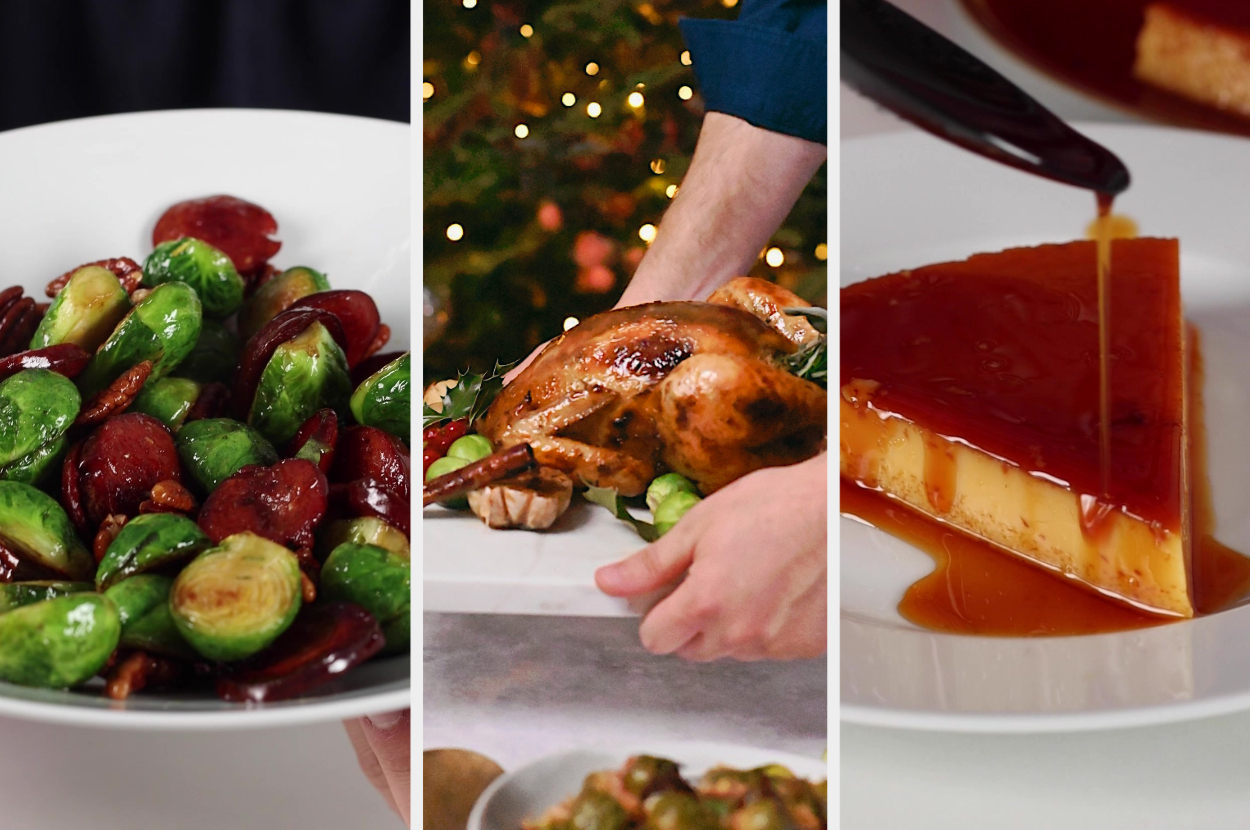
Are you still a sprout doubter? You won’t be once you’ve tried these bad boys. The magic to this recipe from Lirim Gula, aka @gulasgrub, is Sujuk, a dry, spicy and fermented Balkan sausage that takes this festive veg from no to “WOH!”
Advertisement
If you’d like something different to turkey, give this juicy chicken recipe from Romany Henry, aka @dudu_eats. a go. Spatchcocking ensures the crispiest skin, while the honey glaze and (hidden) garlic cloves add flavour.
Who said Christmas pud has to be stodgy? Make this lighter-than-light Filipino flan from @godfrey_mercado instead (and appreciate his jumper while you do!). The secret is in not overstirring – and getting the final flip after cooking just right.
Advertisement
Representing Ghana, plant-based chef Rachel, aka @tastycurls, delivers the ultimate Jollof Rice recipe – with 100% vegan skewers on the side. This dish has spice, thanks to the Scotch Bonnet in the sauce – and we love her for it.
Carinne Julien, aka @carcarj brings sunny Haiti to these chilly climes, with a classy spin on Mac & Cheese. The key? Cheese and more cheese. Watch the vid to see she adds cheddar and parmesan, not once but three times. Yum!
It’s not Christmas without pigs in blankets so praise be to creator Emma, aka @thesugafix_, for giving this British classic a key festive update. Serve this one up on Christmas day and you’ll be getting a round of applause from all.
Advertisement
These tasty Christmas cookies aren’t just for dunking in wine, you actually pour it in the cookie dough, too! You’ll also be using olive oil instead of butter. Could things get more Italian? Wonderful Lucia Fioravanti, aka @luu_cy, explains all.
And finally, the turkey on top! Homam Ayaso (@homamino) adds his own special twist on this Christmas centrepiece, smothering it in delicious butter made aromatic with herbs, spices, citrus and a little festive magic for a turkey, in Homan’s words “like no other”. A very merry Christmas from him – and us!
Advertisement



It’s almost Christmas and work is finally winding down. Instead of using this time wisely to plan goals for next year or productively to wrap the presents under your tree, you’re doing what you do best: time-wasting on social media.
You scroll and scroll and – what’s this? – somehow you’ve made it onto your ex’s Instagram page (whoops!). It’s been a while since you last spoke so you think: let me just wish them an early merry Christmas. What’s the harm in that?
Advertisement
Because let’s face it, who hasn’t been contacted by an ex-partner or fling over the holiday season – or done a little festive messaging ourselves?
These dwindling days of the year are often a time for reflection and/or twiddling our thumbs. A time to think about the people you miss (or the ones you missed out on). And whether you’re single or in a relationship, it’s now we mull over who we really appreciate and want to keep in our lives. Or who we want back…
Chris*, 27, a product designer from Manchester received an interesting email just this Tuesday. The subject read “Hi Christopher.” It was his ex of a few years back reaching out to ask for forgiveness and apologise for past mistakes.
“I had forgiven her years ago so I was quite shocked when I saw the email,” Chris tells HuffPost UK. “She asked to meet up, but I replied and said this would be inappropriate. I think she’s still holding on to the past but I’ve moved on and hope she does the same.”
Advertisement
Sometimes the contact is not as chill. Savannah*, a 23-year-old doctor from London, only broke up with her partner at the start of 2022, but due to the nature of the relationship, it didn’t end on good terms.
Following their split, Savannah blocked the ex across several different platforms, but this didn’t stop him from trying to get in touch – and he recently attempted to contact Savannah through their joint Netflix account. She removed his profile, but he somehow logged back in and deleted her account entirely.
“He’s done that because he knows it’s the only way he can get through to me,” she says. “I would never want to get back to him again and he knows this, which is why he’s trying so hard.”
It’s not all unhappy endings, however. Laura*, a 29 year old writer from east London reached out to an ex-situationship fling last Christmas.
“We stopped dating a month before but, I really missed him so I texted him on Christmas morning. We live really close to each other so I wanted to press my luck to see if he would come and see me in the evening,” she tells HuffPost UK.
Advertisement
“Even though he didn’t visit me, we spent the whole day talking which felt nice and familiar. I have a small family so Christmas always feels a bit boring, I think I reached out to him so I could have some entertainment throughout the day.”
A few days later the former fling ended up visiting her. And spoiler alert: “We started dating again. So I guess you could say it worked,” she says.
Sliding into your ex’s DMs over Christmas ended up being a good move for Laura but is this really a time to be contacting past lovers?
Relationship and dating expert Christiana Maxion weighs in.
There’s usually a reason an ex tends to reach out during the holidays – and that reason might not necessarily be you, warns Maxion.
“It could be because they have ‘time’ on their hands whilst off work, stuck and bored within a family situation, or feeling nostalgic or maudlin,” she says.
Advertisement
“This will make them think about the potential for a new hook up or about a past love. They will then use any excuse to try and get back into your good graces. And they’re also hoping that the holiday cheer will erase bad memories and you’ll let them back in and engage with their contact.”
Maybe you’re like Laura and feel the pull to message someone you once dated? Maxion says it’s easy to remember the good times especially around Christmas, but an ex is usually an ex for a reason.
However, maybe your past relationship ended down to bad timing or a set of circumstances that have since changed.
Whoever makes the first contact again, Maxion advises asking yourself: “Do you still have feelings for this person? Are they [or you] trying to rekindle love or just seeking attention? Are they bored with family or actually interested in you?”
Being back home can conjuring up past feelings, she says, which can make you want to take a stroll down memory lane in other ways. “Let your answers inform you as to whether this is a truly good idea or not.” she recommends.
Advertisement
“I would ignore an ex if you’re over them or in a new relationship. Silence speaks volumes!.” Maxion says. And if it feels like a sign to revisit things?
By all means, explore your feelings, “if you can be clear headed about it, disregarding the obvious ‘cheer’ and goodwill we fill ourselves with at Christmas.” But explore your motivations too, she adds.
“Make sure you ask yourself those questions – you’ll find your answer!”
* Surnames have been omitted to offer anonymity

But molnupiravir showed no obvious benefit at reducing hospital cases and deaths, a study found.

Existing conservation efforts are insufficient to protect Antarctic ecosystems, and population declines are likely for 65% of the continent’s plants and wildlife by the year 2100, according to a study by Jasmine Rachael Lee at the University of Queensland, Australia, and colleagues, publishing December 22 in the open access journal PLOS Biology. Implementing ten key threat management strategies — at an annual cost of 23 million US dollars — would benefit up to 84% of terrestrial bird, mammal, and plant groups.
To better understand which species are most vulnerable and identify the most cost-effective actions, researchers combined expert assessments with scientific data to evaluate threats and conservation strategies for Antarctica. They asked 29 experts to define possible management strategies, estimate their cost and feasibility, and assess the potential benefit to different species between now and 2100.
Climate change was identified as the most serious threat to Antarctic biodiversity and influencing global policy to limit warming was the most beneficial conservation strategy. Under current management strategies and more than 2 degrees Celsius of warming, 65% of land plants and animals will decline by 2100. Emperor penguins (Aptenodytes forsteri) were identified as the most vulnerable, followed by other sea birds and soil nematode worms. However, regional management strategies could benefit up to 74% of plants and animals at an estimated cost of 1.92 billion US dollars over the next 83 years, equating to 0.004% of global GDP in 2019. The regional management strategies identified as offering the greatest return on investment were minimizing the impacts of human activities, improving the planning and management of new infrastructure projects, and improving transport management.
As Antarctica faces increasing pressure from climate change and human activities, a combination of regional and global conservation efforts is needed to preserve Antarctic biodiversity and ecosystem services for future generations, the authors say.
Lee adds, “What this work shows is that climate change is the greatest threat to Antarctic species and what we need is global mitigation efforts to save them. This will not only help to secure their future, but also our own.”
Story Source:
Materials provided by PLOS. Note: Content may be edited for style and length.

New research shows that glassfrogs — known for their highly transparent undersides and muscles — perform their “disappearing acts” by stowing away nearly all of their red blood cells into their uniquely reflective livers. The study, led by scientists at the American Museum of Natural History and Duke University, is being published Friday in the journal Science. The work could lead to new avenues of research tied to blood clots, which the frogs somehow avoid while packing and unpacking about 90 percent of their red blood cells into their livers on a daily basis.
“There are more than 150 species of known glassfrogs in the world, and yet we’re really just starting to learn about some of the really incredible ways they interact with their environment,” said co-lead author Jesse Delia, a Gerstner postdoctoral fellow in the Museum’s Department of Herpetology.
Glassfrogs, which live in the American tropics, are nocturnal amphibians that spend their days sleeping upside down on translucent leaves that match the color of their backs — a common camouflage tactic. Their tummies, however, show something surprising: translucent skin and muscle that allows their bones and organs to be visible, giving the glassfrog its common name. Recent research has proposed that this adaptation masks the frogs’ outlines on their leafy perches, making them harder for predators to spot.
Transparency is a common form of camouflage among animals that live in water, but it’s rare on land. In vertebrates, attaining transparency is difficult because their circulatory system is full of red blood cells that interact with light. Studies have shown that ice fish and larval eels achieve transparency by not producing hemoglobin and red blood cells. But glassfrogs use an alternative strategy, according to the findings of the new study.
“Glassfrogs overcome this challenge by essentially hiding red blood cells from view,” said Carlos Taboada, the study’s co-lead author from Duke University. “They almost pause their respiratory system during the day, even at high temperatures.”
At Duke, the researchers used a technique called photoacoustic imaging, which uses light to induce sound-wave propagation from red blood cells. This allows researchers to map the location of the cells within sleeping frogs without restraint, contrast agents, sacrifice, or surgical manipulation — particularly important to this study because glassfrog transparency is disrupted by activity, stress, anesthesia, and death.
The researchers focused on one particular species of glassfrog, Hyalinobatrachium fleischmanni. They found that resting glassfrogs increase transparency two- to threefold by removing nearly 90 percent of their red blood cells from circulation and packing them within their liver, which contains reflective guanine crystals. Whenever the frogs need to become active again, they bring the red blood cells back into the blood, which gives the frogs the ability to move around — at which point, light absorption from these cells breaks transparency.
In most vertebrates, aggregating red blood cells can lead to potentially dangerous blood clots in veins and arteries. But glassfrogs don’t experience clotting, which raises a set of significant questions for biological and medical researchers.
“This is the first of a series of studies documenting the physiology of vertebrate transparency, and it will hopefully stimulate biomedical work to translate these frogs’ extreme physiology into novel targets for human health and medicine,” Delia said.
Other authors on the study include Maomao Chen, Chenshuo Ma, Xiaorui Peng, Xiaoyi Zhu, Tri Vu, Junjie Yao, and So?nke Johnsen from Duke University; Laiming Jiang and Qifa Zhou, from the University of Southern California, Los Angeles; and Lauren O’Connell, from Stanford University.
This study was supported in part by the National Geographic Society, grant # NGS-65348R-19; the Human Frontier Science Program postdoctoral fellowship # LT 000660/2018-L; the Gerstner Scholars Fellowship provided by the Gerstner Family Foundation and the Richard Gilder Graduate School at the American Museum of Natural History; start-up funds from Stanford University; start-up funds from Duke University; the National Institutes of Health, grant #s R01 EB028143, R01 NS111039, RF1 NS115581 BRAIN Initiative; a Duke Institute of Brain Science Incubator award; the American Heart Association Collaborative Sciences award 18CSA34080277; and a Chan Zuckerberg Initiative grant 2020- 226178.
The action is a direct result of the government’s refusal to negotiate over pay, union leaders say.

After an intrepid, decade-long search, Johns Hopkins Medicine scientists say they have found a new role for a pair of enzymes that regulate genome function and, when missing or mutated, are linked to diseases such as brain tumors, blood cancers and Kleefstra syndrome — a rare genetic, neurocognitive disorder.
The new findings, published Nov. 21 in Epigenetics & Chromatin, could eventually help scientists understand diseases caused by disruption of these enzymes and develop new treatments for them.
“Developing a better understanding of how enzymes impact the activity of our genomes offers valuable insights into biology and can help researchers design new therapeutic approaches for disease,” says Sean Taverna, Ph.D., associate professor of pharmacology and molecular sciences at the Johns Hopkins University School of Medicine.
The search began more than a decade ago, when Taverna was looking for factors that influence DNA activity in Tetrahymena thermophila — a one-celled, fresh water dwelling organism. During the original study, the research team found a previously unknown signal that the single-celled creature uses to “mark” genes it has turned off.
The location of the mark is on histone proteins, which act as spools that tightly wind DNA, often turning off genes and protecting DNA from damage. If Tetrahymena are not able to add the marks — a process called methylation, which adds chemical tags to a part of histones called H3K23 — the DNA becomes damaged and the cells grow poorly.
In a follow up study published in 2016, Taverna found that the H3K23 location is conserved between Tetrahymena and mammals, including humans. However, the enzymes that control how the chemical tags are placed on H3K23 differ between the species.
Without the identity of these enzymatic H3K23 “writers” of methylation, the researchers found it difficult to study H3K23’s role in human biology and disease.
So, Taverna, recent Ph.D. graduate David Vinson and Srinivasan Yegnasubramanian, M.D., Ph.D., professor of oncology and pathology at the Johns Hopkins Kimmel Cancer Center, led a new study to search for the mammalian enzymes that add the chemical tags to H3K23.
After screening many enzymes that write methylation, Vinson found just one pair of enzymes, EHMT1/GLP and EHMT2/G9a, which placed chemical tags on the H3K23 histone location.
When the researchers used drug inhibitors and genetic mutations directed against the enzyme pair in human brain cells (neurons) grown in the laboratory, the ability of the enzymes to place methylation tags on the H3K23 histone location reduced significantly.
“With this initial precedent established in human neuronal cells, the door is now wide open to study the role of these enzymes and the H3K23 modification in numerous contexts of health and disease, including human cancer,” says Yegnasubramanian.
Now that the researchers know that EHMT1/GLP and EHMT2/G9a place chemical tags on the H3K23 histone location, they are aiming to understand the precise mechanism of how they do so and develop drugs that target this activity.
“We want to better understand why diseases occur when these enzymes aren’t working correctly, and what their connections are to H3K23,” says Taverna.
In addition to Taverna, Yegnasubramanian and Vinson, other researchers who contributed to the study are Kimberly Stephens of the University of Arkansas for Medical Sciences; Robert N. O’Meally, Shri Bhat and Robert Cole of Johns Hopkins; and Blair Dancy of the Walter Reed Army Institute of Research.
Funding for the study was provided by the National Institutes of Health (R01GM118760, R01CA221306 and F31GM130114), the National Science Foundation, the Irving A. Hansen Memorial Foundation and the Commonwealth Foundation.

People suffering from blood cancer often have a weak immune system, putting them at higher risk of falling seriously ill with COVID-19. Some cancer therapies, moreover, result in these patients forming few or no antibodies against SARS-CoV-2 after COVID-19 vaccination. However, vaccination can also activate so-called T cells, which are responsible particularly for the long-term immune response.
A team led by physicians Dr. Andrea Keppler-Hafkemeyer and Dr. Christine Greil from the Medical Center-University of Freiburgand virologist Prof. Oliver T. Keppler from LMU Munich has now characterized in detail the course over several months of the immune response of patients with blood cancer who had received a total of three vaccinations against COVID-19. The results allow inferences to be made about the protection that vaccination gives these patients against serious illness from SARS-CoV2.
Strong T cell response to COVID-19 vaccination
The study focused on patients with two kinds of blood cancer: B-cell lymphoma and multiple myeloma. “Our results show that almost all study participants had a strong T cell response to COVID-19 vaccination,” explains Dr. Andrea Keppler-Hafkemeyer. “This could be one reason why breakthrough infections turned out to be mild to moderately severe even in study participants who had been unable to form any specific antibodies after vaccination because of their therapy,” adds Dr. Christine Greil. The co-principal investigators and lead authors regularly look after blood cancer patients in the Department of Medicine I at the Medical Center — University of Freiburg.
The research group led by Prof. Oliver T. Keppler is specialized not only in analyzing the concentration of antibodies after vaccination, but also their quality. This depends particularly on the strength of the bonds between antibodies and the viral spike protein. In addition, the ability of antibodies to neutralize different SARS-CoV-2 variants in cell cultures plays a major role. As the next step, therefore, the scientists compared the quantity and quality of antibodies and T cell responses to the spike protein among blood cancer patients and healthy study participants after two and three COVID-19 vaccinations.
High-quality antibodies against different SARS-CoV-2 variants
The study revealed that patients who can form antibodies tend to produce antibodies of particularly high quality. After their second vaccination, they are already able to neutralize and thus deactivate different SARS-CoV-2 variants. This ability is considerably more pronounced in this patient cohort than in vaccinated healthy people.
“COVID-19 vaccination can generate very broad antiviral immunity — including highly potent neutralizing antibodies — in patients with various types of blood cancer. Consequently, multiple vaccine doses can be recommended for patients with B-cell lymphoma or multiple myeloma without interrupting therapy,” summarizes Prof. Oliver T. Keppler.
Story Source:
Materials provided by Ludwig-Maximilians-Universität München. Note: Content may be edited for style and length.
