When using virtual reality as a teaching tool, context and ‘feeling real’ matter

A new study by UCLA psychologists reveals that when VR is used to teach language, context and realism matter.

The research is published in the journal npj Science of Learning.

“The context in which we learn things can help us remember them better,” said Jesse Rissman, the paper’s corresponding author and a UCLA associate professor of psychology. “We wanted to know if learning foreign languages in virtual reality environments could improve recall, especially when there was the potential for two sets of words to interfere with each other.”

Researchers asked 48 English-speaking participants to try to learn 80 words in two phonetically similar African languages, Swahili and Chinyanja, as they navigated virtual reality settings.

Wearing VR headsets, participants explored one of two environments — a fantasy fairyland or a science fiction landscape — where they could click to learn the Swahili or Chinyanja names for the objects they encountered. Some participants learned both languages in the same VR environment; others learned one language in each environment.

Participants navigated through the virtual worlds four times over the course of two days, saying the translations aloud each time. One week later, the researchers followed up with a pop quiz to see how well the participants remembered what they had learned.

The results were striking: Subjects who had learned each language in its own unique context mixed up fewer words and were able to recall 92% of the words they had learned. In contrast, participants who had learned both sets of words in the same VR context were more likely to confuse terms between the two languages and retained only 76% of the words.

The study is particularly timely because so many K-12 schools, colleges and universities moved to develop online learning platforms during the COVID-19 pandemic.

“Apps like Zoom provide a rather bland context for learning,” Rissman said. “As VR technology becomes more ubiquitous and affordable, remote learners could be instantly teleported into unique and richly featured contexts for each class.”

The experiment was designed by Rissman and Joey Ka-Yee Essoe, the study’s first author who was a UCLA doctoral student at the time.

Rissman said a key predictor of the subjects’ ability to retain what they had learned was how immersed in the VR world they felt. The less a participant felt like a subject in a psychology experiment — and the more “at one” they felt with their avatar — the more the virtual contexts were able to positively affect their learning.

“The more a person’s brain was able to reconstruct the unique activity pattern associated with the learning context, the better able they were to recall the foreign words they had learned there,” Rissman said.

Psychologists have long understood that people tend to recall things more readily if they can remember something about the surrounding context in which they learned it — the so-called “context crutch” phenomenon. But when information is tied to contextual cues, people can have trouble recalling it later in the absence of those cues.

For example, students might learn Spanish in the same kind of classroom where they learn other subjects. When that happens, their Spanish vocabulary can be tied to the same contextual cues that are tied to other material they’ve been taught, like the Pythagorean theorem or a Shakespeare play. Not only does that similar context make it easier to mix up or forget what they have learned, but it also can make it harder to remember any of the information outside of a classroom setting.

“A key takeaway is that if you learn the same thing in same environment, you’ll learn it really fast,” said Essoe, who is now a postdoctoral scholar at Johns Hopkins University. “But even though you learn fast, you might have trouble with recall. What we were able to harness in this research takes advantage of both learning fast and improving recall in new environment.”

To understand the brain mechanisms that support context-dependent learning, the researchers recruited a separate group of participants and scanned their brains with functional magnetic resonance imaging, or fMRI. As the subjects attempted to recall foreign words while in the scanner, their brain activity indicated that they were thinking about the context in which they had learned each word.

That finding suggests that virtual reality can enhance learning if it is convincingly produced and if different languages or scholastic subjects are taught in highly distinctive environments.

Rissman said although the study only assessed how people learned a foreign language, the results indicate that VR could be useful for teaching other subjects as well. Similar approaches could also be used for mental and behavioral health therapies and to help patients adhere to doctors’ instructions after medical visits: Patients might be able to remember such guidance better if they’re in their own homes while chatting online with their doctors, for example.

Said Essoe: “Variable contexts can ground information in more environmental cues.”

Share Button

Wood-eating clams use their feces to dominate their habitat

Deep beneath the waves, tiny clams with shells usually about as big as a pea bore into pieces of sunken wood. The wood is food for them, as well as a home. These rare, scattered, sunken pieces of wood support miniature ecosystems where different wood-boring clam species can live in harmony for years. But in a new paper in Marine Biodiversity, researchers found that one group of wood-boring clams has evolved a unique way to get the wood all for itself: building chimneys made of poop.

“There are two challenges every sea creature has to face: getting pure water in, so you can get oxygen to your gills, and getting rid of your waste. Because nobody wants to live in their poop. But here are these clams living with theirs, and actually thriving,” says Janet Voight, Associate Curator of invertebrate zoology at the Field Museum and the study’s lead author.

Scientists can put wood on the seafloor, return months or even years later, and recover it with “an amazing array of animals,” says Voight; other times wood that has been submerged for the same amount of time comes up so gnawed and bored-through that you can crumble it in your hand. This difference was a mystery, and Voight wanted to know why.

She took stock of the wood-boring clam species present in reports of sunken wood from all over the world, and she noticed a pattern. “There are six main branches in the wood-boring clam family tree, and every woodfall that was bored so heavily it was crushable by hand turned out to have been bored by a species from the same single branch of that family tree,” says Voight. She says she was surprised by this finding — “that’s not supposed to happen, you just assume that all wood-boring clam species, which tend to look pretty similar, bore into wood the same way. And yet, here’s one group that’s doing something totally different.”

Scientists had suggested that the extra-chewed-up wood was due to lots of larvae happening to be present nearby, or warmer water temperatures, but it turns out, the very nature of the clams may be responsible. Voight noted all of these extra-efficient, related species have a common trait where the sun don’t shine. As the clams dig and move into their boreholes in the wood, they fill the space around them inside the holes with their own feces.

“They don’t do it on purpose, their anatomy makes them do it,” says Voight. “When these clams bore into wood, their little shell does the boring.” Meanwhile, the clams’ siphons, tubular appendages for taking in water to get oxygen and expelling waste, stick out behind them. “In most wood-boring clams, these two “in and out” siphons are equal in length and stick out into the water column,” says Voight. “But in these related hyper-nasty borers, the siphon for expelling de-oxygenated water and feces is short; it stays inside the borehole in the wood. As a result, says Voight, “they poop in their borehole. They just have to, unless they really, really push.” The waste stays right there with the clam, forming a chimney that wraps around the siphon.

That animals would evolve an anatomy that keeps them in such close contact with their own waste, is surprising, says Voight: “It sure isn’t very hygienic, and yet they show no evidence of immune problems. They’re healthy, they’re clearly going to town on the wood. So why did they evolve this way?”

She and her colleagues hypothesized that these fecal chimneys might cue larval settlement: that their free-floating larvae might be able to detect the poop and make their way to it to make a home alongside members of their own species.

But that still leaves the problem: even if a poop chimney serves as a beacon for other members of their species to join them on their wood, how can these individuals survive as more and more larvae settle and the environment becomes filthier and oxygen becomes less available?

“This group of species of clam has been shown in previous studies to be unusually tolerant of low oxygen,” says Voight. They also have additional adaptations, like a mucosal lining of their fecal chimneys, and a substance like hemoglobin in their blood that picks up more oxygen; both may reduce the risk of sulfide poisoning from the waste. Taken together, these adaptations allow these speciesto survive in conditions that would make non-related wood-boring clams sick. The end result is more wood for the chimney-producing species to eat, live in, and for their offspring to settle on, unbothered by competitors.

Beyond just solving the mystery of the gross chewed-up wood with an even grosser solution, Voight says that the study illustrates the importance of looking at ecology with an understanding of how different species are related to each other.

“When you’re confronted with something that seems enigmatic, sometimes you need to step back and look at the big picture, put a lot of different studies together, to see how what had appeared to be enigmatic is a product of evolution,” says Voight. “Having a good family tree can help reveal patterns, and the more we know about the evolutionary histories of these different groups, the more we’ll be able to find out about how they fit together.”

Share Button

Strep A: Pharmacies can now give alternative antibiotics

The new protocol comes amid temporary supply issues of penicillin to treat strep A, as cases rise.

Share Button

Inhaled metal Tube dust can enter bloodstream, study finds

High levels of maghemite were found in some air samples but it is not known if they are harmful.

Share Button

No timetable for infected blood victims’ compensation

A minister agrees there is a moral case for payments to be made, but says he cannot set a timetable.

Share Button

GMB union rejects improved NHS pay deal in Scotland

The union represents the majority of ambulance staff working for the NHS in Scotland.

Share Button

Nottingham placenta error hampered baby death probe – coroner

The parents of a baby who died at a hospital are told the investigation was compromised.

Share Button

‘I Pooped In A Secret Way’: 27 Funny Tweets That Perfectly Sum Up Life With Toddlers

Life with toddlers is a real rollercoaster – one moment they’re telling you they love you, the next they’re mooing at you as you step out of the shower.

Fast forward two hours and they’re prostrate on the floor, screaming at you because you wouldn’t let them lick your shoe.

While they can be pretty harsh sometimes – and totally unreasonable – their brutal honesty and innocent outlook on life often brings plenty of laughs to the table, too.

These tweets sum up just how chaotic life can be with young children – and while we do love a moan as parents, we also know we wouldn’t have it any other way.

1. Where did you hide the poo?!

2. My child loves me… but also pizza.

3. Today in questions you never thought you’d ask yourself: Why is there a car under my back?

4. Hi sweetie. Please stop licking mummy’s face.

5. This parent was probably quite relieved they didn’t get to see their toddler’s carol concert IRL.

6. When your toddler is mad because they can’t do something (that also happens to be impossible)…

7. Get this toddler on The Apprentice.

8. Out of the mouth of babes (and all that).

9. Twinkle Twinkle Little Star. But with the word penis.

10. This two-year-old ran the dishwasher undetected and empty for an entire hour.

11. Imagine being demoted from Your Majesty to Mom Face. Cruel cruel world.

12. Does anyone else’s toddler run like this?

13. Another reason why toddlers get mad: they can’t eat raw food.

14. This toddler wanted to go and buy some more milk for boobies. Then things got a bit dark.

15. Why do all toddlers line up toys like this?

16. Who doesn’t love getting sick 17 times a month?

17. This toddler requested their pear is cut into rectangles and nobody has time for this.

18. Feelings = hurt.

19. When you find out the nation’s favourite coffee chain doesn’t sell books.

20. We’re just wondering why any parent would do this to themselves?

21. WFH and looking after toddlers is a real hoot (said no one ever).

22. This tweet is perfection.

23. Two going on… 42?

24. Admittedly they can be cute.

25. But then in the next breath they can be stone cold.

26. This toddler is going places. (Mainly the steakhouse next door.)

27. We’ll just leave this here…

Share Button

‘My Boyfriend Is Great, So Why Do I Want Sex With Other People?’

You’re reading Love Stuck, where trained therapists answer your dating, sex and relationship dilemmas. You can submit a question here.

The feeling of finding your perfect match is something you can’t explain – like that person was handmade for you and can fulfil all your wants and needs. But what happens if you think you’ve met your soulmate, but still find yourself fancying other people, even wanting to stray.

This is Katie’s dilemma. “My boyfriend is super nice, so sweet, surprises me often, sex is amazing, it’s the first relationship I’ve ever been in that’s healthy but for some reason, I want to have sex with other people,” Katie says.

“I don’t think I love him as much as I thought I did. What do I do? He moved in with me after four months of dating and now I don’t want him there but he’s doing nothing wrong, it’s just me. What do I do?”

Counselling Directory member Ilia Galouzidi is on hand to give Katie her advice.

What is your initial response to this dilemma? What would you say to this reader?

Galouzidi says she thinks it’s great that Katie has found someone who matches her in several areas and that she considers it a healthy relationship. However, she says that “we may often think that once we form a relationship that feels healthy with another person, we automatically abandon the part of ourselves that gets attracted by other people or needs to be seen and feel wanted.”

And it doesn’t usually work this way, she adds.

“We may enjoy being attracted by others or being attractive to others and still run an honest loving relationship with our partner,” Galouzidi says. “This is mainly because the feeling of desire and the feeling of love are different things.”

Why might a person crave sex with others, even in a good relationship?

Galouzidi wants Katie to start by asking herself the following question: am I usually craving sex from being attracted to someone, or when someone is attracted to me?

“Responding yes might just mean you appreciate attractiveness to people and/or you have a high sexual drive. If you tend towards the latter, you may want to think about how important is to you to feel attractive,” Galouzidi says.

“Then in relation to your relationship: do you feel desired, and equally, how much do you desire your partner? Desire is usually about elements of mystery, playfulness, and unpredictability.

“So you may also want to ask yourself: what elements make someone desirable to me? Am I desiring my partner in this way?”

How can moving in together change the dynamic of a relationship?

Moving in with someone can be challenging for couples, says Galouzidi.

“Although it has its benefits and may bring closeness to the partners, it can also create a lot of changes to their lifestyles,” she explains. “Suddenly, people may lose their private space or need to claim their private moments.”

Katie might want to ask yourself: how has my lifestyle changed? Which changes are welcome and which are more challenging? The answers to these questions can help a couple set boundaries to make sure each party respects the other person’s space and lifestyle, says Galouzidi.

Then, there is the element of familiarity. “Moving in together may get us familiar with each other’s habits, preferences, and peculiarities, which on one hand may create a sense of closeness and intimacy, but on the other hand, may take away the “mystery” and excitement that comes with it,” Galouzidi explains.

What practical steps can this reader take to figure out what she wants and adjust her relationship accordingly?

Galouzidi suggests Katie does a bit of self-exploration and reflection by asking herself the questions above to gain a deeper understanding of her personal needs and non-negotiables in the relationship. She may then want to share her findings with her partner in a non-judgmental way.

“Remember, a healthy relationship also means being able to put clear boundaries and feel heard and respected,” says Galouzidi. “You may find it helpful to pencil down time in your calendars when each of you can have some privacy at home. Also, you may want to try different sex games with your partner to ignite mystery and playfulness in the bedroom.”

She also wants Katie to ask herself how close to enacting her sex cravings she is. “Does it require effort from your end to be loyal to your partner? You are not a bad person if you answered: very close or very effortful. I am sure you respect your partner’s feelings and your intention is to be truthful to him.

“However, maybe clarifying your needs at the moment is crucial, so you can show up to yourself and your relationship with honesty.”

Love Stuck is for those who’ve hit a romantic wall, whether you’re single or have been coupled up for decades. With the help of trained sex and relationship therapists, HuffPost UK will help answer your dilemmas. Submit a question here.

Rebecca Zisser/HuffPost UK

Share Button

If Flying Is Giving You More Anxiety Than Ever, Here’s How To Cope

During college, I grew a tumour that meant I hung out quite frequently in MRI machines. Though I’d never had a problem before, I found myself newly and severely claustrophobic – laying in a tiny tunnel for hours, arms raised overhead, will do that.

What I never saw coming was that phobia transferring to other small spaces, namely, airplanes. I’d developed severe anxiety around flying, stemming from that claustrophobia. Once the flight attendants closed the doors, and I was stuck there for a few hours, I was history. Since then, I’ve been on a mission to overcome flight anxiety because who wants to hang out in the Midwest their whole life?

It turns out I’m far from alone — up to 40% of Americans (and one in 10 Brits) have some sort of flying anxiety, from fearing a plane crash to worries about close contact with others. Or, like me, they don’t want to be stuck. Still, others dread navigating the airport, worrying their valuables might be lost or that they could encounter an issue with security doubting their intentions. Flying anxiety has become such an issue that some airlines like British Airways even offer courses, such as their Flying with Confidence one-day class, to get you back in the air.

There’s likely even more of a spike in flight anxiety thanks to the pandemic, according to Susan Zinn, a psychotherapist and author of “The Epiphanies Project.”

“That is why there’s been an uptick in airplane phobias, fear of flying, and feeling out of control, or road or flight rage — people all of a sudden get triggered that bring them back to a time in our recent past where they felt so out of control,” Zinn said.

Here’s what experts say we can do to reduce our anxieties about airplanes.

Expose yourself to the aspects of flying (preferably with a mental health professional)

For Johnny Jet, a worldwide traveler and expert who has been to over 70 countries, his traveling fears started with a doctor’s comment. He was headed on a 27-hour flight when his asthma doctor commented that he “might have a problem breathing on a plane because the cabin is pressurised.”

This led to a full-blown panic attack at a New York airport ahead of the flight, which he called “one of the worst days of his life,” and prompted an almost four-year-long fear of flying.

Exposure to planes and airports ended up being, ironically, part of the solution. “Speak to the flight crew, take a course, read books, go to the airport and do practice runs,” he suggested.

This type of activity ― known as exposure therapy ― can help your brain adapt to the situation over time and take some of the fear and uncertainty away from flying. It’s best to try this with a therapist who is trained in doing this.

Zinn added that medication might also be necessary for some people in tandem with preparation. She’s worked with clients who have spent several months practicing for a flight before the real trip.

Get strategic about your seat selection

Right after 9/11, Zinn had to jump on a plane out of New York for a business trip. She was terrified as their flight was escorted by air marshals openly carrying weapons. She was one of many who would develop a new fear of flying, which caused nausea and panic attacks.

One strategy that helped her was carefully picking a seat that made her feel comfortable. “I always still to this day will sit on the outside aisle [seat] to make sure I can always get up, versus kind of being stuck on the inside, which made me feel better,” she said.

Quick access to the bathroom, where you can splash cold water on your face to “shock your system” when you feel panic is another tool that helps, Zinn explained. If financially possible, upgrading to first class for more room or choosing an exit row for more legroom might also help, Jet added.

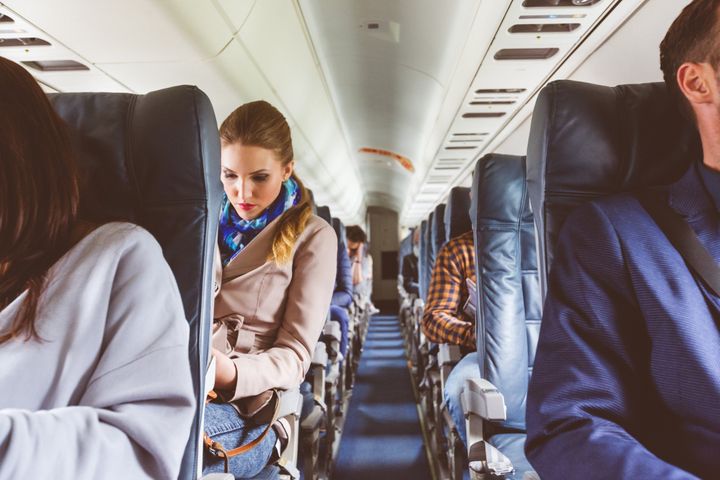
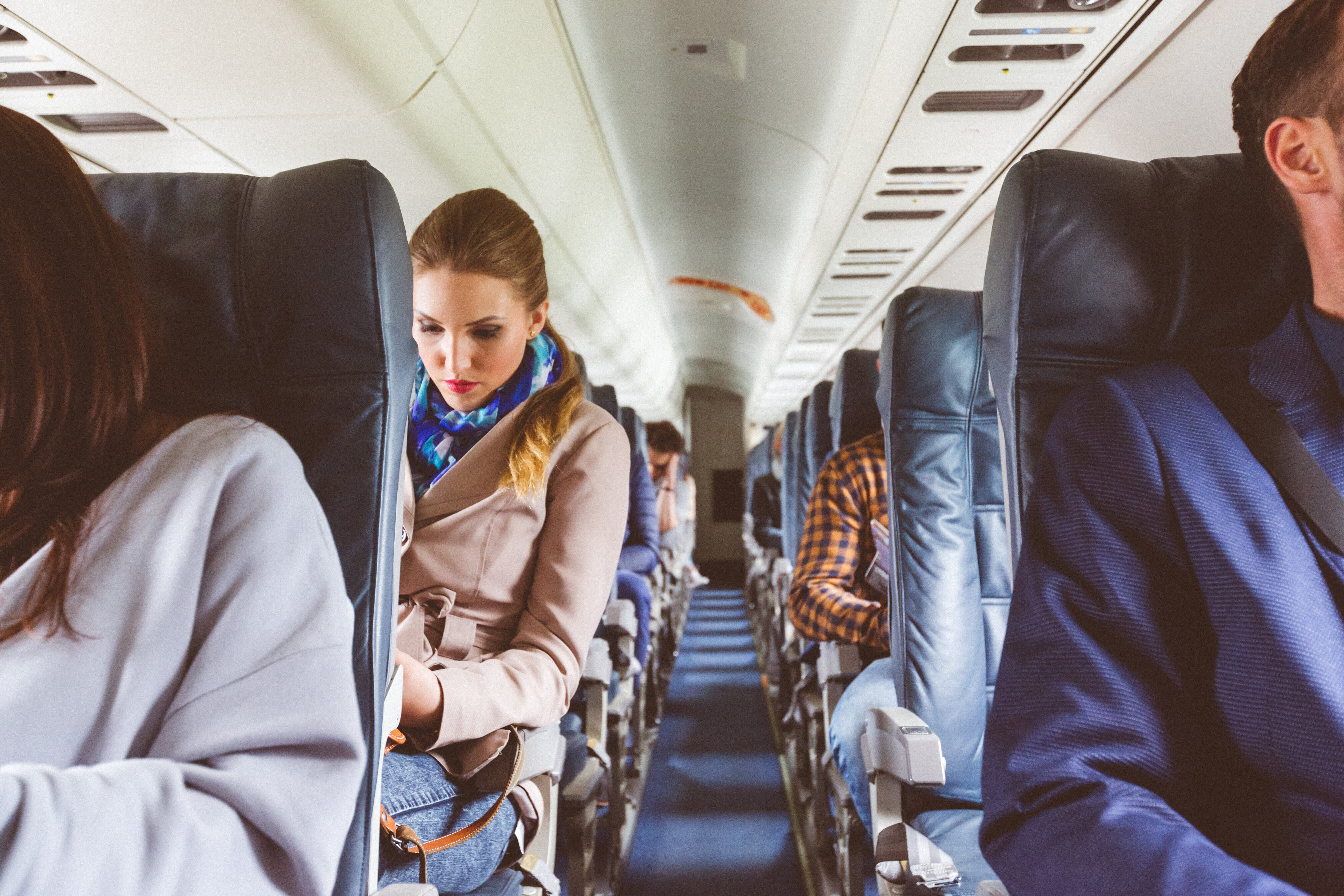
Experts recommend choosing a seat that brings you the most comfort if you're worried about getting on a plane.

izusek via Getty Images

Experts recommend choosing a seat that brings you the most comfort if you’re worried about getting on a plane.

Find a deep breathing method that works for you

It may be an annoying suggestion to hear, but breathing exercises are often given as a recommendation for anxiety because they work. Zinn said she often suggests her patients practice intentional breathing exercises, like five-finger breathing, where you take deep inhales and exhales as you trace the outline of your hand.

Doing this can help calm the panic that arises before it turns into a full panic attack, Zinn said.

Pack some sour candy in your carry on

Zinn also suggested eating some sour candy, such as a WarHead, to force your brain back into reality. The candy’s tartness can help you better focus on the moment rather than the fear or “what if?” during flying. It’s another way to practice mindfulness.

Learn the “why” behind air bumps

Adam Banks, a retired pilot based in New York, said the turbulence is one of the most concerning parts of flying for anxious passengers. Understanding what it is might help you see it as more normal and less of a sign of impending doom.

“Turbulence is just shifting winds. If you fly into a puffy cloud, the airplane is going to get a bump,” he said. “Airplanes are designed to handle these bumps. If you’re sitting over the wing, you can see the wings flex as they absorb turbulence. Turbulence might feel like the airplane is moving around thousands of feet, the reality is the airplane is probably only being jostled a few feet.”

Ground yourself in facts

Zinn said that dealing with both physical anxiety and our mind’s perception of danger plays a role in calming down, so statistics might help. For example, the annual risk of dying in a plane crash is only one in 11 million. You are much more likely to die from sunstroke, a bee sting, consuming a hot substance or even being attacked by a dog.

For me, flying in a tiny space will probably always be a struggle. But armed with some tools and tricks, flying is doable again, and I’m no longer doomed to the Midwest for life.

Share Button