‘I Pooped In A Secret Way’: 27 Funny Tweets That Perfectly Sum Up Life With Toddlers

Life with toddlers is a real rollercoaster – one moment they’re telling you they love you, the next they’re mooing at you as you step out of the shower.

Fast forward two hours and they’re prostrate on the floor, screaming at you because you wouldn’t let them lick your shoe.

While they can be pretty harsh sometimes – and totally unreasonable – their brutal honesty and innocent outlook on life often brings plenty of laughs to the table, too.

These tweets sum up just how chaotic life can be with young children – and while we do love a moan as parents, we also know we wouldn’t have it any other way.

1. Where did you hide the poo?!

2. My child loves me… but also pizza.

3. Today in questions you never thought you’d ask yourself: Why is there a car under my back?

4. Hi sweetie. Please stop licking mummy’s face.

5. This parent was probably quite relieved they didn’t get to see their toddler’s carol concert IRL.

6. When your toddler is mad because they can’t do something (that also happens to be impossible)…

7. Get this toddler on The Apprentice.

8. Out of the mouth of babes (and all that).

9. Twinkle Twinkle Little Star. But with the word penis.

10. This two-year-old ran the dishwasher undetected and empty for an entire hour.

11. Imagine being demoted from Your Majesty to Mom Face. Cruel cruel world.

12. Does anyone else’s toddler run like this?

13. Another reason why toddlers get mad: they can’t eat raw food.

14. This toddler wanted to go and buy some more milk for boobies. Then things got a bit dark.

15. Why do all toddlers line up toys like this?

16. Who doesn’t love getting sick 17 times a month?

17. This toddler requested their pear is cut into rectangles and nobody has time for this.

18. Feelings = hurt.

19. When you find out the nation’s favourite coffee chain doesn’t sell books.

20. We’re just wondering why any parent would do this to themselves?

21. WFH and looking after toddlers is a real hoot (said no one ever).

22. This tweet is perfection.

23. Two going on… 42?

24. Admittedly they can be cute.

25. But then in the next breath they can be stone cold.

26. This toddler is going places. (Mainly the steakhouse next door.)

27. We’ll just leave this here…

Share Button

‘My Boyfriend Is Great, So Why Do I Want Sex With Other People?’

You’re reading Love Stuck, where trained therapists answer your dating, sex and relationship dilemmas. You can submit a question here.

The feeling of finding your perfect match is something you can’t explain – like that person was handmade for you and can fulfil all your wants and needs. But what happens if you think you’ve met your soulmate, but still find yourself fancying other people, even wanting to stray.

This is Katie’s dilemma. “My boyfriend is super nice, so sweet, surprises me often, sex is amazing, it’s the first relationship I’ve ever been in that’s healthy but for some reason, I want to have sex with other people,” Katie says.

“I don’t think I love him as much as I thought I did. What do I do? He moved in with me after four months of dating and now I don’t want him there but he’s doing nothing wrong, it’s just me. What do I do?”

Counselling Directory member Ilia Galouzidi is on hand to give Katie her advice.

What is your initial response to this dilemma? What would you say to this reader?

Galouzidi says she thinks it’s great that Katie has found someone who matches her in several areas and that she considers it a healthy relationship. However, she says that “we may often think that once we form a relationship that feels healthy with another person, we automatically abandon the part of ourselves that gets attracted by other people or needs to be seen and feel wanted.”

And it doesn’t usually work this way, she adds.

“We may enjoy being attracted by others or being attractive to others and still run an honest loving relationship with our partner,” Galouzidi says. “This is mainly because the feeling of desire and the feeling of love are different things.”

Why might a person crave sex with others, even in a good relationship?

Galouzidi wants Katie to start by asking herself the following question: am I usually craving sex from being attracted to someone, or when someone is attracted to me?

“Responding yes might just mean you appreciate attractiveness to people and/or you have a high sexual drive. If you tend towards the latter, you may want to think about how important is to you to feel attractive,” Galouzidi says.

“Then in relation to your relationship: do you feel desired, and equally, how much do you desire your partner? Desire is usually about elements of mystery, playfulness, and unpredictability.

“So you may also want to ask yourself: what elements make someone desirable to me? Am I desiring my partner in this way?”

How can moving in together change the dynamic of a relationship?

Moving in with someone can be challenging for couples, says Galouzidi.

“Although it has its benefits and may bring closeness to the partners, it can also create a lot of changes to their lifestyles,” she explains. “Suddenly, people may lose their private space or need to claim their private moments.”

Katie might want to ask yourself: how has my lifestyle changed? Which changes are welcome and which are more challenging? The answers to these questions can help a couple set boundaries to make sure each party respects the other person’s space and lifestyle, says Galouzidi.

Then, there is the element of familiarity. “Moving in together may get us familiar with each other’s habits, preferences, and peculiarities, which on one hand may create a sense of closeness and intimacy, but on the other hand, may take away the “mystery” and excitement that comes with it,” Galouzidi explains.

What practical steps can this reader take to figure out what she wants and adjust her relationship accordingly?

Galouzidi suggests Katie does a bit of self-exploration and reflection by asking herself the questions above to gain a deeper understanding of her personal needs and non-negotiables in the relationship. She may then want to share her findings with her partner in a non-judgmental way.

“Remember, a healthy relationship also means being able to put clear boundaries and feel heard and respected,” says Galouzidi. “You may find it helpful to pencil down time in your calendars when each of you can have some privacy at home. Also, you may want to try different sex games with your partner to ignite mystery and playfulness in the bedroom.”

She also wants Katie to ask herself how close to enacting her sex cravings she is. “Does it require effort from your end to be loyal to your partner? You are not a bad person if you answered: very close or very effortful. I am sure you respect your partner’s feelings and your intention is to be truthful to him.

“However, maybe clarifying your needs at the moment is crucial, so you can show up to yourself and your relationship with honesty.”

Love Stuck is for those who’ve hit a romantic wall, whether you’re single or have been coupled up for decades. With the help of trained sex and relationship therapists, HuffPost UK will help answer your dilemmas. Submit a question here.

Rebecca Zisser/HuffPost UK

Share Button

If Flying Is Giving You More Anxiety Than Ever, Here’s How To Cope

During college, I grew a tumour that meant I hung out quite frequently in MRI machines. Though I’d never had a problem before, I found myself newly and severely claustrophobic – laying in a tiny tunnel for hours, arms raised overhead, will do that.

What I never saw coming was that phobia transferring to other small spaces, namely, airplanes. I’d developed severe anxiety around flying, stemming from that claustrophobia. Once the flight attendants closed the doors, and I was stuck there for a few hours, I was history. Since then, I’ve been on a mission to overcome flight anxiety because who wants to hang out in the Midwest their whole life?

It turns out I’m far from alone — up to 40% of Americans (and one in 10 Brits) have some sort of flying anxiety, from fearing a plane crash to worries about close contact with others. Or, like me, they don’t want to be stuck. Still, others dread navigating the airport, worrying their valuables might be lost or that they could encounter an issue with security doubting their intentions. Flying anxiety has become such an issue that some airlines like British Airways even offer courses, such as their Flying with Confidence one-day class, to get you back in the air.

There’s likely even more of a spike in flight anxiety thanks to the pandemic, according to Susan Zinn, a psychotherapist and author of “The Epiphanies Project.”

“That is why there’s been an uptick in airplane phobias, fear of flying, and feeling out of control, or road or flight rage — people all of a sudden get triggered that bring them back to a time in our recent past where they felt so out of control,” Zinn said.

Here’s what experts say we can do to reduce our anxieties about airplanes.

Expose yourself to the aspects of flying (preferably with a mental health professional)

For Johnny Jet, a worldwide traveler and expert who has been to over 70 countries, his traveling fears started with a doctor’s comment. He was headed on a 27-hour flight when his asthma doctor commented that he “might have a problem breathing on a plane because the cabin is pressurised.”

This led to a full-blown panic attack at a New York airport ahead of the flight, which he called “one of the worst days of his life,” and prompted an almost four-year-long fear of flying.

Exposure to planes and airports ended up being, ironically, part of the solution. “Speak to the flight crew, take a course, read books, go to the airport and do practice runs,” he suggested.

This type of activity ― known as exposure therapy ― can help your brain adapt to the situation over time and take some of the fear and uncertainty away from flying. It’s best to try this with a therapist who is trained in doing this.

Zinn added that medication might also be necessary for some people in tandem with preparation. She’s worked with clients who have spent several months practicing for a flight before the real trip.

Get strategic about your seat selection

Right after 9/11, Zinn had to jump on a plane out of New York for a business trip. She was terrified as their flight was escorted by air marshals openly carrying weapons. She was one of many who would develop a new fear of flying, which caused nausea and panic attacks.

One strategy that helped her was carefully picking a seat that made her feel comfortable. “I always still to this day will sit on the outside aisle [seat] to make sure I can always get up, versus kind of being stuck on the inside, which made me feel better,” she said.

Quick access to the bathroom, where you can splash cold water on your face to “shock your system” when you feel panic is another tool that helps, Zinn explained. If financially possible, upgrading to first class for more room or choosing an exit row for more legroom might also help, Jet added.

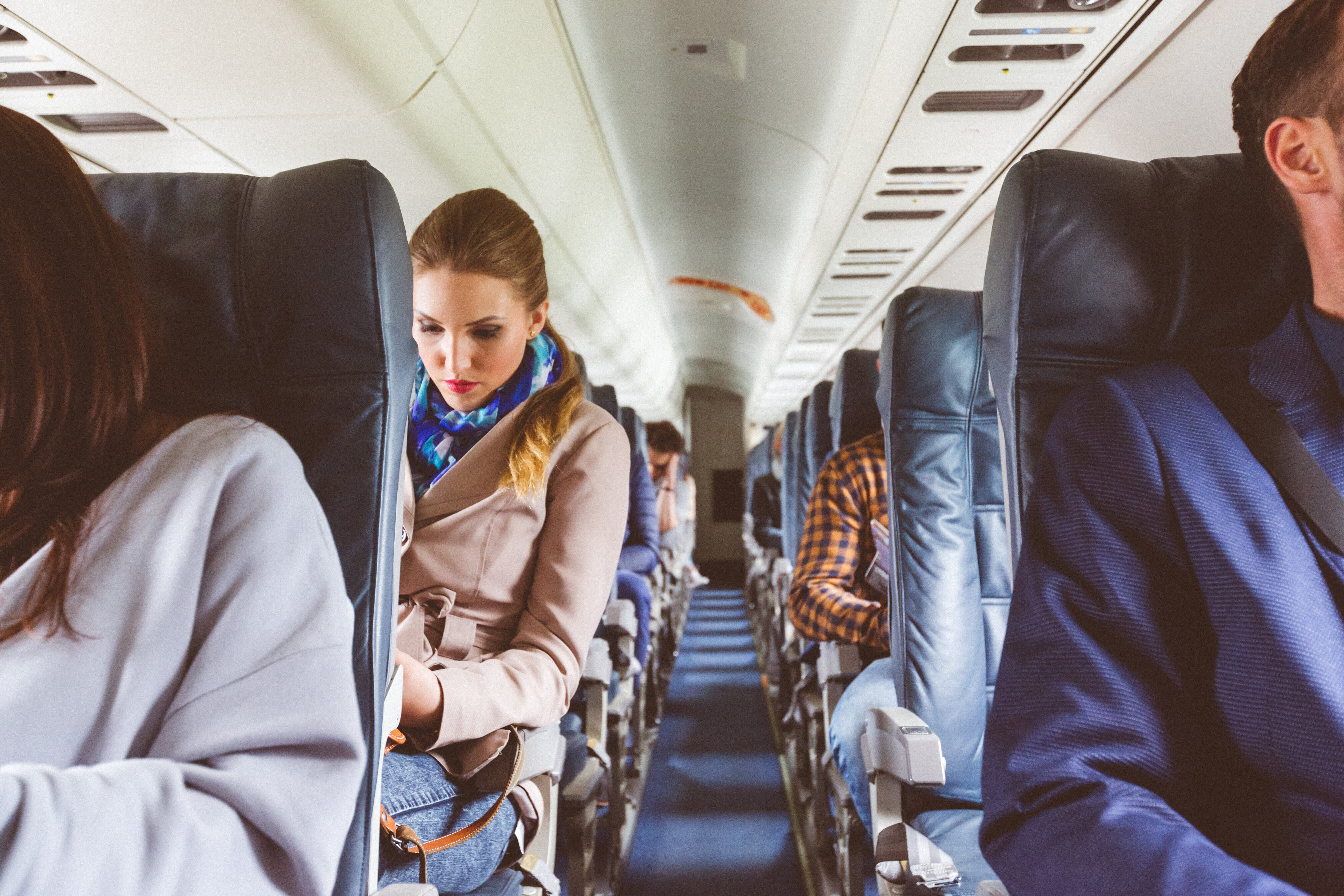
Experts recommend choosing a seat that brings you the most comfort if you're worried about getting on a plane.

izusek via Getty Images

Experts recommend choosing a seat that brings you the most comfort if you’re worried about getting on a plane.

Find a deep breathing method that works for you

It may be an annoying suggestion to hear, but breathing exercises are often given as a recommendation for anxiety because they work. Zinn said she often suggests her patients practice intentional breathing exercises, like five-finger breathing, where you take deep inhales and exhales as you trace the outline of your hand.

Doing this can help calm the panic that arises before it turns into a full panic attack, Zinn said.

Pack some sour candy in your carry on

Zinn also suggested eating some sour candy, such as a WarHead, to force your brain back into reality. The candy’s tartness can help you better focus on the moment rather than the fear or “what if?” during flying. It’s another way to practice mindfulness.

Learn the “why” behind air bumps

Adam Banks, a retired pilot based in New York, said the turbulence is one of the most concerning parts of flying for anxious passengers. Understanding what it is might help you see it as more normal and less of a sign of impending doom.

“Turbulence is just shifting winds. If you fly into a puffy cloud, the airplane is going to get a bump,” he said. “Airplanes are designed to handle these bumps. If you’re sitting over the wing, you can see the wings flex as they absorb turbulence. Turbulence might feel like the airplane is moving around thousands of feet, the reality is the airplane is probably only being jostled a few feet.”

Ground yourself in facts

Zinn said that dealing with both physical anxiety and our mind’s perception of danger plays a role in calming down, so statistics might help. For example, the annual risk of dying in a plane crash is only one in 11 million. You are much more likely to die from sunstroke, a bee sting, consuming a hot substance or even being attacked by a dog.

For me, flying in a tiny space will probably always be a struggle. But armed with some tools and tricks, flying is doable again, and I’m no longer doomed to the Midwest for life.

Share Button

Discovery could explain why women are more likely to get Alzheimer’s

Scientists at Scripps Research and Massachusetts Institute of Technology (MIT) have found a clue to the molecular cause of Alzheimer’s — a clue that may also explain why women are at greater risk for the disease.

In the study, reported on December 14, 2022, in Science Advances, the researchers found that a particularly harmful, chemically modified form of an inflammatory immune protein called complement C3 was present at much higher levels in the brains of women who had died with the disease, compared to men who had died with the disease. They also showed that estrogen — which drops in production during menopause — normally protects against the creation of this form of complement C3.

“Our new findings suggest that chemical modification of a component of the complement system helps drive Alzheimer’s, and may explain, at least in part, why the disease predominantly affects women,” says study senior author Stuart Lipton, MD, PhD, professor and Step Family Foundation Endowed Chair in the Department of Molecular Medicine at Scripps Research and a clinical neurologist in La Jolla, California.

The study was a collaboration with a team led by Steven Tannenbaum, PhD, Post Tenure Underwood-Prescott Professor of Biological Engineering, Chemistry and Toxicology at MIT.

Alzheimer’s, the most common form of dementia that occurs with aging, currently afflicts about six million people in the U.S. alone. It is always fatal, usually within a decade of onset, and there is no approved treatment that can halt the disease process, let alone reverse it. The shortcomings of treatments reflect the fact that scientists have never fully understood how Alzheimer’s develops. Scientists also don’t know fully why women account for nearly two-thirds of cases.

Lipton’s lab studies biochemical and molecular events that may underlie neurodegenerative diseases, including the chemical reaction that forms a modified type of complement C3 — a process called protein S-nitrosylation. Lipton and his colleagues previously discovered this chemical reaction, which happens when a nitric oxide (NO)-related molecule binds tightly to a sulfur atom (S) on a particular amino acid building-block of proteins to form a modified “SNO-protein.” Protein modifications by small clusters of atoms such as NO are common in cells and typically activate or deactivate a target protein’s functions. For technical reasons, S-nitrosylation has been more difficult to study than other protein modifications, but Lipton suspects that “SNO-storms” of these proteins could be a key contributor to Alzheimer’s and other neurodegenerative disorders.

For the new study, the researchers used novel methods for detecting S-nitrosylation to quantify proteins modified in 40 postmortem human brains. Half of the brains were from people who had died of Alzheimer’s, and half were from people who hadn’t — and each group was divided equally between males and females.

In these brains, the scientists found 1,449 different proteins that had been S-nitrosylated. Among the proteins most often modified in this way, there were several that have already been tied to Alzheimer’s, including complement C3. Strikingly, the levels of S-nitrosylated C3 (SNO-C3) were more than six-fold higher in female Alzheimer’s brains compared to male Alzheimer’s brains.

The complement system is an evolutionarily older part of the human immune system. It consists of a family of proteins, including C3, that can activate one another to drive inflammation in what is called the “complement cascade.” Scientists have known for more than 30 years that Alzheimer’s brains have higher levels of complement proteins and other markers of inflammation, compared to neurologically normal brains. More recent research has shown specifically that complement proteins can trigger brain-resident immune cells called microglia to destroy synapses — the connection points through which neurons send signals to one another. Many researchers now suspect that this synapse-destroying mechanism at least partly underlies the Alzheimer’s disease process, and loss of synapses has been demonstrated to be a significant correlate of cognitive decline in Alzheimer’s brains.

Why would SNO-C3 be more common in female brains with Alzheimer’s? There has long been evidence that the female hormone estrogen can have brain-protective effects under some conditions; thus, the researchers hypothesized that estrogen specifically protects women’s brains from C3 S-nitrosylation — and this protection is lost when estrogen levels fall sharply with menopause. Experiments with cultured human brain cells supported this hypothesis, revealing that SNO-C3 increases as estrogen (?-estradiol) levels fall, due to the activation of an enzyme that makes NO in brain cells. This increase in SNO-C3 activates microglial destruction of synapses.

“Why women are more likely to get Alzheimer’s has long been a mystery, but I think our results represent an important piece of the puzzle that mechanistically explains the increased vulnerability of women as they age,” Lipton says.

He and his colleagues now hope to conduct further experiments with de-nitrosylating compounds — which remove the SNO modification — to see if they can reduce pathology in animal models of Alzheimer’s and eventually in humans.

Share Button

Are people with cluster headaches more likely to have other illnesses?

People with cluster headaches may be more than three times more likely to have other medical conditions such as heart disease, mental disorders and other neurologic diseases, according to a study published in the December 14, 2022, online issue of Neurology®, the medical journal of the American Academy of Neurology.

Cluster headaches are short but extremely painful headaches that can occur many days, or even weeks, in a row. The headaches can last anywhere from 15 minutes to three hours.

“Around the world, headaches have an incredibly negative impact on people’s quality of life, both economically and socially,” said study author Caroline Ran, PhD, of the Karolinska Institutet in Stockholm, Sweden. “Our results show that people with cluster headaches not only have an increased risk of other illnesses, those with at least one additional illness missed four times as many days of work due to sickness and disability than those with just cluster headaches. They also have a higher chance of a long-term absence from work.”

The study involved 3,240 people with cluster headaches from age 16-64 in Sweden who were compared to 16,200 people who were similar in age, sex and other factors. The majority were men, which is common with cluster headache.

Researchers looked at work records and disability benefits to determine how many days during a year people were absent from work due to sickness and disability.

Among those with cluster headaches, 92%, or 2,977 people, had at least one additional illness. Of those without cluster headaches, 78%, or 12,575 people, had two or more illnesses.

Of those with cluster headaches, more women had additional illnesses than men, 96% and 90% respectively.

The average number of days a person was absent due to sickness and disability was nearly twice as high among people with cluster headaches with 63 days compared to those without cluster headaches with 34 days.

People with cluster headaches and at least one additional illness had four times as many absence days compared to people with cluster headaches who did not have an additional illness.

“Increasing our understanding of the other conditions that affect people with cluster headache and how they impact their ability to work is very important,” added Ran. “This information can help us as we make decisions on treatments, prevention and prognoses.”

A limitation of the study was that information on personal data, such as smoking, alcohol consumption and BMI, which could affect the occurrence of diseases, was not available.

The study was supported by Swedish Research Council, Swedish Brain Foundation and Mellby Gård, Region Stockholm, Märta Lundkvist Foundation and Karolinska Institutet Research Funds.

Story Source:

Materials provided by American Academy of Neurology. Note: Content may be edited for style and length.

Share Button

Ebola vaccine regimens safe, immunogenic in adults and children

Two randomized, placebo-controlled trials evaluating three Ebola vaccine administration strategies in adults and children found that all the regimens were safe in both age groups, according to results published today in the New England Journal of Medicine. Antibodies were produced in response to the vaccine regimens beginning at 14 days after the first vaccination and continued to be detectable at varying levels — depending on the vaccine and regimen used — in both children and adults for one year. The study enrolled volunteers at sites in Guinea, Liberia, Sierra Leone and Mali to identify optimal vaccination strategies to curtail outbreaks of Ebola virus disease.

The trials were conducted under the Partnership for Research on Ebola Vaccination (PREVAC) international consortium. PREVAC’s partner organizations include the U.S. National Institutes of Health (NIH), the French National Institute of Health and Medical Research and the London School of Hygiene & Tropical Medicine. The National Institute of Allergy and Infectious Diseases (NIAID), part of NIH, sponsored the trial in Liberia and Mali. In Liberia, the study was done in collaboration with the Liberia Ministry of Health through the Partnership for Research on Ebola Virus in Liberia program. In Mali, it was conducted in collaboration with the University Clinical Research Center and the Center for Vaccine Development-Mali.

The trials began enrollment in 2017, were conducted simultaneously and shared a placebo arm. A total of 1,400 adults and 1,401 children aged 1 year to 17 years old were randomized to receive two injections of either placebo or Ebola vaccine in one of three regimens. The Ebola vaccine regimens were Ad26.ZEBOV (supplied by Johnson & Johnson) followed eight weeks later with a booster dose of MVA-BN-Filo vaccine (supplied by manufacturer Bavarian Nordic); two doses of rVSVΔG-ZEBOV-GP (manufactured by Merck Sharp & Dohme Corp) separated by eight weeks; or one dose of the Merck vaccine followed eight weeks later by a placebo injection.

Antibody responses were observed by day 14 after the first injection of either Ad26.ZEBOV or rVSVΔG-ZEBOV-GP vaccine. The researchers say this finding is notable because vaccines against Ebola virus disease are typically administered during an outbreak and so information about how rapidly a vaccine produces an antibody effect is of potential use in efforts to protect at-risk populations. However, it is not currently known what level of antibody response reliably correlates with vaccine-induced protection against Ebola virus infection or disease. As no participants contracted Ebola virus disease during the trial, the investigators were not able to assess protection from disease.

The researchers cite several strengths of the trials, including outstanding retention of volunteers throughout the course of trial, achieved with continuing community engagement and ongoing trust-building efforts.

Story Source:

Materials provided by NIH/National Institute of Allergy and Infectious Diseases. Note: Content may be edited for style and length.

Share Button

Largest nursing strike in NHS history set to start

Routine surgery is likely to be disrupted, but life-preserving and urgent care will still be provided.

Share Button

Antibiotic supply gone from bad to worse, say pharmacists

High demand, due to rising strep A cases, has led to four antibiotics being added to a banned export list.

Share Button

Strep A symptoms: What you need to know, in a minute

If you’re worried, the BBC’s health reporter Laura Foster has some information to help.

Share Button

Using my family’s dark history to teach about vaccines

Vaccine nurse says being descended from Henrietta Lacks helps her understand her patients’ fears.

Share Button