The whole genome sequencing project in England will screen for around 200 rare genetic conditions in newborns.


The whole genome sequencing project in England will screen for around 200 rare genetic conditions in newborns.

Analysis of teeth of extinct lemurs has revealed fascinating clues to the evolution of humans, a University of Otago study has found.
Lead author Dr Ian Towle, of the Sir John Walsh Research Institute in the Faculty of Dentistry, says the “surprisingly large” monkey lemur, Archaeolemur, had novel anatomical features not seen in living lemurs, such as lacking a ‘tooth comb’ in the front of the mouth for grooming.
“These extinct lemurs are so different to those alive today. They also show fascinating similarities to monkeys and apes, including humans,” he says.
The study, published in the American Journal of Biological Anthropology, aimed to assess the diet of Archaeolemur by analysing chipping in 447 teeth, comparing chipping frequencies to those of other primates.
The results were surprising — with these remarkable extinct lemurs with dentitions resembling baboons in shape; but presenting tooth chipping patterns similar to fossil hominins such as Neanderthals.
“Archaeolemur tooth chipping patterns are unlike any living primate, with their front teeth showing substantial fractures, often with numerous tooth chips on a single tooth, yet very little chipping on their back teeth.
“Similar tooth fracture patterns are observed in fossil hominins, such as Neanderthals. Typically, in Neanderthals these fracture patterns are thought to be related to tool-use behaviours,” Dr Towle says.
The results fit with previous research on Archaeolemur, in particular evidence that their large and robust front teeth may have been used to process a diet containing hard and tough foods.
Dr Towle thinks the study raises the “fascinating possibility” that stone tools do not necessarily explain the high rate of fractures on Neanderthal teeth.
“Archaeolemur shows similar tooth chipping patterns, yet there is no evidence to suggest they were capable of, or used, such tools.
“Studying extinct primates not only provides crucial insight into their diet and behaviour, but also elucidates our own evolutionary history.”
Given the overlap in skull and dental shape, and potential similarities in diet and behaviour, it is perhaps not surprising that Archaeolemur was thought to be an ape when first discovered in Madagascar over 100 years ago.
“Archaeolemur is a brilliant example of convergent evolution, showing remarkable similarities to monkeys and apes. This species also highlights the extent to which lemurs in Madagascar diversified into a variety of ecological niches.”
Dr Carolina Loch, also from Sir John Walsh Research Institute, and who mentored Dr Towle during his tenure as postdoctoral fellow at the SJWRI, says the research is another great example of the “breadth and depth of multidisciplinary research” at the Faculty of Dentistry.
Story Source:
Materials provided by University of Otago. Note: Content may be edited for style and length.

Hummingbirds occupy a unique place in nature: They fly like insects but have the musculoskeletal system of birds. According to Bo Cheng, the Kenneth K. and Olivia J. Kuo Early Career Associate Professor in Mechanical Engineering at Penn State, hummingbirds have extreme aerial agility and flight forms, which is why many drones and other aerial vehicles are designed to mimic hummingbird movement. Using a novel modeling method, Cheng and his team of researchers gained new insights into how hummingbirds produce wing movement, which could lead to design improvements in flying robots.
Their results were published this week in the Proceedings of Royal Society B.
“We essentially reverse-engineered the inner working of the wing musculoskeletal system — how the muscles and skeleton work in hummingbirds to flap the wings,” said first author and Penn State mechanical engineering graduate student Suyash Agrawal. “The traditional methods have mostly focused on measuring activity of a bird or insect when they are in natural flight or in an artificial environment where flight-like conditions are simulated. But most insects and, among birds specifically, hummingbirds are very small. The data that we can get from those measurements are limited.”
The researchers used muscle anatomy literature, computational fluid dynamics simulation data and wing-skeletal movement information captured using micro-CT and X-ray methods to inform their model. They also used an optimization algorithm based on evolutionary strategies, known as the genetic algorithm, to calibrate the parameters of the model. According to the researchers, their approach is the first to integrate these disparate parts for biological fliers.
“We can simulate the whole reconstructed motion of the hummingbird wing and then simulate all the flows and forces generated by the flapping wing, including all the pressure acting on the wing,” Cheng said. “From that, we are able to back-calculate the required total muscular torque that is needed to flap the wing. And that torque is something we use to calibrate our model.”
With this model, the researchers uncovered previously unknown principles of hummingbird wing actuation.
The first discovery, according to Cheng, was that hummingbirds’ primary muscles, that is, their flight engines, do not simply flap their wings in a simple back and forth motion, but instead pull their wings in three directions: up and down, back and forth, and twisting — or pitching — of the wing. The researchers also found that hummingbirds tighten their shoulder joints in both the up-and-down direction and the pitch direction using multiple smaller muscles.
“It’s like when we do fitness training and a trainer says to tighten your core to be more agile,” Cheng said. “We found that hummingbirds are using similar kind of a mechanism. They tighten their wings in the pitch and up-down directions but keep the wing loose along the back-and-forth direction, so their wings appear to be flapping back and forth only while their power muscles, or their flight engines, are actually pulling the wings in all three directions. In this way, the wings have very good agility in the up and down motion as well as the twist motion.”
While Cheng emphasized that the results from the optimized model are predictions that will need validation, he said that it has implications for technological development of aerial vehicles.
“Even though the technology is not there yet to fully mimic hummingbird flight, our work provides essential principles for informed mimicry of hummingbirds hopefully for the next generation of agile aerial systems,” he said.
The other authors were Zafar Anwar, a doctoral student in the Penn State Department of Mechanical Engineering; Bret W. Tobalske of the Division of Biological Sciences at the University of Montana; Haoxiang Luo of the Department of Mechanical Engineering at Vanderbilt University; and Tyson L. Hedrick of the Department of Biology at the University of North Carolina.
The Office of Naval Research funded this work.
Story Source:
Materials provided by Penn State. Original written by Sarah Small. Note: Content may be edited for style and length.
The government discusses contingency plans, including using the military to cover border staff.

If you thought Australia was home to only one ancient ‘giant wombat’, think again.
While the Diprotodon — the extinct megafauna species that is distantly related to wombats but was the size of a small car — is commonly (but incorrectly) thought of as Australia’s ‘giant wombat’, researchers from Griffith University have shed light on a large species that does belong in the modern-day wombat family.
The complete skull of this true fossil giant wombat, found in a Rockhampton cave in Queensland and estimated to be around 80,000 years old, has been described for the first time by a team led by Associate Professor Julien Louys from Griffith’s Australian Research Centre for Human Evolution.
Associate Professor Louys said the discovery provided unprecedented insights into the biology and appearance of these previously little known ‘gentle giants’.
“The extinct megafauna of Australia never ceases to amaze and intrigue not just Australians, but people all over the world,” he said.
“Although one of the most charismatic of the giant mammals to go extinct, Diprotodon is commonly referred to as a ‘giant wombat’. But this is incorrect as Diprotodon belongs to an entirely different family — equivalent to saying a hippo is just a giant pig.
“There were however, true giant wombats. These have traditionally been poorly known, but the discovery of the most complete skull of one of these giants, Ramsayia, has provided us with an opportunity to reconstruct what this creature looked like, where and when it lived, and how the evolution of giant wombats took place in Australia.”
The cranium and mandible of the Ramsayia magna fossil was discovered from the rear of the front chamber of Lower Johansons Cave in Rockhampton in the early 2000s, but it was only through subsequent excavations and analysis by Associate Professor Louys’s team that is was confirmed as belonging to a previously described but very poorly known species.
Extinct giant wombats of the family Vombatidae (broadly defined as twice the size of modern wombats) are rarer than the fossil diprotodontids that are often popularly — and incorrectly — referred to as giant wombats.
Associate Professor Louys said this giant wombat — Ramsayia — had extensive cranial sinuses, which had not been previously reported for a wombat.
“This indicates that the wombat had a large, rounded skull for the attachment of specific and strong chewing muscles,” he said.
“The giant wombat also possessed a ‘premaxillary spine’, an indication that it had a large, fleshy nose.
“In this paper, we show that all true giant wombats evolved large body sizes first, then individually became quite specialised to eat different types of grasses.
“We also dated this species as being about 80,000 years old. This is the first date for this species and is much earlier than human arrival in Australia, although we still don’t know exactly when or why this species became extinct.”
The research ‘Cranial remains of Ramsayia magna from the Late Pleistocene of Australia and the evolution of gigantism in wombats (Marsupialia, Vombatidae)’ has been published in Papers In Palaeontology.
Story Source:
Materials provided by Griffith University. Note: Content may be edited for style and length.
Health members of Unison and Unite accept an improved offer which ends the risk of strike action.
If you’ve ever pulled an all-nighter or spent the night tossing and turning, you know how awful it can feel to be sleep-deprived.
Your body might ache, you may struggle to pay attention and your mood will most likely take a hit. This is because sleep is linked to nearly every important bodily function — it affects our immune system and our appetite, our stress hormones and our metabolism, our blood pressure and our cardiovascular system. Even a single night of poor sleep can trigger a wide range of health effects (which is why you may feel so crummy after that late night out).
Advertisement
Most of us need between seven and eight hours of sleep a night to feel alert and healthy the next day. But for whatever reason, that’s not always possible. In fact, a study recently published in JAMA Network Open found that nearly half of Americans are sleep-deprived on a regular basis.
The best way to combat sleep deprivation is ― well, to sleep. There’s really no quick fix, but there are a handful of tips and tricks that can make the day more bearable. We asked a few sleep specialists to share how they cope when they’re sleep-deprived. Here’s what they said.
This is easier said than done, but it’s helpful not to get fixated on the fact that you’re sleep-deprived.
When Fiona Barwick, the director of the sleep and circadian health program at Stanford Health Care, is low on sleep, she reminds herself not to worry about it because she knows her body will do what it takes to get back on track.
Advertisement
Our sleep drive is a self-correcting system that naturally tries to keep the sleep-wake cycle in balance. “If we don’t sleep well one night, we’ll sleep better the next night. If we worry about it, however, our sleep will be worse,” Barwick said.
Barwick also makes a point to expose herself to some bright light first thing in the morning. Our sleep-wake cycle is heavily dependent on light — daylight sends a signal to our brain that it’s time to get up and be active, while darkness sends the cue that it’s almost time to go to bed.
Exposing yourself to light when you first wake up “suppresses melatonin, which increases alertness and boosts mood,” Barwick said. It’ll also help keep your circadian rhythm in check, which should help you sleep more soundly at night.
It might seem obvious, but yes: Coffee helps. This is because caffeine blocks adenosine, a chemical in our body that increases the need for sleep. As a result, caffeine makes us feel less sleepy and improves learning and decision-making if you’re sleep-deprived, according to Dr. Andrey Zinchuk, a sleep medicine doctor with Yale Medicine.
But while it may be tempting to keep refilling your mug, it’s important to be mindful of how much caffeine you consume.
Advertisement
“I don’t have too much caffeine, as I want to avoid the crash that occurs when its alerting effects eventually subside,” Barwick said.
Dr. Wissam Chatila, a pulmonologist at Temple Lung Center and professor of thoracic medicine and surgery at the Lewis Katz School of Medicine at Temple University, advises against having that late-afternoon cup of coffee.
“If taken at the wrong time — e.g. late in evening — then they will interfere with sleep later on,” he said.

FG Trade via Getty Images
If you’re able to squeeze in a 30- to 60-minute catnap, go for it. A short nap can improve alertness, sleepiness, memory and exercise capacity.
Advertisement
On the flip side, a lengthier midday snooze can actually impair cognitive function, Chatila said, and potentially make it even harder to complete tasks. Make sure to set an alarm so you don’t overdo it.
“I keep the nap relatively short so that I don’t use up too much sleep drive, as I want to save most of it for the coming night,” Barwick said.
If you’re not a napper, even getting some deep rest can be beneficial, Barwick said. Ten to 30 minutes of yoga nidra, a meditative yoga practice that involves deep relaxation, can help you feel refreshed and more attentive.
When Barwick can’t nap, she tries to go for a walk outside. Even a 10-minute walk can significantly reduce stress, boost your mood and increase alertness, research shows.
Plus, it can build up your sleep drive, which should help you doze off at night.
“That helps to further ensure I will get better sleep the coming night,” Barwick said.
Lastly, don’t beat yourself up. Our bodies are incredibly resilient, which is why we’re still able to function even when we’re sleep-deprived. (Think about all you’ve been able to accomplish on those days when you didn’t get enough sleep.)
Advertisement
Don’t assume the day will be a wash just because you didn’t get the sleep you needed, Barwick said. Go easy on yourself, and listen to your body.
“I don’t cut back on what I planned to do, but I also don’t beat myself up if I get less done than I wanted,” she said.


Few things are more Christmassy than the smell of pine and fir, which is often the happy result of buying a real Christmas tree. For many, the smell is a true sign of the season. For others, it can be irritating — which is why some people opt for artificial trees as an alternative.
Either way, putting up your festive Christmas tree may tinker with your home’s air quality, according to experts.
Advertisement
Dustin Poppendieck, an environmental engineer in the indoor air quality and ventilation group at the National Institute of Standards and Technology, said that both real and artificial trees can emit chemicals for weeks, a month or even beyond (for artificial trees that are stored in your home all year). And while it’s likely nothing to be overly alarmed about, it’s still worth knowing what’s going down when you’re putting your tree up.
While there isn’t too much research on exactly how much emission both kinds of trees actually create, Poppendieck said there is adjacent research that can inform just what might be happening to our home’s air when these trees are brought inside. Here’s how both real and artificial Christmas trees impact your home’s air:
The pleasant pine scent that your Christmas tree gives off is actually due to a release of a mix of different volatile organic compounds, or VOCs, according to Bryan Cummings, a research scientist in Drexel University’s College of Engineering. Specifically, most of these compounds are known as pinenes and they are what gives the Christmas tree its distinct odour; the same goes for products like pine-scented floor cleaners.
For some people, VOCs can cause minor respiratory irritation when inhaled, he added. According to the United States Environmental Protection Agency, VOCs can cause irritation to your eyes, nose and throat, and can also cause headaches.
Advertisement
While these side effects may be seen in some people, Cummings does not think VOCs from a Christmas tree will have a large impact on the general public’s health either short-term or long-term when compared to all of the items that release VOCs all throughout the year. But, he added that people who are sensitive to irritants of this nature — like people with asthma or certain allergies — may feel extra irritation when they have a Christmas tree in their home.
Beyond the chemical reaction a real tree could have on the air in your home, “when you’re bringing a tree, you’re bringing in a microbial community in addition to the tree,” Poppendieck said.
In other words, that tree could be offcasting irritants that could potentially trigger asthma or allergies, he added. These irritants can include mould and pollen, according to IQ Air, an air quality group based in Switzerland.
Additionally, Poppendieck noted that any spills when watering a real tree could lead to mould growth, too. Or, if your tree has mud on it, the mud may have additional irritants that can permeate the air.
While many people with severe allergies turn to fake Christmas trees for their holiday cheer, Cummings said these trees, too, may make a mark on your home’s air quality.
Advertisement
“These artificial trees, they contain plastics and PVCs [polyvinyl chloride], and one of the major plasticisers in these materials are phthalates,” Cummings said. Additionally, he said that artificial trees also contain flame retardants.
When it comes to flame retardants, “some of the compounds might be neurotoxins or carcinogens with long-term exposure,” he said.
And when it comes to phthalates, “those are thought to be mostly endocrine disruptors,” which are chemicals that could interfere with your body’s hormones. “There’s lots of research going on in the indoor air quality community especially around phthalates because they’re one of those forever chemicals,” he added. Forever chemicals are manmade chemicals that don’t break down, and as a result, stick around for hundreds and hundreds of years.
What’s more, while they can evaporate into a home’s air, which means you can breathe them in, they can also stick to your hands or other products, giving them the ability to be ingested further and can even go directly into your bloodstream after skin contact, Cummings noted.
“I say that’s a bigger health concern than potential exposure to pine-scented terpenes,” he said.
Crispin la valiente via Getty Images
Advertisement
“I also want to say: How many other plastic products do you bring into your home?” Cummings said. Between plastic water bottles, plastic appliances, plastic toys and plastic decor — the answer is probably a lot.
“Are the artificial trees the major source of this pollution? Probably not,” Cummings said.
Additionally, Poppendieck pointed out that “phthalates are commonly found in house dust” beyond the Christmas season. So, no matter what plastics you’re bringing in, the same pollution pattern is happening.
“We know it’s moving from the plastics in our home to the dust,” Poppendieck said.
If you are someone who is very concerned about phthalates and plastics in general, you should avoid artificial trees, Cummings noted. But, if you have many other plastic items in your home, one Christmas tree is not going to change anything.
While both experts said they limit (or do not use) scented home products like scented detergents, body soap and cleaning items, they both have Christmas trees in their homes.
Advertisement
“There’s an emotional attachment that I grew up with,” Poppendieck said, “I like the smell, I like the ambiance and the psychological value.”
He added that when it comes to any indoor air quality topic, you have to balance the physical health impacts with the psychological impact. If your Christmas tree brings you joy, you should not stop getting one to protect your home’s air quality (unless you are one of the few people who deal with severe respiratory reactions) if your home is full of other air quality risk factors, too.
Both experts added that there are many other things in our homes — other plastic items, scented cleaners, candles and gas stoves — that also impact the air we breathe.
There is not enough research to know exactly how much Christmas trees affect our home’s air quality, but Poppendieck said he would be surprised if Christmas trees were a huge risk and would also be surprised if there was zero risk.
Cummings said you should always follow indoor air quality best practices, whether you are bringing a tree in or taking one out.
Advertisement
“So, things I always like to do — clean with soap and water instead of harsh chemicals whenever possible, limit the use of scented products [and] you can always open a window to clear out some of these indoor pollutants,” he said.
You can also use HEPA filters in your home, which “clear out indoor particles and dust,” Cummings noted.
Poppendieck added if you’re really concerned about emissions from either a real or artificial tree, you can set the tree up outside or in a garage before bringing it into your home. This will help lessen the initial indoor emission. But, this step is probably only necessary for those who’ve had historical reactions to trees, he said. It isn’t necessary for the average person.
“Whenever we talk about indoor air quality, we need to talk about relative risk and how dangerous is a Christmas tree compared to the other things that we do,” Poppendieck said.
He stressed that real Christmas trees have the potential to burn. It’s crucial that you keep your tree watered and remove it from your house when it dies.
Advertisement
This will help reduce the risk of fire when it comes to your real tree, which, Poppendieck said, far outweighs any indoor air quality issues.


Figures obtained by Labour through Freedom of Information requests reveal staff pressures in the NHS.
Families across the UK have been urged to stay vigilant about Strep A symptoms this week, following a series of tragic deaths in children.
A total of 15 children have now died in the UK from Strep A since September, according to the latest figures. This includes 13 children under the age 15 in England and two others in Northern Ireland and Wales, according to data from the UK Health Security Agency (UKHSA).
Advertisement
Streptococcus A (Strep A – also known as Group A Strep or GAS) are a group of bacteria that can cause a wide variety of skin, soft tissue and respiratory tract infections. These include strep throat and impetigo, but the most common illness caused by Strep A is scarlet fever, which is highly infections and has been spreading across the country.
But why are infections so awful this year? And what – if anything – can parents do about it?
Less mixing due to Covid could be part of the reason why hundreds of children are being diagnosed with Strep A-related illnesses this year. When social measures were put in place, the spread of Strep A was contained. Now, children who did not catch Strep A in 2020 or 2021 are being infected.
“It strikes me that as we are seeing with flu at the moment, lack of mixing in kids may have caused a drop in population-wide immunity that could increase transmission, particularly in school age children,” microbiologist Dr Simon Clarke, from the University of Reading, told Sky news.
The best way to protect your kids is to know the symptoms and seek treatment quickly. It’s important to remember that Strep A causes a mild illness in the majority of children that can be easily treated with antibiotics. Symptoms include:
Advertisement
“On darker skin, the rash can be more difficult to detect visually but will have a sandpapery feel,” Duncan Reid, pharmacist at Pharmacy2U told HuffPost UK.
Additionally, the British Islamic Medical Association explained that “the rash is more obvious in the groin/armpit area. Sometimes the flushed cheeks appear as ‘sunburned’ on darker skin with whiteness near the mouth”.
“In children with darker skin tones, the rash could be harder to spot as it may not appear red, but will be darker than normal skin,“ Dr Mabs Chowdhury, president of the British Association of Dermatologists added.
“The rash in all pigment types can have a sandpapery feel. The tongue can appear redder than normal with prominent white spots (sometimes called ‘strawberry tongue’).”
Advertisement
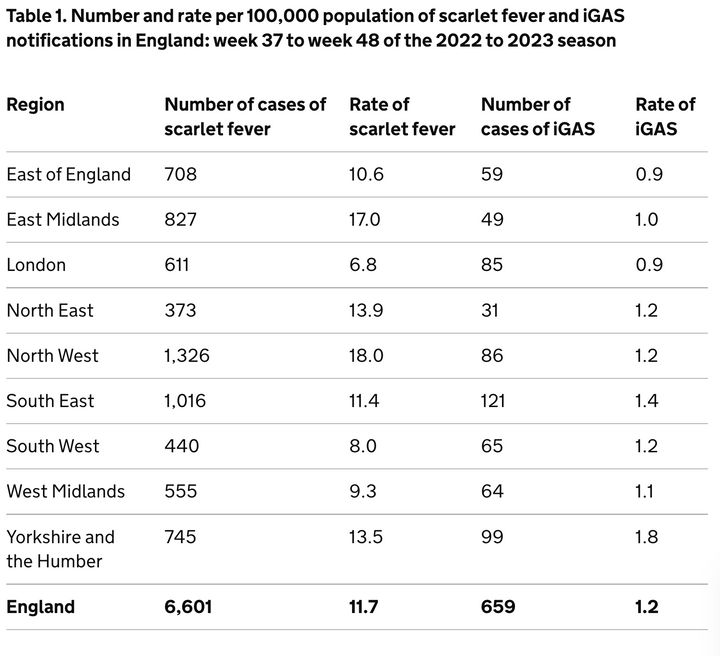
The latest available data shows that in England, there were 1,062 scarlet fever infection notifications received in week 48 (the week commencing November 28).
Currently, there are large concentrations of Strep A and associated scarlet fever cases in multiple parts of the UK, with the North West particularly impacted. The below data also shows incidences of invasive group A streptococcal infection (iGAS) – a rare but serious complication of Strep A, which can be life-threatening.
Plenty of parents are beside themselves with worry right now as strep A continues to dominate the news. On social media and in private Whatsapp groups there’s been an outpouring of worry from parents, who are understandably on edge in case they miss the signs of illness that could progress to something far worse.
Advertisement
“I’m personally more worried about this than I was when Covid started,” said 35-year-old Emma Hawes from Wigan.
Hawes, who has a 13-year-old and eight-year-old, told HuffPost UK: “I am extremely anxious at the moment. I had no idea what the symptoms were so I’ve obviously been reading as much as I can.”
Diana Wilkinson, 45, has two children of primary school age. She told HuffPost UK: “I’m genuinely so worried about it. Every time I see the news it’s full of warnings of Strep A, and horrifically the number of fatalities is rising.
“Our school has been great at flagging concerns and sending out information about what to look out for, but with several cases already it feels very close to home.”
Some pharmacists are warning of a shortage of antibiotics – which hasn’t done much to quell concerns. However, the government has repeatedly denied it.
Advertisement
The National Pharmacy Association explained: “Pharmacies are having to work very hard to obtain stocks of these antibiotics and some lines are temporarily unavailable.
“We have been advised by wholesalers that most lines will be replenished soon, but we cannot say exactly when that will be.”
Leyla Hannabeck, CEO of the Association of Independent Multiple Pharmacies, claimed that authorities going on broadcast rounds saying there is supply is “misleading”.
“I want to reassure the public that pharmacies are doing everything we can to get hold of antibiotics and we are pushing the government to identify where the blockage is,” Hannabeck added.
Health secretary Steve Barclay said there was a “good supply” of penicillin, and that he had been reassured by medical suppliers. However, he said some GPs may experience shortages as stock is moved around to meet demand.
Advertisement
“Now, sometimes, GPs can have particular surges if they’ve got a lot of demand in an area, and that’s quite routine, we can move the stock around our depots,” he told Sky News.
Currently, the Department for Education (DfE) has not updated its official advice to schools, but it is directing them to guidance from the UK Health Security Agency (UKHSA).
Parents were told to keep their children at home if they suspected that their children had Strep A, in a blog published by Dfe.
Education secretary Gillian Keegan said the department was “working closely” with the UKHSA and “monitoring the situation”, adding that the situation is “worrying”.
One school in Hull temporarily closed for a “deep clean” after several Strep A cases, but at the moment, schools on the whole are not being advised to close.
Advertisement
“Some people can have the bacteria present in their body without feeling unwell or showing any symptoms of infections and while they can pass it on, the risk of spread is much greater when a person is unwell. It is still possible to infect others for up to three weeks.”
“Good hand and respiratory hygiene are important to top the spread of Strep A. By teaching your child how to wash their hands properly with soap for at least 20 seconds, using a tissue to catch coughs and sneezes, and keeping away from others when feeling unwell, they will be able to reduce the risk of picking up or spreading infections.”


